It was a bitter winter… It was snowing… It never stopped… Mother and child were living together in a house at the tiny village. The mother was very kind to her child, and the child was very playful. However, despite this, he loved his mother very much. One day, Mrs.Mahbuba fell ill. The doctor came to see him. He checked the sister’s condition and prescribed a treatment for her. It was found that Mrs. Mahbuba has a very serious liver disease. The doctor left the house, saying that if this disease is not treated in time, it will end in death. Mrs. Mahbuba was very worried. Because Samandar was very young, he had not yet gone to school. Moreover, she was a very young and beautiful woman. Who will take care of him if she dies? He will become an orphan…
On top of that, her father died in a car accident 2 years ago… The poor woman asked these questions over and over again. Since he was a seamstress in a sewing shop, he could not afford these expensive drugs. If she took two, she would not be able to pay for third. That is why his illness was getting worse. But as they say: “A mother’s heart is in the child, a child’s heart is in the field…” – Samandar did not know about his mother’s condition. After that, the winter and spring seasons ended, and finally the hot summer came. Due to her poor condition, Mrs.Mahbuba had to go to work 3 days a week. One day it fell late. Samandar still did not return home. His mother went to the street to look for him, but could not find him. Tired of walking so much, he started getting sick. A mother who is running out of medicine and has finally found her son. She brought him home… The mother died…
Samandar was a big guy. He understood everything. Why didn’t he know his mother’s pain earlier? Why didn’t he come home earlier that day? These questions did not give him peace. Poor mother only cared for him even when she was sick. Samandar was tormented all his life by “Pain of Conscience”…
Safina Abdusalomova was born on March 23, 2007 in Sariosia district, Surkhandarya region. Currently, she is a student of the 68th general education school. During the last school year, she took the proud 3rd place in the Olympiad held under the name of “The best school for learning English”. In addition, she took part in the competition “English Language Scholars” and won many places. In the 2021-2022 academic year, in the “Most Exemplary Captains Competition” organized by the “Youth Agency”, together with her team, she took the proud 1st place at the district level, and the proud 2nd place at the regional level. Se is currently the “Head of Press and Media Department” at the 68th General School. Se tested himself in the “Examination of English Language Proficiency” held on June 11, 2023 and obtained the CEFR certificate B2 level. Currently, she is learning English and Korean. In the future, IELTS 7+ level has started a huge effort.
At this time last year, I was just a high school graduate, an ordinary student. I had almost no achievements. They didn’t even know who I was. Everyday life continued. Days passed, days followed by months. My parents opposed me to study in the field I wanted. I gave them a teaching position according to their wishes. But I fell. At first it was very difficult for me to come to my senses. I cannot describe to you what I felt at that time. Then, starting from December, I started to gather strength. I made new dreams for the new year. I set clear goals for myself. Although I am not sure that my dreams will come true, I set big goals for myself. Alhamdulillah!
So far, from the beginning of the new year to now, I have achieved a lot. I am achieving all my goals one by one. My first and early January achievement was this book. And I had a small article published in a book that was sold on morebooks in the UK, which is sold in 26 countries. At that time, I really wanted to write a personal book and have my articles published in newspapers of different countries. Believe it or not, a month later my poem and short story appeared in 2 other people’s books. The same in Europe. I participated in many international webinars. I finished international courses. March has begun. In March, I only worked on my personal book. I worked hard. And finally, the month of April, the month of Ramadan, was a very important month for me throughout my life. My article was published in the international newspaper “PAGE3 NEWS” which is sold in 8 countries.
Also, my autobiography and article were published in the international student section of the Indian newspaper RKD×TIMES EDUCATIONAL. In addition, 08.04.2023. I have published another article on KAVYA KISHOR website. 10.04.2023. My article about teachers was published in the Kenyan newspaper “The Mount Kenya Times” on April 14, 2023. My personal book went on sale on the European website morebooks. Its name is “Heart therapy”. The price is 43.90€ ($48). Not long after that, my second book “Get the motivation in difficult moments of life” was published and sold on the same site at the same price. My poem about mother was published in “BEKAJON” newspaper of Uzbekistan, and an article was published in “YOSHLAR OVOZI” newspaper. The most joyful thing happened today. A famous Korean journalist liked my article, and that journalist translated my article and information about me into Korean and published it on a famous Korean website and newspaper. I am proud of today, every moment of my life. In addition, my goals are getting bigger every day.Action is also appropriate, of course. It was not easy to achieve these things. But I did not give up. I got up and started over. My advice is that if you make the right decisions and be with the right people, your work will develop.
Welcome to the month of Ramadan!

You came joyfully, bright-eyed,
Saying prayers, chanting words.
Grudges leave the heart,
Welcome to the month of Ramadan!

This month is full of rewards,
Good intentions, good deeds.
All anger recedes,
Welcome to the month of Ramadan!

The table is overflowing, give thanks
Give thanks for clear mornings.
My country is peaceful, give thanks to freedom,
Welcome to the month of Ramadan!

There are months apart from each other,
But you are the sultan of these months, Ramadan.
We are waiting for you all year long,
Welcome to the month of Ramadan!


Dilnurabonu Vayisova, student of Bukhara state university
Ways to increase the energy efficiency of buildings and their external barrier structures
Egamova Marguba Turakulovna, teacher;
Matyokubov Bobur Pulatovich, teacher;
Samarkand State Architecture and Civil Engineering University, Uzbekistan.
pulatovich93@gmail.com

            Abstract:  In this article the results of theoretical and field studies with different thermal design solutions of external walls to improve the energy efficiency of buildings.
            Keywords: Natural energy, external barrier construction, polystyrene,thrombus wall, heat-physical

           Nowadays, rational use of natural energy resources remains one of the main tasks in all developed countries of the world.
In order to effectively use natural energy sources in Uzbekistan, in the reconstruction and perfect repair of residential, treatment, children's institutions, schools, lyceums, colleges and boarding schools, which are being built and used in accordance with the requirements of KMK 2.01.04-97*, which was adopted in 2011 as amended, their energy in order to increase its efficiency, it is necessary to increase the thermal protection of external barrier structures.[3]

         Therefore, in order to increase the energy efficiency of buildings, thermal-physical practical experiments were carried out on external wall samples with different structural solutions in the laboratory of the "Building and Constructions" department of SamDAQU. Some of these are listed below:
           In the joint enterprise "OOO SAM ROS KHOLOD" a non-removable form of polystyrene foam was prepared, in the laboratory of the "Building and structures" department of SamDAQU an external wall sample was built and thermal-physical experiments were conducted. this. The experiment was conducted based on the requirements of UzRTS-809-97 "Determining the thermal conductivity of barrier structures" method [4].

 Experimental results were compared with theoretical studies.
The scheme of the wall structure is presented in (Fig. 1).
Figure 1. Scheme of non-removable formwork wall construction made of foam polystyrene.
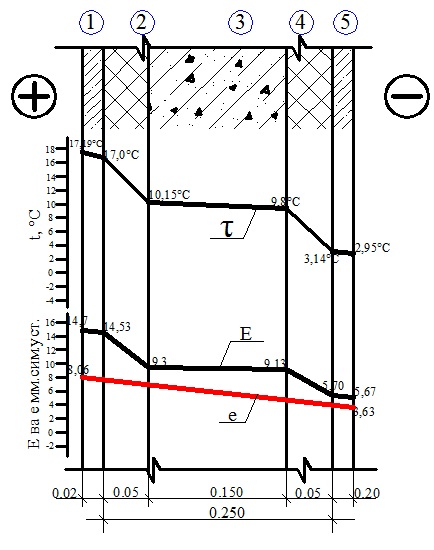
 The total thermal conductivity of this structure is Rу =2.49 м2 .(м2. оC)/Вт and the total thermal protection meets the requirements of QMQ 2.01.04-97 *. In addition, as can be seen from Figure 2, condensation moisture does not form in the layers of this structure.

2 - picture. Moisture status of non-removable formwork wall construction of expanded polystyrene
1 - Cement-sand plaster; 2 - Polystyrene; 3 - Cast heavy concrete; 4 - Polystyrene; 5 - Cement-sand plaster;         In addition, various studies are being conducted in the field of using solar energy for heating buildings in our Republic. An experimental solar house with a heliosystem of the "Thromb Wall" type is located at 40° latitude in Princeton. Built in (New Jersey, USA), this latitude corresponds to our country.

However, such buildings, i.e. "Tromb wall" type solar buildings with helio system, have not been designed and built in our country. In order to build this type of buildings in the climatic conditions of Uzbekistan, it is necessary to justify them as a result of thermal-physical theoretical and practical experiments. For this reason, we have installed a "Thromb wall" model on the outer wall of the laboratory of the "Building and Construction" department of SamDAQU, and thermal physics research is ongoing.

In order to increase the energy efficiency of buildings with the help of local materials, a constructive solution was developed for the external wall with non-removable formwork made of foam concrete, heat protection increased with foam polystyrene. The advantages of this construction are as follows:

      1. The wall structure will be completely restored from local materials; 2. The period of construction of the building will be shortened sharply; 3. The energy efficiency of the building and its exterior will increase; Increases the overall earthquake resistance of the building.

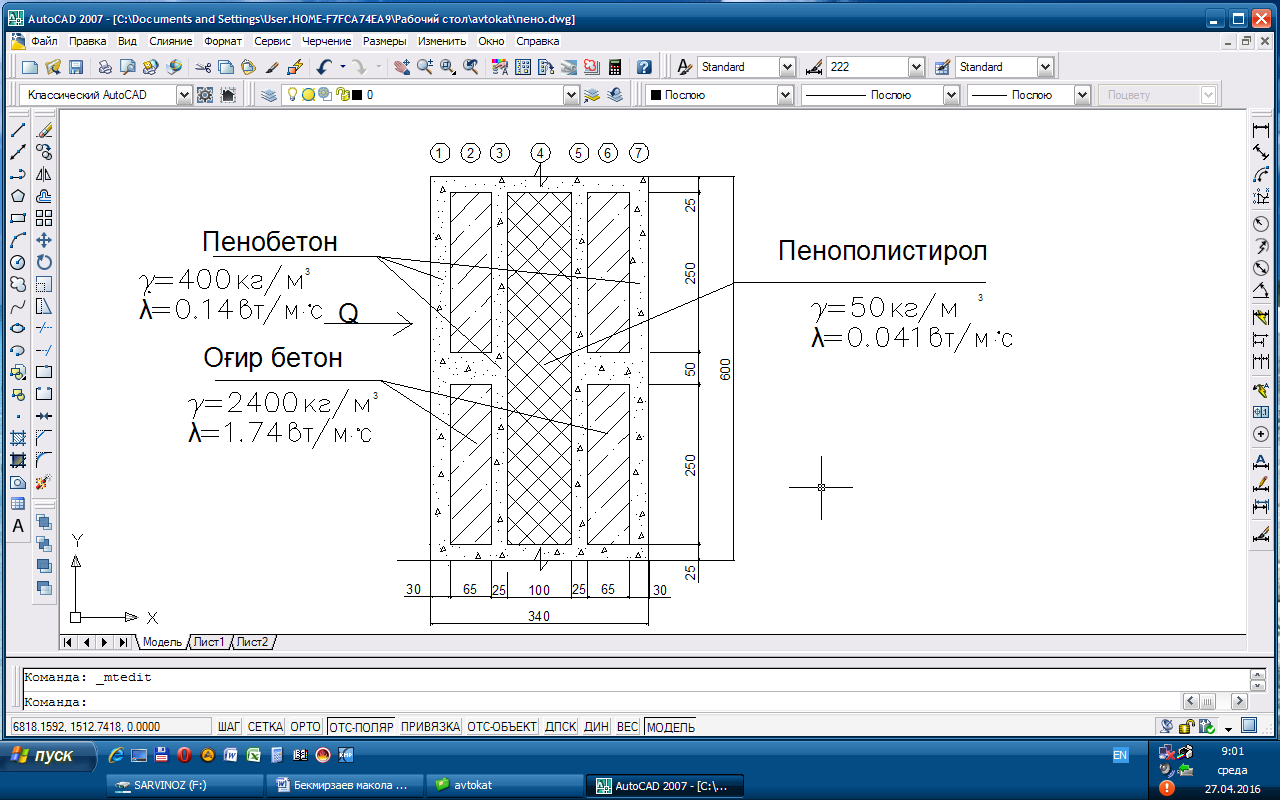
 In order to use this construction in practice, it is necessary to theoretically base it on a thermal-physical basis. For this, it is necessary to determine the total heat transfer resistance of the external wall construction, whose calculation scheme is shown in Fig. 3, compare this resistance with the heat transfer resistance given in QMQ 2.01.04-97*, and recommend the effective thickness of the wall. In addition, it is necessary to justify the formation of condensate moisture in the layers of this construction or not using the graphoanalytical method.

    Thermal-physical calculations are performed in the following order.
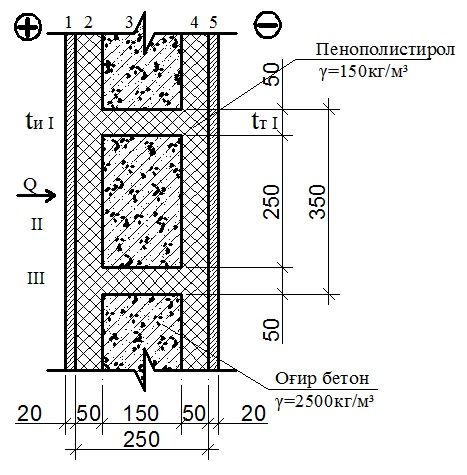
   Since the non-removable external wall construction of foam concrete shown in Figure 3 is not homogeneous, we cut it with planes parallel and perpendicular to the direction of heat flow and determine the thermal heat transfer resistance.
 Figure 3. Scheme of a non-removable formwork wall construction of foam concrete.

         We divide the construction into parts I and II by cutting it with a plane parallel to the direction of heat flow. The first part is made of foam concrete and the second part is made of heavy concrete and expanded polystyrene. We determine the heat transfer resistance for the first part using the following formula.

R_I=δ_1/λ_1 +δ_2/λ_2 +δ_3/λ_3 ;          (1)

For thermal physical calculations, we accept the following heat transfer coefficients[3].

1. Foam concrete, Υ_0=400-600 кг/м^3,λ=0,14 Вт/(м^2∙℃) ;
2. Heavy concrete, Υ_0=2400 кг/м^3 ,λ=1,74 Вт/(м^2∙℃) ;
3. Styrofoam, Υ_0=100 кг/м^3,λ=0,041 Вт/(м^2∙℃);

〖   R〗_I=2,428 м^2∙℃/Вт. Surface of the first part F_I=0.05.
The second part of the structure consists of foam concrete, heavy concrete and expanded polystyrene. Its heat transfer resistance. RII=3.298( м2 .оC)/ Вт.

We determine the thermal heat transfer resistance of this structure using the following formula [2].

R_II=(F_I+F_II+F_III+⋯.)/(F_I/R_I +F_II/R_II +F_III/R_III +⋯.)    (2)
Here, R_I,R_II,R_III…,- thermal heat transfer resistance of individual layers,  м^2℃/Вт;  F_I,F_II,F_III…, the surface of individual parts, м^2

The surface of the second part is F_II=0,25..
Wall thermal heat transfer resistance, RII=3.1(5 м2 .оC)/ Вт.

Cutting the construction with a plane perpendicular to the direction of heat flow, 1;2;3;4;5;6; and divide into 7 layers (Fig. 3).
1st and 7th layers of foam concrete〖 R〗_1=R_7=0,214〖(м〗^2∙℃)/Вт; 3 and 5 layers of foam concrete 〖R_3=R〗_5=0,178( м^2∙℃)/Вт; 4th layer expanded polystyrene R_4=0,10/0,041=2,439 (м^2∙℃)/Вт;; Since part 2 is not homogeneous, we determine the average heat transfer coefficient of the construction using the following formula. [1.2]

λ_ўр  (λ_I xF_I+λ_II xF_II+λ_III xF_II)/(F_I+F_II+F_III )=1.473 Вт/(м^2∙℃),

Here, λ_I,λ_II… is the thermal conductivity coefficient of the materials that make up the individual layers, Вт/(м^2∙℃) ; F_I,F_II…  surfaces of individual layers,

Then R_2=R_6=0,044 ( м^2∙℃)/Вт.
       So, R_⊥=R_I+R_2+R_3+R_4+R_5+R_6+R_7=3,311 〖(м〗^2∙℃)/Вт.

The heat transfer resistance of a non-homogeneous structure is determined using the following formula. [1.2]
R=(R_II+〖2R〗_⊥)/3  =  (3,157+2x 3,311)/3=3,259 〖(м〗^2∙℃) / Вт,

          We determine the total heat transfer resistance of a non-homogeneous wall structure made of foam concrete.
R_ум=R_и+R+R_T=0,114+3,259+0,043=3,416 〖(м〗^2∙℃)/Вт;
        Therefore, the total heat transfer resistance of the non-removable formwork wall construction made of foam concrete that we recommend meets all the requirements of the level of heat protection specified in QMQ 2.01.04-97*.

	Conclusion. The following can be concluded from the above theoretical and practical studies:

1. As a result of the calculations, it was found that the thermal protection of the non-removable formwork wall construction made of foam concrete is sufficient for the conditions of Uzbekistan and meets the requirements of QMQ 2.01.04-97*;
2. Heat transfer resistance of non-removable formwork wall construction made of foam concrete, thickness 38 cm. and it is 4.9 times greater than the heat transfer resistance of a brick wall with a density of 1600 kg/m3 and 1.3 times greater than the heat transfer resistance of a non-removable formwork wall structure made of polystyrene foam;

3. If this wall construction is based on thermal-physical practical experiments, it will provide an opportunity to build various energy-efficient buildings.

References

	Шукуров Ғ.Ш., Бобоев С.Н. Архитектура физикаси 1-қисм. Дарслик Қурилиш иссиқлик физикаси-Тошкент, Меҳнат, 2005 й..160 б.
	Шукуров Ғ.Ш.,Исломова Д.Ғ. Қурилиш физикаси. Дарслик - Самарқанд,. 2015 й., 217 б.
	ҚМҚ 2.01.04-97*  Қурилиш иссиклик техникаси.-Тошкент, 2011й.

	Ўз РСТ 809-97 “Тўсиқ конструкцияларининг иссиқлик узатишга қаршилигини аниқлаш” Т., 1997й.
	Bolikulovich K. M., Pulatovich M. B. HEAT-SHIELDING QUALITIES AND METHODS FOR ASSESSING THE HEAT-SHIELDING QUALITIES OF WINDOW BLOCKS AND THEIR JUNCTION NODE WITH WALLS //Web of Scientist: International Scientific Research Journal. – 2022. – Т. 3. – №. 11. – С. 829-840.

	Тулаков Э.С., Бўронов Ҳ., Матёқубов Б.П., Абдуллаева С. А.. Кам қаватли турар-жой бинолари ертўла деворларининг иссиқлик изоляция қатлами қалинлигини ҳисоблаш. //Me’morchilik va qurilish muammolari Проблемы архитектуры и строительства.Samarqand 2020. №2. -С.41-45.
	 Pulatovich, M. B. . (2021). Energy Efficient Building Materials for External Walls of Residential Buildings Physical Properties of Heat. International Journal of Culture and Modernity, 9, 1–11. Retrieved from https://ijcm.academicjournal.io/index.php/ijcm/article/view/67

	 Тулаков Э.С., Матёқубов Б.П.. Thermal Insulation Of The Foundation Walls Of Buildings And Calculation Of ItsThickness. THE AMERICAN JOURNAL OF ENGINEERING AND TECHNOLOGY (TAJET) SJIF-5.705 DOI-10.37547/tajet Volume 3 Issue 04, 2021 ISSN 2689-0984  The USA Journals, USA www.usajournalshub.com/inde x.php/tajet -С.70-78

Pulatovich, M. B. . (2021). Analysis of Underground Projects of Energy-Efficient Residential Buildings. International Journal of Culture and Modernity, 9, 12–18.Retrieved from https://ijcm.academicjournal.io/index.php/ijcm/article/view/68
	Inatillayevich, G.O. and Pulatovich, M.B. 2021. Analysis of Underground Projects of Energy Efficient Low-Rise Residential Buildings Built on Highly Flooded Soils. International Journal on Integrated Education. 4, 9 (Sep. 2021), 96-102. DOI:https://doi.org/10.31149/ijie.v4i9.2156.

Pulatovich, M. B. ., & Innatillayevich, G. O. . (2021). Laboratory Experimental Studies on the Properties of Highly Sedimentary Lyos Soils when their Moisture Changes Over Time. European Journal of Life Safety and Stability (2660-9630), 8, 91-98. Retrieved from http://ejlss.indexedresearch.org/index.php/ejlss/article/view/119
	 Pulatovich, M. B. ., & Shodiyev, K. . (2021). Thermal Insulation of Basement Walls of Low-Rise Residential Buildings and Calculation of its Thickness. International Journal of Culture and Modernity, 9, 19–27. Retrieved from https://ijcm.academicjournal.io/index.php/ijcm/article/view/69

Матёкубов, Бобур Пўлатович, and Сарвара Музаффаровна Саидмуродова. "КАМ СУВ ТАЛАБЧАН БОҒЛОВЧИ АСОСИДАГИ ВЕРМИКУЛИТЛИ ЕНГИЛ БЕТОНЛАР ТЕХНОЛОГИЯСИНИ ҚЎЛЛАНИЛИШИ." INTERNATIONAL CONFERENCES. Vol. 1. No. 15. 2022.
	Pulatovich, M. B. . (2021). Energy Efficient Building Materials for External Walls of Residential Buildings Physical Properties of Heat. International Journal of Culture and Modernity, 9, 1–11. Retrieved from https://ijcm.academicjournal.io/index.php/ijcm/article/view/67

Тулаков Э.С., Иноятов Д., Қурбонов А.С., Матёқубов Б.П.. Бинолар-нинг ертўла деворларини иссиқлик изоляциялаш ва унинг қалинлигини ҳисоблаш. //Me’morchilik va qurilish muammolari Проблемы архитектуры и строительства.Samarqand 2020. №4.(2-қисм) -С.29-32.
	 Матёкубов, Б. П., & Саидмуродова, С. М. (2022). КАМ СУВ ТАЛАБЧАН БОҒЛОВЧИ АСОСИДАГИ ВЕРМИКУЛИТЛИ ЕНГИЛ БЕТОНЛАР ТЕХНОЛОГИЯСИНИ ҚЎЛЛАНИЛИШИ. INTERNATIONAL CONFERENCES, 1(15), 103–109. Retrieved from http://researchedu.org/index.php/cf/article/view/319

Inatillayevich G. O., Pulatovich M. B. Analysis of Underground Projects of Energy Efficient Low-Rise Residential Buildings Built on Highly Flooded Soilshttps //doi. org/10.31149/ijie. v4i9. – Т. 2156.
	 Matyokubov , B. P., & Saidmuradova, S. M. (2022). METHODS FOR INVESTIGATION OF THERMOPHYSICAL CHARACTERISTICS OF UNDERGROUND EXTERNAL BARRIER STRUCTURES OF BUILDINGS. RESEARCH AND EDUCATION, 1(5), 49–58. Retrieved from http://researchedu.org/index.php/re/article/view/364.
	https://scholar.google.com/citations?view_op=view_citation&hl=ru&user=jhldcIoAAAAJ&citation_for_view=jhldcIoAAAAJ:RHpTSmoSYBkC.

	Носирова С. А., Рустамова Д. Б., Эгамова М. Т. ЭНЕРГИЯТЕЖАМКОР УЙЛАР-ЎЗБЕКИСТОННИНГ ЯҚИН ЙИЛЛАРДАГИ ЭНГ АСОСИЙ ШИОРИ //Журнал Технических исследований. – 2021. – Т. 4. – №. 2.
Nowadays it is common for young people to travel to far-flung places to study. This essay will argue that despite the fact that it often leads to financial difficulties, it is far more advantageous to study in places that are far away from one’s parents because it leads to independence.

Young people frequently face financial problems if they decide to enrol in a degree course in a distant town. This is because it is no longer possible for them to live in their parents’ house, and they, therefore, have to pay for their own accommodation as well as utilities and food. This can come as quite a shock for many young people who have never had to pay a bill in their lives. For example, in this country, it is common for young people in this situation to take on part-time jobs so that they can pay their expenses while at university, and perhaps the most popular such job is being a waiter in a restaurant or bar.

The great advantage of studying in a far-off place is that it allows young people to experience what it is like to be independent of their families. In many Western countries, it is humiliating for someone over the age of 18 to have to ask their parents for money and also to not be able to live their life the way they want to because they have to live by their parents' rules. Leaving the family home allows them to choose whatever lifestyle they want and not be under any influence from their elders. For instance, at universities in the UK, it is noticeable that students who are no longer living in their parents’ houses mature more quickly than those who are still living at home, and this is clearly because they cannot depend on their parents and must instead embrace their newfound independence.

In conclusion, travelling to a distant place to study might be financially challenging for those who have just left their childhood home, but the advantages of being independent far outweigh that drawback.


Shabnam Shukhratova


She was born on August 13, 2008 in Navbahar district, Navoi region. Currently, she is an 8th-grade student of school 21 in Navbahor district and is the class captain of this class. Her works have been published in anthologies. She is also a volunteer. SHe is also a participant and winner of various Olympiads and competitions. SHe also has international certificates.
Nowadays it is common for young people to travel to far-flung places to study. This essay will argue that despite the fact that it often leads to financial difficulties, it is far more advantageous to study in places that are far away from one’s parents because it leads to independence.

Young people frequently face financial problems if they decide to enrol in a degree course in a distant town. This is because it is no longer possible for them to live in their parents’ house, and they, therefore, have to pay for their own accommodation as well as utilities and food. This can come as quite a shock for many young people who have never had to pay a bill in their lives. For example, in this country, it is common for young people in this situation to take on part-time jobs so that they can pay their expenses while at university, and perhaps the most popular such job is being a waiter in a restaurant or bar.

The great advantage of studying in a far-off place is that it allows young people to experience what it is like to be independent of their families. In many Western countries, it is humiliating for someone over the age of 18 to have to ask their parents for money and also to not be able to live their life the way they want to because they have to live by their parents' rules. Leaving the family home allows them to choose whatever lifestyle they want and not be under any influence from their elders. For instance, at universities in the UK, it is noticeable that students who are no longer living in their parents’ houses mature more quickly than those who are still living at home, and this is clearly because they cannot depend on their parents and must instead embrace their newfound independence.

In conclusion, travelling to a distant place to study might be financially challenging for those who have just left their childhood home, but the advantages of being independent far outweigh that drawback.


Shabnam Shukhratova


She was born on August 13, 2008 in Navbahar district, Navoi region. Currently, she is an 8th-grade student of school 21 in Navbahor district and is the class captain of this class. Her works have been published in anthologies. She is also a volunteer. SHe is also a participant and winner of various Olympiads and competitions. SHe also has international certificates.
Youth policy begins with children's policy

Currently, I am the leader of the children’s organization’s “Kamalak” under the youth union of Uzbekistan. I have been working in this system for three years. Do you know what the leadership gives to children? First and foremost, leadership provides children with a happy childhood. Along with this, it provides skills such as helping our peers, working with children through projects based on their learning and interest.

In the system of "Kamalak" children's organization, we implement various social projects. An example of this is the "Euclid Olympiad" project to increase students' mathematical abilities during the winter vacation, the "Chess Kingdom" online competition among students interested in chess, and the "Eco Frame" project among students interested in taking pictures. Many projects are currently being carried out in order to meaningfully organize free time of students. During the coming summer vacation, we are planning to hold the "Summer with a Kamalak" project in schools, neighborhoods, parks, streets, and camps.

Almost 22 years have passed since the foundation of my beloved organization "Kamalak" children's organization. It is no exaggeration to say that the organization discovered thousands of talented children during this time. In addition, before I joined the organization, I was a child whose speech was not developed enough, and when he appeared on stage, he would forget his words. I became a leader in the organization, I went to different regions, I made friends there, we talk and exchange ideas with them through social networks.

Last year, as a member of the Uzbek delegation, we participated in the international "Children of the Commonwealth" forum organized in Kyrgyzstan because of my exemplary work in "Kamalak". We exchanged ideas with knowledgeable and active students from 6 countries and participated in discussions on various topics. We are using the knowledge and skills we have gained from the international forum among our peers. Friendship, social activity, field trips and unforgettable memories are the gifts that "Rainbow" gives. I am proud to be a part of such an organization! At this point, I would like to recall the favorite motto of our organization:
For the homeland, friendship and happy childhood!

Mirfayzbek Abdullayev
Student of the 4th general education school in the city of Karshi, Leader of the “Kamalak” of Kashkadarya region