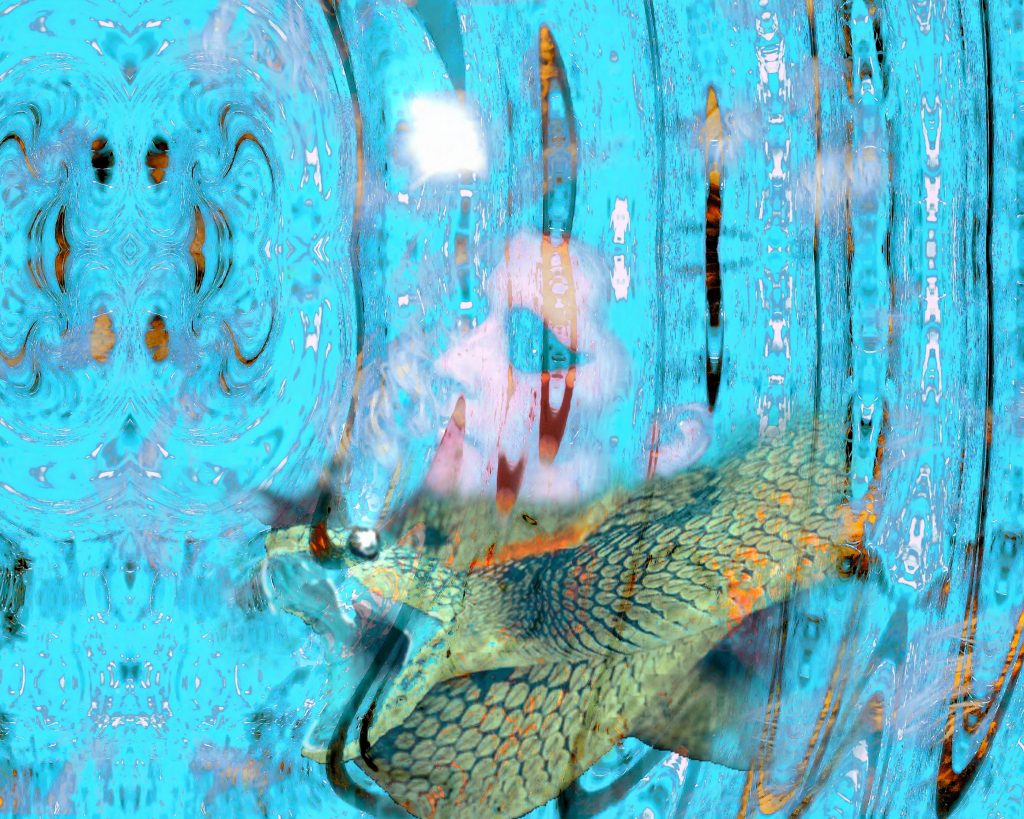
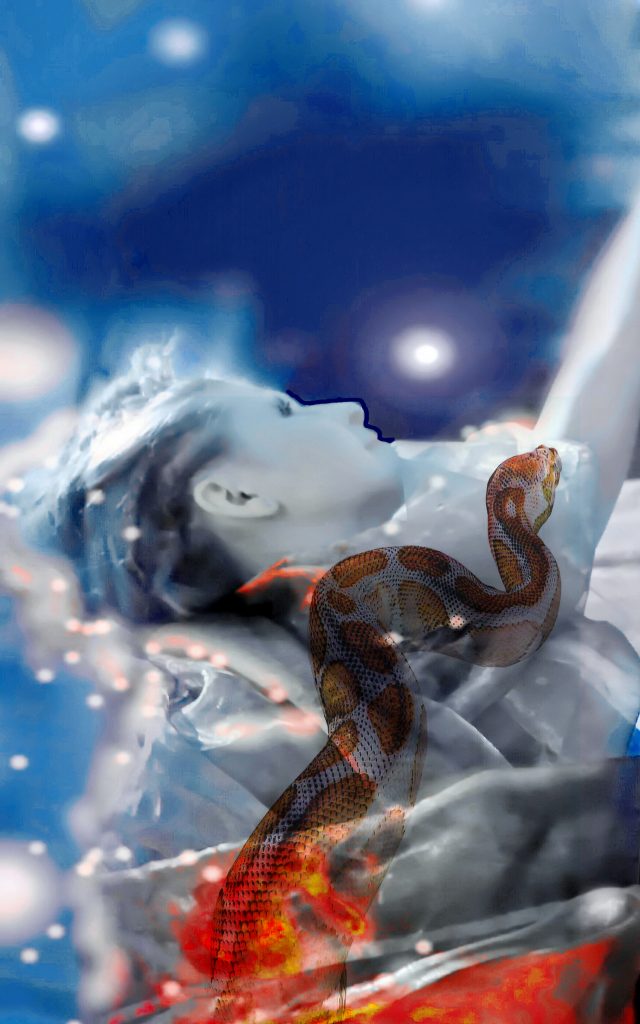
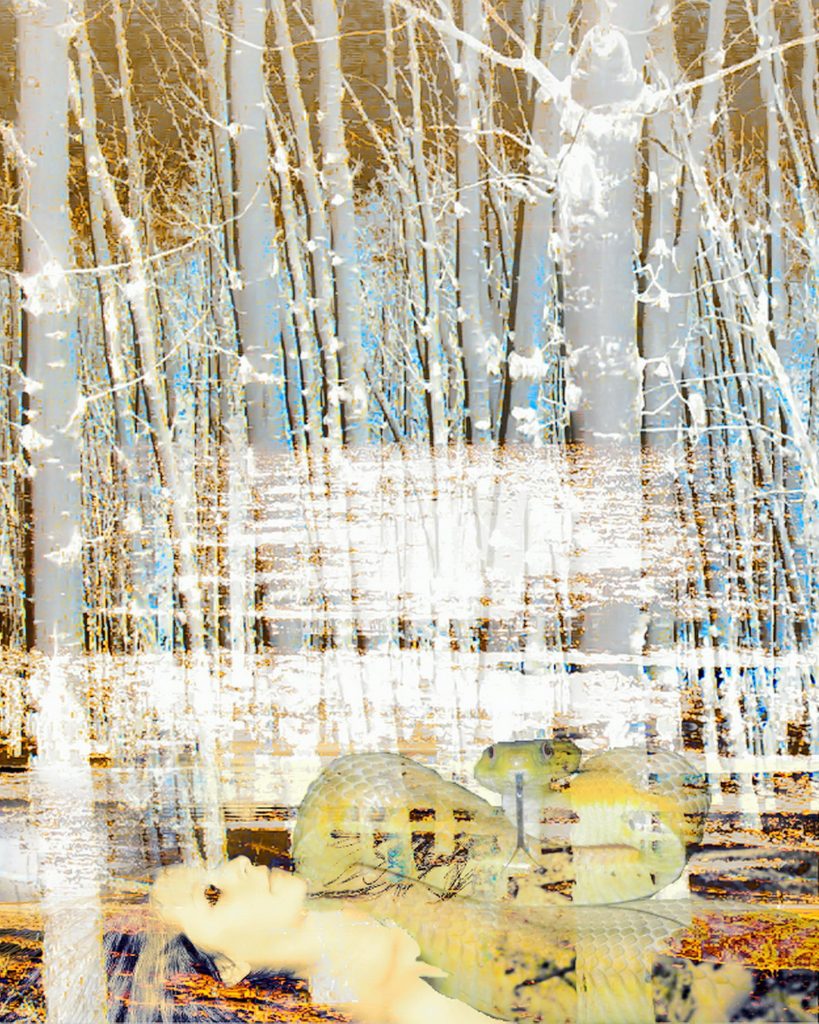
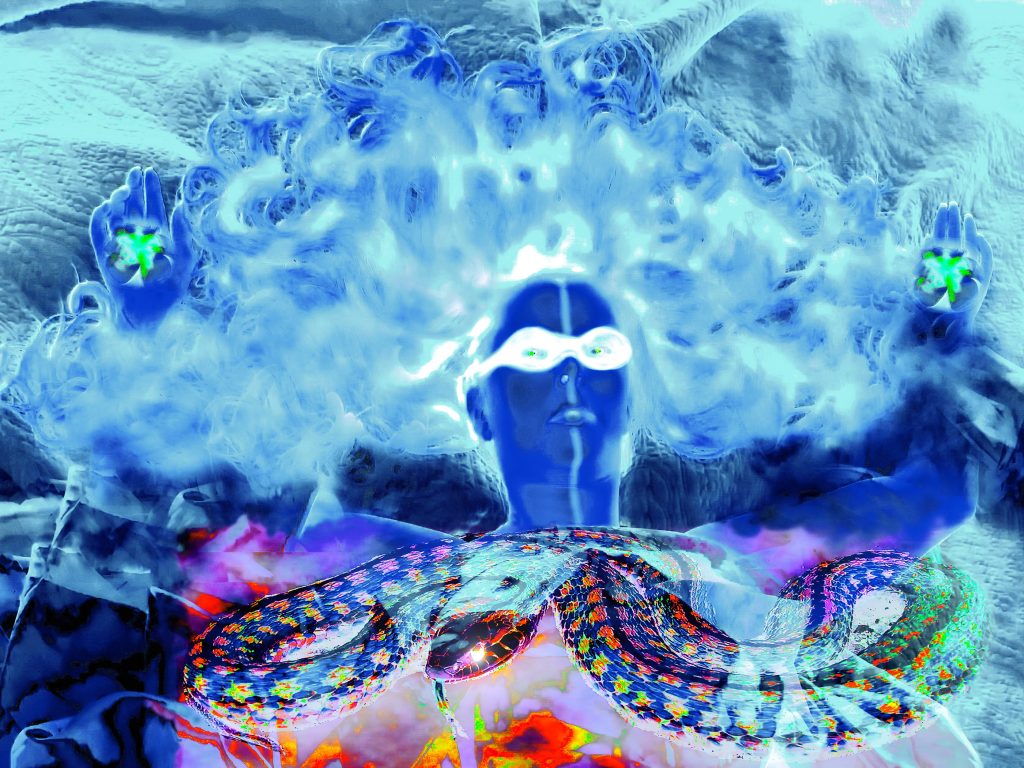
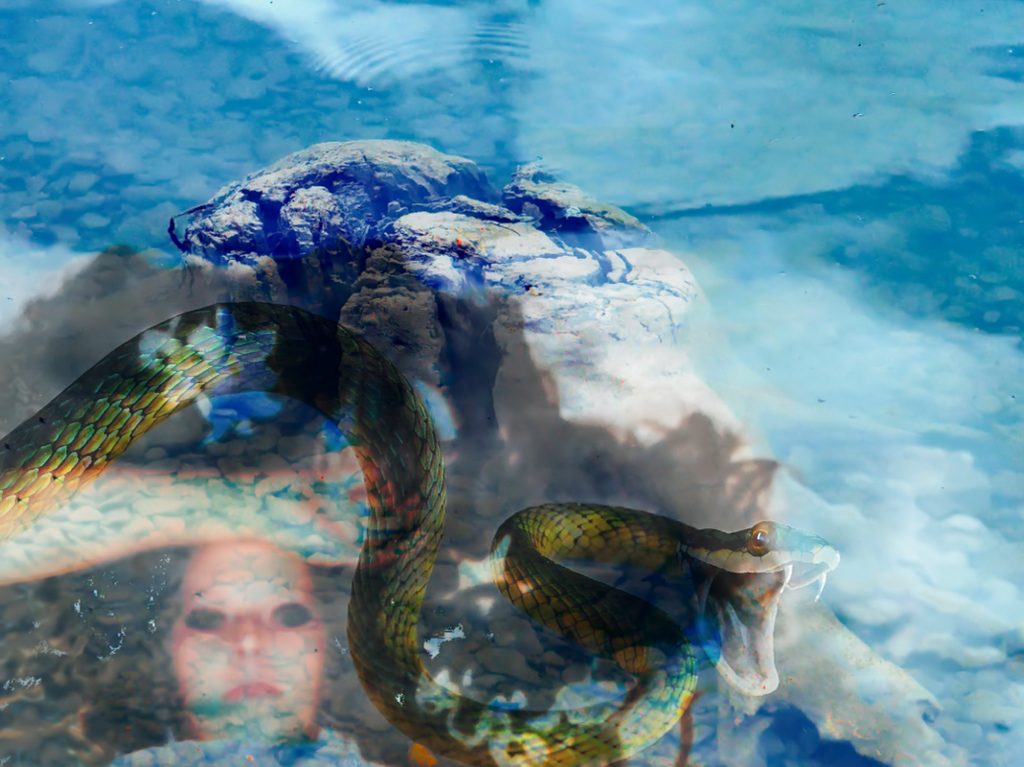
I come from Zambia, Africa. Unknown to most travellers, there exists a creature of myth & cultural memory called Chitapo. If you travel in the north, there are pictures around the Kafue area that depict her; in the south around the Zambezi also. She/they are part-mermaid/ siren, part snake, lurking in the depths of the rivers and lakes. Their enchanting song lures wandering souls into the water to drown. She is always hungry. In the half-awake, half-comatose state of grief, self doubt, fear of addiction or diminution, she appears to us. She’s beautiful and terrible, the snake ever poised and watchful, and we cannot look away… Do we dare embrace her? At what cost?
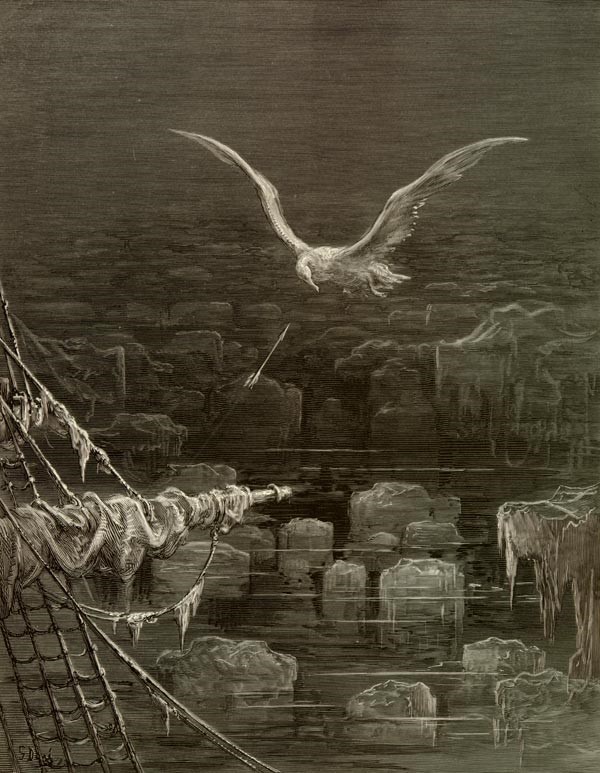
Illustration from “The Rime of the Ancient Mariner,” Gustave Dorè
The Rime of the Ancient Mariner
Word for Word Performing Arts Company
And Z Space
San Francisco
A review by Christopher Bernard
“ ‘God save thee, ancient Mariner!
From the fiends that plague thee thus!
Why look’st thou so?’ With my crossbow,
I shot the ALBATROSS.”
The new theatrical adaptation of Coleridge’s haunting poem by San Francisco’s Word for Word and Z Space could hardly be more timely. It opened on the day of the mass global Climate Strike of September 20; some in the audience still carried dust from local marches on their shoes.
The famous poem tells, in the form of an extended ballad, the tale of an old seaman who stops a young man on his way to a family wedding to tell him a story he is compelled to tell over and over again, of a mysterious and tragic voyage he made in his younger days south to the Antarctic wastes, where he shot and killed an albatross, despite the bird having led the ship back into open sea, thus sparing it wreck in frost and ice, and about the terrible punishments thereupon visited upon himself and the crew for this crime against nature.
Word for Word’s beautiful, sometimes harrowing, adaptation underscores the many prophetic aspects of the poem; not only for its, and our, terrifying future, but also those deeply rooted in our civilization: the humanism of the Greco-Roman world and the special creation of man and his role as master of nature claimed for him in the Old Testament; the humanism that has long defined Western civilization and that, turbocharged by the scientific revolution, the enlightenment, and the multiple industrial revolutions of the last two and a half centuries, has made us world-conquering and now world-destroying.
There is one question that anyone who has read “The Rime of the Ancient Mariner” has asked. The question has nagged for the more than two centuries since the poem first appeared. Students, teachers, critics, lay readers of all kinds ask: why on earth did he do it?
Why did the Ancient Mariner shoot the albatross?
It is not explained in the poem—indeed, the idea of motive is never raised. It seems an act of wanton thoughtlessness, boredom, whim. Yet, to a brutal fate, to avenging spirits and “a rotting sea,” to mass death and, for those who survive, a life worse than death, leads (in director Delia MacDougall’s memorable phrase) this “thoughtless act of dreadful consequence.” A seemingly random, unfortunate, but surely trivial deed has results beyond anything that seems morally or even practically explicable.
There is, perhaps, only one humanly understandable, if not respectable, reason. He did it, not because he thought that it was right or necessary, from superstition or fanatical zeal, or even from sheer malevolence—out of pride, cruelty; what we might call “malignant narcissism” or “toxic masculinity.” It was an act neither of misguided virtue nor of willful evil. He did it for one reason alone: because he could.
Our world of relentless disruption has come about for reasons not far different: the Mark Zuckerbergs, Steven Jobs’, Travis Kalanicks of the world have upended our existence time and again because they could. Some young man working in a midnight bedroom may yet find a way to blow up the world just because he discovers that, with this little thread of code populating every computer in the world with a single click of his mouse, he can.
Word for Word follows its customary method of dramatizing texts by presenting them literally “word for word”; in this instance, enacting the entire poem on a stage representing a minimalist skeleton of the Mariner’s ship, and flanked by sweeping ramps, like two arms embracing the vessel, that rise to a shrine-like alcove where figures of transcendence briefly appear—the “spirits” that inhabit the poem, including that of the albatross. The stage is a bit like a schematic image of a woman’s body, with head, arms, and womb: mother nature from which all things come and to which all things must in the end return.
Among the most notable performers of this evening were Lucas Brandt as both the Wedding Guest to whom the Ancient Mariner tells his inescapable tale, and the young mariner of the awful deed and spectral sea tragedy (most of the cast take double roles); a splendid Darryl V. Jones who takes the part of the Sun (who has indeed a defining role in the poem, as bringer equally of life and death) and also as the Hermit who shrives the mariner at the end of his long journey (Jones also wrote the idiomatic music for the Hermit’s song); and the lovely Leontyne Mbele-Mbong as a crew member and second of two disembodied spirit voices. Charles Shaw Robinson presented the Ancient Mariner with mournful authority.
The two directors, MacDougall and Jim Cave provide, in the program, particularly eloquent “director’s statements,” demonstrating an unexpectedly comprehensive understanding of Coleridge, who in later years became an influential philosopher some of whose ideas left traces on American transcendentalism, existentialism, and ecological philosophies. The directors, performers, and production team braid together their skills like good hemp cable to help the poet’s words, ideas, and warnings cross the generations to reach us with as much urgency as theatrical power.
It is well accepted that we are in the midst of destroying much of living nature that has thrived for tens of millions of years on planet earth, like the mariner’s shooting of the albatross, just because we can. Before our time no matter how much we were able to destroy each other, cities, cultures, entire civilizations, we could not, in effect, destroy everything. But now the world has become our toy; like many a child, we have been busy taking it apart to see how it works. And, like many a child, we are now crying because we don’t know how to put it back together again.
At the very beginning of this adaptation, in a brief prologue, the “spirits” that are as vital to the story as the benighted humans, and acting together as a benignant chorus made up of everyone except the tragic protagonists, present a short speech not to be found in the poem; it is repeated, word for word, at the poem’s conclusion. Who invented it? No one is saying. It is modest, kindly, ingenuous, and deeply moving, ending the performance on a note both questioning and hopeful. One can only be grateful, as we have never been more in need of hope.
_____
Christopher Bernard is co-editor of the webzine Caveat Lector. His novel Meditations on Love and Catastrophe at The Liars’ Café will appear in 2020; his third collection of poetry, The Socialist’s Garden of Verses, will also appear in 2020.
Welcome, readers, to October’s issue of Synchronized Chaos Magazine. As our editor Cristina Deptula is traveling, here’s a Literary Carousel of writerly advice and excerpts from books whose authors are clients of our colleagues Desiree Duffy (and the Black Chateau team), Kristina Marie Darling of Penelope Coaching and Consulting, and Gini Graham Scott of Changemakers Publishing and Writing.
Also, we will have a presence at four different LitCrawls:
Portland, Oregon (November 8th, the Portland Psychedelics, including Lisa Loving, Arielle Dione Hartwell, Douglas Cole, Jennifer Robin, Ted Cheng and Bonnie Greene)
San Francisco (Partnered Reading, where published authors write new short pieces inspired by the work of emerging authors) (October 19th at Adobe Books. Kristen Caven, Douglas Cole, Sheryl Bize-Boutte, Christine Volker, Aqueila Lewis-Ross, Robert Cohen and Joan Gelfand)
New York City (‘History Rhymes’ – Manhattan, October 12th in Cobble Hill) (Nhi Chung, Jim Feast, Bernadette Giacomazzo, Pam Saxelby, and the satirist ‘Autumn Leaf’)
Los Angeles (‘The Literary Heroics’, October 6th, Joan Gelfand, Raj Naiksatam, Jacqueline Berger, Charles Ayres and Peggy Wheeler).
Black Château offers award-winning digital marketing services. Website development, PPC, SEO, social media, digital public relations, online advertising, viral marketing, graphic design, branding, influencer marketing and media outreach are just some of the services we offer authors and their books.
Manuscript Consultations withline by linefeedback onbook-length length poetry, nonfiction, fiction, hybrid genre, experimental, and cross-disciplinary work, as well as chapbook manuscripts in all genres.
Application Coaching forartist residencies, literary arts fellowships, cover letters, projects proposals, grant applications, and more.
Book Publicity for your most recent poetry collection, novel, short story collection, memoir, hybrid text, or essay collection. We can assist with facilitating reviews, interviews, and features in literary magazines.
Professional Development Coaching andassistance with literary journal submissions, pitching articles to editors, pitching book reviews and review-essays, and networking strategies.
Private Workshops for Individuals and Groups, including courses on hybrid and mixed-genre writing, women’s writing, book reviewing, publishing arts, verse novels and the long poem, collaboration, and other topics as determined by student interests.
Kristina Marie Darling
Kristina Marie Darling was born in 1985 in Tulsa, Oklahoma. She is a first-generation college student and an advocate for women in the arts, higher education and the professions.
Kristina is the author of thirty books, which include Look to Your Left: The Poetics of Spectacle (University of Akron Press, 2020); Je Suis L’Autre: Essays & Interrogations (C&R Press, 2017), which was named one of the “Best Books of 2017” by The Brooklyn Rail; and DARK HORSE: Poems (C&R Press, 2018), which received a starred review in Publishers Weekly. She has also written in collaboration with Carol Guess, Professor of English at Western Washington University; John Gallaher, winner of the Levis Prize in Poetry; and novelist Chris Campanioni, who is the recipient of the Best First Book Distinction from the International Latino Book Awards. Kristina’s writing has been set to music, installed in gallery settings, utilized in fashion photography, and stitched onto kites by textile artists.
Her most recent poems appear in The Harvard Review, Poetry International, New American Writing, Nimrod, Passages North, The Mid-American Review,and on the Academy of American Poets’ website, Poets.org. Kristina has published essays in The Kenyon Review, Agni, Ploughshares, The Gettysburg Review, Gulf Coast, The Iowa Review, and numerous other magazines.
Her work has been recognized with three residencies at Yaddo, where she has held the Martha Walsh Pulver Residency for a Poet and the Howard Moss Residency in Poetry, both of which are endowed residencies awarded, by internal committee nomination only, to recognize outstanding contributions to the arts; a Fundación Valparaíso fellowship to live and work in Spain; a Hawthornden Castle Fellowship, funded by the Heinz Foundation; an artist-in-residence position at Cité Internationale des Arts in Paris; three residencies at the American Academy in Rome; two grants from the Whiting Foundation; a Morris Fellowship in the Arts; a Faber Residency in the Arts, Sciences and Humanities; and the Dan Liberthson Prize from the Academy of American Poets, among many other awards and honors.
A former Pabst Cultural Endowment Fellow at the Atlantic Center for the Arts, and the recipient of grants from Harvard University’s Kittredge Fund, Yale University’s Beinecke Rare Book and Manuscript Library, the Ora Lerman Trust, the Regional Arts Commission of Greater Saint Louis (on two occasions), and the Rockefeller Archive Center, Kristina also was named the recipient of an Elizabeth George Foundation Fellowship, a cash grant in the amount of $4,000 designated to further her contributions to the arts.
An editor, critic, and publisher, she serves as Editor-in-Chief of Tupelo Press and Tupelo Quarterly, an opinion columnist at The Los Angeles Review of Books, a contributing writer at PublishersWeekly, a staff blogger at The Kenyon Review, and a freelance book critic at The New York Times Book Review. Kristina has also held staff positions at Gulf Coast, The Best American Poetry, and Black Ocean, where she worked as a book publicist and grants specialist.
She has lectured on contemporary literature, poetics, the publishing arts, and creative writing at San Diego State University; New York University, as well as NYU’s Summer Paris Writing Program; the Sorbonne Library in Paris; the MFA Program for Writers at Wichita State University; the Poetics Program at the University at Buffalo; the University of Missouri at Columbia; the University of North Texas; Drake University; Buffalo State University; Florida International University; the Yale University Writers’ Conference; the University of Arizona; Western Washington University; and the Castle of Otranto in Italy. In 2019, she was named to the U.S. Fulbright Commission’s roster of Senior Specialists.
Kristina’s student loan memoir is represented by Marilyn Allen of the Allen O’Shea Literary Agency.
Gini Graham Scott, founder of Changemakers Productions
Changemakers Publishing and Writing has become a conglomerate of writing, publishing, and marketing services with a team headed by Gini Graham Scott, Ph.D.
She has written and published about 200 books — 50 with traditional publishers, 150 through Changemakers Publishing.
She has also written and executive produced 6 film projects, which include 4 feature films, a pilot for a TV series, and a documentary, as a co-producer through Changemakers Productions.
Gini Graham Scott, founder of Changemakers Productions
Changemakers Publishing and Writing has become a conglomerate of writing, publishing, and marketing services with a team headed by Gini Graham Scott, Ph.D.
She has written and published about 200 books — 50 with traditional publishers, 150 through Changemakers Publishing.
She has also written and executive produced 6 film projects, which include 4 feature films, a pilot for a TV series, and a documentary, as a co-producer through Changemakers Productions.
Guidelines for Writing an E-Mail Query Letter
Keep your query short and to the point — ideally around 300-400 words, and no more than 500. Fill in the details as indicated, though put the letter in your own words. Also, don’t use bold type, underlines, or italics, since it is best to send out your query as a text message, which is most likely to be received and read, and the software we use will convert special fonts to regular type. Use CAPS for emphasis instead. And please no markup, review, or tracking features in your letter.
In the following template, the CAPS are instructions to fill in with your own information. Adapt the wording to make it your own.Subject Line: (HIGHLIGHT THE MAIN POINT OF YOUR BOOK AND BE SPECIFIC; THIS LINE IS VERY IMPORTANT. IT IS WHAT APPEARS IN THE BROWSER ADDRESS LINE, AND IT IS WHAT WILL GET THE EDITOR, AGENT, PRODUCER, OR OTHER RECIPIENT TO OPEN UP YOUR E-MAIL QUERY; IF YOU HAVE BEEN PRODUCED OR PUBLISHED NOTE IT HERE)
Dear ************: (THE EDITOR’S/AGENT’S NAME WILL BE FILLED IN HERE; IT WILL BE FILLED IN AUTOMATICALL; PUBLISHERS AGENTS & FILMS USES SPECIAL SOFTWARE TO FILL IN THE PERSON’S NAME FOR EACH QUERY)
[NONFICTION BOOK/NOVEL/SCRIPT) TITLE which is about (DESCRIBE THE SUBJECT AREA OR PLOT IN 25 WORDS OR LESS…POINT UP ANY BIG SELLING POINTS, SUCH AS MULTI-PUBLISHED AUTHOR, PRODUCED SCREENWRITER, FILM RIGHTS TO BEST SELLING BOOK, ETC. THIS SHOULD BE LIKE A LOGLINE. KEEP THIS TO 1-2 SENTENCES.
It features (DESCRIBE THE HIGHLIGHTS OF THE BOOK IN 1-2 PARAGRAPHS; ABOUT 5-8 SENTENCES; HIGHLIGHT THE MAJOR SUBJECTS COVERED OR MAJOR PLOT POINTS; THIS IS LIKE A MINI-SYNOPSIS).
TITLE should be highly marketable in that (GIVE ONE OR MORE REASONS, SUCH AS “IT IS THE FIRST BOOK TO COVER THIS TOPIC FROM THIS PERSPECTIVE” AND DESCRIBE HOW YOU WILL HELP TO SUPPORT THE BOOK THROUGH YOUR OWN PROMOTIONAL EFFORTS).
(NOW WRITE A PARAGRAPH ABOUT YOUR EDUCATION, BACKGROUND, EXPERIENCE, ORGANIZATIONAL MEMBERSHIPS, OR OTHER FACTORS THAT SHOW WHY YOU ARE IN AN IDEAL POSITION TO WRITE AND PROMOTE THIS BOOK OR FILM.)
I would be happy to submit a (SYNOPSIS/PROPOSAL/SAMPLE CHAPTER/COMPLETE BOOK, COMPLETE SCRIPT) or other materials for your further consideration. I can also submit (MENTION ANYTHING THAT MIGHT HELP PROMOTE THE BOOK, SUCH AS PROMOTIONAL MATERIALS, LETTERS OF ENDORSEMENT FROM WELL-KNOWN PEOPLE IN THE FIELD, NEWS CLIPS OF PREVIOUS PUBLICITY, A LIST OF THINGS OU MIGHT DO TO PROMOTE THE BOOK, ETC.)
I hope you will be interested in pursuing (TITLE OF YOUR BOOK/SCRIPT), and I look forward to hearing from you.
“Our success rate stands at 45%, the highest in the industry,” said Dr. Godwin, the director of the Center for Human Reproduction. “We’ve had sister surrogates, friends, strangers—but you’re our first mother-daughter team, and we’re very excited.”
They sat across from him, three in a row, Mary in the center. With his prominent ears and boyish smile, Dr. Godwin resembled a leprechaun, a trickster, capable of magic, the kind of man who had turned Mary on before she’d declared herself a lesbian.
“A 45% success rate sounds like a 55% failure rate.” Joel perched on his chair as if any second he’d vault to his feet, shouting, Put up your dukes!
“We look at cycle percentages and factor in retrieval rates resulting in live births.” Dr. Godwin rattled off numbers and criteria, things Mary spaced out on. She splayed her fingers to examine her rings, her force-field of strength, with a ready explanation for each, in case anyone should ask: gold with tiger’s eye to guard her spirit, Mother-of-pearl and onyx yin-yang to balance her chi. Jade for healing, lapis lazuli for love and, of course, her mother-ring, identical to Ann and Joel’s wedding rings, an expression of solidarity.
She caught Ann’s gaze, her daughter’s pale blue eyes almost transparent, rimmed by short, blunt lashes as bleached as her straight blond hair. Somehow in the light, enhanced by the mauve upholstery and carpet and walls, Ann was illuminated in a lovely pink aura. I made you! Mary wanted to shout. And I can make another you!
“How long will the process take?” Joel cracked his knuckles. “Or are you going to throw out smokescreen numbers on that, too?”
Typical man. Mary tried to catch Ann’s eye again, to exchange a private communion about men’s need to dominate, but Ann was leaning forward, utterly engrossed. “What about the chances of having a baby like me, without a…?”
Mary broke in. “Without a uterus. Good question.”
“I don’t think the research bears out a genetic component.” When Dr. Godwin smiled, dimples appeared in both cheeks. “As for the timing, let’s say everything goes smoothly. Once cycle synchronization begins, we’re talking about four weeks for egg stimulation. Then we harvest the eggs and fertilize. A few days later we transfer the pre-embryos. Two weeks after that, a positive pregnancy means you’re in the hands of your obstetrician. Which comes to seven weeks. I suggest we work aggressively for the transfer. At your age, we don’t worry so much about multiple births, we just want a take-home baby.” He aimed his boyish smile at Mary. How appealing he was, even when calling her old!
“What about Mary’s weight?” said Joel. “It’s not just the age factor. She’s carrying some extra weight.”
He got her with that one. Count your blessings, Mary’s mother used to tell her, fat women stay youthful-looking longer than slender ones. More flesh, fewer wrinkles, it works in your favor now. Mary grabbed her blubber through her shirt. “Are you calling me fat? More to love is what I say.”
“You shouldn’t grab yourself like that,” said Ann.
The scolding made it worse. One hundred eighty-three pounds at five feet, four inches, Mary was aware of moisture seeping into the folds of her flesh. Her hip creases were damp. She nudged Ann. “I think I’m power-surging!”
“Too much information, Mom.”
“You’re not, as we say, morbidly obese,” said Dr. Godwin with his quick smile. “You’re a healthy woman. And a little extra weight seems to improve the chances of implantation.”
“If only my mother were alive to hear this,” said Mary. “All these years, I’ve been healthy, not fat.”
Ann jiggled her foot, bumping rhythmically into Mary’s chair. “When you said multiple births, did you mean we could have more than one?”
“Twins are not uncommon. I’ve heard them referred to as ‘the jackpot,’” especially if they’re one of each gender,” said Dr. Godwin. He rubbed his palms together so briskly Mary imagined sparks flying out.
“That’s crass,” said Joel. “The jackpot.”
“Let’s think twins. We’ve got yin on one side…” Mary grabbed Ann’s hand, then clasped Joel’s sweaty one. “…Yang on the other. And I’m the circle to hold them.” They both tried to disengage but Mary had a strong grip. She shut her eyes to call on Demeter as the goddess appeared in the marble likeness on Mary’s altar, with her torch and sheaf of wheat. But, instead of Demeter, a vision of Dr. Godwin with the hind end of a goat materialized, consort and son of the universal mother. She opened her eyes. “I’m going to call you Dr. God.”
#
Ann remembered her childhood in fragments, each memory an island surrounded by a void. She didn’t recall leaving Peace Ranch but she recollected arriving at the yurt with Mary and Lars. At the end of a dirt road with a mound of grass in the center, bordered by bushes that scraped the sides of the car, the yurt stood in a field, a giant cylindrical tent with a mounded top.
It was beautiful, with its three-layered walls, rafters, and tension cables. The apex of the roof was covered with a clear dome. The space inside was circular, with dividers to separate the kitchen and the bathroom. No doors but a cozy nook with a single bed for Ann.
Boulder, Colorado. Outside of Boulder. West, if you want to get technical, said Lars.
Annapurna likes getting technical, don’t you? Mary’s smile dazzled. Her happiness was contagious. An island.
Ann remembered watching Lars’s long fingers press guitar strings, sliding from fret to fret along the neck as he taught her how to play. He called her a quick study. Another island.
He was an artist. To paint from nature, he would roll up his sleeping bag and mat, hoist his backpack on his shoulders with his paints, easel, and canvas, and trek high into the hills. He stayed away, sometimes overnight, sometimes a couple of days.
In his absence, Mary let Ann sleep with her, spooning her in a soft, warm hug. Play our cards right and he’ll adopt you, she whispered. And we’ll travel all over the country: Oregon, North Carolina, Arizona. That’s the beauty of the yurt, we can set up anywhere. We belong together. Me and Lars are soulmates. And soon, I hope to give you a sister or a brother, you’d like that, wouldn’t you? Ann was happiest then, in bed with Mary, listening to their beautiful future.
Lars left one afternoon while Mary was at work. She worked at a self-serve gas station in a little booth, collecting money. When she wasn’t doing that, she was sitting at her drafting table with her silver and her beads and her semiprecious stones. Tell your mother the winds are changing and I have to go.
Ann was trying to learn chords on the guitar, his guitar. Lars stroked her beneath her chin, forcing her to look into his fierce blue eyes, like an icy lake. Tell her I’ll be back when the north winds blow.
He left behind his tubes of oil paints, an unfinished landscape drying on an easel, clove cigarettes and two gallon jugs of chlorophyll. His saucepan and his Coleman stove hung off his backpack, clanking as he walked away.
When are the north winds supposed to blow? Why didn’t you stop him? When Mary came home, she threw a fit, overturned her drafting table so all the beads and stones lodged in the rug. She ran around screaming, then she curled into bed and refused to get up.
For days, as she watched Mary sleep, Ann strummed the guitar and practiced Travis picking until her fingers hurt. It sustained her through those endless, frozen hours. First, they ran out of milk and eggs. Then they ran out of rice cakes. In the morning the school bus stopped, honked, and moved on.
When the truant officers came, they shouted and knocked but Ann wouldn’t let them in. By the time the police arrived, there was no food left at all. When’s the last time you went to school? a policeman asked.
They found half-smoked joints in the ashtray and seeds embedded in the rug. Get up, you’re under arrest. Magic words, they broke the spell. Mary got out of bed, donned her clothes, and laced her boots.
Ann remembered being driven to a big, shabby house in the center of town. An aproned woman led her down a hall to a bedroom crowded with bunkbeds. On the wall hung a picture of cherub-cheeked children in a meadow with the words: Suffer the little children to come unto me.
The woman was wearing rubber gloves. She was always cleaning something. Ann recalled the contoured texture of rubber against her palm when the woman shook her hand, and remembered how the woman peeled off the gloves to kneel on the floor by the bottom bunk. This is your bed now. Shall we pray?
Twelve children lived at the house. For breakfast, numerous cereals were lined up on the counter. Before every meal, they bowed their heads and prayed: Bless us our Lord for these thy gifts, which we are about to receive through thy bounty and through Christ our Lord, amen.
The man in the house wore thick glasses, magnifying his eyes so they seemed to float away from his face. Before dinner he added a lengthy sermon to the prayer and the meatloaf would be cold by the time they were allowed to dig in.
On Sunday, no one was permitted to eat until they had been to church. A blue cotton dress was presented, ironed and starchy and too small for Ann; it dug into her armpits. Standing, kneeling, singing, she felt her soul rocked in the bosom of Abraham, as the lyrics of the gospel song went, and she remembered feeling that she would survive. Another island.
Evenings were predictable: Chores, homework, prayers, bed. Chores were designated on a chore wheel. Drying dishes: Annapurna. The sight of her name brought a strange thrill, and she took great care in drying, pressing the towel edge between each fork prong until the woman said, We don’t abide laziness here. You must learn to be more efficient.
Ann wasn’t unhappy except at night when she lay awake, not knowing where Mary was, fearful that Mary was afraid, painfully aware that Mary needed her. Then she sobbed into her pillow until she drifted off to sleep, waking again only after she had already wet the bed.
Even now, as an adult, Ann could conjure the cold fear churning in her stomach, the harshness of the blanket and the crinkle of the plastic sheets, the shame of bedwetting. The other kids jeered. They said she smelled like pee. They called her Cooties, broke her crayons, and pinched her arms.
She missed the yurt then, and Lars. And she began to miss Peace Ranch, too, not sleeping in the children’s room, but the brook where everyone swam on hot afternoons, the sweat lodge and full moon rituals when they joined hands and danced in a circle, when Mary was happy, her laugh deep and infectious.
In the morning, Ann felt okay, or, rather, she didn’t feel anything, and that became okay. When a letter arrived from Mary she opened it slowly, easing the flap, so as not to tear it. I love you Annapurna Peace and I miss you. A drawing of a sad-faced sun. We’ll be together soon, I promise. I love you very much, Mom. Intricate swirls and doodles of flowers decorated the border. Ann pressed the paper to her face, smelling Mary’s patchouli with a longing so deep it suctioned her breath right out of her.
Later, she had no idea what might have happened to those letters. They had slipped into the void between islands. Then came a viscerally memorable moment: Annapurna, you have a visitor. And there stood Mary, horribly out of place in her brightly embroidered denim skirt, her hiking boots and Heidi braids interlaced with purple ribbons.
They were ushered into the visiting room, a first for Ann. She had seen the other kids walking in there with adults, closing the door. Now it was her turn. The parlor was wallpapered with faded pink roses. Two sofas faced each other with two armchairs on either side, a rocking chair in the corner. A stack of Bibles sat on the coffee table.
Wow, a rocking chair! Mary went straight for it, while Ann sat stiffly on the edge of the sofa.
Do you like it here? Mary rocked back and forth with peculiar urgency.
The inchoate, incommunicable immensity of an answer lay beyond Ann’s skill. It’s okay, she finally said.
Well, I’ve come to give you a choice. You can stay here for a little bit longer, or you can ride on an airplane to Gran’s house. Mary stuck the end of one of her braids between her teeth. She was sucking on it while she rocked.
I want to stay with you.
I’m sorry. It’s foster care or Gran’s, just for a short time. I promise. Mary burst into tears and Ann jumped up, hugging her head, her soft brown hair, stilling the rocking chair. She clung. I want to stay with you.
Gran met her at the airport, a stern woman with a sharp gaze and blue eyes the same shade as Mary’s. Your mother makes a virtue out of chaos but I hear you’re the levelheaded one.
On a television leaning against a floor-to-ceiling window
in the southern portion of the peninsular apartment, a latenight
talk show host claims, “Scientists no longer believe that
the universe will be destroyed by fire. They used to think the
whole place was going to burn up one day, but not anymore.
Now they say the universe will eventually run out of the
energy it needs to keep everything going, that it will just keep
expanding and expanding out into complete chaos where
everything will break down. So, it’s pretty much like Los
Angeles.” The audience laughs.
Trevor is unable to laugh because he wonders, as he
forever works at solving the mystery of his Rubik’s Cube, why
a late-night show is on during the day. He sits in a chair,
facing a set of bookcases perpendicular to the television set.
Trevor once believed in mathematics, experimentation, and
causality. Now there is only speculation, observation, and
probability. Life is uncertain, indeterminate, chaotic. Toys are
as likely to hold answers as anything. Yet like Einstein
searching for a local hidden variable theory that would restore
determinism and causality to measurements, Trevor hopes
order will return when he finally solves the Cube. It has to.
There’s nothing else.
Trevor says: “There must be an energetic center to life.
There must be a focal point where it all makes sense,” and
keeps manipulating the toy.
Kat says: “Ninety million miles is one Astronomical Unit,
or AU.” She makes campy quotes in the air with her fingers
when she says AU, and continues shuffling zombie-like in an
ellipse of unknown momentum around the coffee table in the
center of the room, mumbling numbers, computations,
formulae, equations, differentials, smoking a cigarette, ashing
on the floor, staring at the debris-covered ground. She does
not care what time it is.
Indeed, although the television displays a late-night talk
show host performing his opening routine, the sun beats down
on the awkward apartment, enervating each one of the atoms
in and surrounding the structure; this atmosphere consists of
Nitrogen (78%), Oxygen (21%), and many other gases,
including some Hydrogen. It might be assumed that the star
is taking a vendetta out on the people below, but it does no
such thing, for the sun remains a G-class star, burning at five
to six thousand degrees Celsius, ninety million miles, or one
Astronomical Unit (AU), away from earth, as it will for
another 4.5 billion years. None of this matters to Trevor, who
wonders about the late-night show and its illogical timeslot.
More proof of chaos. He would ask Kat, but she has become
catatonic with her mathematics, and to Trevor particularly
high figures represent the number of times Kat’s cheated on
him, ratios equal the probability of her having some harmful
disease …
Kat says: “Twenty percent.”
In the East, Trevor and Kat were as indistinguishable as
the molecules in a cloud. They could only be taken as a whole,
could only be measured as a system.
Trevor tries to ignore Kat’s numbers because the Cube,
the precious Cube is much more important. It holds the key.
Unfortunately, Trevor has never heard of Augustus Judd who,
a mere six years after the Rubik’s Cube was invented in 1974,
founded Cubaholics Anonymous.
The apartment is a peninsula because it juts from the side
of the main building, because it is for no discernible reason
supported by raised piers like houses in Louisiana, and because
there are floor-to-ceiling windows on all but the north side.
Hence the structure, built obviously as an afterthought, is a
protrusion of living space surrounded on five sides by
pressurized and enervated gas. The windows to the east are
blocked by bookcases containing Kerouac, Ginsberg,
Burroughs, Keats, Byron, Hemingway, Fitzgerald, and other
Romantics, Beats, and general adventurers. There are also
textbooks, dictionaries, thesauruses, and a set of
encyclopedias. Lying open on the floor in front of Trevor,
who faces the eastern wall, is a volume of the encyclopedia.
The article displayed is one about the birth and death of stars.
Kat once said: “We’re gonna be stars, baby.”
Trevor once said: “We’ll shine as bright as the Dogstar,
Sirius.”
Kat once barked.
A wide view: to the south is the television, tilted because it
is on an uneven elevated stand. The picture is snowy and
shows a man with a large chin rocking his head back and forth
as if it were on a spring. The set itself is placed dangerously
close to the edge of the slanted dais. The room is chock full of
items placed on the edges of tables, bookcases, ledges, etc., a
veritable diorama of potential energy, giving one the idea that
the precarious balance of the apartment, itself poorly stabilized
on its piers, could be upset, could come crashing down if the
proper force were exerted. Kat, on her mumbling ellipse, often
comes close to disturbing the perilous construction of the
room, but she hasn’t quite upset the equilibrium. Yet.
The apartment forms a T, with the vertical portion
making the peninsula, the left portion of the horizontal being
the kitchen, and the right the bedroom and bathroom. In the
kitchen, the oven is on, pumping heat into the already stifling
atmosphere. The windows in the peninsula not covered with
bookcases are open, although they are held up by slight cords
which could let loose at any minute; it is a blistering day
outside. Also in the kitchen, all four burners of the stove are
on, waiting to conduct heat into pots, pans, anything that may
land upon them. Next to the stove is a microwave which is on
the fritz, which continuously fires electromagnetic waves
inside itself heating nothing at all. Adjacent to the microwave
is the sink, where water flows and flows down the drain.
There are light fixtures and lamps throughout the apartment,
all turned on, but none furnished with light bulbs.
Kat once said: “There’s no moon. It’s so dark.”
Trevor once said: “It’s Kansas, what would you see?”
In the bedroom, pitch black because there are no windows,
a hurricane lamp leaks oil onto the floor; upon closer
inspection, the oil continues into the kitchen and the
peninsular room, as if someone had been carrying the lamp
around searching for something. Other than the lamp, there is
an unmade bed, a fiercely rattling fan, and an alarm clock
running on double A batteries incorrectly blinking 3:05 AM.
In the bathroom, the shower and sink are both on, two
different brands of electric shavers buzz, the lights (here there
are light bulbs) are illuminated, and a blow dryer blows.
Throughout the apartment, the floor is covered with
myriad books, papers, journals, notebooks, piles of drawing
paper, cardboard, newspapers, magazines, etc. The density of
the paper products at all points in the apartment is so thick it
is impossible to see the floor. Footprints cover the manifold
dross because of Kat, whose ellipse is almost perfect, but not
quite; the detritus is also covered in ashes.
Amongst the debris on the floor is Trevor’s now shredded
journal which he kept during the trip West. Some pages near
the kitchen read, “Our trip to the West begins with so much
potential. Our car is filled with gasoline, our Zippos with
butane, our coffee mugs with espresso. Our bobble-head doll’s
spring is compressed—all anyone has to do is push the button
on the bottom and the toy’s parts will shoot upwards, its silly
brainpan bouncing around. The lure of the West, leaving
everything behind for the Promised Land is intoxicating; we
can hardly restrain the energy built up inside of our own
bodies, let alone the various means of energy in our
possession. Before we even leave our former driveway, Kat
pushes the button on the bobble-head doll, and we laugh as
the crazy thing careens around.”
Trevor once said: “The road trip will be a grand
experiment, although it will employ elementary cause and
effect. In the East, we have stagnated. And whereas occasional
dissipation is acceptable, final stasis is not. In order for life to
continue, it must be put through the crucible.”
Kat once said: “The cause for our stagnation in the East is
comfort. Here we have our families, our friends, our familiar
places. Our epic will purify us via unknown experiences.”
To the west a window looks out to the Pacific Ocean. In
the center of the room, facing the western window is a couch.
A journal entry describes the scene: “Every night we sit here
and look to the West, just like we used to back home. Now we
see the Pacific Ocean curling, blue-green before us, always
roaring inland, quietly sliding up the beach, touching the very
sand of California, the Promised Land. We can only imagine
that the water wishes it could freeze time and remain there
forever, perched on the whiteness. And then, inexorably, it
slips back, tumbling off of the beach and returning to the
hulking ocean filled with memories of what was, filled with
the soaring energy of the journey up that cliff which can only
ever be made once before being sucked back into the aqua
oblivion.”
Kat says: “7.5 x 10¹⁸.”
Trevor worries he will never solve the Cube, will never
regain the confidence of Newtonian physics, that his entire
life will go by without him figuring out whatever he’s
supposed to figure out, that order will be lost forever; Kat
continues on her kinetic ellipse and says, “Two thousand four
hundred fourteen.”
Trevor stops working for a second and says nothing.
§ §
Trevor once wrote:
“The East was a landscape disgustingly imbued with
desperation, pathetically surviving on the chimerical hope of
going West, but never making it. The Great Plains were
singularly depressing because for miles in all directions the
land was flat as if it had lain down to die quietly without
dreams or memories, just one nigh-infinite blank space. Past
the Plains, the Rocky Mountains, knowing they were next
door to the Promised Land, soared to breathtaking heights,
and much as any being that strives for greater things, the
Rockies attained a majesty stemming from their desire to
achieve California. And then there was the place itself: the
Golden State. Where dreams came true. Where life was lived
to the fullest. Where everyone was a rock star or a movie star
or a TV star or some kind of star. No matter what your life
was like back East, and everywhere was east of California, you
could be transformed in the Promised Land. But beyond the
Promised Land … the world was so crestfallen after leaving
California, it couldn’t hold itself together. In a fit of
geographical suicide, the tectonic plates cut off abruptly at the
Golden State and dashed themselves into the sea – that blue21
green abyss which forever and ever wishes it too could be a
part of California, filching pieces of the Dream Land out of
spite and envy. The ocean in its sadness and jealousy remains
for eternity in a liquid, tear-like existence for being west of
California. For west of California is Sheol.”
For months after they arrived in California, Trevor and
Kat stared out at that invidious body of water and felt like
Balboa, who, in a manner of speaking, discovered the Pacific.
After all, if you were looking at the ocean from where they
were, that meant you were in the “Promised Land.” But
much as the landscape west of the Golden State lacked the
energy to remain in solid form, the system created by Trevor
and Kat was slowly being consumed by entropy (that can only
increase), as they found that the West was merely another
place on the map. The extreme differentiation they first
perceived was replaced by an acknowledged and allconsuming
sameness.
Their trip had been remarkable, but now Trevor and Kat
tried not to think about those Romantic days. They tried not
to think at all. With each passing minute, the energy that
surrounded them, so easily harnessed before, was being
abstracted beyond comprehension. And as the energy became
more and more abstruse, Trevor lost all confidence in his
Grand Experiment, lost all confidence in definites like
experimentation and mathematics, and saw the world as a
chaos of probability. Cursing Einstein, Trevor became an
obsessed shut-in, playing with his Simon or his Rubik’s Cube,
looking for answers where there probably were none. Kat,
meanwhile, began bouncing from bed to bed, hoping to
perpetuate the power discovered on the savage burn across the
country. When she found only sex and the risk of disease, and
once Trevor fell silent, she went numb, and, having once been
a math prodigy (which she despised because her family forced
her into … Kat once said: “People should feel, not think”), she
began reading about chaos theory, then delved into her old
math textbooks.
Until they ended up where they are now.
Trevor says: “There are so many. But it must exist. It just
must.”
Kat once said: “You’re looking in the wrong place. It’s in
the numbers. It’s not happy, but it’s in the numbers.”
Trevor once said: “In the quantities, you mean. Integers,
whole numbers, imaginary numbers. You’ll be like me soon
enough. Right now, you rest your hopes in the quantities.”
Trevor originally played with a Simon, lights flashing like
those in Las Vegas, simple sounds erupting from the machine.
But the batteries, or so Trevor thought, had burned out.
Actually, the speaker had merely gone bad. The Simon was
still operational, still on.
The late-night talk show ends and a meteorologist comes
on. He predicts a high-pressure front will move in. “Which
means it’s only gonna get hotter,” the weatherman says in a
strained, high-pitched voice, then flops his arms around like a
bobble-head doll. Without air-conditioning or wind, although
next to the ocean, and with the oven and the microwave, even
to some degree with the stovetop burners and the blow dryer,
the apartment is already diaphoretic, each atom in the vicinity
moving faster and faster. Now adding in the high-pressure
front, it would be as if the gases of the atmosphere were
squeezing their way into the space occupied by Trevor and
Kat, thanks to the ever-present force of gravity; and then the
pressure of the gases, along with the pressure of the
atmosphere and the proximity of the sun, combined with the
small size of the apartment, would all work together to elevate
the temperature in Trevor’s and Kat’s room to the point of
fusion.
Trevor once said: “Always know the time, but never worry
about it. That way everything will make sense, but you’ll still
have that feeling you’re getting away with something.”
Trevor says: “What time is it?! Why won’t you tell me the
time?! Why doesn’t the sun die already?! It’s always daytime,
never night! Nothing makes sense.”
Kat once said: “I never know the time and I never worry
about it. I’m timeless, baby.”
Kat says: “1.5 or greater in 4.5 billion.”
According to T-symmetry, or time reversal symmetry, the
universe is not symmetrical. It is, therefore, always creating
more entropy, although the amount of energy remains the
same. Hence, there is more interference than information,
more chaos than dynamism. In the East, Trevor believed that
his relationship with Kat would be similar, only that they
would create more and more energy, while the entropy would
remain constant. He has lived, however, to learn that the First
and Second Laws of Thermodynamics always apply: 1)
Energy can neither be created nor destroyed, and 2) Entropy
tends to increase over time, and once created it cannot be
destroyed. Because of this asymmetry leaning toward the
negative, it is difficult for Trevor to remember the good times
in his relationship with Kat. Anything positive is now shut out
by the ubiquitous interference of the negative. Only bits of
dialogue remain.
For a brief period, after the romance had been drained
from California and the relationship, Trevor spent his days
looking west, smoking cigarettes, and wishing the sun would
explode into a supernova, blowing the earth to smithereens;
occasionally, when she was not searching for a man with a
new source of adventurous energy, Kat would join him—
although she had no idea what Trevor was thinking about as
he sat there silently, staring out at the sky and the ocean.
Without causality or determinism, without control, life was
unlife and all were undead.
Drawing further inward, Trevor imagined the time when
the sun’s explosion would collapse in on itself becoming a
black hole which would crush all the remaining pieces of this
drab planet into nothing. It was his last coherent dream before
the mania of the Simon and later the Cube. Each day Trevor
waited for the sun to begin its descent into the west so his
visions of heavenly explosions could return, and at his behest,
right before his very eyes, the sun would ignite into a blast so
powerful it would rend this worthless planet into bits.
Kat says: “One trillion.”
When he still had some coherent energy left, Trevor
looked up “stars” in his set of encyclopedias. His heart raced as
he read about stars that were torn to pieces by neighboring
black holes, about giant planets engulfed in explosions so
grandiose they made our entire nuclear arsenal look like so
many bottle rockets, about mysterious pulsars firing encoded
messages perhaps to other stars. But then he read about our
sun. It was too small to go supernova. It was only a G-classed
star. It would have to burn one thousand five hundred degrees
Celsius hotter and be much more massive to erupt into the
blast Trevor wanted. Instead, in about five billion years, the
sun would expand out into a red giant. The red giant would
extend past Mercury, Venus, and almost as an afterthought, it
would reach past earth. The three planets would continue to
revolve inside of the red giant sun. The new stellar
configuration would remove the atmosphere; it would partially
melt the mountains; it would burn off the trees, grass, hills,
soil, and any other piece of nature; it would evaporate the
water; it would leave the earth a desolate, golden brown as if it
were a giant space cookie. Then the red giant would emit
more gas and become a planetary nebula, later shrinking down
to a fierce but impotent white dwarf, and finally it would
recede into a black dwarf: a dead cinder. The earth would
continue on, but it would be revolving around an exanimate
ember of a star with just enough gravitational pull to keep the
planets moving on their pointless elliptical paths.
Trevor once said: “I keep time for both of us.”
After Trevor finished reading about the sun, he dropped
the book in front of him, turned his chair to face the
bookshelves, and began playing Simon, feeling that it must
hold the answers since nothing else did, all the while cursing
Einstein and his probability. What Trevor doesn’t know is
that Einstein did not like probability, it was Niels Bohr and
Heisenberg that accepted the notion.
Einstein once said: “I cannot believe that God would
choose to play dice with the universe.”
Bohr once said: “Einstein, don’t tell God what to do.”
Soon, Kat began her orbit around the room, walking in an
ellipse that would extend seemingly over days and nights
computing all the figures and formulae the world had to offer,
extending out past Pi and remaining for ages with the
imaginary numbers.
The colors spin around in their seemingly endless
configurations. Each time Trevor believes he has solved the
Cube, he finds he is incorrect; it then takes hours to approach
the elusive conclusion. Perhaps he aligns the blue and the
white sides, but the green and the yellow remain jumbled in a
confused mass. Trevor understands that he could conquer the
puzzle rapidly by tearing each colored square off the Cube,
hence making the entire toy black; or he could carefully
remove all of the colored squares and rearrange them so the
red, orange, yellow, green, blue, and white are all perfectly
aligned, but there is a principle at stake here, and since
experimentation failed and certainty never existed, observation
of this random event is all that remains. The Rubik’s must be
solved.
Consequently, provided Trevor never ends up at the same
point twice, his solving the Cube could take 1400 million
million years, given one second for each move and going
through every possible configuration, since there are
43,252,003,274,489,856,000 possible configurations (only one
of them being the “solved” Cube), which more simply put is
4.3 x 10¹⁹. But what else is there to do?
Trevor once said: “Look at them all. There are maybe as
many as grains of sand on the beach.”
Kat says: “Astronomical.”
Trevor once said: “We have a connection to them. The
energy pulsing through us came from them. But we have to
find a way to access that energy, to understand it in order to
get anywhere.”
Trevor says: “I don’t understand! I just don’t understand
… anything!”
Kat says: “Astronomical.”
Kat once said: “They’re too far away. There aren’t any
connections to make. See those lights? The lights of the city,
at the bottom of the mountain. Those are the only lights we
ever need to worry about, baby.”
Their energy had finally dissipated into the formulae and
numbers which explained it. And the numbers which
explained it were soaring higher and higher, perhaps
increasing the pressure, perhaps aiding in the contraction of
the cloud surrounding their apartment.
§ §
The book on the floor in front of Trevor, besides
explaining the death of stars, also explains their birth:
“Stars are formed from clouds of Hydrogen left over from
the Big Bang. During the formation of a star, before the star is
born, it exists as an amorphous cloud of Hydrogen. Due to
some outside force (a shockwave from a nearby supernova,
contact with another cloud), and then due to gravity, the
cloud shrinks in on itself. The pressure of all the gases heats
the cloud. With luminosity, the stellar object becomes a
protostar—the stage before the stellar object can begin fusing
Hydrogen into Helium. As a protostar, the object burns with
an infrared glow, increasing with maturation along the light
spectrum until it reaches stability. The youngest visible stars
are T Tauri, which often appear in binary pairs.”
But when the star is in its amorphous cloud phase, it looks
exactly like a planetary nebula, the stage in a small to midsized
star’s life right after the red giant phase. Hence it is
almost impossible to differentiate between a star being born
and a star dying, unless one waits to see what happens next.
The problem is that what happens next may not happen
for years and years. But those who understand such
circumstances can speculate on what might occur.
§ §
An errant book (On the Road) covered in lamp oil, sitting
on the floor in front of the oven, will burst into flames. The
fire will spread quickly, following the trail around the
apartment, igniting all of the oil on the ground, in turn
igniting the papers scattered everywhere and the coffee table,
along with the entire stock of oil left in the lamp in the
bedroom, the flames of which will set the walls and the bed
ablaze. The shock of the ensuing conflagration will knock Kat
off her nearly perfect kinetic, elliptical course, sending her into
the windows on the west side (which will slam shut) and into
an end table just past the windows. Upsetting the delicate
balance of the apartment, Kat’s collision will set off a chain
reaction of falling ash trays, coffee cups, books, glasses, lamps,
plates, silverware, pencils, pens, everything will crash to the
floor. Between the fire and the cascade of precariously placed
items, Trevor will leap out of his chair, and his Rubik’s will
fly, still unfinished, into the fire. When he sees the puzzle
burning, Trevor will scream:
“No! There must be a center of energy where it all makes
sense!”
He will make several attempts to wrest the puzzle from
the flames.
Kat, frightened, will heave the burning coffee table
through the western windows and leap out after it.
She will proceed to lift the table (which will cool from red to white and
finally stop burning, a charred remnant of the apartment) and
carry it with her. Walking out past the rocky cliffs, over the
sands of the beach, to the ocean, Kat will place the scorched
table in the surf and begin limping around it.
After Trevor tries several times to reach into the flames to
save the Rubik’s Cube, the Simon will burst back to life
emitting the angry, electronic pulse it emits when someone,
unable to recall the proper sequence, has pressed the wrong
color. Trevor, eyes staring incredulously at the game for a
moment, will turn away from the Cube, which will melt into a
black plastic puddle, the colored squares dissolving away.
Understanding that he must find a way out, Trevor will
reach into the debris, come up with a plunger, and begin
bashing his way to the East. He will scream, “There must be a
center of energy somewhere! I know there is! I know it!” And
as a chink in the bookcases is opened, as the windows beyond
are broken, a faint, almost imperceptible red light will shine
through. As Trevor continues bashing his way out of the
burning apartment, as the entire place begins collapsing, the
red light will become more intense, until Trevor is bathed in
it. And when there is a hole large enough, still screaming
about the center of energy, he will leap from his apartment in
California into the much cooler air outside, into the focused
red light.
The light will surge, engulfing the building, as the fire
blazes and the awkward apartment finally falls. But even with
the former apartment burning on the ground, the light from
the east will continue to shine, although it is impossible to say
which color. Depending, it may progress from red to orange
to yellow to green to white and maybe, maybe even to blue, the
color of the biggest and brightest stars, the stars that go
supernova.
But that is only one possible future.
For now, Trevor remains in his chair facing the eastern
bookcases, while Kat continues in her kinetic ellipse around
the coffee table.
Trevor once said: “How will we know if we’re wrong?
What plans should we follow? What do the stars have in store
for us? How do we access their power?”
Kat once said: “Just keep your head down. Don’t worry
about the stars. They’ll take care of themselves.”
Trevor says: “Oh … I think …”
Trevor once said: “It seems too easy. Too miniscule. Like
… we’ll wreck for not seeing the bigger picture.”
Trevor says: “I think …”
Kat once said, laughing: “At least we’ll leave beautiful
corpses behind.”