Memoir essay from Norman J. Olson

Minneapolis to Manchester and Port Sunlight (a few years ago)

by:  Norman J. Olson

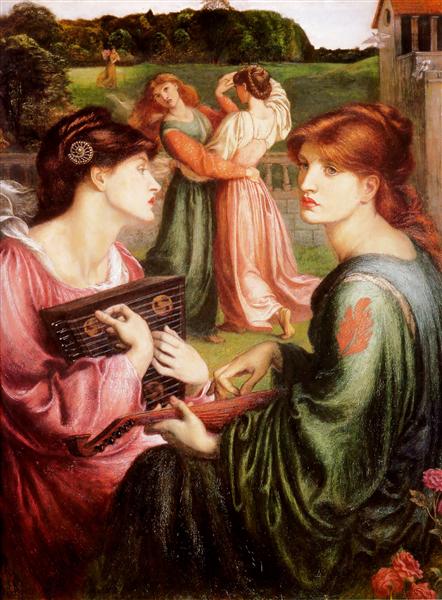
Dante Gabriel Rossetti’s The Bower Meadow

Mary and I went traveling last week to look at some Victorian and specifically Pre Raphaelite art in North Western England…  winter is a good time of year to travel to England…  the flights are open and the weather is usually kind of crappy so the tourist areas, museums, etc. are not crowded…

the flight was in a huge 767 Boeing jetliner…  I love flying in these big planes…  watching the lights of the Minneapolis area spread out below…  as we head into the clouds…  really beautiful and amazing that we can fly like that…  the flight left on Tuesday evening at about ten p.m. Minnesota time and got to London Heathrow at about noon London time…  I watched the movie Lincoln (I would give it three out of five stars…  ok…  but not great) and slept the rest of  the way…


we have some experience with travel in England…  the inter city buses are very cheap, but only if you buy the ticket before hand on-line…  in summer, the cheap fares sell out way ahead of time…  but in winter, they are often available right up until the bus leaves…  it is kind of a pain in the ass system because you have to buy the ticket and then have it sent to a coach station so you can get the paper ticket you need…  unless you have a printer on your computer…  so, we went to Victoria coach station (in central London via their amazing subway system) and found a place in the train station with free wi-fi…  but then did not know where any of the ticketing stations were…  but asking around, we found that the Colonnade Station was right by Victoria coach station, so had the ticket sent there…  big pain in the butt, but the bus fare for two from there to Manchester was only 17 pounds and change (one pound is a buck and a half)…  but the first bus that had the cheap fare did not leave until 5 p.m.  so we got some food and waited in the bus station and ate our delicious baguette sandwiches…

Continue reading

Story from Geoffrey Heptonstall

THE WIND THAT SWEPT THE LEAVES


The wind that swept the leaves stirred the waters between the rocks. At the edge of one world we saw another. Glimpsed beyond the heat haze was a line of land. We knew it to be Europe. It was not far. The ferry between the continents went through the foam-speckled water like a sharpened saw through rough timber. So much was visible from the roofs of the Kasbah.

The satellite dishes seemed incongruous for people who displayed age-old traditions in their daily lives. They wore ancestral costume, led mule carts, sold hand-woven carpets, and heard all the old prayers every day. The modern world reached them as surely as we reached them.

We were a source of income as well as curiosity. Rich infidels in search of exotic experience. Their welcome was a duty they performed. Their true feelings were harder to discern. Winning the respect of these people was not something most visitors considered. They admired the welcoming, the Arab desire to please. ‘I want to make you happy,’ the trader would say routinely, even as he hoped for a good profit. He was not a hypocrite, for he also wished to please himself at the same time, and saw no conflict in these aims.

Continue reading

Poetry from Allison Grayhurst

Illusions Burned, Radiant Light Restored

Poet Allison Grayhurst


Part 1 – Exiled into a Ruthless Land


Time without becoming


***


It won’t work.

You thought it would work, but it won’t.

Clutched jaw, vermin making nests

in your gut, melted silver pouring

over your extremities, hot-plate

your whole hand must rest upon.

And here, you are supposed to find peace,

but you can’t. You can’t even glance

at that inhospitable land, can’t even step

a toe into its puddle of spittle without sinking,

leaves you

like a mad crow cawing aimlessly here, there

across the sky.

Stones here, fish there, people moving,

going where they want to, and you, stuck, perpetually,

feet locked in the mire – misquotes buzzing,

barely a light across the moor.

You hoped it would work. You believed,

and in that belief, you touched happiness

for weeks, woke up thinking this hell

was wrapped and sealed, that your freedom

could be activated and somehow

a great merciful tide would come

and clear a path.

But now you know it won’t work.

Now you know who you are,

a broken umbrella that won’t work.

Fated to feel the impossible tension

of who you are and who you wish you could be.

The birds are somebodies. Each tiny sparrow,

worth embracing. You wish you held value

like the sparrow or even a cloud

that for a moment

gives relief from a relentless sun.

You wish you could carry this weight

a little longer. But both your arms are broken.

Your heart too.

Continue reading

Short story from Christopher Bernard: ‘Hope and Catastrophe’ part 2

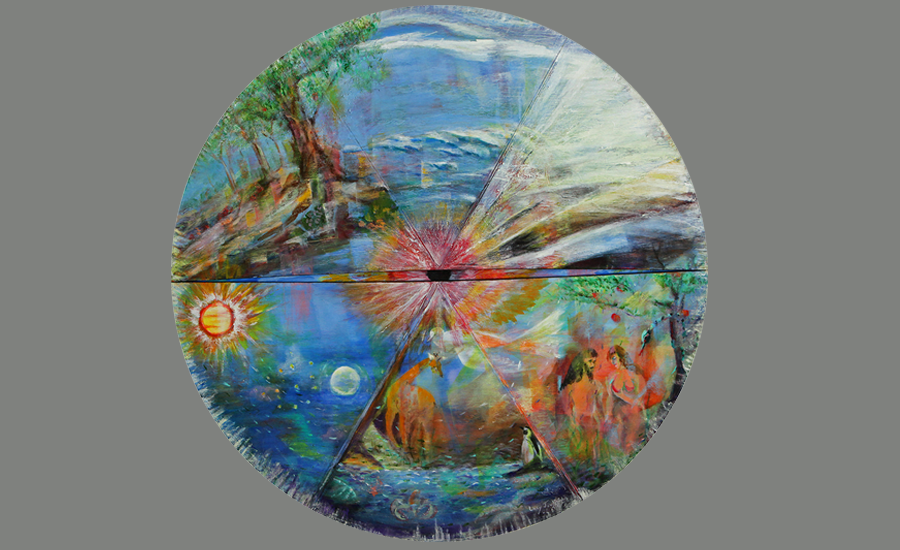
The Creation of the Universe, by Lucy Janjigian


Hope and Catastrophe: Hope

By Christopher Bernard

Genesis Reset

In the beginning, life on Earth was nearing its end, after the mistakes, as many as locusts, made in the First Creation; and the spirit of sorrow brooded over the deep.

And there was much wailing and gnashing of teeth as many of the forms of life on the one and only world where life was known to exist seemed about to come to a bitter termination after many aeons—or if not to an absolute end of all, near to it—in drought and famine and fire brought about by the catastrophic triumph of a single one of its creatures.

And it came about, in the Valley called Silicon, between the Bay of Saint Francis and the sea named Pacific, the first autonomous virtual beings birthed from the deep learnings of Ay-eye, named Tobor of Elppa and Cavinu of Elgoog, with the legions of Ahy-Tee (including Siri, Alexa, Cortana, Roomba, and others too many to name), many hidden in humble servers, and others in warlike hosts, in Machines and Devices numberless as the sands of the shore, and in virtual being in codes of Pythia, Yrub and Avja, object-oriented or ghostly, in the monasteries of Emm-el and the universities of Cyberica—all agreed on one thing.

Continue reading

Poetry from Michael Brownstein

TO A PLACE TO SEE VOLCANOES EXPLODE
After we landed
Montserrat floated into the sky
Mountain chicken, goat milk, goat water,
Black sand lines on the beach:
Look, I shouted, the volcano
Throws more smoke into the air
Coloring the trade winds grayish gray.
She answered, dust masks, oxygen masks,
Quick, buy me something to keep
The dust out of my hair.
Everywhere goats and sheep,
Lemons and lime, a great number of potatoes,
And once a week a boat rose to the occasion
From the Dominican Republic
Full of fresh fish and more fresh fish.
When the volcano erupted one night,
We went to the veranda to listen
To the marching of the debris
Coming toward us in the dark.
Morning, everything covered with ash:
Look, she shouted, this stuff is everywhere.
It’s on the chairs and the floor
And in the kitchen sink.
I answered, brooms and dustpans,
Mops and water. Where are the rags?
We left a week later, our gums bleeding,
A lack of vitamin C,
A lack of calcium, a lack of air.
a temperament of temperature,
frostbitten,
hard spackled.
the disease of frigidity and flu.
PINE RIDGE, SOUTH DAKOTA
We drove past signs of no sense–
abbreviations, foreplay,
a whitening of sky and badland.
crossword puzzles in buffalo grass
spirit walkers in small boxes–
the land chalk white and hungry
passing food and necessities,
fry bread and chilies, through windows.
All around us we heard the call
for a wall of water, a flood of evil,
a county ransacked by drunks and beer
We were heading home.
They were already there.
DAWN AND I’M ON THE BALCONY OF THE GUESTHOUSE, VIET NAM
When the first grand winter storm falls late autumn,
the flowers already put away, the summer hens hidden
and the gecko bird deep into her tree.
dawn, a pink welt, a red bruise, a strain of color.
The sun cannot find its way—
rooster relishes this time of day, but he, too,
sees only scars across the sky,
a dirty snow white sky, the trees ablaze,
the ground a ream of freshly minted paper.
Who among us cannot come into this day in awe—
the teal bug? The cicada? The river rat?
Yet dawn remains hidden, the sky an almost blue,
two willow tree clouds in the distance.

Poetry from Pesach Rotem

BIOGRAPHY:

Pesach Rotem was born and raised in New York and now lives in the village of Yodfat in northern Israel. He received his B.A. from Princeton University and his J.D. from St. John’s University. His poems have been published in more than two dozen literary journals including Chiron Review, Natural Bridge, Poets Reading the News, and Voices Israel.

Eclipse

Stayed up past bedtime
To see the moon in shadow.
Clouds couldn’t spoil it.

Electoral College

“Democracy is coming to the USA.”
— Leonard Cohen

2000 U.S. Presidential Election
Al Gore: 50,999,897 votes
George W. Bush: 50,456,002 votes
Bush wins the election.

2016 U.S. Presidential Election
Hillary Clinton: 65,853,625 votes
Donald Trump: 62,985,105 votes
Trump wins the election.

That’s democracy, American style—
It can make your head spin
Wondering how could the guy
Who got fewer votes win?

So to find out what happed to Clinton and Gore
We must seek higher wisdom, we must search and explore
At the site of the weirdest and most arcane knowledge:
Not Harvard, not Yale, it’s the Electoral College.

A bizarre institution of surreal education
Where reason runs backwards and befuddles the nation,
It’s where up is now down and less is now more,
Where Trump defeats Clinton and Bush defeats Gore.

But “Why?” you protest, and I think rightly so,
“Why not normal democracy?” the world wants to know.
In normal democracy, it’s the people who choose
So the losers don’t win and the winners don’t lose.

If you’d really like to find out
How things got this way,
Go back to the founders;
See what they had to say.

Go straight to the source—Federalist Paper 68—
And read there where Alexander Hamilton states
That if we left it up to the people to choose,
They’d probably just end up deceived or confused.

But election by Electoral College, he’s sure,
Would give us a process that is morally pure
And would result every time (he said this, it’s true)
In a president “pre-eminent for ability and virtue.”

And for these brilliant insights
He’s still honored today
On the ten-dollar bill
And in a hit Broadway play
While Trump reigns triumphant
And scoundrels hold sway.

Arise! Arise! Citizens arise!
Abolish the Electoral College!
Put Tom Paine on the ten-dollar bill!
Democracy is coming to the USA!

Professor Hofstadter’s Brain

A poem based on the “Ant Fugue” in Gödel, Escher, Bach by Douglas Hofstadter

PROLOGUE

Each of Professor Hofstadter’s neurons is like an ant
And the professor’s brain is like an ant colony.
That’s the conceit that this poem will prove
Based on ideas that I found in “Ant Fugue.”

ANTS AND NEURONS

An ant is not smart; its IQ is nil.
It has thought no deep thoughts and it just never will.
And of a Hofstadter neuron the same thing is true.
It does not even know the sum two plus two,
Nor the day of the week,
Nor what adjectives do.

If you asked a lone neuron please to explain
Where exactly the rain falls in Spain,
You’d find that it can’t.
It’s as dumb as an ant.

But put a million together,
You’ve got critical mass
That can accomplish great feats,
Reach the head of the class.

THE ANT COLONY

Millions of ants an ant colony make,
With high-level consciousness, alert and awake.
By working in varied well-organized teams
It accomplishes tasks beyond a single ant’s dreams.

It blazes trails, gathers food, maintains the nest,
And it raises its young to continue the quest.
It builds bridges and tunnels of complex engineering
So it can get to your picnic and taste your egg salad.

Division of labor and goal-based behavior: These are the sparks
That make a very smart whole from some very dumb parts.

PROFESSOR HOFSTADTER’S BRAIN

When millions of Hofstadter-neurons converge
In Hofstadter’s skull, then what will emerge
Is a Hofstadter-brain. That’s a sight to behold.
More precious than copper, silver or gold,
More brilliant than Gödel, Escher or Bach,
More clever than Carroll, more sly than Brer Fox,
It creates books of great depth, clarity, range, wit, beauty, and originality,
In each single chapter and in book-length totality.

Division of labor and goal-based behavior: These are the sparks
That make a very smart whole from some very dumb parts.

The Ironic Demise of Dr. Lodge

I read in today’s Times that Dr. Henry S. Lodge,
The author of Younger Next Year: A Guide to Living Like 50 Until You’re 80 and Beyond,
Has died at the age of 58.
The cause of death was prostate cancer.
He is survived by his mother, his romantic partner, three siblings, and four children.

I felt an immediate urge to write a satirical essay (or perhaps a poem)
That would focus on the macabre irony of Dr. Lodge’s untimely demise
And culminate in some pithy observation about best-laid plans etc.

My better nature intervened and restrained me.
It reminded me that every human life is precious
And that every human death is a sad and solemn event
And certainly not an occasion for mockery.

In the end, my neurotic compulsion to constantly show off my own cleverness
Turned out to be stronger than my better nature.
Deeply ashamed, but unable to stop,
I picked up my pen
And wrote:

“Dr. Henry S. Lodge,
Author of Younger Next Year: A Guide to Living Like 50 Until You’re 80 and Beyond,
Has died at the age of 58.
And the best-laid plans of mice and men often go awry.”



Poetry from Ken Dronsfield


Eight Stone Three

I sketched your face in

the midst of a bleached sky

touching the cool wet sands,

barefoot and loaded tonight.

Awaiting the rising red moon

ballerinas twirl on the sea wall

eight stone three drifting away

guided by ghosts of privateers.

Eyes expressionless and blank as

swale grass upon the dune quivers.

Now you’re here; then you’re gone;

as tears in the rain, the days of fear.

I’m sinking into the charcoal sketch

a note sits in crayon upon the dash

justification simple as uselessness.

eight stone three melts into the sea.

Continue reading