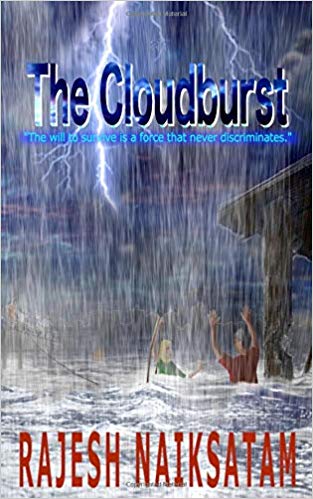
The Cloudburst by Rajesh Naiksatam is a novel that lives up to its title gradually, developing with an excellent form, style and line of thought. It reveals the past and present exploitation and persecution of India’s common people by both Indian nationals and foreigners. But nature is the best healer when all things within and outside us cleanse us, giving us a hope for starting anew. The author was born and brought up in Mumbai, India. So, his knowledge of the country runs through this story, taking place all over India and the Indian subcontinent. The characters are international, from all corners of the world.
Editor’s note: here’s a summary of Mahbub’s view of Rajesh Naiksatam’s The Cloudburst!
E.M. Forster’s A Passage to India illustrated colonial attitudes towards Indian culture in 1924: the people’s behavior and attitudes, how the rulers treated the commoners. Now, nearly one hundred years later, Rajesh Naiksatam’s The Cloudburst pulls off a similar feat with a different type of setting, a fresh style and characters, and lucid and colloquial language.
He (or she) has a sexually not-good past but will change, though, still in the habit of flirting
Chimezie Ihekuna
Do you know that when you form a habit, the habit will eventually form you evil communication corrupt good manners? Indeed, it takes sheer determination and special grace to give up this life-long addition to cigarette smoking promiscuity of unpleasant consequence. Audrey, a dashing middle-aged young man, had been smoking since the age of 15. Now married with children, he is yet to say “no” to cigarette smoking. If not for the principled nature of his wife, Lilian, probably his three sons would have taken into his lifestyle of cigarette addiction. The same analogy is applicable to sexual promiscuity.
He has a sexually not-good past but will change, though is still in the habit of flirting
At this point, if you have a spouse who is busy ‘playing around’ with other ladies, then I suggest you ask him the question, “Sexually are you worth being faithful to?’’ His sincere response will tell whether or not you should go ahead with the relationship. What makes you think he will change, considering the fact he is been busy “sharing” you with other women? Would you be surprised if I told you that he apparently sees your sexuality as no better than the ladies he had rammed, despite his seeming praises of you? Probably, he is financially or materially assisting you, does it mean you cannot prevent the imminent blindfold – his flirting habit? Given this identified recognition, what gives you the impression you are mentally and physically prevented from the clutches of insecurity and doubt, diseases, lack of focus and judgment? Automatically, if not now, in a not-too-distant future, like he had done to other women, and if not changed by then, you will be realistically be seen as a sex object and just as the disposable (medical) syringe, he will treat you like or leave you for other women. If you really want to get on with the relationship, then the need to strongly change him by painstakingly imposing on him with humility practicable truths of managing one’s sexuality by yourself or the services of a trained counselor is undoubtedly very essential.
She has a sexually not-good past but will change, though is still in the habit of flirting
The dream of most responsible men is to be in serious relationship with or marry chaste girls. Imagine a situation where your spouse is gallivanting with other men. Would you ordinarily be in a relationship with such a person? What do you expect from her- fidelity, a good home, a secured marriage or something? Judging by her promiscuous lifestyle, there is no significant difference between her and just by-the-roadside sex hawkers. Do you want to marry such a lady? Even if she is intelligent, beautiful and possess what you think are essential requirements of a lady, can’t you exercise the worth of self-control on her and teach her the essence of upholding womanhood—fidelity? If you think you can’t leave the “love of your life’, then I advise you strongly yield to this advice. On her part, it takes self—determination and a special grace to turn a new leaf from this chronic habit. This can only be met provided she can practically exercise the lesson of self-determination and special grace. It must be established the warning: ‘’this will be a herculean task to complete.’’
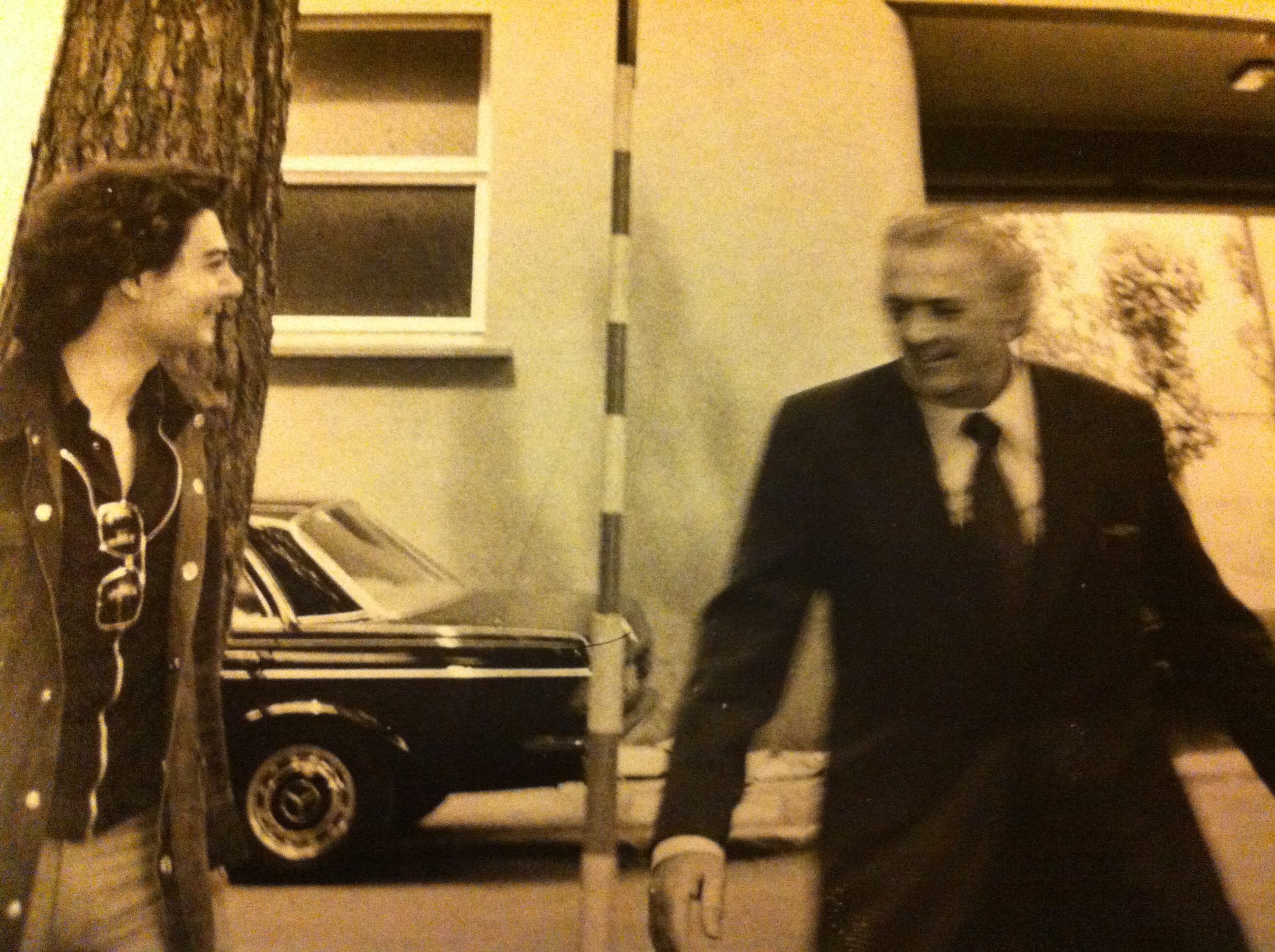
There is a parallel between this interview by Count Federico of Wardal, Fellini’s muse for Fellini 100, and the movie Interview by Federico Fellini that tells us about Rome’s Cinecitta Studios celebrating its 50th anniversary. In the movie, a Japanese television crew arrives to interview director Federico Fellini (played by himself), who is preparing to shoot an adaptation of Franz Kafka’s novel Amerika. Federico Wardal is presenting his new movie Federico and Fellini telling his story with Fellini for Fellini 100. It is like a timeless interview which reflects Fellini’s poetics.
——————————————
What would you wish for your mentor Fellini for his one hundredth birthday?
W: Every day I think about him, so every instant for me is like his birthday.
Q-He was born on Jan 20th and you on Jan 24th , correct ?
W: I am an Aquarius and when I asked him, as a joke : ‘Are you an Aquarius too?’, he said : “No, I am a Capricorn, but we are at the “border “ of the two signs “ . That told me that we have many things in common.
Q-Fellini was very involved in esotericism and you believe you have the power to tell the future. What did you say to Fellini about his future?
W: always I avoided any esoteric topics with him.
Q- Why ?
W: Adding the esoteric ingredient between Fellini and I would have changed our relationship.
He was hungry for esotericism which in our relationship would have obscured fundamental aspects of how we related to each other.
He had his private magicians and I knew them and we had two twin magicians in common too….lol!
Q-Who?
W: oh, you are so curious!
Q-Wardal, this is a public interview for a magazine…not a private conversation..
W: lol! Ok , they were the twins Laura and Lia Levi- Strauss.
Q- A very important Jewish family! What kind of relationship did you have with Fellini?
W : Creative, extremely stimulating, a soulmate relationship. .
Q- Feelings? Sensations?
W: Soul to soul.
Q-Platonic. He was deeply attached to his wife Giulietta Masina.
Space for other relationships? What kind of space did Fellini have for his relationship with you?
W: Dear, a lot of space. A soul is beyond one sort of space.
Q-When you met him for the first time, he was 55 years old and you were a teenager…
W: yes, but again : the soul has no “ space “ and no age, lol ! Anyway,
he needed young people to regenerate his creative inspirations.
Q-How did you meet him? Common friends ?
W: We had common friends, the Levi-Strauss twins, but I met Fellini just by a coincidence. An actress told me to rush to talk with him, because, she said, I could strongly inspire him.
Q-Where was your first meeting with Fellini? And when?
W : On April 1975, at Cinecittà, on the office upstairs of theatre 5. Some people quite famous were waiting to see him, but as soon as I arrived, I got to go straight up to him, since Norma Giacchero, who was Fellini’s edition assistant and Maurizio Mein, who was Fellini’s direction assistant, immediately opened for me the two doors that separated me from him.
Q-Then what happened?
W: a strong impact through our eyes , an atomic explosion ….
Q- On both sides?
W: yes. We both tried to hide it.
Q-Why?
W: because…that meeting between Fellini and I was about my role in the movie Casanova and not to talk about something else deep and out of that context.
Q- But to talk about a character who belongs to a Fellini movie with Fellini, is already “ something deep “ .
W-Yes, Fellini is an ocean and we were just on a sea…lol!
Q- then?
W- then he started to explain my role to me.
We remained, gazing eyes into eyes, for about twenty minutes.
Q- Big language! And so, what about your role ?
W: The young Casanova . Casanova as an adolescent.
Q-An important role. Which kind of criteria did Fellini use to give you such an important role? You were just an adolescent .
W: Age doesn’t matter to a genius. There was Fellini’s intuition….and afterwards, the “ atomic impact “…I will tell you later…
Q- Because it is a surprise?
W- Ok, I will tell you now.
Q-Let’s do it.
W: After Fellini met me personally, after the “atomic impact,” his curiosity about me grew moment by moment.
Q- And so ?
W: He confessed to me that I was confirming my rightness for the role he had envisioned for me, he wanted something more from me, something extraordinary, amazing …
Q- What exactly?
W: The role he had thought for me was an adolescent Casanova prone to sexual vices, dissatisfied, sad, since Fellini-Casanova saw himself being alone in his future. Fellini told me that he would write some extra lines for me and while he spoke, he started to write down those lines for me.
Q-Do you remember the lines? Sorry, I know 45 years have passed since then, maybe you forgot them.
W: No, it’s impossible to forget something like that. Every word he wrote is engraved in my life.
W : … “I know that my life …. will be an immense dream made by travels,
face powder (he is touching his face) , sex, masks and fogs …and mirrors that are lying to themselves….
impossible desires, elusive loves … and I know that one day all will vanish
as if nothing never happened.
He said that maybe I could recite this, immersed in the fog of Venice, in a night of total silence. I quickly took what Fellini had written and I started to recite it.
and when I finished, Fellini ….
Q-Yes, what happened?
W: it happened that Fellini took my hand and kissed it, while Maurizio Main, his first assistant, entered the office. Fellini told Maurizio that he had not finished with me..
Q- An unthinkable honor for you.
W: Sure. Tears invaded my eyes, but I immediately stopped them.
Q- But had you acted before meeting Fellini?
W: Yes . Although I was a teenager, I had a lot of experience acting in front of large audiences.
Q- Amazing. Surely Fellini asked you with whom you had acted.
W: No, Fellini was curious about other kinds of things. In this case, Fellini was interested in the result, not in how the result had been achieved. I told him that I was acting in a theater in Rome with an actress that he surely knew. That actress was a friend of Flora Carabella, Marcello Mastroianni’s first wife.
Q-What is the name of the actress?
W: Maria Teresa Albani, actress, director, playwright, intellectual. She had
attended the Silvio d’Amico National Drama Academy of Rome with Marcello Mastroianni.
Q- Mastroianni would have been a perfect Casanova. Why did Fellini choose Donald Sutherland?
W: Mastroianni had already played the role of Casanova in the film Casanova 70.
Fellini wanted a grotesque character, tall in stature, spectacular, with a strong face and languid eyes. Although Fellini totally modified Sutherland’s face with strong makeup, Sutherland is very tall, his face has strong features with light eyes…
Q- What about you?
W : I’m the opposite, totally natural.
Q- It means that over the years Casanova became a caricature of himself in Fellini’s mind.
W : Yes
Q-What’s the similarity between you and Casanova?
W : I am Casanova.
Q- Why?
W: Not because I have Venetian heritage through my father, not because I am aristocratic as Casanova was, not because I am a magician as Casanova was, not because I am an alchemist as Casanova was, not because for me make up is more important than history as it was for Casanova, not because I am sad over love as Casanova was – and I can continue without end…
Q- But Fellini liked to play with the truth…
W: Fellini invented a role for me, based on me.
Q-May be he invented the real Casanova whom he really wanted?
W: For another movie! Casanova-Sutherland-Fellini, this was the movie he made. A great unforgettable Fellini movie.
Q: Above and beyond this, there is the Fellini’s connection with Mastroianni.
Help me to understand it.
W: You already asked me this question and I already gave you my answer.
Although Mastroianni and Fellini had a destiny together, Mastroianni didn’t fit into Casanova by Federico Fellini.
Q- Many years later, Mastroianni refused to do the last Fellini movie The Mastorna’s Voyage. Why?
W: The energy of their artistic relationship was over.
Q: You are preparing the short movie “Federico and Fellini” for Fellini 100. Is this film the continuation of “Casanova”?
W: There is a secret about that.
Q- Welcome secrets revealed!
W: In that movie I talk with a ghost of Fellini who comes back from his death.
Q: To close the circle? Did you talk with Fellini about that idea at that time?
W : Yes, I did.
Q- He agreed about this idea?
W: Which idea ?
Q-To do Casanova’s sequel.
W: Well….In a few words….Casanova as an adolescent and Fellini as an adolescent transformed into themselves because life works in an amazing way. Maybe the wish of Fellini was to be what I was. Then life transformed me in an amazing way. So, Fellini was right.
Q- So, because of this, your movie could be the Casanova sequel ?
W: To tell the truth, Fellini’s intention was to shoot a sequel to Casanova, but after shooting The Mastorna’s Voyage.
Q: So your movie can’t be the sequel to Casanova because Fellini never shot that movie.
Welcome, readers, to August’s issue of Synchronized Chaos Magazine!
We have an announcement from Tabitha Grace Challis, the writing and media professional who designed our original website back in 2008. She and her husband are in the process of adopting a child from Eastern Europe. This past summer, they hosted a teenage boy “K” who they fell immediately in love with. The opportunities for K in his home country are very slim and most orphans have little or no chance to build a life after they’re released from the orphanage at 16. Since there are a lot of costs involved with international adoption the family is fundraising to support this new phase in all three of their lives! People are able to contribute here.
This month we open the hood and watch narratives in progress, put together by a variety of storytellers.
Available free here: https://giphy.com/gifs/personal-YPXKpdSNR26bu
No matter how far they migrate from each other, for educational or personal reasons, Goswami’s characters retain their familial tenderness and caring. This reminds us that what we see in life, the narrative we choose to create, depends as much on who we are and who we choose to be as it does on the world around us.
Some contributors demonstrate the power of our words, and our priorities, to shape our understanding and our actions.
Denis Emorine’s novel Death at Half-Mast, also reviewed by Cristina Deptula, presents a professor protagonist who exists in the uneasy middle between personal identities. He reaches a crisis point when he must make a choice that has huge consequences, not just for himself but for those around him.
While less openly political, J.J. Campbell points out the disparities that we sometimes see between cultural messages and promises and reality. Just because people say that the world will work a certain way, even when many powerful people affirm it, that does not mean that reality will follow suit.
Our lives, as most narratives, contain a mixture of joy and loss, growth and despair, beauty and tragedy.
Indunil Madhusankha’s selected poems reverberate with the energy of kittens and puppies, yet in the next breath bring the tragedies of lost love and deaths due to terrorist and military violence. The official narratives of why the loss of life was worth it, whether from the government or the terrorist organization, bring scarce comfort to the grieving families. As in J.J. Campbell’s pieces, cultural messages don’t always trickle down to people’s personal lives.