Yes, I admit it! All my previous girlfriends were right. It was, in fact, all my fault.
I reach this conclusion with the deepest reluctance, even embarrassment. It’s a horrible responsibility to have to confess to. It came as a surprise, even a shock. But one day I stumbled on it, staring me in the face. And ever since, it has never left me in peace.
I had always believed my sins were, at the worst, venial—I mean, I’ve never stolen, or robbed, or knowingly cheated anybody. I don’t do drugs, I drink in moderation, I stopped smoking ages ago.
I’ve never killed anything bigger than a mouse, and even that I mourned as, unable to save it, I watched it die miserably in a roach trap.
My lies are the innocent kind (“Doing great. How about you?” “No, it does not make you look fat”).
It’s true I have an occasional fit of uncharitableness, but as a rule I bend over backward to be fair-minded and I don’t discriminate against people based on race, sex, gender identity, mental health, financial status (well, I have problems with the super-rich, but I don’t think I’m alone in that), nationality, religion—whatever.
Many people have just celebrated Samhain, Halloween, Day of the Dead or All Souls’ Day, when we contemplate the mysteries of life and death and remember those who have gone before us.
Maria Evans writes of learning experiences common to many people throughout life: unrequited love, nostalgia on seeing a younger person’s enthusiasm, finding and questioning one’s talents and creative abilities. She also remarks through her two final poems on our capacity for both great compassion and horrifying cruelty.
Joan Beebe communicates the fun of Western celebrations of Halloween, where children visit neighbors trick-or-treating in costume for candy. Her other pieces reflect explicitly on time, encouraging readers to remember to make the most of the holidays and commenting on how much, paradoxically, young children and old people have in common.
Michael Robinson’s poetic verse expresses the cost of living, and dying, in a different sense, through his sorrow over the death and despair he sees on the streets of the American inner city. Rather than impersonal statistics concerning violence, he shows us vignettes that bring home the humanity of those within that environment. A simple gift of a lily evokes the memory of children who will not grow up, the young son of an incarcerated woman misses his mother, blood has replaced ladybugs on a preteen’s arm.
Shawn Nacona Stroud memorializes a friend who has passed away in one of his poems. Other pieces from him explore his creative process, the feelings of a Shakespearean witch, and the emotions brought up by a past intense relationship, reminiscent of being caught as a fish. He plays with language in ways more apparent to readers than in Robinson’s intentionally spare prose, inviting people to enjoy the craft of his writing along with the natural settings he describes.
Julian Raine reaches deep into consciousness to create her pieces, lush and unvarnished by formal capitalization or punctuation as they evoke the intoxicating sensuality of the sun, dandelions, orchards, memory and love. Tempest Brew brings us small, crafted pieces that assert the speaker’s personality and individuality. We see his small objects, notice what sets him apart since his teen years, hear his angst over love gone wrong, and watch him assert artistic control over his work.
J.D. DeHart also creates a set of short pieces that highlight various facets of life: our weaknesses, our motivations, our mild arguments, and our stubbornness when we’ve already made up our minds. He references an image from Greek mythology to illustrate the foolishness of adjusting the facts to fit one’s opinions.
Dami Lare’s short story about orphan children draws on cultural myths to convey the nebulous fear the children experience in a world where so much is shocking and beyond their control. When reality holds angry adults who confront them while selling food and accidents that send friends to the hospital, the existence of the scary Baba Yaga witch makes sense.
Although your introduction to Synchronized Chaos may be less dramatic than Roberts’ poem, we hope that you will also find yourself captivated by this month’s submissions.
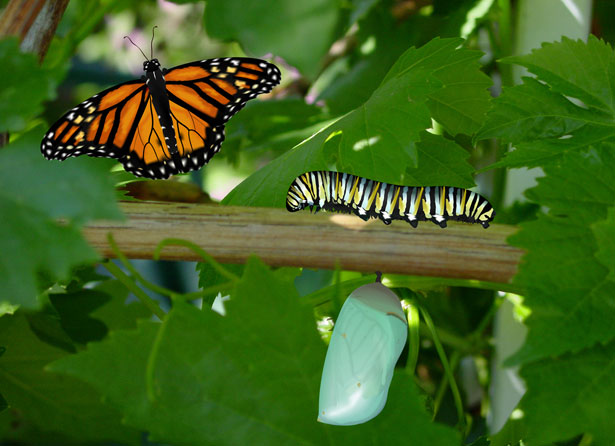
Butterfly Life Cycle, photo by Laurie Williams. http://www.publicdomainpictures.net/view-image.php?image=3549
I brought my mother a lily yesterday,
She placed it on the dining room table,
And I wept—
For those I had seen die in the streets.
The lily opened to reveal its seeds
And I wept—
For each seed, there was a black boy that would not bloom. Ocean Breeze For Lorraine
The water is calm today.
Seagulls cry out in the wind.
I celebrate my life,
And I forget the violence.
The waves run across my feet.
As I watch the sunset and I smile.
My mother holds my hand and I’m born again.
The Unheard of World. Joan Howard pictured center. Photo by Robbie Sweeny
(IN)COMPLETELY ABSURD
The Unheard of World
By Fabrice Melquiot
Translated by Michelle Haner
Exit Theater
San Francisco
A review by Christopher Bernard
Even with the best of intentions, to say nothing of energy, intelligence and talent, world premieres can be treacherous things. The premiere of an English translation of a modern French play can be more treacherous than most, given the great differences of premises and expectations between French and American audiences—including such things as their different senses of humor and attitudes toward philosophy, which can quickly become awkward in a philosophical comedy.
The latest production by one of San Francisco’s most audacious companies, foolsFURY, which in October premiered, as part of its Contemporary French Plays Project, Michelle Haner’s translation of Fabrice Melquiot’s magical realist Le Monde inouï is a textbook case. (Melquiot is a prominent contemporary French playwright; foolsFURY produced The Devil on All Sides, in artistic director Ben Yalom’s translation, to much acclaim in 2006.)