Essay from Saminjon Khakimov

Young Central Asian man with short dark hair, brown eyes, a dark suit, white collared shirt, and blue tie.

CODE-SWITCHING AMONG UZBEK ENGLISH LEARNERS: REASONS AND FUNCTIONS


Saminjon Khakimov University of Business and Science Non-Governmental Educational Institution Philology and Language Teaching (English) K.XF 23-04 Phone number: +998 333696936 +998 943623669 Email: saminjon.khakimov@gmail.com ORCID: 0009-0006-1444-7331

Annotation: This article examines the phenomenon of code-switching among Uzbek learners of English and analyzes the major reasons and communicative functions behind it. Based on classroom observations and learner interviews, the study reveals that code-switching is not simply a sign of linguistic weakness but a strategic tool used for clarification, social bonding, topic shift, and emotional expression. The research emphasizes that code-switching plays an important pedagogical role in foreign-language learning environments, especially in multilingual societies like Uzbekistan.


Keywords: code-switching, bilingualism, Uzbek learners, English learning, sociolinguistics, communication strategies, multilingual education


In multilingual communities, switching between two or more languages during communication is a common linguistic practice. This phenomenon, known as code-switching, has been widely studied in sociolinguistics. For Uzbek learners of English, code-switching frequently appears in classrooms, social media communication, and informal conversations. Although it is often perceived as a barrier to language fluency, many researchers argue that it serves important communicative, psychological, and pedagogical functions. This article explores why Uzbek English learners code-switch and what functions it performs in their communication.


Code-switching typically occurs when speakers alternate between languages depending on context, topic, or interlocutor. Scholars classify it into several types:


 Inter-sentential switching — language shift between sentences.
 Intra-sentential switching — switching within one sentence.
 Tag-switching — insertion of discourse markers such as “ha”, “you know”, “aslida”.


Previous studies (Gumperz, Myers-Scotton, Poplack) show that code-switching is often systematic and purposeful, rather than random.


The study uses:
1. Classroom observation at secondary and vocational institutions in Fergana region.
2. Semi-structured interviews with 20 English learners aged 15–20.
3. Analysis of chat-based communication (with participants’ consent).
Qualitative analysis was applied to identify repeated patterns and motivations behind switching.


1. Reasons for Code-Switching
a. Lexical Gaps
Learners often lack vocabulary for certain concepts and naturally insert Uzbek words. Example: “Teacher, I don’t know this tushunchani in English.”
b. Ease of Expression
Some ideas feel more natural in L1 due to cultural closeness.
c. Learning Strategy
Learners intentionally mix languages to confirm understanding: “Past Simple o‘tgan zamon bo‘ladi, to‘g‘rimi?”
d. Classroom Norms
Teachers themselves switch languages to save time during explanation, influencing learners’ behavior.
e. Emotional Expression
Feelings such as surprise, humor, or frustration are often expressed in Uzbek even during English conversation.


f. Social Bonding
Switching helps maintain group identity and solidarity, especially among classmates and friends.
a. Clarification Function
Students switch to Uzbek to clarify grammar, meaning, or instructions.
b. Emphasis and Focus
Certain Uzbek words are used to highlight important information.
c. Identity Marking
Using Uzbek markers like “ha”, “xo‘p”, “baribir” creates a shared linguistic identity.
d. Topic Shift
Learners switch languages when changing from academic talk to everyday conversation.


e. Pedagogical Function
Code-switching helps teachers scaffold learning and reduce confusion during complex topics.
f. Affective Function
Use of mother tongue reduces anxiety and increases speaker confidence.

The findings indicate that code-switching among Uzbek English learners is a strategic communicative practice, not a sign of poor proficiency. Learners rely on both languages to negotiate meaning, express identity, and maintain social relations. In Uzbek classrooms, where English is learned as a foreign language, total exclusion of L1 may create unnecessary psychological pressure. Instead, structured and purposeful use of the mother tongue can support language acquisition.


Code-switching among Uzbek English learners serves multiple linguistic and social functions. Rather than discouraging it completely, educators should understand its pedagogical value and guide students toward more intentional and balanced usage. Future research may explore differences in code-switching patterns across age groups or proficiency levels.


REFERENCES
1. Gumperz, J. (1982). Discourse Strategies. Cambridge University Press.
2. Myers-Scotton, C. (1993). Social Motivations for Codeswitching. Oxford University Press.
3. Poplack, S. (1980). “Sometimes I’ll Start a Sentence in Spanish Y TERMINO EN ESPAÑOL.” Linguistics, 18(7–8), 581–618.
4. Auer, P. (1998). Code-Switching in Conversation. Routledge.
5. Matras, Y. (2009). Language Contact. Cambridge University Press.
6. Iskandarova, S. (2020). “Code-Switching Practices in Uzbek EFL Classrooms.” Uzbek Journal of Education Studies, 4(2), 45–51.

Saminjon Khakimov was born in Margilan, Fergana Region, Uzbekistan. He is a student of Philology and Language Teaching (English) at Namangan University of Business and Science. He works as a Head English Teacher and IELTS Instructor at a private educational center.

Poetry from J.J. Campbell

Middle aged white man with a beard standing in a bedroom with posters on the walls
J.J. Campbell

———————————————————————

nightmare after nightmare

the holidays…

where some people

drown themselves

in nostalgia

where those of us

that grew up in

dysfunctional

families

get to relive nightmare

after nightmare

what i tend to think

about when the holidays

come around is my

father’s father

i never got to meet

him

he committed suicide

three years after my

father was born

as i have grown older

i can’t help but think

he was probably the

smartest man ever

to live

—————————————————————

sunk into the creases of existence

pride will kill

you faster than

any disease

i was told that

long before i

could understand

what it meant

fast forward to

a bad back, arthritis

head to toe, apathy

racing through the

veins and i’m pretty

sure i’m an expert

by now

the dreams of exploring

the world and becoming

a legend died in my

twenties

and before life

simply became

a battle between

bottles of lotion

and liquor

i had sunk into

the creases of

existence

laughing in the

shadows

pretending that any

of this had meaning

empty and broken

pride no longer exists

i suppose now it

is up to the disease

————————————————————————

that tempting myth

the bitter taste of defeat

the sad songs of christmas

always hit the hardest

love, that tempting myth

so many miles away

like water in a world

of concrete

and here comes the

neon of the season

joy wrapped up

in a bundle of

greed

these are the moments

where i wish i could

sleep more than four

hours a day

they tell me all these

things that will happen

when you die

i laugh

i tend to think nothing

will happen

and if it does

i won’t have much

say about it, being

dead and all

—————————————————————

chaos and bewilderment

a paper cut that won’t

stop bleeding

a sign that the end

is near

must be the most

beautiful time

of the year

hot enough on christmas

to be wearing shorts

i suppose this is the future

we have all been running

from

chaos and bewilderment

i believe that is a drink

i made by mistake in

my teenage years

i haven’t closed a bar

in a couple of decades

now

that probably held off

a disease or two

the sound of darlene love

will put me to sleep tonight

solitude on christmas never

felt right, just what i had

still time for that to change

but not as long as i would

like

—————————————————————-

where they came from

a buddy i used

to work with

said one night

that the problem

with the world is

men spend their

whole damn lives

trying to get back

in where they

came from

everyone laughed

and i took another

drag from a cigarette

i said dan, explain

this to me

i was a c-section

he laughed

and said hope you

won’t be lonely

forever

fucker…

J.J. Campbell (1976 – ?) is old enough to know better. He’s been widely published over the years, most recently at Disturb the Universe Magazine, The Beatnik Cowboy, Crossroads Magazine, The Rye Whiskey Review and Yellow Mama. You can find him most days at home in Ohio taking care of his disabled mother and betting on sports. Most people will say he’s okay at both, most days. He does still have a blog, evil delights, but rarely has the time to write on it. (https://evildelights.blogspot.com)

Poetry from Priyanka Neogi

Young Indian (South Asian) woman with light skin, lipstick, brown eyes, long earrings, a red dress and crown and sash.

Women’s Journey  

You have seen the woman 

Sushmita from Jhasi Rani, 

But why, without the power of disorientation, 

Get over the fear! Have you seen 

Nazrul’s poem! 

There are broken locks, women’s talk.

 understand yourself, 

Move forward with freedom, keep your direction. 

Let men and women 

Complement each other, flow. 

You are good, you guide the sweet path, 

You are the family matter to keep. 

You are the light of love, blessed with love, 

Ignore the storm and rain, 

All is well in your patience, 

No matter how hard it is to build your life, 

The essence of showing uprooted. 

Create yourself with value & creativity.

23.12.2025

Short biography: Amb. Dr. Priyanka Neogi from Coochbehar. She is an administrative Controller of United Nations PAF, librarian, CEO of Lio Messi International Property & Land Consultancy, international literacy worker, sports & peace promoter, dancer, singer, reciter, live telecaster, writer, editor, researcher, literary journalist, host, beauty queen, international coordinator of the Vijay Mission of Community Welfare Foundation of India.

Poet Eva Petropoulou Lianou interviews historian and influencer Ruqaya Mehran

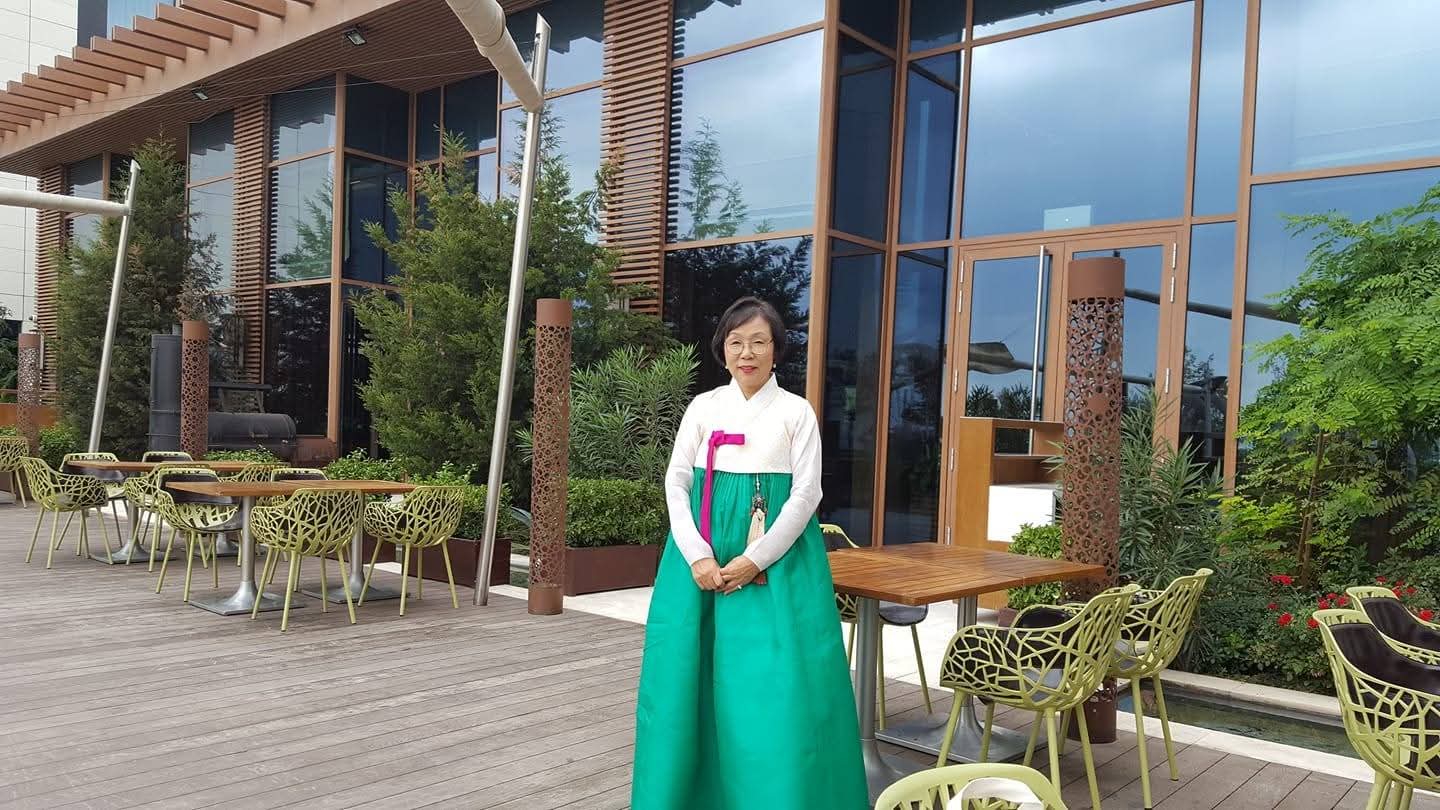
Young woman with long dark hair, brown eyes, a gold necklace, and a white gown, in front of one of Egypt's pyramids at sunset or sunrise.

Interview with Ruqaya Mehran 

Conducted by Eva Petropoulou Lianou 

Dear Ruqaya Mehran, tell us about your childhood.

Where were you born?

Egypt, and I have Turkish roots from my family and ancestors.

What were you dreaming as a child, and have you achieved your dream?

I used to dream of being a media personality, journalist, and actress, and now I’m a university student studying advertising, journalism, and acting. Also, I’m Deputy Head of Media at the Ministry of Youth and Sports.

I also worked as a reporter, attended academies, and joined public relations teams. I am a voice-over and dubbing artist and also an Ambassador of Middle Eastern Media and a Middle Eastern Program Presenter. Yes, I have achieved much, but I still dream and dream….

What is more important to you, journalism or acting?

Personally, I love both journalism and acting, but I love acting more.

What are you dreaming?

I dream of many things, including being a world-renowned, famous, and skilled actress and presenter.

How do you feel being popular and having followers who are inspired by you?

I feel proud when my followers increase; I feel like an inspiring person, and the admiration grows.

What is your goal now?

My goal is to finish my bachelor’s degree and continue my studies abroad.

What is your favourite dish?

Yes, I love Egyptian food, especially feseekh (fermented mullet) and herring. I love them so much; they are among the most famous dishes in Egypt. I also really love Greek salad.

What is your favourite book?

Yes, I read, but I don’t have any favorite books besides psychology books and language learning books.

What is your message to the new generations?

“To the generations to come: never underestimate the power of your voice. Speak with honesty, act with integrity, and remember that true influence comes from inspiring others, not from seeking attention.”

What is your wish for 2026?

My wish for 2026 is to achieve all my dreams of entering the world of acting, working more, becoming famous, and earning more than my current profession.

Travel and success in my studies are also important to me.

Ruqaya Mahran, a media and journalism student and actress, was an assistant secretary in the Training and Education Department of the Future of the Nation Party and the deputy head of media for the Ministry of Youth. Mahran is also a journalist and member of the public relations team for organizations and an ambassador of Middle East Media. She’s Egyptian with Turkish roots, a citizen of the whole world.

Poetry from JoyAnne O’Donnell

New Year’s 

This year like a fresh white page

Still warm from the press of tomorrow.

Midnight spills sparkling light on the snow

Time exhales, fast but taming.

We step forward carrying new seeds in our pockets,

Dreams as seashells,

Morning waves of calm

Singing a vibrant new song,

Sunlight rinses the dust 

For our new plans

Like a sea of healthy rhythms

For our new days

To breathe steady as waves

Learning our shore.

Hope stands tall

with a strong tree in winter 

And now a new beginning we grow.

Poetry from Eva Petropoulou Lianou

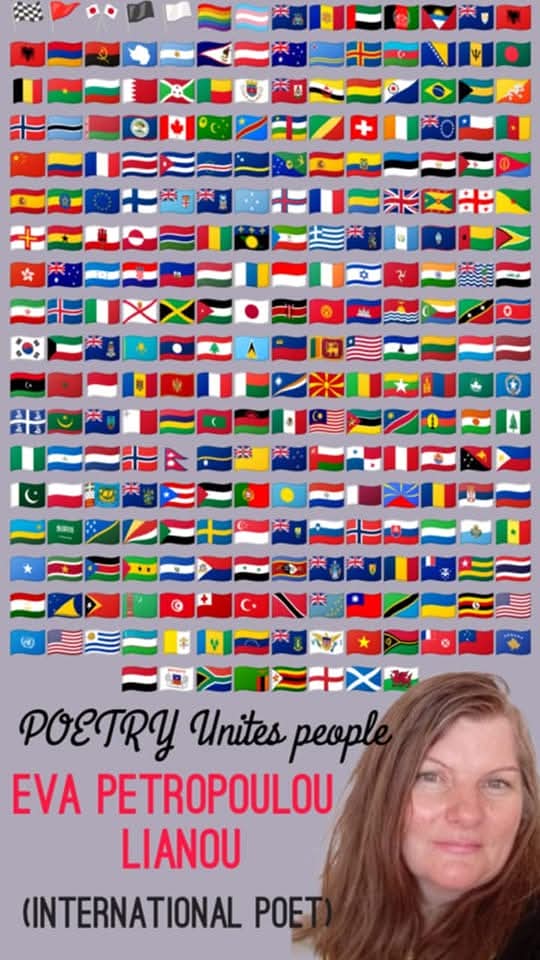
Image of a bunch of colorful flags from various nations on a gray background with the name "Eva Petropoulou Lianou" in red and the words "Poetry Unites People" in black. Image of a middle aged light skinned woman's face with light brown hair, brown eyes, and a sweater.

Freedom

A word 

Who has all the meaning of…

This is happiness 

This is harmony 

This is respect 

But what we do

Humans are killing humans 

Humans are manipulating humans

Freedom,

A game between two birds without wings

Freedom,

A hope inside two hungry stomachs …

Freedom,

Elefteria

A sun waiting to rise…..

In our days 

In our century 

We are in need of second educational system 

Re write new words 

Or learn the meaning of the old one 

EVA Petropoulou Lianou