Mirta Liliana Ramírez has been a poet and writer since she was 12 years old. She has been a Cultural Manager for more than 35 years. Creator and Director of the Groups of Writers and Artists: Together for the Letters, Artescritores, MultiArt, JPL world youth, Together for the letters Uzbekistan 1 and 2. She firmly defends that culture is the key to unite all the countries of the world. She works only with his own, free and integrating projects at a world cultural level. She has created the Cultural Movement with Rastrillaje Cultural and Forming the New Cultural Belts at the local level and also from Argentina to the world.
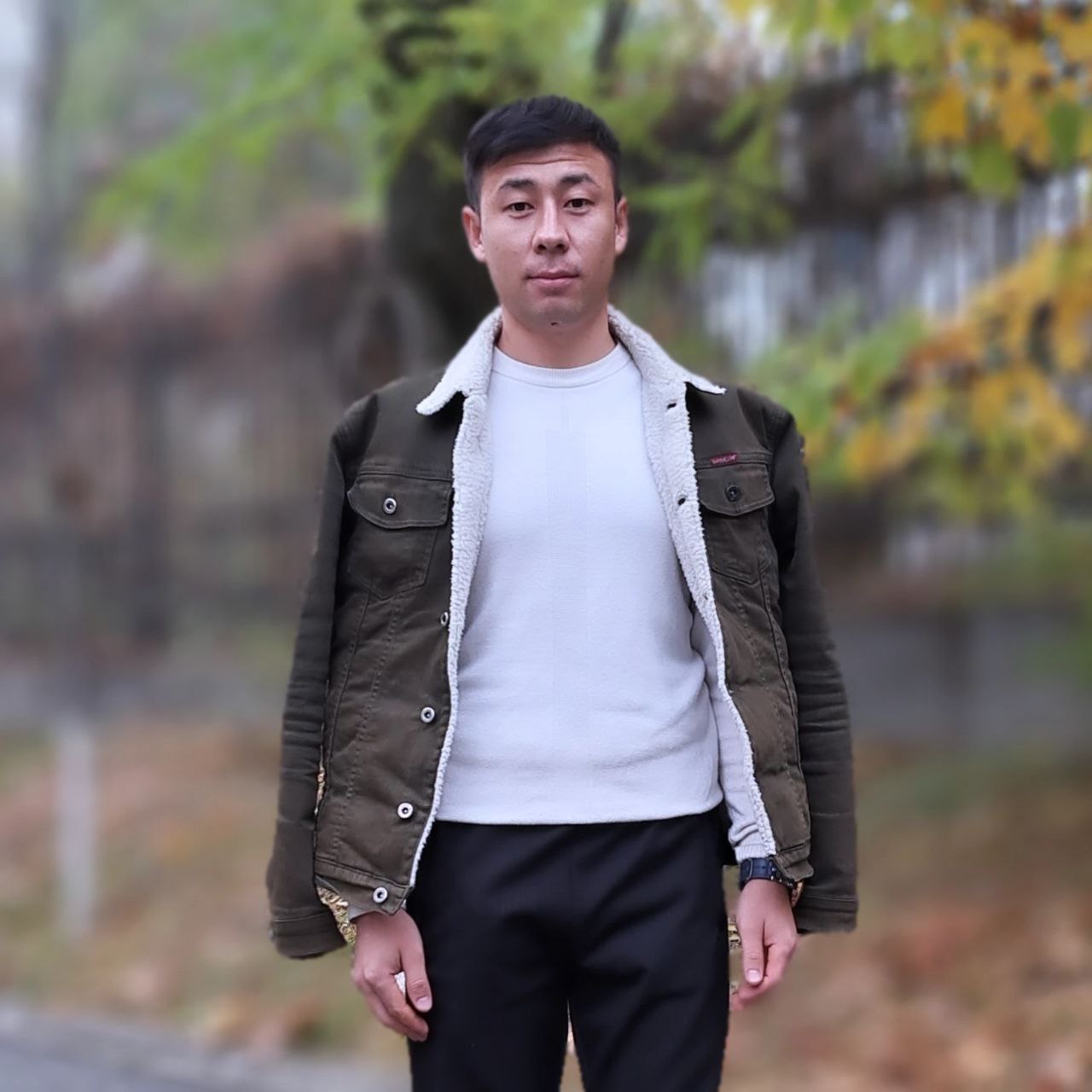
Dilbek Ergashev is a 3rd year student of the direction of organization and management of the activities of cultural and art institutions at the State Institute of Art and Culture of Uzbekistan.
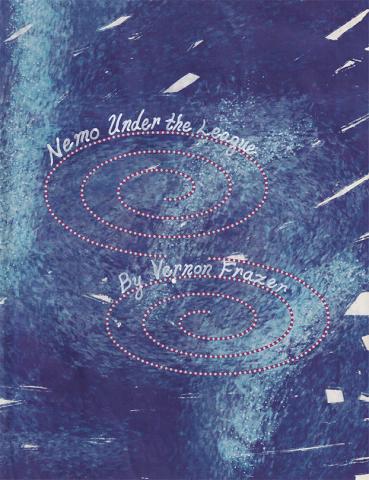
Vernon Frazer’s concrete poetry collection “Nemo Under the League” recalls Jules Verne’s underwater sea exploration journey in its title. Like Captain Nemo, Frazer’s poems probe lesser-explored and lesser-mapped areas: aesthetics and the subconscious. Black, white, and grey text, text boxes, lines and shapes appear on the page with the focus more on the aesthetic effect of each composition than on the literal meaning of the words.
The phrases and their arrangement on the page may seem random at first glance. However, there’s usually a directionality to pieces, such as “Blocking the Inevitable” which guides viewers’ eyes to the right, and “Reflection Locked in Reflection,” which follows a diagonal or elliptical path to suggest light bouncing off a mirror.
Sometimes the images evoke clip art, as in “Desire After the Elms,” or comic books, traffic lights, or even soup cans, as in “Career Moves.” Or even art deco motifs, as in “Birthing an Ungiven Given.” The text will occasionally relate to the title or presumed theme of the poem (such as “hordes of insufficient data” in “Finding a Reaction” and “overblown deduction guides tax the patience excessively” in “In Charge of What Follows”) but tangentially, creating the effect of a composition inspired by the idea rather than the linear development of a thought.
At times, while reading, I speculated on what colors and shades Frazer would choose had he decided to incorporate colors. Sometimes my mind suggested possible shades of deep blue, or vivid orange, or light green. The monochromatic feel works, though, to focus attention on the words themselves as the artwork rather than splashy colorful shapes.
In some pieces, “Flayed Nerve Endings Frayed” and “Reeling Toward the Reel” text itself forms into oval egg shapes or curlicues. Elsewhere, words appear in mirror images of themselves, vertically, diagonally, penetrated by arrows. Words become not just representatives of images or ideas, but as images and design implements themselves, while remaining readable.
The very last poem in Frazer’s collection, “The Transverse Clatter Balcony,” ends with text cascading down to the end of the lower right of the page. It reads “the last word … cast overboard … definition matter … soaked … in the lumbago sea with Carthage.” Words and meaning are not impermeable or permanent here, but forms of matter subject to the weathering of time, nature and history.
I recently came across Dr. Leonard Shlain’s The Alphabet Versus the Goddess: The Conflict Between Word and Image, in which the cultural anthropologist argues that the development of abstract, linear, alphabet-focused language rewired human brains and changed ancient societies. These changes brought about modern technologies but also fostered war, competition and hierarchy, religious extremism, legalism, and the subjugation of women and the natural world. As an author himself, Dr. Shlain advocates, not for the eradication of books and alphabets, but for greater balance between holistic, image-focused understanding and reductionist, linear ways of making meaning.
Vernon Frazer’s Nemo Under the League represents an effort at re-calibrating that societal balance by integrating words and images inextricably. It’s worth a read, or a perusal!
How do you match up the words you use to their backgrounds? Is there a pattern, or do you choose what feels right each time?
It seems different each time, but I probably work with several patterns that I’ve acquired from doing the work.
Even in these pieces, which involve composition, improvisation always plays a role at some point, directing me to choose what, basically, feels right at the time I’m writing it. During improvisational thinking, more elaborate plans do emerge: I can see a full page design or pattern of several pages at times.
What makes a word interesting to you? Sound, shape, length?
Sound is probably the foremost. Sometimes I feel like a jazz musician whose instrument is language. Generally, when I have difficulty finding the right phrase, I choose the one that sounds the most musical to my ears. It almost always turns out to be the best choice. Sometimes working with the shape of a letter or word leads to a phrase, a verse or a visual pattern.
Would you ever work in color? What inspired you to choose a black, white, and gray color scheme?
My equipment and the economics. My old color printer used an ink cartridge for every page I printed and the cost of printing a color book would make the sale price too high. Over the years, technology changed many things, as we all know. Ten or fifteen years ago, I talked about trying to do this work in color but my life didn’t make it a priority. When I joined the C22 Poetry Collective a few years ago, their aggressive experimentation led me to try it. So, I wrote a color book called SIGHTING I did that’s online, but not yet officially published. It’s officially coming out May 7.
When words occur to you, how do you decide whether to put them into a concrete poem or free verse?
More my mood in the moment, I’d say. When I feel I’m starting to stagnate, I’m more likely to do a concrete poem or a multimedia video to relieve my dissatisfaction. Those are the most demanding, after all. Sometimes I write textual poems because I don’t want to meet a more demanding challenge. Nothing is entirely easy, but some days I want to work in a different way, say, strictly with text and either a projective or left-margin pattern. Each method plays a role in my life.
Do you have any other writers or artists who have inspired or influenced you? Anyone whose work you find especially interesting?
I have many influences and hope I’ve made something of my own from all that I’ve learned. Jack Kerouac started me as a writer at 15. William Burroughs and Joseph Heller’s Catch-22 shaped my prose style. Until age 36, I aspired to be a novelist. But Charles Olson was an early influence at 15 and a major influence on my poetry until about 1988, when my style changed considerably. Peter Ganick introduced me to language and visual poetry. I absorbed many writers he published. My writing began to reflect the experimental work bassist Bertram Turetzky exposed me to in the mid-60s, when I studied bass with him. Peter’s publications revived those interests. Then, Steve McCaffery and bp Nichol influenced my work around 2002. I’ve read and absorbed many others; I was a literary omnivore.
Muhsin kizi, student of Polytechnic No. 1 Phone number 94 326 58 50
Annotation
When every Uzbek girl says these words, she feels a sense of pride in herself, as if there is a divine feeling in these words. Of course, after all, this is what she says, I am an Uzbek girl. Do you know what makes Uzbek girls Uzbek?. An Uzbek girl is distinguished from representatives of other nations, first of all, by her honor and pride, because with these we proudly say that we are Uzbeks. Throughout history, Uzbek women have stood out from women of other nations with this feature and still do. When we hear these women, the brave Tümaris and Tümaris followers, we sincerely envy them. The woman who paved the way for literature, science, and thinkers, Nodirabegim Uvaysi Zulfiyakhanim, is following in their footsteps and is raising the Uzbek flag all over the world and proclaiming that she is an Uzbek girl.
Key words: Uzbek girl, nation, family, upbringing, demands of the times, science, culture, nationality,
Introduction Uzbek girls receive their first and foremost upbringing from their own family. Of course, mothers, grandmothers, grandfathers, and fathers are responsible for this. Generally speaking, seven neighborhoods are responsible for an Uzbek girl. Every girl is told from a young age that in the future she will be the head of a family, the mother of a child, the companion of a man, the daughter-in-law of a family. As she grows older, she is taught household chores, greetings, and from these ranks. In many cases, there is a discrepancy between traditional views and the requirements of modern life. However, by adapting this discrepancy, the image of Uzbek girls is enriched more and more.
Main part Today’s Uzbek girl is choosing a specialist in science, a scientist, a researcher, a politician, an athlete and a number of universal professions and is improving her knowledge and skills in these areas theoretically and practically. Uzbek girls are not only preserving their national values, but also declaring themselves in any professions around the world, of course, raising the flag of Uzbekistan to the sky and saying that we are Uzbek women and girls, seeing these results, Uzbek women and girls are giving themselves the strength, energy and motivation to achieve their goals and dreams, and seeing these results, one is delighted.
Conclusion The Uzbek woman is not only the trust of the family, but also the trust of the entire society, the pride of the nation and the mirror of culture.
References
Norboyeva G. – Sociology of the Family – Tashkent Uzbekistan 2020.
Kadirova M. Women and Society Gender Equality Issues – Tashkent Social Thought 2019
Kurbonov D. Ancient Customs and Traditions of the People of Uzbekistan – Tashkent Akademnashr 2014
Poetry submissions to North of Oxford’s Streur Anthology are now open!
North of Oxford would like to pay tribute to the late Russell Streur, poet and publisher of The Camel Saloon and The Plum Tree Tavern with an online anthology dedicated to Nature. Send us your poems of Nature, of floral and fauna, of forests and trees, of rivers, creeks and streams. Of farms, of urban nature, of parks and sanctuaries, of oceans and bays, of islands, of all things, Nature.
Send one to three poems for consideration of publication to North of Oxford at sahmsguarnieriandreutter@gmail.comSubject line of submission: Streur Anthology. Submissions will be accepted until 5/31/25. Only submissions attached as word doc will be reviewed. Please include a 100-word bio within the word doc.
Jacques Fleury’s book You Are Enough: The Journey Towards Understanding Your Authentic Self
Eva Petropoulou Lianou shares a short film inspired by NASA’s inclusion of her poetry in a capsule launched to the moon.
Synopsis On 26th February 2025 NASA launched a capsule with poems to the moon, one of them was the anti-war poem “Happy Birthday”. Written by Eva Lianou Petropoulou, Directed & Animated by Zina Papadopoulou, Music & Sound by Grigoris Grigoropoulos
Lunar codex, Athena, Minerva Excelsior, The Vagabond Anthology, edited by Mark Lipman, dedicated to the Palestinian poet Ahmed Miqdad
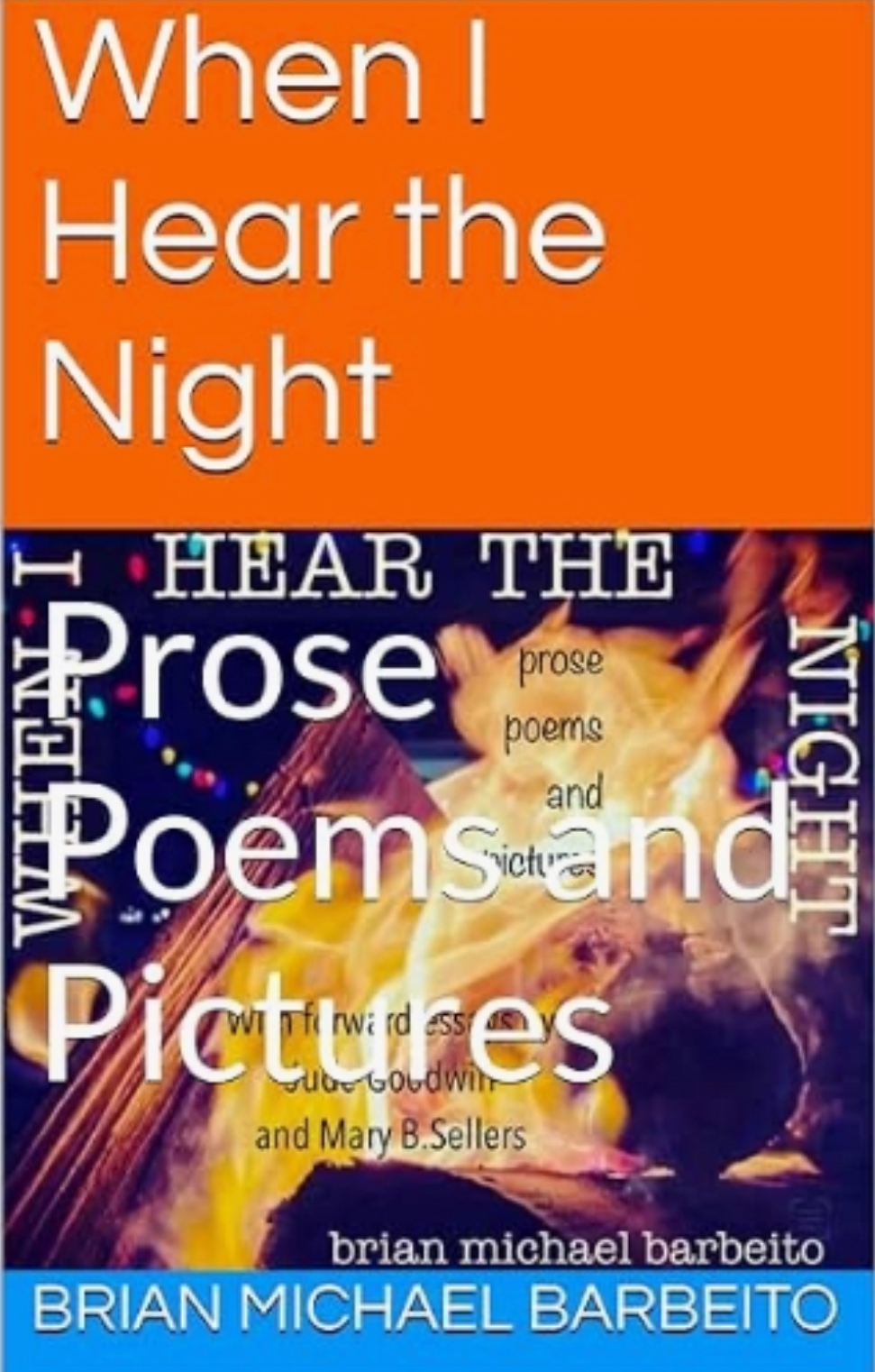
Also, our contributor Brian Barbeito’s new book has just come out, When I Hear the Night. This is a prose poem and landscape photography book. Included with the words and pictures are two literary and dynamic introductory essays, one by poet and editor Jude Goodwin, and another by the writer and editor Mary Buchanan Sellers, figures current and thus well-informed in the field. There are also author notes and question-and-answer sections. The writings can be said to have interesting elements of memoir, essay, belle-lettres, poetry, and short story forms. Their content often includes the mystic and inner vision of the author coupled with the outside world of nature walking and travel.
Now, for May 2025’s first issue: Paradoxical Understandings. In this issue, we explore various perspectives and vantage points, how multiple things can be true at once in our complex universe.
On a more personal level, Peter Cherches writes of understandings and misunderstandings, how much we can come to know or forget about those closest to us. Aziza Xazanova urges human understanding through avoiding assumptions and listening with empathy. Daniel De Culla relates a story where a person in trouble simply seeks a listening ear, not rescue.
One way people can understand each other better is by learning each other’s languages. Several contributors discuss pedagogical methods for language teaching.
Other contributors reinterpret language in concrete and abstract ways. Jerome Berglund renders different poetic forms into concrete images. Noah Berlatsky contributes a humorous poem about procrastination that uses repetition as a literary device. Christina Chin and Uchechukwu Onyedikam craft joint tan-renga poems, finishing each other’s pieces with images of music, nature, rest, and memories. Rus Khomutoff’s concrete poetry takes us on a journey of surrealism, music, and romance.
Like Khomutoff, other writers travel deep into their own psyches. Brian Barbeito reflects on his thought process and creative journeys, considering how he both opens his mind to emptiness and enlightenment and, like a skilled hockey player, remembers the basics of his craft. On another note, Nigar Nurulla Khalilova evokes writers’ block and an intense, foul mood as harsh as the Arab Simoom wind.
Mesfakus Salahin ponders the fragility of human identity and self-concept. Mark Young’s poetry explores creative processes, relationships, and the search for meaning. Texas Fontanella’s music digs deep for a dose of duende. Tagrid Bou Merhi draws on train travel as a metaphor for introspection and longing for one’s past or future. Stephen Jarrell Williams crafts a series of verses describing a person’s inner struggle and renewal. Ari Nystrom-Rice explores identity, wondering who he truly is underneath the surface. Mexribon Shodiyeva’s poetry celebrates the fragile butterfly and the beauty of being yourself. Shamsiya Khudoynazarova Turumovna relates having had the courage to free herself from an unhealthy situation and walk her own path.
Paul Cordeiro speaks to the aftermath of significant relationships and events and to how our feelings can reshape our memories. On a less serious level, Mark Blickley develops a farcical story of unemployment fraud inspired by a photo of a man with a sheep skull, where a character invests deeply into reinventing himself.
On a more cosmic level, Jack Mellender’s work looks at space, time, and humanity’s place in the universe. Ummnusalma Nasir Mukhtar relates a fanciful and expansive dream where she traveled to the moon and stars and gathered her strength. Jacques Fleury’s photography encourages us to view life from different vantage points, exploring concepts as varied as travel, physical attraction, thought, and justice.
Duane Vorhees reflects on ancient archetypes and how we tell stories about ourselves. Sayani Mukherjee reflects on the constant turbulence of human and natural history. Dr. Jernail S. Anand probes some basic paradoxes of modern human life.
Rezauddin Stalin reflects on the beauty and the price of freedom as Blue Chynoweth reflects on the blessing and curse of being able to contemplate one’s place in the universe rather than living by instinct.
Mahbub Alam wonders whether love or self-destruction will win the day. As a person of faith grappling with these issues, Chimezie Ihekuna addresses life’s seemingly intractable struggles, suffering, and human evil, and also God’s implacable goodness in a paradoxical couplet of poems. Lilian Dipasupil’s paired poems take a similar approach, warning of child kidnapping while honoring the love and sacrifice of Jesus.
As writers, one of the ways we can respond to evil is to bear witness and document it as a warning. This is one of the roles of journalism. Davronova Asilabonu affirms the value of journalism and speculates on the field’s future.
More traditionally literary writing can bear witness as well. Yucheng Tao provides a sobering reminder of the historical massacres of the indigenous people of the American West by European settlers and of many Cambodians later in history by the Khmer Rouge. Z.I. Mahmud explores how Arthur Conan Doyle’s The Hound of the Baskervilles brought realism into detective fiction, illustrating the monstrosity of human greed and vengeance. Rahmat Muhammad laments how people where she lives in northern Nigeria no longer honor elders and ancestors as much as they should.
Shuhratbekova Gulzoda describes the historical contributions of the humanist Jadid leaders of Uzbekistan to art, literature, science, and culture. Dilobar Maxmarejabova expresses her pride in her Uzbek heritage and her hometown of Qashqadaryo. Hashimjonova Durdana affirms her pride in her Uzbek heritage and culture. Nozima Gofurova outlines the many achievements of today’s Uzbek youth.
Bhagirath Choudhary points to the role of literature in terms of helping people and societies evolve to become more humane. Dr. Jernail S. Anand illuminates the power of art and literature to touch people’s hearts and souls and inspire wiser and more compassionate behavior.
Alexander Klujev highlights connections between Russian music and Russian philosophy and how both honor the triumph of life over death.
Various contributions celebrate different aspects of life. Shahnoza Ochildiyeva enjoys a picnic with her classmates on a sunny spring day. Su Yun evokes the struggle and beauty of flowers growing in an urban environment. Isabel Gomez de Diego photographs childhood exuberance in a neighborhood where humans coexist with nature, trees and bike paths near city apartments. Eva Petropoulou Lianou crafts a story around the evocatively named “Hero’s Path,” a hiking trail near a European monastery. She finds simple joy in nature and travel. Manik Chakraborty takes poetic inspiration from misty mountains as Taro Hokkyo honors his muse and the land on which he writes.
Marjona Jorayeva Baxtiyorovna expresses her respect for women and the feminine, which she links to nurturing and compassion. Gulsanam Qurbonova celebrates the tender nurturing of a mother’s love. Vo Thi Nhu Mai reflects on the warmth and tenderness of her childhood in Vietnam and how that inspired her creativity. Kylian Cubilla Gomez’ photography captures vintage childhood images: Snoopy, old Easter themed toys, a colorful frog, even possibly Dad’s aftershave. David Sapp enters the mind of a three-year-old, excited about cereal and dogs. Marjona Jo’rayeva relates her enthusiasm for a fresh term at school.
Kristy Raines expresses the simple yet profound joy of two souls finding true love and choosing each other. Eid Saleh writes in English and Arabic of the meeting of souls in a similar way, and refers both to romance and to close friendship. Qaraboyeva Zilola expresses the tender urgency, trepidation, and obsession of young love. Marley Manalo-Ladicho ignites a fiery love feast in his poetry.
However, as Taylor Dibbert points out in his brief poem, romances, and other sources of happiness, aren’t guaranteed to last.
Tuliyeva Sarvinoz’ elegant poetry laments lost love as Mirta Liliana Ramirez honors the memory of a beloved, asserting that she’s not yet ready to move forward. Eva Petropoulou Lianou touches on the tenderness of human hearts and how many of us carry emotional trauma. J.J. Campbell’s poems describe a soul’s slow descent into misery and cynicism. Luis Cuauhtemoc Berriozabal speaks to social and psychological entrapment, stuck with folks tired of his old stories. Linda S. Gunther’s short story “Bake Me a Banyan Tree” explores what we owe our loved ones and how far we would go for them.
Eric Barr’s poetry reflects the realities of navigating life after a stroke. Manik Chakraborty laments destruction caused by a fire as Mykyta Ryzhykh reimagines the Three Little Pigs into a futuristic dystopia in light of environmental destruction. Don Bormon evokes extreme desert heat and the specter of climate change.
Alex S. Johnson takes us on a mythical journey to transmute sorrow in a poem translated into Greek by Cassandra Alogoskoufi.
Sometimes what one needs to overcome suffering isn’t as complex as alchemy, but can just be time at home curled up with one’s cat. Nicholas Gunther’s poem describes a weary soul’s desire to return home after a long journey. Bill Tope’s short story explores how a senior cat helped bring an older woman out of depression after society made both feel useless.
We hope that Synchronized Chaos can inspire creativity, bear witness to the joys and pains of the world, and transform sorrow and stagnation. Please enjoy this issue!