
Essay from Bakhromova Gulsanam

THE GOALS, OBJECTIVES, AND PRINCIPLES OF INCLUSIVE EDUCATION

Bakhromova Gulsanam, a second-year student in the Surdopedagogy program, Faculty of Pedagogy and Psychology, Kokand State University.

ABSTRACT

This article discusses the goals, objectives, and principles of inclusive education, as well as its significance in the modern context. It also examines why students should be included in inclusive education and highlights the priority of its current goals and objectives.

 Keywords: Inclusive, social, psychological, child, behavior, physical, mental, education, needs, pedagogical.

Based on the humanistic principles of any state policy, the conditions created in society for persons with disabilities and socially vulnerable groups, as well as comprehensive support in all areas necessary for their free and prosperous living, reflect great attention to people with disabilities. The fact that one of the five principles of Uzbekistan’s development is defined as a strong social policy is a clear indication that the country is moving toward improving the lives of persons with various types of disabilities and those in need of social support through the targeted implementation of comprehensive approaches. According to statistical data, there are about 240 million children with disabilities worldwide. Like all children, they need quality education to develop their skills and fully realize their potential. Nevertheless, children with disabilities are often overlooked in policy-making, which limits their access to education and participation in social, economic, and political life. Worldwide, these children are more likely not to attend school. They face discrimination, stigma, and persistent barriers to education arising from the failure of decision-makers to systematically include disability in school services.

Inclusive education develops the general education process and implements an education system suitable for all children. It creates favorable conditions for children with disabilities by organizing additional support and facilities that facilitate their access to education. Educating children with disabilities in a separate special education system makes it difficult for them to adapt to society after graduating from school. In addition, they are forced to live away from their families, which may contribute to the formation of various negative behavioral traits. These children may become dependent and develop difficulties in self-care.”

To implement inclusive education, the integral criteria of the developed system for staff consist of personal and procedural components. The personal component includes the following socio-psychological indicators: social activity, readiness for self-regulation of behavior, self-awareness, and self-esteem related to physical and mental health. During the learning process, students demonstrate changes in certain personal qualities, which makes it possible to assess the level of achieved socialization and identify emerging needs for creating and promoting additional conditions for social integration. The procedural (socio-pedagogical) component does not directly reflect changes in the personal characteristics of children with special educational needs; rather, it helps to understand the mechanisms of influence of technologies and methods applied in the socialization process.

This component includes the accessibility of inclusive education for children with special educational needs, the inclusive competence of participants in the educational process, and the readiness of the community to provide volunteer-based services. Ensuring access to inclusive education plays an important role in implementing socialization mechanisms for young people with special needs, as it helps remove key barriers to obtaining quality education and to full and independent participation in society. When evaluating the effectiveness of socio-pedagogical work, first of all, we identify the achievements made in working with applicants (providing information about study conditions, professional guidance, adaptation to the student environment, and preparation for university admission by teachers). The next indicator requiring detailed analysis is the adaptation of the educational base to students’ individual needs (architectural accessibility, adaptation of classrooms and workplaces, provision of learning materials and modern information technologies, and modifications in accordance with curricula).

The main goal of inclusive education is to involve all children who have access to education, including children with special educational needs, in the general education process. Inclusive education is of great importance as it provides access to education for children with special needs. It means the inclusion of such children in the continuous general education system. In many cases, parents of children with special educational needs have incorrect perceptions about their children’s educational rights and other opportunities; as a result, they do not demand proper education for these children.

The objectives of inclusive education are:

1.To create a unified adapted social environment that ensures equal treatment of all children and excludes any form of discrimination against students with different developmental abilities;

2.To develop a tolerant attitude among the public and all participants of the educational process toward the issues of students with special educational needs;

3.To develop the intellectual and social potential of both typically developing children and children with special educational needs within the educational process;

4.To provide opportunities for all students to master preschool, general secondary, vocational, and higher education programs in accordance with state educational standards;

5.To create conditions for the comprehensive development of students, activation of their emotional-volitional sphere and cognitive activity, as well as the formation of social skills and competencies;

6.To provide advisory support to families raising children with special educational needs, to increase parents’ awareness of educational and upbringing methods, pedagogical technologies, teaching methods and tools, and to offer psychological and pedagogical support to them.

In the process of inclusive education, students with special educational needs are taught together with typically developing children in the same school and classroom. Children with disabilities require special support from the very first days they enter school. Such support is considered necessary throughout their entire lives. Therefore, it is essential to create favorable conditions for the social development of these students starting from the early stages of schooling.

The educational process organized for students with disabilities requires identifying forms of inclusive education and integrating them into the general education system. Such integration must correspond to their specific educational needs.

Principles: The main principles of inclusive education. The implementation of an education system always requires adherence to certain rules and principles. The implementation of inclusive education is based on the following principles:

  1. Recognition of inclusive education.
  2. Accessibility of inclusive education for all learners.
  3. The principle of interaction and cooperation (communication).
  4. The principle of decentralization.
  5. The principle of a comprehensive approach in inclusive education.
  6. The principle of flexibility in inclusive education.
  7. The principle of professionalism.”

The role and significance of inclusive education in the development of society require the implementation of the following tasks: creating the necessary psychological, pedagogical, and corrective conditions for the education of children and adolescents with special needs in educational institutions; ensuring their mental development and social adaptation through the implementation of general education programs and corrective work oriented toward their abilities; guaranteeing equal rights to education for all students; meeting the needs of both children with and without disabilities with the active participation of society and families, and ensuring early social adaptation; realizing the right of children and adolescents with special needs to live with their families without separation; and forming a friendly, compassionate, and supportive attitude in society toward children and adolescents with special needs.

In the full implementation of the above tasks, special attention should first be paid to the following: a child with special needs is still a child like all others and has the right to be recognized and respected; therefore, referring to them by their impairment is considered inappropriate. Regardless of their condition or abilities, every child always needs the support of adults. Isolating or labeling them is not consistent with the principles of humanism. Previously, terms such as “abnormal children,” “disabled children,” “blind children,” “deaf children,” “mentally disabled children,” and “children with locomotor disabilities” were used. However, such terms violate the rights of children with special needs and have a negative impact on parents as well.

Although children with special needs may not perform tasks as quickly or perfectly as typically developing children, they are still able to complete tasks according to their abilities. Protecting the rights of the child and treating them positively is an important educational approach. Therefore, any form of discrimination or disrespect must be avoided.”

Inclusive education is an important approach that ensures equal access to education for all children, including those with special educational needs. It promotes the creation of supportive psychological, pedagogical, and social conditions that enable children to develop their potential and successfully integrate into society. The main principles and tasks of inclusive education focus on equality, accessibility, cooperation, flexibility, and respect for individual differences.

This system not only improves the quality of education but also strengthens social inclusion, tolerance, and humanistic values within society. It helps eliminate discrimination and negative labeling, ensuring that every child is recognized, respected, and supported according to their abilities. Therefore, inclusive education plays a key role in the development of a fair and compassionate society where all children have the opportunity to learn, grow, and participate fully in social life.

List of References

1.Sadikovna, Rakhimova Khurshidakhon. “Theoretical Foundations For Teaching Future Surdopedagogs To The Development Of Speech Of Children With Cochlear Implants.” Onomázein 62 (2023): December (2023): 2408-2416.

Amirsaidova SH.M. “Maxsus pedagogika fani taraqqiyotida sharq mutafakkiri g‘oyalarining o‘rni va roli” . Ped. fan. nom… diss. – T., 2006.

2.  IIektra Spandagou, Cathy Little, David Evans, Michelle L. Inklusive Education in Schools and Early. Childhood Settings.springer Springer Singapore. 2020.

3. Инклюзивное образование в Испании. Пашкова.М, Скуднова. Т.Д.2018.

4. Екатерина Михальч. Инклюзивное образование. 2021.

5. Наталья Микляева, Татьяна Чудесникова, Анна Виленская, Ольга Кудравец, Светлана Семенака. Инклюзивное образование детей с ограниченными возможностями здоровья. Москва Юрайт. 2021.

Essay from Shahnoza Amanboyeva

Digitizing Laboratory Education: The Synergy of 3D Modeling and Artificial Intelligence

Introduction

In the modern educational landscape, updating the teaching methodology is no longer just about providing hardware; it is about the complete digital transformation of the learning experience. Traditional laboratory settings often face significant hurdles, including a shortage of advanced equipment, high maintenance costs, and safety constraints that prevent complex experimentation. These limitations frequently hinder students from gaining the necessary practical depth in their fields.

The Power of 3D Modeling: Creating Digital Twins

The integration of 3D modeling offers a transformative solution by creating “Digital Twins” of physical laboratory environments. Unlike static diagrams, 3D simulations allow students to interact with machinery and chemical processes in a risk-free, virtual space. This is particularly vital for engineering and science students, as it enables them to perform high-risk experiments—such as high-voltage electrical testing or volatile chemical reactions—without the danger of physical harm or equipment damage. The ability to repeat these simulations infinitely ensures that the student masters the procedure before ever stepping into a physical lab.

AI Integration: Personalized Learning Trajectories

Artificial Intelligence (AI) acts as the “brain” of these digital laboratories. By incorporating AI algorithms, the virtual environment can monitor a student’s progress in real-time. It analyzes the logic behind their actions, the errors they commit, and the time spent on specific tasks.

Adaptive Feedback: If a student struggles with a particular step, the AI provides contextual hints or suggests supplementary theoretical material.

Customization: The system can adjust the difficulty level of the experiments based on the learner’s individual performance, making education truly personalized.

Challenges and Future Outlook

Despite the obvious advantages, the transition to fully digital labs is not without obstacles. Developing high-fidelity 3D environments requires significant computational power and advanced programming expertise (utilizing tools like Python, Unity, or Unreal Engine). Furthermore, digital simulations cannot yet fully replicate the tactile sensory experience of a physical laboratory. Therefore, a hybrid model—combining virtual preparation with physical execution—currently stands as the most effective pedagogical approach.

Conclusion

3D modeling and AI are not just tools; they are the architects of a new era in laboratory education. These technologies offer a scalable, safe, and cost-effective way to enhance the quality of higher education. To fully realize this potential, universities must invest in both technical infrastructure and the digital literacy of their faculty. The future of engineering education lies in this seamless blend of the virtual and the physical worlds.


Shahnoza Amanboyeva is a dedicated first-year Computer Engineering student at Urgench State University. She is passionate about the intersection of technology and education, specifically focusing on virtual simulations and AI-driven learning systems.

Essay from Isakova Mukhlisa Khusanboevna

ADAPTATION OF STUDENTS’ BODIES TO PHYSICAL LOADS AND METHODS OF SELF-CONTROL

Philology of Teaching English Language, Groups 25–26

Isakova Mukhlisa Khusanboevna

Supervisor: Senior Lecturer Khayitboev Nabijon Sheraliyevich

1st-year student at KUAF University

ANNOTATION

This article examines the impact of regular physical activity on students’ stress levels and academic performance. The importance of physical recreation as a means of preventing emotional burnout during examination periods is substantiated. An analysis of self-control methods and their role in maintaining the body’s homeostasis under intensive mental нагрузки is also presented.

Keywords: physical culture, students, adaptation, psycho-emotional state, hypodynamia, self-control, healthy lifestyle.

The relevance of this topic is обусловлена a sharp decrease in the level of physical activity among modern youth in the context of the digitalization of the educational process. Students spend more than 8–10 hours a day using computers and smartphones, which leads to the development of “muscle starvation” (hypodynamia). This not only weakens the muscular system but also negatively affects the cognitive functions of the brain.

The aim of this work is to study the mechanisms of the influence of physical exercises on the nervous system and to develop recommendations for optimizing work and rest schedules. The research objectives include analyzing the phases of fatigue and identifying the most effective forms of recreation.

MAIN PART

1. Physiological Mechanisms of Stress Reduction

Physical activity activates the endocrine system. During moderate aerobic exercise, cortisol (the stress hormone) production decreases, while the synthesis of endorphins and dopamine increases. This creates a “biological release” effect necessary after prolonged static tension.

2. Prevention of Hypodynamia at University

To maintain performance, it is necessary to introduce micro-breaks (physical exercise minutes) every 90 minutes of mental work. The author identifies three levels of adaptation of the organism to physical нагрузкам:

Immediate adaptation: changes in heart rate (HR) and deeper breathing during exercise.

Long-term adaptation: structural changes in the cardiovascular system and an increase in lung vital capacity.

3. Methods of Objective Self-Control

In order for physical activity to be beneficial, students must possess self-diagnosis skills. The most important indicators include the Quetelet index (BMI) and the Stange test (breath-holding on inhalation), which helps assess the condition of the respiratory system.

It is recommended to keep a “Self-Control Diary”, where the following are recorded:

Pulse rate at rest and after exercise

Subjective well-being (sleep, appetite, willingness to train)

Dynamics of anthropometric indicators

CONCLUSION

In conclusion, physical culture can be considered the only natural antagonist to nervous overstrain. Regular exercise (at least 150 minutes per week) not only strengthens health but also improves working memory capacity and concentration. The formation of a movement culture is not an optional task but a foundation for the successful professional activity of a future specialist.

REFERENCES

Lubysheva L. I. Sociology of Physical Culture and Sport: Textbook for University Students. — Moscow: Akademiya, 2021. — 272 p.

Matveev L. P. Theory and Methodology of Physical Culture. — Moscow: Fizkultura i Sport, 2019. — 544 p.

Kholodov Zh. K., Kuznetsov V. S. Theory and Methodology of Physical Education and Sport. — Moscow: Publishing Center “Akademiya”, 2022. — 480 p.

Vilensky M. Ya. Physical Culture and Healthy Lifestyle of a Student: Study Guide. — Moscow: KnoRus, 2020. — 240 p.

Essay from Charos Mansurova

The Role and Impact of Loanwords in Modern Korean Speech: A Socio-Linguistic Analysis

Tashkent State University of Oriental Studies

Faculty of Philology and Language Teaching (Korean Language)

1st-year student: Mansurova Charos

Abstract: This study examines the integration of loanwords (oerye-eo) into the modern Korean lexicon and their functional role in contemporary communication. Through a quantitative analysis of 500 media texts and social media samples, the research explores how foreign linguistic elements, particularly “Konglish,” adapt to Korean phonetic and morphological structures. The findings indicate that loanwords constitute over 30% of modern terminology in key sectors, reflecting broader trends of globalization and cultural shift within South Korean society.

Keywords: Korean linguistics, Loanwords, Konglish, Sociolinguistics, Language Globalization, Oerye-eo.

Introduction

Language is a dynamic organism that constantly evolves through cross-cultural interaction. In the 21st century, the acceleration of globalization has intensified linguistic exchange, with the Korean language serving as a prominent example of rapid lexical transformation. While historically influenced by Sino-Korean characters (Hanja), contemporary Korean is experiencing a significant influx of Western terminology.

The purpose of this research is to analyze the prevalence of loanwords in South Korean daily discourse, media and technology. This study argues that these elements have transitioned from mere technical necessities to essential components of modern stylistic expression and social identity.

Literature review

The study of loanwords in the Korean language has been a focal point for many linguists over the past few decades.

Traditional Perspectives: Early researchers like Sohn (1999) categorized Korean vocabulary into three distinct layers: native Korean words, Sino-Korean words and loanwords (oerye-eo). Historically, Hanja occupied the prestigious position that English occupies today.

The “Konglish” Phenomenon: Kent (1999) and Lawrence (1912) explored the concept of “Konglish”-words derived from English but adapted with unique Korean meanings or structures (e.g., handphone for mobile phone). They argue that Konglish is not a “broken” language but a creative adaptation.

Sociolinguistic Impact: Park (2009) emphasizes in South Korea is closely linked to status symbols, where Western terms often convey modernity and global connectivity.

Research methodology 

To determine the role of loanwords in modern Korean discourse, a multi-methodological approach was employed:

1. Descriptive Analysis: Theoretical literature and lexicographic sources were examined to establish the conceptual framework.

2. Quantitative Method: A corpus of 500 text samples was collected from prominent  South Korean media  media portals ( Naver News, Daum) and social media platforms ( Instagram, You tube).

3. Comparative Analysis: Traditional Sino-Korean borrowings were compared with modern Western influences regarding their frequency of use.

Research results

The following data represents the empirical findings from the corpus analysis:

Distribution of Loanwords across Sectors 

            Sector  Loanword Proportion             (%)    Primary Source          Language                     
Information Technology            72%          English
Fashion and Beauty            65%      English, French
Youth Slang & SocialMedia            50%          English 
General News & Media            30%      English,Japanese

1. Source Distribution: A significant majority (85%) of these borrowings originate from English, while 15% are derived from Japanese, German, and French.

2. Morphological Integration: Data shows that 90% of English-derived verbs integrate via the Korean auxiliary verb –hada ( e.g., 드라이브하다 – drive-hada). 95% of nouns are transliterated directly into Hangul without phonetic reduction.

Discussion

The results confirm that the Korean language is undergoing an intensive process of “Anglicization”. The fact that loanwords exceed 30% in general media suggests they are no longer merely auxiliary tools.

The high concentration in IT (72%) is attributed to the lack of traditional  equivalents for rapidly evolving global technologies. Furthermore, the 50% usage in youth slang confirms Park’s (2009) theory of status symbols; younger generations perceive “Konglish” as a marker of being globally connected. Unlike Sohn (1999), who observed a lower percentage of loanwords, our findings suggest that the pace of lexical borrowing has doubled in the last 25 years due to digital acceleration.

Conclusion 

 In conclusion, this study demonstrates that loanwords (oerye-eo) have evolved from auxiliary technical terms into essential components of modern Korean identity and stylistic expression. The quantitative analysis confirms that foreign-derived vocabulary now constitutes over 30% of contemporary media discourse, with a dominant 85% originating from English. These findings answer the primary research question by highlighting that “Konglish” acts as a marker of modernity and global connectivity, particularly among the younger generation. Practically, this linguistic shift necessitates a revision of current educational materials to reflect the reality of active Korean speech.Future research should focus on the sociolinguistic gap between generations caused by this rapid lexical transformation.

References

1. ​Kent, D. B. (1999). Speaking in Tongues: The Role of English in South Korean Society. Korea Journal, 39(4), 187-209.

​2. Lawrence, C. B. (2012). The Korean-English Linguistic Landscape. World Englishes, 31(1), 70-92.

3. ​National Institute of Korean Language. (2022). Report on the Use of Foreign Loanwords in Mass Media. Seoul, South Korea.

4. ​Park, J. S. (2009). The Local Construction of a Global Language: Ideologies of English in South Korea. Berlin: Mouton de Gruyter.

​5. Sohn, H. M. (1999). The Korean Language. Cambridge: Cambridge University Press.

6. ​Kiaer, J. (2018). The Routledge Course in Korean Translation. London: Routledge. (Chapter 4: Loanwords in Korean: Their History and Development).

Poet Lan Xin honors United Nations Chinese Language Day (4/20)

Tribute to the 17th United Nations Chinese Language Day

Portrait of Confucius

On the 17th United Nations Chinese Language Day we celebrate the timeless charm of Chinese characters a carrier of thousands of years of Eastern wisdom poetry and cultural heritage

Five years ago during the 12th UN Chinese Language Day one of the three core thematic lectures selected by the United Nations “The Mysterious Dongba Hieroglyphs” was solemnly held at our Dongba Culture Academy My respected master the 17th-generation Grand Dongba Priest Aheng Dongta appeared on the front page of the official United Nations website As a wise man of the Naxi people and the soul inheritor of Dongba culture he brought the world’s only living pictographic script to the global stage letting the wisdom of Dongba culture and the brilliance of Eastern civilization shine on the international stage

Dongba hieroglyphs are the living fossil of Naxi civilization a cultural code spanning millennia and a spiritual bridge connecting the past and present and linking civilizations As the sole female inheritor and international communicator of the Dongba culture of the UNESCO Memory of the World I will always stay true to my mission as a cultural messenger delving into the translation and research of Dongba ancient books to let this precious human cultural heritage revitalize in the new era Taking language as a bond I will promote dialogue and mutual learning among different civilizations injecting oriental energy into world peace and cultural prosperity

Christopher Bernard reviews the Joffrey Ballet’s Midsummer Night’s Dream

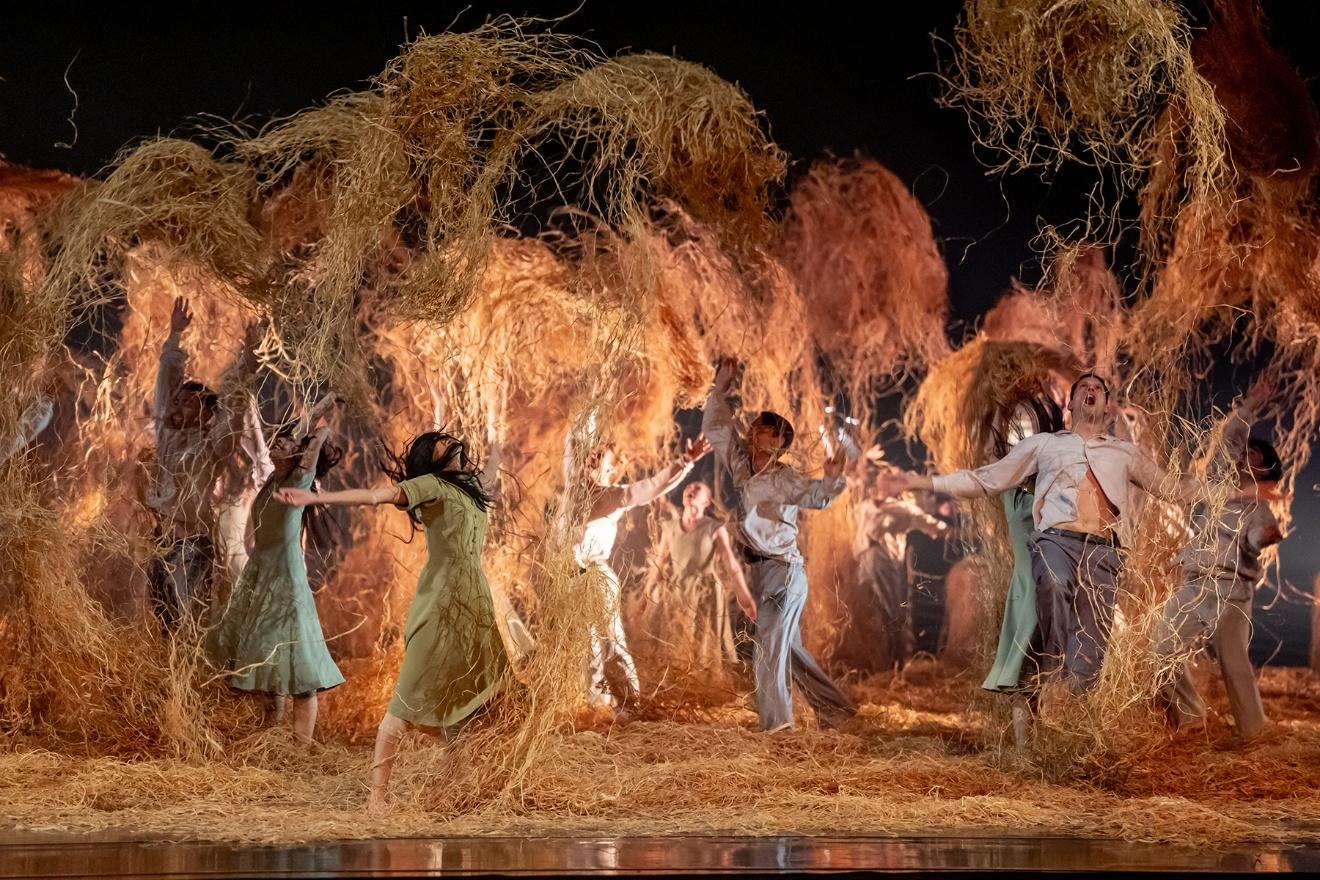
“Scene from “Midsummer Night’s Dream” by The Joffrey Ballet. (Photo: Cheryl Mann)”

Midsummer Night’s Dream

The Joffrey Ballet

Zellerbach Theater

Berkeley, California

Midsummer Madness

“We had this beautiful summer house in the Swedish countryside. My favorite thing was to run in the field in front of the house and pick seven different flowers to put them under my pillow. Tradition says that if you put these flowers under your pillow before you go to bed, you will dream of your future love.”—Anna von Hausswolff 

When you go to see a performance titled “Midsummer Night’s Dream,” even when warned ahead of time it will be set in the pale summer night of Sweden, you can be forgiven for expecting a dependably Shakespearian outing, though this time with maybe a Scandinavian Oberon and Titania and a regiment of local gnomes, a confusion of misguided romantics bounding through an Arctic midnight forest, and maybe a donkey-headed Svenska Bottom and his rude mechanicals defying the stagy and the stage-struck and a teasing trickster of a northern Puck declaring while displaying to all the world: “What fools these mortals be!”

And you might even be forgiven if, in the opening moments of the performance, you feel slightly disappointed that, no, this is not quite what you are about to be graced with this chilly spring evening. 

But then, if you have always loved a surprise, especially when it is packaged as a bonbon and then explodes into a party, your expectations are turned on their head and go leaping in cartwheels across the stage, as if the whole theater had been turned into a circus expressly for your entertainment, and you find yourself with little alternative but to let yourself be blissfully carried away for the rest of the enchanted evening. There are a lot worse disappointments! And it’s easy enough to imagine Puck roaring with laughter up his gossamer sleeve.

Such, anyway, was this viewer’s experience when Cal Performances brought The Joffrey Ballet to the Zellerbach Theater on the UC Berkeley campus over a weekend this April. I’m still sorting out all the chaos of revelries that made it one of the most memorable evenings of a season that has had, frankly, a lot of competition. 

The dance was divided into two parts, the first running a little under, the second a little over an hour, but who’s counting? The proof of any wonder is how fast it seems to fill any pocket of time with riches, and yet how brief it all seems in the end.

The first half opens, with deceptive minimalism, with a buffed up young man (a fine Dylan Gutierrez, who served as our point of contact for the evening; it’s his dream, after all, that we’re sharing) as he tries, unsuccessfully, to go to sleep in the glaring Scandinavian midsummer night. His bed stands in front of the stage curtain on which random sayings are projected, immediately dissolving: “Pick some strawberries!” “Meet me in the meadow,” “Sven is drunk,” “I prefer Christmas,” “Do you still love me?” . . . 

A graceful young woman (the excellent Victoria Jaiani, who will be our main point of romance for the evening) bearing a sheaf of hay, dances down the aisle and up to the stage, waking the young man and then whisking him away through a crack in the curtain, which opens up to a wild, choppy confusion of dozens of dancers thrashing and dashing and flailing across a stage blanketed with golden hay like a vast field at the height of harvest season. From here on, we are far from the forest of Arden, but never far from magic.

The first act unfolds as a kind of bacchantic fertility rite, a revelry of farm workers dancing and playing, not only in, but with the hay, at the foot of a tall, mask-like pagan symbol, integrating a cross, an arrow, and two eye-like wreaths, erected above them. 

The dancing workers whisk about, flail and harvest and roll the hay up into tub-like bundles which as used as little stages for couples dancing for love and delight, and they finally cast it all back into a long, luxurious play on the eternal idea of a sweetly innocent roll in the hay, quite literally.  

A long table is then rolled out, and the hay is swept gaily off the stage, and the host of workers gather and celebrate the harvest in a traditional banquet. A solitary singer (the magical Anna von Hausswolff, who will appear at especially mysterious and lyrical moments) comes out and sings of the peace and joy of the long festival of summer in these cold and northern climes. 

Then the revelry resumes, leading up to a long, strange, mysterious moment, when all the dancers, arranged in an almost intimidating phalanx stretching from end to end of the stage, approach the edge and, wreathed in enigmatic smiles, stare at the audience as if waiting for us to . . . do what? 

There was nervous laughter, nervous applause, a little bout of rhythmic clapping, tense silence, and childlike wonder at what it all meant, as the dancers gazed silent as the midsummer sun on the puzzled mortals beneath them, then, just as mysteriously, dissolved back into seemingly random reveling. 

The first act ended with one of the evening’s most magical moments, as the dancers moved up and down the long banquet table, bearing candelabras, until they stepped down to and across the darkened stage, off the stage, into the audience and up the aisles, with candelabras still aloft, until they froze, staring at the audience with mad charm. 

The first half had many such marvels of enchantment. But it provided nothing to prepare us for what we would see in the second:  a fever earthquake, tidal wave of inventions without end, technique without boundaries, a pagan unleashing in a teeming, ecstatic nightmare – for what would a dance about a dream be without the challenge of a nightmare? And everybody rose to meet it, conquered, and conquered again and again for the rest of a dream no one wanted, honestly, to wake from. 

Because when was a nightmare ever more turbulent, tumultuous, tumacious, titillating, terrifying fun? Not only did the choreography raise its game to undreamed of heights, and the dancers follow, ever braver and more victorious than the last, but so did the set, the lighting, the props; nor forget the brilliance of music and musicians, never left behind, indeed often leading, including, later, in a soft passage after the seemingly endless rolling frieze of thrills of the opening, the already mentioned singer, who capped many a manic moment with a soft, still climax. 

Did I forget the humor? Unforgivable! Because this was a production that, in its deeply romantic and pagan heart, knows how to laugh, out of pure high spirits and unshackled joy. I will mention only the giant Max Ernst fishes landing at unexpected moments or parading enormously across the boards, and the gleeful gigglers prancing in the odd corner at the odd moment, and the tutu-refined would-be swanners undermined in their earnest pliés by the gleeful gigglers and snarky bystanders, and the dueling immaculately haberdashed duo of headless gentlemen (Edson Barbarosa and Aaron Reneteria) bouncing around the stage with arms flailing and trading slaps at each other’s invisible heads, and the half-naked chef (danced with elegant insouciance by Fernando Duarte) parading around en pointe and buff-butted for much of the act in a chef’s hat and apron – and nothing else, my friend. He was, no doubt, a stand-in for the chef of this spectacular banquet of a production, the choreographer (and set designer) Alexander Ekman, as fine a magician of dance and stage as, I believe after this evening, we now have among us.

The music, a heady combination of contemporary and classical, pop, experimental and traditional Swedish folk music, and played live by a sextet of strings, piano and percussion, was by Michael Karlsson. The ingenious lighting design was originally created by Linus Fellbrom and re-created, not least the ribbons of lights hanging above the audience in the image of a circus tent, for the Zellerbach performance by Chris Maravich. 

I think the fairies of Arden would have mightily approved.

_____

Christopher Bernard is an award-winning poet, novelist, playwright, and essayist. His most recent book is the poetry collection The Beauty of Matter: A Pagan’s Verses for a Mystic Idler.

Synchronized Chaos’ Second April Issue: A Chorus at the Threshold

Image c/o Anonymous User

First, some announcements. Tao Yucheng invites the winners of the poetry contest he hosted earlier this year to contact him at taoyucheng921129@proton.me. He’ll send out the prize money this month. He also announces that no one person won the Honorable Mention (there was a tie among multiple pieces) so he will automatically enter those pieces in the next competition, which will be at a yet-to-be-determined date this summer.

Also, contributor Mykyta Ryzhykh has a new book out, Tombboy, from Lost Telegram Press.


“In his book, as in books of poems written in poetic forms and free verse, language moves through a pattern, and the basic organizing unit is the line. In tombboy, the line may be a syllable, a sign, an image, or even a dot… Readers may rightfully assume that many, even all the poems in tombboy are anti-war poems… yet it would be inaccurate to infer these concrete poems are doctrinaire, or purely political. Nor are they autobiographical. But they are personal, intuitive, original, and memorable, each with something to show…”
Peter Mladinic, author of House SittingKnives on the Table and many other books

tombboy is filled with an experimental spirit, combining fearless phrasing with satirical madness. The result is a fascinating examination of the human condition… it seems there are no limits to his masterful creativity. Each page of this book will grab your attention. tombboy deserves a prominent spot on your bookshelf.”
Roberta Beach Jacobson, editor of Five Fleas Itchy Poetry and smols poetry journal

Tombboy is available here.

******************************************

Welcome to Synchronized Chaos’ mid-April issue: A Chorus at the Threshold. This issue presents a chorus of voices singing, speaking, sometimes whispering, at different types of thresholds. People of different ages and backgrounds come together in this issue, each sharing thoughts, observations, and feelings at points of shifting and transformation.

Some of these thresholds are deeply interior. Adalat Gafarov Izzet oglu’s poetry is contemplative and reverent, with a focus on spirituality and the search for meaning. John Edward Culp speaks to self-discovery, love, and finding one’s own rhythm in life. Duane Vorhees’ poetry forms a cohesive meditation on struggle, distance, and the human effort to bridge impossible gaps—whether spiritual, emotional, or existential. Mesfakus Salahin’s piece highlights self-exploration in times of solitude, as Maja Milojkovic laments the increasing unwanted loneliness caused by the setup of much of modern life. Mahbub Alam probes the highs and lows and capacities of human nature, highlighting the need for empathy and compassion. Prasanna Kumar Dalai’s poetry is romantic and melancholic, expressing deep emotions and longing. Poet and physician Anwer Ghani suggests that despite our attempts to conceal our emotions, they can still be sensed and felt.

J.J. Campbell’s writing touches on his inner shadows: feelings of isolation, the desire for a simple, authentic life, and the pain of his loneliness and inner demons. Ana May likewise writes from the doorway between suffering and transformation, insisting that pain must be faced if it is ever to yield meaning. Fhen M.’s eerie poem recollects the legend of G. Bragolin’s Crying Boy painting surviving house fires, meditating on trauma and memory. Thi Lan Anh Tran depicts the complex, multilayered social and psychological effects of both romantic love and war. Amina Kasim Muhammad’s poem illuminates how people rebuild after the loss of a loved one, growing around rather than overcoming grief. In David Sapp’s vignettes and Eva Lianou Petropoulou’s scenes of personal and public tragedy, ordinary life itself becomes a threshold where loss is transfigured through memory and grief into reverence.

Other voices gather at the threshold between childhood and adulthood. Yeon Myeong-ji and Hamdamova Dilzodaxon Halimjon qizi craft scenes of family love, care, and loss. Their work, and Jacques Fleury’s return to his father and their childhood treehouse, all stand in that tender doorway between then and now. Sarvinoz Bakhtiyorova depicts the impact of remembering one’s past and how that can shape one’s identity. Here, affection survives distance and the past remains startlingly alive.

Nature, too, shifts throughout this issue, with pieces about seasons and the liminal spaces between dreams and reality. In Stephen Jarrell Williams’s idyllic vision, the act of learning to fly becomes an awakening into another mode of being. Elaine Murray’s visionary reflections on natural landscapes, Charos Ismoilova’s gratitude for the sunrise, Ananya Guha’s pensive thoughts on seasonal time, Graciela Noemi Villaverde’s vision of a world where humans protect and care for the natural world, Joseph Ogbonna’s song to a nightingale, and Brian Barbeito’s dream journey scenes of birds, constellations, and moonlight all invite us to the threshold between the visible and the unseen. Sayani Mukherjee’s luminous piece on the sacred mystery of existence completes this movement, reminding us that existence itself is a continual process of change.

History and heritage form another vital threshold in these pages—the place where inheritance meets the present moment. Dr. Jihane El Feghali’s tribute to Lebanon, radiant with resilience and memory, stands beside Ilya Ganpantsura’s portrait of Pushkin, writing in a nation poised between autocracy and intellectual freedom. Abdulaxilova Sevara’s meditation on Yusuf and Zulayha reveals divine and human love, earthly devotion blended with spiritual transcendence. Eva Lianou Petropoulou shares the tale of miraculous holy fire burning the day before Easter in Jerusalem’s Church of the Holy Sepulchre. Lan Xin acknowledges the shared humanity and commonalities within the heritage of the world’s people, finding harmony within global religious teachings, and Bhagirath Chowdhary echoes that sentiment in his poem. Mohizoda Xurshiq qizi Roziqova discusses Uzbekistan’s legacy of teacher-apprentice training in the trades as Shokhida Nazirova highlights the Uzbek government’s investment in youth education, athletics, and personal development. The works rooted in Uzbek heritage further remind us that culture survives through crossings: hand to hand, teacher to student, voice to voice.

Image c/o Marina Shemesh

The chorus also rises at the threshold leading to justice.

Sim Wooki confronts racism and colonial power, while Patricia Doyne and Manik Chakraborty write from the brink where historical violence and oppression not only cast a shadow upon the present, but continues to this day. Alan Catlin and Stephen House stand at the moral threshold of witness, asking what it means to remain human before scenes of suffering, ecological damage, and collective harm. These are works that refuse the comfort of distance. They ask us not merely to observe, but to consider the ethics of paying attention.

Elsewhere, the collection turns toward personal thresholds of growth and development. Axmatova Maxliyo Ag’zam qizi discusses challenges in ESL education. Satimboyeva Risolat Ilhomboy qizi compares AI technology to the human brain as Adkham Mukhiddinov outlines how integral calculus can function in economic analysis. Khamidova Shahzoda Kholbozor qizi’s poem extols the promise of Uzbekistan’s next generation as Tursunoy Akramjon qizi Umirzaqova highlights the potential power of computer technology to improve traffic flow and safety. Ibroximova Hayitbon Mirzoxidjon qizi explores another potential role for AI in education, developing individual study plans. Yoqubova Barnoxon Baxtiyorjon qizi suggests ways to harness digital technologies in preschool education. Yunusova Robiyakhon Khayotbek qizi discusses challenges and opportunities for new technologies in the financial services sector. Charos Yusupboyeva outlines the promise of online education for remote areas. Doniyorbek G’ulomjonov and Tillayeva Muslimaxon Yashnarjon qizi examine the evolving role of technology in education, Saitkulova Fotima reflects on how living standards and education have greatly improved over the years in Uzbekistan, Axmatova Maxliyo Ag’zam qizi suggests ways to improve language students’ writing competence, O’rinova Diyora outlines methods for improving language learners’ speech, Kurbanova Mohinur Abdumuxtor qizi discusses challenges in translating idioms between English and Uzbek, while Rakhmonova Gulzoda Sodiq qizi stands at the threshold of a career in medicine, drawn forward by compassion, intellect, and personal resolve.

Image c/o Anonymous User

Jernail S. Anand looks at compassion, care and the consequences of individual actions. Mykyta Ryzhykh highlights the dissonance between our ideals of gentleness and innocence and abusive human behavior that falls short of these ideals. Asalbonu Otamurodova’s reflections on boundaries offer another kind of threshold: the necessary line where care for others must meet care for the self.

Art itself becomes another form of threshold, creating space for various ideas and sensibilities to meet and overlap. Noah Berlatsky considers how even a weathered, broken artwork can convey meaning, how the breakage can become part of the work. Doug Hawley and Bill Tope’s joint short story humorously compares an ordinary couple with historically famous idealized sculptures of people, finding in favor of the average, imperfect, but real, married couple. To’lquinay Ubukulova points out creative people’s current dependence on technology of various sorts. Jerrice J. Baptiste’s poems and paintings of women highlight their individuality, strength of character, and connection to the natural world. Juraeva Aziza Rakhmatovna interviews Croatian writer and poet Ankica Anchia, illuminating her love for her nation and birthplace as creative inspiration.

Ummusalma Nasir Mukhtar celebrates the power of writers to move society forward through their creativity, as Bill Tope explores his personal literary motivations. Ri Hossain analyzes themes in his own poetry, highlighting his combination of materialism and surrealism and how he renders urban realities through free verse. Gionni Valentin’s fragmented thoughts, images, and reflections explore themes of creativity, self-discovery, and the human condition. Kandy Fontaine describes post-Beat poetics, defined by inclusivity, community, focus on embodied and lived experience with living writers, and rejection of hierarchies and trophies. Patrick Sweeney’s tiny poetic fragments touch on art, identity, nature, history, and relationships. Joshua Martin’s poems combine lexical debris, media fragments, bureaucratic residue, and historical ruin, while Mark Young’s fragmented transmissions emerge from different frequencies of reality.

Image c/o Daniele Pellati

What binds these many works is not sameness, but shared arrival. Each piece stands at some edge—of understanding, of memory, of identity, of survival—and from that edge it calls out. The result is a true chorus: not a single melody, but many voices meeting in resonance.

Chorus at the Threshold sums up this collection because every page invites crossing. Between sorrow and wonder. Between history and dream. Between the self we have been and the self we are still becoming. Yet, many of these doors remain open, so that the thoughts and impressions in one “room” carry forward along one’s journey or can be remembered.

May you enter these pages with openness, attentiveness, and the quiet recognition that something in you may emerge changed.