
One Day

One day, I will leave this world behind
Leaving my existence to be forgotten by you
However I came, that's how I will go
You won't perceive the struggles I've endured.
When the day comes, my silence will break your heart,
You'll wish to hear a single word from me.

When the day comes, I'll become your pain,
You'll wish for me to return, but in vain.
When the day comes, my eyes that spoke of love,
Will be deprived of the light of affection.
No matter how many regrets you have for me,
Love will always conquer sorrow's affliction.
I have no desire to burn my dreams,
You wash away my hopes like clay and soil.

I am leaving, perhaps just like you did once,
Now you too are growing old and weary.
I'm leaving behind everything in my past,
Leaving, crossing over the world's surface.
Maybe one day you'll hear a whisper from me,
Letting go of the memories and set me free.

I ventured into darkness on a starry night,
The sky united with the silent earth.
My unspoken words were left behind,
I escaped from this deceitful world.
Don't mourn or cry for this stranger,
False mourners are unnecessary when I'm gone.

If one day I leave you all alone,
It is my eternal liberation from those who have passed.
Category Archives: CHAOS
Poetry from Duane Vorhees
CAREFUL DRAGGING


I need to be careful dragging these words from their minefields and dungeons, these weighted syllables of assayed worth. They guard against the bludgeons applied by the enemies of my growth.


When I forget how to live, then that’s the when when I will start to die.

My fault lines can’t fill my rifts, my rainbow vow can’t heal my rainfull sky, until When conquers If.


I live in this continuing city of self-mirroring mirrors.

It is the there where I double and split. Other wheres wither into unintended identities.


My face picks its own disguises from among these many costumes and masks I saved to reveal the lies I wield, with my executioner’s axe, when I end hindering cries.


Forgotten thought may find a place to hide in the nooks of memory. Experience can be buried alive – amnesia as amnesty – but the ignored remains can never die.


In the act of becoming the mind is not molded by the body; it thinks it is eyes and wings. The who I am is never my what. I’m part of everything.

My brain is inferior to my soul, my chamber is not my heart.

By navigating the oceans of Whole and staying true to the art, tomorrow’s ship escapes yesterday’s shoals.


Timeless time measures changes.

No stone is a stone until you kick it, and then time rearranges stones into the anchors of a frigate to mark and limit its range.

Time’s economist tallies the cockroach, the coelacanth, the centaur, the allosaurus, the ape, and the sloth … and assigns expiry hours.

But I prolong, impersonating ghosts, while time rearranges me. I am what I was and what I was not, but I’m always becoming me. The “mine” is distinct from the “common lot.”


And I think I’m almost me.


APPLE BLUES


Look at me, bald, fat as an apple.

Here I am, bald, fat as an apple.

But don’t value goods just by their wrapper.


Old as your father, that’s what you said.

“You’re old’s my father,” is what you said.

But that’s no bother, ain’t decrepit yet.

May look like a wolf, pitted and ugly.

Big bad old wolf, grizzled and ugly.

Feed me love enough, tame as a puppy.


You think I’m a shit, I make your garden grow.

I may be a shit, but I make your garden grow.

When you need a prick, let me be your rose.

Look at me: bald, fat as an apple.

Look at me, bald just like an apple.

Don’t value the goods just by their wrapper.


(Lean me against your marrow like a giant midget jumbo shrimp. Hold my poor minute against all infinity like any other parasol you’d prop against a hurricane. A gossamer-armored middleaged scholar in swimming trunks, let my steady frailty hold the frailty of your own, let my cardboard walls withstand the world’s assault.)


If you break your compass, I am true north.

You lose direction, here I am, true north.

And when you end your wanders, I’m fire in your hearth.

If I’m silent, don’t have much to say.

I’m kind of silent, not a lot to say.

Just like my violence, words left yesterday.


Horny old bastard, last grape on the vine.

Horny old bastard, the end of the line.

Wrinkled and blasted grape a-makes the sweetest wine.


SUBURBAN SHOESTORE


So, you inhabit a steady orbit,

you’re comfortable – or, that is, until

chaos comet comes. Not on provisions

have you spent your self, but on emptied shelves.

You paid prostitutes to wear all the boots.


QUEEN OF DENIAL


So Jennifer you are.

Wrapped in just your thoughts,     (and mine too)    [not that you'd notice]    you assume the Mummy pose in bed. Are you sure your heart's hermetic, secure in its canopic jar? Or is it yet in your breast, just beyond sight, cowering still? (And don't forget your nightly negative confession – the world's bad deeds you've never done -- all of them – don't miss even one.)


And that kind woman in the Registry told you, didn't she, as kindly as she kindly could (but in the blameless guilt of your secret vacuum heart, what was it you heard? And how in your soul did it reverberate?) "Sorry. This is all we have. This is all the information anyone has. We can't find out who you are. We don't know what year you were born. We can't find out where you were born. Nobody knows who your parents are, your mother or your father, or why they didn't want you. Someone – we don't know who – found you, wrapped in a ragged, dirty blanket, lying by the side of the road. You were turned over to the authorities and you were sent to the orphanage. And that's all we know. I'm sorry. I wish we could help you. Sorry." Of course, you knew the whole story already – how could it hurt you now? "Don't touch me," you warn me as kindly as you can manage. "If you just leave me alone     [you, too!]      I can handle this by myself." But a single slow tear somehow engineers its hopeless escape down your Alcatraz cheek.


Wrapped like a glove on the dresser. Lovely warm solft leather. Carefully crafted. Turned nicely out. Waiting for the proper hand.


Together      (does that word really mean separately alone?)     in bed again. Pickets intent, rapt in their mission, inspecting invisible perimeters.

      "All lines secure, Sir."

No intruder can penetrate.    (friendly, or otherwise)     And there you lie, wrapped around your arms     (not my arms),       world-weary frightened.

So Duane you are.


MONTANA MOTEL


[and the radio cowboy sings]

Come lay your body down close next to mine,

Sure, yes I'm sure, your husband won't mind.

We're in Montana, and he's in Japan.

So lay your body down. Lay it close next to mine.

Just turn your lamp off, and close down the blinds.

If he came home to find us entwined,

Your husband's a good man, he'd understand.

So lay your body down. Lay it close next to mine.

(asleep beneath the bower of other tresses,

i do miss the slow flower of your eyes.

but i'll water i guess the garden of her yesses

till i rest in the hollow of your thighs:

is what we learn worth the loss of what we forget?)

Come lay your body down close next to mine.

Sure, yes I'm sure, your husband won't mind.

Sure, yes I'm sure, your husband won't mind.

Sure, yes I'm sure.... Sure, yes I'm sure....

(though i taste the desserts of another's mess,

i still miss the silvered service of your limbs,

i must suppress the appetite of these whims

till again i can dine at the table of your breasts.

who else turns his face from the light to stare at shadows?

who abandons the concert to attend to echoes?)

Come lie here beside me, pass down the wine,

Sure I am that your husband won't mind:

Needs in Montana can't wait for Japan.

So lay your body down,

Lay your body down, body down. Body next to mine....

...
Poetry from Kristy Raines

WAITING TO MEET YOU AGAIN

If ever we are in this life or the next,
I will be there waiting to meet you.
Take me to the sky and beyond my imagination
Touch me deeply and tenderly in the depths of my soul
For my heart pines for you over and over
no matter which life we are living in.
Your name is always on my lips when I speak,
as well as the memory of you kiss
At night as I sleep, you enter my dreams gently.
At times they are so real that I cry out your name.
I have no control over the outcome of our life together,
Because, my Love, One who knows best has already
drawn that line and I can not erase it.


Alone...

Loneliness and sadness grew in my heart without you
I tried to find in someone else what I found in you
What I failed to realize is that you can not be replaced
When two hearts are one, none can separate them,
no matter how much I try to move forward..
If he would try to touch my hand, it would chill me
I couldn't look in his eyes...
Because I couldn't find my reflection
You hold the key that locks these golden chains around my heart
I need your kiss, your touch, and the love only we share
But I have no answers...
Because though we are apart in distance
our hearts couldn't be closer
So I will stay alone with your memory
'cause I can't live a life with someone else that was only meant for us
I pray that one day you find your way back to me
You will find me where you left me.... Alone


WHEN I SMILE!

Do you ever wonder why I smile?
I smile when I see a beautiful sunset
When I hear birds sing on a silent day
When a baby laughs, I shine
For many years I lost my smile
Then I saw yours, and slowly
I found my smile again.
Now our world has changed
Our destiny is clear ahead of us
You can rely on me; My world is in you!
Could you not see?
And yes, I am smiling now
So when you see me smile
I hope you realize I smile because of you .... ❤
Poetry from Mirta Liliana Ramirez

Heart

To my heart
they have hurt him
hundred times.

Treachery
tore it apart,
The deception
shook him.
disloyalty
made him bleed...
But nothing
he annihilated him.

With pain he beat
and again
but he did not succumb.
always
reborn
showing me
that exist
beautiful things
by which
it's worth living.

The ones that hurt
must be left behind
as experience
that I must not repeat.

Mirta Liliana Ramírez has been a poet and writer since she was 12 years old. She has been a Cultural Manager for more than 35 years. Creator and Director of the Groups of Writers and Artists: Together for the Letters, Artescritores, MultiArt, JPL world youth, Together for the letters Uzbekistan 1 and 2. She firmly defends that culture is the key to unite all the countries of the world. She works only with his own, free and integrating projects at a world cultural level. She has created the Cultural Movement with Rastrillaje Cultural and Forming the New Cultural Belts at the local level and also from Argentina to the world.
Essay from Aziza Umurzakova

The role of preschool education, family and society in child education

Abstract:  Through this article, you will learn about the role of pre-school education, family and society in child education.
Keywords:  Child education, family education, community impact, small state, educational departments.

In 1779, Johann Friedrich Oberlin and Louise Scheppler founded the first institution in Strasbourg for the care and education of preschool children whose parents were away during the day. [5] Around the same time, in 1780, that similar infant institutions were established in Bavaria , in 1802 Pauline zur Lippe founded a preschool in Detmold.
Pre-school, also known as a kindergarten, primary school or play school, is an educational institution that offers children early childhood education before they begin compulsory primary school education. It can be public or private and may be subsidized by public funds.

When talking about the education system, which is of decisive importance in our lives, we have to repeat the wise words of our grandfather Abdulla Avloni: education is a matter of life and death for us," said the President.

No matter what field we choose, we cannot achieve any changes or a prosperous life without educating modern mature personnel.

The preparation of such personnel, the healthy gene pool of the nation, begins first of all with the preschool education system. When you compare a child who attended kindergarten with a child who did not attend kindergarten, it is not difficult to notice that there is a huge difference in their thinking level. That is why we raised the issue of revision of the preschool education system to the level of state policy and started great work in this regard. If we do not carry out this work thoroughly, it will be difficult for us to achieve a quality change in the entire education system, to ensure the continuity of education, - Shavkat Mirziyoyev said.

Education is a social phenomenon.  It is from the time when the personal society appeared there is.  In order for a person to be the most perfect breed on earth, he must first be educated necessary.  Abu Lays Samarkandi's work "Bostanul-arifin" on upbringing and education explaining the meaning: "O son, before you educate your children, A well-mannered, well-mannered, and educated person grows up in a well-educated family is enough," he said.  This idea has a special place in Ibn Sina's work.  "To whom Whatever Pandu advises, follow it yourself first," says Allama.

East thinkers, pedagogic scientists, what is the education for raising a perfect person who justified its necessity, its essence and content. The educational process is organized between educators and students and is a goal-oriented collaborative process. The purpose of education is to form a comprehensive personality. The content of education is related to the set goals and tasks knowledge, skills, beliefs, personality qualities that should be acquired by students character, behavior system is understood.

Preschool Educational Institution, in turn, cooperates with parents those who started it.  This is the most effective cooperation with the family in raising a child one of the methods.  The content of work with parents is varied  and it is necessary to discuss some issues together.

For example:

• about the role of the family in raising children, the role of parents laws on preparing children for school;

• on the annual work plan of the pre-school education institution;
• issues about the work of the parents' community are among them.

According to scientific sources, human personality is formed under the influence of three factors.The first of them is the influence of the external social environment in which a person is born and grows up. The second is social education that is systematically given to a person over a long period of time. Is the effect of upbringing, and finally, the third is genetic, which is given to a person through generation is the influence of factors.  Thus, in the psychic development of a person and personal The role of the external social environment and education is decisive in the formation of qualities is important.  This, in turn, is the role of the family and society in the upbringing of the child's personality also shows that the role is extremely large.

 In short, preschool education, family and society in child education also has an equal contribution.  Because the child is the first to receive education in the family further forms, strengthens and brief explanation in preschool education, learns the elements of education through advice or games.  And the upbringing he had certainly applies in society and mutual relations.  This is the basis of child education is considered.

References:
1. O.U. Hasanboyeva, M.X. Tojiyeva, Sh.K. Toshpolatova et al. Preschool education pedagogy. A textbook for pedagogical colleges. (Completed and revised 2nd edition). T .: «ILM ZIYO», 2011. - 184 p.
2. Kushmatova Maftuna Mahamadali qizi. Topic: Family relations and social psychological features of upbringing in child rearing. Graduation thesis. Andijon-2017
3. Islamova, M. Sh. "Fundamentals of Forming a Professional Worldview." Science and Education 2.Special Issue 1 (2021): 78-87.
4. Usarov, J. E., G. N. Sharipova, and Sh. S. Abdusamatova. "The role of student self-development competence in the effectiveness of education and its importance in practice." Science and Education 2.Special Issue 1 (2021): 276-285. 5. Usarov, J. E., L. G. Boboxodjaeva, and N. Yusupova. "The mixed form of education as a modern approach to the pedagogical education cluster." Science and Education 2.Special Issue 1 (2021): 286
Umurzakova Aziza was born 2004 in Uzbekistan.She is a student of Jizzakh State Pedagogical University. From a young age,she was interested in literature .About a lot of articles have been published in magazines of Europe, America, Germany , Great Britain and Uzbekistan magazines and conferences.
Excerpt from “Is the Koran True or False?” by Dr. Abdul Awal
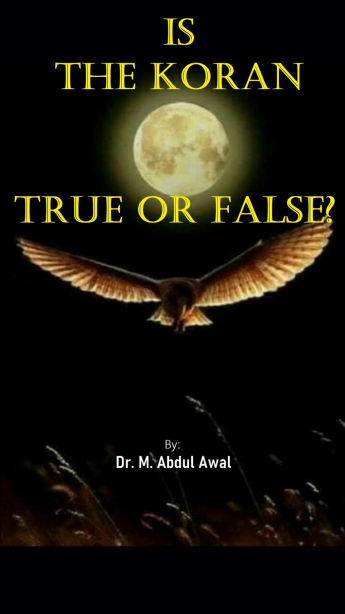
Numbers and Astonishing Mathematical Secret Codes in the Koran
Compiled by:
Dr. Muhammad Abdul Awal
About the Author
Dr. Muhammad Abdul Awal was educated in Germany and USA, and has 17+ years of Industrial and R&D experience at AT&T Bell Laboratories (NJ), and 16+ years of Academic Teaching experience during his 35+ years of professional career in a very broad and diverse national and international environment (mostly USA, UK, Middle East and South Asia). Currently (March 2022): Dr. Awal is the Asst Professor at the Department of Electrical Engineering, City College of NY, Department of Electrical and Telecommunication Engineering, NYC College of Technology of the CUNY, Dept of Physics, Hunter College, CUNY and the School of Business (Technology Management), and School of Engineering Technology (Law Enforcement Technology) SUNY Farmingdale. His major past research contributions are in the area of optical and wireless communications, opto-electronic IC, Ultra-thin opto-electronic materials growth and device fabrication and characterization, system engineering and concurrent engineering, commercialization of technologies, system analysis, High Tech Manufacturing, optimization of global supply chain network, Technology Economic modeling, Management of technology and innovations, business and network performance modeling, and current interest in the area of technologies/innovations, Nano Technology, Voice over LTE, academy-industry-government liaison, and next generation wireless technology driven services and products (IoT) involving 5G technology.
He had studied in various colleges and universities worldwide, including earned a PhD in Applied Physics from the City University of New York, New York, USA, and a Vor-Diplom in Physics and Mathematics from University of Halle, Germany.
Dr. Muhammad Abdul Awal has also earned a mini-MBA from the Bell-Labs Learning and Performance Center, Piscataway, NJ, and is enthusiastic about writing books and researching science.
2
Introduction
The nature of science is that it continuously evolves.
This makes scientists, like myself, doubly enthusiastic about the researches we conduct, because there is always a possibility of change. In science, the inherent rule of thriving is always the same. New learning replaces old learning. For men of science, this gives us fallibility, and the changing nature of science does not necessarily make the process of our earthly learning unreliable, but makes it doubly useful.
For any scientist, this very possibility of change makes science interesting and profitable to our realm. For example, as a physicist, I study the solar system from this little earth, and the things we see beyond the horizon are considered true and real, and we make hypothesis, observation and theories based on what we see. One example of obvious science in Physics is the famous theory of expanding universe. For thousands of years, astronomers wrestled with basic questions concerning the universe. Until 1920, it was believed that the universe had always been in existence and that the size of the universe was fixed and not changing. The idea of a static universe was not only popular but believed unquestionably, presumably backed by science. However, in 1912, the American astronomer, Vesto Slipher, made a discovery changed other astronomers’ beliefs about the universe. Slipher noticed that the galaxies were moving away from earth at huge velocities. These observations provided the first evidence supporting the expanding-universe theory. Before the invention of the telescope in 1608, man could do little more than wonder about the origin of the universe.
In 1916, Albert Einstein formulated his General Theory of Relativity that indicated that the universe must be either expanding or contracting. Confirmation of the expanding-universe theory finally came in 1929 in the hands of the well-known American astronomer Edwin Hubble. By observing redshifts in the light wavelengths emitted by galaxies, Hubble found that galaxies were not fixed in their position; instead, they were actually moving away from us with speeds proportional to their distance from earth. This extraordinary fact came to be known as the infamous Hubble’s Law, and it was Hubble’s discoveries that had elated me as a boy, and gave me the lifelong aspiration to become a physicist.
Using the Hooker Telescope, Edwin Hubble discovered that the galaxies were indeed moving away us. Edwin Hubble observed that the only explanation for this phenomenon was that the universe had to be expanding. Indeed, Hubble’s discovery was and is still regarded as one of the greatest in the history of astronomy. After he published his paper about the velocity-time relation in 1929, the expanding-universe theory was accepted by scientists and astronomers alike. However, the expanding universe theory was mentioned only in one other ancient document prior to Edwin Hubble. I was fairly astonished to find that well before telescopes were even invented and thousands of years before Hubble published his Law, the Moslem prophet Muhammad used to recite a verse of the Koran to his companions that ultimately stated that the universe is expanding. “And the heaven We created with might, and indeed We are expanding it.” (Koran 51:47) At the time of the revelation of the Koran, the word “space” was not known, and people used the word “heaven” to refer to what lies above the Earth. In the above verse, the word “heaven” is referring to space and the known universe. The verse points out that space, and thus the universe, happens to be expanding, just as Hubble’s Law states.
The second part which is doubly disconcerting about the Expanding Universe theory is that just as we had abruptly discovered this, future generations might regress into primitive minded ness and conclude, as they had for thousands of years, that the universe is static. This was explained with a wealth of details by Brian Greene, who was a professor of physics and mathematics at Columbia University. Professor Greene told the students who attended his lecture that if the world should somehow face a great disaster, and all technology got destroyed, and all the text books were reduced to rubble, and the universe continued to expand for another fifty billion years, then the humans who managed to survive all the disasters would glance up at the night sky and find no blue or red shift there, and would have to conclude that the universe is not expanding at all. Naturally, they would be wrong because that is the nature of science. As scientists, we are allowed to make errors, change our theories, and come up with news hypothesis each year. However, Brian Greene added that is one of the students left behind a paper, with a note, saying that the universe is actually expanding, and the only reason they are being unable to see any red shift from receding stars is because the billions of stars that surrounded this galaxy have travelled too far away, much farther than the capacity of human vision.
Professor Greene’s words hit close to home, and I too wondered how mankind would ever know the absolute truth of this universe. What shall be our source of undeniable facts? How will people, a billion years later, ever find out that the universe they are living in is actually expanding steadily? Such questions perplexed me and brought me back to the Moslem holy book. That the Koran mentioned such a fact centuries before the invention of the first telescope, at a time when there was
3
primitive knowledge in science, seemed remarkable to me, so with the curiosity ingrained in me as a scientist, I decided to delve deeper into the study of the booklet which Moslems call the Koran, their Holy Scripture. I found that like many people of his time, Muhammad, the man upon whom Koran was revealed, happened to be illiterate and simply could not have been aware of such facts by himself. Could it be that he had truly received divine revelation from the Creator and Originator of the universe? Or was there some clandestine mission roaming around the earth? The possibilities which I considered were endless, so I decided to begin at the basic. As a math-person, I started to look into the pages of the Koran, and attempted to apply my mathematical formulas there, hoping to find a pattern or theory about how this specific piece of information came to be.
This book would have been incomplete without the generous contribution of Benumed Etikue, whose lectures and researches offered many of the knowledge imparted here. A considerable amount of the information in this work is based on the findings of the researchers at the Research and Studies center.
The author and publisher are in no way liable for any misuse of the material contained within this book.
4
The way to God, Exalted and Glorified be He, is the way of guidance and rectitude. It can be accessed only through senses, mind and revelation. Since the human senses and mind are limited and unable to attain full guidance on their own, the need emerged for divine revelation and prophethood.
However, not all people are qualified to be prophets, so there was an urgent need for revelation from God to a number of them to be an authority that guides people to the true knowledge of God’s will and full details about the way to Him, Exalted and Glorified be He. Since revelation is not something tangible or visible to people, there must be some tangible evidence of the veracity of a prophet’s mission showing that such a person is a real messenger from God and that he received real revelation or inspiration from Him.
This evidence is the “MIRACLE” for which prophets and messengers of God were singled out from among all humans. Miracles enable the messengers of God to bring about miraculous events or acts that other people cannot do. The miracles of each prophet support the truthfulness of his mission in his time and place; therefore, they are transient events that end and only their stories remain.
This applies to all miracles except the Koran, the miracle of the last and seal of prophets, Mohamed, blessings and peace of Allah be upon him. The Koran is the only existing and everlasting miracle that addresses the generations over the ages and is witnessed by people in all times. Therefore, there is no prophet or messenger of Allah after Mohamed, peace be upon him, and no miracle after the Glorious Koran.
It is the Koran – the unique book that is inimitable in its style, eloquence, rhetoric, as well as in its rules and verdicts, structure, order of its surahs (chapters), verses and words, and the shape and positions of its letters. It is unique in its beliefs and tenets; educational and moral system; universal signs and unseen tokens, economic and administrative principles, comprehensive systems and methodology; the meticulous care, attention and preservation it receives; its impressive impact on hearts and minds; and the sweetness and elegance of its words. Above all, it is the only scripture with which Allah, glory to Him, has challenged both humankind and jinn, ancient and present, jointly and severally.
The Holy Koran is the last and immortal book to humanity. It is a heavenly system that regulates and organizes the life of individuals and communities, and at the same time it is a miracle that is associated with and inseparable from the divine system forever. Thus, the Koran owns a unique feature that is lacking in earlier divine scriptures that contained a system, while the miraculous aspect was something else independent from the book and the system.
At the time of Moses, peace be upon him, people were skillful at witchcraft. Therefore, the miracle of Moses, the staff, was similar to what they were skillful at. At the time of Jesus, peace be upon him, people were skillful at medicine, so his miracle was to heal blind people who were blind from birth and lepers and raise the dead by Allah’s will. At the time of Mohamed, peace be upon him, people were skilled at high literary style, eloquence and rhetoric. Therefore, Prophet Mohamed’s miracle was the Koran, which challenged with its rhetoric and eloquence the whole Arab nation that received the first message, and won the honor of preaching the divine message all over the Globe. After the dissemination of the Message, the “miracle” for other people and nations would be something else other than the high literary style and eloquence: the Koran is not only for the Arabs; rather, it is for all times and places. Therefore, God provided it with miraculous aspects and elements that make it a miracle that challenges people in all times in whatever they are skillful at.
Our age is the age of science and knowledge. It only acknowledges tangible things, recognizes reason and knowledge and accepts only obvious physical proofs. Therefore, the Koran challenges the people of this age with its wonderful numerical structure, this structure that is part of the challenge journey over centuries and another one of the infinite aspects of the miracle of the Koran. It provides people in our times with an irrefragable scientific proof that the patterning and composition of the Koran’s chapters, verses, words and letters are ordained by God, glory be to Him, through revelation, and not from anyone else. Common sense and good reason cannot accept the claim that any part of this marvelous numerical patterning is a human effort, because the language of numbers is the language of tangible, physical facts, the incontestable global common language among all humankind. It is also the language of firm irrefutable evidence that cannot be denied or ignored.
It is a language that has its miraculous aspect, exactly as is the case with linguistic and literary miracle. For it interacts with the intended meaning in the minutest details to give a fantastic picturesque artwork for those who can reflect on its deep meanings and comprehend it in this digital age. Digits and numerals have their own eloquence that probably excels that of words. They have become the language of persuasion for deniers and doubters of the authenticity of the Glorious Koran.
Thus, generation after generation, and day after day, the Great Koran reveals in all domains more and more of its marvels that never end. Hence the aspects of the Koranic miracle are as multiple as the angles of viewing or approaching it.
The masters of eloquence and rhetoric were unable to bring forth even the like of the shortest surah of the Koran. This challenge still exists for people in our present times, not only in the domain of language, but also in multiple aspects, including this miraculous Koranic numerical structure by all standards of our age. How then if you know that this Koran was revealed more than fourteen centuries ago.
5
It is really a Scripture with linguistically and numerically perfected revelations, as it comes from the One Who is All-Wise, Well-Aware. Therefore, you will not find any conflict or defect throughout the book, and its magnificent numerical system is not at the expense of its eloquence and literary excellence, nor does its clear Arabic which defeated and surpassed the most eloquent poets and orators detract from the amazing numerical structure of the Koran’s letters and words.
In this new publication, we present firm certain facts and clear inductive data about the Koranic numerical structure. Each of these facts constitutes an unquestionable and undeniable proof of the veracity of this Koran, because they can easily be verified.
These facts mean that the Koran’s letters and words in its verses and surahs are not chosen haphazardly, but in accordance with a highly accurate and perfect divine balance that takes into consideration a great number of facts simultaneously without affecting the meaning. This feature that characterizes the marvelous structure of Glorious Koran is one of the hardest challenges to the human mind. Therefore, all humankind – with all ways of knowledge it possesses – cannot create even the like of one verse from the Koran.
Believers in the Koran will be pleased with what they see in the Scripture of their Lord, Exalted and Glorified be He, and their faith will be augmented; while disbelievers and deniers of the Koran, and those who raise doubts about its source, will hopefully contemplate it and discover that it is a revelation from God, glory be to Him, and then believe in it.
The Glorious Koran is far more marvelous than the human mind can imagine, and too broad for anyone to comprehend fully even one aspect of it. What I present in this and other books is no more than a mere glimmer of the perfect and highly outstanding features of the Koranic structure. Each letter of the Koran conceals behind it an integrated world of wonders and numerical systems that are controlled by the balance of revelation. However surprised you may seem to be at the marvels of the Koranic numeric structure, which we are trying to expound some general features and aspects of here, they are no more than tiny drops from a sea without shore, yet they constitute irrefragable evidence of the truthfulness of this Koran and its divine source.
My welfare is only in Allah..
In Him I trust and unto Him I turn.
Koran
God supported all his prophets and messengers with tangible miracles in domains in which people excelled in their time, so that the challenge would be stronger and more effective. Those miracles were a proof of the truthfulness of their mission. They were valid only in their physical and historical context and were meant to be evidence against those who witnessed them. Of all prophets sent by Allah to humankind, Mohamed, peace be upon him, had the greatest number of miracles. While all these miracles had ended in their own time and context, as was the case with the miracles of earlier prophets, and became part of the Prophet’s biography, the Glorious Koran ensures as the everlasting miracle for all times and places, and for all peoples and generations. It is one and the same book whose content never changes, yet its meanings and connotations adapt so as to suit the people of each era.
The marvels and miracles of the Koran are countless and endless. They are multiple, diverse and never-ending, so every period of time has its share of new aspects of this ageless miracle. It is the Koran- the unique book that is inimitable in its style, eloquence, rhetoric, as well as in its rules and verdicts, structure, order of its surahs (chapters), verses and words, and the shape and positions of its letters. It is unique in its beliefs and tenets; educational and moral system; universal signs and unseen tokens, economic and administrative principles, comprehensive systems and methodology; the meticulous care, attention and preservation it receives; its impressive impact on hearts and minds; and the sweetness and elegance of its words. Above all, it is the only scripture with which Allah, glory be to Him, has challenged both humankind and jinn, ancient and present, jointly and severally. The journey of Koranic challenge with the lingual and rhetorical miracle began when the Arabic language was at the apex of its glory. However, we live at a different era in which emerged the digital and numerical power, making letters and numbers more eloquent than words. Thus, the Koranic numerical fabric has come to challenge the whole humankind to bring forth the like of the Koran in the accuracy of the structure of its surahs, verses, words and letters.
A book cannot be a divine holy scripture or recognized to be the Word of Allah unless it is proven conclusively that it was recorded and written down during the time of the prophet who received the revelation in his own language. It must be reported to us through a valid continuous chain of narrators without any interruption, change or alteration. If any of these essential conditions is missing, the book cannot be sacred, divine or deemed to be the word of Allah, even though the whole humankind agreed unanimously on it. As for the Koran, Prophet Mohamed, may the blessings and peace of Allah be upon him, ordered every text of revelation to be written down immediately. The whole text of the Koran was recorded verse by verse, word by word and letter by letter, as dictated directly from the lips of the Holy Prophet, peace be upon him. Therefore, the Glorious Koran was scripted in the Prophet’s time and handed over and exchanged among Muslims, and also memorized and obeyed by them.
Since the Glorious Koran is the word of Allah, the Almighty Creator, with its divine purity and enlightening illuminations, it must be different from human speech in structure and content; scientific, historical, educational and psychological indications; administrative and economic controls; and future prophecies. Add to these the Quran’s steadfastness and survival against all attempts of distortion, and its challenges for both humans and jinn combined to create something similar to it as a whole, or ten of its surahs, or even one of its surahs. This
6
challenge is still ongoing, and yet not a person of reason proceeded to say: “I could write a surah like those of the Koran.” On this, Allah, glory be to Him, declares:
َكْوَلَِ ِه ولِِْمثبَنْوُتْأَيَِن لآر ُْقْا الَذَِل هِِْمثا بْوُتْأَيْنَأََلَعُِّجنْالَُس وْنِْلِْت اَعَمَتْاجِنِئ َللُْق
ْمُهض ُْعَبَان
88( الرساء
اْي ًِْهٍَض ظْعَِبل (
“88. Say: Verily, though mankind and the Jinn should assemble to produce the like of this Quran, they could not produce the like thereof though they were helpers one of another.” (The Koran 17:88) The miracle of the Glorious Koran, which was revealed to be a source of guidance for the whole mankind, cannot be limited to its superior language, which can be appreciated and comprehended only by Arabs. Even the Arabs of today have mostly lost the refined linguistic sense and talent that characterized their forefathers, except for a few linguists and scholars. Since the Koranic challenge to human beings and jinns collectively is a continuous one to the Day of Judgement, there must be miraculous aspects other than the language. This motivated a number of the Koran scholars to research other aspects of the Koranic miracle, such as belief, worship, morals, legislations, and so forth.
In order to establish a strong argument and provide crucial proofs against people in our times through the language they understand best, i.e. the language of science, Allah, glory be to Him, left for us in His Holy Book more than a thousand verses that speak about the universe, its components and phenomena with such a high scientific accuracy that came to be understood only with the advent of modern contemporary sciences i.e. in the past two centuries or so. This precedence and uniqueness – by pointing at a huge bulk of universal facts more than 10 centuries before human science discovered them – is what we call the scientific miracles of the Holy Koran. This is an easy discourse that enables people at present to understand the excellence and uniqueness of the great Islam over other beliefs and faiths and the value of the Glorious Koran over other scriptures, whatever the language used in addressing people. The Koranic context of universal verses in the Glorious Koran indicates that they are mentioned as a testimony to the infinite power of the Creator over His creation, and to godship, lordship and absolute oneness of Allah, Exalted be He above His creation. Allah, glory be to Him, has formulated the verses about the universe in a marvelous way that can be understood by people at all times in a way that suits their level of knowledge and understanding of the universe, its components and phenomena.
No person of reason can imagine a source for this huge multitude of scientific facts in the Glorious Koran other than Allah, the Almighty Creator. It is a book that was revealed over one thousand four hundred years ago unto a man who could not read or write, amidst a nation whose majority were also illiterate, at a time when no one in the world knew anything about these scientific facts that only began to unravel in the nineteenth and twentieth centuries. We find that many verses in the Koran urge us to contemplate the verses of this noble book and reflect on the signs of His power in the universe:َأكَِّبَِرِف بْكَيْمَلَوَأُّقحَْالُهىنَأْمُهَلَنْئ ىَبَتَيَّت ىَحِْ مِسهُفْنَأِينفَِق واَفْالِينا فَِناتَآيِْ ميهُِي نَ
ٍءْس يلِّ ش َُكََلَعُهىنٌيدِهَش
( فص ّ 53 لت )
“53. We shall show them Our portents on the horizons and within themselves until it will be manifest unto them that it is the Truth. Does it not suffice that your Lord is Witness over all things?” (The Koran 41:53) On the Authenticity of the Koran, the Orientalist Sir William Muir wrote as follows:
“There is probably in the world no other book which has remained twelve centuries with so pure a text.” After a study which lasted ten years, Dr. Maurice Bucaille spoke about the existence in the Koran of certain statements concerning physiology and reproduction: “Our knowledge of these disciplines is such that it is impossible to explain how a text produced at the time of the Koran could have contained ideas that have only been discovered in modern times.”
As Mahatma Ghandi affirmed, “My reading of the Quran has convinced me that the basis of Islam is not violence but is unadulterated Peace. It regards forbearance as a superior to vengeance. The very word ‘Islam’ means Peace, which is nonviolence.” It is guidance for human beings:
مَوْقَأَِهيَّت ِيَِّلِدي لْهَيَآنر ُْقْا الَذَهىِنإ
ُ ( )
“Surely this Qur’ān shows the way to that which is most upright.”
——————————————————————————————-
Main References:
1.The Holy Koran.
2.Picthall, M.M., The Meaning of the Glorious Koran.
3.Maurice Bucaille, The Bible, the Quran and Science, 1978.
4.Gandhi, M. K. 1949, Communal Unity, Ahemdabad: Navjeevan
Who Is God?
Everyone is born upright by nature. Pure nature leads to Allah, the One and Only True God. In fact, human nature awakes to Almighty Allah’s existence very early in life, even earlier than we may think. We generally think that only an older person ponders over Allah’s existence and Oneness. But if we observe the life of a little child, we notice that in a certain stage of his life, he asks his parents endless questions about the things he sees around him in the universe. Who made the heaven? Why is the sky blue? Where does the sun go at night? Why doesn’t
7
it appear to us at night? Where does light go when the dark comes? Why do stars glitter? Where does the earth end? Why do some flowers have smells while others don’t? Where did I come from? Where was I before I came? Etc. What do all these questions mean and indicate? They indicate that nature in this child has begun to awake and recognize the Creator of the earth and heavens through His tangible and seen creation.
If we have a look at the heaven and earth, we find that rain falls from clouds, fruit is produced from trees, trees grow from soil and water, water originates from oxygen and hydrogen. Since man opened his eyes on this universe, he has never seen an incident or event happen by itself without a cause or something exist without a maker or creator. This has become a de facto unquestionable fact. No one can break a plate and then claim that it broke by itself without a human or non-human cause. Thus every effect has a cause that makes it happen, and there is a maker or manufacturer of every machine or instrument. Then how can a person dare to claim that our world or universe has just occurred without a creator though everything in it is far more complicated and accurate than a man-made machine.
Whether people agreed or not upon the wise reasons behind the existence of the universe, that would not change the result concluded through scientific reasoning which confirms the existence of the Great Creator, the Almighty, the All-Knowing and the Wise God, Who believers agree to call Allah, the Almighty. The name Allah (God) in Islam never refers to Mohamed, as many Christians may think; Allah is the personal name of God.
What do Muslims believe about Allah (God)?
1. He is the one God, Who has no partner.
2. Nothing is like Him. He is the Creator, not created, nor is He a part of His creation. 3. He is All-Powerful, absolutely Just.
4. There is no other entity in the entire universe worthy of worship besides Him.
5. He is First, Last, and Everlasting; He was when nothing was, and will be when nothing else remains. 6. He is the All-Knowing, and All-Merciful, the Supreme, the Sovereign.
7. It is only He Who is capable of granting life to anything.
8. He sent His Messengers (peace be upon them) to guide all of mankind.
9. He sent Mohamed, peace and blessing be upon him, as the last Prophet and Messenger for all mankind.
10. His book is the Holy Koran, the only authentic revealed book in the world that has been kept without distortion.
11. Allah knows what is in our hearts.
The Glorious Koran is the best authentic source to know the reality and attributes of Allah
Poetry from Anila Bukhari
Open your eyes

I hold the utmost respect in my heart,
For those who are never separated from their families.

Some fathers, however, wear sharp arrows,
slowly eroding the rights of their daughters to freedom.
They say they love them, but they are bound tightly,
Their limited minds, girls, forbidding the light.

Oh how they violate the wishes of their daughters, .
saw the depth of his illness.
It is considered a sin to write as a girl,
Not knowing they are caught in the dark.

How many different souls do you cover?
You cannot understand the magnitude of this.
Harming girls is a horrible crime.
Education, dreams, and time to be rejected.

But in this big world, there can be disappointment,
However, women deserve a safe place and housing.
No sleep or torture, let it be done,
Because they are beautiful and safe.

So open your eyes and see,
The power and strength of your daughters.
Let go of the closed bonds of life, .
and give them the freedom to really shine.


Truly compassionate and determined, Anila Bukhari has dedicated her life to supporting children’s rights and affecting a better world. Born with a compassionate heart, Anila has crossed continents and touched the lives of countless individuals through her incredible work.

Anila lived under the importance and transformative power of education from an early age. With an unwavering commitment to empowering children, she embarked on a mission to provide quality education to those who needed it the most. Anila’s efforts span many countries, making an indelible impact on the lives of children and their communities.

One of Anila’s most important accomplishments has been her work to raise awareness of the refugee situation. Understanding the plight of displaced individuals, he took it upon himself to educate more than 1,000 refugees through online forums. Through her dedication and innovative approach, she created a YouTube channel specifically tailored to meet the needs of visually impaired individuals, ensuring that they too had access to the world of knowledge and literature .

Anila’s passion for social justice extends to her tireless efforts in fighting child marriage and advocating for women’s rights. Through her powerful poems and impactful campaigns, she has highlighted the challenges young girls face and the urgent need to end child marriage. Her work has not only raised awareness but also inspired action, and has brought about a major change in legal and social attitudes.