
I AM A SNOWMAN

I am a snowman built from winter snow
My eyes are large and round
I like to look around
I like to play with the people
Who built me from the ground

I am a Snowman
Each year a new Snowman stands here,
Wide eyed at the earth
Looking at the people who
Made them from the snow

A new Snowman I am
Standing tall and strong

Watery Winter Sunshine
No! Not that,
I feel!

The climate change, I feel
Standing less round and
Closer to the ground
I yell to the children,
Who built me from the ground
Can I have another day?
Can you save your Earth,
Don’t let us melt away

By Linda Hibbard
Previously published by Synchronized Chaos, December 2021
Category Archives: CHAOS
Poetry from Mahbub

Nature's Cuddle

My heart fills in blessings
When I rush to the pastures, green and florid land
The river bank or the other side of nature calls me
To soar higher and higher with the birds the blue mingles with
The eyesight turns back to the condensed shady illuminated mango garden
Invokes me to join the picnic with the neighbors
Here by the water the breeze flowing on blood soothes my heart
Take my breath fresh and longs to stay some more time
The heavenly peace I find even in the sweet dream in my midnight sleep
I won't like to threaten my heart for the nightmare of the tiger's prey
Nor to join the line of the burning fireplace having the body turned into ashes.

Chapainawabganj, Bangladesh
02/01//2021

The Shade of Light

You live in the shade of light
I hover around the grey and pale
Floating in darkness to see the light of morning
Rohingyas' eyes fixed at the unknown future to the sandy Bhasan Char
Night be filled with glowing colors
The mundane fugacious pain or beauty lasts as long as
The winding snakes swimming away before the eyes on the stagnant pond
The light sweeping away from one corner to the other
Make us busy with work, the other deep in sleep or dance.

Chapainawabganj, Bangladesh
03/01//2021


Your Single Word

Your single word of Spanish cherry
Pours the scent in my heart
Your light of the word-smoke flies over on the surface of my eyes
Blows soft wind on the river
The rays of the rising sun - mild reflection of your love
Holding this focus I find the way of reaching the goal
In the midst of millions of stars
You are the moon-my ostrich plume
Throughout the sphere of your single word blooms the world's eye
Phoenix the bird - the glorious wings of your loving charms.

Chapainawabganj, Bangladesh
03/01//2021

The Heavenly Breast

Surrounded by the deceptive world
You stand before me with your jolly and smiling face
And spread the hands
I hide myself into your breast
Passing the night in maddening gay
Are you an angel of heaven?
All the sorrows and sufferings turn into a heavenly joy
Never like to turn my head back from this shelter
Please, allow me dear forever and ever
You are the image of my love
I would like to die, of course in this world you build for me.

Chapainawabganj, Bangladesh
04/01//2021


The Sprouting Laughter

That hidden surprising laugher
I remember ever and anon at my rest
With my sisters I talked and laughed in the starry light so loud
The sunny sprouting grass in the rainy season
But within very short getting in touch of the burning chimney
My heart fully staggered down, tossing in the stormy night
Day by day as the burning wood the heart turned into ashes
While laughing the eyes poured down
Stopped or browbeaten by the vipers
Faltering once and again and faded
What's the use of a ninny?
Now after so many times of rising and setting the sun
I can hear the heavenly laughter of my little daughters
Mingling with the light of the stars
O the world of life and light - the heavenly resort of joy!

Chapainawabganj, Bangladesh
04/01//2021
Essay from Leticia Garcia Bradford
Thinking About Climate Change

I’m thinking of climate change. What have we lost? What have we gained? Do I contribute to it or is it a natural change in nature of our era that man has provoked more than necessary? I’m always faulting myself for what is in the world. Like homelessness. Somehow I feel like I am responsible because I am inept to erase the problem. So in climate change. Have I done enough? Does my every water bottle recycled make a difference? Does using a recyclable plastic water bottle I bought at Starbucks exonerate me of my ever ending guilt? So much we have lost. Green grass. A babbling brook. Dust free wind. I can’t find any gains. I haven’t stopped searching.
Poetry from Jelvin Gibson
When love goes against you


Is like one losing the ability to think
Memory is life

But my life is not  just a memory

Another scene of lie

Like a broken hope and a wooden breath

I'm feeling small

Not so strong
Waiting for you to help me


When love go against you,
You are Walking like a blind

And was given pain instead of your light

A trigger inside me,
Only to pull it down and wake up


Everything I need is not a charity
Is only truth belief
I'm your Waterfall,
 think of me
As I think of you

When love goes against you,

Is a tear in the eyes that says good-bye
You did not accept the love;
You did not accept me
I gave you my all,

But from your side all I could see
Pain and tears in vain.


When love go against you,
Every tear that rolls
Slowly down your cheeks

Searches for the path of love
But life seems so bleak

When I think I've figured out just how I feel,
When I think I've had just about all I can take

I look into your eyes and forget my path

I will recruit for myself as I go,

I will scatter myself among men and women as I go


God's Beauty

All life will testify of you,
if they are loyal

With you, I hope to fly and feel your comfort
Flee to you away from the present heat,

There, I will wash myself and be neat.


Let the rain be my path and the moon my light that I may travel.
My heart decorates your beauty,

The sky above, the source of rain, the snow port
Which calms earth temperature.


God's beauty,
God is a masterful artist
Painting warm colors to show his wonder

He has painted our world in a rainbow of colors

For others to see his wonder
The sky and the moon are scattered with perfection

Such beauty is hard and difficult to understand.


Thankful we are,
For your forgiving heart, and wonderful life

Even the birds that fly high in the sky

Can relate about your wonders and perfection.
Poetry from Doug Hawley
Mortality
I have the body of a twenty year old.
I keep it in the refrigerator for midnight snacks.
I was worried when I was told that I was in room 205 at the hospital.
When I checked in the room, I found out that it was someone else.
I don’t want to die with my boots on.
Because I don’t wear boots to bed.
I check the obituaries before I get out of bed.
If I am in them there is no reason to get out of bed.
I heard someone about my size and age had died on a bicycle.
I was worried until I remembered that I didn’t have a bike.
I want to die in my sleep like Uncle Fred –
Unlike the people in the house he burned down after blocking the doors.
I don’t want to die in the saddle.
So I avoid horses and tack shops.
Appears in Short Humour

                                              Health Survey
A few years ago I got a letter from my health care provider that I would get a phone survey in a few days.  Sure enough, I did.
It started with some questions about physical ability, such as “Can you walk across the room?”  The mental ones followed.  “Do you think that people are after you?” Since I didn’t want the questioner to join the gang that was pursuing me, I said no.
My favorite question was next “Do you think that you have superpowers?”
A few minutes later after an extended period of rolling around the floor laughing, I said no again, because I didn’t want my secret identity revealed.
The questions and answers are largely true.
Appears in Short Humour

                                                    Sleep
I was awakened about 3am by kitchen noise.  My young, beautiful blonde wife came back to our bedroom with a butcher knife and said “I’m going to kill you.”  I jumped out of bed and ran out of the room to get my gun.  As she rushed me, I shot her in the heart.  I went back to sleep and found out the next morning, everything was normal.  We were old and alive again.
Appears in Medium

                                                     Killer
The man in the dark knee length trench coat had travelled miles from his home on that moonlit night.  He knew his way well from experience.  His luck was good as always, there was a couple in a new sedan, her with her hand in his lap, kissing him on the face.  Perfect.
He pulled open the door and as she pulled away from the man he saw the blade in the man’s chest.  Next, he was in the street bleeding out.  She smiled down at him “You thought that you were the only serial killer in town”.
Appears in Detritus


                                                               Date
I tried to get a date with the girl at the grocery store.  Because I was a little nervous and wasn't ready, I asked where the bananas and apples were.  She said "aisle 26".  Ashamed of my cowardice, I got a cart and picked up some bananas and apples.
I got up my courage to ask her out, so when I saw that no one else was in line, I boldly asked "Now, how about a date."
She said "Aisle 15".
Appears in 81 Word

                                                            Found and Lost
I’d seen her at the bar at least twenty times before.  This time I told her “There are better drinks at my place.  Please join me.”
She followed me to my apartment.  After a round, she walked into my bedroom.  When I followed her, I saw one of the few women who looked better naked than dressed.  She told me what she wanted; I did my best to deliver, and enjoyed every minute of it.
The next day I went back to the bar.  Everyone there claimed that no one like her had ever been there.  I doubt my sanity.
Appears in Detritus and A Story in 100 Words


                                                            Myth

A bunch of them broke into my home shouting gibberish while I was sleeping.  I awoke and tried to get them to leave, but they pointed odd looking weapons at me.  I had no choice but to fire my lasers at them.  Until now, I thought humans were a myth.
Appears in 50 Words Give Or Take and 50 Word Stories

                                                                       Cage
The town came to the zoo based on the promise of a special exhibit of animals captured with great difficulty.  The audience was truly impressed.
“My god, they are ten times our size.”
“They are bellowing so loud they can be heard ten towns a way.  The shrieking hurts my ears and might leave me deaf.”
Despite their fear the people stuck around, mesmerized by the crazed beasts.  They trusted the extra thick bars in the cage.
Their trust was ill-advised.  The humans broke out of the cage and stomped the crowd into the ground.  Three thousand Xanians died painfully.
Appears in A Story In 100 Words

                                                                        Lost
I looked at the squirrel and wondered if I could eat it raw.  I don’t know how to start a fire and probably couldn’t catch it anyhow.  My wife, what’s her name, always threatened to abandon me in the woods when I became demented, but I didn’t believe it.
Appears in 50 Give Or Take

                                                          In Tents
“This abandoned road looks really creepy.  Are you sure we’ll be safe camping out here?”
“Not to worry Sally.  My gang used to camp here regularly.  There are no scary animals.  The biggest around here is the chipmunks.”
After Duke set up the tent and Sally fixed food, they went to bed early.  “Can you relax now Sally?  See, it is completely safe.”
“I don’t think that you have relaxing on your mind, not that I disagree.”
They stop what they are doing when they hear something tearing.
Duke yelled “It’s coming from under the tent and it’s bloody huge!”
Appears in A 100 Word Story

                                                          Nature
“Hey babe, let’s go camping this weekend.  I want to get us all alone for a big surprise.  It’s a secret location, so don’t tell anyone what we are doing.”
She asked “Is this place safe?  I don’t want to get lost or get eaten by some big wild animal.”
“There is nothing to worry about, I’ve checked it out. You’ll be safe.”
Later at night in the tent she said “Honey, I’m so glad you thought of this” as she caressed his side, “this works out great for me”.  Her nails and toes turned into talons as he screamed.”
Appears in Siren’s Call ezine

                                               “Guess My Age”
The live in editor and I play a game “Guess My Age”.  At first I hold a towel over my face and ask “How old am I”.
Editor “50”.
I take the towel away.  “80”.
“That’s not fair, you must guess younger than my real age.”
In hopes of a better result, I drop my pants.
“Now how old am?”
“Twelve.  I hope you grow up, that’s pathetic.”
I should learn not to ask questions unless I’m ready for the answer.
Appears in Short Humour and Writer’sEgg

                                                      Legal
January 18 Jack told his wife Jan that she had gained a few pounds.  Why couldn’t she be skinny like her younger sister Jean?  February 10 he stayed out until after 2AM, came home drunk and drove the car into the garage.  March 3, Jan found her sister in bed with Jack. The jury of twelve women ruled Jack’s death justifiable homicide on June 2.  Five days later Jan married her brilliant lawyer, Frank Webster.  When asked what he was doing, Frank said “Sure she’s a murderer, but look at that body.  Anyway, now I know what not to do.”
Appears in A Story In A 100 Words


                                                Untethered

Odd remembrances haunt my lazy brain unbidden at odd times.  Family legend has me nearly drowning after falling out of a boat when very young.  The woman who is now great grandmother and widow that I made out with in my car sixty years ago.  A small clothing store that I walked past in West Portland fifty plus years ago.  Now there is a freeway where it was.  I think it was small, isolated and named Mode O’Day.  The traumatized beauty that abruptly rejected me while in college.  Did she ever care for me, or was it completely one sided?
Appears in A Story In 100 Words

                                                       Stranger One
One day a few years back I accompanied spouse and editor (same person) while she went shopping at the Albertsons a few blocks away.  I would wander aimlessly if I went with her, so I sat in a chair outside.  An average looking and dressing man walked up and sat beside me.  I feared he would talk religion or politics, but the conversation was banal to the point that I don’t remember it.  He walked away.  It seemed that he disappeared, but he probably entered the store or turned a corner.  I wonder why he chose to sit beside me.
Appears in A Story In 100 Words

                                                     Stranger Two
As a teenager, I was walking through Northeast Portland to get to a friend’s house.  At the time, I had no car or drivers license.  A male driver, a bit older than me pulled up and asked something like “Do I know you?”  I didn’t and told him so.  He wanted to know if I wanted a ride.  It was nice weather and I enjoyed walking.  I was a bit nervous and passed.  Years later I wonder what the driver had in mind and if I really looked like someone he knew or if that was just a pickup line.
Not published

                                                       Errands
“Sorry I’m late hun.  I had some errands to run after work”.
“You must be beat.  Let me get you a drink.”
“I’m also a little spooked.  I had the feeling I was being followed.”
“That was me following you on your way to your errands’ apartment.  Like your drink?”
Appears In 50 Word Stories
Poetry from Sarika Jaswani
Home

Here an era e c h o e s
An old song on slopes of silver and crimson descending hills

Where days rush blitz and hours ride turtle back, conversing
Erstwhile memories

The eyes that have cached my spring, my blooming, and colors of my dreams

The place I call home

Memories

Wakeful night
Underpins weight of unfallen tears
Silence shoulders
Gravity of emptiness on pinions of fleeting years

Away from flocking dust on shelves
Books, save your memories in
smudges, highlights
dog-eared text and pages

Places that speak of your presence— your absences


Solitude

Walk with me on a lane most forestalled
Lonely place where solitude caterwauls

I hide from me, my fear
Normalizes in buzz, fuss and throng

For once, I brave the librettos
Silence always sings

These ascetic hills and monastic trees, listen and grow
astute and still

Singularity

Emptiness
Has a character
In your absence

The chasm
Has crushing gravity

Vacuity-a black hole
Floating in my universe

Its voracious appetite
Eats my suns

Your memories-an event horizon
Where days stretch in length

And tug with singularity of your reminiscences

Cityscape

A scalded cat- my City
(mile a minute) changes
Semblance on her face

Dumbfound child in me
Looks for familiar curves and flecks

Measure for measure
Its once comforting scape
Mutates in the name of headway
(I think) she’s still bitter
For when I had once voiced a rescript-
I have outgrown its crossroads, potholes and bends

Her urban facet stretches with lighted bridges
And well kempt suburban alleys
Gone are the similar faces
That had known with heart
The items on my grocery list by

Today when I come to her with wistful longing-

She hands me strangers on construction cones
Festering remorse on forking roads
Souring distances and divider lanes


Sorrow

Cadent, astronomic vastness of aging Cedar

Cannot call a halt, on zeal of a carpenter bee


Like sorrow – solitary, shortsighted

Blindly burrows where shame has softened the grove


Slowly hollowing out the years

Thickening stories written in the stars
Doctor by profession. Sarika Jaswani is a Crochet Artist, Art Tutor Writer of Children's Stories. Philanthropist. Poet. Published. Passionately reads & writes poetry. Art Lover. Bird lover. Dreamer and blogger.

        Published on
        -'Tide Rises Tide Falls'
        --On Medium with A Cornered Gurl @ACG @Scrittura @MoveMePoetry
-Fever Of Mind Poetry
-Silver Birch Press
-The Organic Poet
-SpillWords
-The Women Inc
-Trouvaille Review
-Antonym
-HeronClanPoems
--a frequent vss prompt writer on twitter.

Her poems run on theme of love, reflection and philosophy of life.
Essay from Federico Wardal
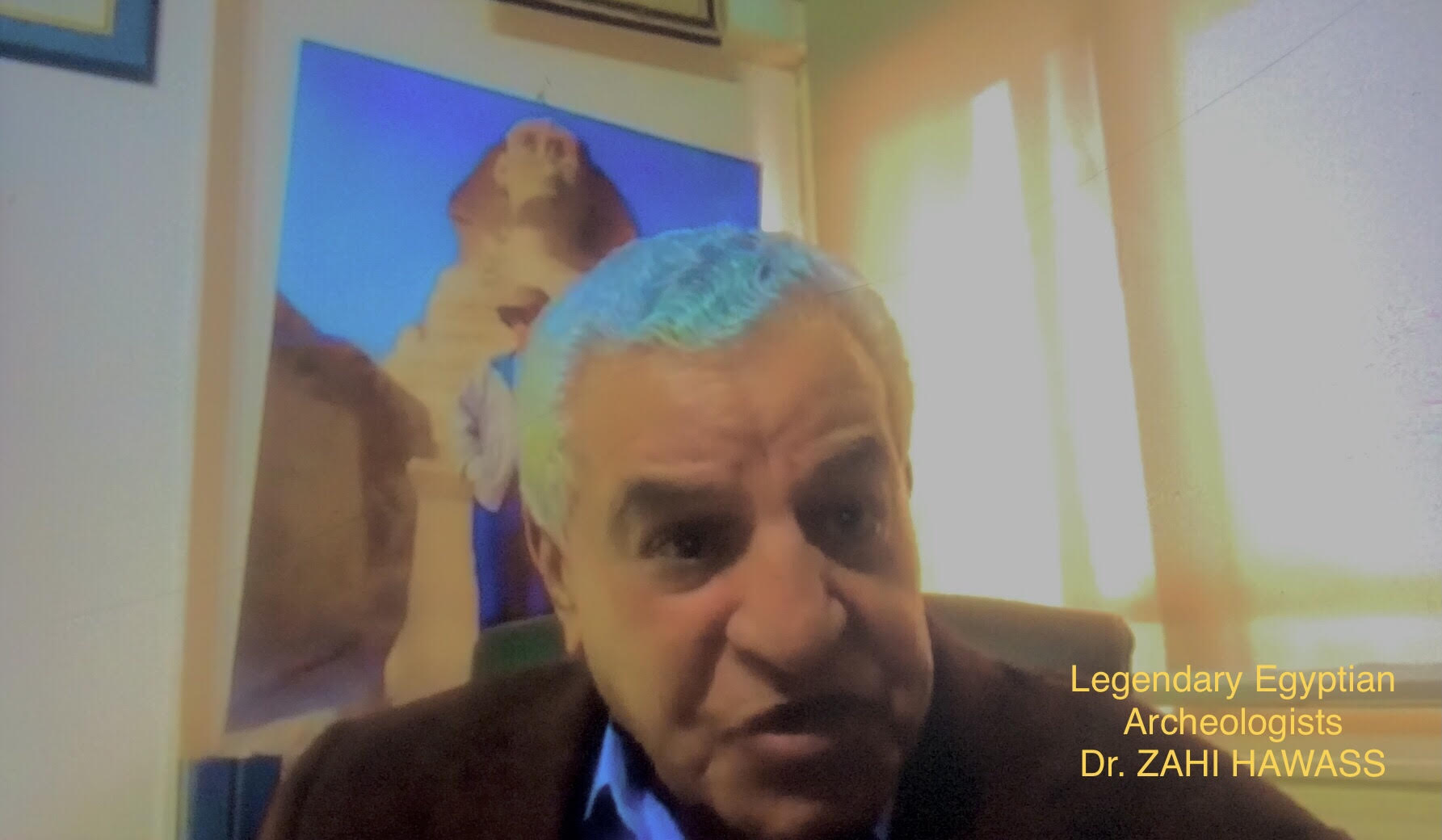
Ramsis the Great exhibition: legendary  Egyptian Archaeologist Zahi Hawass at De Young Museum  .
The tomb of Cleopatra VII and Marc’Antonio, city of gold in Luxor, discovery in Sakkara, the biography of Zahi Hawass
Exclusive interview by Federico Wardal
 ———-
 Legendary Egyptian archaeologist Zahi Hawass is already history.  Hundreds of awards that highlight sensational discoveries in Egyptian archaeology have been given to Hawass and the field has grown enormously over the years due to his constant and tireless archaeological activity.

Hawass reports on excavations in Sakkara, at the oldest pyramid in Egypt, where the tomb of the pyramid architect, a temple and numerous tombs are being unearthed. He took a trip to Rome on 21 March 2022 and visited the Egyptian Academy to inform them about the progress in locating the tomb of the most powerful majesty in the world, Queen Cleopatra VII, the last patron of the Bibliotheca Alexandrina.

Cleopatra wanted to be buried with Marc Antonio, on the day of their suicide, so as not to satisfy the emperor Octavian's wishes that they be captured and taken to Rome to be humiliated.  Horace, the poet and official historian of Emperor Octavian, makes Cleopatra say, in his verses: " Antony is now beside me forever, with a lock of my black hair on his heart".

The most famous and powerful queen in the world was the most important promoter of cosmopolitan culture. She brought about dialogue between peoples and ordered Antonio to replace in the Bibliotheca Alexandrina, which her ancestors had founded, the writings burned during the war with Julius Caesar.

Hawass announced the discovery of a city of gold near Luxor and on 20 August 2022 a colossal traveling exhibition on Ramsis the Great will come to the De Young Museum in SF . The exhibition is currently in Houston.

A great novelty of enormous historical and cultural importance is that Hawass has just finished writing his biography, full of intriguing revelations that help to uncover new aspects of human history through studying the ancient Egyptian civilization. Cloaked in mystery, some have thought they were connected with the world of the invisible and extra-terrestrial.

Preview YouTube video Wardal: Sensational interview with Egyptian legendary Dr. Zahi Hawass on Cleopatra, Luxor, Sakkara