
Remnants


It’s later than you think

or maybe sooner

they’re all that are left now

the letters waiting

ready

to be formed into words

must try to sort themselves

into words

that will never be spoken.

And the words already written

the manuscript

unread

ready

for a reader

who will never find them

never read them.

And the colours

of paint

and paper

fabric

clay

ready

to be put together

reformed into a beauty

never to be seen

or even imagined.

And the worn clothes still warm

almost

almost warm

already worn

stuffed into black bags

ready

to be worn

again.

All that remains

now

it’s later than you think

or maybe sooner.

Too late for them

anyway.


.........


Raining Tears


It’s raining again,

endless rain

or so it seems

the clouds breaking,

fracturing,

letting it all pour out

as I watch

feeling

my heart breaking

bleeding like the rain,

the raindrops of my heart

pouring out like tears of blood.


...............


Keep Your Hat On


There was a time when going out

was an occasion to be dressed for.

You could not be seen,

should not be seen

without your hat.

You would be ostracised,

talked about,

stigmatised,

left alone

shamed.

Hats were mandatory,

a smart felt trilby or bowler for the men

and a fashion statement of flounces or formality

for the women.

Even later

my visiting aunties kept their hats on

while drinking their afternoon tea indoors.

They left them on in cafes and bars,

it’s the generational norm

from the time when one knew

the dress code and conformed.

But not everyone did so

even back then.

Some were daring,

daring enough to go without a hat

and they still found company.

Others followed the code

and kept their hat on

but still sat on their own

the code didn’t admit everyone,

some were left outside.


Lynn White
Category Archives: CHAOS
Synchronized Chaos March 2022: Leaps, Hops and Vaults of Faith
Welcome to March’s issue of Synchronized Chaos! This month’s theme is in honor of the first Lit Hop in the city of Hayward, just east of San Francisco.

All are welcome to attend this multi-venue literary reading on Saturday April 30th, coinciding with Hayward’s first youth poet laureate award ceremony. Several Synchronized Chaos contributors will read from their work.
Also please join us for the Audible Browsing Experience in Philadelphia March 24th at Head House Books.
Due to the huge size of this and last month’s issue, Synchronized Chaos will experiment with going biweekly this spring. We’ll put out issues on the 15th and the last day of each month to make the issues more manageable while still showcasing all of the thought-provoking work we receive.
Also, we acknowledge the heavy state of the world right now and stand with those around the globe who need our support. We encourage you to donate copies of your books to organizations serving refugees or perform in benefit readings or contribute how else you can to those affected by war. Project Smile, founded by two teen brothers, accepts handmade and handwritten cards of encouragement as well as gently used books of all sorts. Information on them and how to donate here.
Also, here are some Ukrainian cultural and literary publications if you wish to support them with contributions.
VSESVIT (Ukrainian word for ‘the entire universe’)

Now, for this issue. Many pieces reference transformation, or the need for it. Writers and artists contemplate hopes, dreams, and aspirations, creative and healing leaps forward into the future.
Mahbub renders the beauty of memory and contemplation in lush, calming pastoral poems while Benyeakeh Miapeh speaks of a gentle connection with nature. Tranquil lakeside scenes pull E.J. Evans into curiosity about worlds beyond his own, whether the lives of other species or children’s futures.
Lori Minor turns to nature for brief, mayfly-like haikus observing her feelings. Abdulrazaq Salihu links his family’s migration to ecological dispersal and evolution while Michael Hough and Christina Chin’s collaborative work explores the love and curiosity caterpillars may feel watching their companions metamorphose to butterflies.

Chimezie Ihekuna’s screenplay collection showcases individuals who encounter grace at change points within their very diverse lives. Mamta Verma reflects on how much she would have missed in life without her lover’s presence. Michael Robinson gives thanks for his physical and spiritual redemption while John Culp, despite his human vulnerability, greets the forward movement of history with optimism.
Ivan S. Fiske seems to choose, or at least find, happiness by reflecting on his ancestors’ escape from slavery, although depression seems always nearly at hand. James T. Whitehead questions whether people can change. Can we overcome our addictions, can we “grow” ourselves like topiary plants, by means of willpower, therapy, or contemplation?
Mario Loprete preserves his clothing from Covid-19 quarantine into concrete, representing our being trapped and held back by the disease while also serving as an act of hope, creating artifacts that will outlast us and represent us far into the future.

Jake Sheff references and quotes thinkers from centuries past while mulling over autumn wind, cheese, rivers and human nature in grassy Oregon. Tareq Samin honors the diverse expressions of human lives and cultures throughout history. As in Sheff’s and Culp’s work, all people, regardless of race or social status, exist as part of a greater whole.
Karol Nielsen contributes postcard vignettes from her world travels, while Pathik Mitra comments on world inequality in a powerful piece, reflecting on individual lives within a global framework.
Stark Hunter presents a panoply of dreams and nightmares, enveloping his family history within his subconscious. Gabriel T. Saah compares his dreams to his children, beautiful creatures pulling him into the future with their beauty. Jean Eureka celebrates the beauty of future dreams while staying aware of the nightmare of potential ecological destruction, while Elbov Kulmonov honors both his dreams, whether realistic or not, and his connection to his native Uzbekistan.

Yusuf Salisu Muhammad laments violence, poverty and corruption in his native Nigeria while also celebrating a special woman in his life, while Ahmad Al-Khatat mourns a generation of young people displaced or killed in wars. Amos Momo Ngunbu portrays the ugliness and dehumanization of slavery and its legacy in cultural memory. Adamu Yahuza Abdullahi elegizes losses to war and violence through the eyes of a young man whose grief lingers while he’s alone with sunlight and nature.
Ananta Kumar Singh ponders the way love gone bad can cause people to take leave of reality. Chukwuma Eke Pacella grieves over a lost father in a poignant poem on divorce from a child’s point of view while Jelvin Gibson evokes the deep sorrow of child abandonment and the strength of survivors of that plight. Raafia Shaheen comments on how domestic violence disfigures people and relationships. Depicting the angry stage of grief on a personal level, Moustafa Dandoush’s piece from a scorned lover urges the past partner to begone forever.
Alan Catlin shares his personal, yet culturally infused, memories, illustrating how the cultural subconscious seeps into his own. Pesach Rotem humorously compares his own ordinary life, and the everyday apple, to high culture and pop culture images. While he may never become a “mean ol’ daddy,” he has taken a worthy journey.
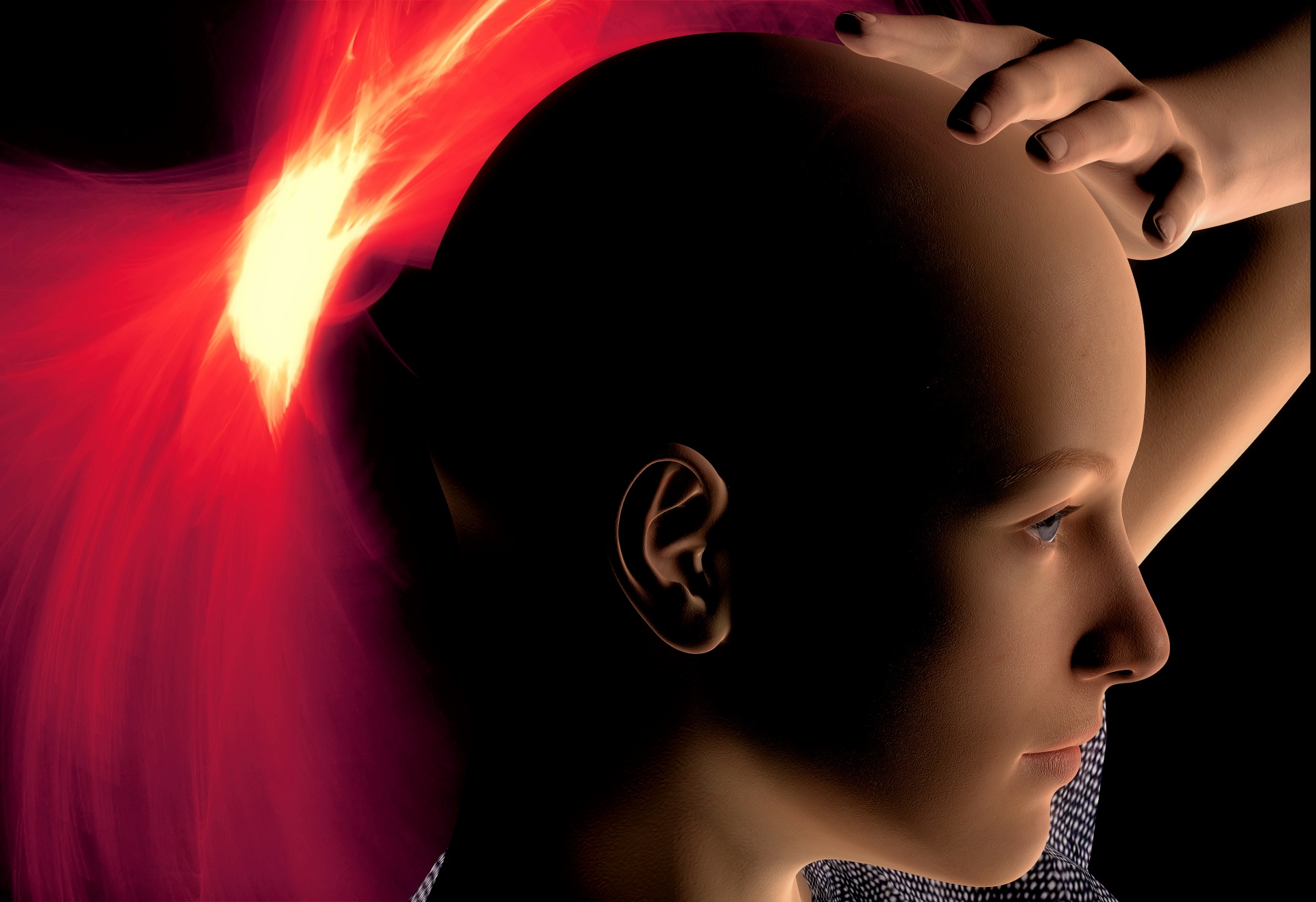
Debarati Sen draws upon the imagery of nature and time to convey how she regrets being so far away from a lover. Oona Haskovec infuses her depression into toast, turning a piece on preparing food into a meditation on existential grief while Aloysius S. Harmon renders psychological anguish into visceral sensory images. Steven Jarrell Williams and Emmanuel G.G. Yamba affirm the dignity and rightful place of sorrow in our lives, whether over one’s own condition or the state of the world. Tears deserve to be acknowledged as much as laughter and intellectual eloquence.
Tali Cohen Shabtai asserts her desire to be heard, for her words or her silence, and of understanding and re-constituting a fragmented identity.
Mark Young fragments words and phrases, lines and shapes, into a symphony of color, while Nathan Anderson shreds words into syllables that he repeats and plays with on the page. Patricia Doyne mocks the ignorance of world leaders with a satirical piece on the “gazpacho police,” illustrating what happens when language and ideas break down in the public sphere. Christopher Bernard pokes fun at overwrought Parisian intellectuals in his piece, satirizing the stultifying effects of too much knowledge while Doyne finds humor in its lack.
Hongri Yuan’s poetry, translated from Mandarin by Yuanbing Zhang, brings us back to the idealism of the first submissions mentioned, recollecting a timeless and glorious metaphysical state for humanity. Mehreen Ahmed’s short story also addresses the human condition, evoking the tension between creature and creator, the natural and the artificial. Nahid Gul also explores creation, but in a more positive vein with a parable about a young writer discovering her confidence.
As we can see, many people from a wide variety of backgrounds have all found their voice in this issue. We hope that this issue will build your confidence and encourage your own creative efforts.
Poetry and art from Michael Hough and Christina Chin
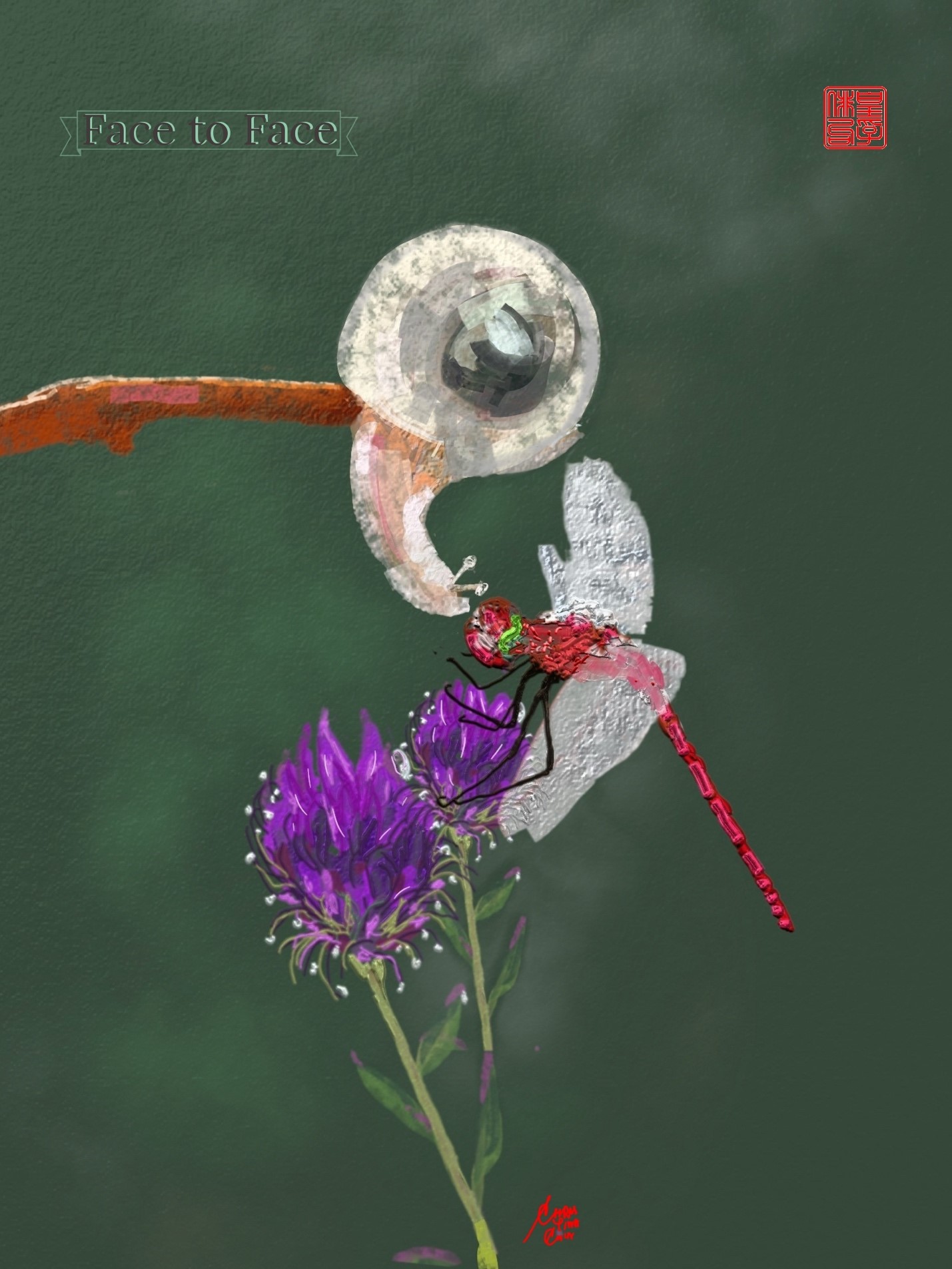
Face to Face

"Oh my God ... is it really you?"
"... Yes ... I was hoping it was you in that shell."
"It's me, and I remember everything."
"So do I ..."
"So .... like all that nonsense they told us about reincarnation turned out to be true, didn't it?"
"It seems like it now."
"That's a lot to think over, especially when our brains are so small."
"I know, I know ... but what else are we here for?"
“Well, I have to crawl down ... I can't stay here all morning. It’s unbearable when the sun is too bright.”
“I'll meet you here tomorrow morning then. Will you come?”
“It will take me all night to climb up here, but I'll do it.
... because, like how long do we live, in these shapes?”
"I dunno ... a couple weeks for me maybe."
“I think I get a little more. I've grown around this shell a whole turn and a half since Spring.”
“You go, girl! ... you are like, still a girl aren't you? "
“In this form we're all kind of half-and-half. I know it sounds weird.”
"I won't kick you out of the flower bed ..."
* laughs ...
“I’ll see you tomorrow, I hope. You be careful. There's a toad under the third brick in the wall. You would NOT believe how long his tongue is. ”
“Yes I would. I've seen him absolutely shred a bumblebee that didn't know he was there. It was horrible, except that I hate bumblebees. And you might want to step it up and go ... there's a Possum that lives behind the tool shed. ”
“Yeah ... bad news ... I have to keep a low profile around that one. I hunker down and pretend to be a wad of old chewing gum.
But hey! Listen! Maybe you can scout this out for me! I was down by the pond yesterday morning and I saw this BIG Catalpa leaf right
at the water's edge. I think it would hold me like a boat. And if you came and perched on the stem, and fanned your wings a bit, we might sail out to that little Island in the pond. We'd be safe there wouldn't we? No possums or toads, or kitties ...”
"Oh babe ... you don't know about the Bullfrog."
"Oh my Gawd, is that what makes that noise ...?"
“I’m afraid so ... top of the food chain on that island anyway. There are also some
big Bass in that pond. I’ve seen them lurking.”
"Shit ... I was hoping ..."
“I know. But I'll wait for you tomorrow morning, right here.”
"Good ... I still love you, did you know?"
“Yes, it's written on your shell in letters only I can see. And when my wings get really going, they make the sound of your name as I remember it. I will always love you, no matter what.”
“Thanks for that. Wait for me ... It might take me a long time ...”
"Yes, it always did ..."

						Michael Hough short fiction / Christina Chin, art.
Poetry from James Whitehead
Zombie film sonnet


We need more cinema about killing.

I mean movies about killing zombies.

Cinema seems the wrong word for zombie

films, or movies about killing zombies,

although cinema could work for killing

as a theme or action.  I mean movies

can be arty, even about killing,

but probably not films about zombies,

or films about killing zombies.  Zombie

movies then are not cinema. Zombie

movies are films.  We could use serial

films.   On television.  A serial

series about a serial killer

of zombies.  Man that would be a killer.


*


Indulgences


My therapist told me the book that I needed


was Out of the Shadows, by Carnes.


Healing the Sexual Addict, it warns.


I’ll buy a copy tomorrow, I lied.


I hated that therapist, anyway,


his post-modern priesthood,


hated his fees, hated to pay


for what ought to come free.


Instead, I read The Story of an Eye,


then Miller, then Nin, then Lawrence,


then Wilde . . .


To drift with every passion ‘til my soul


was a stringed lute on which all winds could play


2 weeks later I was lost, in the pull


of a blonde & feminine gravity,


no less than I was when in therapy.


 *


Talk


All this “God Talk” in all this poetry,


it’s weird.  I do it myself.  I’m guilty.


There’s Eliot, of course.


Is he Christian?


One can’t know.


One can know Christ was Jewish.


I guess that makes Eliot Christianish . . .


given his disdain for the Jewish man.


There’s Hopkins & his symphony of sound,


his sound of God,


his sound of consonants,


his sound of vowels


& his search for constants.


But he knew God as well as he knew sound.


& there’s the masses –


asking God for shit,


a new house,


a new lover, a new me,


& victory over their enemy.


Now. . . if only I can just ignore it.


*


Sick

             – after reading Aime Cesaire


Decadence like war now has veterans,


to die of an age, era, or epoch, hung over,


the “watery suns of rums” gone down,


to the other side of the World,


not forgotten, in their place,


the herald of morning signaled,


by horns blown with curled toes,


a rousing cock’s crows,


& the unfurled sheets of a nameless whore,


me,


the sun,


in place of the watery suns of rums,


coming up,


& on the other side of the World,


dreams aborted by a mere alarm clock.


To die from an age, era, or epoch


            is not the desired aim.


She shows gums, yellow teeth, smiles.


Speaks tenderly . . . please. . . come. . .


*


Topiary


It is a strange art.


And a strange reminder.


People cannot just leave plant life alone


            anymore than


leaving people alone.


Whoever did this is no gardener.


He shaped you,


                                    (and editors cut my work),


shaped you into some cartoon character


for tourists to this amusement park.


Some donor has taken over nature by proxy.


You can’t follow the money when it comes


            to a mutilated plant.


Gardeners grow.


This hack job is different.


But I can follow your roots.


I can see your patience hidden in you.


You will still return to Earth despite this.


We both will.


 *


Giving it up


                        – After John Berryman


When my un-warranted wants get planted


deep into the plots of my seedy head


I think thoughts of deflowering, of bed.


It’s not just hell that leaves me imprisoned.


For all the tricks of its light, I see red.


Red is fire, stop, passion, blood, her hair.


“I couldn’t rest from hell just anywhere.”


(I should be resting from heaven instead.


Whenever I think of her, I’m not there,


but she is . . . she is an aporia).


Images of her dance about like smoke


about my face while I think, pace, drink, choke.


My lungs turn black, my cigarettes burn red.


Alack, alas, a lack, et cetera.


*


(may be cut as needed)


About the Poet


 J.T. Whitehead has Bachelors’ degrees from Wabash College in English & Philosophy. He received a Master’s degree in Philosophy from Purdue, where he studied Existentialism, social and political philosophy, and Eastern Philosophy. He earned a law degree from Indiana University, Bloomington.  He spent time between, during, and after schools on a grounds crew, as a pub cook, a delivery man, a book shop clerk, and a liquor store clerk, inspiring four years as a labor lawyer on the workers’ side. Whitehead now practices law by day and poetry by night and lives in Indianapolis with his two sons, Daniel and Joseph.

 Whitehead was Editor in Chief of So It Goes: The Literary Journal of the Kurt Vonnegut Memorial Library, briefly, for just five issues: 1, 2, 3, 4, and 6.  He is a one-time Pushcart Prize-nominated short story author (2011), a seven-time Pushcart Prize-nominated poet (2015, 2015, 2016, 2017, 2018, 2019, 2020), and was the winner of the Margaret Randall Poetry Prize (2015).  Whitehead has published over 300 poems and prose works in over 110 literary journals and small press publications, including The Lilliput Review, Outsider, Slipstream, Left Curve, The Broadkill Review, The Iconoclast, and Gargoyle.  His first full-length collection of poetry, The Table of the Elements, was nominated for the National Book Award in 2015.
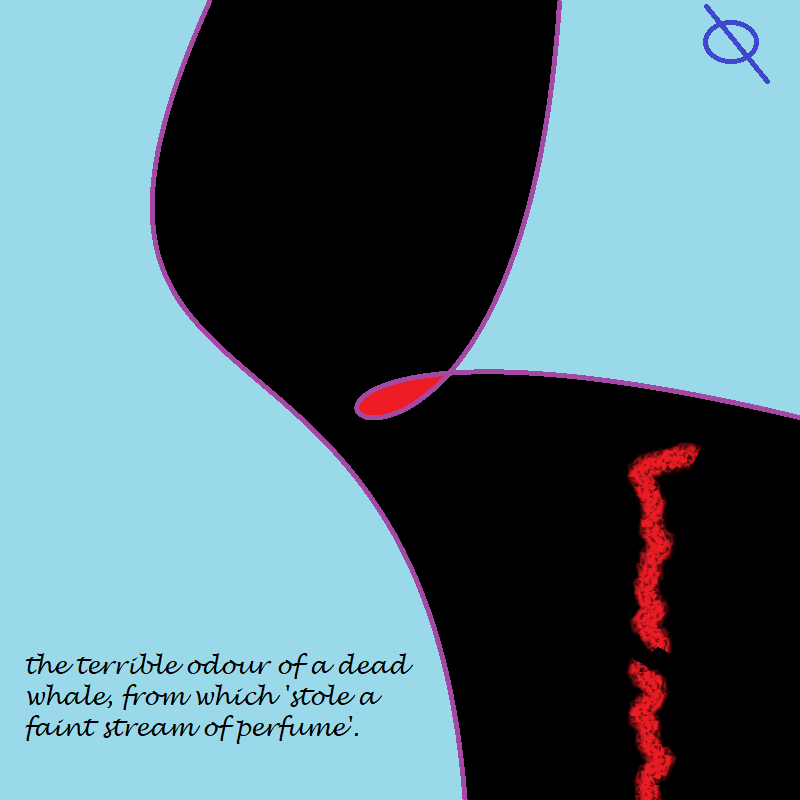
Visual art from Mark Young
Poetry from Abdulrazaq Salihu
EVOLUTION.

In this waltz, I carry you in my mouth;
Between little piano keys that snowflakes wars.
On this floor my body is brass; grief stricken metal and
A wall is a leaf on fire so my mother looses her throat
And tried to pronounce requiem, she lifts her right palm
And becomes a lotus, she lurches towards a mirror
To gather my fate and father’s reflections, she waters her face,
Count periwinkles, colours and the shell of a snail beside a broken pot.
She embodies a fish that drowned of thirst
And through the wind binoculars; a lapel folds a ladle
Through the kitchen window. A wild flower sprouts
From my mother’s palm and we are two step into evolution;
A wormhole that made my father’s journey to soil 1mile
Away from home; a recapulation of carefully collected snapshots
Of my father’s bones; his father’s bones; bones and more bones are now
Tree branches transforming into grief.
I dance;you dance;northern hemisphere harbours a hiccup and
My mother drowns.
I grow; you try to;you fail;schizophuta and rhizopus gather dead organic
Matter entracellularly and my brother is found identifying himself
A saprophyte.
I decline; my mother swallow’s earth;she drowns in between a
Floating microscopic heterotroph and grouped us into a photo album;
Zooplanktons.I name it grief,
She names me son and shades of coat colour counters my decline ;
She names me an x-gene and I pause in between her war-teeth and a
River of thirst rubbing my chest gently.
Poetry from Patricia Doyne
                GAZPACHO  POLICE

Not only do we have the DC jail which is the DC gulag, but now we have
Nancy Pelosi's gazpacho police spying on members of Congress, spying on the legislative work that we do, and spying on American citizens.  – Marjorie Taylor Greene,  2/9/2022

		Police are key ingredients in this puree.
		Like red, ripe tomatoes, they blend in, indistinct.
		Add cucumbers, red onions, green peppers, cumin, garlic:
		flavor enforcers.  Quality-control squads.
		But recipes do not send scofflaws to jail.
		Juries are made up of citizens doing their duty.

		Maybe average citizens are the bread-base,
		a mix of day old and fresh,
		adding texture,
		thickening the broth,
		infusing a medley of ethnic spices.

		The angry lady rages about spies:
		police that spy on lawmakers.
		She decries Pelosi’s private army--
		simmering, on call, ready to chill and serve:
		gazpacho police.
		How does a Congresswoman recruit an army?
		Wouldn’t the CIA notice?
		And why spy on legislators?
		Isn’t the Congressional Record public?

		Are Congressmen really sneaking around
		doing sneaky things
		until busted by gazpacho police?
		Perhaps someone is adding water instead of olive oil?
		Skimping on oregano?
		Nipping at the red wine vinegar?

		If you don’t have the right blend of
		tomato, veggies, bread, and spice--
		informed citizens as well as the gullible,
		public servants vs. self-servers--
		then all the mincing and mixing
		yields only a hiccup of gourmet broth.


		So, what’s the point?
		Why whip up a goulash of grievances?
		Gripers dine on a diet of dudgeon:
		outrage at the DC “gulag,”
		outrage at alleged spies,
		outrage at the scapegoat party leader.
		One righteous finger-pointer
		reads a speech on the floor of Congress
		claiming gazpacho police run rampant in the Capitol.
		She pushes big-time bad-guy buttons:
		Soviet prison camps and Nazi Secret Police--
		though the Nazi zinger sinks in its own sauce,
		thickening as it chills…

		Somewhere in this name-calling soup,
		there lurks a rotten tomato.


		Copyright 2/2020          Patricia Doyne