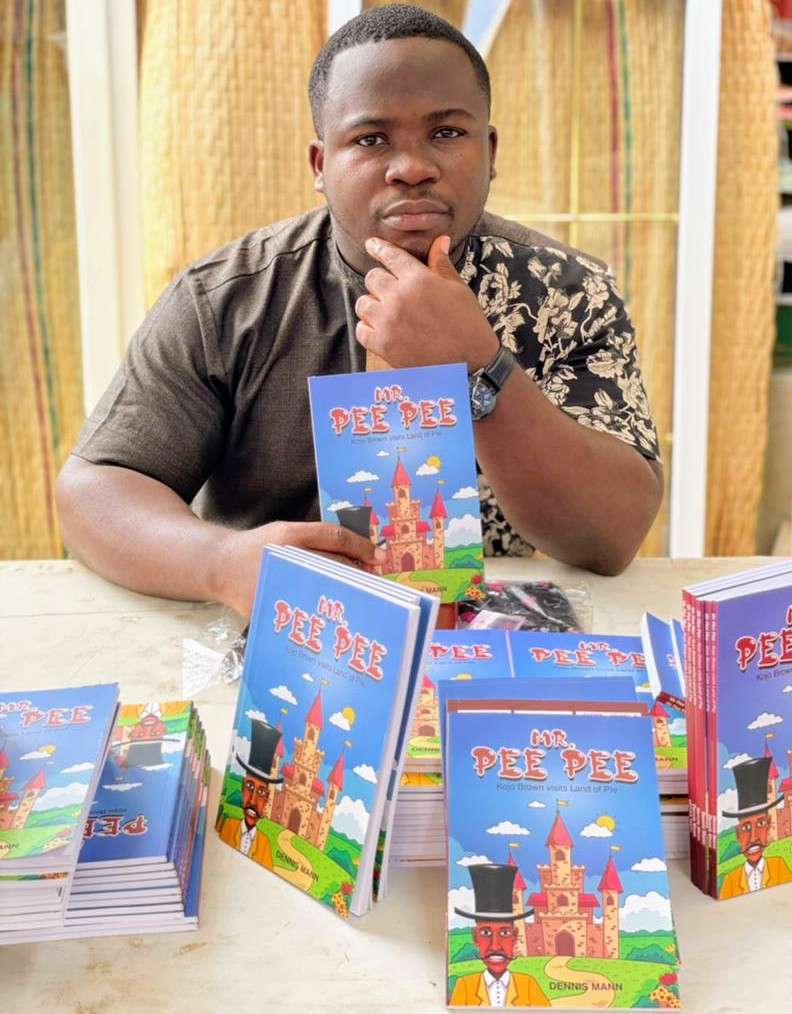
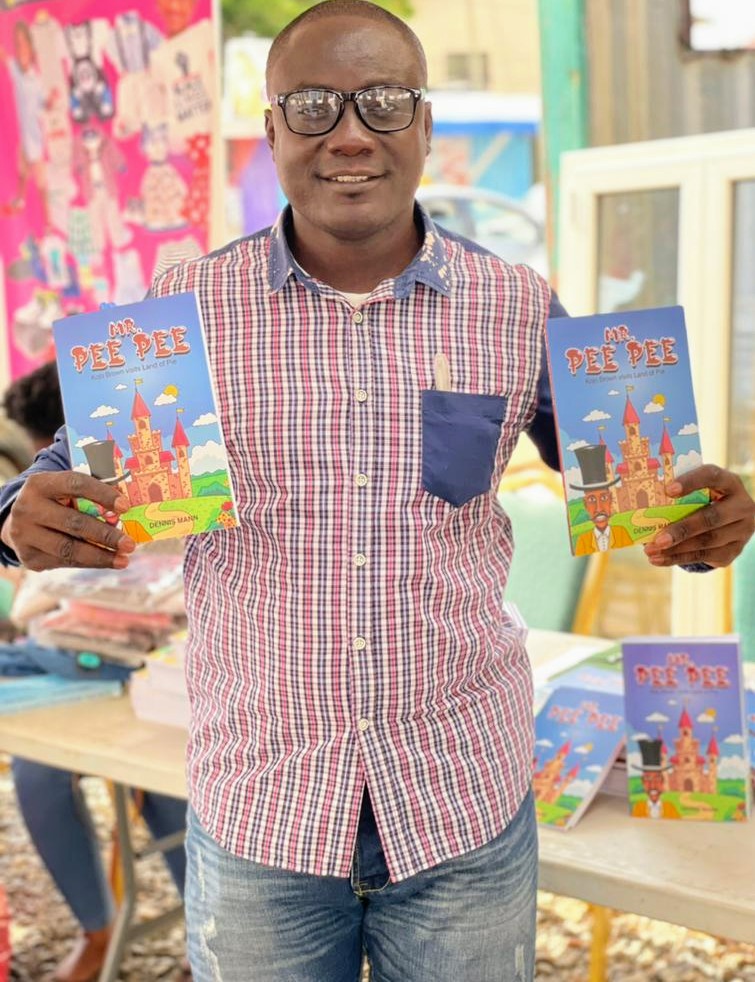
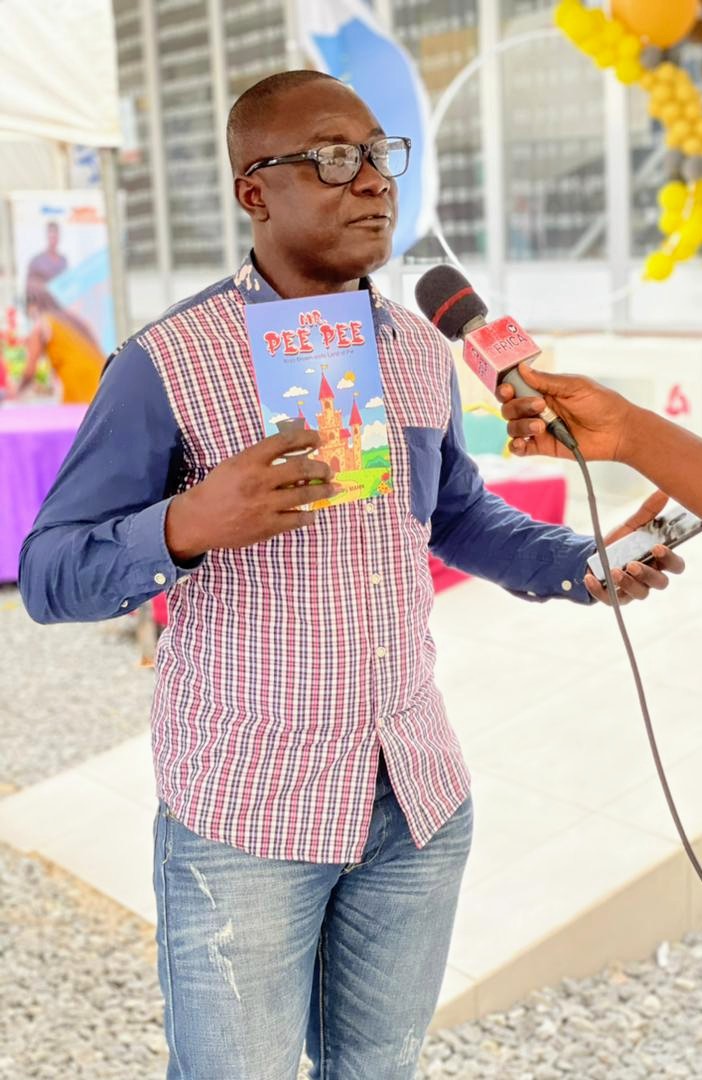
Let me take you on a roller coaster ride through the memory lane of BRR journey. Thus, some weeks ago I re-established communication contact with Mr. DennisAgyeman, popularly known by his professional pen-name Dennis Mann. Apart from his career as an author, he’s a reputable Banker with in-depth knowledge about the financial sector coupled with the world of Forex Trading and the Crypto-System spheres across the globe. Undoubtedly, he’s been described and identified as a man of compassion with heart of generosity as well as integrity. He’s such a brilliant devoted and committed Christian man with Godly character in most of his inter-personal business dealings in both the creative writing and money-making financial sectors, be it local or global.
My first time phone conversation with him commenced when I was in Takoradi, Western Region of Ghana, thus a couple of years ago whilst the Manager of Amanful Digital Library & Learning Arena which is abbreviated ADLLA. If my memory serves me right, someone came to study and research at ADLLA then upon conversation his name came into equation so I had his phone contact number. Indeed, it about six years ago! Aside, thankfully going through a note-book I found his contact number and discerned right away to get in touch with him. Of course, his invitation to Prayer Breakfast and Business Networking program organized at Pleasant Place Church in Spintex, Accra brought about positive thoughtful, insightful and delightful conversation on the aftermath. It’s heart-warming and welcoming moment bring with his better-half and kid onboard his car. Oh, once again, am so grateful and thankful for the lunch which subsequently became my dinner! LOL, I can’t forget the book club reading and speed-dating event we attended over the weekend at seemingly garden-like venue of Dzorwulu in Accra, Ghana (West Africa). It’s a whole new experience for me, as a couple of Vlog 233 and other interactive video was recorded whilst there and onboard his car to and fro the event place.
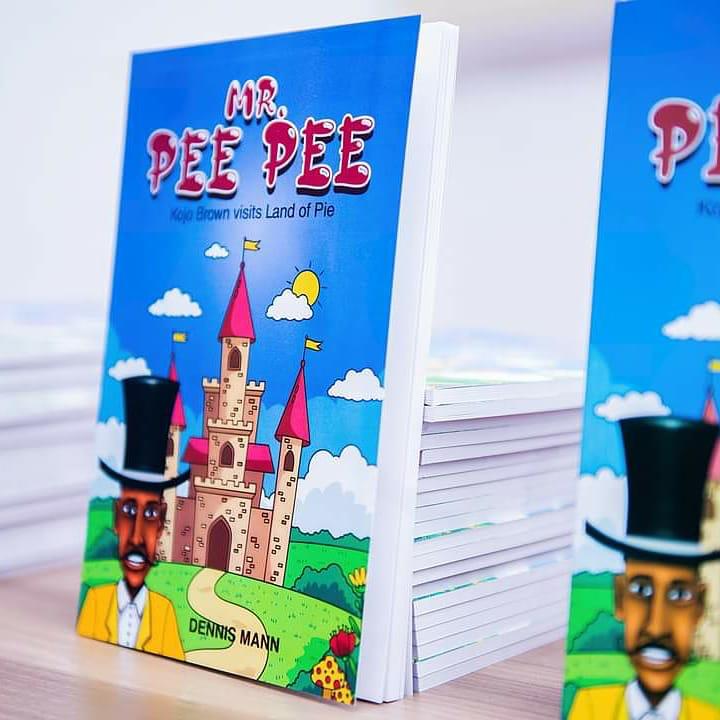
Quite significantly, in this writing as Arti-Blog I bring you the Book Review Revelations – BRR which I spent about two weeks reading and recording his maiden kid’s book titled Mr. Pee Pee even by posting and promoting on our People OfExtraordinary Talent – P.O.E.T Africa Whats-App group-platform. Factually, it one of the best kids book I’ve ever done Read Aloud Session – RAS on. The following happens to be three (3) reasonable personal professional observations in relation to Mr. Pee Pee and characters he out-lined in the chapters of its contents. I. Easy-To-Read (ETR), II. Easy-To-Understand (ETU), III. Easy-To-Buy (ETB).
Easy-To-Read (ETR): Factually, it’s in clear simple every-day English sentence and easy to read in terms of word pronunciation. Beside, soft diction for kids growing their vocabulary to the mind’s absorption. Of course, pages and chapters to make the whole book easy to read by children.
Easy-To-Understand (ETR): Definitely, it’s so lovely to fathom in terms of understandability. Thus, in view of how characters and images show in the pages to bring about it understanding being prime purpose of author Dennis Mann. Come to think of reading suspense, it’s equally easy to capture and picture with imaginative thought processing revelations to understand.
Easy-To-Buy (ETB): Affordably, it’s not expensive to get in terms of purchasing price being such a beautiful kid oriented book with nice pictorial chapters. I recommend and suggest that you get a copy or copies to your child, friend and families. Kindly, use the following Amazon web-link to buy online: https://www.amazon.com/Mr-Pee-Kojo-Brown-visits-ebook/dp/B096HNK4N3
It’s worthy to state in this Arti-Blog that Dennis Mann has good vision and purposeful mission for kids in Ghana and across the globe. Hence, he’s the Founder, President and CEO of Wide Reading Among Kids – WRAK non-governmental organization which seek to inculcate the habit of reading among kids in various communities in Ghana as well as across the continent of Africa and beyond. It also hopes to have Patrons and Partners come aboard so as to carry-out its literary charitable functions, thus donation of books to rural kids of school going age.
Facebook Page: Wide Reading Among Kids
Kindly, get in touch with the Author via below contact details:
This Book Review Revelation as Arti-Blog written by Ike Boat (Synchronized Chaos International Magazine) Contributor & Promoter In Ghana, West Africa. Email: ikeboatofficial@gmail.com Whats-App Contact: +233 267 117 7700, Alternative Number: +233 55 247 7676
In her deftly constructed poetry chapbook Hikikomori, Virginia Aronson builds a house of mirrors reflecting our social isolation. Her interlocking poems and metaphors draw inspiration from a phenomenon the Japanese define as hikikomori, or “pulling inward,” the impulse to withdraw from the pressures of modern life, which resonates with our current experience of the Covid-19 pandemic.
Told from the point of view of a person afflicted with hikikomori, the poems are succinct in their impact. In the title poem, for example, the narrator inhabits a small room, which is both his world and his inner landscape. He describes himself like a specimen: “alone / in your own world / alone / with yourself / your swirling thoughts.” His urge to confine himself indoors is further outlined in the poem “Brave New World” and echoes Aldous Huxley in reverse. The victim of hikikomori does not experience the evolution of society but its denial.
Cultural pressure and lack of respect for the individual inform the poem “It Can’t Be Helped,” where is the reader is haunted by images of ultimate isolation: “Japan is a suicide forest / the people wandering / in the ancient woods / … / to gut the emptiness.” Sadly, young people are most vulnerable to social oppression and parental pressure as described in “Anime Me.” The child in the poem succumbs to the lure of online entertainment, including video games and binge watching as a means of relaxing and evading social interaction, which sound familiar but frightening in this context as symptoms of deeper withdrawal.
Aronson shows how self-isolation can evolve into a psychological or medical condition. In extreme examples of hikikomori, adult children continue to live with their parents and depend on them for support well into their own middle age: “over forty / lacked self-esteem / locked in my childhood / bedroom / dreamless / alone.” In the poem “Homosocial” while thinking of women in society, the poet writes: “I sit in my dark / womblike room / thinking of them / living in the / present / no future for us.” The tragedy of the hikikomori is characterized by the victims who are no longer able to live or participate in society, excluding them from such essential endeavors as holding employment, having relationships, and raising a family. The individuals and society both suffer.
I found Aronson’s description of hikidashiya, or “those who pull people out,” to be quite chilling. In “Spirited Away,” the narrator endures an extraction reminiscent of attempts to force people to change sexual identity or religion. These violent attacks, often undertaken by one’s family members, are justified as necessary or well meaning, but they are painful to all involved.
One of the most beautiful images in the chapbook is also one of the most haunting. Given the Japanese sense of society and how those excluded tend not to exist, the victim describes his view of the hierarchical culture: “the pyramid leaving / me: / a grain of sand / at the very bottom.” We see the traditions of college, hiring, and corporate meetings evolving into drinking marathons from the eyes of one who has bound himself to nonconformity by retreating to his room.
This sense of loss and rationalization informs many other historical traditions of religious and philosophical inquiry from ancient hermits and monks to modern attempts to achieve enlightenment and insight through meditation or nature. But here the withdrawal feels tragic because of its permanence and emotional toll. The poem “Day #3652,” for example, finds the poet describing “my life floating past / on a dark thundercloud / … / And if the Earth stops spinning / I’m sure / I won’t notice.” Not only is the victim removed from society and the world, but he experiences a sense of timelessness and eternity in his condition.
My enjoyment of the collection was enhanced by the notes following each poem explaining the aspects of hikikomori in Japanese and English terms. The phenomenon of hikikomori has a rich history in Japanese culture, and I came away with a deeper understanding of hikikomori and its resonance with modern society. Hikikomori is an appropriate metaphor for the lure of staying home and withdrawing into binge watching and gaming despite its potential impact on the individual and society, even before the pandemic. This is the final epiphany of Aronson’s chapbook, that we are all reflected in her house of mirrors.
It is my wedding day! And I am sitting in the inner sanctum of the wedding tent worshipping goddesses I feel no affinity with. It is 1973 now and I am studying for a Ph.D. in Physics. Why then am I following such antiquated rituals?
Through the wooden grill, I watch the activity in the wedding canopy.
Dressed in a dhoti and Nehru shirt, my father Dada rushes to the entrance. Behind him, aunts line up to sprinkle guests with rosewater. My mother Aai stands in a corner, making no attempt to help in the preparations. Since her nervous breakdown over a decade ago, she has mostly been bedridden.
As I face the goddesses I strain to recall my fiancé’s face. I can only remember him as a blurry figure at the end of the parade of men I was exhibited to during the last year; the dressing up in my finest sari, the bringing of the tea tray to the in-laws, the visitors’ inquisitions about my education, but more importantly, about my housewifely skills.
Am I getting married just to avoid the humiliation?
Flanked by his brother Vasant and sister-in-law Savita, my fiancé Sharad walks into the wedding canopy. His parents, brothers, and sisters follow.
This is my husband, I tell myself. But he does not look like a man who could be my husband. My body does not stir at his sight.
A few months earlier, Sharad’s brother, Vasant, had arrived at our gate. “I asked for the smartest girl in the locality,” he said. “And everyone gave me your name.” He was an executive civil engineer in Bhopal, he told us, and had just returned from a sabbatical in the US. His aunt lived in our neighborhood. His younger brother, who worked as a textile engineer in Mumbai, wanted to marry an intelligent girl and go to America as soon as possible.
It all sounded so very exciting.
He asked about my Ph.D. and about my debating competitions. He did not talk of rolling chapattis for a hundred people or matching astrological signs.
A few days later, Dada and I traveled to Bhopal and stayed with a cousin. The following evening, we walked to Vasant’s flat and sank into a sofa, facing an American TV, which, in 1973, still awaited transmission.
Dressed in a nylon sari and a sleeveless blouse, Vasant’s wife Savita brought the tea tray in, bearing a Mona Lisa like smile.
The boy, Sharad, entered the room. He had a sharp nose, thin moustache, and trim figure. In a full-sleeve white shirt and brown slacks, he looked appealing. I could not gauge his physique but I was counting on meeting him again.
He talked of the textile research he was doing at an institute in Mumbai. I wondered why I was meeting him here under the watchful eyes of his relatives instead of in Mumbai where we could have gone on a date.
“Are you interested in going to America?” he asked.
What a silly question. Who would not want to go to America?
Sharad’s father was a humble man in white pajamas and a khadi shirt. “You should have a registered marriage,” he said to Dada. “No need to spend money on a wedding.”
Dada beamed.
“See what good people they are? They don’t even want a dowry,” Dada said as we walked back. “The boy has a company flat. You won’t have to bother with the in-laws. He might even go to America. But you shouldn’t count on it.”
But I was counting on it. Everything was falling into place, I thought.
Holding a chrysanthemum garland, I walk to the bohla -the wedding platform – and stand behind the saffron-colored wedding cloth two priests are holding up. I can sense Sharad’s presence on the other side of the fabric.
Aunt Shobha nudges me forward. I bow. Priests chant the mantras. I am about to link my destiny to the man standing on the other side of the cloth. I would be his, not only for this life, but for the next seven incarnations.
The trouble is, I can’t quite recall the exact moment when I agreed to the marriage.
After we returned from Bhopal, Sharad’s aunt, who lived in our neighborhood, arrived at our door. Circling an oil lamp around my face, she said, “You’re engaged,” and put a sari in my lap.
I was taken aback. I could not quite recall the exact moment when I had made the decision to marry. Rather, the decision seemed to have been made for me.
“You’re arranging Aruna’s marriage to a boy I haven’t even met?” Aai said to Dada after the woman had left. Aruna was my birth name.
“I want to see him again,” I said, wondering why Sharad hadn’t attended the engagement in person. I planned to go to Mumbai for my Ph.D. work in any case and could easily meet him there.
Dada wrote to Vasant. He replied that Sharad would be in Madras for a technical conference and would not be able to meet me.
Returning from Mumbai, I found the house buzzing with wedding preparations. “Didn’t they ask for a registered marriage?” I asked. Dada explained that his brothers had pressured him to have a formal wedding.
The next day, a letter from Sharad arrived, asking for the dowry of a scooter. Dada paced the yard, up and down, up and down, his cheeks hollow, his eyebrows furrowed. “Where am I to get a Vespa now? I will have to pay at least six thousand,” he said.
“I don’t want to marry a man who asks for a dowry,” I said.
“The boy’s family’s spending nothing,” Aai said, coming out of the kitchen and sitting on the divan. “They asked for first class train tickets for twenty people. They asked us to print two hundred invitations too. Who ever heard of the bride’s father printing invitations for the bridegroom?”
“Dada doesn’t know how to play the power game,” Prakash whispered in my ear.
“If we say no now, people will think the boy rejected you,” Dada said. “They will malign your character. No one will marry you.”
“I don’t want Aruna to marry into such a family,” Aai said.
“I have invited all of my relatives,” Dada said. “How can I back out now?”
“He is spending all his savings on the marriage and the scooter,” Aai said. “He will be retiring in February. What will we live on then? Prakash hasn’t even finished college.”
Dada raised his palm to indicate shut up.
Something snapped inside me at that familiar gesture. “Don’t ever do that again,” I said. “You repressed her all of her life. And now you are repressing me. You care more about what people think than what I think.”
Dada stared at me.
“You say you support women’s liberation. But you don’t. You like controlling women. You are controlling me. And you controlled your wife all her life. Which is why she went crazy.”
Dada crumpled into his chair. “You don’t know anything. You don’t know what struggle it was for me to keep you and Prakash alive after your mother’s breakdown. So many times I thought of leaving her. But I felt sorry for you kids.”
My arms and legs, my whole body, began to shake.
“And now you think of me as a dictator? You, whose tiffins I filled and uniforms I washed?”
Holding his face in his hands, he began to sob.
The universe seemed to crumble around me at the sight of his tears. I had never seen Dada cry. He had been the one person who had always stood by me, who had tended to my every need.
I reached out to take his hand. “I will marry whoever you want,” I said. “But please don’t cry.”
Kuryat Sada Mangalam, the priests sing the finale. People throw colored rice on our heads. The holy cloth is removed. I peer into two timid eyes. This is the stranger who asked my parents for a ransom. His downward gazing eyes and slack demeanor do not compute with the hostile act he has perpetrated. How do women surrender to husbands who have demanded dowries? I cannot. My heart and soul are rebelling against this man. Every cell in my body is asking me to run away, like Walmiki, the ancient sage, who, after being coerced into an arranged marriage, had fled the wedding tent, and after taking refuge in an Ashram, become a seer and a scribe.
The only flight I am capable of is a flight of the soul. It leaves my body now, and sitting on a wooden beam at the top of the canopy, watches the wedding rites.
Aunt Shobha nudges me forward. The shehnai breaks into a merry tune. I put the chrysanthemum garland around Sharad’s neck. He puts a garland around my neck. Everyone claps. Sharad takes my hand and we begin the saptapadi -the seven circles – around the holy fire.
The bridegroom’s palm, I note, is soft and clammy.
In Hindi films, the heroine circles the holy fire accompanied by the villain who has coerced her into the marriage. But just as the bride and the groom are about to take the seventh step, the hero appears, shouting, “Stop the wedding!”
Is there a precise moment at which a Hindu wedding becomes irrevocable, I want to ask the priest? Or is it a myth that Bombay filmdom has concocted in imitation of Hollywood, where the lover invariably makes an appearance before the bride says I do?
I take the seventh step. I gamble away my life. I am married, forever and ever. To a man I do not love.
Female cousins arrange banana leaves on the floor and draw colorful rice powder designs around them. Guests sit down. But no one eats. It is customary for the bride to initiate the feast by putting the first morsel of food into the groom’s mouth while rhyming his name in a lyric.
“Say it in English if you want,” Vasant says.
Sitting by Sharad’s side, I pick up a piece of jilebi from his plate. “Smashing the atom and unleashing the particle is no miracle compared to the marriage of Aruna to Sharad the oracle.” I thrust the sweet into his gaping mouth.
I have never felt more foolish in my entire life.
Sharad and I sit on a sofa, accepting gifts. “What a good looking boy you have found your daughter,” someone says to Dada. I look sideways at Sharad. With his sharp nose, pointed chin, curly dark hair, my husband is handsome I suppose. Why then does he stir nothing in me?
As evening approaches, I brace myself for the farewell ceremony. Brides throw their arms around their mothers and sob hysterically during this ritual. Weddings become funerals. Even men weep.
Aai stands catatonically in a corner, her lips moving silently to some inner voice. Dada hovers at the edge of the canopy. My parents have never embraced me. They would not begin now, in public. Prakash stands among a group of friends, staring at me with large sad eyes. He would have to cope with our fragile parents single-handedly from now on.
But I cannot react to his plight. I cannot afford the luxury of emotion.
I sit down to face a plate of rice grains. The bridegroom will now write the bride’s new name in the rice. In our community a bride is given, not only a new surname, but a new first name too. Like a Mafioso in the witness protection program – Mario Puzo’s Godfather has recently hit the bestseller lists – her identity is completely erased.
Sharad scribbles a word in the grains.
“Sarita,” the priest reads.
This morning, I woke up as Aruna but tonight I became a Sarita.
Rodney read the letter over and over. Though the letter remained resilient. No matter how many times he read it, the meaning stayed the same. He had been summoned for Jury Service.
He had dreaded doing Jury Service on account of his inability to moor his thoughts. He knew they would drift from him as they always did. He just couldn’t help it. His indecisiveness played upon his mind. He struggled to decide what to do with himself let alone somebody else’s fate.
The week that followed was as harrowing as he’d expected it to be. Rodney found himself sat bolt upright in court aiming to listen to both sides of the story. It wasn’t at all like the movies, but he found himself watching the proceedings as if it were. He never could guess the perpetrator. He’d always get it wrong. Even when he was watching if for a second time.
At times, his mind ran away with the evidence. Placing him at the scene of the crime. Throwing accusations at the accused as if they were complimentary peanuts for him to help himself.
The man was on trial for the murder of a woman named Anne Barlow. Her asphyxiated body had been discovered under the third arch of the nearby aqueduct by a seven-year-old brother and sister out for a picnic with their parents.
The accused, Richard Templeton, worked in the same office as Anne. He was a quiet, introverted man. But he was committed to his job. Always punctual. Never missed a day of work. Kept himself to himself. Some of the witnesses who’d been called up said that he’d been obsessed with Anne. But they also confessed to not knowing anything about him. The more Rodney heard about the man, the more he identified with him. The more he heard the evidence against him, the more he identified him to the crime.
Rodney sat perplexed at the table listening to the other jurors. Nodding at one opinion, then at the other. He felt imprisoned. His eyes kept wandering to the window, leaping outside to freedom, where he saw lawyers wigs dripping ink upon the grazed verges. The humidity of the summer caused the room to contract. The sweat congealed within him.
“So, what do you think Rodney?” asked Lena looking hard at him.
Because they were all weary due to their confinement, the words felt more restricted, making it all the more difficult to determine. Rodney cleared the congestion from his throat. “I agree with Frank.” he replied, unsure if he agreed with what he’d just said himself.
As the days became a week, he knew he didn’t agree with Frank anymore.
In the end he really couldn’t make up his mind, but he knew he had to say something, and following the majority numbed his responsibility.
After his decision had been released, Rodney felt free. But as the judge delivered the verdict, he became more and more incarcerated by an abiding sense of guilt.
The population of North American indigenous people was decimated by a 90 percent reduction and the land they controlled was reduced from 100 percent to 2 percent, as a result of the Anglo-European invasion and US conquest. The entire USA has and continues to benefit from the inhumane treatment of the people of the Native Nations.
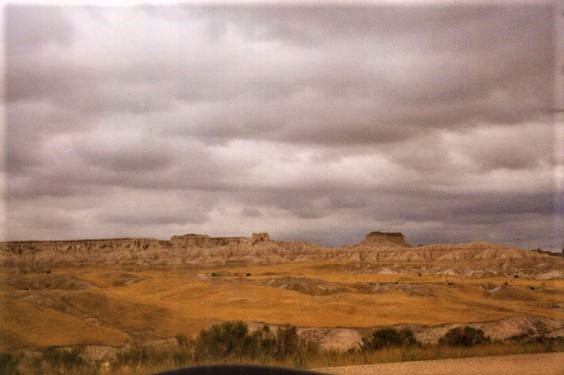
It is shocking and dispiriting to see first hand the land the US government “gave” the tribes of the Sioux Nation for their reservations in the Badlands, after Sitting Bull and Crazy Horse surrendered to end the Black Hills War. The Sioux didn’t even get all of the land, because the government cut out a major chunk of the Badlands to create Badlands National Memorial in 1929. Ten years later the memorial was upgraded to become a national park.
Driving across the bleak, prairie land of the Badlands, you pass forbidding white spires, angry grey cliffs, and squatty buttes. The Sioux people must have felt as desolate as the landscape, when they realized that, of all the lands they had roamed, the most uninhabitable area was where they were to be confined. The oppressive August heat in 2013 emphasized the grim harshness of the sun-baked landscape of the Badlands as I motored along State Road 40.
Evidence of neglect of reservation lands, and the needs of resident Indians, was even revealed in the road conditions to and through the Pine Ridge Reservation. South Dakota’s State Road 40, the road I drove heading southeast from the City of Keystone to the Pine Ridge Reservation, was a well-maintained, paved road. But when it became a Bureau of Indian Affairs (BIA) road within the reservation, the pavement ended. My vehicle had to endure forty miles of gravel whacking its undercarriage to reach Wounded Knee. Pavement reappeared when I left the reservation.
I stopped at Badlands National Park before driving through Pine Ridge to Wounded Knee. After reviewing the historical and geographical information at the Park Visitors Center, I asked the sole ranger on duty what I would find at the actual site of Wounded Knee. The ranger was tall, lanky, and had the weather-beaten good-looks of Gary Cooper. His laconic reply to my question was, “There’s not much there.” His answer was correct on the surface, but at a deeper, personal level, he was wrong.
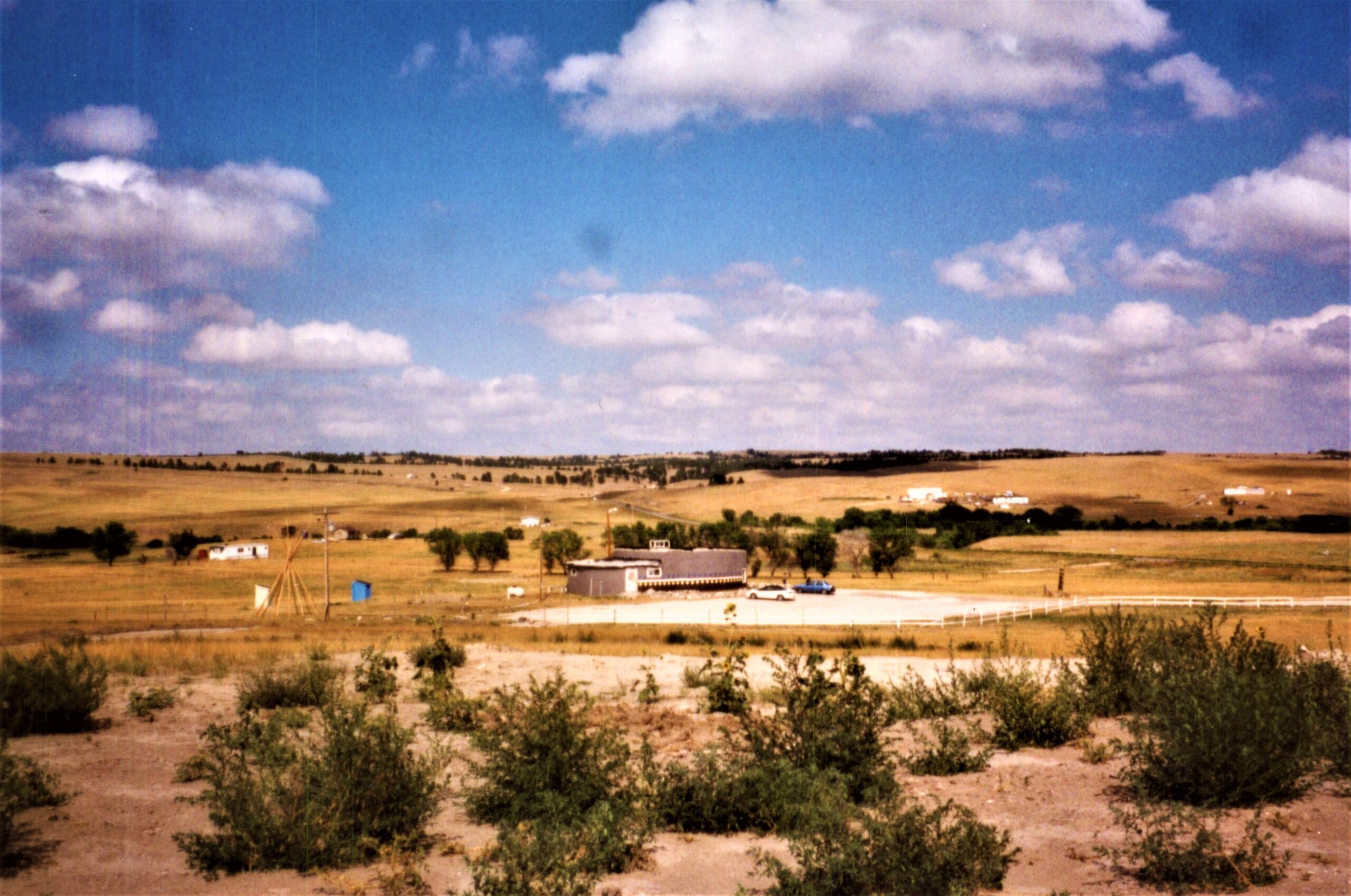
On the east side of the dirt road at the site of the massacre were a couple of forlorn-looking booths with beaded belts, necklaces, and other handcrafts for sale. An elderly Indian in a stained white t-shirt with a Fruehauf Truck cap shading his eyes was asleep on a metal folding-chair behind one booth. A couple kids played in the dirt under the other table. On the west side of the road was a curved structure of wood and concrete with a sign indicating it was the American Indian Movement Center.
Inside, the walls were covered with posters and propaganda for AIM. The sparsely furnished interior had a long counter with an aged metal cash register. Piles of t-shirts, books, and handmade trinkets were for sale on top of rickety tables. The “library” consisted of several boxes of cut-out newspaper and magazine articles, a few dusty hardback books, and a scrapbook about the history of AIM.
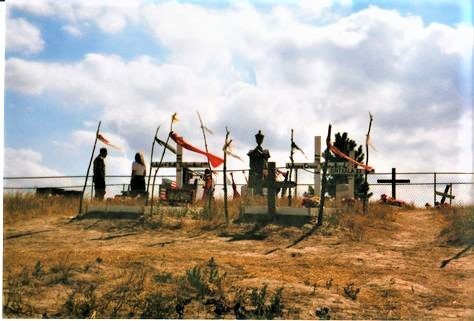
Behind the building were two small hillocks with graveyards on top of each mound. An elderly Indian wearing a faded cowboy hat, dirty jeans, and stained t-shirt was leaning against the side of the building smoking a hand-rolled cigarette. I asked him if there was a monument to those who were killed at Wounded Knee by the US Cavalry. He looked me up and down without registering any expression. He slowly raised his arm and pointed toward a fenced area beyond a number of grave markers on the closest mound. I thanked him. He made no reply.
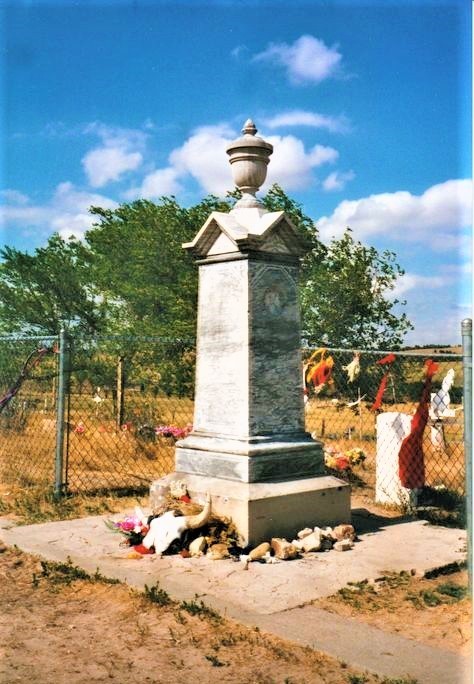
The fenced area for the memorial was about ten feet by six feet. A six-foot high granite monument stood inside the fenced area. Names of victims and a few words about the massacre were incised on the monument.
While we know that at least 200 – and it was probably closer to 300 of the 350 Minneconjou Sioux in Spotted Elk’s band – were killed at Wounded Knee, I counted fewer than 40 names on the monument. I don’t know whether the other names are lost in the mists of history. The skull of a horned steer was placed at the base of the monument. Shards of broken pottery, a few faded flowers, ribbons, and a couple fake gold coins were scattered around the base of the monument.
I placed two stones on top of the weather-beaten skull. I had purchased the rocks for one dollar each from two Oglala Sioux kids at the intersection of two gravel roads within the Pine Ridge Reservation. Their father told me he wanted to “encourage entrepreneurship” in his kids. Beaming with pride, Dad explained how his two boys search for nicely-shaped rocks, polish the best ones they find, and then sell the shiny stones on the roadside to people driving through the reservation.
How brave and pathetic! My heart ached for those kids and their dad.
It seemed like an appropriate symbolic gesture to pay for those two little pieces of the land and then give the polished stones back by leaving them at the memorial to Spotted Elk and the Minneconjou who were killed by the bullets fired by my ancestor, First Lieutenant James DeFrees Mann, and the soldiers of the 7th US Cavalry.
No one else entered the small cemetery during the half hour I spent on the hillock meditatively eyeing other grave markers. I shielded my eyes from the sun and gazed back across the road beyond the AIM Center. It was just over there, on the other side of the road, where Spotted Elk and his band of 350 Minneconjou Sioux had camped under the watchful eyes of Lt. Mann and the cavalrymen of K Troop. Beneath the soil of the earthen mound where I stood are the bones of the men, women, and children, whose bodies were tossed into the mass grave dug in the days following the massacre. The remains of more recently deceased residents of Pine Ridge Reservation share that little plot of raised earth with Spotted Elk and his Minneconjou.
Back inside the AIM Center, I tried to make conversation with a stoic-looking middle-aged woman, who was sitting behind the counter with a few kids. She didn’t give her name, and I didn’t ask. No other visitors entered the building while I was there.
I overcame my hesitation and told her about my ancestor’s participation in the Wounded Knee massacre. She evinced no hostility; just gazed evenly at me through tired brown eyes. She wore a blue work shirt buttoned up the front, jeans, and had long, straight black hair, which almost reached her waist.
She said she didn’t know anything about the cavalrymen involved in the massacre, and didn’t recognize Lt. Mann’s name. My look of surprise registered with her. She looked away, then pursed her lips and said that maybe she remembered reading an old newspaper that mentioned Lieutenant Mann.
A boy, who looked to be about ten years-old, studied me with watchful, curious eyes, when I was perusing the library materials. Later, while I was conversing with the Center’s attendant, the lad listened intently to our conversation. When the conversation wound down, the woman nodded at the boy and told me he was her son. That seemed to be the cue he’d been waiting for, because he launched into an obviously prepared speech requesting a contribution to a fund for his baseball team. He held out a rumpled leaflet for me to read. His limpid, brown eyes shone with excited anticipation. I gave him a ten-dollar bill, tapped the brim of his baseball cap, and wished him and his team good luck. His mother’s lips turned up very slightly at the corners. It was almost a smile; the first and only indication of friendliness I received from his mother. Her son thanked me and shook my hand formally.
Before I left the AIM Center, I bought a t-shirt for twenty dollars with the American Indian Movement logo on the front and back. The logo was the figure of an Indian warrior with two feathers in his hair shaped to look like the two-fingered gesture of victory.
I fantasized time-traveling back to high school and wearing the AIM shirt to a basketball game. Our varsity teams were the Goshen Redskins. The mascot was a little White kid, whose cheeks were streaked with red “war paint”. During my K through 12 years in the Goshen Community Schools, “Little Chief” wore an elaborate buckskin outfit with a feathered-headdress. He led the basketball team onto the court for warm-up drills before the start of each home game. During warm-ups, Little Chief stood at mid-court with his arms crossed like a dignified Indian chief. The little White boys chosen to be Little Chief were always about the same age as this boy, who looked at me with wide-eyed curiosity when I entered the AIM Center and shook my hand before I left.
My junior year in in high school, a young woman fresh out of college was hired as our journalism teacher. Ms. Thomas allowed students to change the name of the school paper from The Tomahawk to The Goshen Peace Times. Instead of bland, rah-rah school-spirit articles, The Peace Times published anti-Vietnam War articles and reviews of rock music. It printed an editorial suggesting that the team name should be changed out of respect for Native Americans. The editorial was met with almost universal hostility. It was condemned by townspeople, faculty members, school administrators, and many students. No Indians had complained about our mascot being offensive, nor had any tribes demanded that the school change the name. It was outrageous blasphemy against our customs and traditions even to suggest such a thing!
Ms. Thomas was rebuked for allowing her student-journalists too much freedom of expression. The high school administration shut down The Peace Times after that outrageous editorial. The young, idealistic journalism teacher left town at the end of the school year. But a couple decades later, in 2016, the Goshen Community Schools Board decreed that the team name would be changed from Redskins to Redhawks.
The Goshen News
I left the AIM Center and drove into the “town” of Wounded Knee, which was just around a bend on the unpaved BIA Road 28. A rusted metal chair stood in the middle of the dirt road running down the center of town. Resting on the rusty chair was a hand-painted sign on poster board. It read, Drive Slow Stop Killing Our Children.
Wounded Knee had the depressed ramshackle look of other settlements I’d driven through on reservations in South Dakota. But it was the worst. It was and is a squalid, poverty-stricken settlement with dilapidated houses and rusting mobile homes. When I was there, trash littered the street. An old woman walked across the dusty road in front of my car. She looked at me through the car’s window without registering any emotion. Her eyes were dull and her movements listless.
The Census Bureau’s information on the town of Wounded Knee for 2018 reports a population of 456 with a median household income of $7,292, which has fallen, instead of rising, since I was there in 2013. Between 2017 and 2018, the population of Wounded Knee declined from 521 to 456. According to the Census Bureau, the poverty rate is 95.2%, and only eleven residents are employed. The median household income for the State of South Dakota in 2019 was $58,275, about 8.5 times higher than the median family income in Wounded Knee.
The median age reported for Wounded Knee is 21.6. In South Dakota it is over 40. Several Trip Advisor descriptions of tourist experiences at Wounded Knee and the Pine Ridge Reservation include complaints of being accosted by young men demanding money or trying to scam tourists. Not that I approve of scamming tourists, but what exactly are young people supposed to do in a community with a poverty rate of 95.2 percent?
If America is going to continue to claim it is a moral leader, the “city on a hill” and beacon to the rest of the world, we have to finally and fully face up to our genocidal history and national sin.
Excerpted from America’s Existential Crisis: Our Inherited Obligation to Native Nations by Jeff Rasley, Midsummer Books 2021, exclusively available on Amazon.
In the sadness of afternoon, shadows of former happiness lengthening, sounds of other lives muted, lone tyre howl receding, future appalling, I recall my past. I read curved across carpet like a cat, aggravating my father, a boy lost in American struggle from afar; Steinbeck, Dos Passos, Sinclair Lewis. On Friday nights I sat engrossed, face ghost-lit, sometimes watching cinematic adaptations of those books.
During a barren fog of factory hours in my excited teenaged loneliness, my yearning a storm to go somewhere, go there, a chaotic jumble of imagery merges with books and movies. A moody John Cassavetes type, I prowl the clangour of a poverty-shrouded waterfront area, sling my hook with longshoremen, argue with an emphatic unshaven priest who demands a beer, and workers’ rights.
World now moved on to these tragic times, light fades as if weary, reflects from familiar surfaces; the great dumb fridge, TV’s blank screen. I drift back again, seize my chance in neon-festooned Vegas, run numbers, survive on actors’ charm, bounce along Atlantic City’s boardwalk, Lucky between lips, ready to rebel, stumblingly articulate like James Dean’s shooting star, high on hope, adventure, revelling in American grunge glamour.
In my refuge’s silent splintering memory doubles as medication. This plague spins its web, trapping world travellers. Remember jetlag? Narratives of life and death disappear faster than turned pages. Among my cramped comforts screens much smaller than those of youth’s captivation occasionally transport me in isolation to a better time when I flew across a broad ocean, then a continent, heaved my heavy backpack into the Newark night. Veni vidi.
****************
Ian C Smith, Australia <icsmithpoet@gmail.com>
Magnetic Horizon
Watching yachts, tinnies, round Old Man’s Head in this thrum of wind ruffling the feathers of patrolling sandpipers, he considers the choice of a single word to describe the way gulls flicker across sifted cloudlight blanketing Bass Strait. Each summer he dwells there like a gipsy, staying wherever he can overlook this cove.
Barefoot, sunburnt in the lamplight by the beach of an island in a primal sea, they played rummy, two packs, jokers wild, a rum recipe of clan rules. Nobody could decently shuffle such a knackered elastic-banded deck. The father, off the grog, going around in circles, dealt, cards flying, acolytes alert for arcane witticisms.
Here, in the lee of the roaring forties, sand engulfs the ribs of an old wreck. Children have built a Lord of the Rings realm, a stark beachscape weathering tides, reminding him of sojourns when his children sculpted sunlit sand, when, like most, he was unable to foretell the haunted whispering of his blind spots.
Sensing glory, one might reach for the discard pile, taking a chance on a bait-stained handful, only to be stunned by the winner going out with a whoop. Caught with your pants down, was their chortle. A king of spades, beard curling, looked sad for a family man on holiday. If he used that sword on some hapless subject it was for the common good.
Where the sea furls, muscular young men run. He would wind this vision down to slow-motion like the opening scene of glorious athletic youth in Chariots of Fire. How can they be his sons from long ago? Yet their names are the same, the blond manes, their self-conscious shouts, a narrative nothing like his own best-forgotten youth. They plunge into foam, a weight shifting in his heart.
A queen of hearts resembled Anne Boleyn on the way to her own execution clutching a posy of forget-me-nots, wondering what happened to romance. Two jokers idled on crescent moons peering down through binoculars, prankster gods bemused by in-house catchphrases, deft mental arithmetic, the way the suits always ended up together.
Near a pioneer’s grave silent women from the yoga retreat exchange smiles with him as a pair of sea eagles circle the tinted sky. He catalogues his picaresque past, wonders about absolution, if he is a recurring antic dream to his sons, silence ringing like the cessation of a tolled bell, marking seasons that all too quickly fell.
******
Traversing Afar
Shucking the duvet on runny-nosed mornings that winter, the view from my attic window was often of frosted fields. Instead of slouching off to work in those pre-computerised days I filled pages with biro ink. Adlestrop station nestled nearby, unknown to me, as was Edward Thomas’s aching poem evoking a past all changed. Wind-borne rain ruffled rooks in tall elms sheltering horses, rattled that window of what I fancied a garret atop the mansion where I attracted the law, ineptly triggering the burglar alarm several times scrubbing six bathrooms for my rent, to the cops’ smirking annoyance. A gas heater on castors like a metallic seeing-eye dog companion-cum desk collecting an Olympian pattern of coffee rings, completed my joy of faux hardship, days I once did, the rest memory.
In Lower Oddington’s Norman church I stood, silent before the pale colours of medieval paintings, imagination brimming with people’s fate. In that sanctum’s musty mortar odour I thought of hope’s constant struggle, the word Beloved mind-echoing. Born in Twickenham, Australian-raised, I remembered Sunday school, hassock dust smell, knees hurting, apostles of stained glass pitying poor sinners, our quivering vicar praying for salvation. Now in Gloucestershire, befriended by a local woman who exercised hunters for a pittance, I accepted her invitation to join the villagers calling on the wealthy, an annual event on Christmas Eve, my birthday.
Surrounded by servants we chorused for local charity, this carolling crew of the Cotswolds below portraits galore: We Three Kings within tall walls. A Who’s Who of privileged begetting, lords in tweed, looked down on menials warbling their way through grand equestrian estates. A feed of mince pies, mulled wine from a silver tray, was served with wit from one squire about booze and Aussies. I bit off the crust, near choked, but these workers were anxious to amuse the weed. How funny is a rich man’s joke? I chased a maid for more wine, flashed a grin at this unwise man, their chief with no chin.
*****************
Biog: Ian C Smith’s work has been published in Antipodes, BBC Radio 4 Sounds,The Dalhousie Review, Griffith Review, San Pedro River Review , Southword, The Stony Thursday Book, & Two Thirds North. His seventh book is wonder sadness madness joy, Ginninderra (Port Adelaide). He writes in the Gippsland Lakes area of Victoria, and on Flinders Island.
Art(Tarot, Major Arcana XIV.)The declining age first tastes like honey, yet its instant fermenting sweat, the constant human struggle, the cramped and inflexible exercise of power squeezes stinking secretion through the pore billions of Earth’s skins.The degenerate species are dying out. The Savior is climbing on the lustfully gaping chimney of the caves towards our Earth mother’s womb. The universe: an umbrella.Successive events: sewing machine. The creative intention: dissection table.What it’ll find is Cybele’s frog-headed, rotten fetuses,their tales are arrowhead claws(We lifted the processes of the dead world to the vegetative level,and indeed, fat homunculus jumped out of the alchemist's cauldron, but at a lower quality, as its creator.)The offspring are our caricatures! The offspring are our caricatures!The eternal mystery is research, experiment, when Aethyr collapses into a magical orgasm,and explodes. The remains are a cooled off, lifeless cosmic spider web, what for a moment, the charlatan enchanted to live.
(Translated by Gabor Gyukics)
Laszlo Aranyi (Frater Azmon)
A Művészet(Tarot, Nagy Arkánum XIV.) Hanyatló kor először mézízű, ám azonnal erjedő verítéke… Az állandósult emberi erőlködés, a görcsös és rugalmatlan hatalomgyakorlás bűzös váladékot présel ki a Föld-bőr pórus-milliárdjain. Kiveszőfélben a korcs faj. A Megmentő barlangok kéjre táguló kürtőjén mászik Földanyánk méhe felé.Az univerzum: esernyő. Az események egymásutánja: varrógép. A teremtő szándék: boncasztal. Amit talál: Kübelé békafejű, rothadó magzatai, farkuk nyílhegy-karom. (A holt világ folyamatait emeltük vegetatív síkra, s tényleg, kövér homunculus ugrott ki az alkimista-üstből, de alacsonyabb rendű minőség, mint teremtője.)Az utódok: karikatúráink!Az utódok: karikatúráink! Csakis a kutatás, a kísérlet az örök misztérium, amikor az Aethyr mágikus orgazmusba ájul, és szétrobban.A maradvány kihűlt, élet nélküli kozmikus pókháló, amit a szemfényvesztő egy pillanatra élővé bűvölt. Aranyi László
Laszlo Aranyi (Frater Azmon)
The One Who Arrives Late Leaves the EarliestGhost figure. Stretching and dilating erratically.It’s a cotton candy textured. wobbling flame of a candle. Its puke tasting flesh is sticky. Its silvery spark disappears in the depressing whiteness.“Whaddaya want, dickhead?”The Philosophers' Stone! The universal knowledge that transcends the worlds!Gopher chewed, holed, spray-stained hat on the scarecrow… Worthless… Our depraved World soon will be nothing else but a shrunken head pendant on the keyring of the Guardian of the Keys.Why do you always have to stir up the sediment? Miserable, despicable restrictors and restricted ones!A distrustful, fat cat is sitting on the threshold. (It is a Threshold…)The woman is again endlessly screaming without taking a breath. She’s drunk.She peed herself so ‘cause she wasn’t able to take her panties off in the toilet…She turned out from the forge, eerie amount of waste stir and move insidiously.A bunch of passersby are slim sandglasses demanding usurers.
(Translated by Gabor Gyukics)
A késve érkező korábban távozik Szellemalak. Szeszélyesen nyúlik-tágul. Imbolygó gyertyaláng. Vattacukor állagú. Émelyítő ízű húsa ragadós. Ezüstös csillogása a elvész a nyomasztó fehérségben. „Mit akarsz, fatökű?”A Bölcsek Kövét! Az univezális, világokon átívelő tudást! „Pocok-rágásoktól lyuggatott, permetlé-foltos kalap a madárijesztőn… Nem jó az semmire… Az elfajult Föld előbb-utóbb úgyis zsugorított fejű figyegő marad a Kulcsok Őrzőjének kulcstartóján.Miért kavarjátok fel mindig az ülepedőt? Nyomorult, hitvány korlátozók és korlátozottak!”A küszöbön gyanakvó, kövér macska ül. (Ő a Küszöb…) Az asszony már megint egyfolytában, levegővétel nélkül rikácsol. Részeg. Még a bugyijától sem szabadult meg a WC-n, így összpisálta magát… Héphaisztosz műhelyéből került ki, alattomosan mocorog-mozdul a hátborzongató mennyiségű selejt.Uzsorást sürgető karcsú homokórák az összeverődött járókelők. Aranyi László