Magical Thinking
We wish upon the stars, breathe upon the moon,
our outgoing breath outpouring
against an infinity of jewels populating
innumerable galaxies as we look at the night-sky.
Nothing is out of place, only our own sense
of dispossession, which repeats
like every shot of whisky
on the irrationalisms of which we are made.
Turning ever inwards, the winter nights becoming
less endurable, less navigable by the hour,
our oblivion more of a constant
companion than any sought after destination.
Should we meet again, we might well
ascribe our good fortune to the numbers.
Whatever outcomes are realised by errant dreamers,
love shall transform the season over and over.
Phenomonology of the Soul
Where is the soul of man to be found?
In dreams? A boy prays,
struggling with the thought.
“What if I should not wake tomorrow,
but continue to dream
and if I should not wake
from that dream, but find myself caught
in a perpetual dream-loop,
then what of the real world,
father dear and mother?” As a younger child
he imagined himself unable
to escape his world of dreams.
Now he believes he is still dreaming
when he thinks
he might be awake.
“Perhaps I’ve been stuck
in this dream for as long as I am
able to remember.
Perhaps there is no way out.”
His heart leaps within him, stirring his soul
to doubt God.
As a grown man, the former boy dreams
of waking from his trance,
no nearer to finding God,
his only consolation
to be found in the music of his dreams,
between earth and sky.
Precept and Prayer
for Helen Bullas
Town full of revelers, couples, beautiful girls.
Not a soul to step forward for me,
Except for you, my most beautiful friend.
Your tears hurt me more than I can tell,
But I’m still capable of bravery,
Laughter and forgetting, like a man
Who hasn’t entirely lost hope.
Sometimes there’s nothing to do, but write
Our poems as if it really made a difference.
As if, somehow, it mattered more than a jot.
At last, I beg you not to cry for me
Because my feud with god isn’t yet over.
So come pray with me now
And all the unbelievers, as if praying
Were the only sacrament missing from our lives.
Law of the Past
This poem is the only artefact that’s left
after all the years
of my loving you in secret. Even now
we hope to hide our identities
from the world. You are still L, and I, M.
This is how it must be, with all the resolve
of heaven and Earth.
Perhaps this will be the last thing
I ever write about us.
Remember when you played guitar for me?
Now you are married with a family
and wish to forget.
Only the past has a way of catching up,
catching us off guard, forcing us
to account for our strange, conflicted selves.
Dead Dog Paradox
Was the dead dog man’s best friend?
Did the dog deserve to be burned alive?
Did the dog deserve to be beaten to death with a stick?
Did the dog deserve to be poisoned to death?
Who set the trap to cut the dog in half?
What was the dog’s name?
Was the dog troubled with rabies?
Did the dog deserve to be hanged in the street?
Who sanctioned the killing of the dog?
Had the dog played at ball in the fields?
Had the dog run wild in the woods?
Had the dog run amok in the town square?
Did the Mayor pay local citizens to murder the dog?
Who threw the first stone?
Who beheaded the dog?
Who skinned the dog alive for its pelt?
What had the dead dog done to warrant such cruelty?
Self-Portrait, 2019
for Frank Bidart and for Nora
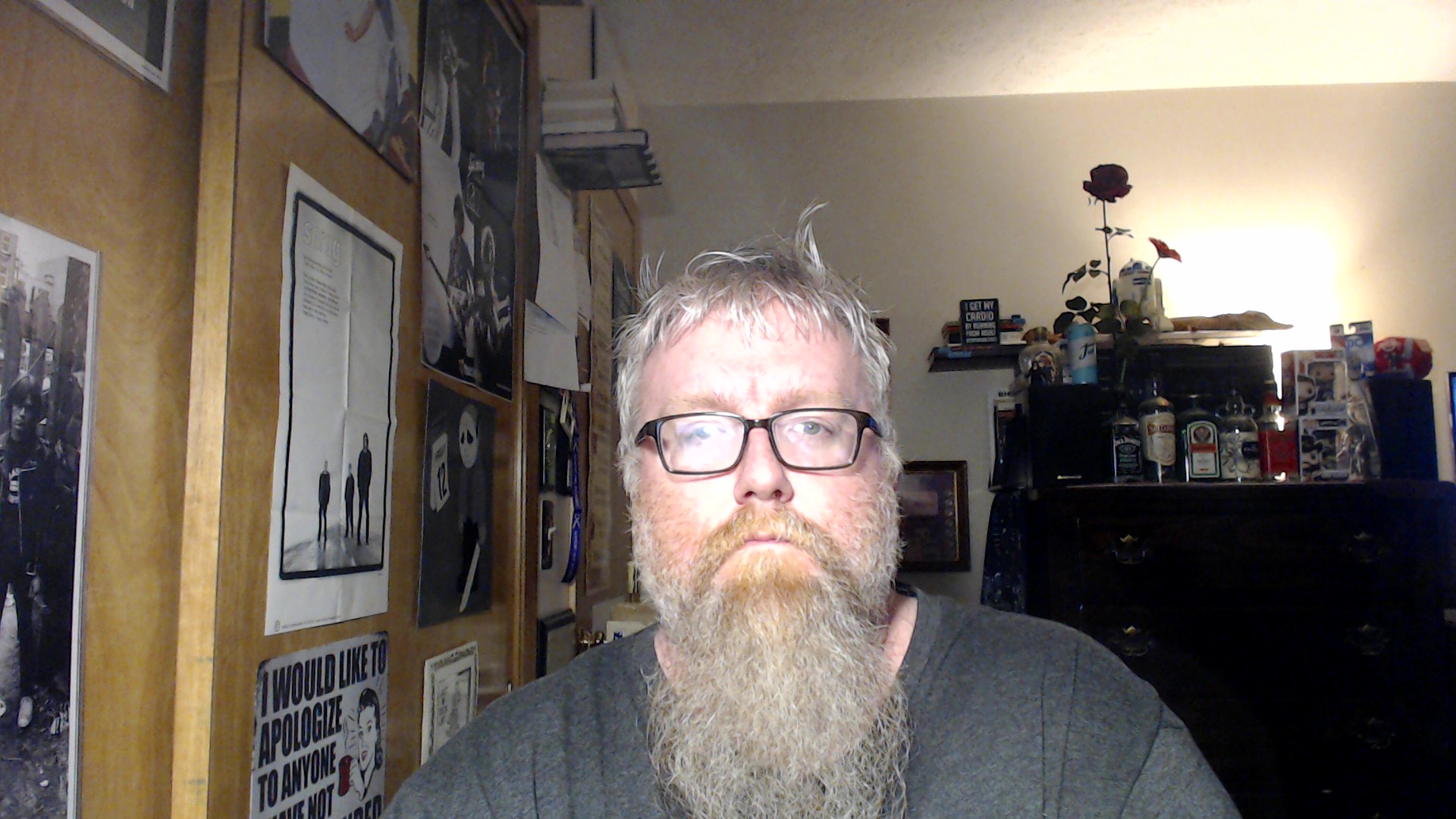
He’s no longer young at forty-nine, but looks younger,
or does he? Certainly, he feels younger
than his years, but the baggage under the eyes
has justly recorded a decade of sleepless nights,
the greying hair, the almost white unkempt beard
betrays
his exit from the world of bodies, but signifies
a wider, more pressing change of heart. The one time asexual
poet, grieves no more for the pejorative virginity
of yesteryear, but looks at the tear in his right pupil —
not as the symbol of a once broken heart,
but a super sigil, denoting and demanding a rare optimism
in place of doubt and denial. In the mirror, nothing
is missed, the yellow worn out teeth, the metaphorical
lumps and bumps of ageing, his mother’s sensual mouth,
his father’s Roman nose, the desire still to be loved.
Mark A. Murphy is the editor of the online journal, POETiCA REViEW. His poetry collections include Tin Cat Alley (1996), Our Little Bit of Immortality (2011), Night-watch Man & Muse (2013) and his next full length collection, Night Wanderer’s Plea is pending from Waterloo Press, UK in 2019.