Uzbek State World Language University, Faculty of English Philology, 2nd-year student
The Role of Sleep in Academic Performance
Choriyeva Oynur
Uzbek State World Languages University, Faculty of English Philology
2nd-year Student
Abstract
This article examines the important role of sleep in academic performance. It demonstrates how adequate and quality sleep can enhance memory, improve focus and concentration, and support cognitive functions such as problem-solving and critical thinking. It also highlights that insufficient sleep can reduce memory recall, decrease attention, worsen academic performance, lower grades, and reduce productivity. The purpose of this article is to emphasize the importance of obtaining sufficient, regular, and high-quality sleep for effective studying.
Keywords: sleep, academic performance, memory, attention, cognitive functions, reading, productivity, student health, effective studying, overall quality of life
Introduction
Sleep plays a vital role in student health and academic success. According to the Centers for Disease Control and Prevention (CDC) and the National Institutes of Health, adequate sleep is essential for physical health, mental clarity, and overall quality of life, especially for young people. During Student Sleep Health Week, the Indian Board of Education provides resources and recommendations on the relationship between deep sleep and success.
The CDC emphasizes that sleep is crucial for memory consolidation, learning, and cognitive functioning. Students who do not get enough sleep struggle with concentration, problem-solving, and remembering information. This can negatively affect their academic results, lower their grades, and reduce productivity.
Leslie L. Crow, a licensed professional counselor and specialist in BIE’s Student Behavioral Health Program, notes that sleep significantly impacts students’ academic and athletic performance.
“Healthy sleep habits greatly affect the mental and physical health of children and adults,” Crow states. “Sleep influences our emotions, stress management, and overall well-being.”
Main Body
Sleep is essential for cognitive functions as well as overall physical and mental health. According to the CDC, insufficient sleep is associated with increased risks of obesity, diabetes, and other chronic health conditions. For students, lack of sleep can lead to reduced energy levels and greater susceptibility to illness, preventing full participation in academic and extracurricular activities.
The two most common consequences of insufficient sleep are decreased focus and impaired memory. These effects are not only harmful individually but also compound each other. Lack of focus results in incomplete information retention, which is further compounded by inadequate neural connections formed during learning.
Insufficient sleep can reduce both short-term and long-term memory. Short-term memory retains information briefly, such as remembering someone’s name upon meeting them or recalling the last few words on a fast-changing PowerPoint slide. Long-term memory involves retaining information for hours, days, months, or longer, such as remembering due dates or recalling past events. Students struggling with sleep-related stress over classes may benefit from seeking tutoring to improve mastery of the subject.
Leslie L. Crow emphasizes the importance of understanding recommended sleep durations for different age groups. According to the National Sleep Foundation, teenagers need 8 to 10 hours of sleep per night, while younger school-aged children require approximately 9 to 11 hours within 24 hours. Crow notes that many behavioral and mental health issues, such as attention-deficit/hyperactivity disorder, anxiety, depression, and difficulties in emotional regulation, may be partially or entirely caused by sleep disorders.
To address these challenges, the CDC recommends maintaining a consistent sleep schedule, even on weekends, to regulate internal biological clocks. Additionally, creating a sleep-friendly environment—keeping the bedroom dark, quiet, and cool—can significantly enhance sleep quality.
Crow also provides practical tips to improve sleep:
Go to bed and wake up at approximately the same time every day.
Maintain a consistent bedtime routine.
Use the bed only for sleep.
Spend time outdoors to get sunlight and engage in physical activity.
Avoid screen time before bedtime.
Model healthy sleep habits for students.
Consult a medical professional if sleep problems persist.
By prioritizing sleep, students can improve academic performance, enhance physical and mental well-being, and establish habits that contribute to long-term success. Student Sleep Health Week serves as a vital reminder that adequate sleep is not a luxury—it is a necessity.
Conclusion
There are multiple ways to measure the relationship between sleep and academic performance. Much of the earlier research focused on sleep duration and sleep quality, with mixed results. These measures have limitations—sleep duration is usually self-reported, and sleep quality is subjective. Recently, novel measures of sleep have emerged. The timing and consistency of sleep may have the greatest impact on academic performance.
J.J. Campbell (1976 – ?) is old enough to know where the bodies are buried. The three- time Best of The Net nominee and two-time Pushcart Prize nominee lives with his disabled mother in Ohio. He’s been widely published over the years, most recently at Yellow Mama, The Rye Whiskey Review, Night Owl Narrative, Disturb the Universe Magazine and The Beatnik Cowboy. His latest book, to live your dreams, published by Whiskey City Press, is available on Amazon.com. for more info on the book, go here: https://www.goodreads.com/book/show/245883678-to-live-your-dreams.
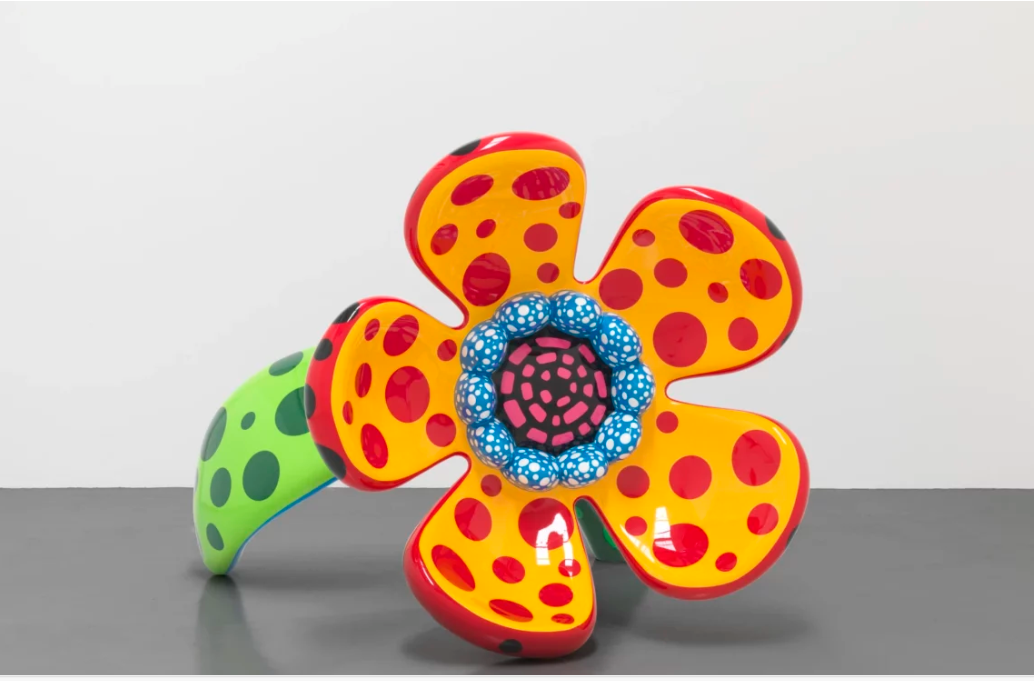
The spell of the red flowers in the nursery seeds planted in World War Two Japan in the afternoon shadow of the Japanese Alps in the personality shade of a troubled family a berating mother sending the child to spy on the playboy father sexual obsession and fear sitting side by side by the smooth white river stones, flowers speaking
of the war lingering in the blackout factory thinking of hanging herself throwing herself in front of a train a shrink called her a genius helped her gain recognition planning her escape from self-obliteration from endless revolving in the infinity nets the absoluteness of reality and unreality a proliferation of talking pumpkins only to be reduced to nothingness.
Yayoi Kusama grew up in a small mountain town west of Tokyo in a wealthy, high society family, owners of successful wholesale seed nurseries. As a child she had asthma and a partial hearing loss, and she suffered from hallucinations and periods of depersonalization. Her domineering mother forced her to spy on her father and his geishas, ripped up her artwork and tried to marry her off.
Infinity Nets
The Flower That Blooms In My Heart
Out in the purple fields of flowering spring the blossoms sprung tiny individual faces opened pistil mouths to her, to the child the violets spoke chasing her back to her mother’s house of anger, fighting and a pencil, paper the art supplies her father gave her only escape.
Her spirit floated from her little body wandering the border between life and death a thin curtain of gray like a personal cloud shadowing the girl the young woman bent over body drawing, sketching painting, creating in a wild fever born of desperation reproducing endlessly on the conveyor belt to infinity, net cast over her life, art her creed.
Paintbrush in hand imagination overdrive obsessions crawling mind and body working herself away from madness on an endless highway of fear and visions fleeing hallucinations seeking obliteration following the flowers following red thread on the path to freedom allowing her to live.
Yayoi’s art has been called feminist. It’s been labeled pathological art brut, or outsider art. She doesn’t think it fits any category. She mixes East with West, realism with surrealism, hallucinations with humor and pathos. Her work is eclectic and electric and eccentric. It is her own, unique.
The Scandal Queen of Japan
“Ultimately, behind the impulse to fight is the simple fact that men have penises.”
Repetitive Vision
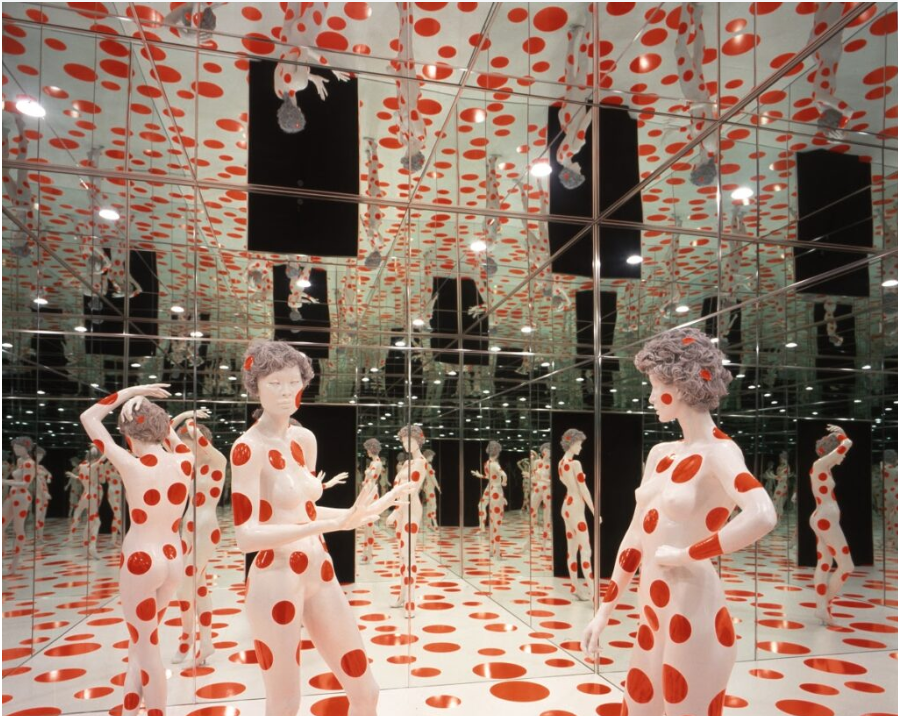
Soft-sculpture figures by the boatload the couch load the chair load furniture obsessions macaroni mannequins overcoming fear machine-made naked polka dots all the way to her studio across the street her permanent residence a psychiatric ward.
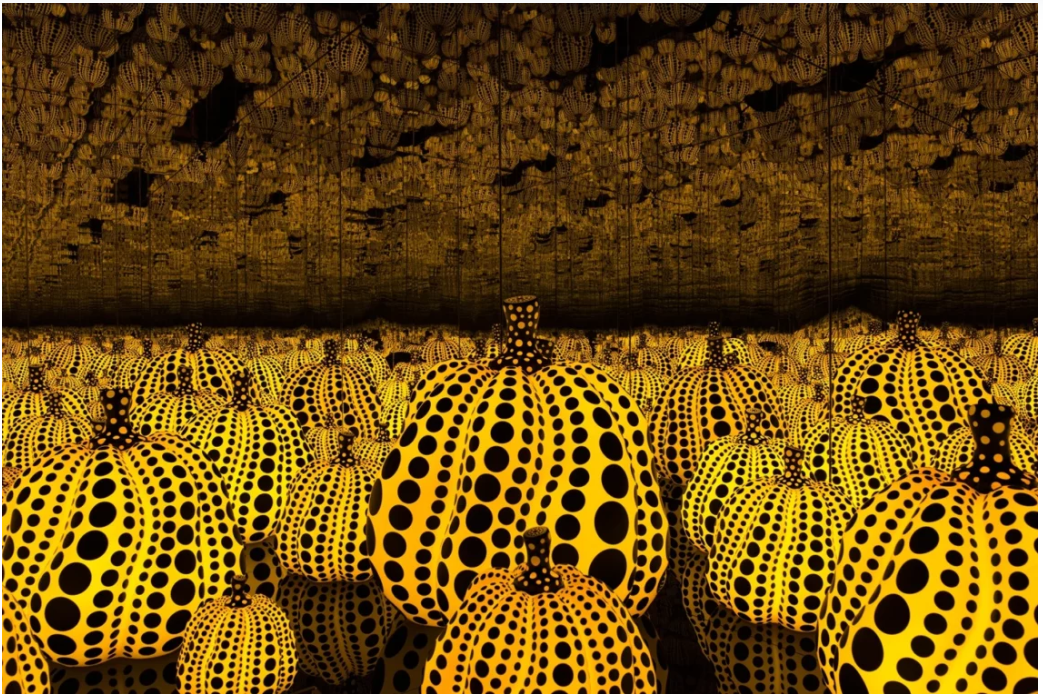
If it were not for art I would have killed myself a long time ago before global fame before legions of fans her alter-ego pumpkin black spots on a pier of plastic and I’m here but nothing in Tokyo infinity in mirrored rooms dancing lights fly up to the super-reality to the unclothed universe all together in the altogether the dissolution of self via immersive obsessions repetitions and intrusions transporting us too to another cosmos.
In the midst of the mid-century avant-garde art revolution, Kusama’s large scale paintings of nets and polka dots caught on. Critics called her work obsessional, austere, disturbing, and a tour de force. She expanded her work to include political theater, fashion design, and body art. Her clothes were sold in Bloomingdale’s, and she appeared on The Tonight Show. But in Japan she was a national disgrace and her family shamed.
Fire Burning in the Abyss
My Eternal Soul
The Manhattan suicide addict starving, suffering the vertigo of nothingness crawling into cold hands no heat, no bed, no money the downtown den of resistance a shimmering veil across reality fate like a chorus of violets launching her like a moonshot into the bright eye of acclaim crowds at galleries, museums drawn to her strange beauty blending personal revelations bare-faced self-promotions branding the self as product art as fiery weapon: Go live your shining life.
Back home in Japan the castle of shed tears a studio down the street from the stark white room at the soft sculpt loony bin in the moon dot aftermath of obliteration of eternity the world’s most successful living artist transcending female Asian identity art genres and cataloging unnecessary boundaries barriers and structures dancing swarms of fireflies fly up and out of this universe showing the route to full happiness to spending everyday every day embracing red flowers.
Yayoi believed that Japan had ostracized her for her mental illness. But she returned there after 17 years in the U.S, famous and successful and so ill she chose to live in an open ward of a Tokyo mental hospital for her own safety. In the 2000s, she collaborated with several brands to share her style including polka dot Cokes and pumpkin-like BMW Minis. She continues to create at age 97 and traveling retrospectives of her work still draw massive crowds.
Mazkur hikoyada kundalik hayotda uchraydigan oddiy savdo jarayoni orqali halollik, mas’uliyat va insoniylik kabi fazilatlar yoritiladi. Muallif Rossiyada tahsil olayotgan paytida quloqchin sotib olish jarayonida yuzaga kelgan kichik muammo haqida hikoya qiladi. Sotuvchining vijdonli munosabati, xaridor oldidagi mas’uliyati va halolligi voqea orqali ta’sirchan tarzda ochib beriladi. Asar insoniy qadriyatlarning millat va hudud tanlamasligini ko‘rsatadi.
Kalit so‘zlar: halollik, savdo madaniyati, mas’uliyat, insoniylik, sotuvchi va xaridor munosabati, ishonch.
Аннотация В данном рассказе через простой случай из повседневной жизни раскрываются такие человеческие качества, как честность, ответственность и порядочность. Автор описывает ситуацию, произошедшую во время покупки наушников в период обучения в России. Несмотря на возникшую небольшую неисправность товара, продавец проявляет честность и ответственность перед покупателем. Рассказ показывает, что такие человеческие ценности, как честность и добросовестность, не зависят от национальности и границ.Ключевые слова: честность, культура торговли, ответственность, человечность, отношения продавца и покупателя, доверие.
Annotation This story highlights values such as honesty, responsibility, and humanity through a simple situation from everyday life. The author describes an incident that occurred while purchasing headphones during his studies in Russia. Despite a minor defect in the product, the seller demonstrates honesty and responsibility toward the customer. The story emphasizes that human values such as honesty and integrity go beyond nationality and borders.
I study in Russia. Recently, I bought a pair of headphones. Since the distance was quite far, I asked the seller to deliver them to the place where I live (my rented apartment). He agreed and brought the headphones. I received the product, but the delivery person did not give me even 15 minutes to check it. Therefore, I had to test the headphones later. After he left, I tried them. Unfortunately, the volume control buttons did not work, although the rest of the headphones worked perfectly. I thought, “Never mind,” and decided not to tell the seller about it. After some time, unexpectedly, the seller himself contacted me on Telegram. He asked how the headphones were working. At that moment, I told him the truth — that the volume control buttons were not functioning.
The seller immediately called me and sincerely apologized. He then refunded the full price of the headphones. What surprised me the most was that he also told me to keep the headphones as a gift. Although I am still young, I have visited several countries. In those places, I have also faced various problems while shopping. In many cases, sellers would turn off their phones or simply ignore messages.
This incident proved something to me once again: honesty and conscience do not depend on nationality. Once again, I was impressed by the honesty of the Russian people.
About the Author
Muslimbek Abdukarimov is a computer engineering specialist with a higher education. He works in the field of modern technology. His writings reflect real-life events, human values, and meaningful situations from everyday life.