Jerrice J Baptiste is a visual artist, poet, author of nine books. Her watercolor drawings on paper have been accepted or forthcoming in Synchronized Chaos, Las Laguna Art Gallery exhibit in California, MER, Spirit Fire Review, Jerry Jazz Musician Magazine. She’s presented her art work at The Omega Institute in Rhinebeck, NY in 2025. She’s been featured as a solo artist at The Mountain Top Library in Tannersville, NY in 2025 & 2026. Her most recent poetry book called Coral in the Diaspora is published by Abode Press in 2024. Her poetry has been published in numerous magazines and journals, Artemis Journal, The Yale Review, Mantis, Kosmos Journal and hundreds of others.
Help me understand why nothing matters. Repeatedly, I listen to a joke that is not funny.
Maybe my ears do not work. Maybe I am drunk, too drunk, and my mind,
my poor mind is gone. I could barely hear my own
thoughts. In my head I hear dogs barking and a tarantula dancing and time beating backward.
I grow tired of sound. If a tree falls, I cannot hear it when I see it drop in front of me. In my head an orange sunset swallows a burning plane whole.
I hear my heart racing. I pretend my heart has stopped. Believe me that nothing matters.
When I think back, I could never find my footing. The ground broke my fall. Above
the sky stood witness all day and all of the night.
Kicking Stones
I will not go along the road without kicking stones that are in the way. I kicked one so far that it was not seen again. I believe it went up to the clouds. I think it put a hole in the sun. I believe it brought down a satellite. The others only exploded right after I kicked them, too brittle for this world.
Go Nowhere
If I could anywhere, I want to go nowhere. With these eyes as my windows, I could see far and wide. I could see inside myself. I could hear everything I have ever forgotten. I can see the truth which is basically nothing depending on what you believe. I can see nowhere. It is where I want to go.
I thought I knew how people love. But I was mistaken.
While I was wandering, searching to find you, you were walking the very same path— pausing at different places, treading the same ground, searching too, just as desperately.
And when I found you, I believed that I knew more about love than you, that I would be the one to teach you what it truly meant.
But I was wrong.
You taught me how people love!
Without ever speaking the words. Without ever demanding a thing.
You taught me how to step outside the castles I had fortified myself within, how to shatter my foolish pride into pieces— simply because standing beside you was my only choice.
…..
2
The Handcuffs of Love
That night, you were beside me. And I was proud to be at your side.
No one knew about us. Nor did anyone care to know.
You were beside me, yet I could not touch you— except with my eyes. And you embraced me with yours— protectively, claiming your place next to me, unwilling to let anyone take it away.
Nor did I wish it so.
And though you had placed no handcuffs on me, I was bound to you.
Then you followed me, and you led me to the Palace of Love— where you could fasten me with your own handcuffs, as if you wished I would never leave your side.
“Release me!” I cried to you. And you searched for a way to set me free.
Yet when you freed me, I bound myself to you even tighter— for you had managed to imprison both my body and my soul, with handcuffs I had locked myself.
….
3
INEVITABLE
Some say that people meet by chance in life. That by chance they fall in love and bind themselves by Fate’s own knot.
Parallel roads that at some point finally converge.
And I wonder how all those that you desired had already been mine, long before I ever knew you.
Perhaps that is what made our union something… Inevitable.
…….
4
FAITH
I trusted you from the very first moment. I believed in you— even when my reason screamed for me to leave.
I believed in you, as if I were a lost fragment of your soul.
I felt the cry of your heart, even though you were silent, even though you claimed you had settled.
Free hearts do not settle for conventional bonds. They crave openness. Growth. Play. Variety.
But more than anything, they crave Faith— as all things do.
It is faith that keeps the flame alive, that makes it grow even under adverse conditions.
And if it falters for a moment… let it always smolder— so that with a single breath of hope it may return, just as strong as before…
THE IMPACT AND IMPORTANCE OF ARTIFICIAL INTELLIGENCE IN THE PROCESS OF LEARNING ENGLISH
Author: Jumanazarova Nafisa
Email: davlatmuradovna@gmail.com
ORCID:0009-0001-5442-4349
University:National university of Uzbekistan
Field: Foreign language and literature
Annotation: This article discusses the role of artificial intelligence in learning English. The topic is relevant, as it was chosen due to the impact of AI tools on educational processes amid the development of digital education. The aim of the article is to analyze how AI technologies can enhance the efficiency of language learning. The study employed analytical and comparative methods. The results indicate that artificial intelligence helps to individualize language learning and increase motivation, which makes the educational process more effective.
Keywords: artificial intelligence, digital education, individualization, motivation.
Annotatsiya: Ushbu maqola sun’iy intellektlarning ingliz tilini o’rganishdagi roli haqida yoritilgan. Mavzu dolzarb bo’lib, raqamli ta’limning rivojlanishi AI vositalarining o’quv jarayonlariga ta’siri tufayli tanlangan. Maqolaning maqsadi – AI texnologiyalari til o’rganish samaradorligini qanday oshirishini tahlil qilish. Tadqiqotda tahlil va solishtirma metodlaridan foydalanilgan. Natijalar shuni ko’rsatadiki, sun’iy intellekt til o’rganishni individualizatsiyalash va mativatsiyani oshirishga yordam beradi, bu esa ta’lim jarayonini samarali qiladi.
Kalit so’zlar: sun’iy intellekt, raqamli ta’lim, individualizatsiyalash, mativatsiya.
Аннотация: В данной статье рассматривается роль искусственного интеллекта в изучении английского языка. Тема актуальна, так как была выбрана в связи с влиянием инструментов ИИ на образовательный процесс в условиях развития цифрового образования. Цель статьи — проанализировать, как технологии ИИ могут повышать эффективность изучения языка. В исследовании использовались аналитический и сравнительный методы. Результаты показывают, что искусственный интеллект способствует индивидуализации изучения языка и повышению мотивации, что делает образовательный процесс более эффективным.
As is well known, in recent years digital technologies have been rapidly developing in the field of education, and tools such as artificial intelligence have been widely introduced in schools and universities. Especially in learning foreign languages, AI technologies play an important role. Of course, this makes language learning more convenient, effective, and engaging. Therefore, the role of artificial intelligence in language learning has become a highly relevant issue.
The significance of this topic lies in the fact that in the era of globalization, the English language is considered one of the main tools for professional development. For this reason, the demand for learning this language is increasing day by day. Traditional teaching systems are no longer able to fully meet everyone’s needs. Artificial intelligence, however, can organize the learning process according to the learner’s level of knowledge, learning speed, and interests.
However, it has also been observed that AI technologies do not always produce sufficient positive results in learning English. In many cases, they negatively affect students’ ability to think quickly and independently. The main purpose of this article is to analyze the role of artificial intelligence tools in learning English and to study the extent of their impact on the education system.
RESEARCH METHODOLOGY
This study was aimed at determining the effectiveness of artificial intelligence in learning English and was conducted using a mixed-methods approach. This method made it possible to examine the issue from multiple perspectives. The study analyzed the level of use of AI tools and their impact on language learning outcomes through both qualitative and quantitative data.
The main focus of the research was to identify how effective artificial intelligence tools (such as ChatGPT, Duolingo, ELSA Speak, and others) are in the process of learning English compared to traditional teaching methods. For the study, 100 students majoring in English at the Faculty of Foreign Philology of the National University of Uzbekistan were selected as participants.
Within the scope of the research, a survey was conducted to address the following questions: How useful are AI technologies in developing language skills such as listening, speaking, and grammar? Do students consider these technologies more effective than traditional education methods?
Data were collected through questionnaires, interviews, and observation. Through surveys and interviews, students shared their opinions on how frequently they use AI tools and how convenient they find them. The observation process allowed for the analysis of the practical application of AI technologies during lessons.
The effectiveness of the study was evaluated based on test results, vocabulary development, and speaking activity.
Literature Review
The integration of artificial intelligence technologies into the process of teaching English has led to significant changes in instructional methodologies. Studies conducted worldwide highlight the role of AI tools in developing language skills, organizing personalized learning, and increasing student engagement. In addition, AI-based systems for text translation, chatbots, and automatic analysis of written texts are considered effective tools in English language learning.
In a 2020 study conducted by Li and his colleagues, it was found that students’ pronunciation improved significantly through the use of AI-based speech recognition systems. These findings are consistent with Chen’s research, which demonstrated that artificial intelligence enhances learners’ oral fluency and accuracy. Furthermore, in his studies on digital education and artificial intelligence, Ben Williamson emphasizes that AI-based applications (such as ChatGPT, Gemini, Grammarly, and others) make the learning process more flexible and tailored to individual needs. According to him, artificial intelligence presents materials in accordance with learners’ proficiency levels, thereby significantly improving language learning effectiveness.
At the national level, Uzbek scholars have also been conducting research on the implementation of artificial intelligence technologies in language education. For example, studies published by Dilrabakhon Akhmedjonova and Shahnoza Hasanova analyze the role of AI tools in the process of learning English, along with their advantages and pedagogical limitations. In addition, an experimental study carried out by Zarina Sherali qizi Murodova showed the positive impact of AI-based pronunciation analysis applications on students’ pronunciation development.
At the same time, some researchers point out that the excessive dominance of AI technologies in education may limit the role of teachers and reduce social interaction. In their view, AI tools should be used as supportive instruments in education, while the human factor should remain central.
Research results
During this study, the performance of students learning English through artificial intelligence tools was analyzed. The collected data indicated that students who regularly used AI-based applications achieved higher results compared to those who followed traditional learning methods. In particular, noticeable improvement was observed in pronunciation, speaking fluency, and vocabulary development.
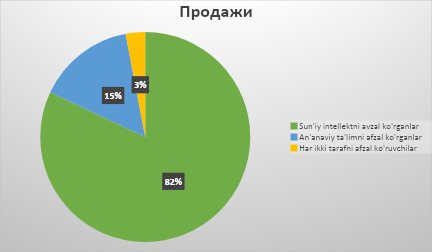
According to the statistical analysis, the test scores of the group using AI tools improved by an average of 18–25 percent. The survey results revealed that 82% of students stated that artificial intelligence applications made language learning more interesting and easier, while 15% preferred learning through traditional teachers. The remaining 3% indicated that it was not important who or what they learned from, as long as knowledge was gained.
Furthermore, classroom observations showed that students completed independent exercises more frequently and corrected their mistakes more quickly when using AI technologies.
Discussion
The obtained results demonstrate that artificial intelligence technologies have a high level of effectiveness in the process of learning English. AI-based applications play a significant role in increasing students’ motivation to learn languages, expanding opportunities for independent practice, and developing communicative skills. The analysis revealed that artificial intelligence creates a personalized learning environment, provides immediate feedback, and enhances learning efficiency through interactive exercises.
At the same time, some students prefer direct interaction with traditional teachers, which indicates that the human factor still holds considerable importance in the educational process. Additionally, 3% of the participants stated that the source of education was not important, emphasizing that motivation to acquire knowledge is the key factor. This suggests that it is not technology itself, but rather learners’ intrinsic motivation that plays a decisive role in the learning process.
Overall, the findings of this study confirm that integrating artificial intelligence technologies into English language education serves as an effective tool for improving the quality of the learning process. Therefore, it is essential to use AI capabilities wisely in educational practice, align them with pedagogical approaches, and develop digital learning environments tailored to students’ needs. This approach not only enhances language learning outcomes but also contributes to the development of learners’ independent study skills and future professional competencies.
Conclusion
This study was aimed at examining the impact of artificial intelligence technologies on the process of learning English and identifying the effectiveness of modern digital tools in education. The findings indicate that AI-based applications enhance student engagement by making language learning more interactive, convenient, and personalized. These technologies play a crucial role in providing immediate feedback, expanding opportunities for independent practice, and developing communicative skills.
At the same time, the importance of the teacher’s role in the educational process remains significant. The results suggest that artificial intelligence technologies are most effective when integrated with traditional pedagogical approaches rather than used in isolation. This combined approach not only improves the quality of education but also helps develop learners’ critical thinking, responsible learning habits, and conscious use of modern technologies.
Overall, the implementation of artificial intelligence technologies in English language education represents a key direction in the modernization of teaching and learning processes. It broadens students’ learning opportunities and increases educational effectiveness. Therefore, further research is recommended to explore the impact of AI tools across different educational levels and to analyze their psychological, pedagogical, and social aspects in order to develop more advanced digital education models.
References
1.Chen X., Liu G., Zhang Y. Virtual tutors and speaking fluency in English language learning. — New York: Educational Technology & Society, 2018.
2.Smith J., Anderson L. The Impact of Artificial Intelligence on English Language Learning. — New York: American Journal of Pedagogical and Educational Research, 2022.
3.Brown T., Wilson M. The Use of Artificial Intelligence in English Learning: Teachers’ and Students’ Perceptions. — New York: Journal of Language and Education, 2021.
4.Murodova Z. Sun’iy intellekt asosidagi talaffuz tahlilining ingliz tili fonetikasini o‘rganishga ta’siri: O‘zbek EFL o‘quvchilari misolida. — Moskva: Obrazovanie Nauka i Innovatsionnye Idei v Mire, 2025.
5.Murodova Z., To‘xtayev A. Sun’iy intellekt asosidagi talaffuz tahlilining ingliz tili fonetikasini o‘rganishga ta’siri. — Toshkent: Zamonaviy filologiya tadqiqotlari jurnali, 2023.
6.Abdusamadova M. Raqamli texnologiyalar asrida sun’iy intellekt orqali talabalarni ingliz tilida gapirishni o‘rgatish. — Toshkent: World Scientific Research Journal, 2025.
7.Kamolova F. O‘zbekiston sharoitida sun’iy intellekt texnologiyalari yordamida ingliz tilida gapirish ko‘nikmalarini o‘rgatish. — Toshkent: World Scientific Research Journal, 2025.
Youth unemployment in Uzbekistan: causes, consequences and recommendations.
Tashkent State University Of Oriental Studies
World economy and international economic
relationship orientation student
Toshbekova Nozima Rasul qizi
Orcid: 0009-0002-8038-3656
Email:nozimatoshbekova58@gmail.com
tel: (+998)93 949 49 78
Annotation: This article will consider the issue of youth unemployment in Uzbekistan. The purpose of the study is to identify the main causes of unemployment among young people, their socio-economic consequences, as well as provide practical recommendations for solving the problem. The study used statistical analysis, comparative method, observation methods. As a result, it was found that the main causes of youth unemployment were discrepancies between education and labor market demands, inexperience, lack of jobs, territorial and gender differences.
Keywords: Youth unemployment, labor market, employment, digital economy, gender equality, human capital
Annotatsiya: Ushbu maqolada O’zbekistondagi yoshlar ishsizligi masalasi ko’rib chiqiladi. Tadqiqotning maqsadi yoshlarning ishsizligining asosiy sabablarini, ularning ijtimoiy-iqtisodiy oqibatlarini aniqlash, shuningdek, muammoni hal qilish bo’yicha amaliy tavsiyalar berishdan iborat. Tadqiqotda statistik tahlil, qiyosiy usul, kuzatish usullari qo‘llanilgan. Natijada, yoshlar ishsizligining asosiy sabablari ta’lim va mehnat bozori talablari o‘rtasidagi tafovutlar, tajribasizlik, ish o‘rinlarining yetishmasligi, hududiy va gender tafovutlar ekanligi aniqlandi.
Аннотация: В статье рассматривается проблема безработицы среди молодежи в Узбекистане. Цель исследования — выявить основные причины безработицы среди молодежи, их социально-экономические последствия и дать практические рекомендации по решению проблемы. В исследовании использовались методы статистического анализа, сравнительного метода и наблюдения. В результате было установлено, что основными причинами молодежной безработицы являются несоответствие между образованием и требованиями рынка труда, отсутствие опыта, нехватка рабочих мест, региональные и гендерные различия.
Introduction
Unemployment is a situation in which a part of the economically active population cannot find a job that is suitable for them and becomes unemployed. In economic life, unemployment manifests itself as a situation in which the supply of labor exceeds the demand for it. The cause of unemployment can vary: such as the development of techniques, a reduction in market demand for goods, an increase in demand for skilled labor.
Youth unemployment in Uzbekistan is becoming an increasingly urgent socio-economic problem. Youth unemployment not only slows economic growth, but also increases migration, negatively affects the morale of young people, and leads to inefficient use of the country’s human capital. More than 60% of Uzbekistan’s population is under the age of 30, and 500,000 to 700,000 young people enter the labor market each year. While the overall unemployment rate has fallen to 4.9% by the end of 2025 , the youth unemployment rate has been found to be approximately twice as high as the overall figure, at 10.94% in 2024, according to the ILO and World Bank models. The purpose of the article is to provide an in-depth analysis of the causes of youth unemployment as well as to offer effective solutions and recommendations.
Research methodology
This study was conducted using a survey method to study the problem of youth unemployment in Uzbekistan. The study was conducted in September-October 2025 in various districts of Tashkent city (Yunusabad, Chilanzor, Shaykhontohur, Mirabad, Sergeli). The number of young people who participated in the survey was 52. The survey was conducted based on the following main questions:
Young people’s NNG age, gender, level of education and studied specialty;
Current employment status ;
The biggest obstacles to finding a job (experience requirement, lack of practical Qualifications, low number of jobs, territorial restrictions, gender differences);
The degree of incompatibility between the education system and labor market requirements;
The impact of digital technologies and automation on youth employment .
The survey was conducted online through the Google Forms platform, as well as in paper form in places where young people gather in Tashkent.
Review of used literature
The World Bank’s (World Bank)report “Youth Employment in Uzbekistan: Opportunities and Challenges” (2021) cited inconsistency between education and labor market demands , inexperience, poor jobs in rural areas, and high informality as the main causes of youth unemployment. The authors of the report (Alicia Marguerie and Maddalena Honorati) stated that the NEET level of youth (not in Education, Employment or Training) is high, especially among young women, which can reach up to 66%, stating that this situation is due to social norms, low wages and lack of formal jobs. It was noted that most young people work in low-productivity sectors (agriculture, construction, trade) and that labor migration is a temporary solution to the problem, but not a long-term one. The report highlights the need to improve the quality of education, strengthen career guidance, and reduce labor market barriers to improve youth employment. According to the International Labour Organization (ILO) model assessment (ILOSTAT, 2020-2025), youth unemployment rates in Uzbekistan between the ages of 15-24 are fluctuating between 10.8–13% and are 2 times higher than overall unemployment. ILO data points to demographic pressure (500–700,000 young people entering the labor market each year) and insufficient job creation from economic growth as key factors. A 2020 study by UNICEF and the promotion movement found that 54.6% of young people are not engaged in either study, work, or vocational training after compulsory secondary education. The report highlighted the difficulties in accessing education and employment as the most pressing issue for young people, and emphasized the need to develop skills such as foreign languages, entrepreneurship, and business literacy. The UNDP’s 2025 report “Informal Employment in Uzbekistan” highlights the hidden forms of unemployment among young people and their exclusion from the pension and healthcare systems. It is noted that youth unemployment could reach 15.9%. Many local studies conducted by the Statistics Agency of the Republic of Uzbekistan (stat.uz) highlight that the main causes of youth unemployment are the mismatch between education and the labor market, lack of experience, regional and gender differences. For example, in the works of Jo’rayev Sherali Anor o’g’li and others (2022–2025), demographic growth, lack of professional skills, and disparities in regional economic development are identified as the main factors of youth unemployment. The article by Abdullayev and Begalova (2021) analyzes current issues in ensuring employment, including youth employment, the development of vocational education, and improving the infrastructure of the labor market. They made proposals for professional orientation and the creation of new jobs based on foreign experiences. Mansurov Shahzad (2024) in his article” youth employment in Uzbekistan: opportunities and problems “assessed the effectiveness of programs such as creating new jobs for young people,” and subsidized loans, but still noted the high NEET level and migration problem.
Research Results
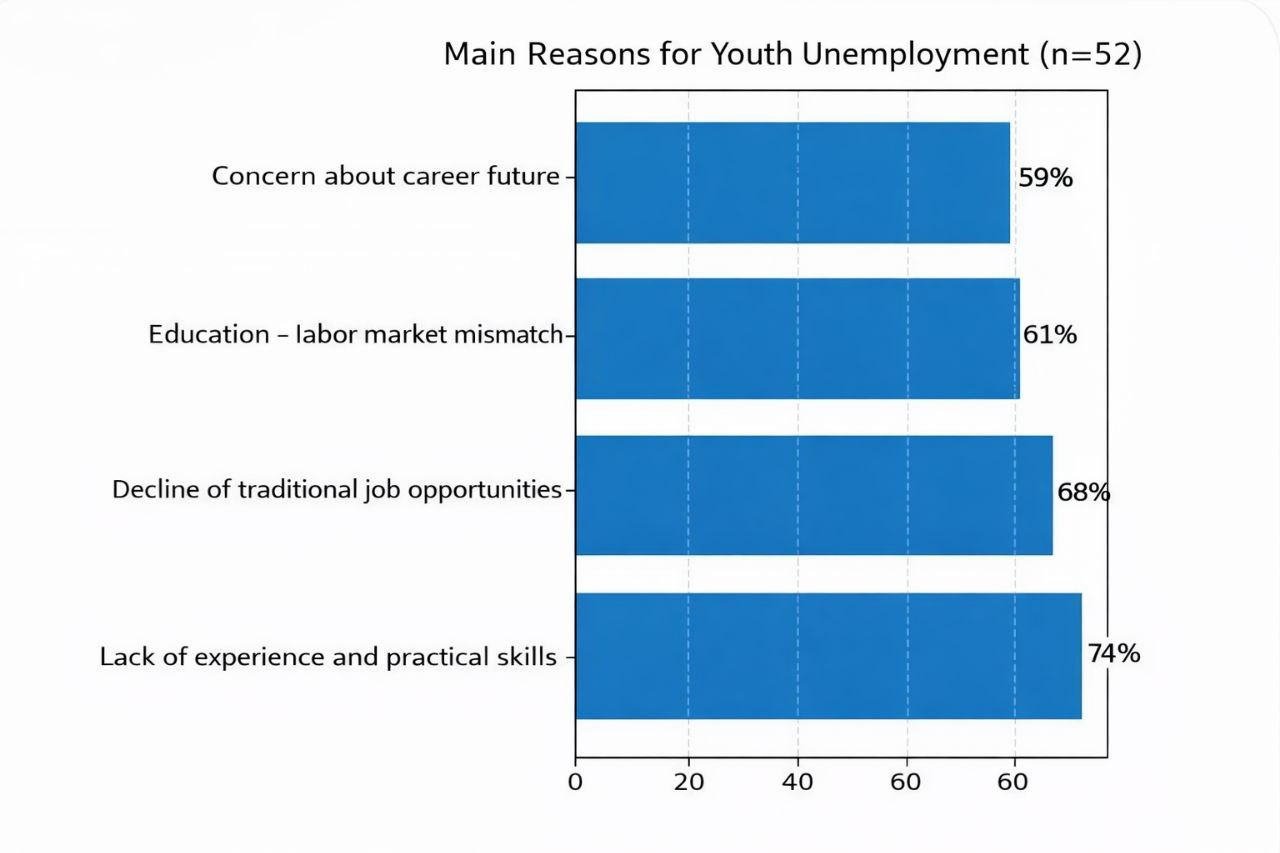
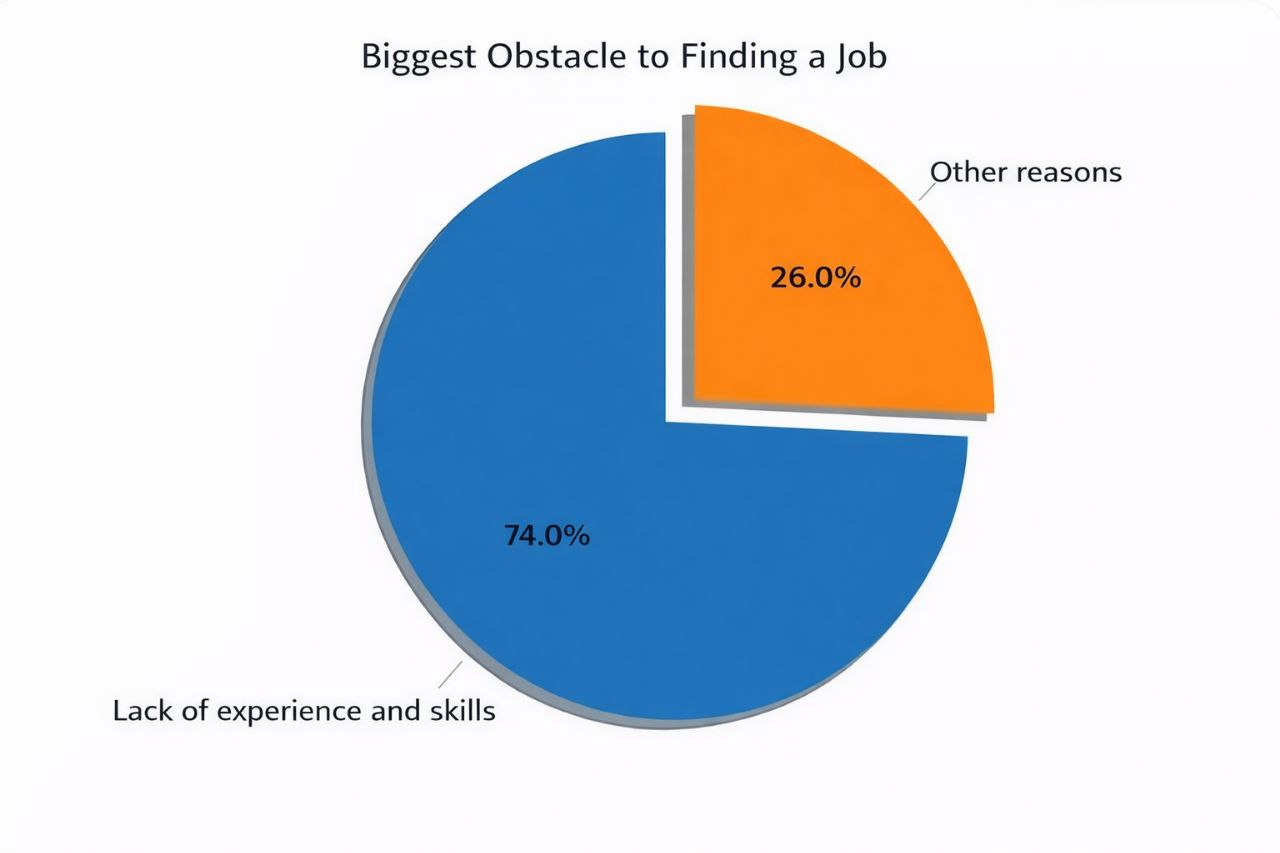
The following key observations were made based on the survey results: 74% of young people cited lack of experience and practical skills as the biggest obstacle to finding a job. 61% of young people said that the knowledge they received in educational institutions does not meet the requirements of the labor market. 68% of survey participants said that traditional jobs are being lost due to the development of digital technologies, but at the same time, new opportunities are opening up for young people with digital skills.
Among young people who have found a job or are expecting a high income, interest in digital directions turned out to be 2.1–2.4 times higher. 59% of young people who are in traditional occupations or are looking for work in this field said they are worried about the future of their professions due to digital transformation.
The results of this survey empirically confirmed the main factors of youth unemployment (lack of experience, mismatch between education and the labor market, difficulties in adapting to the digital economy).
The limitations of the study include the small sample size (only within the city of Tashkent), as well as the fact that it did not fully reflect the hidden unemployment situation. This methodology provided a clearer picture of the current state of youth unemployment and its relationship to digital transformation.
Discussion
The strength of the study was that it identified the impact of digital transformation through a survey conducted in Tashkent. This topic has become increasingly relevant in recent years, as automation is reducing traditional jobs while demand is increasing in IT, digital marketing, and other tech fields. It is a positive trend that interest in digital skills is high in the survey, but it is necessary to develop these skills.
At the same time, the limitations of the study are also worth noting: since the sample size is small (52 people) and limited only to the city of Tashkent, it is impossible to generalize the results to the whole country. Hidden unemployment and did not fully reflect the situation in rural areas. Overall, the study highlights the following areas to address youth unemployment:
Adaptation of the educational system to the requirements of the labor market.
Teaching digital and modern skills.
Development of mechanisms for creating the first work experience for young people Elimination of Gender and territorial inequalities.
If these directions are implemented, it will be possible to significantly reduce youth unemployment and effectively use the country’s human capital. The study shows that the problem is not only economic, but also social and educational in nature, requiring a comprehensive approach.
Conclusion
The main objective of this study was to conduct an in-depth analysis of the causes of youth unemployment in Uzbekistan, identify its socio-economic consequences, and develop practical recommendations for solving the problem. The main results are that the overall unemployment rate will remain around 10.8–10.94% in 2025, and youth unemployment will remain around 10.8–10.94% in 2024, according to ILO models – more than twice the overall rate. The significance of these results: youth unemployment not only slows economic growth but also increases migration. Based on the results of this study, the following recommendations can be made:
Adapting the education system to the needs of the labor market,
Creating opportunities for young people to gain experience,
Encouraging the creation of new jobs in digital and innovative fields;
References
1.M.K.Abdullayev, D.B.Begalova (2021). Current issues in ensuring employment in the Republic of Uzbekistan. Scientific electronic journal “Economy and Innovative Technologies”.
2.Honorati, M., & Marguerie, A. (2021). Youth employment in Uzbekistan: Opportunities and challenges. World Bank Group. https://documents1.worldbank.org/curated/en/666311634704762319/pdf/Youth-Employment-in-Uzbekistan-Opportunities-and-Challenges.pdf
3.International Labour Organization. (2024). ILOSTAT database: Youth unemployment in Uzbekistan. https://ilostat.ilo.org/data/
4.Jo‘rayev, S. A. son. (2022–2025). Research on demographic growth, lack of professional skills, and disparities in regional economic development.
5.Mansurov, S. (2024). Youth employment in Uzbekistan: opportunities and challenges.
6.United Nations Development Programme. (2025). Informal employment in Uzbekistan. UNDP Uzbekistan. https://www.undp.org/sites/g/files/zskgke326/files/2025-10/report_informal_economy_eng.pdf
7.UNICEF, Youth Union, & Yuksalish National Movement. (2020). https://www.unicef.org/uzbekistan/media/3541/file/YouthofUzbekistan-ChallengesandProspects.pdf
8.Statistics Agency of the Republic of Uzbekistan. (2025). Labor market statistics and youth employment indicators. stat.uz. https://stat.uz/