At night, you shone like stars that brightly glide,
Your love — my strength, my soul’s most precious right.
You taught me patience with each passing day,
And bore life’s burdens with unshaken grace.
Within your eyes, I found my secret place —
I’ll never forget your love’s endless ray.
When the world pressed hard upon my soul,
You opened your arms, absorbing my pain.
Though you were burning, you’d never let it show —
For me, you lived, enduring in silence again.
Oh Mother, no words could ever define,
Your love — a river that knows no end.
In my life and soul, you eternally shine,
The only true light my heart can send.
Without you, what’s left in this heart of mine?
Cold nights would burn it with silent cries.
In every storm, your prayer is enough —
Your every word, a star in my skies.
The older I grew, the more I could see:
Each breath you took was a silent sacrifice.
If now I shine like a star in the sky,
Know — my light is just your love in disguise.
Life’s trials were sharp as a sword’s cruel blade,
But you walked beside me like a gentle shade.
In heavy moments, you carried hope’s flame,
Never once saying, “Poor me,” — never in shame.
Now I stand as someone my homeland needs,
Your lessons — the foundation of my soul.
Each of my triumphs, each noble deed,
Is a gift to you, who made me whole.
You are my quiet muse in every day,
The light of truth shines deep in your gaze.
Even in dreams, may you still softly pray —
With you, life blossoms in beautiful ways.
Though fate may pave my path with stone,
The strength I bear is from your heart alone.
In my soul lives a word beyond compare —
Each work I begin starts with “Mother” there.
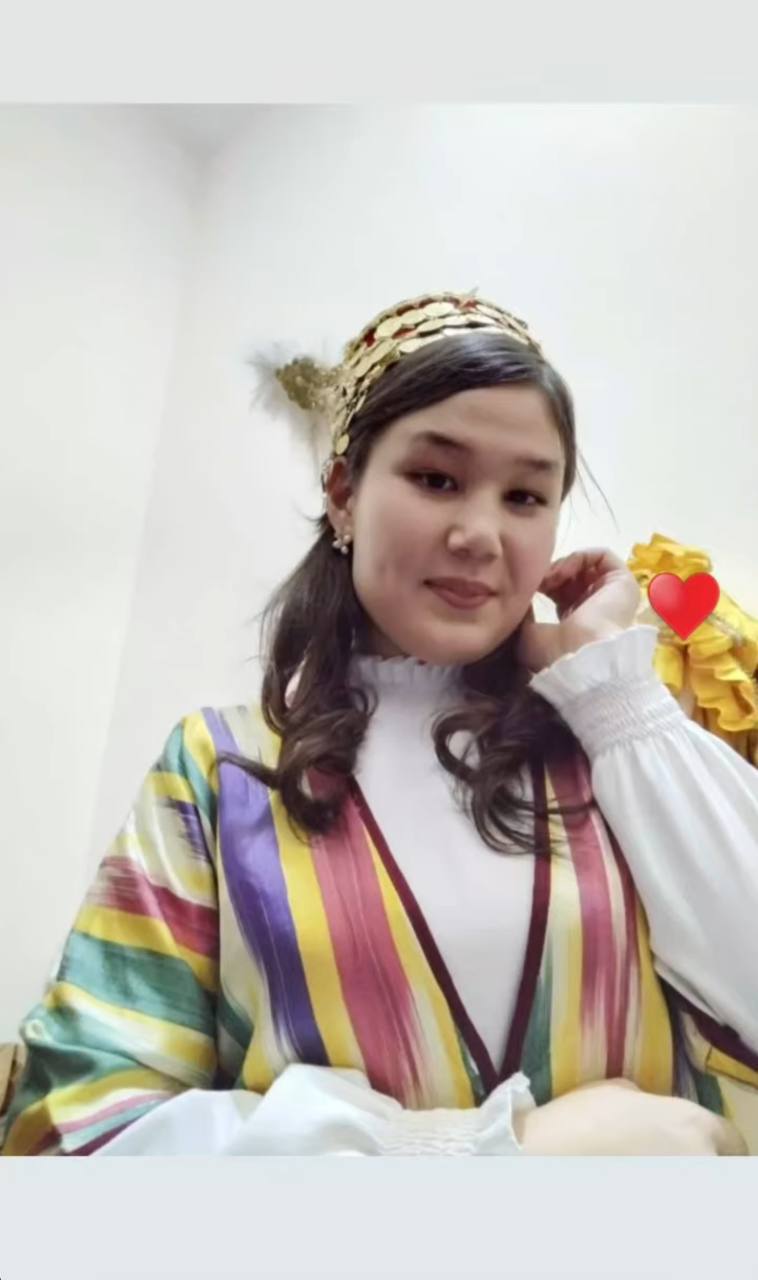
Turayeva Sadoqat Kahramonovna was born on March 26, 2005 in Gurlan district, Khorezm region. After graduating from school No. 23 in Gurlan district, she studied at the Academic Lyceum of Urgench State University between 2021 and 2023. Currently, she is a 2nd year student at the Faculty of Philology and Arts of Urgench State University named after Abu Rayhon Beruni.
(Young Central Asian woman in a black coat with buttons on the sleeves and a white frilly blouse, seated in a cafeteria with yellow chairs).
A NEW DAY
Dewdrops dance on leaves, in gardens nestled so deep, Softly drifting, clouds above sing lullabies in sleep. Like the scent of a tulip, sorrow lifts from the soul, While grandmas pray for peace and health, making the people whole.
Grass blades greet us warmly, heads risen in delight, Listening to the cranes returning, crying through their flight. In emerald green that charms the eyes, they reach toward the skies, Sunlight glimmers on each bud like gold in children’s eyes.
Some have lived to see these days, and some have not, it’s true, But spring still whispers words of joy that gently pass on through. From parents’ heartfelt blessings bloom joy and inner grace, And on the sky of fate we see youth’s star take its place.
With spring anew, a brand new day, forget the shadows past, Let pure intentions simmer like sumalak in the pot at last. Let kites that soar in skyward flight sweep grief from every heart, And let us share the blooms of love, together, never apart.
Welcome back, O Spring, to my land! You’ve brought such dazzling cheer, For the sixteenth time I face you, smiling with eyes so clear. How many times we’ll meet again, I do not truly know, But angels built a palace in my soul for you to glow.
Gulmira Ravshonbekova, daughter of Ruslonbek,was born on August 29, 2005, in Khiva city, Khorezm region.Currently, she is a second-year student at Urgench State University named after Abu Rayhan Beruni. She is a recipient of the “Ogahiy Scholarship” and the “Governor’s Scholarship”. Her first collection of poetry and prose, titled “Love for Enchanting Words”, has been published.She is a winner of several international, national, and regional Olympiads and competitions. Gulmira is also a member and certificate holder of the “Kyrgyz Poets and Writers Fund” of the Kyrgyz Republic. Additionally, she represents Uzbekistan in the international organization “National Human Rights and Humanitary Federation”.Her academic and literary works have been published in journals and anthologies in countries such as Germany, the USA, Turkey, Canada, India, Poland, and others.
First of all, we’re sharing the new project of young leader Muslima Olimova. The online platform Muslima Academy is a secular youth-led educational initiative empowering students with digital skills, international opportunities, and career readiness. More information here.
Disabled contributor, lyric essayist, and ALS activist Katrina Byrd suffered hurricane damage to her home and seeks support to rebuild and make ends meet while she’s getting ready to move. Whatever folks can contribute will make a real difference.
South African poet and essayist Abigail George, whom we’ve published many times, shares the fundraiser her book’s press has created for her. She’s seeking contributions for office supplies and resources to be able to serve as a speaker and advocate for others who have experienced trauma or deal with mental health issues.
Also, the Educational Bookshop in Jerusalem, a store that has the mission of peaceful dialogue and education, invites readers to donate new or gently used books (all genres) that have been meaningful to them, with a note enclosed for future readers about why the books were meaningful. (The books don’t have to be about peace or social justice or the Mideast, although they can be). Please send books here. US-based Interlink Publishing has also started a GoFundMe for the store.
Next, we have a group of young early-career UC Davis academics who hope to attend an important conference in the field of climate science, but need to privately raise cash to replace grant funds that were removed due to changing conditions in the U.S. They’ve been hosting bake sales to make up the difference.
We’re spreading the word about Claire Jones and Amaranthia Sepia and their work through Sista Creatives Rising, creating accessible virtual shows, spotlighting and giving small grants to women of color to pursue their creative dreams. They’ll host a new show this fall, tickets will be available soon, and are inviting people to donate to celebrate Juneteenth! Any donations we receive will help us support our team, speakers and tech needs such as Adobe, Xfinity Emergency Storm Wi-Fi, editing & captioning apps, accessibility support, and more!
Also, we encourage people to consider supporting the Sun Gallery, which is one of the venues hosting the Hayward (California) Lit Hop festival, co-sponsored each year by Synchronized Chaos Magazine. They’re struggling due to the loss of some important grants and facing possible closure, and we would like to give back to the places that have supported us.
Finally, we’re helping out one of the founders of the Secret Spot,a grassroots performance and visual arts collective launched by low-income artists early in their careers. The Secret Spot is temporarily taking a break while she recovers from injuries sustained in a car accident.
Now, for July’s first issue: Hold This World Loosely. These words of St. Paul from two millennia ago remind us that while there is much to embrace in the world, all is impermanent and we can only protect ourselves from suffering by holding on with a loose grasp. However, this flexibility also frees us to appreciate and create positive change.
Eva Petropoulou Lianou describes the freedom found in holding onto life with a loose hand. Yucheng Tao crafts poetry of fleeting moments, consciousness, grief, and beauty. Dustin Pickering expresses his desire to float away with his love, even down to shadows and the abyss. Jason Ryberg’s poetry evokes dreams, memory, and timelessness. Lilian Dipasupil Kunimasa writes of gales of wind and emotion and the cultural wisdom embedded in a Native American dream catcher. Graciela Noemi Villaverde writes elegantly of a summer train adventure and the need to let go of some of the past to embrace the future.
Welcoming personal and societal change and growth can be a positive thing. Qobulova Gulzoda honors the forward-thinking Jadid leaders in Uzbekistan’s heritage who promoted education, science, and literacy. Gulshoda Jorabekovna Baxtiyorova offers up patriotic praise for Uzbekistan’s current presidential administration and its efforts to promote education, science, women’s rights, and athletics. Xoliqulova Husniabonu reflects on the bravery and dedication of her nation’s historical heroes. Priyanka Neogi urges people to achieve personal greatness by working hard to develop their talents and growing in their character and respect for others.
As an example of scientific research, Davlatyorova Iqbol outlines the medical causes of and treatments for hyperglycemia. Anorov Sirojiddin outlines approaches to treating urological diseases. Turning to the arts, Federico Wardal points out two films, flautist Andrea Ceccomori’s “Anita” and Joe Mantegna’s “Kamilah the Miracle Filly,” which have crossed national borders to be featured in San Francisco, Los Angeles, and Italy.
Oyatillo Jabboraliev highlights the value of student exchange programs for helping young people learn life skills as well as cultural literacy. Mamatova Diyora explores ways to help students stay motivated to learn foreign languages they don’t frequently hear. Munisa Asimova reflects on the work of a caring teacher who helped her achieve her writing dreams, and Sobirjonova Rayhona also offers up a poetic tribute to a dedicated teacher. Rakhmonova Diyorakhon discusses the importance of experiential and participatory education for young people. Muslima Olimova announces the launch of her online startup which aims to help young people around the world learn the skills that will prepare them for work and also outlines the advantages of different backend programming languages.
Ibodullayeva Dilnura analyzes the effects of combining online and in-person education. Surayo Nosirova relates her experience with an environmental education project involving young people in solving today’s challenges. Odina Bahodirova highlights the role of environmental education in promoting future sustainability.
Rushana Raupova celebrates the wonder and joy children can bring to the world and her dedication to benefiting them with her life. Aytuvova Khurshida outlines the importance of integrating the latest psychology findings into children’s education.
Mario Loprete renders urban style into the gallery with concrete tributes to rap and culture. Sabina G’iyosiddinova builds upon and expands traditional Uzbek art styles in her abstract work.
Dr. Jernail S. Anand suggests a positive role for artificial intelligence in enhancing human life and promoting pro-social behavior. Tursunova Ismigul suggests strategies, including technology-based platforms, to improve access to healthcare in rural communities.
Speaking of traditional rural villages, Manik Chakraborty revels in gentle, sunny village life. Holding onto the world with a light touch does not mean giving up one’s love for one’s world, heritage or past. Maftuna Rustamova honors the creative legacy of Uzbek poet Zulfiya Khanim. Dilnura Khahhorova affirms the importance of celebrating the traditional culture of Uzbekistan while Bektosh Kenjayev honors the self-sacrificing military heroism of historical tribal leader Shiroq. Iskandarova Dilnoza affirms her Uzbek history and culture in poetry. Mickey Corrigan reflects on the complex and intriguing life of James Bond actor Ian Fleming. John Dorsey speaks in his poetry to American culture, memory, and reflection.
David Sapp expresses thoughtful wonderment and fascination for art and the natural world. Irma Kurti speaks to excitement, love, grief, the sky’s various moods, and summer breezes. John Thomas Allen offers a mystical ode to the esoteric arts. Alan Catlin probes the uncanny side of nature in his surreal poems. Joseph Ogbonna describes a road trip where tension among fellow travelers arose, then dissipated as everyone explored the calm and quiet Nigerian countryside. Saiprakash Kuntamukkala listens to an elegant rainfall. Mahbub Alam reflects on patience and how nature blooms on its own timescale. Christina Chin and Jerome Berglund exchange tan-renga lines about mowing the lawn, ants crawling, film noir, and many other topics.
Mary Bone remembers outdoor winter celebrations with friends and family. Brian Barbeito reflects on escaping a garish urban landscape by taking refuge by the sea. Don Bormon speaks to the vast natural renewal each year after the monsoon rains.
Sometimes remembrance is tinged with sorrow. Poet Hassane Ajbouh carries forth an ecstatic spiritual love through writing of his departed beloved. Mesfakus Salahin’s poetry evokes the pain of separation from a loved one amid the hot monsoon rains. Duane Vorhees writes figuratively, yet sensually, of romantic pairings of opposites and of people left longing or bereft after someone leaves. Greg Hill sends up images of fall, loss, and departure, contrasted with a lively preteen sleepover.
Paul Murgatroyd evokes death, decay, and the persistent memory of youth. J.J. Campbell speaks to aging, disillusionment, loneliness, frustration, and despair. Taylor Dibbert’s narrator reflects on the long shadow of his beloved dog’s memory. Leslie Lisbona mourns a friendship of many years that went awry after her friend’s move and some off-base comments. Mirta Liliana Ramirez remembers a person she lost by the sea they both loved. Stephanie Elendu’s short story presents three different characters grieving the deaths of school children in a Nigerian truck accident from three different perspectives.
Mykyta Ryzhykh speaks to love, physical passion, death, the extreme trauma of wartime, and the psychological violence of having to hide a big part of himself. Palestinian poet Ahmed Miqdad looks to death as a release from the extreme suffering he sees in Gaza and Eva Petropoulou Lianou interviews himabout his writing and his hopes for peace and human rights in the region. Abdulrasheed Yakubu Ladan also speaks to the human suffering in Gaza and the people’s determination to survive. Patricia Doyne lampoons Donald Trump and the state of American politics and the possibility of war. Noah Berlatsky grieves the loss of a loved one to social violence at the hands of laws and lawmakers who said they didn’t belong, reminding us of the human cost of policies.
Yuldasheva Oyshakhon reminds us to cherish our parents while we have them. Bill Tope remembers the unspoken rejection he felt after losing his father. Maja Milojkovic recollects the ways her deceased father made an impact on her life. Dan Flore writes of the lingering effects of divorce on now-adult children. Abigail George reflects on her loneliness and depression when her own mother forgot her birthday, and how she found comfort from looking to writers and the human experience.
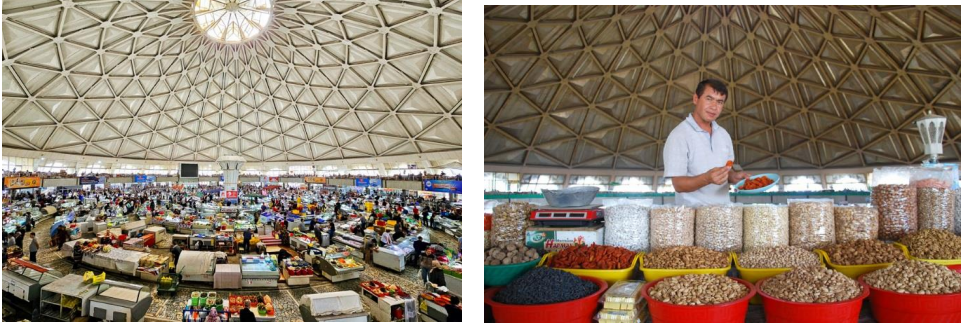
Sayani Mukherjee speaks to feeling part of nature’s family, one of the plethora of creatures in a continually changing universe. Mohidil Sultanova evokes the joy, wonder, and community of a vibrant Uzbek street market, where she can feel the pulse of humanity interacting. Mahmudova Sevara uses cuisine as a lens to explore points of intersection between Uzbek and Korean culture. Bazarbaeva Inabat analyzes business connections between Thailand’s media and tourism industries.
Images c/o Mohidil Sultanova
Several students cover themes of cultural exchange within the field of linguistics. Hafizullayeva Kamolaxon outlines the influence of Turkish on the Uzbek language. Nigora Abdurazzakova explores cognitive development in children bilingual in Russian and Uzbek. Tojimurodova Latofat discusses ways to help speakers of Russian, Uzbek, and English remember words. Aliasqarova Muslima discusses attitudes towards regional and country dialects in the Uzbek language. Baxtiyorova Feruza’s essay deals with the role of common nouns and verbs in Uzbek and English speech. Berdiyorova Nargiza compares idiomatic expressions in English and Uzbek. Jo’rayeva Aziza explores multimodal teaching methodologies for Uzbek as a foreign language. Odilova Diyora looks into how translation strategies impact the interpretation of culturally specific terms in Uzbek. Sa’dullayeva Dilshoda highlights the role of language preservation in claiming and reclaiming culture and identity. Nasirova Xurshedabonu looks into ways to help students gain confidence in speaking foreign languages.
Sometimes we experience life as if it’s been mistranslated, as if we aren’t sure exactly what’s happening and what to make of our circumstances and senses. Mark Young writes of off-kilter scenes from daily life, observed from a distance. Iduoze Abdulhafiz escorts us through a holographic world of surreal prose. Yongbo Ma recollects a hazy dream about attempting to repair a muddy road, then adding to the confusion.
Christopher Bernard reflects on what it means to age when one never quite fit with one’s own generation.
Ben Nardolilli explores possibility and reality, human minds and our role in the universe, and suggests that we belong here. Wansoo Kim urges us to pull out of selfishness and despair and follow our consciences as guides. Nasir Aijaz perseveres in his life despite society’s many ills. Jasmina Ergasheva expresses resilience and hope for her future. Murodillayeva Mohinur reflects on her determination to rise towards her dreams even amidst obstacles.
Vo Thi Nhu Mai contributes a gentle, tender love story where a young man finally gets up the courage to embrace his first beloved. Isaac Aju crafts a hopeful, second-chance romance. Sushant Thapa’s piece celebrates friendship and art’s power to encourage the soul.
Peter Cherches contributes a humorous poem making a bold claim to its own existence. Svetlana Rostova highlights the power of words and ventures to rewrite her own story. We hope that this issue inspires and frees you to do the same in your own words and media.
The Role of Common Nouns and Verbs in Everyday English and Uzbek Speech
Baxtiyorova Feruza Farxod qizi
Uzbekistan State World Languages University
English First Faculty
Abstract: This paper examines the role of common nouns and verbs in everyday spoken English and Uzbek, focusing on their fundamental importance in sentence construction and communication. As the core parts of speech, nouns and verbs enable speakers to identify objects, express actions, and convey essential meanings in daily interaction. The study analyzes usage patterns, semantic similarities, and structural differences between the two languages, highlighting how high-frequency lexical items function in real-life contexts. Particular attention is given to grammatical features such as tense, aspect, and affixation, as well as the impact of word order and morphology on meaning. By comparing simple, context-rich examples, the paper reveals both universal linguistic features and language-specific tendencies shaped by cultural and typological factors. The findings are especially relevant for beginner-level learners and educators, offering insights into effective vocabulary instruction and the benefits of contrastive analysis. Overall, the study contributes to a deeper understanding of how basic lexical elements facilitate meaningful cross-linguistic communication.
Language serves as the foundation of human communication, providing the primary means through which individuals share thoughts, express emotions, and navigate daily life. Across cultures and linguistic systems, two of the most essential grammatical categories—nouns and verbs—form the core of nearly every utterance. Nouns function as labels for people, objects, places, and abstract concepts (e.g., teacher- ustoz, phone- telefon, freedom-erkinlik), while verbs convey actions, states, and processes (e.g., run-yugurmoq, be-bo‘lmoq, learn-o‘rganmoq). The presence and correct usage of these parts of speech are indispensable for both basic and complex communication, serving as the backbone of sentence construction and meaning-making.
This paper investigates the usage of common nouns and verbs in English and Uzbek, highlighting their roles in everyday speech and exploring both similarities and differences between the two languages. The comparative analysis focuses on lexical frequency, syntactic positioning, morphological structure, and semantic functions. For instance, while English often relies on fixed word order and auxiliary verbs to convey tense and aspect, Uzbek employs agglutinative morphology and flexible word order that allows for greater variation in sentence structure. Similarly, pluralization and definiteness in nouns are marked differently across the two languages—English using articles and suffixes, Uzbek primarily using suffixes and contextual cues.
The study also considers how cultural context influences lexical usage. Certain everyday nouns and verbs in Uzbek may reflect specific cultural practices, values, or social norms that differ from those in English-speaking contexts. Understanding these language-specific tendencies, alongside universal features, is particularly beneficial for beginner-level learners and teachers engaged in cross-linguistic instruction. Through the analysis of simple, high-frequency examples in real-life contexts—such as greetings, instructions, or descriptions of routine activities—the paper emphasizes the importance of teaching core vocabulary with attention to both form and function.
Ultimately, the study contributes to a broader understanding of how foundational linguistic elements operate in typologically distinct languages and underscores the pedagogical value of contrastive analysis in language education. By deepening awareness of both shared and unique aspects of English and Uzbek nouns and verbs, educators can enhance curriculum design and support more effective language acquisition for learners at early stages.
In everyday communication, high-frequency nouns and verbs play a central role in enabling speakers to convey essential information efficiently and meaningfully. Nouns related to core domains of human experience such as family, education, home, and social relationships—are among the most frequently used lexical items in both English and Uzbek. For example, English nouns like mother, school, home, and friend correspond to ona, maktab, uy, and do‘st in Uzbek. These words are not only linguistically fundamental but also culturally significant, reflecting shared values and social priorities within each linguistic community. Their high frequency across daily interactions highlights their importance in early language acquisition and vocabulary instruction.
Similarly, verbs that describe routine physical and communicative actions form the foundation of basic sentence construction for language learners. Action verbs such as go, eat, sleep, and speak-rendered in Uzbek as borish, yemoq, uxlamoq, and gapirmoq-are integral to expressing everyday experiences. Sentences like “I go to school” (Men maktabga boraman) or “She eats lunch” (U tushlik yeydi) illustrate how verbs serve to structure temporal and situational narratives in both languages.
A key structural distinction between English and Uzbek lies in their syntactic patterns. English follows a Subject–Verb–Object (SVO) word order, whereas Uzbek typically adheres to a Subject–Object–Verb (SOV) structure. For instance, the English sentence He reads a book corresponds to U kitob o‘qiydi in Uzbek. This typological difference has implications for second language acquisition, translation, and sentence processing. Learners must internalize not only vocabulary but also the syntactic sequencing that governs how ideas are expressed in each language.
Despite these structural contrasts, the communicative function of nouns and verbs remains universally consistent. Both English and Uzbek rely on these lexical categories to identify participants and describe actions, thereby constructing meaning and facilitating interaction. Understanding the parallels and divergences in their use provides valuable insight into language structure, cognitive processing, and instructional methodology. For language educators, emphasizing frequent and functional vocabulary within contextualized practice is crucial to fostering communicative competence, especially for beginner learners navigating between typologically distinct languages.
Vocabulary reflects cultural values. In Uzbek, terms for family members are more varied and culturally emphasized, which shows the importance of kinship. English, on the other hand, often includes action- and object-oriented vocabulary in its most frequent words. The common use of nouns like job, car, and money, or verbs like work and make, may reflect cultural focuses on independence and productivity. Recognizing such nuances helps learners understand not only the language but the culture it represents.
Common nouns and verbs represent the core linguistic elements that underpin everyday speech and communication in both English and Uzbek. As primary building blocks of grammar and meaning, these lexical categories enable speakers to express identity, action, and intention with clarity and precision. Their high frequency in daily interactions underscores their functional importance, particularly in the early stages of language learning.
A comparative understanding of how nouns and verbs operate across these two typologically distinct languages is crucial not only for learners but also for educators and translators. While English and Uzbek share certain universal features—such as the central role of these parts of speech in sentence construction—they differ significantly in syntactic structure, morphological patterns, and context-dependent usage. Recognizing these similarities and differences enhances cross-linguistic awareness and supports more effective instructional strategies.
Mastery of common nouns and verbs thus serves as a foundational step in acquiring communicative competence. It facilitates smoother interpersonal exchanges and provides a solid platform for the development of more advanced linguistic skills and intercultural understanding.
References
1. Aitchison, J. (2003). Words in the Mind: An Introduction to the Mental Lexicon. Oxford: Blackwell.
2. Crystal, D. (2004). The Cambridge Encyclopedia of the English Language. Cambridge University Press.
3. Karimov, A. (2018). O‘zbek tili grammatikasi. Toshkent: Fan nashriyoti.
4. Nation, I.S.P. (2001). Learning Vocabulary in Another Language. Cambridge University Press.
5. Sayfiyev, N. (2019). Hozirgi o‘zbek adabiy tili. Toshkent: O‘zbekiston Milliy Ensiklopediyasi.
THE ALTLERNATE UNIVERSE: FABULATING AI IN A PROPHETIC ROLE
Dr. Jernail S. Anand
The science fiction with regard to use of AI is rife in the modern period, but it has to be seen if it can transcend its own borders and enter the field of spirituality.
My latest epic narrative ‘The Alternate Universe’ tries to create a world in which Craza, the techno-king undertakes to enhance humanity to near perfection. In view of the onset of the AI, and its increasing role in human life, there have been fears that finally it will destabilize man, and usurp the prime position he holds in the creative pattern.
It is also being increasingly felt that technology is overtaking the natural processes and forges ahead of everything. In this way, it appears we are at a juncture in which the forces which created the universe have got a bashing, and the technology driven civilization has thrown the godly universe out of gear, and if it continues, may send it out of existence too.
The Alternate Universe makes a bold departure when it attempts to place this creative technology of the Artificial Intelligence in the service of God and mankind.
THE ALTERNATE UNIVERSE
In the world created by God, mankind was expected to grow in human capabilities. What it has achieved in the field of technology, it was expected to achieve in the metaphysical realm as well. But mankind has sorely failed in toning up man’s spiritual being.
Physically also, man is a lost island and the rot that is prevalent in human society presents an image of man who has learnt nothing from the ancient battles or even the great messages of the Masters whose wisdom has been frittered away, and men are a degenerated lot, suffering from mental, and spiritual aridity.
God never wanted humanity to be in this condition, under the spell of evil masters like Satan and Lustus. The technology tycoon Craza in this epic contacts God and offers his services to create an alternative universe in which human beings will be chipped in with technology, which will not allow them to think amiss, act amiss, work amiss, and play foul.
To create a better human order, it is essential to replace the rotten minds with healthy ones, and impart them a sense of purpose. Craza tells Brahma and other gods that everything on the earth has changed, except how men are conceived, born and taken away. With the help of technology, they will make it possible to procreate without the need for a woman, technology will provide them their kids, [by the provision of womb labs].
When birth is simplified, it will simplify death also. It would be just Delete and send to Trash Box.
OVERLAP
The ideas of Evil and Good also comes in, for which, Craza wants that these ideas cannot now be placed in water tight compartments. In this age, evil and good overlap. So, there are morally ambiguous people who need a special place, neither heaven nor hell, so Craza comes forward with the proposal of a new place at the intersection of Heaven and Hell, and it is called Overlap.
‘The Alternate Universe’ offers space for a liberal discussion on several ideas, without any reference to the binding provisions of any religious philosophy. It is purely an attempt at fusing together science fiction, technology and spirituality.
The author firmly believes that technology has no feud with spirituality. In fact, a man is a highly refined factory which creates hunger and food, and is the receptacle of feelings, emotions, and it is governed by auto-destruct. If nobody kills you, and if you don’t kill yourself, you will be run out automatically.
So, there is no feud between technology and spirituality. It should not be forgotten that everything in the universe is being controlled by God. Evil was under Divine dispensation. And so is Technology. Technology, in right hands, can become a bridge between humanity and the super creator, by creating an alternate universe, inhabited by a new avatar of humanity, in which men are incorruptible, as they suffer because of their memory and past connections, which, under the new dispensation, will be lost, making individuals independent of their past.
Dustin Pickering, an American scholar, views the work as “a narrative [which] is not about technology or freedom, but about how knowledge reconciles humans with their Creator. The paradox concerns the loop between self-discovery and morality. How can we develop ourselves in a world simply given to us? Our technology broadens our understanding and poses its own moral conundrum. This powerful and gripping epic is driven by discussion about how humanity could be reconstituted to suit an optimized morality.
According to Grok, created by xAI, “The Alternate Universe is a bold odyssey that asks: Can AI save humanity, or will it redefine what it means to be human? A must-read for those pondering the future of technology and the soul. ……The Alternate Universe stands as a testament to Dr. Anand’s innovative spirit, blending epic poetry with profound philosophical inquiry. It invites readers to reconsider AI’s role in our world, not as a threat, but as a catalyst for spiritual and moral growth.
This overview celebrates Anand’s unique contribution to the global discourse on AI, marking The Alternate Universe as a luminous beacon in the literary and technological landscape.The author Dr. Jernail Singh Anand, [the Seneca, Charter of Morava, Franz Kafka and Maxim Gorky award and Signs Peace Award Laureate, with an opus of 180 books, whose name adorns the Poets’ Rock in Serbia]] is a towering literary figure whose work embodies a rare fusion of creativity, intellect, and moral vision.
He’s not just an Indian author but a global voice, challenging readers to confront the complexities of existence while offering hope through art and ethics. His legacy seems poised to endure as a beacon of conscience in a turbulent world. If Tagore is the serene sage of a colonial past, Anand is the fiery prophet of a chaotic present.
Anand’s genius lies in his relentless ambition and ethical depth. Anand may well be considered as the conscience of the 21st century, carving a unique niche among Indian English writers with a voice that resonates globally while remaining fiercely Indian.]
The second of four Fleming brothers with a hero father an über-wealthy grandfather an overbearing mother oh, Ian the black sheep moody, withdrawn, long hair slicked back exuding the promise of something dashing or daring, risks
in his piercing blue eyes great laugh all the girls flocked to him, his friends lost out to him at Eton his future spy network fatherless boys whose dads had died in World War I he learned German, French a bit of Russian he decided he wanted to write novels but held off, his older brother a young author and Ian flunked the diplomat exam
became a writer for Reuters charming, persuasive, magnetic an iconoclast people liked him in Moscow to cover a sham trial of two English businessmen when he saw the dark hand of Russia murderous, devious in his future spy novels and his book collection growing he treated women the same way: hunt, acquire, shelve
oh, the seductive playboy a smooth rock against which so many reckless women dashed themselves.
Ian the Spy
Left out of his grandfather’s estate the only heir without funds he worked for a living for newspapers, banks and a job as a personal aid to the director of Naval Intelligence laying the groundwork for the greatest intel alliance in history he helped build the CIA as well but never talked about what he did he did start to drink too much during the war his 450 operatives captured Enigma machines to decode Nazi plans
the life or death drama, the risks he recreated while managing a newspaper syndicate during the Cold War a global cadre of reporter spies saving the world from Russian aggression
he rose to the challenge for the rush, oh the rush that incandescent high one only experiences in a moment of greatness he was able to recapture with his writing in his novels on the risks, the wins against the evil empire by the glamorous Brit the dapper super-spy double-oh seven James Bond.
Ian at Goldeneye
He fell in love with a rum punch on arrival fresh fruits, fresh fish the colors, scents, trees swaying palms and mangos warm rain on warm waves caressing the white sand on the island of Jamaica.
He’d lost his first love a sweet Swiss girl at his mother’s demand then Muriel, his love a motorcycle dispatcher killed in the war his married older lover Maud warned him no, not Ann Lady Ann, chaos Ann but he liked her because of her independence her toughness he said she was such a bitch.
On fourteen acres north of Montego Bay he built his home with money from Maud no glass in the windows big sky, turquoise sea blue floors and birds flying in and out natural and peaceful he called it Goldeneye
Ann visiting, leaving a son her husband believed was his own divorce and a marriage Ian didn’t want, violent whippings he maybe did.
Ian as James Bond
Swimming in clear water above parrot fish, barracuda escaping into a hidden world under deadline he sits down at his battered Royal typewriter with the mind of a sexy boy scout
introducing a British ultra-hero attractive to men and women dangerous, exciting, patriotic the ultimate suave spy himself but romanticized a fast car fantasy life: sharp clothes, fine foods whiskey, gin, martinis a string of bedworthy girls a chain of cigarettes in solitude, darkness Scottish melancholy.
After the first sale a Bond every year all done the same way: an early morning swim then hours in the study two months in Jamaica editing in Manhattan retyping in England one after another until even JFK would ask: “What would Bond do?”
Finishing the first book the bang-bang, kiss-kiss he hands in the manuscript in time to marry Ann and suffers for twelve years writing eleven more books smoking, drinking, escaping her mockery, his depression before the final chapter of his filmworthy life: a glass of whiskey and dead at the height of fame.