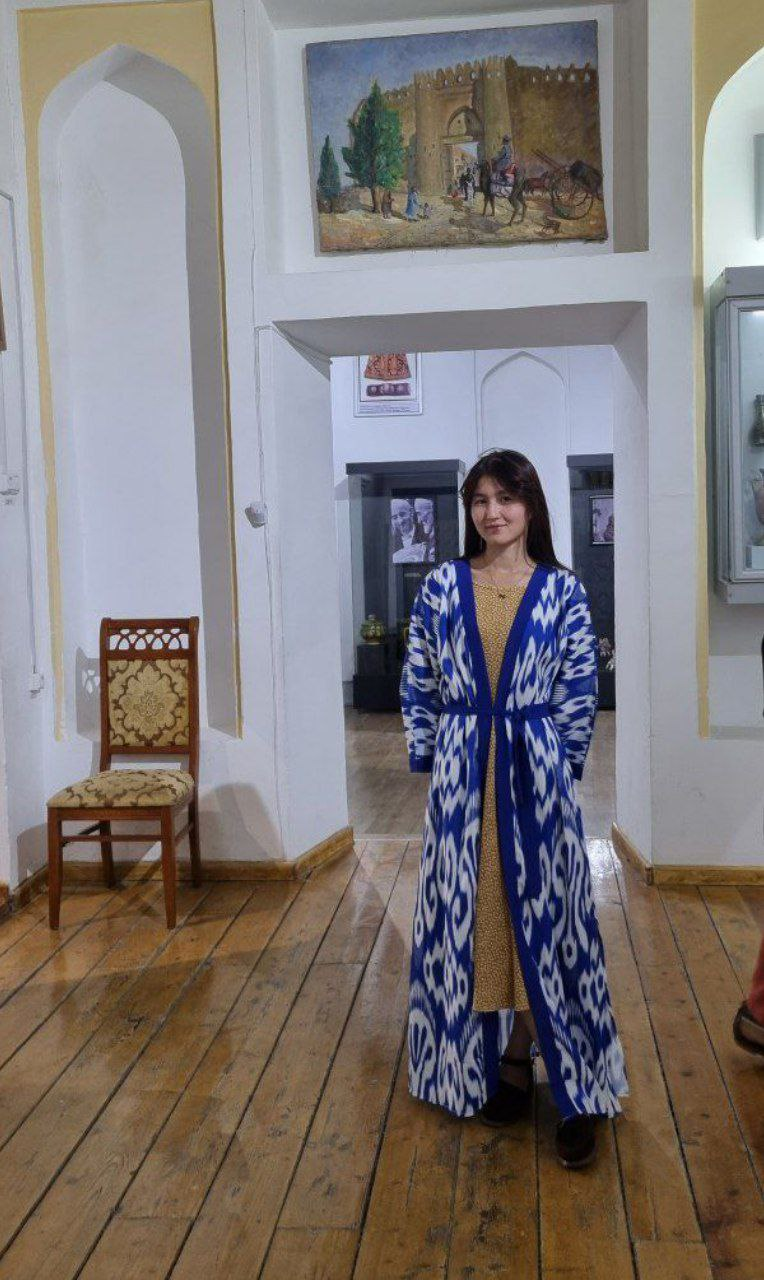
Essay from Eshmurodova Sevinch Bahrom qizi

THE PROSPECTS OF ARTIFICIAL INTELLIGENCE TECHNOLOGIES ON THE DEVELOPMENT OF THE BANKING SYSTEM

Eshmurodova Sevinch Bahrom qizi

Qarshi State Technical University

2nd-year student, Banking Department

+998994190825

eshmurodovasevinch266@gmail.com

Abstract: The article discusses the use of artificial intelligence technologies in the banking sector. The focus is on simplifying customer service processes, reducing credit risks, detecting fraud, and strengthening cybersecurity.      

Keywords: artificial intelligence, bank, digital services, security, lending.      

Аннотация: В статье рассматриваются вопросы использования технологий искусственного интеллекта в банковской системе. Основное внимание уделено упрощению обслуживания клиентов, снижению кредитных рисков, выявлению мошенничества и повышению уровня кибербезопасности.      Ключевые слова: искусственный интеллект, банк, цифровые услуги, безопасность, кредитование.      

Introduction:

Today, major changes are occurring in the global financial market. Banks are no longer limited to simple transactions, accepting deposits, or issuing loans. Their main objective has increasingly become providing customers with convenient, fast, and secure services. One of the most significant technologies supporting this transformation is artificial intelligence (AI).Initially, artificial intelligence seemed like something found only in science-fiction movies. However, in today’s real world, AI technologies are actively involved in services ranging from bank cards to online applications. Therefore, discussing the future prospects of this technology is highly important.

Main Part:

One of the first and simplest applications of artificial intelligence in banks is chatbots. Today, most banks have their own mobile applications, and when a customer asks a question through the app, the initial response is given by an automated system. Although this seems simple, it plays a crucial role. While a human operator needs time to answer and queues may occur, artificial intelligence can serve thousands of customers simultaneously.The second direction is risk assessment. Previously, bank employees examined customer documents, requested employment references, and often required guarantors.

Today, AI systems can analyze a customer’s financial behavior, spending patterns, and even mobile payment history to calculate the probability of loan repayment. This process is convenient for both the bank and the customer.Another important aspect is fraud detection. Thousands of transactions are carried out every day, and it is impossible to manually inspect all of them.

Artificial intelligence can detect unusual or suspicious activity among transactions. For example, if a customer usually uses their card only in Tashkent but suddenly attempts to withdraw a large amount of money abroad, the system stops the transaction automatically. This helps protect the customer’s funds.

Of course, these technologies also have challenges. First, developing and implementing such systems requires significant financial investment. Second, banking data is highly confidential, making its protection extremely important. Third, the shortage of qualified specialists is also a major issue.

Despite these challenges, the advantages of artificial intelligence outweigh its drawbacks. Competition in the banking sector is increasing every day. Customers now pay attention not only to interest rates but also to service speed, convenience, and security. Banks that use AI technologies can enhance their reputation and attract more customers.

AI also opens new opportunities for banks in Uzbekistan. For instance, using artificial intelligence in loan portfolio management reduces risks. Financial inclusion — expanding access to banking services for the general population — can also be improved through AI. Additionally, AI can play an important role in future green financing projects.

One of the most critical issues is cybersecurity. As financial crimes around the world are increasing, AI systems help not only detect fraud but also protect large volumes of data. Therefore, banks in Uzbekistan must strengthen their efforts in this area.

Conclusion:

In conclusion, artificial intelligence is becoming an essential part of the future banking system. It simplifies customer service, reduces risks, detects fraud, and most importantly, increases the efficiency of banking operations. In the context of Uzbekistan, the gradual introduction of AI technologies, training qualified specialists, strengthening cybersecurity, and improving financial literacy are of great importance. If consistent work is carried out in these directions, banks in Uzbekistan can become competitive not only in the region but also in the global financial market.

REFERENCES

1. O‘zbekiston Respublikasi Markaziy banki. Raqamli moliya hisobotlari, 2024.

2. World Bank. AI in Financial Services. Washington, 2023.3. Brynjolfsson, E., & McAfee, A. Machine, Platform, Crowd. Norton, 2017.4. Harvard Business Review. Artificial Intelligence for the Real World. 2018.

I am Eshmurodova Sevinch Bahrom qizi, born in 2006 in the Kamashidistrict of the Kashkadarya region. Between 2022 and 2024, I studiedat the Academic Lyceum of Karshi State University in the “exactsciences” department and successfully graduated. In 2024, I wasadmitted to Karshi State Technical University and am currently a2th-year student at the Faculty of Economics and Management, BankingDepartment. In my free time, I play sports. I am a 3-time champion ofUzbekistan. I have also taken the honorable 1st place in Tashkentseveral times. In addition, I have won the Rector’s Cup several times.Currently, I am running an online business at home. I make tiaras forgirls. I take an online course in Turkish. My goal is to open atraining center in the area where I live, in agreement with thegovernor.  I would like to pay special attention to Turkish, Russian,mathematics, and robotics at the center.

Essay from Kandy Fontaine

Lemmy from Motorhead. He's middle aged, white, smoking a cigarette, in a jean jacket with long dark hair and a black hat with a design

Lemmy’s hotel bed: an altar, a stage, a throne. Lemmy Kilmister, high priest of the Church of Motörhead, placed me there as if I were a supplicant, a guest, a fellow conspirator in the endless liturgy of rock ’n’ roll. He pressed cigarettes on me—his communion wafers—and the gesture was both casual and ceremonial.

Later, I told Hollywood scenester and Lemmy associate Tequila Mockingbird about it. She hadn’t been there, hadn’t seen the way Lemmy’s eyes carried both mischief and gravity, hadn’t felt the weight of his charisma pressing down like a bass riff. From the outside, she misjudged it, calling it seduction. But that was her projection, not the truth of the moment.

Because Lemmy’s seduction was not necessarily sexual. It was existential. It was about drawing you into his orbit, making you part of the mythos. He seduced everyone—men, women, journalists, fans—into the gravity well of Motörhead. To sit on that bed was to be baptized into his world, where the sacred texts were written in nicotine stains and the gospel was screamed through Marshall stacks.

At the time, I was Alex S. Johnson, rock journalist. I wasn’t out as transfemme yet. My identity was still a private constellation, a truth I carried but hadn’t named aloud. Lemmy didn’t know that part of me, and yet—looking back—I see how his gesture resonates differently through the lens of who I am now, as Kandy Fontaine.

Classic Lemmy: collapsing the distance between journalist and confidant, between interview and communion. He didn’t care about categories—man, woman, transfemme goddess, fan, or critic. He cared about whether you could hang, whether you could accept the offering, whether you could step into the myth without flinching.

The cigarettes were not just smokes. They were a bond, a way of saying: You’re one of us now. The bed was not an invitation to romance but to belonging. And in that moment, I understood the difference between being misjudged from the outside and being initiated from within.

Now, as Kandy Fontaine, transfemme goddess, I revisit that memory with new eyes. I see not just the ritual of inclusion but the radical acceptance embedded in it. Even though I wasn’t out, Lemmy’s gesture carried no judgment, no hesitation. He didn’t need me to explain myself. He simply welcomed me into the communion of rock ’n’ roll, and in retrospect, that welcome feels even more profound.

Essay from Sarvar Eshpulatov

The Importance of Digital Literacy in the Modern World

In today’s rapidly evolving technological landscape, digital literacy has become an indispensable skill for individuals across all walks of life. Digital literacy means more than just the ability to use a computer or smartphone; it encompasses the capacity to critically evaluate digital content, communicate effectively through digital platforms, and safely navigate the online environment.

Enhancing Communication and Social Interaction

With the rise of the internet and digital devices, communication has transcended traditional boundaries. Digital literacy empowers people to connect instantly through emails, social networks, and video calls. This accessibility enriches personal relationships and expands professional networks, fostering cross-cultural understanding and collaboration.

Facilitating Access to Information and Lifelong Learning

The digital world offers an enormous amount of information at one’s fingertips. Having the skills to find, assess, and apply this information accurately is crucial in education, research, and day-to-day decision-making. Digital literacy encourages self-directed learning and adaptation in an era where knowledge rapidly evolves.

Boosting Employment and Economic Growth

In the modern job market, digital competence is often a prerequisite. From basic computer skills to advanced data analysis, employees with strong digital literacy can perform tasks more efficiently and innovate within their roles. Organizations that invest in digital transformation experience improved productivity, competitive advantage, and market growth, which in turn stimulates the economy.

Addressing Challenges and Promoting Responsible Use

Despite its advantages, digital technology also poses risks such as misinformation, cyberbullying, and privacy breaches. A digitally literate person understands these challenges and applies ethical standards while using technology. Awareness of cybersecurity practices and digital etiquette ensures a safer online environment for everyone.

Supporting Social Inclusion and Empowerment

Digital literacy reduces the digital divide by enabling marginalized groups to access resources and opportunities previously out of reach. It fosters empowerment by providing tools for civic engagement, access to healthcare information, and participation in digital economies.

Conclusion

Digital literacy is foundational for navigating the complexities of the 21st century. It enhances communication, education, employment, and social inclusion while promoting responsible digital citizenship. Societies that prioritize digital literacy are better equipped to harness technology’s full potential, ensuring sustainable development and global connectivity.

Poem from Farzaneh Dorri

Older dignified looking woman with dark curly hair and a green business dress coat standing in a library with a fireplace.
Farzaneh Dorri

The Scales of Dawn

In loving memory of human rights lawyer Khosrow Alikordi

Iran breathes deep in shadowed hues,

where Injustice holds its heavy chain,

Binding spirits, dimming views,

and hope becomes a whispered pain.

But hark! A stirring, strong and clear,

a call for balance; sharp and bright,

to dry the marginalized tear,

and bring the silenced into light.

Justice angel walks on the earth as a warrior bold

with eyes that hold the sun’s own fire

a story waiting to unfold,

fueled by a deep and unquenched desire.

Her armor forged from Truth’s own gleam,

her voice; a trumpet, clear and strong,

to break the mold, to shatter dream

of ancient wrongs that linger long.

For every door held shut by fear,

for every heart that knows despair,

she brings the promise, ever near,

a breath of freedom in the air.

With steady hand, she lifts the scales

to weigh the hidden and meet the need

until the day that wrongness fails,

and Love and Equity take seed.

Middle aged man with short dark hair and a black suit coat standing in front of the scales of justice.
Khosrow Alkordi

Essay from Habibullayeva Laylokhon Zarifjon kizi

National and Cultural Features of Phraseological Units in the Uzbek Language


Kokand University, Andijan Branch
Faculty of Philology and Language Teaching
Uzbek Language, Group 25-07, 1st Year Student
Habibullayeva Laylokhon Zarifjon kizi


Annotatsiya:
Ushbu maqolada o‘zbek tilidagi frazeologizmlarning milliy-madaniy xususiyatlari, ularning xalq tafakkuri, qadriyatlari va turmush tarzi bilan uzviy bog‘liqligi tahlil etiladi. Frazeologik birliklarning mazmunida xalqning mentaliteti, tarixiy tajribasi, urf-odat va an’analari aks etgani ilmiy asosda yoritiladi. Shuningdek, maqolada o‘zbek tilidagi barqaror iboralarning badiiy-estetik va ma’naviy yuklamasi, ularning xalq og‘zaki ijodi hamda milliy o‘zlikni ifodalashdagi o‘rni misollar asosida tahlil qilinadi. Tadqiqot natijalariga ko‘ra, frazeologizmlar o‘zbek xalqining dunyoqarashi, axloqiy mezonlari va madaniy boyligini namoyon etuvchi muhim til birliklari sifatida baholanadi.


Kalit so‘zlar: frazeologizm, milliy madaniyat, xalq tafakkuri, qadriyat, mentalitet, an’ana, o‘zlik, til, badiiy ifoda.


Annotation:
This article analyzes the national and cultural features of phraseologisms in the Uzbek language and their close connection with the people’s mentality, values, and way of life. It is scientifically substantiated that the meanings of phraseological units reflect the historical experience, traditions, and worldview of the Uzbek people. The article also examines the artistic, aesthetic, and spiritual significance of stable expressions in Uzbek, illustrating their role in folk creativity and in expressing national identity. The research concludes that phraseologisms are important linguistic units that represent the worldview, moral principles, and cultural richness of the Uzbek nation.


Keywords: phraseologism, national culture, folk mentality, values, mentality, tradition, identity, language, artistic expression.


Аннотация:
В данной статье анализируются национально-культурные особенности фразеологизмов в узбекском языке, их тесная связь с народным менталитетом, ценностями и образом жизни. Научно обосновано, что в значении фразеологических единиц отражаются исторический опыт, традиции и мировоззрение узбекского народа. В статье рассматриваются художественно-эстетическая и духовная значимость устойчивых выражений, их роль в устном народном творчестве и выражении национальной самобытности. В результате исследования установлено, что фразеологизмы являются важными языковыми единицами, отражающими мировоззрение, моральные принципы и культурное богатство узбекского народа.
Ключевые слова: фразеологизм, национальная культура, народное мышление, ценности, менталитет, традиции, самобытность, язык, художественное выражение.


INTRODUCTION
The language of every nation is its spiritual wealth and an expression of its mentality. Through language, a nation reflects its worldview, traditions, and historical lifestyle. In this regard, phraseology is considered one of the brightest examples of national thinking and culture. Phraseological units in the Uzbek language also deeply reflect the lifestyle, values, and psychology of the Uzbek people. Expressing a simple idea through phraseology gives speech imagery and expressiveness. Nowadays, their usage has become common in social networks, memes, and advertisements. For example, the phrase “to disconnect from the Internet” is understood as being left behind from news or trends.


Many linguists have thoroughly studied Uzbek phraseology. For instance, Sh. Rahmatullayev is one of the founders of Uzbek phraseology. He compiled the Explanatory Dictionary of Uzbek Phraseological Units and developed the theoretical foundations of phraseology. N. Mahmudov conducted research on the role of phraseological units in literary language and their national-cultural aspects.


Phraseological units of the Uzbek language are linguistic elements that reflect the nation’s history and way of life. The contribution of the above-mentioned scholars is invaluable in the scientific study of these expressions.
The main purpose of this article is to study the national-cultural features of Uzbek phraseological units and analyze their usage on artificial intelligence platforms.


MAIN PART
At the beginning of the 20th century, phraseological units began to be studied as a separate field of linguistics. The general theoretical issues of phraseology were first investigated by the French linguist Charles Bally. In his works, Charles Bally systematized word combinations and, based on their meanings and syntactic features, referred to the stable combinations used as a whole as phraseological units.¹ According to Sh. Rahmatullayev, many expressions originate from ancient Turkic languages and have preserved their meanings to this day. In the studies of E. Begmatov and M. Mirtojiyev, the lifestyle, values, traditions, and mentality of the Uzbek people are revealed through phraseological units. Phraseological units are closely connected with the life, values, and national-cultural characteristics of the people. They enrich the artistic expressive possibilities of the language and add expressiveness, imagery, and national spirit to speech.


Review of sources used
During the preparation of this article, several scientific sources related to issues of phraseology were utilized. In her research, M. Asqarova provides detailed information about the lexical-semantic features of Uzbek phraseological units, their structural types, and their role in the language. The scholar’s views served as an important source in shaping the theoretical foundations of phraseology. Based on her scientific views, phraseological units represent the richest layer of the people’s language and culture, embodying their spiritual world, lifestyle, and national-cultural characteristics.

As a result of the works of A. Madlayeva and A. Hojiyev, phraseology has been recognized as a separate branch of Uzbek linguistics. The structure, meaning, types, and grammatical features of phraseological units have been clearly defined.
Use of Phraseological Units on Artificial Intelligence Platforms
In today’s era of globalization, artificial intelligence and digital technologies are creating new interpretations of linguistic units. Platforms such as ChatGPT, Google, and DeepL work with phraseological units during translation, processing, and text analysis. However, the national color of language is most vividly expressed through phraseology itself. Artificial intelligence often translates phraseological units literally or interprets them incorrectly. Therefore, deep linguistic knowledge is required to correctly identify and contextually translate phraseological expressions.


For example, phraseological units such as “miyasi qotmoq” (to be confused), “kallasiga keltirmoq” (to realize), “tishi o’tmoq” (to become experienced) may be translated by AI literally as “freeze of brain”, “bring to head”, or “tooth becomes sharp”. This leads to distortion of meaning.
That is why, in the process of integrating phraseological units into AI platforms, the following aspects must be taken into account:
historical formation of the expression connection with national mentality semantic field usage contexts.

Conclusion


In conclusion, phraseological units are the richest layer of a nation’s worldview, cultural memory, and mentality. They create imagery in language, give speech a national spirit, and express meaning more strongly. Since the 20th century, phraseology has developed as an independent scientific field in Uzbek linguistics and continues to develop consistently even today. In the modern digital era, the correct application of phraseological units on artificial intelligence platforms is becoming increasingly relevant. This process plays an important scientific and practical role in correctly integrating the richness of the Uzbek language into the global information space, preserving the national linguistic heritage, and transferring the cultural spirit of the people to future generations.


References
Shirvonova, Z. A. (2023). Dissertation. Termiz.
Rahmatullayev, Sh. (1978). Modern Uzbek Literary Language. Tashkent: O‘quvchi.
Ma’rufov, Z. M. (1981). Explanatory Dictionary of the Uzbek Language. Moscow: Russian Language Publishing.
Khodjaeva, Sh. R. Article.
Rahmatullayev, Sh. (2006). Modern Uzbek Language. Tashkent: University Publishing.
Abdurahmonov, G. On the Modern Uzbek Language. Tashkent.

Poetry from Mohan Maharana

Middle aged South Asian man with black hair and a mustache and a yellow and blue checkered shirt.

Hands That Heal

I have seen the world through broken eyes,
Where silence screams and reason dies,
Yet even there, beneath the pain,
A trembling soul still seeks the rain.

I do not ask for thanks or name,
For love is never born of fame
Each drop of kindness that we give,
Becomes the reason hearts still live.

If madness walks, I walk beside,
No judgment there, no hate to hide.
For every wound I’ve tried to seal,
I’ve learned, it’s love that truly heals

Mohan Maharana is a renowned social worker dedicated to humanitarian service and community upliftment. Over the years, he has personally helped more than 2,000 mentally ill individuals find treatment, dignity, and hope. His current focus lies in promoting voluntary blood donation and raising awareness about its life-saving importance. Beyond his social work, he also serves as the Global Director of the World Union of Poets, contributing to the union’s mission of uniting voices across cultures through poetry and compassion.

Poetry from Richard LeDue

Not Much of a Poem

Why does every poet have a poem

called “poem,” and why do empty bottles

seem more poetic than anything

I ever called a “poem”? 

Metaphorical drowning a joy

like a first drink on a Friday night,

but also the sort of death that feels as if it should rhyme.

On my best mornings, I’m a puddle

in love with its own evaporation,

while the sun writes a ‘Dear John’ letter

all over my closed eyes.

SAD

Winter nights the colour of whisky

because it’s better than darkness

telling the same story about shortening days and snow

clean as a funeral shroud.

Happiness an empty glass,

while blacked out laughter

better than another evening

remembering there’s less and less light

and how my bed is inviting like a grave.

Background Noise

Better than silence,

and even if it doesn’t know

my name and can never learn it,

it welcomes me and this poem home,

along with so many others

who believe they’re louder

than they are.