Synchronized Chaos August 2025: Longings of the Heart

Our publication expresses great sorrow at the suffering in Gaza. We call for the return of the hostages, for an end to the siege, and for humanitarian aid to be allowed in for the starving people of the region. To support the people of Gaza, you may contribute to the Middle East Children’s Alliance.

Also, For the Writers, a manuscript coaching service, seeks to document what’s happening in the region by compiling first-person journalistic narratives from anyone of any background in Gaza. They’ll put the stories live on the site to create a digital archive to bear witness to history. Writing is invited from those in the region, of all faiths, races, or national backgrounds.

Here’s another announcement from J.B. of Heterodox Haiku:

I am whipping up another modest lil issue of our journal, and just wanted to extend a hearty invitation in case you might have a poem or essay which you are looking for a great home for that could fit into small showcase we are assembling! The theme is ‘contrarians’, you could submit up to 10 haiku or senryu for consideration challenging assumptions and conventions of society, government, or English Language Haiku (especially! :D) for consideration. Please send work to jbphotography746@yahoo.com

Now, for our first August issue: Longings of the Heart.

Woman making a heart symbol with her hands in front of a lit carnival ride at dusk. She's got long dark hair and is in a jean jacket.
Photo by Garon Piceli

Rizal Tanjung reviews poetry from Eva Petropoulou Lianou on human needs and emotions. Mark Young’s poetry explores our human quest for identity and agency from various angles. Amirah Al-Massif wanders through dreams, madness, existence, and perception. Alan Catlin evokes harsh landscapes where life dies, evolves, and regrows.

Strider Marcus Jones probes the search for truth, memory, history, beauty and love. Abdijabborova Sabrina considers both the richness of world culture embedded in linguistic metaphors and the challenges diverse metaphors pose for cross-cultural communication. Mesfakus Salahin reflects on humanity’s journey through the ages and on what makes a civilization. Mahbub Alam wonders at the great variety of world climates and events: peace in some places, suffering in others. Rus Khomutoff poetizes about memory and nostalgia and living in multiple places in one’s mind. Christina Chin and Jerome Berglund observe smaller and larger ways living creatures navigate the world and assert their existence.

Eva Petropoulou Lianou’s poems express the longings of the human heart for intimate love, global peace, food, meaning in life, and nurturance. Hanan Abdelkader Ashour sings of the simple, yet meaningful, essentials of hope and love. Chorshanbiyeva Gulnoza Akrom outlines key moments in the emotional development of babies and young children. Eshtemirova Jasmina honors the support parents give children of all ages. Ilhomova Mohichehra urges young students to respect teachers who are devoting their minds and hearts to helping them learn. Sitora Sodiqova reflects on the consistent love and care she receives from her mother, as do Gulnoza Valiyeva, Boyqobilova Nargiz Alimardonovna and Zahro Kahramonova. Bibixanifa Jumanazarova speaks poetically of the care and concern she receives from her mother as Manik Chakraborty rhapsodizes on tender parental and romantic love. Graciela Noemi Villaverde rhapsodizes with elegance on her shared memories with the love of her life. Eva Petropoulou Lianou whispers tenderly of love and friendship and the support one needs for artistic imagination.

Mykyta Ryzhykh wonders how to stay human in the face of numbing devastation. Iduoze Abdulhafiz renders colonialism into the language of science fiction, with an alien protagonist pondering concepts of parasitism and existence. Bill Tope mourns the lives broken because of homophobia and transphobia and illustrates how far some people have to go into self-delusion to survive. James Tian lampoons hypocrites who demand that others care for land they themselves trample. Don Bormon shows respect to those who took to the streets for justice during a recent Bangladeshi student protest. An anonymous writer in the United States declares independence from the current presidential administration. Otabayeva Khusniya takes a fresh look at George Orwell’s classic Animal Farm with an eye to how well-intentioned revolutions can end up replicating old injustices if power imbalances remain.

Fanciful image of a white fluffy cloud in an ice cream cone held in a person's hand in a blue sky.
Photo by Rakicevic Nenad

Some contributors look into various realms of human creativity. Yongbo Ma reviews poet Deborah Bogen on her inspirations and journey as an artist. Duane Vorhees crafts burnished pieces concerning art and creation, particularly how one’s poems can embody and become their subjects. Patrick Sweeney’s one-line monostichs craft nuanced thoughts in single lines. Mauro Montakkyesi reviews Dr. Jernail Singh Anand’s sci-fi work of moral philosophy Epicasia. Karimova Navbaxar Mahmudjanovna encourages teaching children the art practice of applique to enhance skill and creativity and advocates for reforms in Uzbek preschool education and for the use of innovative technological approaches. Sevara Uzaqova considers the value of blended instruction for second-language English learners. Panoyeva Jasmina O’tkirovna and Sevara Uzaqova share methods for language learning that focus on real-life conversation and application as Muattar Tursunboyeva shares ways to teach language arts that inspire student creativity.

O’ktamova Shakxnozabonu outlines techniques for tooth implantation and post-treatment care. Ahmadova Sarvinoz discusses treatments for dental cavities. Boyqobilova Nargiz Aliamardonova relates the importance of uninterrupted sleep to human mental and physical health. Sabina Nafasova outlines theories about the value of incarceration in public safety and offender rehabilitation. Sattorova Mohinur Lazizovna explores methods for efficient water conservation in industrial processes. Faizullayeva discusses environmental issues concerning the atmosphere and advises on sustainable practices. G’ayratbek Toshmuxamedov outlines his own journey as an athlete and an academic. Sattorova Mokhinur highlights the importance of English language learning to young people’s ability to succeed in the modern world.

Muqimova Nazora celebrates the beauty and creativity of computer coding. Surayyo Nosirova highlights her inspirational experience at animation technology camp. Jasmine Rashidov considers modern communication technology and social media to ultimately be beneficial to young people’s cultural exchange and education, despite negative effects such as cyberbullying. Ismoilov Muhammadmirzo points out uses for technology for mapping and data processing functions in predictive ecology.

Maftuna Rustamova affirms the potential for young students and researchers to accomplish much in science. Muslima Olimova showcases the innovation and achievement of the students at the new Uzbek technology and career center Muslima Academy and the amazing potential of Uzbekistan’s students and digital entrepreneurs. Urazaliyeva Sarvinoz Saidakhmadovan shares a moving tale of a rural family determined to educate their children. Khumushbibi Kholikulova acknowledges the incredible potential of Uzbekistan’s young women to succeed in many different areas, as Olimova Sevara explores the many ways Eastern European women’s lives changed for better and worse with Soviet modernization.

Zumrad Sobirova sings the praises of her independent Uzbek homeland. Mahzuna Habibova urges her fellow Uzbek nationals to draw courage from patriotism and the glory of their country. Shahnoza Ilnar qizi Allayarova sings of the virtues of the Uzbek people and of the dignity of the nation. Maftuna Rustamova praises Ghulam Shomurod’s book The Value of the Great, which highlights important figures in Uzbek history and encourages young people to emulate them. Dilobar Maxmarejabova urges the world’s youth not to ignore or denigrate their own cultural heritages in this age of globalization. Ermatova Dilorom Baxodirjonovna describes and celebrates traditional Uzbek clothing. Xavier Womack reflects on how each of us learns from and contributes to the lives of others around us as Isaac Aju offers a letter of encouragement to the world’s emerging writers. One emerging writer, Farzona Hoshimova, shares her journey and literary accomplishments along with her gratitude to those who supported her along the way.

Elderly light skinned gentleman of undetermined race looking deeply into a metal bowl as he shapes the metal with a hammer. He's in a shop with wooden walls and doors and tools.

Photo by Mahmut Yılmaz

However, Chimezie Ihekuna speaks to the tension between optimism and dreams and reality and cynicism. Doug Hawley and Bill Tope craft a story together about an alcoholic humorously remaining in denial. Mirta Liliana Ramirez describes an unstable relationship with an unreliable lover or friend. J.J. Campbell’s poetry speaks to love, loss, the search for connection, and being beaten down by life.

Abigail George reflects on lingering grief for a lost lover and for parents who have drifted away from her. Chorshanbiyeva Gulnoza Mirzo expresses her love for her deceased father. Doug Holder offers a brief moment of tenderness to his wife as she grieves. Irma Kurti speaks to grief and humans’ tender hearts as Cherise Barasch evokes a Jewish ritual of remembrance.

Stephen Jarrell Williams crafts scenes of people navigating a troubled world together in small groups, finding strength and comfort from their faith. Michael Robinson also explores themes of faith, looking at how his awareness of physical mortality due to a health crisis reminds him of the spiritual concept of dying to selfishness and finding new life through Christ. Maja Milojkovic reflects on the themes of compassion, sorrow, and sacrifice in the relationship of Christ and the Virgin Mary. Eva Petropoulou Lianou puts out a humble plea for peace and compassion. Peace Ogunjemilua speculates on the meaning of hope and what keeps us believing – which may be as simple as a flower.

Surayyo Nosirova shares reasons why some young adults may struggle with mental health in college and offers hope and strategies for overcoming. Bibixanifa Jumanazarova praises the strength of women who rise above and shine through adversity. Priyanka Neogi urges readers to dig deep within themselves and work to reach their goals. Maria Miraglia shares her determination to love selflessly, even in a world where she can be betrayed. Taylor Dibbert speaks to making the most of everything, even English food!

White petaled fragile flowers on a white background.
Photo by Evie Shaffer

Sayani Mukherjee speaks to appreciating the delicate beauty of craft and nature in urban areas. Brian Barbeito finds wonder in a single small snail shell as Gregory Wallace revels in the dazzling splendor of the sun, moon, planets, bees, and Milky Way. Su Yu showcases the work of elementary and teen writers, whose works mostly celebrate urban and rural nature.

Dr. Jernail S. Anand reflects on how the Earth will always be there for humans, even when other people or our deities fail us. Dante Parameseo, along with a humorous take on relationships, offers a poetic piece on a tamarisk tree that’s in touch with reality more elemental than human art or concepts of beauty. Vo Thi Nhu Mai encourages us to get out of our own way, to come to life with gentle spirits and appreciate the cherry blossoms. Finally, Wazed Abdullah finds joy in riding his bicycle.

Poetry from Mykyta Ryzhykh

Morning is war

We’re burning like matches

But who sets us on fire every time?

Our meat hurts as if someone is trying to eat our flesh

But what does the word “we” mean?

Seven marble

Seven marble suns have died in the last week

Seven tin gods have burst in the last week

Seven donkeys with gifts from the Magi have been torn apart in the last week

Seven sulfur streams have soared into the air in the last week

Seven days have passed in the last week

Seven people have disappeared in the last week

Seven babies were born in the last week

A state of emergency has been declared seven times in the last week

In the last week seven numbers have become uncountable

No one has been resurrected in the last week

Singles

The sandcastles of human rights are falling into my eyes

My cat buries his shit in the folds of my skin

Not a single spit of time can wash away the sand from a person

As luck would have it, there is not a single footprint of your foot on this sand

I teach water to build silence

I am learning from the sand to remain silent in agreement

Belly is home

We don’t fuck in basements:

We live in them

Thirst

salt smeared on lips

sugar dissolved in the veins

lips in an eternal search for sperm

in order to quench the thirst

for love

Facts and lives

mantrap in my left torn off leg

pretends I’m not there

The bird

The bird tries to break into the room without realizing that the window is transparent

In the end in despair the unfortunate creature disappears into the nightleaving feathers as a souvenir

A feather that comes off is no longer part of the bird

I burst into the night shooting at my cast iron temple

A ghostly bird breaks out of its body cage and runs into the garden through the glass

A dead body ceases to be part of the life that goes on around

Silence everywhere

Silence everywhere

The stone drinks the silence of the sand

Sand castles

The river plays with the sound of the tide

Poetry from Doug Holder

To My Wife: On a Death in the family

When the afternoon fades-

lighting your face

with its resplendent death

Pull the shades and come to me

Let me feel your breath…

Doug Holder’s latest book of poetry is “I ain’t gonna wait for Godot, No More.” (Wilderness House Press)

Board of Directors of the New England Poetry Club

Boston Area Small Press and Poetry Scene   http://dougholder.blogspot.com

Ibbetson Street Press  http://www.ibbetsonpress.com

Poet to Poet/Writer to Writer  http://www.poettopoetwritertowriter.blogspot.com

Doug Holder CV http://www.dougholderresume.blogspot.com

Doug Holder’s Columns in The Somerville Times

https://www.thesomervilletimes.com/?s=%22Doug+Holder%22&x=0&y=0

Doug Holder’s collection at the Internet Archive  https://archive.org/details/@dougholder

Poetry from Manik Chakraborty

Older middle aged South Asian man in a white collared shirt seated in a wooden chair with sunflowers behind him.

A touch of blue sky 

A touch of blue sky 

The drawing of clouds, 

A morning of sunshine 

The chirping of birds. 

A morning of thumping 

The rain-soaked soil, 

The mother’s lap in green grass 

Enchanted and tidy. 

A sky of generous pictures 

The ocean meets the river

My mind is flying away, 

The waves are playing in the blue today.

A morning garden of flowers, 

A fair of honey locusts,

A morning of flying, 

A raft of white clouds.

A morning of dawn, 

Sleep in the eyes of a child,

A kiss of sweet lips, 

A kiss of mother’s love

………….

I forget you are not there 

I forget you are not there 

You are not there beside me, 

It feels like you are 

With every breath. 

The wailing wakes up 

With a terrible thirst, 

I search for you 

In the blazing wind. 

The shadow of memory is painted 

The hem of the saree, 

The rain clouds fall on my eyes. 

The lonely night 

I wake up alone

I hope to see you one day, my dear

Essay from Jasmine Rashidov

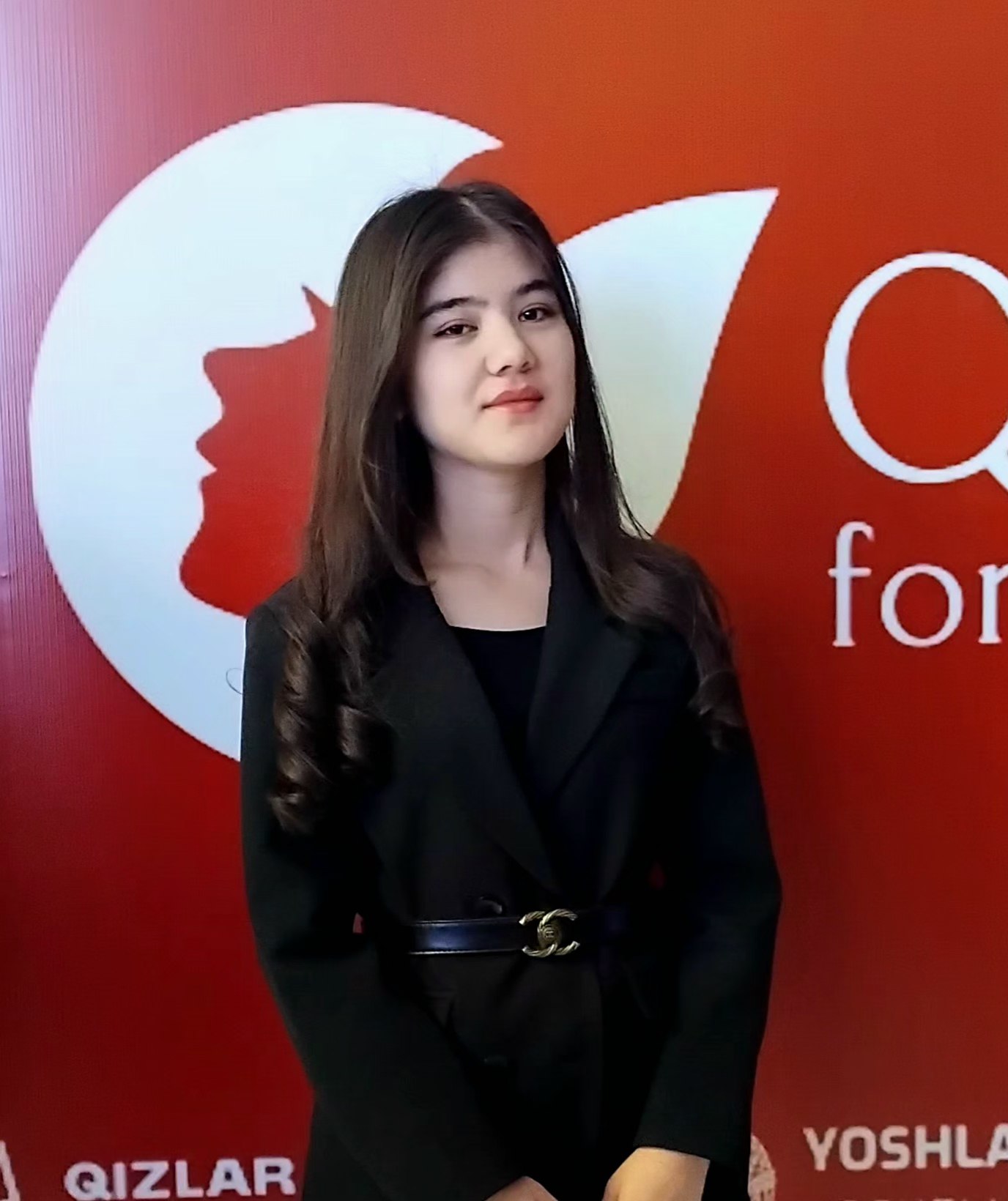
Three young adults, two young women in blouses and one guy in a dark suit, seated at a table at a formal event representing their schools.

Many argue that the use of new technologies has become increasingly pervasive and has significantly altered how young people spend their leisure time. I strongly believe that the positive aspects outweigh the negatives.

First and foremost, many young individuals have become accustomed to using modern technologies, which has led to an improved lifestyle in various ways—such as access to online learning and productive screen time. These activities can often be monitored and controlled by parents, reducing potential risks. Nonetheless, the advantages clearly outweigh the disadvantages.

On the other hand, excessive use of technology can expose youth to serious threats, such as cyberbullying or even influence from extremist content. For instance, a study conducted by specialists found that 89% of adolescents prefer to spend their free time online, which may increase their vulnerability to digital risks.

To conclude, although the use of modern technology can bring certain negative consequences, I firmly believe that the benefits—particularly in learning internationally recognized languages and gaining access to global knowledge—far outweigh the drawbacks.

My name is Jasmina Rashidova, a passionate and ambitious student born on November 23, 2008, in Shakhrisabz district, Kashkadarya Region, Uzbekistan!


I currently study at School No. 74. I have earned several educational grants and awards, and I am a finalist of competitions like BBG, FO, and VHG. I actively participate in international Model United Nations (MUN) conferences and lead my own educational channel — @JasminaRashidova_channel.

With a deep interest in leadership, public speaking, and writing, I continue to work hard toward achieving academic excellence and inspiring others in my community. A bright example for this can be about little Jasmine Rashidova — A finalist of StriveHub, LOT’2025, and CAMLP’25.

Essay from Abdijabborova Sabrina

The Role of Conceptual Metaphors in Cross-Cultural Communication: A Cognitive Linguistic Perspective

Abdijabborova Sabrina

Uzbekistan State World Languages University

English First Faculty

Abstract: This paper examines the crucial role of conceptual metaphors in facilitating or hindering cross-cultural communication, through the lens of cognitive linguistics. Conceptual metaphors are not merely stylistic devices, but fundamental cognitive tools that shape how individuals understand abstract phenomena such as time, emotion, and life. Each culture develops unique metaphorical frameworks influenced by historical experience, environmental interaction, and socio-cultural norms. By comparing English and Uzbek metaphorical expressions, this study reveals how divergent cultural backgrounds give rise to distinct conceptualizations of the world. For instance, where English may conceptualize time as a resource (“Time is money”), Uzbek might present it as a natural force (“Time is a river”). Misunderstanding these metaphorical constructs can result in miscommunication, especially in intercultural dialogue, translation, and international relations. The findings stress the necessity of incorporating metaphor awareness into language education and translation studies. Understanding metaphorical mappings enables more accurate translation, deeper cultural understanding, and more effective global communication. This interdisciplinary approach contributes to both theoretical linguistics and practical language teaching strategies.

Keywords: conceptual metaphor, cognitive linguistics, cross-cultural communication, metaphorical mapping, linguistic relativity.

In an increasingly globalized world, effective communication across languages and cultures is more important than ever. However, language is not merely a neutral tool for communication—it is deeply rooted in culture and cognition. One of the most revealing aspects of this relationship is the use of conceptual metaphors, which allow speakers to understand abstract concepts through more familiar, concrete experiences. As posited by Lakoff and Johnson (1980), metaphors are not decorative linguistic elements but central to human thought processes.

Despite the universality of some metaphorical themes, the way metaphors are structured and understood varies significantly across cultures. This can lead to misunderstanding in cross-cultural interactions, especially when metaphorical expressions are interpreted literally or translated without cultural sensitivity. Understanding how conceptual metaphors function in different languages—such as English and Uzbek—can help reveal the cognitive and cultural models underlying each language community.

This paper aims to explore the cognitive and cultural dimensions of conceptual metaphors, focusing on their role in shaping intercultural communication, translation accuracy, and language education practices.

Cognitive linguistics views language as an integral part of human cognition rather than an autonomous system. Within this framework, conceptual metaphor theory (CMT) has emerged as one of the most influential models explaining how abstract concepts are understood via concrete, embodied experiences. The seminal work of George Lakoff and Mark Johnson (1980) revealed that human thought is fundamentally metaphorical. According to their theory, individuals use source domains (often physical and concrete) to conceptualize target domains (usually abstract and intangible).

Take, for example, the metaphor “LIFE IS A JOURNEY.” This mapping allows us to talk about life in terms of paths, obstacles, goals, and companions—concepts derived from physical travel. Expressions such as “He’s at a crossroads in life” or “She’s going down the wrong path” illustrate how deeply ingrained this metaphor is in English-speaking cultures. Such metaphors are not arbitrary; they are grounded in bodily experiences and shared cultural knowledge.

Importantly, while the cognitive structures that give rise to metaphors may have universal roots—such as physical orientation or spatial awareness—their linguistic realizations often vary significantly across languages due to cultural differences. For instance, in Uzbek, the metaphor “Yuragi tor edi” (literally “His heart was narrow”) conveys the idea of someone being emotionally closed or selfish. While English may use the metaphor “cold-hearted” or “stone-hearted” for similar meanings, the imagery differs, reflecting distinct cultural conceptions of emotion.

Moreover, conceptual metaphors serve not only communicative functions but also cognitive and affective ones. They help us structure time, morality, emotion, and social relationships. They influence reasoning, memory, and perception. Therefore, understanding how different languages utilize metaphorical mappings is essential for grasping how their speakers conceptualize the world. CMT thus offers a powerful explanatory tool for exploring the interface between language, thought, and culture. One of the central insights of cognitive linguistics is that while human beings may share similar cognitive processes, the cultural environments in which they grow up significantly shape how these processes manifest linguistically. Conceptual metaphors are deeply embedded in cultural narratives and worldviews, making them highly susceptible to linguistic relativity—the idea that language influences thought (Whorf, 1956). For instance, in Western cultures, metaphors related to competition, war, and business dominate public discourse. Expressions like “He’s crushing the competition” or “Let’s target the market” reflect a metaphorical worldview influenced by capitalism and individualism. In contrast, metaphorical expressions in Uzbek culture often emphasize harmony, collectivism, and nature. Phrases such as “Ko‘ngli qushdek uchdi” (His heart flew like a bird) or “Sabr daraxti meva beradi” (The tree of patience bears fruit) reflect values rooted in patience, humility, and interconnectedness with nature.

These differences are not merely aesthetic—they represent distinct ontological metaphors and value systems that influence how individuals interpret events, emotions, and relationships. For example, time metaphors differ significantly across cultures: English often treats time as a commodity (“save time,” “waste time”), whereas many non-Western cultures—including Uzbek—may view time as cyclical or natural (“vaqt daryo” – time is a river). Such metaphors shape punctuality norms, scheduling preferences, and even perceptions of life stages.

Linguistic relativity becomes especially relevant when metaphors are used in political, religious, or emotional contexts. A metaphor that may sound neutral in one culture could be offensive or meaningless in another. For instance, metaphors involving pigs, dogs, or certain colors carry radically different symbolic meanings across cultures, underscoring the importance of cultural sensitivity in metaphor interpretation.

Thus, studying conceptual metaphors from a cross-cultural perspective offers a valuable lens into how different societies encode and transmit collective experiences. It supports the view that language and culture are mutually constitutive, and that metaphors are cultural artifacts as much as cognitive tools.

The translation of metaphorical language is one of the most challenging aspects of intercultural communication. Unlike literal language, metaphors often carry implicit cultural assumptions, symbolic meanings, and cognitive associations that are not easily transferable from one language to another. As a result, literal translations of metaphors frequently lead to confusion, misinterpretation, or even offense. Professional translators must decide whether to preserve the metaphor by finding an equivalent metaphor in the target language, paraphrasing the meaning, or in some cases, omitting it entirely if no suitable counterpart exists. For instance, the English metaphor “breaking the ice” (to initiate conversation or reduce social tension) may be translated in Uzbek as “suhbatga ko‘prik qurish” (to build a bridge into conversation)—a different metaphor that carries a similar communicative function but reflects a different cultural image.

Failure to appropriately translate metaphors can have serious implications in fields such as diplomacy, literature, media, and marketing. Political speeches filled with war-related metaphors (“fight for justice,” “combat poverty”) may be misinterpreted or sound aggressive in cultures that value indirectness or pacifism. Likewise, product slogans based on metaphorical language may lose their persuasive power or become laughable when poorly translated.

In language education, metaphor is often neglected in favor of grammatical or lexical instruction. However, learners who are unaware of common metaphorical structures in the target language may struggle to grasp idiomatic expressions, understand humor, or read between the lines. Integrating metaphor awareness into curriculum design can greatly enhance learners’ pragmatic competence and intercultural sensitivity.

Ultimately, recognizing and respecting metaphorical differences is key to developing intercultural communicative competence. Translators, teachers, and learners must all navigate the space between linguistic fidelity and cultural adaptation—a task that requires both linguistic expertise and cultural empathy. The study of conceptual metaphors within a cognitive linguistic framework provides valuable insight into the deep interconnections between language, thought, and culture. As demonstrated throughout this paper, metaphors are not merely stylistic elements of language, but core cognitive mechanisms that shape how individuals across different cultures perceive and engage with the world. They structure abstract concepts such as time, emotion, morality, and social relationships by grounding them in embodied experiences.

By comparing English and Uzbek conceptual metaphors, it becomes evident that metaphorical thinking is both universal and culture-specific. While human beings may share basic cognitive tendencies—such as spatial orientation, bodily experience, or causality—the ways in which these experiences are metaphorically mapped onto abstract domains vary according to cultural norms, historical background, and social values. For instance, the English metaphor “Time is money” reflects an economic worldview, while the Uzbek metaphor “Vaqt daryo” (Time is a river) suggests a natural and cyclical conceptualization. These differences are not only linguistic but deeply conceptual, influencing behavior, priorities, and communication styles.

In the realm of cross-cultural communication, awareness of conceptual metaphor variation is essential. Metaphors often carry implicit meanings that, when misunderstood, can lead to confusion, misinterpretation, or even conflict. This is particularly significant in areas such as translation, diplomacy, education, media, and international collaboration, where communicative precision and cultural sensitivity are critical.

From a theoretical perspective, this research supports the growing body of work in cognitive linguistics that emphasizes the embodied and experiential basis of meaning. It affirms that studying metaphor is not only a matter of linguistic analysis but also a window into cultural cognition and human conceptual systems. Looking ahead, further interdisciplinary research is needed to explore metaphorical systems across a broader range of languages and cultural groups, particularly underrepresented or endangered languages. Additionally, future studies could investigate how digital communication, globalization, and media discourse influence the evolution and convergence of conceptual metaphors across societies.

In conclusion, conceptual metaphors are powerful tools that reflect and shape the way we think, speak, and relate to one another. Understanding them is not only beneficial for linguists and translators, but also essential for educators, policymakers, and anyone engaged in meaningful intercultural communication in today’s interconnected world.

References:

  1. Deignan, A. (2005). Metaphor and corpus linguistics. John Benjamins Publishing.
  2. Kövecses, Z. (2005). Metaphor in culture: Universality and variation. Cambridge University Press.
  3. Kövecses, Z. (2010). Metaphor: A practical introduction (2nd ed.). Oxford University Press.
  4. Lakoff, G., & Johnson, M. (1980). Metaphors we live by. University of Chicago Press.
  5. Lakoff, G., & Turner, M. (1989). More than cool reason: A field guide to poetic metaphor. University of Chicago Press.
  6. Whorf, B. L. (1956). Language, thought, and reality: Selected writings of Benjamin Lee Whorf (J. B. Carroll, Ed.). MIT Press.
  7. Gibbs, R. W. (1994). The poetics of mind: Figurative thought, language, and understanding. Cambridge University Press.
  8. Barcelona, A. (Ed.). (2003). Metaphor and metonymy at the crossroads: A cognitive perspective. Mouton de Gruyter.
  9. Yu, N. (1998). The contemporary theory of metaphor: A perspective from Chinese. John Benjamins Publishing.