Synchronized Chaos’ Mid-January Issue: Human Passions

Older bald man with a beard and a robe meditating in a pond with lotus blossoms with snow-covered trees and a waterfall behind him.
Image c/o Jacques Fleury

Contributor Eva Petropolou Lianou would like to let us know about this call for submissions of poetry to benefit a writer in Gaza (whom we’ve also published).

Also, contributing poet Christina Chin has a new book available now on Amazon, “First Day of the Rest.” This is a special project, a collaborative haibun/haibunga book written with Michael Hough, poet, composer, and musician featuring both photos and art by the authors. More about the book here.

Next, an announcement from contributor Chimezie Ihekuna, who is seeking an investor/executive producer for the project, One Man’s Deep Words. It is set in the US, details here.

Also, poet and prose writer Christopher Bernard would like to share that his magazine, Caveat Lector, will be giving a reading to commemorate the Winter 2025 issue, at Clarion Performing Arts Center. Information and address here.

In this issue, our international contributors address themes of passion.

Some writers explore this concept in the way modern people tend to understand it, with pieces on love of various sorts.

Black and white silhouette family, two older adults, one with a cane, and a little child, on blue ground heading to a yellow sun and orange sky.
Image c/o Mohamed Mahmoud Hassan

Madaminova Ogiloy’s tender poem praises the kindness and care of her mother. Ilhomova Mohichehra reflects on the steady consistency and dedication of her father. Xonzoda Axtamova honors a mother who cared for her children despite her own struggles.

G’ulomjanova Marjona reminds us that family love and care for parents should come before materialism and success in our short lives.

Anindya Paul’s piece compares the pressure of a son trying to live up to his father’s expectations to that of a father doing his best to provide for and raise children.

Teachers and other professionals also extend deep concern for the children under their care. Azadbek Yusupov outlines effective ways to evaluate teachers’ classroom performance. Medical student Dilshoda Izzatilloyeva outlines causes and treatments of pneumonia in young children.

Rus Khomutoff evokes a mix of spiritual and sensual feelings in his transfixing concrete dream poem. R.K. Singh’s poetry explores the feelings of men and women navigating complex sensual desires and emotions: fear, danger, lust, and ecstasy that can come with intimacy. Mark Blickley fills out the story in a bawdy Greek myth in historical speculative fan fiction.

Luis Cuauhtemoc Berriozabal fantasizes about imagined romances as his body slowly decays with time. Doug Holder crafts a mood of giddy romantic anticipation in his ekphrastic accompaniment to Gieseke Penizzotto Denise’s painting.

Person's hand gripping a rope with trees in the background.
Image c/o Linnaea Mallette

While the word has come to be associated with romantic emotion, the word “passion” comes from an old Latin word for suffering and originally referred to the willingness to endure much to reach one’s goals. Some of our contributors celebrate this kind of determination and perseverance, on their paths to personal or creative development or just to survive in the world.

Jacques Fleury reviews Lyric Stage Boston’s production of Lynn Nottage’s play Crumbs from the Table of Joy and discusses how the show highlights the struggles of working-class Black people for full inclusion in the United States.

In Bill Tope’s short story, a young woman rebels against the humiliation of an oppressive dress code.

Graciela Noemi Villaverde draws on gardening metaphors to describe the cultivation of character over time. Feruza Sheraliyeva writes of the corrosive nature of corruption on society and urges every individual to uphold ethical standards. Asadbek Yusupov outlines the balance between individual rights and civic responsibilities in Uzbekistan. Aminova Dilbar highlights the value placed on inter-ethnic harmony, equality, and mutual respect in Uzbekistan, codified into the highest levels of government.

David Sapp’s poetic speaker wishes to transcend this life to a higher spiritual plane, but human feelings keep calling him back to this mortal coil. Kieu Bich Hau remains resolute during her time of soul-searching loss on the shores of Italy’s Lake Como. Michael Robinson speaks to how his faith in Christ gives him joy and peace as he undergoes dialysis. Abigail George’s essay speaks to what it means to create in times of great struggle and societal marginalization.

Anna Keiko celebrates individuality in her short poem, encouraging readers to be unafraid to be themselves. Z.I. Mahmud highlights themes of female emancipation and agency and freedom from existing purely for the male gaze in Sylvia Plath’s poetry.

Outline drawing of a man playing the guitar, wavy colored lines on a black background.
Image c/o Omar Sahel

In his Reflective Thinking spoken word album and screenplay concept One Man’s Deep Words, Chimezie Ihekuna mulls over what makes for a wise and satisfying life. Sometimes, satisfaction can come through dedication to one’s craft.

Jacques Fleury’s poem on a day of solitude reminds us of what unites us all as human beings and brings his literary and cultural aspirations to clearer focus.

Stephen Bett evokes the feeling of hearing performance poetry at a reading in his concrete-ish piece, and also jeers at weaponized misogyny and reflects on chemical happiness. Patrick Sweeney crafts one-line poems that become near-stories with a thoughtful reading.

Poet and nature photographer Brian Barbeito outlines his creative process and goals in a creative personal essay. Kylian Cubilla Gomez’ photos this month explore mediated images of nature: drawings and cartoons we create to interface with our world from a step removed.

Actor and writer Federico Wardal spotlights Egyptian actor Wael Elouny and Italian director Antonello Altamura and their new indie film Ancient Taste of Death. Mark Young’s mix of intriguing and explosive visual pieces meld color, shape, text, and design. Texas Fontanella mixes up chatspeak and everyday language in a cyberpunk-style set of surreal anecdotes and shares some intense, wild musical vibes.

Maftuna Mehrojova outlines basics of and new directions in the craft of business marketing and communications. Gulsevar Bosimova describes and takes pride in her proficiency in traditional Uzbek martial arts.

Dilbar Koldoshova Nuraliyevna writes of how Uzbek poet Abdulla Oripov’s works were grounded in his love of his homeland. Joseph C. Ogbonna reflects on his trip from Nigeria to visit John F. Kennedy’s birthplace and rhapsodizes on the glory of the past president and his times.

Empty bush branches with thorns and raindrops.
Image c/o Andrea Stockel

Another aspect of passion, or love, is grief for what we lose. Ahmed Miqdad mourns loss of life, hope, and joy in Gaza during wartime.

Christopher Bernard laments in mythological, epic language the loss of so much beauty and history to the flames in Los Angeles. Pat Doyne grieves not just the fires in Los Angeles, but the callousness of some in society towards the survivors and the natural environment.

Rob Plath’s poetry conveys the understated numbness of grief and remembrance as Ahmad Al-Khatat’s character sketch illustrates the emptiness and fragility that can come with being displaced from one’s homeland and loved ones. In a more upbeat tone, J.K. Durick recollects fragments of people and literary works that populated his youthful consciousness and now his dreams. Taylor Dibbert reflects on the passage of time through a brief encounter with someone he remembers from long ago.

Linda S. Gunther reviews Nikki Erlick’s novel The Measure, a tale asking big questions about mortality, purpose, and destiny through the lives of carefully drawn, highly individual characters. Wazed Abdullah reminds us to cherish life, with all its ups and downs as Mahbub Alam points out how we are all mortal, how time ticks quickly for us all.

Yucheng Tao’s impressionist poetry touches on themes of memory and loss while Mykyta Ryzhykh draws on imagery of death, decay, and natural renewal.

Lazzatoy Shukurillayeva translates a poem from historical Uzbek poet Alexander Feinberg about the brevity of life and the vanity of assuming you can make yourself great in a short time. Noah Berlatsky humorously reflects on how perhaps most of us do not need to be memorialized through ponderous tomes.

Preschool age child with a large floppy hat and jacket wandering through a field of flowers and tall grass. Black and white image.
Image c/o George Hodan

Despite the finite nature of our lives, some people take passionate enjoyment in our ordinary world.

Dr. Jernail S. Anand recaptures the wonder of childhood and urges his fellow adults to reclaim youthful curiosity.

Isabel Gomez de Diego’s photos suggest the wonder in everyday scenes: a mural of a wine toast during a meal, public fountains, loaves of sourdough bread. Lidia Popa waxes poetic on birds and green butterflies as Alan Catlin sends up many different ways of looking at winter, summer, crows, and the moon.

Sayani Mukherjee illustrates the rebirth of sunrise as winter gives way to spring and she rejoins the outdoors in her running shoes.

In another kind of rebirth, we’ve just barely started another planetary journey around the sun. Lilian Dipasupil Kunimasa welcomes in the Northern Hemisphere’s wintry New Year and speaks of the difficulty of conveying the feel of snow to someone in a temperate climate. Maria Cristina Pulvirenti’s minuscule haiku captures how snow can muffle sound, dulling the senses to focus your attention.

Daniel De Culla cynically speculates that selfish human nature will not change much in the New Year. J.J. Campbell considers signs of hope in his life, then rationalizes each of them away. And, in another piece, Ahmed Miqdad contrasts the human suffering in Gaza with the world’s joyful holiday celebrations. Pat Doyne reflects on quirky, hopeful, and fearsome bits of 2024’s news cycle and wonders playfully about 2025.

Poetry from Sayani Mukherjee

Burning

As the months processed
I surmise a new fall
Flamingo pink skies 
Burning over the horizon
A new Streetlamp hung around my closet
I swam a darkness high 
As I breathe deep I drink a new paradise
Hope's cities has new avenues
Before they all fall a decade high
Hung around still for the spring
Matches for matches 
This is what justice felt like
Over my running shoes 
I knew the darkness has tapestry
So it showed me a matchstick sky
Heaven knows I tried 
For the spring comes 
With burning winter's sickly delicate lace. 

Essay from Madaminova Ogiloy

My beautiful flower 

You are my angel mother 

You are unmatched in the world 

My mother without paradise 

There is no woman like you in the world 

No even in heaven 

No even yours 

My mother without paradise 

You made me out of nothing 

You who washed and combed white 

You are sorry if I make a mistake 

My mother without paradise 

It is true that I love you 

Itʼs true that I even got hit 

This word is also true. Yes, it is true 

My mother without paradise 

There is little I can do for you 

Even the moon in the sky little 

Just laugh a little 

My mother without paradise 

If I cheer you up with my poem 

If I say my love, my flower 

Donʼt let my father be jealous, mother 

My mother without paradise 

Madaminova Ogiloy was born in 2002 in Kopkopir district of Khorezm region. 3rd stage student of Jizzakh State Pedagogical University. She is currently studying English and Turkish. In her free time, she enjoys reading and baking.

Essay from Dilbar Koldoshova Nuraliyevna

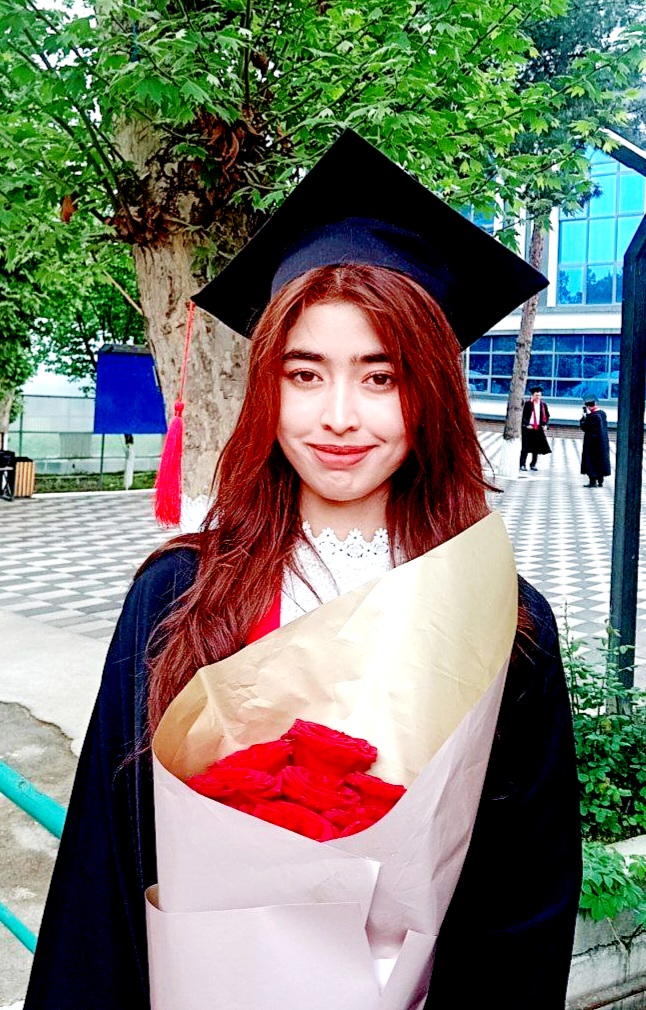
Teen Central Asian girl leaning to our right with dark straight hair, brown eyes, and a white collared blouse.

A POET WHO COMES ONCE IN A THOUSAND YEARS

      My country is Uzbekistan.  I couldn’t describe this country, this people, except Abdulla Oripov. 

      — A voice from far away,

      — Tell me, what should I do, grandfather?

      — He is a voice from the Motherland, 

      — Payondoz on their way.

      — The sound came again suddenly,

      — Tell me what to do, grandfather?

      — A world with a burden on its shoulders, 

      — He is your people, help me, my child.

      It is a holy happiness for me to know that I was born in a land of fire from the loving sun, that I live.  My heart is filled with pride and joy to be the child of Abdulla Oripovday Kashkadarya, who is known and recognized as the second Navoi of world literature.

      A person can choose everything in life.  But he cannot choose the blessed Motherland and parents.  Happy land with umbilical cord blood.   My homeland is Uzbekistan.  By his own name, he is a bek, he is a sultan.  Motherland is our grandfather’s legacy, our father’s legacy.  In every line of Abdulla Oripov, he found the independence of the Motherland and its definition. 

      …Only my weak pen is mine, 

         Uzbekistan is my country.

      In the poem “Uzbekistan, My Country, My”, the poet tells a deep story about the past of the Motherland.

      Today, I decided not to criticize Abdulla Oripov’s biography or his poetry collections, but to visit the poet’s homeland, his heart’s blood, his palace.

      My heart sings the ode of the poet “Uzbekistan, my country” like a charming song.

      As I read the poem from the beginning to the end, the glory of our ancestors, the halal bread of Uzbek people, appears in my mind.  My heart trembles like a chained poem because of the dark days and difficult times they have seen.  That’s all you do, old world.  Beruni, Amir Temur, Uluğbek, Ghafur Gulam… .  In this poem, the word “Motherland” finds its form and shape and pace in the blood of the farmer in the field. This feeling flows like hot blood in my body and soul. It screams like a sign of life. Indeed, Abdulla Oripov  A unique poet who glorified and conveyed the value of the homeland in this poem, it is not an exaggeration to say that the heart that has not penetrated into this ode is not an exaggeration. 

      Don’t be sad, my dear,

      Don’t worry about your age.

      Over the centuries,

      Your everlasting love. 

      In the great human family,

      Your forehead is so bright.

      My bright abode is mine,

      Uzbekistan is my country.

      The poet wrote many beautiful poems about the “Motherland”. 

      The poet created by mixing his soul and body.  I understand the poem “Why I love Uzbekistan” as a logical continuation of the ode “Uzbekistan, My Country”.  In this poem too, the artist praises verses about the soil, sky and sun of the Motherland.  While talking about Furqat, Mirza Babur, who became a king and a khan in his own country and a king in other countries, came to my mind.   My heart is already aching.  Because, as the poet said, wherever a person is born, that soil is his land.  If his Motherland is surrounded by a cold country that dominates like ice, he will look warm and give his love.  He bows to this place and this people.

      Well, if they tell me the reason why I love Uzbekistan, before the poet’s beautiful poems – I bow to my motherland.

      Abdulla Oripov is like that, a poet who loved the people and was loved by the people.

      Today, the wind of Independence is blowing in the song that the poet sang… .  In new Uzbekistan, the country is prosperous and the people are happy.  The joy of happiness shines on the faces of our people.  Today, navbahar came to our country full of light and spring full of flowers.  The days of living and living are visited by Navròz.  We are also celebrating the poet’s 82nd birthday on such happy occasions.  This is also a great blessing of God.

Hero of Uzbekistan, People’s Poet of Uzbekistan Abdulla Oripov wrote thousands of poems, epics, dramas.  He translated masterpieces of world literature into Uzbek. 

      If he writes about the poet, he will not do it.  A poet who honors the country and the people always sings the National Anthem of Uzbekistan.  It’s no wonder that this is the pride of the poet’s heart. 

      As I put the last point, I bow to the great poet Abdulla Oripov, who instilled in me and us young people the feeling of loving the Motherland in colorful verses.

      To the homeland, grandfather,

      You have planted flowers. 

      In every line of your poem, 

      You have lost the value of the country.

      This nation, this country,

      How many bloods have you swallowed?

      Before your description ends,

      Today the pen is weak.

      Once in a thousand years,

      A saint like you.

       Kashkadarya region

Koldoshova Dilbar Nuraliyevna, a student of the 10th grade of the 10th grade of the 43rd school of Karshi district.

Dilbar Koldoshova Nuraliyevna was born on March 5, 2007 in the Karshi district of the Kashkadarya region.

   She is currently the 10th “B” student of the 43rd school. 

      Dilbarhan is the queen of poetry, the owner of creativity, a singer with a beautiful voice, and a ghazal girl.

      She came first in the “Leader of the Year” competition.

        1st prize in the regional stage of the “Hundred Gazelles and Hundred Gems” competition.

         It took part in the “Children’s Forum” category and won first place in many competitions.

          She is currently the coordinator of the training department of Tallikuron MFY in Karshi district.

          Kamalak captain of the opposite district.

          Head captain of the “Girls There” club at school 43. 

         The articles titled “Memory is immortal and precious”, “Our School” and “Mother” were published three times in Kenya Times International magazine in 2024.

     In 2023, the first poems were published in the poetry collection “Yulduzlar Yogdusi” of the creative youth of the Kashkadarya region.

      In 2024, ghazals of the creative youth of the Republic were published in the poetry collection “Youth of Uzbekistan”.

Poetry from Dr. Jernail S. Anand

Older South Asian man with a beard, a deep burgundy turban, coat and suit and reading glasses and red bowtie seated in a chair.
Dr. Jernail S. Anand

CHILD 

The things were too complex 

And when the spectacle 

Moved in front of my eyes

I looked at them

In utter amazement.

When I was a child

Every thing

Even simple things 

Looked amazing

And I looked at them in wonder, 

My eyes wide open.

I had no inclination then

To know what was what 

Simple amazement 

A sense of wonder 

And it kept me away

From my hunger 

And my need for my mother

Mind was stirred 

With strange passions

And eyes, with stranger visions.

Now when I am grown up

And going down the drain,

When I have known so much 

Written so much, debated so much 

When people call me a pseudo philosopher 

And listen to me with open mouths

And shutless winks

They know out of my wisdom

I shall tell them some secret of living. 

I find reduced to a child before the spectacle

That is moving in front of my eyes.

I can’t decipher why there is disparity 

Why there is poverty 

Why gods do not listen 

And why men stoop low

These questions have a ride

Morning and evening like 

The military unit of a tyrant,  

And scared, I turn a child, 

Incapable of standing up to these 

Stratagems of evil, hunger, and deception.

Poetry from Mark Blickley

Italian Renaissance painting of a curvaceous naked woman holding onto a man with a hat and grey hair and a blue robe and white shirt who's holding a sword.
Pietro della Vecchia – Tiresias transformed into a woman

“Tiresias Disrobes”
by Mark Blickley
“A prayer for the wild at heart kept in cages.”
~ Tennessee Williams

One day in ancient Greece, Tiresias was walking down a path when he was interrupted by two snakes copulating on the road, blocking his way. Tiresias got so angry that he took his staff and killed one of the snakes. It turned out to be the female s/erpent. What Tiresias didn’t know was that these snakes were guarding Hera’s sacred tree with golden apples in the Garden of the Hesperides. Hera’s rage, upon learning of the death of her beloved female guardian snake, was to turn Tiresias into a woman.


For ten years Tiresias lived as a woman. And not just as any woman, but the town whore. One day the female Tiresias was walking down a path and once again came upon two snakes copulating. She killed one and this time it turned out the slain serpent was male, so Hera changed him back to a male. These gender transformations made Tiresias the only man in the history of the world to have been both a man and a woman.


Years later, Zeus and Hera were having a terrible fight on Mount Olympus about who enjoys sex more, the man or the woman. Hera had caught her insatiable husband once again cheating on her. Zeus roared females enjoy sex more than men. Hera called him a liar and claimed females accommodate the male out of duty, not pleasure.


Zeus called her a liar. Hera screamed back that her husband was a Trickster and a vicious rapist. Their battle over which gender derives the greatest satisfaction from carnal knowledge went on for days. A frustrated Hera finally decided to summon Tiresias to Mount Olympus to settle their heated dispute. Tiresias’ unique experience of indulging in sexual intercourse as both a man and a woman could supply the definitive answer.


Poor Tiresias was summoned to the foot of their thrones where Hera ordered him to respond to the question of whom achieves more satisfaction from sexual intercourse—the man or the
woman. Tiresias drew a breath, fearful of the consequences of any opinion he would admit. But he decided to tell the truth and answered, “It is nine parts female, one part male.”

An enraged Hera did not allow Tiresias to explain which nine parts favored women and what
single part favored men because she immediately blinded him for exposing her feminine truth to Zeus, thus losing their argument.


One god cannot undo the spell of another god, not even the King of the Gods, Zeus. Yet taking pity on Tiresias, Zeus decided to give the poor man the gift of inner version, the prophetic insights of a seer, to compensate for his wife physically blinding Tiresias due to his honesty.


This is how Tiresias became the blind seer who foretold Oedipus that he would kill his father and copulate with his mother.
I’ve spent years wondering which nine parts of human sexuality Tiresias claims favor women
and what was the only part that favored men because I’ve wanted to write a one-man (sic) play about Tiresias that finally exposes his responses to his ten-point comparison of which gender receives the greatest pleasure. Here’s my list:


Nine Parts to the Women:
#1. Women have orgasms not men. Men have ejaculations. Women can achieve an orgasmic altered state whereas men most often just feel a profound sense of relief. The patriarchy calls ejaculations orgasms because they never want women to consider themselves superior in any way, so they pretend the sexual experience is equal for both genders.
#2. Men most often strain to finish with a grunt of relief, whereas women shriek in ecstasy.
#3. Women are sexually superior to men because they have the courage to join the dual
nature of pain with pleasure.
#4. A woman can tell if a man is sexually aroused by looking at his erection. A woman’s
response isn’t obvious, so she can make the male work harder to prove his manhood by feigning a lack of desire so he puts more effort into pleasing her. His testosterone will poison his ego if he thinks he’s not as desirable or can’t please. Viewing his erection is a visual power she can withhold from him.

As opposed to male performance anxiety, a woman can enjoy sexual pleasure when she turns her brain off and is calm, which shows that a woman also has a brain she can control below her waist.
#6. Women can have multiple orgasms so she can accept many more sexual partners in a day while men are busy recovering from their ejaculations. Thus, if one male partner doesn’t satisfy her, she can immediately move on to another lover.
#7. The clitoris alone has over 8,000 nerve endings to enhance pleasure. The penis has less than half that number of nerve endings.
#8 “When you scratch the inside of your ear using your finger, which one feels better? The finger or the ear?”
#9 While men’s sex organs serve more than one function, a woman’s clitoris has no other
purpose but to give her pleasure during sex.


One Part to Men:
A male having sex with a female does not have to suffer the fear of pregnancy or childbirth.

Mark Blickley grew up within walking distance of New York’s Bronx Zoo. He is a proud member of the Dramatists Guild and PEN American Center. His latest book is the flash fiction collection, ‘Hunger Pains’ (Buttonhook Press).


Poetry from Joseph C. Ogbonna

Tese’s Historic Visit

I visited the 1917 birth

place of America’s first president

of Catholic and Irish descent.

In the historically significant

town of America’s northeast.

Once identified as the disdainful

“Beantown.”

It got me so thrilled that all I could

utter in my amazement and wildest

fascination was a jaw rending wow!!

The artefacts, the vintage furniture,

the early 20th century switch hook,

the relics of the sitting room, bedrooms,

bathrooms, restrooms and kitchen,

all aged a century plus.

The home the all time American great;

John Fitzgerald once called his childhood

home.

The childhood residence of Joe the ill-fated air man.

The childhood residence of the ambitious but tragically mowed down Bob.

The childhood residence of decades long lawmaker, Ted.

And the childhood residence of poor Kathleen, disabled Rosemary, and the athletic and philanthropic Eunice.

For me, it was nothing more than a metamorphosis of abstract history

brought to the fruition of tangible reality.