A Story about the “Where Are You From?” Conundrum…
A what appears to be a “black” guy discreetly steps into a room full of “white” people. Well, as “discreet” as a “black” guy can be in a room full of “white” people. Presumably, and rightfully so, the first thing they see is his “blackness”. But wait, there’s more… The next thing they hear is his “accent”. So, the “black” guy knows what comes next. They will try to discover just what kind of “black” he is. He notices a “white” guy coming his way with the usual disarming wide grin he’s come to know so well designed to lower the defenses. The “black” guy got a twisty feeling in his gut. He knows that this is NOT going to go well or maybe it’s brought on by a self-fulfilling prophecy.
“Hi there, I’m Dick!” The “white” guy exclaims with exaggerated gusto.
“Hi! I’m Jean-Pierre,” says the “black” guy. “I used to know a Dick …” The “black” guy says wistfully.
“Oh, is that riiiight?!” The “white” guy trails off, rapidly batting his eyes, as is somewhat caught by surprise. Then quickly proceeds to his original intention of interrogation style questions, which could be interpreted by some as a form of microaggression among non “whites”.
“So….where are you from? The Caribbean? He asks with the widest grin on his “white” face. Notice how he attributes the name Jean-Pierre to the Caribbean when, in reality, it is of Franco-European origin. Had the “black” guy been a “white” guy, he would most likely attribute the name to France.
Jean-Pierre displays an equally disarming wide grin and blurts out what he’d rehearsed in front of the mirror at home many times over.
“Thank you for your curiosity. Naturally, I come from Mr. Semen and Madame Ovary. I was born in South Central Vagina. Any other explanation would be an exercise in fertility…” He accentuated his response with a guffaw, leaving Dick in a germinative stupor…
Jacques Fleury
Jacques Fleury is a Boston Globe featured Haitian American Poet, Educator, Author of four books and a literary arts student at Harvard University online. His latest publication “You Are Enough: The Journey to Accepting Your Authentic Self” & other titles are available at all Boston Public Libraries, the University of Massachusetts Healey Library, University of Wyoming, Askews and Holts Library Services in the United Kingdom, The Harvard Book Store, The Grolier Poetry Bookshop, Amazon etc… He has been published in prestigious publications such as Wilderness House Literary Review, Muddy River Poetry Review, Litterateur Redefining World anthologies out of India, Poets Reading the News, the Cornell University Press anthology Class Lives: Stories from Our Economic Divide, Boston Area Small Press and Poetry Scene among others…Visit him at: http://www.authorsden.com/jacquesfleury.–
Jacques Fleury’s book You Are Enough: The Journey Towards Understanding Your Authentic Self
Nigar Nurulla Khalilova is a poet, novelist, translator from Azerbaijan, Baku city, currently in the Kingdom of Saudi Arabia. She is a member of Azerbaijan Writers Union. Nigar N. Khalilova graduated from Azerbaijan Medical university, holds a Ph.D degree. She has been published in the books, literary magazines, anthologies and newspapers in Azerbaijan, Russia, Saudi Arabia, USA over the years. Nigar N. Khalilova participated in poetry festivals and was published in the international poetry festivals anthologies. Conducted data in the Austin International Poetry Festival (AIPF), 2016-2017.
I was that awkward girl who did not get much interest from boys. I was gangly, tongue-tied, unattractive, and I was okay and fine. I helped my mom in the market to sell her perishable goods. I was hardworking, and people would always tell my mother, “Oh your daughter works so hard like a boy. You are so lucky.”
My mother would smile and nod, and I would keep my face blank.
It was almost a good thing that I hardly got serious attention from boys, until Chima appeared. Chima with his dark muscular build and charming smile. Chima had machines that ground things in the market for him, things like pepper, tomatoes, corn, cassava. His shop wasn’t far from my mother’s, and he even had boys working for him, boys who did most of the messy work for him. It was either they were learning work, or they were hired as proper workers.
I had always been happy with myself, gangly or not, beautiful or not. I didn’t bother about makeups, it just wasn’t my thing. If anyone would ever have something to do with me, that person should be acquainted with the real me. Not hating on people who use make-up, though. I’m just saying it wasn’t my thing. The highest I did while going to church on Sundays was to apply black tiro – the ones I imagine Nollywood actresses used in their epic, culturally-rich movies, and on some dramatic Sunday mornings I would stand in front of our large mirror and mimic the voices of Nollywood actresses. I would start with Ngozi Ezeonu commanding a palace maid, and I would end with Chioma Chukwuka flirting with a cute, muscular black man beside a quiet stream.
I didn’t know that Chima was interested in me until I gave him an envelope for our church harvest. Every year we were given large envelopes in church to share with people we knew, family, friends and well-wishers, and they were supposed to put money in those envelopes for the work of The Lord. When I went to take it back, Chima had put ten thousand naira in it. Other people had put five hundred naira, one thousand naira highest, but Chima put ten thousand naira. I was startled. I had never been interested in anybody’s money, except for business. Right from a young age I was getting money, I hustled with my mother in the market. What else did a young girl need? I was properly fed, I had come out of secondary school. Nobody was talking about going further, my mother wouldn’t afford that, so I was content with myself, doing business with my mother, trying to be a succor to her soul as a woman who left an abusive husband – my father – many years ago. I was twenty-two when Chima picked interest in me, but never been in a serious relationship before. Somehow I thought things would unfold on their own, but the way mine unfolded scared me.
Chima started giving me money every weekend, without me asking him for it. I never knew how to ask, by the way. I had always been satisfied with my mother’s financial coverage, and with the little income I made. I took Chima’s money for weeks. I saved it. Because of Chima I added a little more effort in the way I dressed to the market. At least I tried my best. The market wasn’t a place where one needed to dress extravagantly while going out for the day, but I tried my best to look very good or sharp, in the Aba slang.
Ahịa Ọhụrụ market wasn’t like working in the bank, or in an office where you could dress yourself daintily. Here in the market you dress in a certain way, in a subtly rugged way because anything could happen. A fight might break out. A barrow pusher might hit you, somebody might look for your trouble, a rogue might try to steal your goods, so one came to the market with a certain kind of dressing void of superfluity.
Chima got more friendly with my mother, and I wondered if my mother suspected anything.
Then I started visiting Chima in his house. Many months had passed, and yet Chima was still giving me weekend money as though I was working for him, as though I did anything for him. It started with him saying, “You never ask me where I live. You never bother to just pay me a visit.”
That was how I started visiting Chima, me the unattractive, skinny girl. The first day I visited him was the day I took a proper look at myself, really observed that I didn’t have a robust nyash – buttocks – like a proper girl should have, a proper Igbo girl, if there was any such thing. I just observed it, but I did not pity myself. I was not the type that wallowed in self pity. I was ready for anything. What was the worst that could happen? The worst that could ever happen was Chima to stop being interested in me, to stop giving me money, and to stop grinning too widely when he spoke with my mother. That was the worst that could ever happen, and I was ready for that, in case it happened.
So on that first day of me visiting him in his house I prepared myself and went, wearing a new gown I had bought in Ariaria market. It was a bit loose, the gown, modern, and a bit churchy. And I went, feeling confident and reserved at the same time.
Isaac Aju is a Nigerian writer whose works have appeared in Poetry X Hunger, Writers’ Journal -New York City, The Kalahari Review, and is forthcoming in Flapper Press. He lives in Aba where he works as a fashion designer.
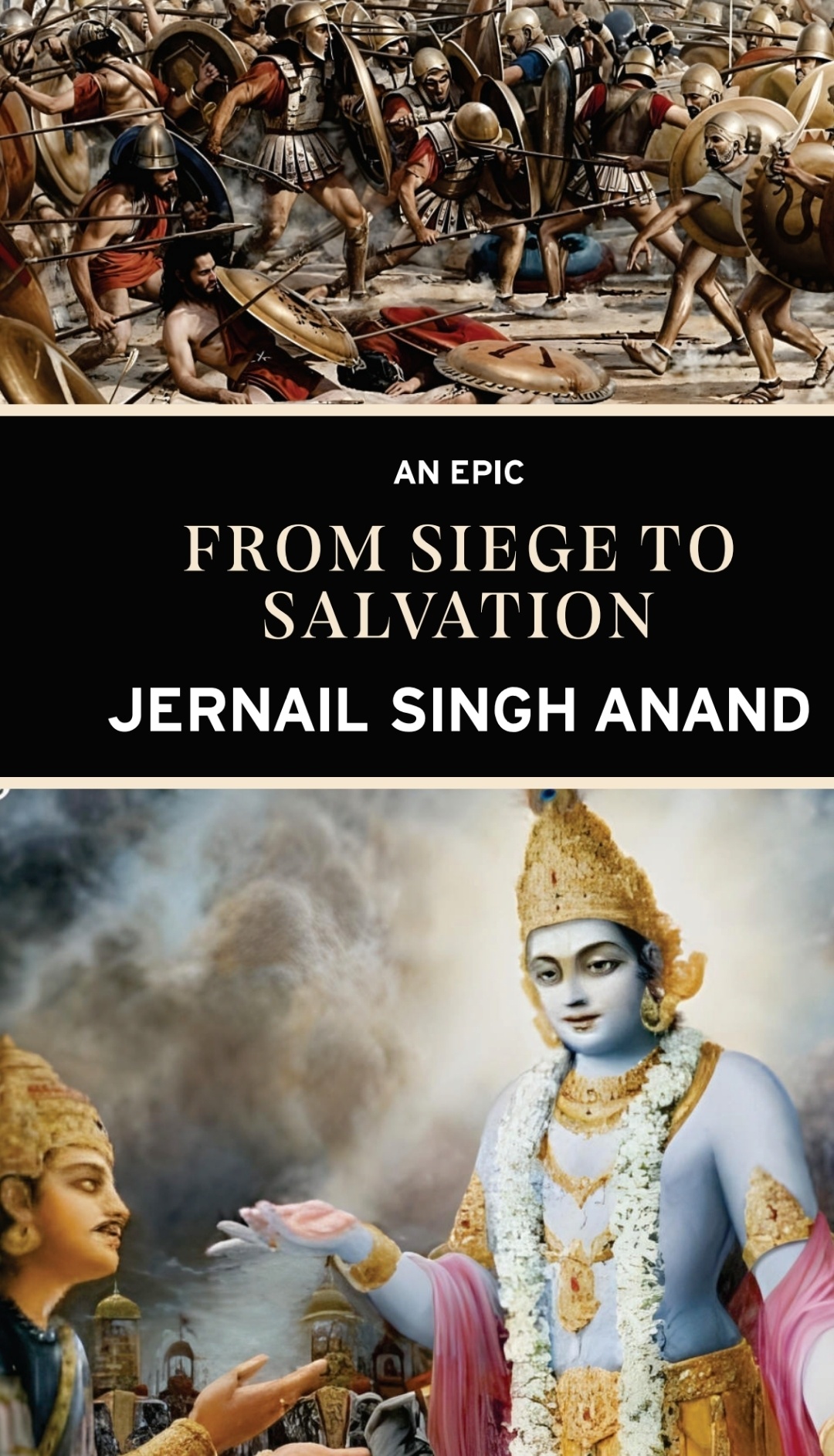
DR LALIT MOHAN SHARMA ON DR JERNAIL SINGH ANAND ‘S EPIC POEM ‘FROM SIEGE TO SALVATION’
SEIZING THE ESSENCE
Dr. Lalit Mohan Sharma
Having harnessed a creative instinct to compare and contrast, Dr Jernail Singh Anand finds himself in the presence of a thesis, confronts the anti-thesis and arrives at a synthesis between the East and the West, the ancient and the contemporary, the spiritual and the mundane, actualising in his poetry the conflicting claims of the sacred and the profane, moral ethical and the narrow personal egotistical, the precious and the spurious. In the preface to the poetic drama, Dr Anand observes that ‘the siege of troy led to the exhibition of great personal valour and national honorifics, while the Mahabharata shows us the way to immortality through righteous action’. In Invocation, the author juxtaposes the two events :
How the West revels in individual
And the East in a collective destiny for mankind.
The thirteen Canto poem unravels through interaction between Chorus and Professor as they debate and deliberate in an argumentative manner on the ethical and human consequences of this juxtaposition. Other characters from the epic poems also mark with their appearance the progression in ‘Siege to Salvation’. Even as ‘an impersonal fate directs ‘unquestioning minds’ in terms of religious mythology, Anand has the Professor articulate how poor masses suffer ‘ not only mediaeval obscurity/ But also the identity stricken massacres of modern times’. Ancient time of the epics or the contemporary scenario, the fate of common man is at the mercy of ‘ vain power’, for it is ‘not only siege of Troy/ But also the siege of human will’. Professor wonders if ‘ Iliad has no moral framework’. Is it only to ‘settle personal jealousies, not epical issues’. Does Mahabharata concern itself not with victory only, but victory of ‘ good over evil’? Only beauty of Helen is extolled, but doesn’t it ‘deny her individuality and personal will’ ? Isn’t such freedom ‘imparted to Cleopatra/ And other great women of epics/ Like Draupadi and Sita of Ramayana’?
During this juxtaposition between the great epics, Dr Anand raises a sequence of questions and erases a plethora of doubts about the celebrated happenings; 1184 BC events being the reflection of the heroic age Homer recounted in his epic poems, and the Mahabharata, the great Vyas, contemporary to the epic events serialised in his work! How these great poems impacted Western literature and that of the East is universally acknowledged. Dr Anand has taken over the audacious approach to access works of Homer and Vyas in a simultaneous gesture of looking at them as a single imaginative canvas. Consequences are the lavish details Anand presents in this epic drama, leaving the reader with a freedom to arrive at his own conclusions and reflections.
Dr Lalit Mohan Sharma
Poet, Translator and Reviewer,
Dharmshala, HP.
More than a dozen books of English poetry besides a verse translation of Urdu poems, Dr Lalit Mohan Sharma, born 1952, taught language and literature at government colleges in Himachal Pradesh and retired as Principal in 2010. His 2025 publications include ‘Voids of Silence’, ‘ Accepting Absences’ and a Monograph, ‘Another Gandhi’, on Pr. Durga Dass, a freedom fighter. Settled in Dharmshala, his association with State War Memorial and Harmony Day Care Centre for Special Children is close to his heart. A former member of NAAC’s Peer Teams, Sharma’s writings are included in “A Handbook of Contemporary Ethics”, (2024).
Poets and artists of the world, we are receiving video entries. Send your photo and your environmental-themed video to 3 minutes with your name and country.
Registration for non-official members of the Global Federation: US$15.