willing it,
he draped tinsel across the train tracks
of his childhood


she said: the Tao teaches you in your sleep


when the mathematicians get here, be sure to use the word 'approximately'
and please don't bother them with knotty questions about prime numbers


she kept her 'waitress' shoes in the hall closet


day moon
briefly in the nucleus
of dew


she filled the holy water bottle from the polluted creek


Rosary and a half-pack of Pall Malls
in the big front pocket
of her knock-around housedress


he's wasting his gifts envying butterflies


it can't be normal to think about a cardinal in a blue spruce tree all day


I got the parking spot
and a half-baked notion of an infinite universe
Category Archives: CHAOS
Poetry from Jacques Fleury
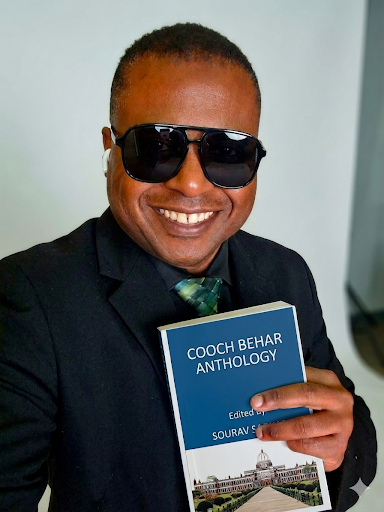
It is Always Sunrise Somewhere
[Published in Fleury’s book “Chain Letter To America: The One Thing You Can Do To End Racism” and in the Indian international “Cooch Behar Anthology,”, Sourav Sarkar, Editor, available on amazon]
Photo c/o Jacques Fleury
Ahhh, the sweet smell of morning, coffee brewing, eggs frying, birds chirping, eagles flying…
Dawn has awakened to adopt the forsaken, those born without tongues;
They are the colorful birds without nests, outside of this daylight darkness looms with a smirk,
Patiently waiting for somebody’s light to capitulate
To its black tunnel of nothingness and to laugh
When they get lost and stranded
On their way to salvation, but the morning’s breath offers direction,
A sound that rings ripples in the sea of lost souls,
Anxiously waiting to escape the destitution that stands
Between the richest and the poorest; the destitution that stands on wobbly legs
As naked as a tree in the deep dark frost of winter;
The parts of the earth surrounded by rows of semi-invisible iron bars
Anchored from the ground to the infinity of the sky;
While affluent oppressors gorge on caviar…
And isn’t it about time that someone asks “why?”
But the breath of dawn has come and it’s blowing just enough cold
To seal the pores of the poor so that the venom of racism and classism
Won’t infiltrate their gaunt paper thin skins.
They listen for the breath of morning to announce a new beginning;
Hoping to rid the world of famine…giving them a reason, particularly those sleeping on treason,
To get up in the morning, and to bask in the knowledge that
It is always sunrise somewhere…
Jacques Fleury is a Boston Globe featured and internationally published Haitian American poet, theater reviewer, educator, author of numerous books of essays, reviews, fiction, poetry and literary arts student through Harvard University. He was chosen among over 4, 000 competitors from 83 countries as the Recipient of the International Naji Naaman Literary Prize for Creativity (2026) and a Certificate of Participation for his “…esteemed contribution of poetry to the anthology Water: The Source of Life (Volume IV) presented by La Fenetre De Paris.

Poetry from Timothee Bordenave
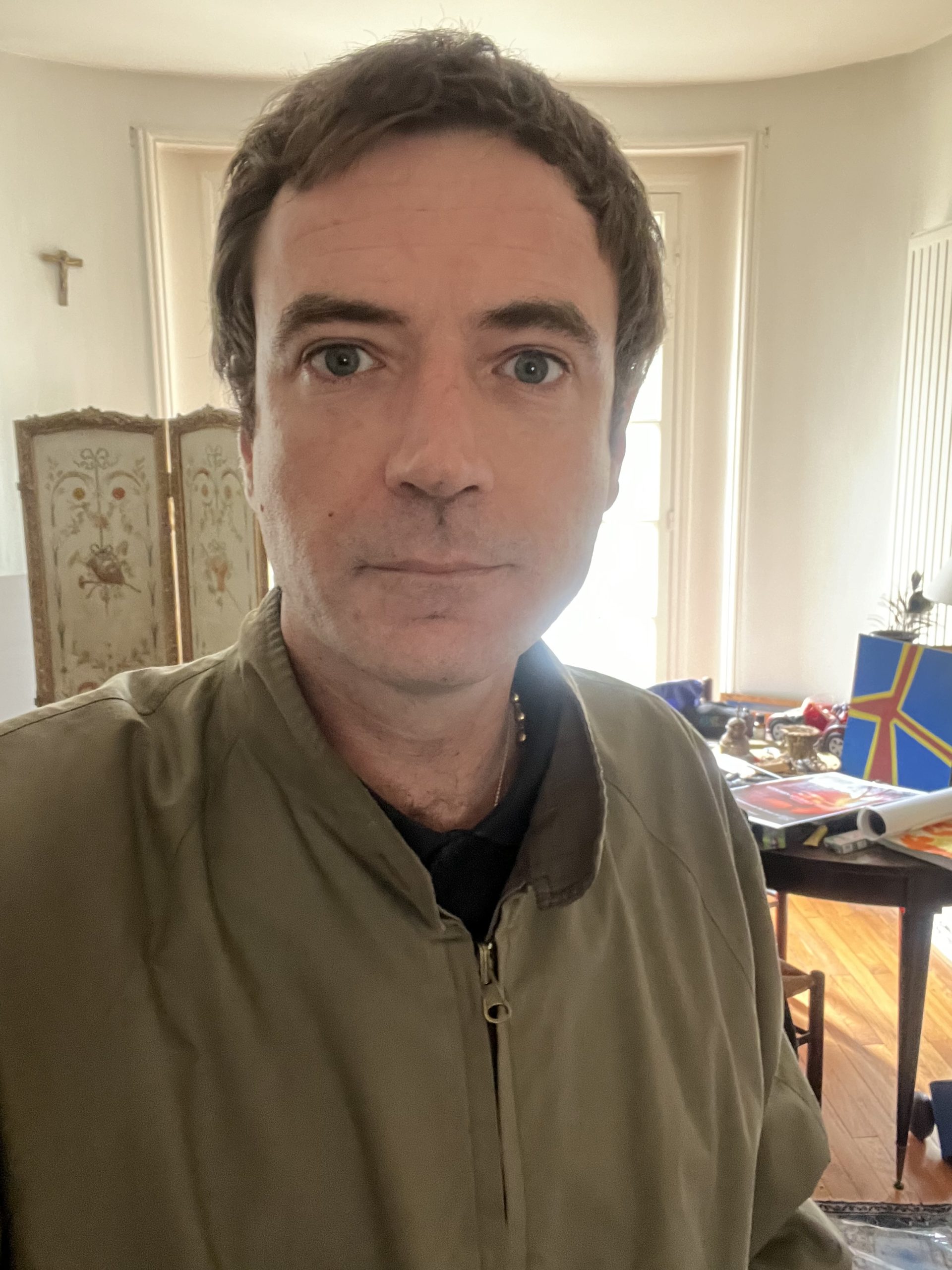
Jesus is with us.
In Paris, there is a legend,
That Jesus lives, rue Cordelières,
In a hidden villa, where ends,
A lane… Since our past hundred years.
He reputedly reads a lot,
Of old scriptures and some novels,
Served by a guard of the angels,
He thinks, he prays there, for the most.
Some say, He sometimes walk the streets,
To museums, or bakeries,
Or cafes, anonymously…
To a beggar, apparently,
A man who gifted jewelry…
Could have been Him !
Who knows ?
Him, Christ !
*****
The poet plans for work.
You see me now, well quiet, at my library desk !
Director here. Further, I hear cars passing by,
Further, I see grey clouds… The silence is at stake,
Calm, as I read Plato : moments some wish could buy.
Then I take my pen on : I will write for Roma,
For the woman I love, her lips, their aroma…
I will write for Paris, for London, for Madrid,
For a farm in the snow, then for my youth in need.
I want to write again ! For a trip to Jersey,
On a boat, whilst a storm was raging the Channel,
I want to write about hiking, and this tunnel…
In Geneva when I questioned my survival.
I will write about my past girlfriends – when opals,
Drizzled from their glances on our soft Odyssey !
*****
An adventurer, at home.
The soft, suavous scent, of these burnt lavanders,
Dwells my mind, whilst I quietly write this poem,
In my living room, books and paintings, masks and gems,
Just keep still… All around the silence reigns over.
Blessed be, o Lord ! Thy peace, granted to a poor boy,
Came with the faculty to work, and learn your books…
I can pray now Thy love, in this shrine full of joy,
Rich refuge for my life, which I am glad none took.
There are the jewelry, tailored clothes, lithographs,
Sea shells and silver lamps, ivories, or gold rings…
All reminding of past battles. – My humble being.
Then I will read the Psalms, the Gospels and some Saints !
Before writing a stance, a try, until I faint…
To express gratitude ! As for an epitaph.
*****
Timothee Bordenave
Born in 1984 in Paris, France, Timothee Bordenave is a French author of fiction and essays, and a poet. He has published about 27 books to date, and his literary works have been translated in large parts to about 20 languages… He is also a visual artist, whose photographs and paintings have been shown in France and on various international locations.
Timothee Bordenave studied Law, then he studied the Information Sciences. He used to work directing libraries in Paris, and nowadays he is a full time creative. With continuous media and university related publications worldwide, many art shows he presented around the world too, and his books published in French and English, he has been said by the critics : one of the most intriguing French writer – and artist – of his generation.
Aside from his own creativity, Timothee collects contemporary artworks, along with religious and ethnic artifacts. He also devotes himself to prayer, and the study of sacred texts and traditions from our civilization’s ancient masters throughout the World.
He describes himself as “a humble, quiet, and very ordinary man who only wants to serve as worker, in the vast fields of our Lord, as is recommended by the Good Spirit of the Gospels of Jesus.” “Living in a pilgrimage here, for his eventual salvation if the Skies would allow.”
*****
T. B. MMXXVI. III.
Poetry and art from Srijani Dutta
Think like a blabber
(Selected pieces)
(2019-2023)
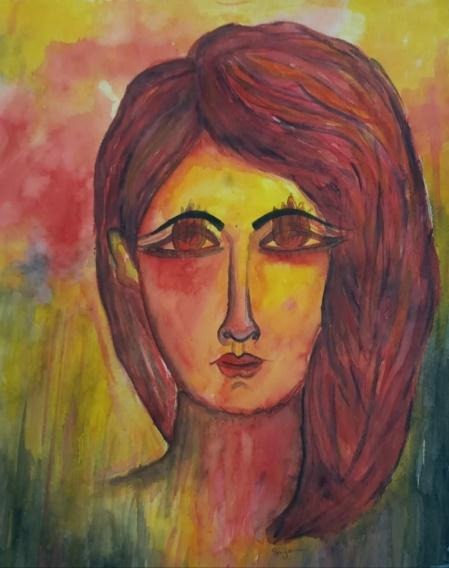
Self-Portrait
2020
I contemplate a lot. I ponder over my mind, my prejudices and my existence. It makes me express myself through words and colours.
Fragment 1
There is a light, I believe
At the end of the tunnel
Shimmering, blinking
To show the hapless souls
The meaning of life.
There is a light, I hope
At the far end of a tunnel,
Hope to see
Not its death
Its constant struggle
Against the rough winds
And the hammering silhouettes.
Burning flames, burning flames
Flicker but not yield.
Burning flames, burning flames
Pose like a crumbled soul;
Remaining ashes
Pose like a crooked nail;
Moisture, dewdrops, lavender,
Skin of oaks, landmine, sound of those
Savage disasters, elusive memory,
Knightly armour, tattered jackets, wet soils
Uncharted vision- all I want
From the daybreak to the last ray of hope.
Till then, burning flames,
Seek, strive,
As there is a light at the end
Of doubt and denial:
Conquerable and
Solemn.
6 the September
2021
Trash box
We throw garbage in a garbage box. Unknowingly, we throw a fragment of ourselves in the box; we throw our skins and unknowingly we look down upon at the wastages. So, what is it doing in the box? How long?
16 December
2021
Fragment 2
Contemplating over things: Mind’s progress
I. Similarities
It feels like air
When someone sleeps,
Seems like a box of stones has been dragged out
Pacified
Hollow like balloon.
It feels like river
When the sweat trickles down from forehead
And touches someone’s knees,
It is cold like water
When the fan runs in full swing.
It feels like a jolt
When the bus driver hits a break,
Seems like one discovers oneself
And starts searching for the past skins
Of the past times
In the road
Once travelled
Of his livelihood.
07.11.2022
II. The Pain
My mind needs a sheet
To cover itself up
For camouflage
For hiding from the wind
As it carries the unwanted thoughts
Of different times,
Thought about bodies,
Uncertainties,
Failures;
My mind does not halt for a moment
I like a sleepwalker try to cut the entrance door
To have a look
Of the sunny mornings
Of its other side;
Gloomy, it sounds
Mild, it appears
It bombards,
It bombards the wall
Between my tempo and mood
I don’t want to have the darkness
Around my body
When my mind
Can leave its skin
Within a wink of an eye.
The cobwebs inside my mind
Like fear
Increase
If they are not untangled
With the feelings
Of ease
And
Of melodies.
From the melodies,
One can find a tune
The tune
That binds
The hearts of those
Who cycle through the veins of life
Cycle through the spark of failures.
08.06.2023
III. Agony
I am born in the month of agony
As peace has not dared to appear;
From sunbeams to sunlight,
Shapes and intensity
Change,
The toddler learns to run with words;
Here, I, the agonized, disorganized soul
Do not know how to crawl.
All the butterflies spread their wings
Around the tip of a bud
Encouraging it to grow,
Hope,
The world acts like this
And makes a constellation
Of lost souls.
March, 2023
IV.
She cries and cries
As if she is destined
To bear the weight
Of the cracking sky,
She never imagines
That her teardrops
Can paint the white rose
Into blue
That she drew
In her notebook.
7th April
Fragment 3
The Blabber
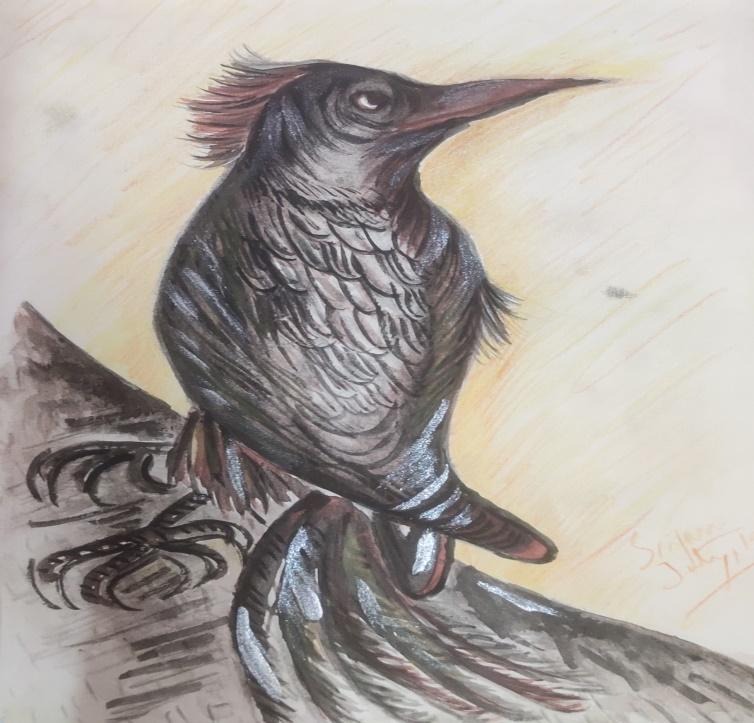
Side face of a blabber
2019
The Blabber
Part 1
If something wonderful happens in my life, what will I do?
The best thing may arise in me.
My instinct or my strong belief in miracle can bring miracle to me.
People say that life is a box of miracles.
Life happens when nothing is happening.
Who will open the lid of the box of my life?
Waiting is the foe of creative energies,
I believe.
Restlessness creates the symphony
That takes refuge in me.
Blabber is one who speaks a lot but can do nothing.
I am that blabber.
Blabber is one who lives in the bubble.
Bubble of misconception, bubble of doubt.
I am that blabber.
I am such a blabber that I fail at everything.
I want to be a doer.
From being a dear to a deer, one goes through a journey.
Part 2
I write to free myself from the clutches of thoughts.
My body acts like a vessel and I am the sailor of the sea.
My vehicle is not so big like my body.
Its frailness makes me ponder over my rowing skills.
The canoe like body faces hurdles to go forward.
I want to be free like water.
As free as the birds.
The boxes around my existence enable me to think
That I have to take a shape
Of a cube, round, square
Or of any geometric figures.
Water is shapeless
So does the wind.
Sky is shapeless so does the earth.
The oxymoronic sensation is my breath
That acts like a fuel to the machines of my body.
Oil makes the machine run properly.
Every evening, the horizon paints the scenic beauty
That does not demand any mechanical or technological recording.
My eyes see the eyes of the firmament.
At night, it is the evil but the day comes with the prediction.
A hope,
A dawn.
14.04.2023
The moods of Future
The future is a giant ball. A mystery starts with the anonymous suspects and ends with the prominent names. The more you try to look at the future, the more it will get away from you. It is like sand slipping away from your fingers. It only makes you realize what you can hold on and that is present. Today, the first day of the Bengali calendar says what can happen in the near future. Possibility and probability are not same with certainty. Certainty gives you the feeling of ending. As long as a soul can float, he is happy.
Happiness gives you wings. It makes you venture into the lands that you have never thought of. The blankness in the eyes of a kid does not hypnotize an adult. But, the same blankness garnished with wonder can make anyone feel lost if anyone peeps into it.
Eyes are like ocean, I always say.
From yellowish blue to bluish brown, the colour paints the layers of the sky. They symbolize the different moods. The cinematographer plays with the colours, technicality of the cameras, and the camera decides which mood (circular or horizontal) it should concentrate on. The process of contemplation evokes out the psychology of the scene, the inner spectrum of the human beings.
The wise man can quickly advise on the significance of the minutes. Seconds are better than minutes. The tourists wait in the Tiger Hill to witness the rising of the sun, the advent of a new dawn. They wait with their cameras but within a blink, they can miss the metaphorical birth of the sun. This is the power of the seconds. The future is exactly like this one. It follows the laws of nature. And miraculously, the nature is the creative offspring of God. This nature stores the gems under its soil. It lets her rivers flow. It is also like mood. Very uncertain yet so adventurous just like life.
Youth is life; life is youth. How long can youth stay? Youth is the bohemian river, a wild horse. After youth, comes the mid age. The age of grey hair. White means wisdom. Wisdom means a step closer to death. And everyone will meet the future. The future comes with a hazy mood.
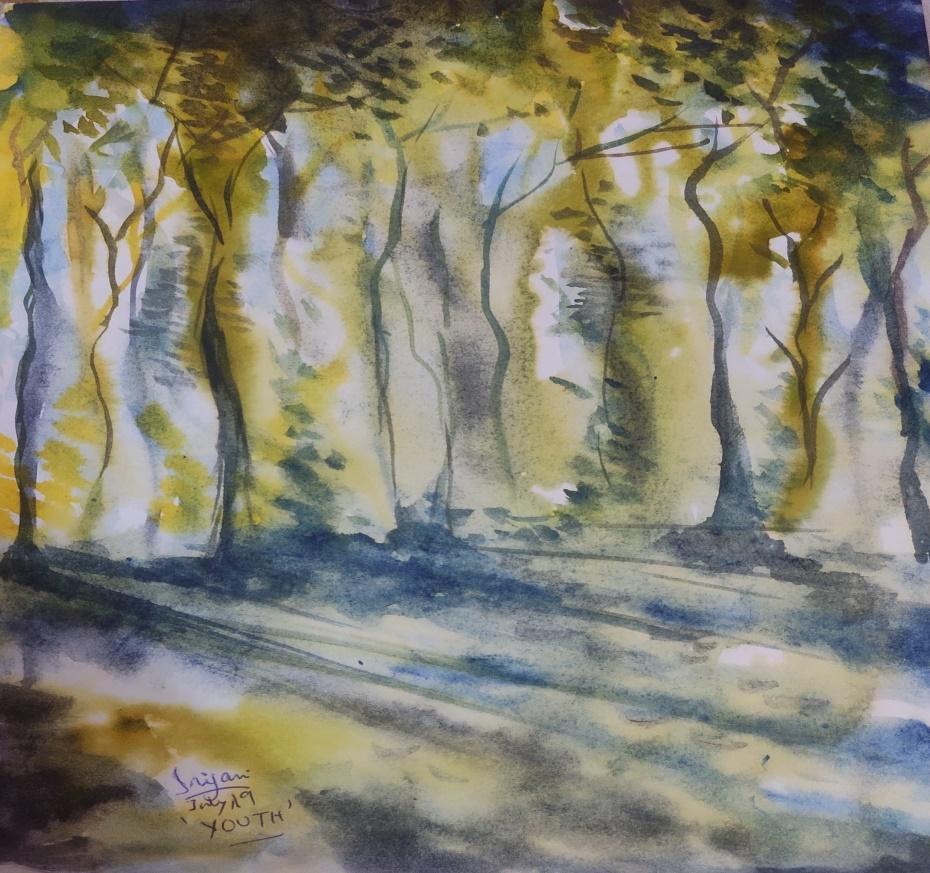
Youth
2019
Life is synomous with youth. Youth can be existent, omnipresent if one only thinks of present. Destiny is like a flame. Moths are like the pedestrians. Flame attracts the moths. Some die; some make a life of illusions.
15.04.2023
Prayer and Prayer
Folding the hands and looking upwards are the ways to alert the God. You become silent; you become calm. You have words but you throw words at the wall. There is no receiver except God. The tantrums of the world, the gullibility of the human existence, the love for the breathing- all sterilize our thinking capacity.
The act of thinking makes the hair grey.
Hair falls down onto the ground.
The empty baldness starts appearing.
Still, you pursue conversation with God.
Your sweaty body starts getting melted due to agony and excitement.
Uncertainty aligns with belief and belief is a force.
A force
Indomitable.
15th April, 23
Fragment 4
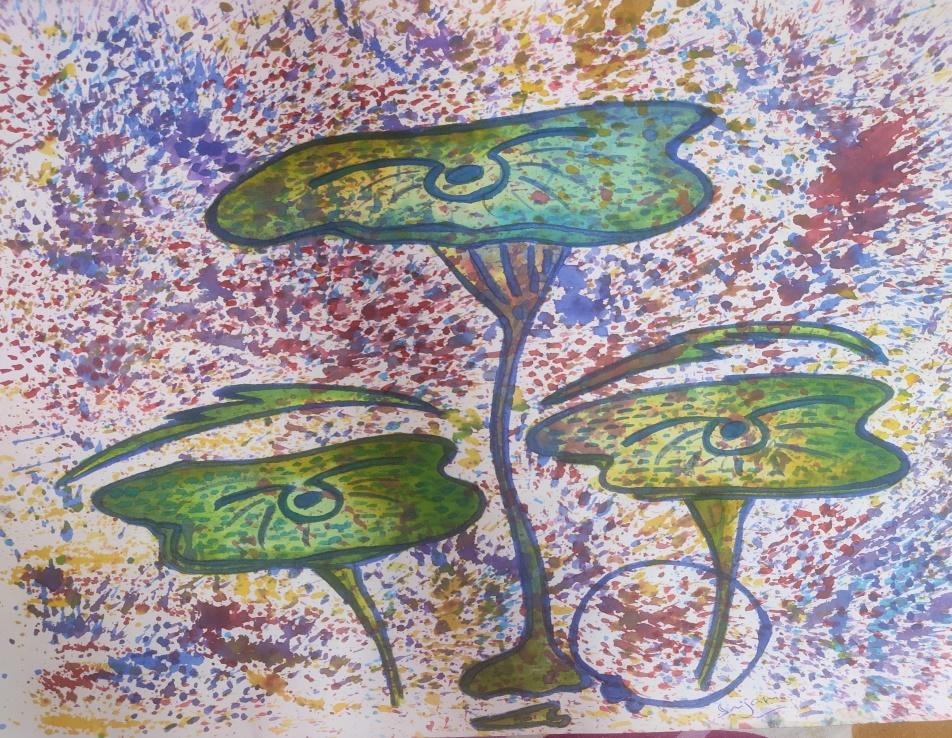
Face of Durga
2021
The (000) of my life
I don’t know the meaning of (000). But, I am sure what may be the possibilities of (000) in my life. People say that life is existence. I believe that life is doing. Journey means going from one place to another, moving from one space to another. Moving signifies that you are doing. You are doing for the mind; you are doing for the body; you are doing the deeds. Does (000) refer to a circle? Is it a line? Does a straight line hit itself back-to-back until it gets transformed into a round shape? Line has an end. Circle has no exit. Line has an exit. Circle has no end. I am Srijani. I am happily stuck to the ground of (000). I am running, growing like the leaves of a plant. A seed in a soil.
The beauty of livelihood is such that it makes one pause for a moment. One thinks and thinks until his eyes feel the burden of sleep.
Mahalaya, 2023
Fragment 5
I see you-
The people,
I see myself there,
Just there.
From here,
To here
Navigating, slowly, silently like a
Super sleuth or a cautious frog
I am going
I am traversing.
I am visualizing images
Like a heap of moments
So transitory
So illuminating
Ephemeral like wind
Like a second.
It evaporates,
It evokes out the smell of
Loveliness
Loveliness of the face
That is standing in the dark,
The eyes as dark as caves
Dark as the veiled sky,
I am standing in the mid centre of stage
Called life.
How ironical it appears!
I am cycling through the words
Some want to become the dusk
And I want to become a dawn.
Tears blow like wind
Only to make a bridge
Between you and me
Me- the mind
And you-
The people, the receiver
And the audience.
17.11.2023
Fragment 6
Two years have passed.
I forget to read the notes.
There is a coin in the notes.
The coin that I place on my palm
Only to listen to its subtle sound
Is a boon to anyone’s miserable days.
This sound is so silent
That the deaf intends to receive its noiseless words.
Sometimes, it is my soul
That reciprocates to the sound of my brain.
Who gives me signals?
Me to my selves?
Or something else?
18th November
2023
Fragment 7
I can smell the smell of the dead men
But, I forget to smell the odour of the flowers
Of my garden.
I see the vision of the forebears in the
Eyes of the girls,
I can smell the smell of their bodies
I smell the smell that is yet to come
But, I forget to smell
That is already there.
Is it just my fear?
Is it something else?
I think and overthink
To let my thoughts flow
Through my veins
And I walk
I go.
25th November
2023
Poetry from J.K. Durick
Full Tourist
I’ve been a tourist all my life –
Always passing through
Touring from here to there
Always trying to recall where
I am today and on to tomorrow.
I’ve been looking for a guide
To direct me in a language I know
(English spoken slowly, a little
Frence and of course
My high school Latin) spoken
Clearly and loud enough.
I’m a tourist taking selfies and
Buying post cards and souvenirs
To remind me where I’ve been
And all the things I’ve probably seen.
I’ve learned to live in and out
Of a suitcase, rummaging about
Through underwear and socks
Enough of both I’m always hoping
But never sure – just ask me.
I’m always a tourist planning my next
Excursion, out and back, next and
After that, every day, all day, smiling at
And wondering about all these locals
Natives of the place.
Packing Up
I picture you packing
A backpack, a carry-on
And you didn’t mention
Anything else, so my
Picturing will be limited.
A few weeks in Europe
Touring, sightseeing, and
dressed to the nines, as
I expect you will be, will
Need careful selecting
Folding and matching
One thing with another.
Walking through the Roman
Forum, sipping the right
Wine in a Parisian café
Standing in line for just
About anything this time
Of year, hottest it’s been
In Europe in recorded time.
Your backpack and carry-on
Left in that bed and breakfast
Your kids picked and there
You are – I can picture it –
Dressed for whatever comes
Your way.
Time Travel
We time travel, but not like Wells
In a machine going back or
Ahead, blurring centuries as
We find out what went on or
What will happen. No, the kind
We do, requires that we just
Sit back, stand back and let
It happen. It’s inevitable, so it
Needs no outside assistance.
We’re travel through time, going
Forward on the clock and on
The calendar, sometimes plunging
Ahead, sometimes tick-tocking
Onward, but always moving on
Shedding yesterday, disposing of
Last week, last year, and what it
All meant. We do carry ourselves
So things accumulate on us, in us
Follow us, become part of us. We
Never get to go back to relive and
Or improve on what happened in
Our past. We travel forward, but we
Don’t know when it all will end, don’t
Know when our clock unwinds or
When that last alarm goes off and
We can’t get up and start again.
Poetry from Noah Berlatsky
got my chakra
got my chair
eyes are going
can’t tell one from the other
keep trying to sit and
falling out of
enlightenment
Art from Mark Young