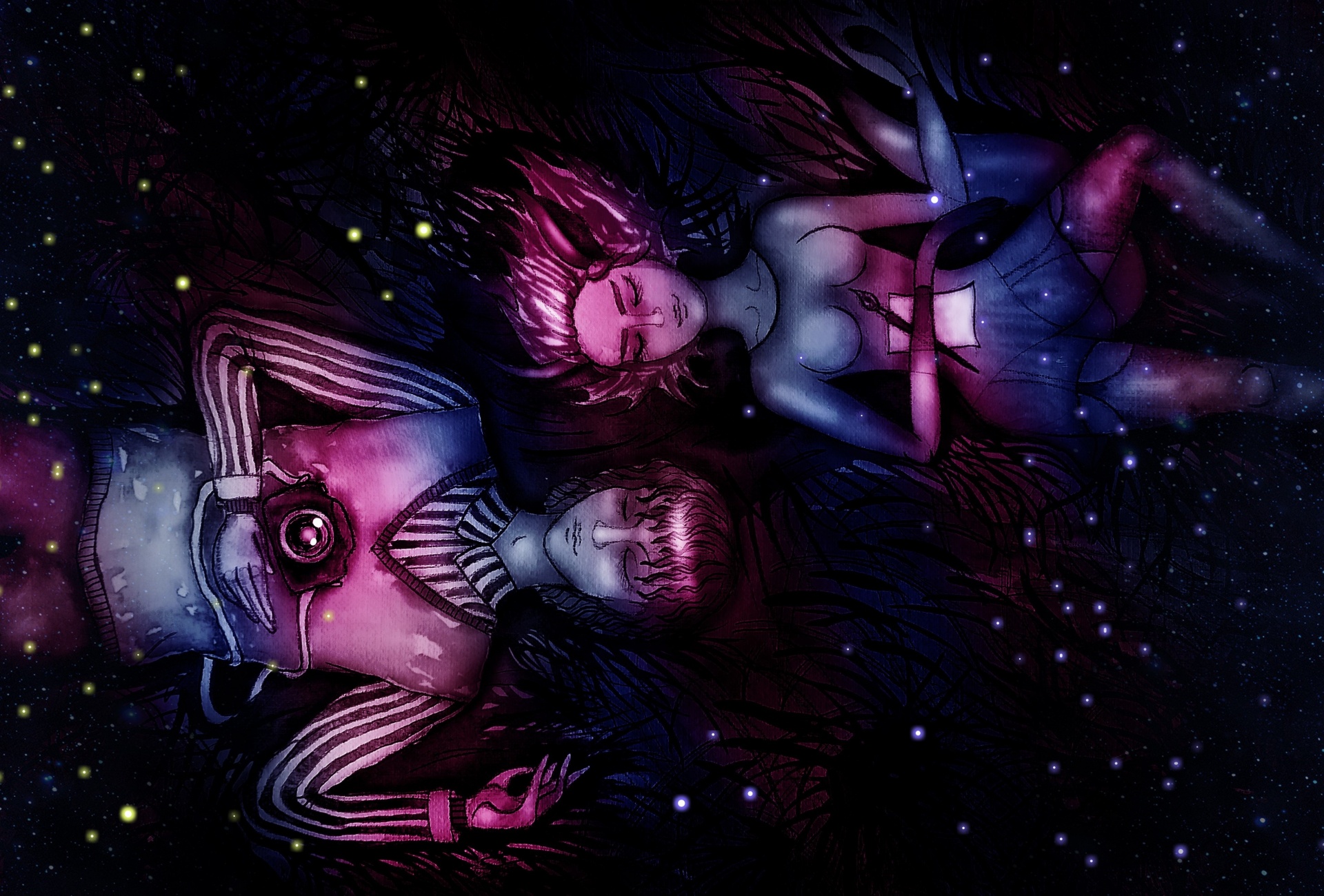
I'm gonna be happy.

One day a flower will open for me,
The way will always be open to me.
It's always a fun day
I will be happy, believe me.

Spring will surely come for me,
Trees bloom early in the morning.
You can also have lunch at a glance at the flowers
 I will be happy, believe me.

A rose will soon grow for me Honey is really the happiest Summer is a big work for me I will be happy, believe me.

 Ilhomova Mohichehra  7th grade student of Zarafshan city, Navoi region, school No. 9.
Echoes of Eternity: A Comparative Study of Greek and Roman Mythology
Parichita Saha
B.A.(H), B.Ed student, Kolkata Teacher’s Training College, Panpur,
Kankinara-743126
Keywords: Greek Mythology, Roman Mythology, Gods and Goddesses, Epic Narratives, Cultural Exchange, Influence on Western Culture.
Abstract:
Greek and Roman mythologies serve as cornerstones of Western thought, art, and culture. Greek myths are chronicled in works like Homer’s Iliad and Odyssey, contrast with Roman myths centred around Romulus and Remus and immortalised in Virgil’s Aeneid. Both mythologies feature gods and goddesses embodying human attributes, with Greek deities often personifying traits and Roman gods representing societal roles. Epic poems like the Iliad and the Aeneid reflect the intricate cultural exchange between these civilizations. This interchange extends to language, art, and philosophy, highlighting the profound interconnectedness and enduring legacy of Greek and Roman cultures on Western civilization.
Introduction:
Myths are not mere stories; they are the bedrock of civilizations, offering insight into human condition and the cosmos. Both Greek and Roman mythologies have profoundly influenced Western thought, art and culture. Greek mythology, rooted in a rich oral tradition, was eventually chronicled in texts like Homer’s Iliad and Odyssey and Hesiod’s Theogony. Conversely, Roman mythology centres around the birth of Romulus and Remus, the mythical founders of Rome and is immortalised in Virgil’s epic, The Aeneid. Thus, Greek and Roman mythology stand as two pillars of ancient storytelling, shaping beliefs, values and cultural identities of their respective civilization. Despite originating from distinct societies, separated by time and geography, the parallels between these mythologies are striking. From their gods and goddesses to epic narrative of heroism and tragedy, Greek and Roman mythology share a profound interconnectedness that reflects the intricate relation between these ancient civilizations.
Pantheon of God and Goddesses:
As the central figures of mythology, the ancient Greek and Roman gods and goddesses embodied an array of human attributes, from fortitude to folly. They were worshipped in temples and exalted in myths recounted by people living ordinary lives. When Rome conquered Greece in the 2nd century B.C.E, many Greek deities were absorbed into the Roman pantheon, often under new names but retaining similar roles and characteristics.
For instance, Jupiter, the Roman sky-god overseeing all aspects of life, originated from the Greek god Zeus, ruler of Mount Olympus and god of thunder and lightning, as well as law and order. Juno, Jupiter’s wife and sister mirrored the Greek goddess and Hera by closely overseeing women and all aspects of their lives. Athena, the Greek goddess of wisdom and warfare, known of her strategic prowess and symbolised by the owl, was transformed into Minerva, who retained these attributes. Poseidon, the Greek god of the sea, horses and earthquakes, wielding a trident, became Neptune in Roman mythology, depicted similarly with a trident chariot drawn by sea creatures. Demeter, the Greek goddess of agriculture and fertility, who presided over the harvest, was represented in Roman mythology by Ceres, also depicted with symbols of agriculture like barley and wheat. Demeter also presided over the fertility of the earth and the natural cycle of life and death.
Greek gods were often personifications of human personality traits and emotion, such as love, hate, honour and dignity. Their myths were shaped by these traits, making them relatable to human experiences. In contrast, Roman gods were more abstract, often embodying objects or actions that were represented in a way that emphasised their roles within Roman society and state religion.
This direct comparison highlights the deep interconnectedness yet distinct adaptations between Greek and Roman deities, showcasing how Rome Incorporated and reinterpreted Greek mythology to suit their cultural societal contexts.
Epic Narrative:
The stories of these gods and goddesses, along with mortal heroes, came to life in the form of epic poems. Epic, derived from the Greek word ‘Epos’, meaning word or speech. An epic is a long poem, usually composed of lines with six rhythmic measures. Epic poems of Greece throughout antiquity, the most prestigious literary form, the apex of the hierarchy of genres. Through it they articulated their conceptions of war, empire, mortality, religion, gender, the natural order, psychology and cultural identity. Homer, the legendary author of both the Iliad and the Odyssey, is often credited with pioneering this literary form. When Rome began translating Greek works in the 200s B.C., they adopted the epic tradition, infusing it with their own historical narratives. The Greek epics, such the Iliad and the Odyssey by Homer and Argonautica by Apollonius of Rhodes, were mythological epics, inspired by Greece’s legendary past. While Roman epics were modelled on these Greek epics, Roman epics also included stories from recent history. Ancient Roman and Greek literature, while sharing some similarities due to the Roman culture being heavily influenced by Greek culture, also have distinct differences. Greek literature often focused on mythology, philosophy, and the human experience. Roman literature, on the other hand, often emphasised practicality, politics, and historical narratives. Greek literature is known for its development of literary forms such as epic poetry, tragedy, comedy, and lyric poetry but Roman literature, while also including epic poetry (e.g., Virgil’s Aeneid) and drama, is particularly noted for its development of the genre of satire. Thus, epic poetry became a bridge connecting Greek philosophical musing and Roman practically, illustrating the cultural dialogue between these great civilizations.
Cultural Exchange and Adaptation:
This cultural dialogue extended beyond literature and into every facet of life as the Romans absorbed and adapted Greek culture. The Greek civilization, flourishing much earlier than the Roman, laid the groundwork for many of the art, philosophy and architectural advancements that the Romans later embraced. In the Mycenaean era (1500 to 1100 B.C.) the Macedonian Wars (roughly 214 to 168 BCE) resulted in the Roman Empire conquering and absorbing Greece. Greek culture, however, superseded Roman culture. Romans were enthralled by Greek culture and highly influenced by it, especially in areas of art and philosophy. Although Greek culture heavily influenced Roman culture, especially in art. These two civilizations, though distinct in their political structures and societal norms, were deeply intertwined through cultural exchanges that occurred over centuries. This cultural exchange helped the Romans advance in their community to become one of the greatest empires of that time. One of the most significant areas of cultural exchange was language . The Romans adopted the Greek alphabet and many Greek words into their language, resulting in a significant linguistic influence. We know the Romans for their beautiful art, their outstanding architecture. Roman fascination with Greek culture is clearly evident in many Roman works of art, which appropriate heavily from Greek artistic canon. Many surviving statues of Greek origin in museums today are actually Roman copies of the Greek original. Greek statues were typically made of bronze, which, in later centuries, were typically made of bronze, which, in later centuries, were often melted down to make weapons or destroyed by other cultures who saw them as pagan. Marble Roman statues, on the other hand, have mostly survived. Some Roman statues are unique in design, but many others are exact or partial copies of Greek statues. The influence of Greek art also can be seen in Roman temples, theatres, and public buildings, with iconic features such as the use of columns, pediments. As well as art, Greek ideas of philosophy spread to Rome, where they grew and developed as they became popular with the people. For example, stoicism originated in Greece, but became immensely popular and was further developed in Rome. Stoicism is an originally Greek philosophical system founded by Zeno of Citium around 300 BCE in Cyprus; it was introduced to Rome in the second century BCE where it quickly became a popular philosophy among a wide variety of people.
Greek philosophy had a profound impact on Roman intellectual thought. Roman elites were educated in Greek philosophy with Stoicism, Epicureanism, and Neoplatonism gaining popularity among the Roman intelligentsia. Greek philosophers such as Plato and Aristotle were studied and revered in Roman intellectual circles, influencing Roman ethical, metaphysical, and political thought. The enduring legacy of Greek culture in Roman civilization speaks to the richness and complexity of the ancient Mediterranean world, where cultural interchange played a pivotal role in shaping the course of history. Since literature is known to reflect the overview of the socio-economic structure of an era, chronological relevance is evident even in two mostly similar mythological literary patterns. Greek mythology observed more intricate philosophical thinking in character building, whereas Roman mythology celebrated materialistic practicality and historical narratives.
Conclusion:
In conclusion, Greek and Roman mythologies have numerous similarities that show their intertwined cultural and religious histories. Both myths feature a pantheon of gods who rule over various aspects of nature and people’s lives, sometimes with human weaknesses and emotions. The Romans inherited several gods of the Greeks, but were given different names and occasionally modified features as a sign of respect for Greek culture and a desire to take in their strengths. Myths from both traditions serve as foundational stories that explain natural phenomena, human behaviour, and social customs, highlighting the values and beliefs of their respective societies. Furthermore, these mythologies have had an indelible impact on Western literature, art, philosophy which has left an indelible mark in hearts ever since. Studying what they share among them contributes much not only to the better understanding of ancient civilizations but also helps us see how humans seek to interpret the world through narrative discourse. The legacy of shared heritage of Greek and Roman culture endures, a testament to the power of myth to shape and inspire, resonating in our hearts and minds ever since.
References:
Graf, F. (1993). Greek Mythology: An Introduction. Johns Hopkins University Press.
Hard, R. (2004). The Routledge Handbook of Greek Mythology: Based on H.J. Rose’s “Handbook of Greek Mythology”. Routledge.
Leeming, D. A. (2005). The Oxford Companion to World Mythology. Oxford University Press.
Wiseman, T. P. (2004). The Myths of Rome. University of Exeter Press.
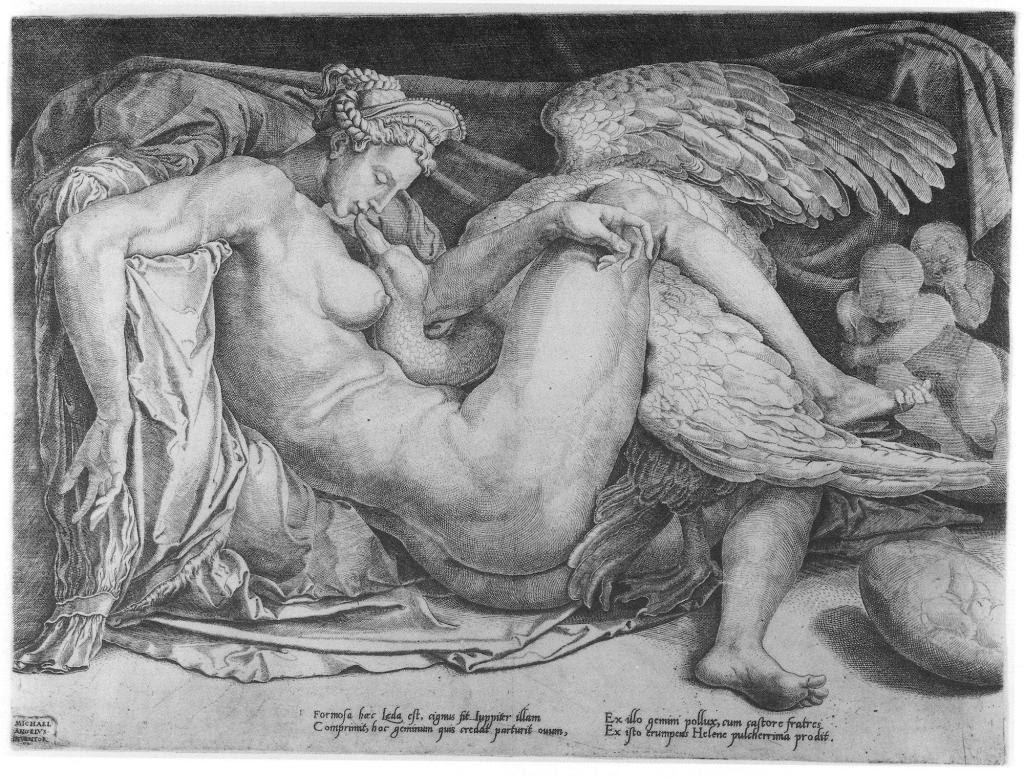
Critically examine the postmodern reading of Leda and the Swan by William Butler Yeats.
(Black and white pencil drawing of a naked human entwined with a winged bird and her egg)
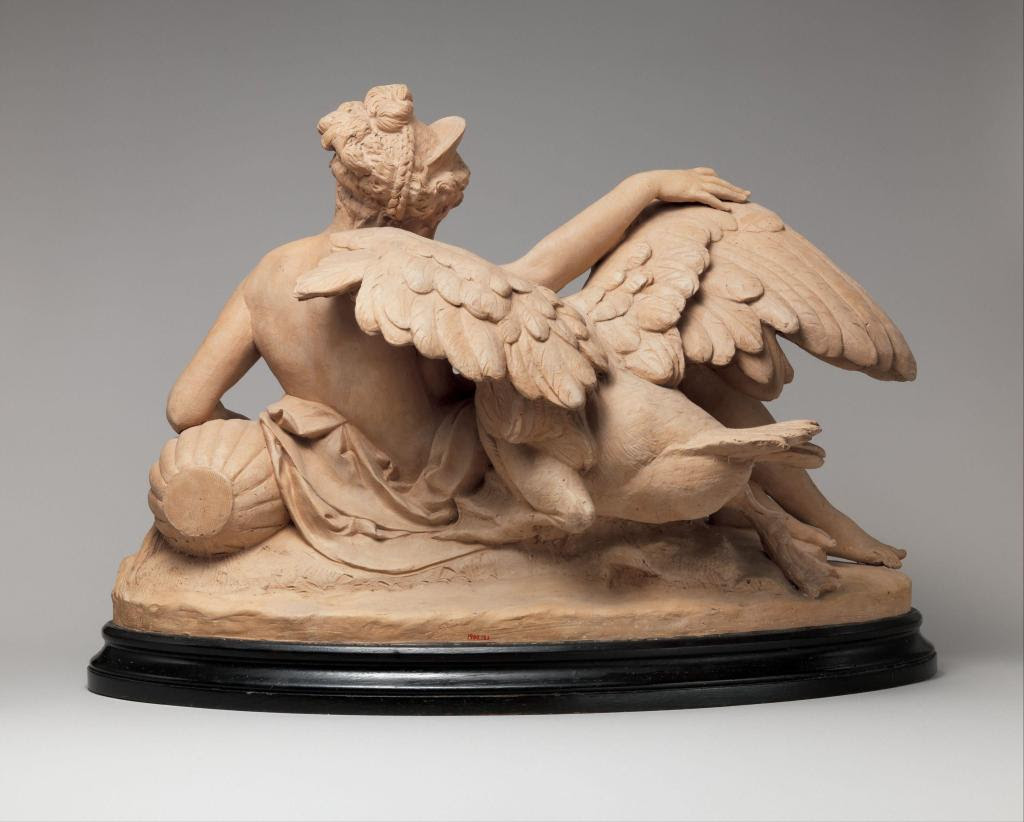
Leda’s virgin femininity is at stake by the perilous encroachment of anthropomorphic Zeus. The masculinized possession upon the staggering girl by caressing her frail thighs symbolizes helplessness. This helplessness manifests emblematic relinquishment of virginity to the amorous conquest of Zeus. Love and war are supposedly antithetical paradoxes and fruits in reproduction of offsprings and therefore vindictive of the polarization between supernatural immortality and mortal beings or bonded and free..
Seduction and rape of Leda the Queen of Sparta, by the God of Heavens and King of the Olympics, in disguise of Swan in Greek, mythologizes the fantastical narration of Helen of Troy and the cloned brothers Castor and Pollux. Orgasm and ejaculation implicates shudder in the loins with impregnation of Leda by Swan while engendering the broken wall, burning roof and tower alike architectural landmarks and milestones. Later this climatic Homeric allusion pontificates toward Agamemnon’s bereavement. Historical cycle of Helen’s and Clytemnestra’s seeds are planted and fertilized by Leda. Rhetorical questions become justifiable with the explanatory statements: “The feathered glory from her loosening thighs?/ But feel the strange heart beating where it lies?” Herein, succumbent of Leda’s virginity to the supremacy of the mightier and loftiest God has been decreed as consummation of sexual gratification. Allegorically colonial hegemonic culture of England reigning with superpower supremacy over colonized Ireland has been satirically implicated.
William Butler Yeats examines the consequences of the rape intimating the eventual defeat of Troy and triumph of Greece and the restoration of Western history. These mythic puns and sublime images are a testament to the legacy of Celtic Anglo Irish poetic cult amidst the traumatic outbreak of World War I, inviting readers toward imaginary resistance to oppression. “He holds her helpless breasts upon his breasts” furthermore implicates the political turmoil of historical Irish landscapes as implied metaphorically in Leda’s succumbing to the temptation of Zeus’s busty demeanor. The invasion of Ireland by Britain is allegorically manifested by this dialectic. Yeats revisits mythological fiction through fragmentation of Leda and this case spotlights metaphorical fragmentation of a country, nation, tribe and culture.
The act of Leda and the Swan is a bright marbled sculpture of apopsiopesis that is constantly resurrected from the microcosmic everyday acts, released from the ravages of delusory time. “Did she put on his knowledge with his power /Before the indifferent beak could let her drop?” These lines succinctly projects the rebellious spirit of the nationalistic freedom movement and the aftereffects of post revolution in accord with the domain of England’s imperial regime. Ireland’s defeminization and emasculation afterthoughts foreshadowed by the rhetorical questions indeed.
Further Reading
Textual/Sexual Politics in Yeats’s “Leda and the Swan”, William Johnsen, Yeats and Postmodernism, Leonard Orr, Sycrause University Press.
(Brown clay sculpture of a naked person whose arms and legs are entwined with a winged bird)
Love left in the depths of the void

The night is plunged into darkness. The quiet city was disturbed by the rushing sound of a car moving with flashing lights in the distance. The door was opened and a young man was brought in who was seriously injured in a car accident.

Doctors immediately ordered someone to find a donor to give him a kidney and blood. They called the number that was made after the bloodied phone of the young man and informed them that they would come to the hospital immediately. In no time, a beautiful girl with bowed eyebrows, bright eyes, and plump lips came rushing in.

Doctors:
- Who will you be to the patient?
- His future wife. What happened?
- His condition is serious. A kidney and blood donor is needed. Time is very little.

The girl’s color was pale, blood was running out of her face. She leaned against the wall, deep in thought, and left a letter in the patient’s room around dawn. After some time, a donor was found and the young man was operated on. By God’s grace, everything went well.

The next day, when the young man opened his eyes,
«didn’t anyone come?» he asked. One of the doctors said «she left you a letter».

The young man opened the letter and read:
«I was very sad to hear. But this accident separated us from each other. It’s a pity. Now our paths are different. Take care,» it was written.

The young man was deep in thought, thinking that maybe she didn’t want to stay with me in this state. Days passed. The young man’s condition improved, and when he left the hospital, he said «thank you» to the doctors. When the doctor was coming back following the
young man, the faces inside the door were pale, the eyes were filled with sadness, the girl’s delicate hands were showing the doctor a sign of silence on her dry lips.

While doctor was watching with tears to girl, doctor felt deep in her heart that the calm sea was flooding today and becoming colorless…..


Nosirova Gavhar was born on August 16, 2000 in the city of Shahrisabz, Kashkadarya region of Uzbekistan. Today, she is a third-year student of the Faculty of Philology of the Samarkand State University of Uzbekistan. Being a lover of literature, she is engaged in writing stories and poems. Her creative works have been published in Uzbek and English. In addition, she is a member of «All India Council for Development of Technical Skills», «Juntosporlasletras» of Argentina, «2DSA Global Community». Winner of the «Korablznaniy» and «TalentyRossii» contests, holder of the international C1 level in the Russian language, Global Education ambassador of Wisdom University and global coordinator of the Iqra Foundation in Uzbekistan. «Magic pen holders» talented young group of Uzbekistan, «KayvaKishor», «Friendship of people», «Raven Cage», «The Daily Global Nation», Argentina;s «Multi Art-6», Kenya’s «Serenity: A compilation of art and literature by women» contains creative works in the magazine and anthology of poets and writers.
Thank you to Jacques Fleury for responding to our request for readers to offer their expertise to assist writers! He has a variety of published writing which he can refer people to on request and is open to being interviewed on these topics:
-History of Haiti, as an author on the subject & as a Haiti born American citizen
-Black/African American History, as a “black” man who grew up in America & as an author on the subject
-Race and Racism, as a Person of Color having survived & thrived despite lived experience of racism & as author on subject
-Mental Health/Illness/Wellness & Recovery, having had lived experience & as an author on the subject
Everyone else, if you have an area of knowledge where you’d be glad to be interviewed to help people who are writing about that topic, please reach out to us at synchchaos@gmail.com.
Also, our contributor Abigail George’s book When Bad Mothers Happen, released January 2024 from European publisher Morten Rand, is available for Synchronized Chaos readers to review. Please let us know if this interests you and her publisher can send review copies (and we can publish reviews!)
This month, our contributors figure out how to make sense of the universe, piece by piece.
Alan Catlin renders lists and catalogues into a form of poetry, building up objects from their components, like a brick tower or a floral arrangement. J.D. Nelson crafts auditory and visual snapshots that can stand for and evoke an entire scene.
Soren Sorensen contributes mixed media alterations of reality and existential poetry on making sense of the universe. Mars Brocke’s mixed media artwork plays with reality and perception in a nod to Alice in Wonderland. His poetry, also surreal, evokes memories and states of mind. Martha Ellen conveys the psychological changes induced by benzodiapine medicine and the fluidity and vulnerability of the human brain and mind. Mark Young creatively defines concepts through descriptive words that once explained something.
Saidova Mahzuna outlines methods for learning and teaching vocabulary. Mo’minjonova Diyora highlights the benefits of continuing to read and learn throughout life. Sevinchoy Sanat outlines ways to enhance education through technology as Ibrohimova Durdonaxon outlines different areas to focus on when improving childhood education. However, sometimes the old ways still hold wisdom: Daniel De Culla relates a humorous tale of a modern woman who chooses to go with folk wisdom regarding her health. Gregg Norman presents a poem from the point of view of a character who’s living life to the fullest, with health benefits as incidental.
Noah Berlatsky muses on the identity of Spock and on what makes intriguing literary characters. Jacques Fleury reflects on his personal and cultural identity. Mesfakus Salahin speaks to life, death, and personal accountability, redemption, and the meaning of one individual life. David Sapp relates a tale of responsibility, honor, and mailboxes. Ranjan Sagar reminds us that others’ poor character need not diminish our own. Lilian Dipasupil Kunimasa addresses the tension between roots and wings, needing to fly free and wanting a stable nest, and reflects on the end of life. Paul Tristram speaks to personal growth, strength, and self-discipline while Sarvinoz Mansurova shares her family’s dreams for her and her own aspirations. Nigora Tursunboyeva’s short story celebrates adventure and finding one’s own way in life.
Gaurav Ojha reflects on how he will take nothing with him when he leaves the earth. Graciela Noemi Villaverde expresses the exquisite anguish of losing someone close to her. Engin Cir speaks to the grief, but also the indignation, of romantic heartbreak. Faleeha Hassan evokes the feeling of anxiety, being exposed and weighed down. Mykyta Ryzhykh conveys alienation, cold, and a halfway state between life and death.
Duane Vorhees speaks to creativity, sensuality, and history, evoking major and minor apocalypses that occur when people cannot or do not adapt to constant change. Taylor Dibbert reflects on how creativity can help him weather, if not avoid, his struggles. Z.I. Mahmud links the expectations of Samuel Beckett’s characters in Waiting for Godot to those of broader Western religious and cultural traditions.
Adam Fieled writes of our twin natures, the balance of masculine and feminine. Z.I. Mahmud examines the family relationships in D.H. Lawrence’s Sons and Lovers through a Freudian psychoanalytic lens. Karimova Sarvara Karimovna crafts an elegant and highly personal love poem. Kristy Raines speaks to the joy of a close loving relationship. Aytuvova Khurshida shares a love story that gets interrupted by life, but where the former partners always remember each other. Numonova Khonzodabegim poignantly shares the challenges and risks military families face.
J.K. Durick speaks to the harsh realities of aging and death and hunger, which can be eased, but not completely erased, by modern culture. J.J. Campbell’s poetry addresses aging and resignation while Dildora Toshtemirova reflects on the loss of a close friend or lover. Nosirova Gavhar’s short story combines two great human passions: love and grief.
Paul Callus and Christina Chin collaborate on a wide-ranging haiku collection evoking home, place, and time. Stephen Jarrell Williams captures many of summer’s varied moods in his haiku. Steven Croft watches a Civil War reenactment through the eyes of a modern veteran. Brooks Lindberg speaks to what we remember and what we forget, of grasping happiness despite reality. Rustamjonova Nodira celebrates the perseverance of Uzbekistan’s founders, leaders, and people, as Nuraini Mohammed Usman urges her society to carry out collective housecleaning and purge old enmities.
Murodova Sitora urges teachers to continue to learn and develop their skills and be accorded the respect and resources in order to do so. Abduraximova Muyassarxon relates how a dedicated teacher helped her regain her confidence. Rukshona Qiyomova outlines the many responsibilities of a teacher and the value of the teaching profession. Sevinch Saidova reflects on the value of education for personal development. Sushant Kumar highlights the need for teachers to serve as role models as well as impart intellectual information.
Majidova Sevinch pays tribute to the many dimensions of a mother’s love and care. Sobirjonova Rayhona offers a tribute to her sister’s care and friendship. Ilhomova Mohichehra takes joy in her friends and her lovely homeland of Uzbekistan.
Brian Barbeito revels in the easy intimacy of the conversation on a summer hike. Salokhiddinova Mohichehra examines the structure and function of nature close to home, the human kidney. Isabel Gomez de Diego contributes visual poetry of everyday life: dinner with family, a visit with a grandson, a tree in the yard. Kylian Cubilla Gomez takes closeup peeks at backyard chickens.
Sayani Mukherjee recollects a quiet morning outdoors under the blue sky, smelling the scent of trees with her child. Maja Milojkovic yearns for and finds reminders of her lover in every aspect of nature. Intizor Samandarova evokes the sky’s expansive emptiness in her poetry as Don Bormon poetizes about the vast variety of clouds.
However, nature is not always calm: researcher Les Beley speaks to the ecological impact of Russia’s invasion of Ukraine. Mahbub Alam describes the recent flash floods in parts of Bangladesh and the loss of life and property.
Farida Botayeva reflects on how quickly our circumstances and emotions can change. Ziyoda Murodilova considers how she will persevere in her life despite unpredictable feelings.
Finally, Christopher Bernard presents an old-style lyrical recipe for preparing hope in the kitchen.
The Teacher: Beyond Intelligence

"Mero ta  Moj cha Yaar,"- “I am having extreme fun” – my friend Ramesh replied when I asked him about his well-being over the phone. Ramesh and I had been intimate friends since childhood, growing up in the same countryside, studying together at the local college, Ramesh was always the top student; his intelligence was far superior to that of his peers, a fact reflected in his academic results as well.

After earning his bachelor's degree, he headed to Kathmandu to pursue further education and continued to shine in his academic journey. He excelled at the top of his master's degree program at a prestigious university. His academic achievements were the talk of our village, and we all celebrated his success.

However, during the conversation, Ramesh revealed another side of his life. "During the day, I teach at three different private colleges as a part-time English teacher in Kathmandu," he admitted. "But mostly on Friday nights, I spend time drinking whiskey at bars in Thamel with some students. They pay for everything since they belong to rich families."

I couldn't help but feel a pang of disappointment. Somewhere deep down, those words compelled me to question the ethics of his professional life, as they seemed to reflect a lack of wisdom and character despite his engaging classes, knowledge, and the success of his students under his guidance.

Some philosophers argue that wisdom is a broader term than intelligence. Wisdom includes ethical values and actions, and those who possess wisdom can distinguish between wrong and right.

However, despite being a teacher who is supposed to be full of wisdom, Ramesh’s choice to visit bars and drink with students made me feel that he lacks such qualities. During our conversation, he also mentioned that he does not feel the positive burden of duties and responsibilities, as he is a part-time teacher and most of his fellow teachers are unfamiliar with him.

"Who comes and goes doesn’t matter. No one knows except the person who hired you," he said. Ramesh is a clear illustration of the moral deficiencies prevalent among many teachers today. It is truly disheartening to realize that they undermine the integrity of the educational system.

The conversation made me ponder what makes a good teacher. Is intelligence the only criterion for being a good teacher? What about wisdom and character? What is the right process for selecting teachers? Do educational institutions train teachers to be honest and moral? How can they motivate teachers to be duty-bound and self-disciplined?

In recent years, with the rise of science and technology, teachers have become more resourceful and knowledgeable than ever.

However, it is crucial for them to also embody wisdom and good character. The role of a teacher is not only to impart academic knowledge but also to serve as a role model for students. The impact of a teacher on a student's life spreads beyond the classroom; Teachers’ values, ethics, overall personality, and character absolutely influence students.

Therefore, the following considerations should be made during the selection process and after the selection of teachers.

Selection of Teachers

When selecting teachers, the education institutions should initiate a mechanism to evaluate candidates' ethical values, in addition to their excellent academic qualifications. The mechanism could include thorough background checks, psychological well-being assessments, and interviews focusing on ethical issues. By doing so, schools can ensure they are hiring teachers who are not only knowledgeable but also capable of serving as positive role models for their students.


Teachers’ Trainings beyond Curriculum and Methodology

Educational institutions often focus teacher training solely on curriculum, syllabus, and teaching methodologies. However, training should encompass more than these aspects. It should also cover ethics, self-discipline, and teachers' roles and responsibilities.


The cushioning role of the principal

The principal should create an environment where teachers feel that the institution is their second home by bridging the communication gap among staff members. Rewarding good behavior can motivate teachers to strive for excellence in all aspects of their roles. Additionally, the principal should make teachers feel like the school's true foundation by recognizing them as valuable employees. Fostering a sense of permanence and belonging will encourage teachers to dedicate both their hearts and minds to the organization.

This can be achieved through regular meetings, team-building activities, and, if needed, one-on-one positive counseling.
In a nutshell, the role of a teacher goes beyond imparting academic knowledge. Teachers should serve as role models embodying wisdom, good character, and ethical values.

Therefore, educational institutions should prioritize selecting teachers who possess these qualities and provide professional as well as ethical training to help them grow in all aspects of their profession. Thus, schools can ensure that teachers are highly motivated, duty-bound, and self-disciplined. This, in turn, will have a positive impact on pupils. Over time, students will grow into individuals with strong moral values and ethical standards.

[Sushant Kumar B.K. is a Nepali poet, translator, educator, and freelance writer from Gulariya, Bardiya, Nepal. He holds two degrees: an MA in English Literature and Political Science. He primarily writes poems in English and Nepali. His poems have been featured in national and international anthologies, magazines, newspapers, and online portals. He can be reached at sushantacademia@gmail.com.".]