Essay from Ibrohim Saidakbar

THE PERSONALITY OF GAFUR GULAM IS AN INDELIBLE IMAGE OF UZBEKISTAN


Ibrahimov Saidakbar
Tashkent State University of Law
Faculty of Criminal Justice
3rd-grade student


Today, we are informed about the work and life of the national poet of Uzbekistan, a great representative of our literature, academician Gafur Ghulam through school textbooks, various books, or mass media. However, it will be useful if we briefly dwell on the work of this artist and learn the necessary conclusions from it.


People’s poet of the Republic of Uzbekistan Gafur Ghulam was born on May 10, 1309, in the Korgontegi neighborhood of Azim Tashkent in a family of hard workers. His father Ghulam Mirza Arif knew the Russian language, read poetry, and wrote poetry himself. Gafur Ghulam was nine years old and his father died when he was fifteen.

In these periods of his youth, our writer studied first in the old school, and then in Russian-Tuzem schools. After completing teacher preparation courses, he teaches in schools. Gafur Ghulam even works as a teacher in an orphanage and for some time as a director of such schools. At that time, the writer established relations with the publishers of various newspapers. He worked in the newspapers “Kambagal Dehgan”, “Kyzil Uzbekiston”, and “Sharq Haqikatii”.

The first literary activity of the poet began in 1923. He expresses his life in the poem “Felix’s Children” written this year. The poet’s first poetry collection was published in 1931 under the name “Dynamo”, and in 1932 the second collection was published under the name “Living Songs”.


As everyone knows, world and Uzbek literature has many great representatives of prose and poetry. That is, most creators have their creative achievements in the same direction of literature, and some creators feel free in poetry, and others in prose or drama, and enhance their creativity. When we hear the names of Abdulla Qahhor and Abdulla Qadiri, we think of masters of the epic (prose) genre, when we think of the names of Abdulla Oripov, Usman Nasir, Hamid Olimjon, Muhammad Yusuf, we think of artists who have come to the public’s attention with their poems. Because someone was an
unwitting fan of one of their works, and someone was a fan of their poems.

However, if we dwell on the name of Gafur Ghulam, we can think that the ideas mentioned above are somewhat inconsistent with his works. Because the creator skillfully waved his pen in both prose and poetry genres and left great examples of creativity in both directions, and each of them is worthy of admiration. In particular, anyone who is interested in Gafur Ghulam’s work is familiar with the artist’s work “Shum Bola” or “You are not an Orphan”.


The author’s short stories and stories “Netay”, “Yodgor”, ‘Resurrected Corpse”, and “Shum bola” written in the 30s of the 20th century made a great contribution to the development of our national literature. In many works of Gafur Ghulom, the true heroism
of the people, humanity, and Uzbek nationalism are shown.

Gafur Ghulam dedicated many of his works to the personality of children. The work “Shum Bola” is one of the successful works of the writer. In the play, the hero talks about his tragic life. The boy ran
away from his house to his aunt’s house because of his mother’s punishment while taking the products out of the house. However, the boy is not lucky here either: he accidentally kills his uncle’s quail and leaves this house. Thus, he begins to be darbadar and trouble. The
writer focuses on describing the worries and inner experiences of this child. Depicting external events, things and everything surrounding the little hero in the play serves to express human feelings deeply.


The events and scenes of the Second World War left an indelible mark on Gafur Ghulam’s heart. If he went back to his childhood in the years of the First World War and could not fully feel all the horrors and complications of the war, the artist considered the new war and those who provoked it to be his personal, bitter enemy. In these years, the poet’s literal works such as “You are not an Orphan”, “Gold Medal”, “Observation”, “Time”, “Missing”, “There Will be a Holiday on our street”, “I am a Jew” classical poems were born.

In many of the writer’s poems, there is the image of an oriental sage – a father: “You are not an orphan” (1942), “Grief” (1942), “One is a student, one is a master” (1950), “You are young people” (1947), “Spring Songs” (1948) and others.


The poet received the State Prize in 1946 for the collection “I Come from the East”, a collection of poems written during the war years. Gafur Ghulam was awarded the title of academician together with his creative friend Oybek for his great contribution to the development of Uzbek science and culture (1943).


Gafur Ghulam also used his pen effectively in the years after the war and created high artistic works; published several excellent articles on journalism and literary studies. His work appeared as a unique chronicle of the people’s life in this period. If Gafur Ghulam rose to the level of a philosopher-poet with his poetic works during this period, he also showed that he was a skilled writer who knew the people’s life and spirit well with his stories such as “Shum Bola” and “My Thief Boy”.

Gafur Ghulam’s selected works, collections, and works in ten volumes have been published several times. His articles written as a scholar of classic and modern literature, his journalistic speeches on various aspects of life, feuilletons, and funny stories are warmly welcomed by the people, the poet is highly praised everywhere. would be honored.

Gafur Ghulam was awarded the title of “People’s Poet of Uzbekistan” in 1963. At the end of our speech, we should quote a verse from the author’s pen: Be as hardworking as the world, sooner or later.


With this, the poet emphasizes that movement means aliveness, that both the universe and the earth are always in motion, and he encourages our fans to move and live. In conclusion, we can say that during his life, the writer left an indelible mark in history with his life, his will, and his legacy equal to gold. Today, finding such works, even writing them, is a difficult task.


References:
1. Uzbek writers. Sabir Mirvaliyev – “Fan” publishing house – 1993
2. Naim Karimov, publishing house named after Gafur Ghulam, Tashkent-2003.
3. The spiritual and educational significance of Gafur Ghulam’s work. Scientific
conference. Tashkent-2003.
4. www.ziyo.net
5. www.ziyouz.com library

Poetry from Taylor Dibbert

London’s Ramp


He still has

London’s 

Doggy ramp,

He’s not

Sure why

He hasn’t 

Been able 

To let

That go.

Taylor Dibbert is a writer, journalist, and poet in Washington, DC. “Rescue Dog,” his fifth book, was published in May.

Excerpt from Joe Byrd’s Monet and Oscar

Monet's painting of a blue bridge surrounded by water lilies and flowers and leafy trees with script font white text reading Monet and Oscar.
Monet & Oscar: The Essence of Light
Oscar Meets Monet

Oscar Bonhomme’s palms sweated as he crept from the warm kitchen filled with the spice-laden aroma of frying sausage mixed with the smell of aromatic, dark coffee into Monet’s yellow dining room. 
He’d used what little money he had to purchase new work clothes for his first day on the job. He twisted his still-stiff brown woolen cap between his sweating fingers as he glanced at his reflection in the picture glass to see if his pale skin betrayed his stay in the military hospital. Did his slight frame and frail stature look well enough for rigorous gardening work? No one would believe he was once tanned, muscular, and robust. Did his prematurely graying hair and the red circles around his eyes reveal the trials he had endured at the front? 
Although thirty-four, he felt and looked much older. 

Oscar summoned his courage, pulled from somewhere deep inside himself as he did when climbing out of the trenches and facing the enemy. “Bonjour, Monsieur Monet.” 

No movement. The newspaper Monet held did not lower. The first salvo had fallen short.
He fired off another. “Bonjour, Monsieur Monet.” 
Still no response. Second salvo, off-target.

Perhaps Monet was hard of hearing. Oscar added more powder and fired the third shot as he shouted, “Bonjour, Monsieur Monet.” 
The paper lowered to reveal piercing black eyes and a long white beard stained yellow with nicotine. Monet resembled the newspaper photos Oscar had seen of him—short, stocky, and with an intense gaze that seemed to miss nothing around him. His hands, with translucent skin and heavily veined, looked muscular and tanned, befitting a painter who mainly worked outdoors. 

Monet stared at Oscar as if trying to remember who was this invader of his dining room and disturber of his early morning coffee. He wore an English herringbone wool suit buttoned at the neck, with just an inch of white ruffled shirt cuffs showing at the sleeves. 
At last, he spoke. “Who are you?”
He sounded irritated.

Oscar drew in his breath and squared his shoulders to make himself look the part before responding with, “I’m your new gardener, Monsieur.”  
Monet frowned. “I don’t remember you. Who hired you? Why should I hire a gardener in the middle of the winter?”

Oscar stammered as he gathered enough breath to reply. “You… You did, Monsieur. Yesterday. At least, that’s what I was told.”
He gripped his newspaper tighter, shook his head, and frowned. “So, what are you doing in here? This isn’t the garden.”

“Madame Blanche asked me to meet you here before dawn to carry your paintings for you.”
“Humph!”

And with that, Monet raised the paper again. Oscar remained standing in the doorway, unsure whether to stay or go. 
Oscar stood twisting and untwisting his cap and wondering if Monet would dismiss him, fall asleep, or begin their first day together. Could this cranky old man be his father? Probably not. But he might know who is.

Since it was his first day on this new job, he remained to see what would happen next.
He looked around the room after one, two, three, four, five minutes with no response. Yellow was the theme color. Even the chairs and light fixtures were Provence yellow, as his mother called it. Monet seemed obsessed with the color yellow and eating, by the looks of the dining room with its multiple sets of dishes and an abundance of silverware.

The odd prints that hung on the walls perplexed him. They were most unusual and not yellow. He saw dozens of them depicting an assortment of Japanese people in native costumes through scenes of Japan. They reminded him of photos his Japanese friends in San Francisco had shown him. The prints featured plants and animals that he didn’t recognize. 

Oscar scratched his head and thought, why would one of the world’s most famous Impressionist painters have these Japanese prints on his walls instead of his art or that of his colleagues?
Lying in the hospital, he had dreamed of what he would do when he was released. He never imagined he would work in one of the most famous gardens in France. This job was the start of his new life; he was excited and frightened to be here.

Curiosity was getting the better of him as he walked around the long table, examining the prints. Each one seemed more colorful and stranger than the one before, and someone had labeled every one with the artist’s name. He made a note to ask Monsieur Monet about the prints. They must have been significant to him if they were hanging in his dining room. Undoubtedly, he would have dictated the decoration of this space, the essential room for entertaining. 

Finally, Monet’s hand emerged to crush out his cigarette in his overflowing ashtray. He lowered his paper, rose from his chair, and shuffled to the door. 
“Are you coming?” he threw over his shoulder.

Caught off-guard while still staring at the prints, Oscar felt he was a puppy following its master and hurried through the door after him, down the steps, across the garden, past the cart, and into the massive darkened studio. 
“Put these in the cart and follow me.”

The paintings looked to be in various completion stages, and Oscar assembled them back-to-back so as not to smudge the fresh paint. Later, he’d need to add wooden partitions between them to keep them safe. Equal measures of fright and honor washed over him as he quickly managed this chore and set off behind Monet in the pre-dawn. 

Once outside, his inquiry about where they were going received no response—Monet lived up to his storied reputation as a reluctant speaker. Oscar acknowledged his role was to obey commands and keep silent. 

After some minutes struggling with the loaded cart down the garden pathway, up a hill, across the railroad tracks that divided the two pieces of Monet’s property, down an embankment, and across a bridge, he stopped beside Monet at the edge of the water lily pond. Oscar was sweating and exhausted. 

Monet chose the first canvas of the day. It proved to be large and awkward to place on the easel that Oscar set up under the umbrella used to shield Monet from the sun or rain. He settled on his stool and prepared his palette with paints, squeezing first one tube, then another. Monet allowed no distractions. Speaking was a distraction.
Oscar’s lungs burned from the exertion, his breath short and choppy. His arms and legs hadn’t worked so hard since he’d left the front. It would take a lot of gardening to get his body back into the shape it was when he worked for his mom at Golden Gate Park.  

He stepped back to take in the scene Monet was painting. The pond covered several acres, encompassed by trees, flowers, and shrubs. They’d crossed over a Japanese-style bridge covered with bare wisteria branches. It was still winter, and the famed water lilies were waiting for the season when they would again cover the water’s pea-green surface. 

But that was not what Monet was painting. Instead, he captured the fractured light on the water’s surface and the rays filtering into the depths beneath them. No ground, no sky—just the water and the willows interwoven in patterns of colors and shapes. He looked to be painting the essence of the light that moved on the surface of the pond.

It was not the typical garden scene Oscar had studied in landscape design classes at college. The lily pond represented a living canvas upon which the sun painted a constantly developing picture, just, he supposed, as Monet had designed it. His Japanese gardener friends would say it felt reminiscent of a Japanese garden, but this one held far more prolific planting. Monet had covered every inch with stocks and petals of exotic and familiar domestic plants. 

As the sun changed positions, so did the subtleties of light on the water. When the light changed, so did the colors. And so did Monet, who switched to another painting location. 

“Let’s move down the path. Follow me.”
“Oui, Monsieur.” Caught up in the scene, he had nearly missed Monet’s command to move on. “I’ll pack up and be right there.”

He carefully removed the canvas from the easel so as not to smudge the wet paint, placed it back in the cart, and secured it for the brief journey around the pond with the easel, stool, and umbrella. Once he’d arrived at the new spot, he repeated the set-up routine, and Monet was once again ready to continue with a different canvas. 
This time, Oscar watched the creation process more closely, so he didn’t miss the time to change locations. He observed every detail of the painting to understand how light affected the scene Monet was painting. 

He set ten canvases up in ten different locations over the morning. After several tedious hours, it was time to pack up for the journey back to the studio. The light at noon proved too harsh for the effects Monet desired. After unpacking the cart, the time came for him to begin the job he believed Monet had hired him to do. 

Monet led him into the Grande Allée of trellises, down to the bottom of the garden. The trellises supported pink roses intertwined in their metal arches. He explained how he wanted the rose canes trimmed. Oscar shook his head in annoyance, if not disbelief—as if he hadn’t done such a menial task before. Then he realized Monet had no idea what his new gardener knew or didn’t know. He was used to working for a perfectionist, his mother, after all. Monet couldn’t be any more exacting than she was.

Clearing the trellises of dead rose blossoms, diseased leaves, and dead canes took all afternoon, and he did not finish. Usually, he didn’t trim climbing rose canes, but Monet knew best how he wanted things done. Oscar was ready to head back to the room he’d booked in a local boarding house. His arrangement with Madame Blanche, Monet’s daughter-in-law, was he would work ten to twelve hours a day but have evenings and weekends free to do as he pleased. This would give him time to research the Impressionist painters his mother had met in the south of France. According to her, one of them was his father. That’s the most she would tell him. 

Joe Byrd's Monet and Oscar is available here. 

Short story from Abdamutova Shahinabonu

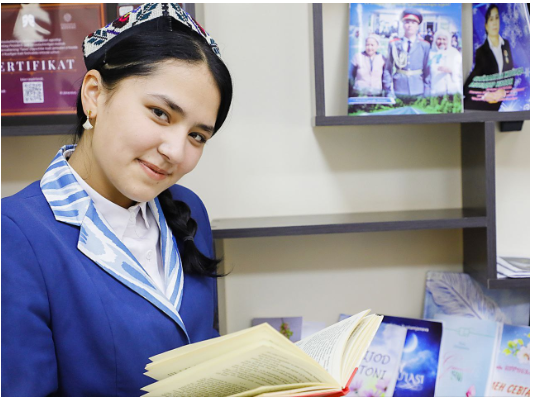
Central Asian teen girl with a blue coat over a white blouse. She's got a braid of black hair and earrings and an embroidered hat and is holding a book.
BITTERNESS


People are buzzing around. I can neither find a place to park, nor drive my car. I came here looking for someone to clean the small garden in our yard for Sunday. Everyone is coming from all over and asking for work. They were all in old and worn-out clothes. Among them, a student wearing a white shirt caught my attention. 

I immediately asked:
- You can do some tough stuff, can't you?
- Yes, I can.
- Then get in the car.

As we were driving, the silence was broken by a phone call. He took his phone out of his pocket and answered. It was his father who made the phone call. It was so loud that I could hear the whole conversation. Dad immediately asked:

- Where are you, son?
-Making my way to the extra lesson.
-Hope you are not hungry?
- Nah, had lunch in the cafe in front of our school. Mom is all right, isn't she?
- Don't worry, she's okay.

- Okay, Dad, I'm late for the class. I sent you money. They gave me a prize for doing exceptionally well.
- Proud of you son. Keep up the good work.

The young man turned off his phone and sighed deeply. I wanted to ask him something, but I couldn't speak as if something was stuck in my throat. If I spoke now, it seemed that he would strangle me and make me cry. We arrived home. As soon as we entered, my children ran to me and I hugged them, and the painted ivy seemed to loosen a little. Then I explained what he had to do. Then I told my wife to prepare food and went out.

I was driving a car, but I couldn't feel my hands, I wanted to scream and cry. I parked my car in the shade of a tree. I immediately got down and walked along the stream. I could hear the water flowing, the chirping of birds, and the soft swaying of trees. As for me, I involuntarily step into the past.

Fifteen years ago, I was the same age and situation as today's student. I was farming with my father in the village. We used to go to the field early in the morning and when it got late we would drag our feet back from there. Every day was spent helping my father. Since my brothers were young, they could not help my father. One day I was returning from the field when a very beautiful blue "Volga" drove past me and stopped at the roadside. A tall, slightly plump man, dressed in a slouch, got out of the car.

"Zakir, how are you?" he asked me.
That's when I found out that he was my schoolmate Shakir. He went to study in Tashkent after we finished school last year.

- Thank you, I'm fine, how about you, are you studying?
- Yes, I came to the village on vacation. What are you busy with?
- I am helping my father in the garden.
- Old chap, I have a suggestion for you. Come with me to Tashkent to study, you are skillful enough, you need to develop it, though. How long are you going to live in the village covered in dust?!
I was hesitant, not knowing what to say. "I must talk to my dad?" I said.

- Well, tell me your answer till tomorrow! - He got into his car and stepped on the gas.
I thought about it until I got home. When I came home, my mother was busy with my brothers, and my father was tired and had fallen asleep without eating. Unknowingly, I went to the mirror, looked at my reflection and immediately compared it with Shakir in my mind. It was as if some kind of volcano erupted from my heart. Why should I walk in this condition? Can't I be like Shakir? Can't I drive cool cars like him?

As I was asking myself these questions, I felt a strong urge to go to my father and wake him up. I told him about my wish. Dad was a little surprised at what I was saying, and then he said:
- My son, strive towards your goals, I will support you in any situation, but do not forget this, do not return to the village until you find your way!

Dad gave me a prayer and I came to Tashkent the next day with Shakir. I was left in various situations, without money, and food. But I couldn't request anything from my family, just like today's young student. I pulled a cart in the market and served in people's houses. 

Sometimes I was so tired of all the worries that I wanted to end everything and go home. But every time these thoughts crossed my mind, I heard my dad's wise and majestic voice: "Don't return home until you've truly found your way!" I remembered what they said and found the strength to try again. My life was passing like this. If you live your life striving towards a goal, time will pass so quickly, like the rapid flow of rebellious waves of a river.

           Years later, after graduating from university with honours and getting a master's degree recommendation from my teachers, I was returning home when I heard that my father had died of a heart attack. When I came home, there was the sound of crying, and my mother had no strength left, she was barely standing on her feet. 

They were happy to see me, we talked for a while, and then I asked why they didn't let me know about my father's illness. Dad did not allow us to do so, they said, "My son is studying, he should not be distracted." That's when my motivation increased, and I realized that if before I only worked for myself, now I have to work for my brothers, for my mother, and my perished father. Sooner or later I did not stop and reached the current situation. 

Now I am happy, every moment of my life is full of joy. But I want one thing. If my dad was alive and asked me how I was doing, I would have said I'm fine, I'm fine, I'm doing very well. We would have taken a stroll in my car, filled every moment with joy and happiness. There is moisture on my cheeks, sometimes I cry, and sometimes my pains that have been buried inside me for years come to the surface. I felt some relief in my heart. A soft wind hits my face and eyes, and it seems to touch my heart, which has been deprived of air for years.

The phone rang.
- Hello, I hear.

-Daddy, come home, this guy has finished his work.
- Now, I'm leaving.
I got back into my car, headed to a life of worry and fatherlessness...


Abdamutova Shahinabonu was born on October 6, 2007. Currently, she is in 11th grade at Is'hakhan Ibrat creativity school. She can freely speak in English, Russian, and Korean. Her stories were published in many foreign journals.

Poetry from Usmonova Ogiloy

Dreams


In the quiet hush of night,
Where moonbeams cast a silver light,
My dreams awaken, softly bloom,
In the corners of my room.

They drift on whispers, gentle breeze,
Through endless skies, across the seas,
In colors vivid, bright and bold,
In stories yet to be told.

A castle perched on clouds so high,
A meadow where the fairies fly,
A world where wishes all come true,
And every day begins anew.

In dreams, I dance on stardust trails,
I ride the wings of mystic whales,
I chase the dawn, embrace the night,
In realms of pure, unfiltered light.

No limits bind, no fears confine,
In this sacred, endless shrine,
Where hope and wonder intertwine,
In the garden of my mind.

Though waking hours may be gray,
In dreams, the world is far away,
A place where all my heart’s desires,
Ignite like everlasting fires.

So I close my eyes with sweet embrace,
And journey to that secret place,
Where dreams are real and life’s a gleam,
In the boundless realm of my dreams.

Usmonova O’giloy Gulomjon qizi  was born on October 7, 2009. She is currently a 10th-grade student at the Is’hoqxon Ibrat Creative School. She is fluent in Uzbek, English, Russian, and Korean.

Poetry from Ruxzara Adilqizi

Central Asian woman with curly blond hair, a blue coat, and a white frilly blouse in front of the Turkish flag.

XƏTRINNT OF MY LOVE 

Let me bend my love into your love, 
Let it not be based on the pleasure of my love, 
Let me give up on love, let me not hear, 
Don't let it be based on the pleasure of my love! 
Take away the ovary of my heart, 
Your capacity is abundant, remember me, 
Let it snow, rain, shine in the sun, 
Don't let it be based on the pleasure of my love! 
You are my hearth of hope, my trust, 
O poet to my life, I know the feeling, 
Everyday the wind blows into my soul, 
Don't let it be based on the pleasure of my love! 
Let me close your eyes, let me look at you, 
From the demand, you become bored, you become embroidered, 
My dear, let me be your blessing for life, 
Don't let it be based on the pleasure of my love! 


ISTURUM, MY OWN COUNTRY, WHERE I WAS BORN 

Yad, I have no eyes on Özzgən's soil, 
I want my own homeland where I was born. 
O I who turn back and forth in the land, 
I want my own homeland where I was born. 
I don't want grapes, hazelnuts, pomegranate vineyards, 
The heart desires the sky plateau, the mountain of shish, 
The land to which I speak, my shadow falls, 
I want my own homeland where I was born. 
Flowers would grow on my lawn, 
There the nightingale sang more loudly, 
My thighs would kiss my lips, 
I want my own homeland where I was born. 
Əsən mehi shallow pull telimə, 
Its origins are sometimes different, 
Waterfalls rose into my slice, 
I want my own homeland where I was born. 
At the end of the article, we would flee to the pasture, 
We had learned to bala-yaga, to ski, 
The tulip gave color to the cheeks, 
I want my own homeland where I was born. 
I was a mother, my mother was there too, 
My will was sensitive to my eyes, 
My prince would wash my feet, 
I want my own homeland where I was born. 
I was valuable in my hand, and in myself, 
That's why I said "homeland", 
Wherever I look, the sign is in my eye, 
I want my own homeland where I was born. 
Quickly turn away, let the son go to longing, 
My heart is in need of attention, compassion, 
I'm sorry, what's your name, fame, 
I want my own homeland where I was born. 


CARRYING THIS SPIRIT WE ARE NOT COLLAPSING A NATION 

Envər Pasha of our Turan army, 
Look at the power of his love, 
His love is across the seas, over the mountains, 
This spirituality is only Turkish! 
He gave great importance to the nation and the country, 
Joined in jihad, escaped from the flames, 
“Transformation as a victorious commander, 
Or let me be a martyr!” - choose your slogan! 
Time colliding in the room, 
The letter he wrote to Nacibé Sultan, 
Even though the sultan's heart was saddened at that moment, 
It has become a source of pride for a lifetime! 
“I love you, my praises Raise me with my job!”- he wrote,
 “Write the names of the villages in history, 
Martyrdom is a mark!” - wrote... 
“To protect our country from the enemy, 
Mustafa Kamala, possible help, 
The day that should be from him, 
“One dimension, my sons!” 
The one that comes to life before your eyes, 
He kissed her gentle fingers and left... 
The one that makes hearts happy when you remember it, 
He entrusted tomorrow to God... 
A mill carrying this spirit has collapsed, 
And your truth guides, the path they follow! 
It precipitates the oil, but it does not absorb much of it, 
As long as there is one mill and two states! 
He joined the Turan party, 
Now what kind of Pasha has arrived? 
The great men of Great Turkestan,
Come on, Victory, our heads are high! 


Essay from Guli Bekturdiyeva

Central Asian teen girl with a brown leather jacket, black blouse, silver necklace and long dark hair up in a ponytail.
Guli Bekturdiyeva

THE ROLE OF CURRICULUM, SYLLABUS IN TEACHING LANGUAGE EFFECTIVELY

Annotation: Syllabus plays great role in teaching effectively. Curriculum includes syllabus, course programs instructions. The purpose of creating objective oriented syllabus is to support teacher and serve to reach goal. The syllabus and curriculum given above are well designed and the format is clear and consistent.

The main objectives are: to improve communicative competence in order to acquire daily, specific, and academic knowledge and can use them for their future occupation. Requirements and outcomes are also listed. The content of the subject is also widely explained. The course schedule is fully articulated and logically sequenced. The class length is 102 hours for a year, three times a week.

 Key words: Syllabus, curriculum, communicative competence

Summary: Per topic has required hours, and level A1+. It would be better if they have more classes. I think five times a week helps students learn easily and productively. Course begins in September and finishes in May. Each class is namely mentioned and addressed positively. The rights and responsibilities of both student and school are clearly defined. The students levels are clearly described ( A1, A2, B1, B2, C1, C2). The curriculum was made strong enough, enrich with consistent topics, the link between previous and coming topic is not lost. Unfortunately, syllabus does not include teaching methods.

In my opinion syllabus should define various teaching methods, because during class, teacher can apply some activities, and she should address to syllabus not other resources. Course schedule does not include extra topics or materials except required course textbooks and readings. Instructor who is going to have a class should be armed with sufficient materials, because our generation are going to be more clever than us. If class finishes earlier all exercise or the received reading materials don’t conform to students` level in that case teacher should not be in trouble. In such situation teacher should evaluate situation exactly.

Another drawback is all assignments are linked with a specific course objectives and outcomes are likely to provide sufficient evidence to adequately assess each objective. The syllabus doesn’t contain home works or home reading tasks. Because each student has textbook and at the end of the class there is home work part and it is given by symbol. There is assessing system but there is not any recommendation or list of teaching methods when the class is seemed mixed. The diversity of students make teacher to consider applying another method or change to new one. In this condition teacher should hold various pedagogic methods for different level students. Assignments don’t define and don’t offer any rubric.

Because for school students the tasks are not challenging. I think the homework part should be more critical and more individual. Because most of the students copy from peers, exercise can be copies. In that case tasks could have some description for the task. The curriculum does not offer rubrics for assignments even for college or university. The policies for missing exam, assignments are not given.

Attendance requirements and lateness policies are not clearly explained. In syllabus should be the part which devoted to attendance. Unfortunately the syllabus has not such parts. However syllabus is free of grammatical and spelling mistakes. The curriculum is tested then sent to schools to apply. It passed through long way of experiment however it has some shortage. These shortages should be improved and eliminated. Some teachers besides me complain of syllabus design and content materials. While conducting the class I really avoid using textbook materials. I can apply some of them but not all of given. Because the world is improving and teaching techniques as well. So teachers should utilize more ICT to reach goal. the importance of technology is huge and productive.

Young generation interest in presentations, video materials and the latest news. Today teacher should be aware of using and applying vision materials during the class. Teacher is not supplied with vision materials and interactive methods. Some teachers adopted to this situation and they stopped working on their selves and stopped look critically toward occupation. This kind of problems can cause failure of education institutes especially harms school esteem. Since the school should serve as a foundation and bring up students. If the teacher can not navigate student to proper direction or cannot motivate and can not define the objectives and can not deliver to all participants, they may think English is just compulsory subject and do it only for requirement. If the teachers work on their selves the audience can evaluate their hard working.

Conclusion: Teacher should provide with different colors, avoids of boring activities. So the syllabus should provide with additional materials. In some places the connection to access some internet sites are really bad, furthermore teachers are occupied with a lot of paper works and lessons. I strongly recommend to advice teachers more pedagogical methods and supply with vision, audio materials. English is not theoretical subject and related more to practice. At the end of the syllabus the reference part also mentioned and list of experts also. The syllabus is in use and working well. The content topics are properly chosen and coincide with students level that’s why I didn’t change any. The topics are usual daily themes, which are conform to students competence. The syllabus has strong sense, still some above mentioned parts should be improved.

References:

 1. NA Narzieva, N Hasanova. Communicative competence as a pedagogical model in the classrooms// ACADEMICIA: An international Multidisciplinary Research Journal 10(6),78- 81, 2020

2. NA Narzieva. The concept of defined target technologies and their role in the educational process// Theoretical &Applied science, 356-360, 2020

3. AD Ahmedovna, Narziyeva N.A, Main styles and methods of teaching speaking foreign languages to medical institutes , International Engineering Journal for research and development 6 (SP), 4-4, 2021

 4. NN Narzieva, Development of Education and Research Activity Profile Class Students on the Basis of Integrative and Personal Approach, www. auris-verlag, 2017

5. NN Narzieva Development of Education and Research Activity Profile Class Students on the Basis of Integrative and Personal Approach, www.auris-verlag. de, 2017

6. NN Atakulovna Factors supporting teaching and learning English in non-English speaking countries, ResearchJet Journal of Analysis and inventions 2(06), 297-305, 2021

7. Abdullayeva М.А., Abdurakhmonov М.М. Congenital risk factors in uzbek population with nonspecific aortoarteriitis// European science review. Austria. – 2018. – №11-12. – P. 51-53.

8. NN Atakulovna Teaching Vocabulary by using Digital Technology to Non-Native Learners “ONLINE-CONFERENCE” PLATFORM, 508-509,2021

 9. NA Narziyeva ORGANIZING ENGLISH CLASSES REGARDING LEARNERS WISHES, Scientific progress 2(6), 1003-1005, 2021

10. М.А.Абдуллаева, И.Ш.Садиков, Ш Ш Шодыева , АЗ Олимова Факторы риска острого инфаркта миокарда у болных молодого и среднего возрастов. Биология ва Тиббиёт муаммолари , 3 2013

 11. Abdullayeva М.А., Abdurakhmonov М.М. Congenital risk factors in uzbek population with nonspecific aortoarteriitis// European science review. Austria. – 2018. – №11-12. – P. 51-53.

12. NN Atakulovna Teaching Vocabulary by using Digital Technology to Non-Native Learners “ONLINE-CONFERENCE” PLATFORM, 508-509,2021

13. NA Narzieva ORGANIZING ENGLISH CLASSES REGARDING LEARNERS WISHES, Scientific progress 2(6), 1003-1005, 2021

14. М.А.Абдуллаева, И.Ш.Садиков, ШШ Шодыева ,АЗ Олимова Факторы риска острого инфаркта миокарда у болных молодого и среднего возрастов. Биология ва Тиббиёт муаммолари, 3, 2013

 15. MA Abdullayeva, Analysis of congenital risk factors in the uzbek population with nonspecific aortoarteritis, European research innovation in science, education and technology, 79-81,2019