A Drop of Dew

The sky that sighs in my head,
 Is your lightning heart?
Rain or rain in front of my love,
You will die in front of me.

I breathed... I breathed...
I breathed fire,
Fire is fire, fire is unstable.
Ah, I burned a lot of bad in his grass,
Now my tongue is empty, my life is empty...

Is your longing sad, O poor World,
If you miss me, you are not enough.
"Oh!" fire spews from my mouth
If I sing,
You will burn me!

I lit... I lit... the fire...
A drop of dew on my poems.
I don't care about fairy tales anymore,
I don't want to cry even to music...

Shamsiya Khudoynazarova Turumovna (February 15, 1973) was born in Uzbekistan. Studied at the Faculty of Journalism of Tashkent State University (1992-1998). She took first place in the competition of young republican poets (1999). Four collections of poems have been published in Uzbekistan: “Leaf of the Heart” (1998), “Roads to You” (1998), “The Sky in My Chest” (2007), “Lovely Melodies” (2013). She wrote poetry in more than ten genres. She translated some Russian and Turkish poets into Uzbek, as well as a book by Yunus Emro. She lived as a political immigrant with her family for five years in Turkey and five years in Ukraine. Currently lives in Switzerland. Married, mother of five children. It was not possible to publish poems and translations written by the poet for over ten years.
One freezing mid-December morning, I drove into the forested coastal plains of middle Georgia, along the Ocmulgee River. I was headed to visit The Orianne Society’s Longleaf Stewardship Center, a 2,000 acre longleaf pine preserve outside McRae. A friend’s family had invited me to join them for a tour of the preserve and a barbecue for members and donors to the society.
As I pulled into the dirt parking lot that cold morning, I saw a vehicle with a license plate reading “SERPENT” which peaked my curiosity. Who was this devotee to one of the most feared creatures of nature? As I stepped out of the car, my eyes drank in the bright sunlight and opened wider. The invigorating cold air woke me up and I could see my breath when I exhaled. I saw a group of people standing outside near a big pole barn building, so I walked over to join them. I gathered that this was going to be an educational tour as well as an adventure into the forest.
During a circle of introductions, I found out I was surrounded by lovers of the wild — true outdoors men and women including of an amateur zoologist and former forester, a professor of psychology, ecology and evolutionary biology, a former Athens Y Camp naturalist teacher, herpetologists, biologists, conservationists and prescribed fire ecologists. After introductions, a member of the staff began to talk to us about the longleaf pine. The longleaf pine ecosystem is truly its own Amazon of North America, containing nearly 900 species found nowhere else in the world. I had no idea when I was growing up on the southern coast that our region contained such ecological treasures. Conservation of this system is the mission of The Orianne Society. Started in Georgia, the organization has spread their conservation and education work throughout Florida, the rest of the country and across the world.
When I began learning the history of the longleaf pine savanna before this visit, I was astonished. Original, old-growth forests on this continent covered around 90 million acres across the southern part of the country, from Virginia to Texas. Today only between 3 to 4 million acres of this rare ecosystem still exists, hence the need for preservation. The endangered nature of this ecosystem and its creatures, and what the loss of this diverse ecosystem has meant to the places where it thrived has only come into public awareness over the last few decades. Georgia, Florida, and the rest of the Southeast are worse off environmentally, culturally and socially because of the near-demise of this rich ecosystem, our very own heritage. What is at stake here in health and survival of this ecosystem is our very own existence as humans, as well as all the creatures, flora and fauna within it. 900 species found nowhere else in the world each individually have a role that cannot be replicated elsewhere. By destroying it, we have destroyed parts of ourselves.
To demonstrate this, The Orianne Society staff brought out some crates to show us some of the creatures of the longleaf pine forest, mostly reptiles and amphibians, which are their focus. They passed around creatures so we could hold them. When it came time to show the eastern diamondback rattlesnake, they threaded it into a tube, with the tip of the tail sticking out. Its rattle was made of keratin, smooth and glassy. The turtles and snakes that we got to meet were not living in the wild, but instead were living in The Orianne Society’s research center.
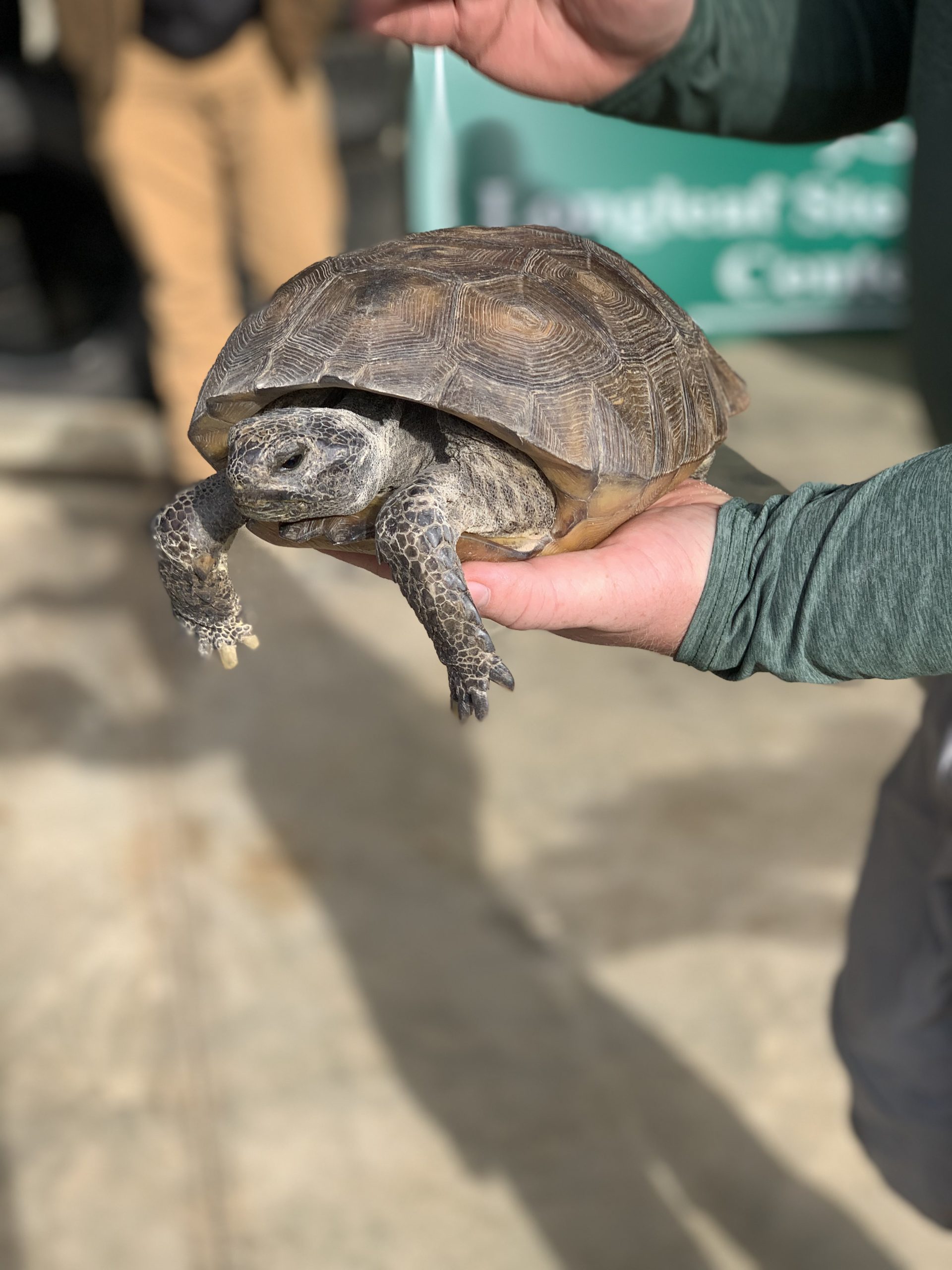
The highlights included gopher tortoises, a keystone species in conservation biology that can live for 80-100 years. They are in the coastal plains and on all the barrier islands in Georgia. Sadly, they are threatened in both Florida and Georgia, and even more so in Florida. Touching the gopher tortoise’s hard, graceful shell, I noticed how this important, reclusive land animal was relatively small, about the size of my two hands together.
The blue-black colored eastern indigo snake, known as the Emperor of the forest, hails as the flagship species of its habitat. My friend and his brother were standing next to me with these large, magnificent indigo snakes casually dangling on their shoulders and arms, studying them in detail before passing them on to me. The indigo snakes sometimes eat rattlesnakes and cottonmouths since they are immune to the venom. Prior to this, the only reptile I had ever held was a baby alligator when I was young, which was still half the size of me — when my family had visited a Louisiana bayou — and anoles, which are little lizards, since they were everywhere in my environment as a child. Sometimes I’d find baby lizards inside the house and want to escort them back to their true home outside. I knew that some people didn’t like lizards, but I did. I wasn’t afraid of them. I thought they were beautiful with their array of colors, and I marveled at how fast they moved. And amazingly, I felt both excited and tranquil to be interacting with the snakes.
As we passed the snakes around, I thought about those who could see their allure. The people who understood these fragile, gentle creatures and knew their role in the ecosystem, as everything in existence has a purpose and contributes to the greater whole. I’d seen snake charmers in India and I still have a photo I took in Indonesia, where a Balinese man sat with a child in his lap with what looked like a very large yellow python contentedly coiled right next to them. I had seen these exceptions in cultures where a few people still remembered that every spot on earth is sacred and that every creature is sacred. But I had viewed these from a distance, not up close as I was now in the sanctuary of the longleaf pine forest. And now, one of my companions commented to me, “You’re so calm in the presence of the snakes.”
During my late twenties and early thirties, I lived in New York City on the 42nd floor of my building and worked in a Manhattan corporate job on Wall Street. As exciting as “Zoo York” was, as it’s known, the concrete jungle always left me yearning for a wilder and more adventurous life that felt far away. Volunteering at the botanical garden in the Bronx provided temporary therapeutic relief. I dug my hands into the earth and crouched down low, sitting on the ground to pull weeds all day long. I practically had to drag myself away at the end of the day, so reluctant I was to leave that slice of nature and return to the depressing gray concrete that left me depleted. My senses were screaming out for more nourishment.
Later that morning, I spoke with conservation biologist Chris Jenkins, the rugged and inspiring head of The Orianne Society. He asked about my background.
“I studied to be a diplomat, but was more drawn to nature over time,” I told him, “and these days I’m writing.”
Not losing a beat, he reflected, “You’re an Ambassador for Nature now.”
It was an epiphanic moment for me when he said that, and the weight of that realization sunk into my awareness. The Orianne Society staff and members were already ambassadors for nature, and here I was, aspiring to join their ranks.
When I had felt depleted over the years, I realized I needed to be back in that lush green glorious landscape of my youth, which is why I returned. Those sublime surroundings lit up something inside me. Now, at The Orianne Society’s longleaf sanctuary, the trees were swaying in the whistling wind that blew my hair, energizing me and charging my senses. I felt more alive hearing the riotous symphony of birdsong, my inner spirit wanting to merge with the melodies. All around was the tapestry of nature connecting me to it. I was part of it and coming back alive.
“Why are people so afraid of snakes,” I asked the group of eleven or twelve people when we passed around the snakes, “since snakes were historically revered in Eastern philosophy and indigenous mythology worldwide?” I knew that the ancient traditions around the world believed water snakes to be symbols of fluid wisdom and elegant steadiness. The kind, distinguished professor (fittingly, the SERPENT license plate that I had seen in the parking lot earlier that morning was his) replied sorrowfully, “In reality, even in India and other Eastern countries, most modern people have lost the connection to nature. Since many people don’t know which snakes are poisonous, they often kill harmless snakes, just like here in the West.” The professor was reflecting what I already imagined but wished was different. Something about what I took to be sincere love for and devotion on the professor’s part to these often overlooked creatures — he had written a book called The Secret Social Lives of Reptiles — resonated with me even though I barely had a fraction of his familiarity with these creatures. I remembered a story my mother told about when I was three or four years old, playing at the edge of the St. John’s River in Florida at my grandmother’s rustic river retreat, and she gasped when she saw a water moccasin glide up nearby where I was playing. My mother, her nerves fraying, called out to me in a wavering voice while trying to remain calm, “Amanda Leigh, can you slowly back up and move away from the water and that snake you’re looking at? Come over here and play!”
Who knew if it was the venomous cottonmouth or a non-venomous water snake? It was enough to give my mom a fright. I suppose the snake swam on because I lived to tell the tale and since, I’ve always been drawn to the symbolism of snakes in mythology, as the archetype has woven its way in and out through the twists and turns of my life with their groundedness, the shedding of their skins, the creative life force, renewal, rebirth, transformation and the ouroboros of eternity.
Finally, here I was living a moment in the much wilder and more adventurous life that I had yearned for, back in the region where I was born, where I felt I belonged. Here I was standing with a yellow and black pine snake snugly wrapped and draped around my body, as if it were the most natural thing in the world, exuberance bursting through me. A surge of energy arose from within me and seemed to go out into the world to meet it and all its inhabitants.
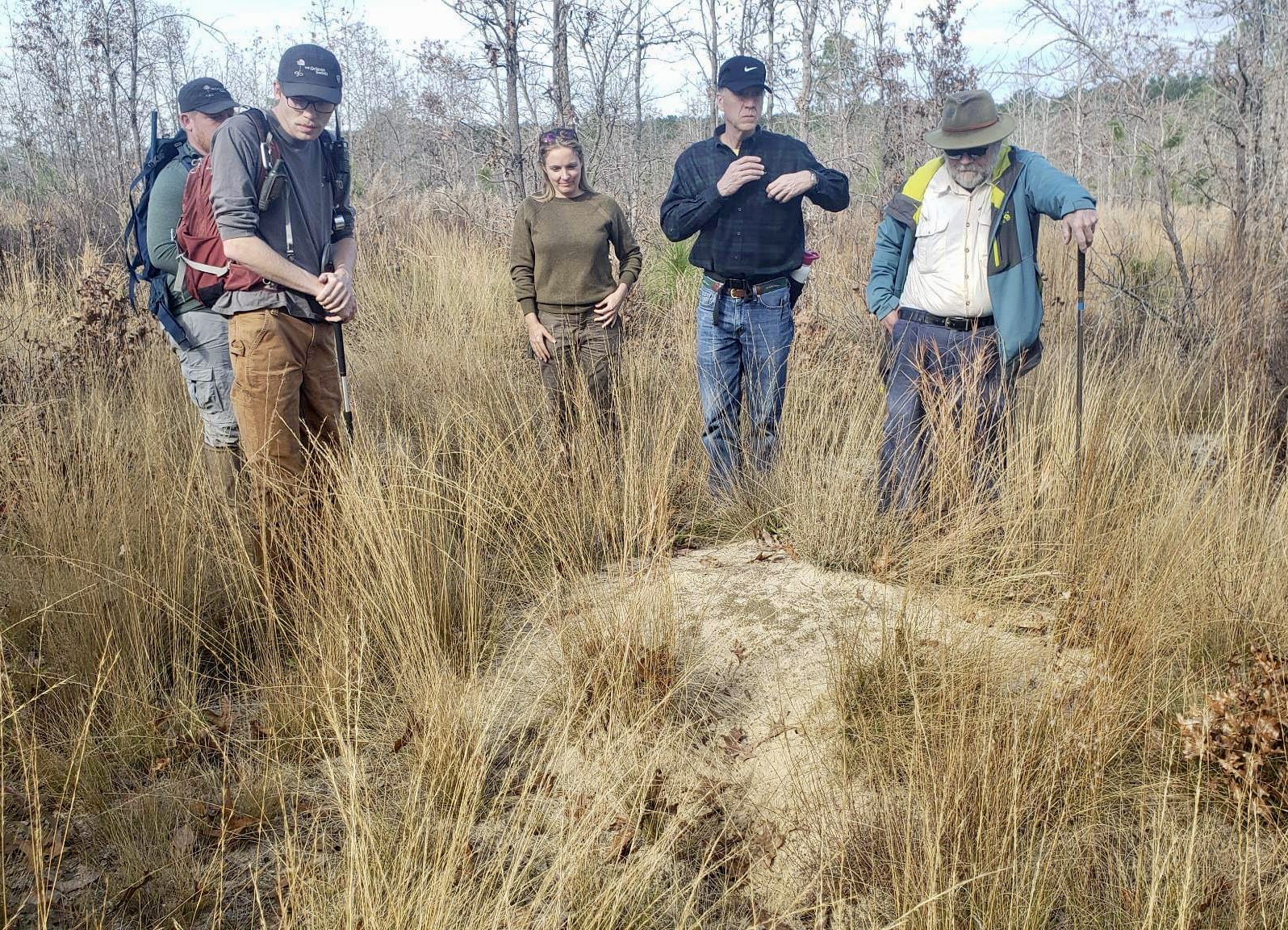
As the day had gone on, we headed out to watch a prescribed fire burn which helps to incinerate competitive vegetation and maintain the health of the forest. Controlled burning is supposed to imitate what naturally occurring lightning strikes used to do for the longleaf savanna. I had to move further away from the shimmering heat of the spreading fire which had swooped in, as my body felt the heat touch my skin. I could smell the smoke as it drifted right towards us, picked up by the fierce wind. At midday, peeling our layers off as the temperatures soared, we hiked out through the wire grass, searching for gopher tortoise burrows, which house a variety of other species as well, especially snakes. Gopher tortoises stay busy digging burrows and a multitude benefits from this underground housing. Quail flew off when they heard us coming.
It was still too cold that day to find any snakes. The sun was blazing yet not hot enough to heat up that cool air. But the Orianne folks showed us their long, meandering hoses with cameras that can reach around 25 feet into the burrows which can be 30 to 40 feet long.
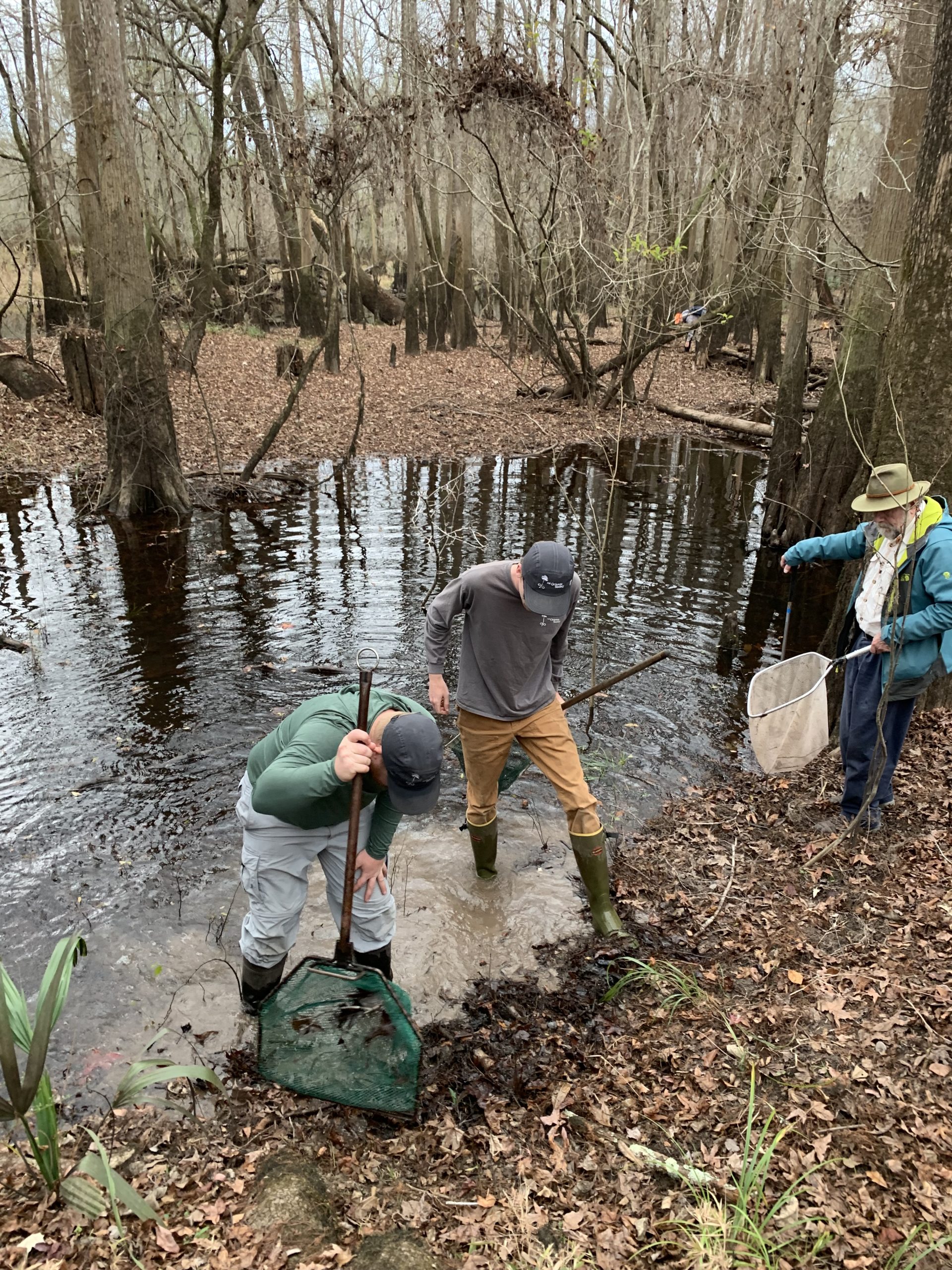
I listened and marveled as the biologists named almost every tree, plant and creature in that setting. Later that afternoon we went off into a different part of the forest again and into a cypress swamp where we found all kinds of salamanders under logs — spotted, marble, dwarf and slimy. The biologists waded into the creeks with their nets, hoping to find more. Some waded so deep that the water spilled over their knee boots. We eventually drove our trucks, bouncing up and down, side to side, along the terrain, all the way to the winding Ocmulgee. Everyone looked like big kids, playing and discovering the delights of nature. I remembered that I, too, was once a child who stayed outside playing and exploring till sundown, communing with creatures in their elements. No wonder I had felt lost and spiritually starved in an unnatural sea of skyscrapers and concrete.
We ended the day with a campfire, seated at wooden picnic tables where we ate barbecue with hot sauce, next to a small cabin which was rustic but comfortable, with a bathroom and kitchen. It felt like a return to more simple times, settings that I recalled from my youth. When it was time to go, we bid each other goodbye with strong embraces and fervent wishes to meet again in this lively setting.
I returned home, full of new awareness after having connected more profoundly with our beautiful natural surroundings in the longleaf pine forest. I also felt called to share the experience with others so perhaps they, too, will answer the call to deepen their relationship with our vital ecosystem. Back when I had pounded the hard pavement for nearly a decade in New York, I’d felt a nearly constant gnawing emptiness inside, my instincts crying out for something more and a pull that was leading me elsewhere. I had struggled with it for a long time. Now, I was finally fulfilling that inner desire, feeding that hunger, in the process of re-wilding and reclaiming parts of my own self. I had experienced a sense of homecoming and rediscovery of my native land that was powerful in and of itself, so strong that I hoped others would seek out such experiences and find similar organizations in order to support and get back in touch with the wild and our ecosystem.
Butterfly

The life of a butterfly is one day,
Isn't it hard for him?
Thinking of living one day after all,
Is not the biggest concern.

I thought once,
A butterfly has no heart.
Doesn't he cry?
It hurts even if he has a heart.

I have a question,
Don't come?
They are also each other,
I will hurt your hearts.


✍️ Qosimova Parizoda
***
people don't want to die either
in spring or summer
prisons are open all year round
(Reprint by Dreginald)

***
sad clowns
die with a smile
every time
performed on stage
(Reprint by Dreginald)

***
nightingale staged a night gala
every night he flies to my yard
even after my death
(Reprint by Dreginald)

***
torn faces
litter
torn tracks
(Reprint by Dreginald)

***
statues also die
and time is not easy to consider
among all that one
in memory of which one today
the bells are ringing in the church
(Reprint by Dreginald)

***
Roar of war
Garcia Lorca don't go back to Granada
(Reprint by Monterey poetry review)

***
summer is a mystery
the winter of nuclear war still
lives in the heart
(Reprint by Monterey poetry review)

***
Old-fashioned tragicomedy

armor protects the soul with the body
and the bombs are flying
(Reprint by Monterey poetry review)

***
The cemetery under the bed opens at the first request
Once upon a time in childhood we were taught to make little men from matches
Today we are taught to burn

My mother says that life was better under the Soviet Union
Someday the future will come, but not now
Today we are taught the word "later"
(Reprint by Star 82 review, 11.3)

***
doctor said
that i died
and i agreed

***
Cardboard Bird
Indignant
In a raspy voice

Doesn’t eat anything
Doesn’t drink anything
Protests

Doesn’t touch anyone
Рretending to be the wind
Handing out money right and left

Imagines himself
Image
A picture of the postmodern half-life

And something else very important
I do not remember
Maybe wings
Could be a beak
Maybe a soul

Exactly
I do not remember
(Reprint by Wise Owl)

***
I promise that I will take away my painful darkness
But not right now

I will be able to understand the meaning of this darkness in the future
Well for now

Give me a chance to die again
Cause freedom is loneliness
Love is a crime against loneliness
(Reprint by Wise Owl)

***
I play war games and watch scat on TV
My freckles are gone
And yes, I will have to pay back the loan for this
(Reprint by Corvus review)

***
Houston, you're in trouble
The gypsy's prediction did not come true
And a lot has happened
Ever since someone jumped off a bridge
The dew from under the eyes has not dried
Where did it all go
Where does it all go
Republic of the Dusk Star
Your cold palms sparkling in the sun
Whisper that it's very cold
The sun has completely faded
The universe is tensed up
And lives in constant tension
around you ever since
How someone jumped off a bridge
At the same time, they started selling
Watermelons have risen in price this year
Note:
Strengthening the internationalization of economic relations between states and the deformation of the economy are possible causes of inflation, causing food prices to rise
(Reprint by Corvus review)
When We Are Just An Ostentation

If her lip was a sweet
I could crave to have it in mine always
After she stole my heart
And set it on mountains
That springs water from depth.

Love sometimes looks like flower
While sometimes; the black ball in your eye.
That very day was another walk
Into heavens
But when everything seize
I rerely believe we're just an ostentation
Which is very otiose.


Reflections

Tales of past has match in
The present as I lingers into the simile
And antonyms of bliss
I snore out the hue of constellations
And held my pillow as the saviour
That dries up the streams on my face.

Can you decipher the joy gotten
From a crippled comic
Or that of the lurch in lurid?

A pellucid hope has made hay
For the future
Only if it will catch reflections.
Reborn

Maybe I will be reborn as a basil.
Being happy from my death
One day my haters will have a party.
Passing through alley with silence
I hear all the gossips they tell.
Now my poems will become orphan,
Now I only live in my poems.
But the world remains the same,
Thousand years again it stays still.
All the lies, all the fake faces,
And ignorance in the gene.
All the lips whisper one by one,
Thanks God, I am far away.
Blind souls never recover,
I am not related to earth any more.
The only thing tortures me is
My days that I spent aimless.
And incomplete writings of mine,
My voice that paused on my throat as well.
One day I lose my life, it is clear
One day I will return to the Creator.
Asking God to revive inside of me
I will utter the name of my elder son.

Sharipova Zuhro Sunnatovna (Zahro Shamsiyya) was born on April 9, 1969 in the Nurata district of the Navoi region. Her first poem was published in 1985 in the Gulhan magazine. Uzbek publishing houses published works in the journal "Sharq Yulduzi", in the literature and art of Uzbekistan - "Ma'rifat", in various regional and district newspapers. World almanacs in Canada, -2017 in Dubai WBA 2018 "Turkish poets of the world" (Buta 3) 2019, "Muhammad Yusuf izdoshlari" 2017 almanac. She published her book "Ismsiz tuigular"
The world is a jungle

The world is a jungle,
is what I was told.
This is what my father said to me
as long as I can remember:
Once a soldier,
always a soldier.

I didn’t know, when I was young,
that I was from a land of warriors.
How could I,
when I was surrounded by them
and that’s all I knew.
I hadn’t yet left
to see from the outside.

Looking back,
I might’ve been
the only little girl
obsessed with war movies,
playing toy soldiers,
held by an era.

Then, one day
I found a book
by a woman
who was the daughter
of a tunnel rat.
She knew what it was like
to have the war brought home to her.

You weren’t there, he said to me.
No, I didn’t have to be
because I lived through it with you
from the day I was born.

It wasn’t much talked about,
it was what was overheard —
all those generations,
the silent ones.

How could you speak
when there are no words
to describe horrors
and atrocities
that threaten
to destroy your soul.

It’s no wonder
the soul had to take flight
until it was called back in
gently coaxing, soothing,
but some never returned.

Soldier’s heart, battle fatigue,
shell-shock, ptsd, finally,
post traumatic growth.
Aren’t we all tired of it?
Hasn’t everyone suffered enough?

The ones who devoted their lives
to helping —
Gabor, Bessel and others,
The mother, the grandmother
who prayed for all her sons.

The relatives would whisper
but the children overheard —
He was never the same again,
they said.

Some wives woke up at night
to find their husbands
up in the trees outside,
somnambulant,
the survivors,
not knowing,
why they’d been spared
but feeling dead.

As a child, I thought
that all hearts were purple,
that all uncles had shrapnel.

Isn’t it fitting
that this daughter,
before she even realized,
would find herself
in tropical jungles,
drawn to them, in love with them,
a full circle of sorts,
but drawn with love,
a different kind of mission.

and along the way,
after a very long time,
she was surrounded by warriors again,
still too young to realize
and recognize
how familiar it all was.

It wasn’t sought out
yet somehow
the past alive and well,
never even really past,
as Faulkner wrote.

Where are the landmines?
they’d ask.
Yet this was a different battlefield.
It saddened me,
weren’t we supposed to be
in this together,
in harmony?

It became apparent that
these were all lessons,
they were all lessons.
It was all learning,
to witness, observe,
to experience.

I was told
that I was a soldier,
that I marched when I walked.

I’d like to say,
that this part of me died
and is long gone.

Some say
that heaven and earth are right here
on this very earthly plane.

The long journey to Hades,
to the underworld,
full of archetypes
as the mythology describes,
is an accurate portrayal
of the parts of us that
go to war within oneself —
That die,
That shed,
mimicking nature
to be transformed.

It is said,
that when you heal yourself,
you heal seven generations back
and seven generations forward.

That is my practice,
That is my practice.
Every day,
every moment,
I am my own medicine.
You are your own medicine.

I now plant gardens,
not quite in the jungle
but close enough.

I build bridges
that connect
different people, languages and cultures,
a place to truly come home,
to return home
to my roots,
to my origins,
to my body
and to my heart.