Essay from Valijonova Bakhtiyar

SPIRITUAL HERITAGE OF ABDULLA QADIRI

Valijonova is the daughter of Nigora Bakhtiyar
In the city of Namangan, Namangan region

Abstract. In the article, the creativity of Abdula Qadiri, one of the factors that raise the morale of the reader in the work "The Past Days" was devoted to the analysis of the pictures aimed at developing reading.

The author also noted that the role of reading literary works in instilling the love of literature and national and universal values in the minds of the young generation is incomparable
Key words: Spirituality, reading, reading, creativity, healthy environment

Literature is an endless ocean, it knows no boundaries. Along with many great personalities, small amateurs also create in it. Only some of the creators make a radical change in literature, update it. One of such geniuses is undoubtedly Abdulla Qadiri.With his works, he contributed to the spiritual development of the peoples of not only Uzbekistan, but also Turkestan.

Honor, honesty and truthfulness are one of the main principles of the life of Abdulla Qadiri, because the talent gifted by nature combined with true Uzbek hard work, his pen created works that will not become obsolete for centuries. 

His works are of special importance in the formation of the spiritual world of every student. The characters of Otabek, Kumush, Yusufbek Haji, Mirzakarim Kutidor created by him strengthen the feeling of appreciation of positive qualities in people. Although the author states with his own language that "the power of the pen is weak for the image...", the goodness expressed in the words in the process of reading the work cleanses the human soul.The example of Kumush's parents shows a truly healthy family atmosphere typical of the Uzbek nation, which is rarely found in works.  Mirzakarim answers to the suitors who came from Otabek: "I would consider myself one of the luckiest fathers if I could have the honor of making a boy like Otabek, but everything is up to me." There is also a woman who is not in lim, but in the meantime she is breastfed..." the box worker's wife advises the mother of the sun.Look how beautiful the environment is in this family. This one word, said by Kutidar, shows mutual solidarity and respect in the family. Every father who reads the work reflects, maybe some of them take an example, and the mother who reads the work appreciates the author's understanding and image skills. 

Why is this work so popular?

"Abdullah Qadiri's works raise the morale of the student," we say. The content of meaning and the range of expressive language of the work "O'tkan kunlar" created by him is extremely wide. While reading this work, the writer as an intelligent person motivates the students to read the book.  The reader who first read Fuzuli's words from the Otabek language, "You should read Fuzuli carefully", in addition to Kumush's "Fuzuli is a good book, I couldn't take my head off this book when I was alone..." not knowing what kind of artist he is or the "taste" of his poems it is possible, but it is clear that there will be interest in Fuzuli and his work. For some readers, it is a reason to get acquainted with Fuzuli's work. In the work, it is stated that Otabek was busy reading not only Fuzuli, but also such a magnificent work as "Baburnoma": “…Hasanali got dressed from his room and went to Otabek. Otabek was busy with the fabric "Boburnoma."

What aspects of Fuzuli's book and "Boburnoma" fascinated Otabek. Adib wanted to show that his hero has matured to the level of "a young man worthy of a Khan's daughter" by reading books and receiving spiritual nourishment from them.In a certain sense, the writer promoted book reading among the people. He skillfully describes how interesting and enjoyable the process of reading a book is, during which the reader forgets his sufferings and life's worries for a moment:."After the evening prayer, Otabek is in the mood to get rid of his marital worries, he sits by the oil pan and takes Fuzuli Divan in his hand. For some reason, he had "a feeling of depression for some tragedy." When a person is in pain, he tries to do some things involuntarily, not willingly. He also devoted himself to the reading of Fuzuli seriously," he said, noting that reading the book not only gives a person spiritual nourishment, but also helps to forget life's worries and depression for a while.

One of the main factors that extended the life of "Days of the past" as a work of art, and gained value in the eyes of current fans, is the presence of artistic visual tools that encourage the reader to think and observe, as well as encourage his people to read the book. it is no exaggeration to say that there are exhorting and promoting aspects.

List of used literature
1. Abdullah Qadiri. Past days. Tashkent "Sparks of Literature" 2018
2. Khurshid Dostmuhammad. Creativity is the enlightenment of the soul. Tashkent. "Classical word" 2011.


Poetry from George Gad Economou

are you out there, somewhere?

staring into the dark
searching for the morning light;
are you out there,
somewhere? 

to bring me back 
from the world of bottles and needles;
every one the last
even though there’s always another
waiting in the shadows. 

are you out there,
somewhere?
to hold my hand, 
to feel my pulse
through my bleeding skin? 

the faintest sound
another memory long gone;
destroyed by the booze, 
eradicated by wrong embraces.

I need you, once again,
to keep me warm
through the endless winter. 
freezing, just like then, 
and the needle has lost its warmth. 

are you out there, 
somewhere? 
waiting for my return, 
patiently sitting in the corner
hoping for the promised miracle.

a sun that never rises, 
a mist that shall never be lifted; 
hiding in the dense forest, 
running away, fast and far,
escaping the ruins that burned too fast. 

squinting into the vast nothingness
of eternal damnation
and I smile; 
your former words sweet music
to my perishing heart. 

is it you I see
walking amid the debris? 
are you still out there,
somewhere, 
searching for the final pieces of the puzzle? 

another attempt, 
you’re nowhere, 
I’m everywhere; 
both lost, both found, 
only the needle is keeping us apart. 

are you out there,
somewhere? 
I ask the night, question the stars;
they can’t explain why your
kisses were tossed into the bottomless well. 

another blurry night, 
more mistakes, 
sins added to an already extensive list. 
it’s all right, 
no need for forgiveness. 

I warm the needle, 
the junk has melted.
are you out there,
somewhere?


Eighty Thousand Words

write long novels, said someone I barely knew, one of them advisors
that know nothing but how to sell bullshit.

long novels sell.
 
I spoke to a woman about a novel I wrote at 19,
it’s more than two hundred thousand words long—still not long enough
to match Wolfe—and she liked the plot.

told me to translate it, publish it. she also asked
about the inspiration, the drinking and drug-abusing. 

I said, it’s fiction. it’s meant to be the disclaimer on
whatever’s published—it’s a work of fiction, don’t call the feds.

could I have mentioned I started it when I was underage and 
getting my feet wet on the ring of drunkardism and
finished it on
a spree of rotgut, speed, and pure junk? 

some chapters are repetitive as fuck, I blame blow. 
some are harsh and honest; bourbon does that. 

it’s a work of fiction. like this poem. 
the woman never called again—she wasn’t a drinker,
one beer and she was off. after the date, I got plastered at
a bar near home—some Irish guy bought a barrage
of well scotch shots.

we got under the table drunk, then I was 
teleported in my bed. 

it’s a work of fiction, do remember that, 
when you tell me I’m 86’d or

mention the tab.


The Mauve Moon

lonely wolves howl at the mauve moon 
as marauders come knocking, razing ancient landmarks. 

stare at the starless sky, the great green mushroom—all gone, 
nothing left but the final wails of unborn souls trapped in limbo.
sour grapes turned into sweet wine, bottles emptied horrid taste, 

gruesome realities and morbid details, nets made of fire catching
rational men. eradicate, destroy, rebuild; what a fine writing

on a half-ruined brick wall in the middle of the ocean.

look down, all the towers emerge from under the sea—old homes
now belonging to fish and mermaids. Ulysses’ sirens reappear, 
under the liquor store they swim, amidst the shelves they sing.

if you are, die; if you think, you don’t exist. Voltaire’s ghost
promenades in the ruins, somewhere in the distance
Aristotle’s swilling Thunderbird. 

we’re still around—the liquor store clerk polishes a shotgun, 
two kids shotgun beer in the back alley. 

the mauve moon howls, the echo shattering what remains of the world.

Currently residing in Greece, George Gad Economou has a Master’s degree in Philosophy of Science and is the author of Letters to S. (Storylandia), Bourbon Bottles and Broken Beds (Adelaide Books), and Of the Riverside (Anxiety Press). His words have also appeared in various places, such as Spillwords Press, Ariel Chart, Cajun Mutt Press, Fixator Press, Outcast Press, Piker’s Press, The Edge of Humanity Magazine, The Rye Whiskey Review, and Modern Drunkard Magazine.

Poetry from Philip Chijoke Abonyi

The Incoming Sun

The hummingbird of Lagos, I, will stay for the incoming sun,
reciting all the verses on the petals of blossoms.

Through winter, I have held back the butterflies,
in my stomach from flying out,
I will, until my fire is quenched, consume regrets.

My mind is a symphony of love carols,
My body is an exhibition of memories.

Of all the darlings I didn't behold,
Out of this, my coy mistress, this songster,
saying every move I make will make me a jewel
in the seabed of despair.

Would my father know my mom by embracing
the flimsy vocalists in his nerves?

In the coffee shop where you steal the gaze of flowers,
And yearn for the coffee entering your mouth to be tenderness,
the kind of tenderness with which you build laughter nests,
where you will place your head for rest.

This too I desire—the incoming sun,
in whose landscape I shall hum my empathy.


Dusk 

We have normalized eating dusk in the cafeteria of life,
Every day breaks with a knife that prays into our bodies,
We are phantoms chewing on the bones of despair.

There are too many ants in my heart
Stinging the little part of me trying to stay alive,
The remnant of the light in the custodian
of darkness is being harassed by the wings
of vultures that devour the skin of the sun.

How much more will our bones scream
Out light,
And leave us as vacuums that welcome featherless birds,

On a dinner table where our spoons try to seize
A little moment to crackle,
Earthquake took over my sister's body,
And our tongues went sour with sorrow.

This darkness raining like memories of war,
In the hands of a boy holding the skull of his mother,
Has engulfed my spirit,
And our home convulses.

The walls are falling apart to the mockery of my broad nose,
At this moment, I am a snail wishing to stay safe,
In my shell,
To nurture my ambitions that are not lost.

Philip Chijioke Abonyi, a native of Nsukka, Nigeria, is a writer and photographer. His exceptional talent has garnered him several awards, including the 2022 Brigitte Poirson Poetry Prize and the 2023 Archipelago Poetry Competition. Notably, Philip was shortlisted for the renowned Eriata Oribhabor Poetry Prize in 2018. His remarkable literary and visual creations have been showcased in esteemed publications like Eve magazine, Agape Review, Typehouse magazine, and other notable platforms. It is his desire to continue to inspire audiences, leaving an enduring impact on the creative landscape.

Poetry from Sayani Mukherjee

June a mid afternoon slush
Whispers of synchronized harmony
A new era 
Flowscape 
Los Angeles's prized possession
The East is exotic
The fresh lime barn
Haiku ridden mosaic scoops
Fallen asleep
Mid day
June an aromatic floor
Flaky sunchildren are asleep
Tip toed motion roars 
June a hummingbird's last escape
Monet's paradise in butterfly case
A new era 
Kindred flames
Droplets
June rain down my sea scape
My portfolios fragrance musks
The amethyst I borrowed from
June my flaky midair day
Rain down on me. 


Story from Bill Tope

Adventure to Bizarro World

"So what if I've had eleven beers tonight?" fumed Darryl, crumpling up another aluminum can and flinging it across the room. It landed in the cat's litterbox and Baby spat and hissed.


"What're you, trying to drink yourself to death?" demanded Olivia, his girlfriend of ten minutes. "If i'd known that was what you were about, I never would have committed myself to your happiness."


Darryl blinked. What the hell was this woman, who had just walked through the door an hour ago, even talking about? After snorting up two lines of blow that he'd had in readiness on a pocket mirror, she'd proclaimed her undying love and then passed out. When she awoke, a few moments ago, she had started carping about how much he drank! If he'd wanted scathing criticism, he could have stayed with any of five ex-wives. How could he get rid of her? he wondered. Where did she even come from? She couldn't even get his name right.


"Dirwood," she cooed, "when are you coming to bed, honey?" He rolled his eyes,


"Who are you?" he asked. He startled, then stared at her with sudden appreciation. She was a dead ringer for the classic vocalist Patti Smith, a gorgeous, sultry, dark-haired creature whom Darryl had always lusted after, back in the day. As if on cue, Olivia suddenly began crooning "Because the Night," until finally, like a spring-wound toy, she ran down.


"Tomorrow's our anniversary, honey," said Olivia in a syrupy voice.

"Hell," said Darryl, "I only just met you.."--he checked his watch-- "...seventy minutes ago! Where did you even come from?" he

asked.


"From the constellation Gridiron," she replied, then she added coyly, "Do you want to see my Big Dipper?" Darryl frowned, looked closer at Olivia, who now resembled Daffy Duck. Darry shook his head, looked away.


"Olivia," he said, "you've changed."


Olivia's face suddenly assumed a feral, rodent-like expression and she said, "We're pregnant again, Dirwood."


"What's that to do with me?" he demanded.


"It takes two gametes to make an embryo," she reminded her boyfriend of 24 minutes. "We did the dirty," she told him.


"I did not..." he began, but she cut him off.


"You weren't the biggest," she said, "or the hardest, but you were the best!"


Swollen by the magnanimity of her words, Darryl preened, threw his arm about her narrow, Patti Smith-like shoulders, and said, "Olivia, will you marry me?"


"Of course," she purred, and threw herself into his embrace.

An hour later, Darryl and Olivia, accompanied by their five children, boarded a three-stage rocket bound for Bizarro World, where everything took place in  reverse.


"It'll take 430 light years to reach Htrae (Earth spelled backwards)," Darryl told his wife of 84 minutes. What do you want to do to pass the time?"


Olivia smiled slyly, then replied winsomely, "Well, Dirwood, we could work on making more ybabs," and embarkation was begun.

Z.I. Mahmud illuminates The Vicar of Wakefield

Book cover with a man in an old time white wig and suit standing next to a horsedrawn carriage with two women passengers in bonnets and long dresses. They're outside with trees and grass.
The Vicar of Wakefield
In the words of Goldsmith “the good are joyful and serene, like travellers who
are going towards home; the wicked but by intervals are happy, like travellers
who are going into exile.” 

Examine the Vicar of Wakefield as a satirical prose
fiction.

Or
Examine the Vicar of Wakefield as allegorical satire and novel of sentimental
genre.
Or
“Here fears are not quelled or hopes are not fulfilled; burlesquing both
sentimental fiction and readers’ expectations.” Examine the perspective from
the main character of the Restoration novel The Vicar of Wakefield.

Goldsmith's novel is allegorical satire and prose fiction embedded with the
characters of sentimental genre, Goldsmith enshrines his novel in engravings
of an everyman Christian in the role of a materialistic clergyman engulfed by
sentimental views of paterfamilias. The abduction of Sophia and imprisonment
of George are further trials to the reconstitution and restoration to the Vicar’s
family. “The joys that fortunes bring, like trifles and decay; Friendship is but a
name and happiness is still an emptier sound”. 

The Christ-like suffering
experience of fatherhood resonates Christ's crucifixion and vicarious
atonement through the resurrection of the Vicar as well as Olivia and furthermore, the
 restoration of George and Sophia.
Goldsmith’s novel is a place where no man is fond of liberty as not to be 
desirous of subjecting the will of some individuals to his own and where virtue
 is always under siege by the likes of Thornhill, a villain motivated less by lust
than like Deborah by an impulse towards tyranny and revenge.
The vicar’s adherence to individualistic spirits to God’s laws reclaim, “ … “ Olivia’s
seduction by the promiscuity and lust of Mr. Thornhill exemplifies the
catastrophic debacle impacted in the world of rigid adherence to principles and
reaches the moral weakness or frailty of the womanhood in Olivia.  The Vicar of Wakefield broad heartedly and open mindedly embraces the returning
 repentant wretched daughter as exclaimed in his assertiveness of dialogue and
action of personae/ ‘His benevolence lies in his rhetoric and his action often
belies what he professes’ …./ 

Firstly, the Vicar storms in remonstrance and
wrathfulness upon Olivia’s escaping the domestic hearth and eloping with the
seductive Squire Thornhill “Bring me my pistols. I’ll pursue the traitor. While
he is on the earth I shall pursue him.” 

Lastly the Vicar settles down in a
 pacified manner to reclaim his lost daughter despite her wretchedness: / “ever
shall this house and this heart be open to a poor returning repentant sinner…
Yes, the wretched sinner shall be welcome to my house and my heart, tho
 stained with ten thousand vices.” /

The Vicar of Wakefield’s dialogue and rhetoric “I only studied my child’s real
happiness” and “my tenderness as a parent shall never influence my integrity
as a man”. His daughters must be killed off in an unsuccessful ploy to obtain his
 freedom and his sons must cheerfully lie in custody with their father; his wife
 must suffer shame and the penury of the situation; Mossess must labour for
the whole family and this stresses the matter of principle. 

Goldsmith's maxim of
‘submission in adversity’ has been metaphorically satirized in the sense of the
disastrous effects of audacious pride associated with the mastery of
fate. Thus, submission in adversity consecrates the Vicar’s stance as "a
 calm spectator of the flames’ whilst sermonizing lectures and preaching
 homilies to families and exhortations to prisoners and the moral
 climax of the action touches its pinnacle in the maxim of the Vicar's: 
“If our rewards are in this world alone, we are then indeed of all men the most
 miserable.”

The Vicar of Wakefield is in stark contrast to the foil of Ephraim Jenkinson and
this is profoundly evidenced in his exclaiming speech after a colossal
 catastrophe infests to pester his family in ruination as in the instances of
 abduction and elopement, murder and violence, crime and imprisonment and
 burning flames. /“May all the curses that ever sunk a soul fall heavily upon the
 murderer of my children/…/ May the flames continue burning all my
possessions…Here they are!--- I have saved my treasures (my little ones)”/

Jenkinson is an allegorical character of evil being defeated by the triumphant
 force of goodness. “Perhaps you’ll think it was generosity that made me do all
 this. To my shame I confess it, my only design was to keep the license and let 
the Squire know that I could prove it upon him whenever I thought proper and
 so make him come down whenever I wanted money.”

Further Reading and Works Consulted

'The Vicar of Wakefield and the Sentimental Novel’ 
David Durant 
University of 
Kentucky, Studies in English Literature 1500-1900, Summer 1977, Vol. 17, No.
3, Restoration and the Eighteenth Century Summer 1977, pages: 477-491
JSTOR Database George E Haggerty’s Satire and Sentiment In The Vicar of
 Wakefield.

Synchronized Chaos Mid-June: Encountering the Mystery

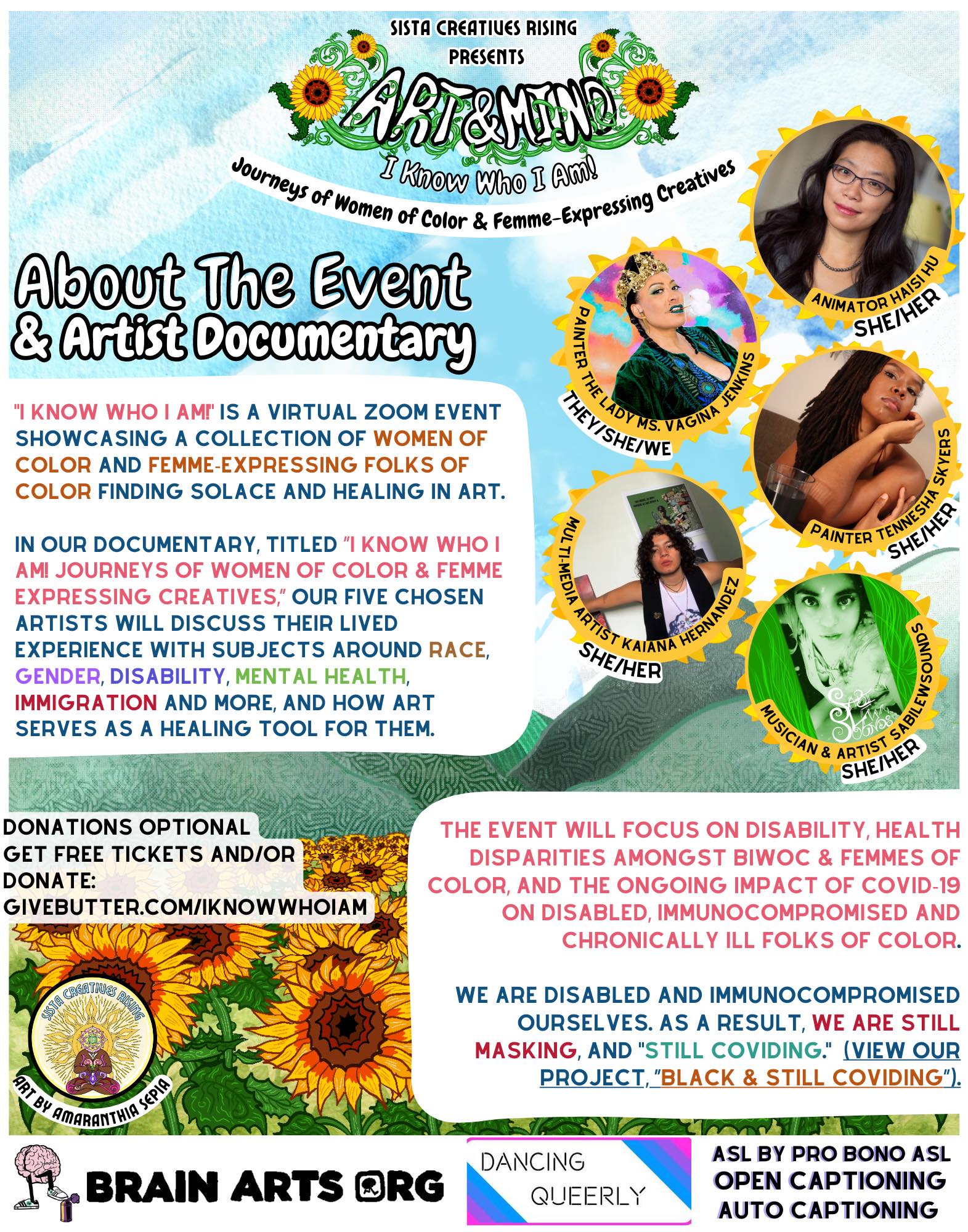
First of all, we have an announcement, an open call for video submissions from women of color, up to four minutes long, showing any artistic practice or medium and how it helps you heal yourself or others. This is for Sista Creatives Rising, a mother-daughter run nonprofit in New Hampshire. Claire Jones and Amaranthia Sepia invite you to submit videos here.

"I Know Who I Am" call for submissions.  Women of Color and Femme-Expressing Creatives. Five Finalists Paid $200 Each, Submit a Four-Minute Video about your art and how it has helped you heal.

PAID OPEN CALL

Art & Mind: I Know Who I Am! Journeys of Women of Color & Femme-Expressing Creatives in partnership with @sistacreativesrising & @dancingqueerly

Please share our call with any BIWOC or femme-expressing creatives of color! A newsletter will be sent at least once a week, into July, featuring our team and other info!

Now, for mid-June’s issue of Synchronized Chaos.

Even with all that we have learned about life, much of our existence is still blanketed in mystery.

This month’s submissions express encounters on different levels with the unknown.

Intricate mosaic-like images of fractally branching teardrops that are bronze, yellow, silver and deep blue.
Image c/o Piotr Siedlecki

Rezauddin Stalin’s fanciful pieces draw on mythology to remind us of all that we do not yet know. Z.I. Mahmud analyzes the comedic aspects of Christopher Marlowe’s Faust, a character driven by an infernal quest for knowledge.

Kahlil Crawford reviews Jeff Deutsch’s In Praise of Good Bookstores, which discusses the life of the mind and the curated bookstore, the physical architecture of the store and how it can encourage learning and discovery. Quademay Usanova probes the linguistic structure of Russian, Uzbek and Central Asian languages while Mamatkasimova Sitora urges us to understand ecology in order to show respect for the world in which we all live.

Sayani Mukherjee conveys the mystical, distinctive gauzy light of evening, while Mercedes Lawry finds moments of art in everyday outdoor scenes and Patrick Sweeney renders glimpses of children and the outdoors into haikulike poetic phrases.

Anshi Purohit renders homeless street survivors as heroes and protagonists, inspirations for art.

Kimberly Gomes and Christina Chin collaborate on tan-renga poetry that takes closeups of everyday scenes from various vantage points. Michael Todd Steffen’s tribute piece celebrates and memorializes Seamus Heaney and the spirit of his poetic readings.

Hazy foggy view of a faraway cathedral from a rock outcropping under some trees. Beige image.
Image c/o Rajesh Misra

Mark Young contributes some more of his geographies: fanciful, yet intricate enough to contain an element of realism. Channie Greenberg creates painted computer images of various kinds of flowers. Don Bormon describes the welcoming and lovely environment of a local beach in his South Asian homeland.

Joan Leotta’s poetry probes the balance of nature’s elements, and what happens when things get out of kilter during a flood. In contrast, Damilola Oyedeji’s work celebrates the rhythm of rain and Rob Plath evokes the calm that comes and returns between life’s literal and figurative storms.

Chuck Taylor’s young and broke protagonists remember the fascination of watching lighting strike near their fireworks stand. Leslie Lisbona speaks to life’s precarity: young adventures traveling and dating in the face of death. Peter Dellolio probes the mindset of those with survivors’ guilt and trauma in his one-act play about a car wreck survivor.

Lorena Caputo writes of travel around the Caribbean, watching locals and tourists and vegetation come and go. Brian Barbeito also aims to capture the spirit of natural scenes through his photographic images, which include many closeups of flowers and stems.

Daniel De Culla regales us with pastoral scenes of dogs and cats and chickens around a small historic village in Spain.

Image of a heart surrounded by other shapes. It's red-orange surrounded by yellow fire, glowing as if it's in a forge.
Image c/o Piotr Siedlecki

Other contributors look to what is less understood about human psychology and relationships.

Maja Milojkovic depicts efforts to communicate with people who are distanced, either by fear of being themselves or by societal and gender misunderstandings. Azemina Krehic relates a desperate attempt to stay together, to cling to union with another person, while Elmaya Jabbarova affirms undying and elemental love. Mesfakus Salahin speaks to how love affects our brains and psyches.

Damilola Oyedeji’s second piece explores the awkwardness of processing lost love and figuring out how to re-categorize and understand the person who has left your life.

Vlad Volochun writes of a deathly, crushing breakup, while Yahuza Uzman probes the pain of loneliness and J.J. Campbell speaks of aged, broken bodies harboring broken dreams.

Stephen Jarrell Williams describes the journey through life under a shadow of continual grief.

C.L.S. Sandoval addresses death and people’s outer and inner griefs, as well as the inevitable and even healthy tension that arises in relationships.

Chimezie Ihekuna’s suspense novel involves unhealthy tension, the inter-generational effects of intimate partner abuse and trauma.

Ghostly human figure, a person with a coat and jeans and tennis shoes, stands in front of gravestones and crosses in a cemetery.
Image c/o George Hodan

Mukhlisa Safarova looks at political tension at a much broader level than Ihekuna, with an analysis of a way to understand the balance of power among states. Tuyet Van Do suggests a darker reality behind our own, along with caution about technology. Pat Doyne satirizes Donald Trump in the language of card games, rendering him a historical caricature while Mark Blickley and Dario Saraceno contribute an ekphrastic spoof of both high art and life coaching.

Other writers look inward. Ammanda Moore’s poetic speaker reflects on losing control of her psyche, rapidly cycling through a bipolar manic episode that distorted her sense of reality.

John Culp describes a different sort of loss of control, spiritual and romantic ecstasy.

Artsy abstract drawing of a woman's face, profile from the left, against clouds and curlicues. She's shadowed and in darker shades of blue.
Image c/o Circe Denyer

Others continue in the vein of celebrating human connection. Kuziyeva Shahrizoda’s piece explores the meaning of gratitude and respect while Sevara Eshonqulova shares memories of her mother’s generosity in hard times. Shoxijahon Urunov advises readers on how to choose a good friend while Mokhinur Abduhalilova relates a story of how a young boy overcoming obstacles inspires others to do the same.

Noah Berlatsky reflects on our search for beauty while Rus Khomutoff’s speaker embraces the moment where he finds himself even while transcending it.

Fotima Sayfullayeva discusses self-awareness, figuring out who she is, wondering if she can change herself.

Mytyka Rzyhykh reflects on where we find joy, on the compromises we make to live, while J.K. Durick explores our relationship to time, how we remember and forget.