
What inspired you to write this collection?
The urge to salvage something I suppose of my losses inspired a good deal of the poetry in this book. That is the oddity of memory: we never really lose anything we cherish. For me, there is an almost invisible essence to each thing we love, each moment, as particular and invisible as the scent of mint in the sauce of a good meal. So part of the inspiration to write the poems was also finding or coming up with the disguises that would conceal those dear ones, moments and things while they held the place of identities and kept the reader (in me) on the appreciative hunt, searching them out anew. An indispensable element of joy is in the pursuit and discovery of it.
Your poems often explore themes of nostalgia and reflection. Can you talk about the role of memory in your work?
To add to the partial answer to this question found in my first response: History contains a key in my way of thinking about my own past. It is collective memory, and it’s a vital key in knowing who we are, who we choose to be rightfully from our journey across time and distances. The fact for most of us is that we have many homes and a large and very diverse family. Going to be with one means leaving and for the time losing the other. I grew up watching the spirited Sand Hill Cranes on the Nebraska-Platte River stop of their migrations from South America to Canada each spring. They’ve flown the same migratory path since the age of the dinosaurs. A simple clue to the nearly perpetual mechanism of nostalgia and desire in me comes by way of the salient ironies of missing America most when I was living in France, and then missing life in France now that I’m living in America. That can be true of the different places I’ve lived here in the States too, living in Boston and missing Oklahoma or Tennessee. I have a joke about a partner who insists she stays with her guy mostly only to avoid falling into the gross error of having to miss him if she were to leave him!
These poems touch on the intersection of personal and historical events. How do you balance these two aspects of your poetry?
Some time back after I’d finished my Masters degree in England, I moved to Normandy in France. To my surprise I was very much appreciated – The American! – by people there. They kept insisting on thanking me for helping liberate them from the Nazis in WWII. I kept thanking them for the wine and fine meals they prepared for me, while insisting I hadn’t even been born yet in 1944. I grew up vaguely aware of a great-uncle, my mother’s uncle Jack, who did participate in the Battle of Normandy, but it took me awhile to connect those dots. In fact, particular interest in WWII came back powerfully to me as a way of finding a language to help me write about those 10 years in France. The end of the long poem in this book alludes to that uncle. Two more long narrative poems were written about the family French-American connection and the days of WWII in rural America and in Occupied France. I met so many people there who had lived under the Nazi Occupation, each with their memorable story to tell. Eventually I’d like to publish the three narratives together as a trilogy.
Your poems often have a strong sense of place. How do you think your surroundings influence your writing, and what do you hope readers take away from your descriptions of specific locations?
Writing about the particulars of a place marks a positive act of writing, of witnessing, but also appreciation. It is like complimenting another for the care and work they put into what they do—gardening, dressing fashionably, fixing a meal. The particular language of love waters the plant we are. When we don’t receive any recognition for our efforts we wilt. Same for place. We need, on a larger scale, to put more into the infrastructure of our country. When I first moved into the Boston area and was teaching, it disheartened me to hear students from Japan and Canada, polite and quiet as they meant to be, lament the shabby conditions of our roads, airports and trains!
In several pieces you write about accepting things you can’t change (death, war, office politics, WWII history). How do you think this relates to your broader themes of identity, mortality, and the human condition?
Acceptance is an abiding wisdom that runs the American in me deeply at odds. Because, I suppose as an American, I do believe humanity can live better – that we have, at periods in history, lived in fact better than in this age of great access to convenience, communication and travel. We are emphatically out of balance with nature, especially its pace and patience, and terribly imprudent in how we consume our resources. That is what the upcoming generations have to struggle for. But it helps me to see that by and large they are becoming lucid to the challenge and I believe they will by numbers overcome the harmful ways our super-tech and voracious society lurches about as though to saw off the branch we’re all sitting on, so to speak.
Your poetry often has a reflective, introspective tone. What do you hope readers take away from your work, and how do you think it can relate to their own experiences?
I try to be very careful about broadcasting any demagogical intention in my writing. I would hope the introspective element would inspire readers to be themselves generous with quiet time, turn off all the media and music, not all the time, not in any strict sense, but to cultivate an appreciation for the sifting ruminative processes of reflection. Great insights do come, but only of themselves with a sort of natural, unforced, even wary way of approaching them. Almost like deer in the wild. Voluminous wide access to all the facts doesn’t really help us put those facts together. On a small very intense scale, that’s an important lesson creative writing teaches us. Beyond what, the how!
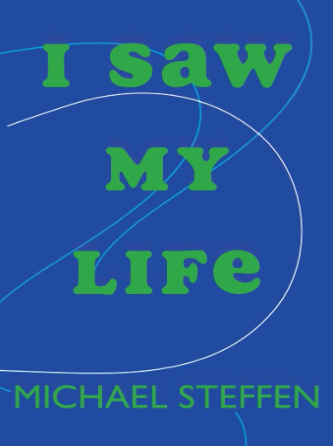
Michael Todd Steffen’s book I Saw My Life is available here from Lily Poetry Review.