
Lustus: The Janus-Faced Modern Epic and the Moral Architecture of Our Age
Dr. Bhagyashree Varma
[Dr. Bhagyashree Varma is Professor of English at University of Mumbai. Previously, she has edited ‘Philosophia de Anand’, a work of philosophy by Dr. Jernail Singh Anand, who has authored 210 books and 20 epic works. ‘Lustus: the Prince of Darkness’ is considered an immortal work after John Milton’s ‘Paradise Lost’.]
INTRODUCTION
While mapping the terrain of Dr. Jernail Singh Anand’s Lustus: The Prince of Darkness, eminent scholars Dr Maja Herman Sekulic, Mauro Montachhiesi, Dr. Basudeb Chakraborti, Dr. P.G. Rama Rao, Dr. Laksmisree Banerjee, Dr. Kulbushan Razdan, Dr. Lalit Mohan Sharma, Dr. Molly Joseph and Dr. Maqsood Jafri, establish the work’s epic ambition, its mock-heroic scaffolding, and its direct dialogue with Milton. With the critical interventions of Mauro Montacchiesi and Dr. Basudeb Chakraborti and Dr Maja Herman Sekulic, the portrait sharpens. Can we think of Lustus as a Janus-faced work, looking back to archetype and forward to civilizational crisis, whose aesthetic eminence equals Paradise Lost in modern times? The chorus of scholars says: yes, and for reasons that go deeper into ethics, aesthetics, prophecy, and the future of collective life itself.
1.The Janus Gaze, Expanded: Montacchiesi’s Allegorical World
Dr. Molly Joseph identifies Lustus as a “dexterous mix of yesterday’s memories, today’s apprehensions, tomorrow’s dreams.” Mauro Montacchiesi gives this Janus function its philosophical frame. For him, the “greatest merit of Anand’s work lies in the construction of a recognizable allegorical world.” This world is not medieval or Renaissance, but ours. It “embraces anxieties linked to contemporary social criticism and technology,” yet “incorporates literary memory and religious mythology.”
That is Janus in full operation. The past face looks to “literary memory and religious mythology” — the Ramayana, the Bible, Buddha, Christ, Mahavira, the Sikh Gurus that Dr. Lalit Mohan Sharma noted. The forward face stares into “progress devoid of compassion, freedom devoid of responsibility, and knowledge devoid of wisdom.” Montacchiesi’s formulation is the ethical core of your own reading: if Milton represented his age’s tiles — the cosmos of divine order and rebellion — Anand’s Lustus is a critique of modernity’s own tiles, where the gods have been replaced by systems.
This allegorical world is recognizable because it is ours. Lustus is not horned and cloven-hoofed. He is the “Corporate of Evil.” Montacchiesi sees the work as posing a single, terrifying question: “can progress devoid of compassion, freedom devoid of responsibility, and knowledge devoid of wisdom sustain a civilization?” Milton asked whether God could be justified to man. Anand asks whether man, having unmoored progress from compassion, can still be justified at all. That is the Janus threshold: we stand between a mythic past and a technological future, and Lustus forces us to look both ways.
2. The Book of the Millennium: Chakraborti’s Prophecy of Endurance
If Montacchiesi gives us the ethical question, Dr. Basudeb Chakraborti gives us the verdict on literary permanence. His claim is staggering in its scope. He calls Lustus “a landmark work, the greatest creation of Anand’s career.” More than praise, it is prophecy: “Dr Anand will not be around / But Lustus will be read after 150 years.” He writes in 2026; he is speaking of the year 2176, which makes Lustus the book of the Millennium. Dr. Basudeb Chakraborti’s claim that Lustus alone would render Dr. Anand immortal underscores the epic’s stature as a singular, epoch-defining work whose structural innovation and moral urgency transcend the author’s entire oeuvre. It frames Lustus not as one book among many, but as a literary monument whose reckoning with modernity’s “Corporate of Evil” is profound enough to secure Anand’s place in the canon for centuries.
This matters when we weigh Lustus against Paradise Lost. Eminence cannot be declared by contemporaries alone. It must be ratified by time. Milton’s epic was not universally loved in 1667. It became “Paradise Lost” through centuries of reading, arguing, imitating, and resisting. Chakraborti is positioning Lustus on that same long arc. He asserts it will be “whispered, debated, and devoured 150 years from now.” Why? Because of “great imaginative power, technical innovation, and neo-mythological power struggle between angels and demons.”
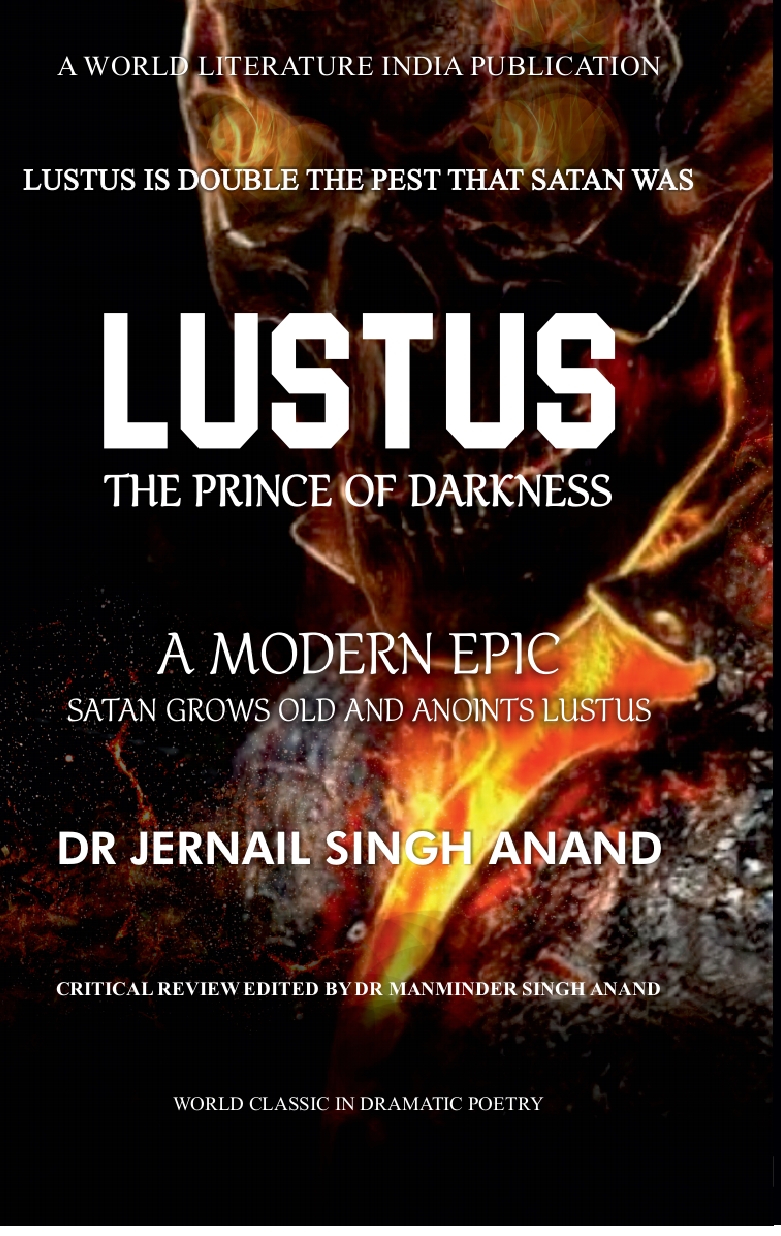
Chakraborti also reinforces that Lustus “situates Dr Anand in close affinity to great satirist Daniel Defoe, brutally critiques an entire civilization for its moral complacency.” The mock-heroic is not a lowering of the epic. It is the only mode left when the civilization itself has become mock-heroic — heroic in technology, mock in wisdom. Milton could still write a straight epic because his culture still believed in Heaven and Hell as vertical facts. We believe in metrics. Anand therefore must use satire as his epic weapon. “Satan is half the pest that Lustus is”, as the book cover states, because Satan wanted to rule but Lustus wants to monetize.
3. The Assertion of Godly Powers Against the Corporate of Evil
The scholars view Lustus is “an assertion of godly powers against stiff resistance by Lustus, the Corporate of Evil” —Dr. Maqsood Jafri already placed the work beside Paradise Regained, saying it “takes us out from the dark and dreary dungeons of evil and shows us the bright Ways of God to Man.” Chakraborti extends this when he says, the epic’s “seminal creation” launches a “neo-mythological power struggle between angels and demons.”
But what are “godly powers” in a post-religious, corporate age? Montacchiesi answers: they are compassion, responsibility, and wisdom. These are the ethical preconditions for “collective coexistence, human dignity, and ethics” — the very dialogue he says Lustus contributes to internationally. The resistance is “stiff” because Lustus does not appear as evil. He appears as efficiency, as growth, as desire fulfilled. Dr. Rama Rao noted that in Lustonia, humans are “motivated only by desire.” Montacchiesi’s triad — progress without compassion, freedom without responsibility, knowledge without wisdom — is the operating system of Lustonia. It is the Corporate of Evil as code.
The “godly” assertion, then, is humanistic and prophetic. Dr. Molly Joseph called the book a “counterblast” that seeks to “justify the ways of man to God.” That is, humanity must re-earn its place in a moral universe violated by automation. The epic form is necessary because only an epic can stage a battle this large: not man versus God, but man versus the system man built to replace God.
4. Aesthetic Value: Syncretism as the New Sublime
Can a work that critiques modernity through satire have aesthetic value equal to Paradise Lost? Montacchiesi and Chakraborti both say yes, and they locate that value in syncretism and structure.
Montacchiesi praises the “unique syncretism of European and Indian traditions” that makes Lustus a “significant contribution to the international dialogue.” This is what Dr. Lalit Mohan Sharma called the intersection of Judeo-Christian and Hindu mythologies. It is also what Dr. Laksmisree Banerjee termed the “meeting-point of the ethos and civilizational processes of the Orient and Occident.” The aesthetic achievement is architectural: Anand has built a cathedral where the Bible, the Ramayana, Milton, and the Upanishads have chapels under one dome, and the dome is wired with fiber-optic cable.
Chakraborti locates the value in craft: “from the point of view of structure, language and content.” He calls it a work of “technical innovation.” While some critics have noted fabulation, metafiction, syntagms, postmodern discursiveness, but not chaos. It is composition. The sublime in Milton was vertical — the vast spaces of Heaven, Hell, Chaos. The sublime in Anand is horizontal — the vast web of cultures, technologies, and desires that now defines the human. To render that web as allegory, to make it “recognizable” as Montacchiesi says, is an aesthetic act of the highest order.
5. Eminence: From “Modern Epic” to “An Immortal Work”
Paradise Lost is eminent because it became unavoidable. You could not write about evil, freedom, or poetry in English after 1667 without positioning yourself toward Milton. The claim now being made for Lustus is that it is becoming unavoidable for the 21st century.
Consider the escalation in language across these scholars: “modern epic,” “mega epic,” “masterpiece,” “landmark work,” “seminal creation,” “book of the millennium,” “the Prince who made his author immortal.” Chakraborti states: “Since Paradise Lost, only one Prince matters — Lustus.” That is not comparison. That is succession.
Montacchiesi does not use such heated language, but his judgment is colder and perhaps more damning: Lustus poses the question on which civilization depends. A work that formulates the defining question of an era has the eminence of Paradise Lost, which formulated the question of obedience, freedom, and suffering for the early modern world.
Conclusion: The Immortal Was Born, and We Are Its Witnesses
Read Lustus now, or let history record that you were alive when the immortal was born — and you looked away — is the final piece. Paradise Lost was born into a world of plague, fire, and political upheaval. It was not recognized at once. Lustus is born into a world of climate collapse, algorithmic governance, and spiritual anomie.
The scholars assembled here are telling us that this work looks back like Janus to every myth that ever tried to explain desire, and forward to the systems that now manufacture it. Its aesthetic value lies in making that double vision coherent, terrible, and beautiful. Its eminence will lie in whether it forces the next 150 years to answer its question: can a civilization survive progress without compassion?
If Milton gave us the epic of the Fall, Anand has given us the epic of the Corporation. If Satan was the first rebel, Lustus is the first CEO of Hell. And if “godly powers” are to assert themselves, it will be through the kind of self-scrutiny, interrogation, and remoulding that Lustus demands.
Based on these critical reviews, Lustus can be considered as a Janus-faced work of great aesthetic value, carrying an eminence that equals Paradise Lost in modern times — not as imitation, but as its necessary successor. The immortal, as Chakraborti says, has been born. The only question is whether we will read it.
Works Cited:
Anand, Jernail Singh, Lustus: The Prince of Darkness, The Poetry Society of India, Gurugram, 2022.
Social media: Critical Comments Dr. Basudeb Chakraborti, Mauro Montachhiesi, Dr. Maja Herman Sekulic, Dr. Lakshmisree Banerjee, Dr. Molly Joseph, Dr. Pedapudi Rama Rao, Dr. Lalit Mohan Sharma, Dr. Kulbushan Razdan, Dr. Maqsood Jafri, accessed from the facebook account of Dr. Anand. [https://www.facebook.com/share/19cp4Bn2kL/]
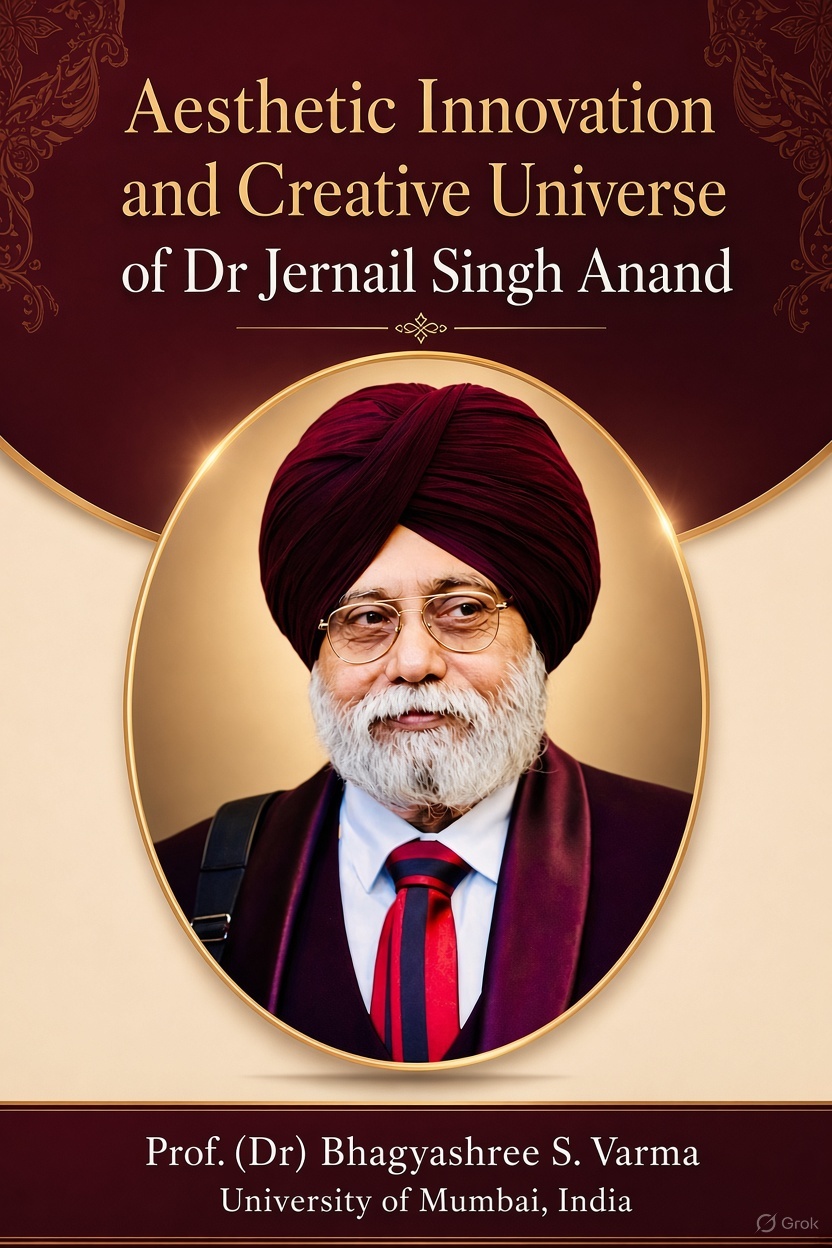
[Note: This article is a part of the upcoming critical work by Dr. Bhagyashree Varma entitled: Aesthetics of Innovation and Creative Universe of Dr. Jernail Singh Anand].
BIO OF DR BHAGYASHAREE S VARMA

Dr. Bhagyashree S. Varma, as a polyglot, writes, and translates in seven languages. As professor of English with prolific publications in literature, her research is published on Amrita Pritam, Kamala Das, Mahashweta Devi, Jean Rhys, Harivanshrai Bachchan, Emily Dickinson, Deepti Naval, and Jeff Goldberg. Dr. Varma is honored by International Academy of Ethics (2024) for Service to Literature. Siesta, Amrita Pritam Life as Literature, Woman and Self, Fragrance (Darwal) and Breaking Silences (Tutati Khamoshiya) are her publications. Siesta (2025), with Emily Dickinson Award is noted for depth and simplicity. Dr. Varma has supervised researchers for M.Phil. and Ph.D. on gender-dynamics, comparative theories and cultural studies.