
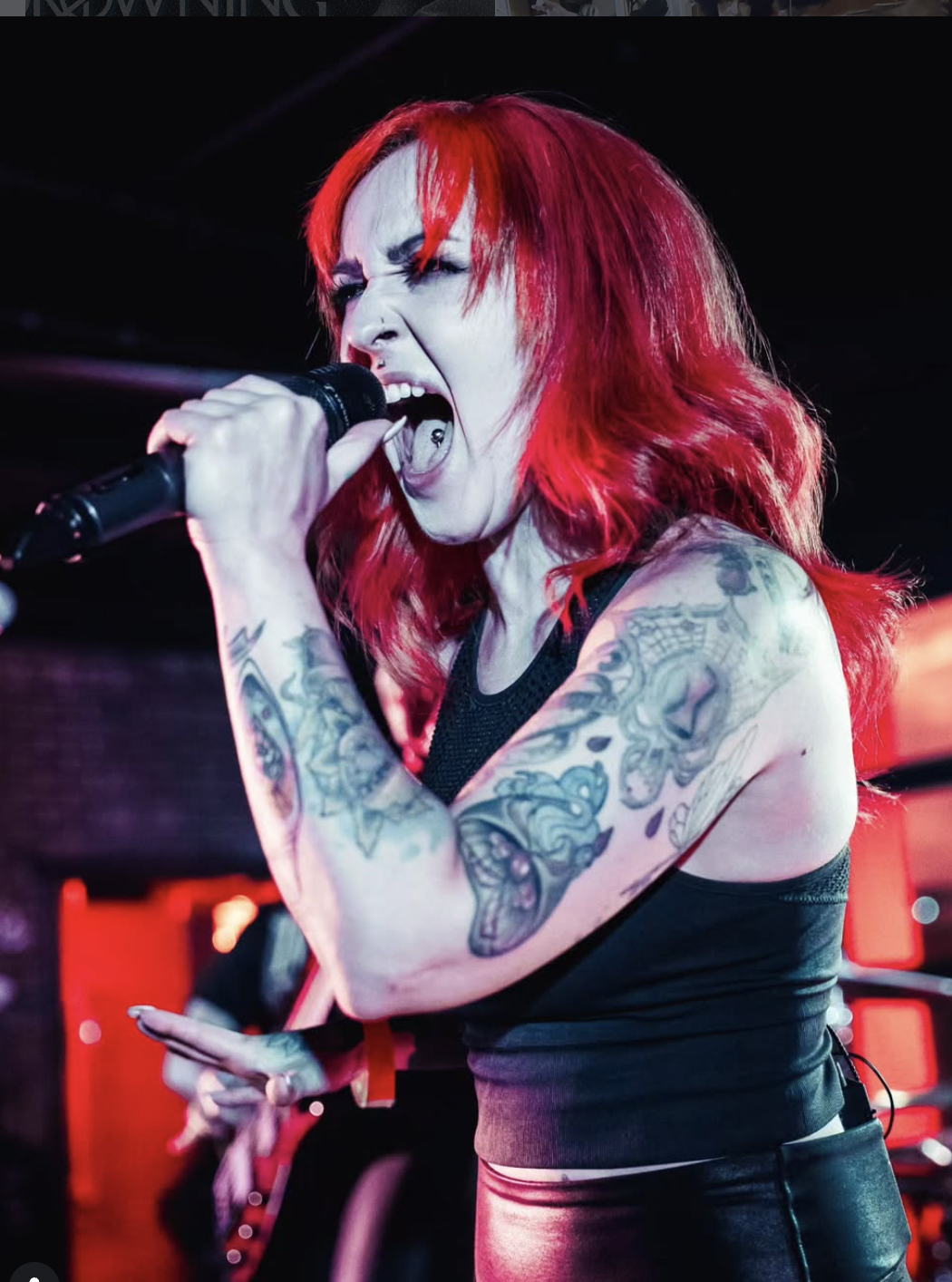
Blackwater Drowning’s frontwoman Morgan Riley carries herself with the kind of grounded ferocity that comes from years of carving out a place in a genre that demands both brutality and vulnerability. Her band, a five‑piece forged in North Carolina’s metal crucible, has become one of the most distinctive voices in modern melodic death metal by refusing to obey the stylistic borders that define so many of their peers.
As Riley puts it, “We’re not trying to fit into one specific little category. We want to just kind of take all of our bits of inspiration and make it into something kind of unique. And we’re not trying to fit some mold of, ‘we got to sound like this’. We just write what we feel. And I feel really passionate about that.”
Her origin story with guitarist Jeremy Bennett is one of parallel trajectories finally converging. “Jeremy and I had been in separate bands, and we played several shows together over the years,” she recalls. “Those bands ended up breaking up. I was in more of a hard rock band, but I always wanted to be more metal, and he was in a really good death metal band, and he wanted to do some more melodic stuff—because we’re both really big fans of Swedish melodic death metal.”
Their chemistry was immediate. “He started sending me stuff, and I started writing over it, and then Aria came into the picture. And several years later, Ron came in… and then Eamon joined, and he’s Ron’s little brother, so it just made sense.”
Looking back at the early EPs, Riley hears the band becoming itself. “When you first start a band, you are trying to figure out what your identity is,” she says. “We started out, I think, with a pretty strong identity, and I still really like a lot of those old songs, but now I feel we’re just more in focus to kind of the concept that we want to be. And I feel we don’t really sound a whole lot like anybody else… I don’t really hear anything that sounds exactly like what we’re doing. So, I love that. I love being a little bit unique.”
Her vocal journey mirrors the band’s evolution. Riley didn’t come up through metal; she came up through musical theater. “I actually came up in more of a musical theater household,” she says. “And I still love musical theater and singing big notes and all that stuff. So, I came upon a lot of that. And it definitely influenced the power.” Her first encounter with heavy women’s voices was transformative. “I think the first metal or hard rock woman that I heard was probably Amy Lee, as a lot of women in my generation did,” she explains. “And that was really big for me. She can sing beautifully, and then there’s this heavy music behind her, right? And then I discovered Flyleaf. And that first song ‘I’m So Sick’, where Lacey does that little scream—‘Oh my God, a girl does that! I want to figure out how to do that.’”
From there, she plunged deeper. “I went down a rabbit hole and found Arch Enemy, and became a big fan of that, just because it’s very brutal,” she says. “And Otep was a big one for me as well, because she does a lot of different things vocally. And I love the emotion that she puts into her voice. I draw inspiration from a whole lot of places. Lamb of God is a big one too. A lot of nu metal stuff.”
Her technique came the hard way. “When I first started, I literally just screamed along to Arch Enemy records,” she admits. “Messed up my voice for a few days trying to figure out how to do it, and I did it until I figured out how to not hurt myself with it.”
That duality—brutal and beautiful—is the core of Blackwater Drowning’s sound. Riley describes their motif with clarity: “If I had to describe us or kind of summarize, I always want to keep the heavy and some breakdowns. We don’t have to have breakdowns in every song—to show off our technical chops, because that’s fun—but never lose the groove of the music, and then keep the dichotomy of having the heavy, brutal stuff along with the beautiful melody.”
Their new album Obscure Sorrows—out now—is the band’s most collaborative work to date. Earlier releases were largely steered by Bennett, but this record opened the creative doors to everyone.
“We had the precedent that Jeremy was our main writer for those first two EPs and half of Sonder Satori,” Riley explains. “This is before Ron had joined the band. He joined at the very tail end of us recording our second EP. We had already had a whole bunch of stuff already written for the next one, and he contributed to that a lot, don’t get me wrong. But this time, we all kind of wrote together.”
The shift happened because the environment changed: they recorded the album themselves, with Bennett engineering. “We recorded this album actually ourselves,” Riley says. “Jeremy was the main engineer for all of that—well, the only engineer for all that. So, it was a little bit more relaxed than when you’re in the studio, because obviously when you’re in the studio, you are on the clock, and we don’t have a lot of money, so we’re not trying to waste our time, or their time, noodling around and figuring stuff out. You want to have everything ready to go, for our budgets. So, it gave us more space—I feel—to be spontaneous and creative, and with less pressure behind it.”
The orchestral elements that thread through Obscure Sorrows came from a trusted ally. “It’s actually our really good friend David,” Riley says. “He had been working on doing orchestration stuff for fun, and then also to put on albums. And Ron and him have been friends for a long time, and we’ve all played shows together. He’s a fantastic drummer, and we contracted him to write the orchestra parts. We’d send him the half‑completed song and be like, ‘Here, do your thing’, and we gave him some notes. And I think I’m really proud of the final product. I think it sounds really cool, and it’s something that we hadn’t really done before.”
Conceptually, the album began as a folklore‑driven project. “Originally, for the album, we had the idea that it was going to be a concept album where every song was going to be about a piece of folklore,” Riley explains. “And as we went along, there were some songs that I didn’t relate to any piece of folklore. I didn’t want to just write something and force it out, because that’s against my entire ethos. It’s got a… a song has to call for it.”
Still, folklore remains a strong thread. “The Sixth Omen was based around the legend of La Llorona,” she says. “And we did another song that was about a giantess—maybe her husband got killed, and no one has any sympathy for her, and she’s just a monster to them. And then ‘Incubus’ is… I mean, we knew what an incubus is, and it’s really just about that subject of, you know, you run into these people who are just an energy suck, you know? Drain you of everything.”
The album also reaches into depression, betrayal, generational curses, demons, and the afterlife. “I think obviously depression and stuff—that is always a strong theme in a lot of heavy music, and just music in general,” Riley says. “I think we all experience it to some degree in our lives. And then the afterlife—I think we all are really curious about what happens after, because nobody really knows.”
One of the album’s key tracks, “Storm,” is rooted in feminism—though Riley refuses to be heavy‑handed. “I have another song that’s more about feminism, which is ‘Storm’,” she says. “Because that’s a subject near and dear to my heart. But I didn’t want to be too on the nose with it, because that’s not really our thing, but I still want to say what I feel.”
Her feminism is grounded in history, not celebrity. “I feel I’m inspired by not necessarily any one person in particular, but just the body of work that feminism has done,” she explains. “And just when you look at history and how new some of these rights are to us—even in my grandmother’s day, we didn’t have some of these rights—and that’s wild to me. Just all the women who have come before me who have paved the way for the things that I have now… there’s so many of them, I don’t know if I could really choose just one or even a couple.”
For Riley, the most powerful part of being in a band isn’t the technical achievement—it’s the human connection.
“We did a tour, and we’re going up north, and a guy drove three hours to see us at this… we’re playing at this sushi bar,” she remembers. “And he has continued to follow us. He’s been following us since our first EP, and the fact that someone cares enough about what we’re doing to keep up with us… he actually got his very first tattoo was our band logo. That’s so cool.”
Then there are the quieter testimonies. “People tell me sometimes how a song helped them through a hard time,” Riley says. “And that always really touches me. I just love the human element of being in a band and affecting people’s lives in ways that you don’t even expect that you’re going to.”
She writes with that in mind. “When I write this music, when I write my words, I am talking about things that I’m going through, and maybe something a little bit more esoteric sometimes,” she explains. “But I always try to keep some element of relatability in there, so that despite the brutal setting, you can still empathize with what’s going on, and maybe it speaks to you. And if it helps you through whatever bad time you’re having—that’s really awesome to me, and that means a lot. Because as a metal band, you don’t expect someone’s going to be, ‘This helped me through my depression. You’re screaming.’ Well, it was really cool when that happened.”
Her conclusion is simple and devastatingly true: “It’s so rewarding as an artist to know that something that you created out of your heart and mind touched someone else’s heart. You connect with people on a deeper level that you’ve never even met. And that’s such a cool part about any kind of art. And that legacy carrying on is what makes artists immortal.”
Blackwater Drowning’s music carries that immortality: a fusion of personal history, theatrical instinct, metal lineage, and emotional honesty. Riley stands at the center of it—calm, powerful, grounded, evolving. She is part of a new generation of metal vocalists who understand that heaviness is not just sonic; it is emotional, intellectual, and spiritual. And with Obscure Sorrows out now, she and her bandmates have crafted a work that feels poised to carry them far beyond the borders of North Carolina’s metal scene, into a space where folklore, feminism, horror, groove, and brutality coexist in a single, unmistakable signature.
About the Author: Alex S. Johnson
Alex S. Johnson is a novelist, poet, editor, journalist, and cultural historian whose work threads the dark fantastique, bizarro surrealism, punk lineage, and countercultural satire into a singular voice. His fiction and poetry has appeared alongside Allen Ginsberg, Charles Bukowski, Edward Lee, Joe Hill, Caitlín R. Kiernan, and Poppy Z. Brite, and he has been hailed by John Shirley as “the Baudelaire of our time.” He has performed with such legends as Punk Rock Royalty Iris Berry from Lame Flames and Ringling Sisters, 2.13.61 (Henry Rollins) authors Tricia Warden and Ellyn Maybe, and SPIN magazine featured poet and cult author Danielle Willis (Dogs in Lingerie).
A veteran of the underground press, Johnson has written for Metal Maniacs, Zero Tolerance, Brave Words & Bloody Knuckles, and Metal Hammer. He is the founder of Nocturnicorn Books / A Collective Paw and curator of the Pawsie Awards. He is co‑writer (with Nicole H. Sixx) of the dark‑comedy slasher screenplay Serial Date.