
Artificial Intelligence: The Creator’s Ally or Assassin?
I recently found myself in a heated debate with an acquaintance who made a rather chilling claim: “Soon, your writing won’t be worth a dime. AI will do it in seconds, for free, and most importantly, without a single mistake.” I fell silent for a moment. It’s a brutal, yet logically haunting thought, isn’t it? Are we—the creators, writers, artists, and architects of ideas—being stripped of our ancestral throne of “creativity”? Or is this just another wave of panic in the face of a technological revolution?
In reality, modern neural networks are essentially massive statistical vaults, a sophisticated dance of mathematical probabilities. They’ve devoured millions of texts and “digested” thousands of paintings. They can mimic Shakespeare’s prose, Van Gogh’s strokes, or Beethoven’s melodies. But one fundamental question remains unanswered: Why are they doing it? For an AI, creation is simply calculating the probability of where the next word or color should land. To a machine, the word “love” differs from “hate” only by its digital code. For a human, however, creation is pain, lived experience, and the sleepless nights hidden behind every period placed on a page. A machine can render a beautiful image, but its hands don’t tremble while drawing, and its heart doesn’t skip a beat with excitement.
In my view, artificial intelligence is not the assassin of the creator, but rather the arch-enemy of “mediocrity.” If your work consists merely of ready-made templates, repetitive thoughts, and soulless data, then yes—admittedly—AI will replace you easily and mercilessly. Machines understand patterns better than humans ever will. But your personal character, your past traumas, and those peculiar, sometimes irrational, yet deeply sincere perspectives—no algorithm can replicate that.
History shows us that when the camera was first invented, painters spiraled into a similar panic: “Art is dead! Everything looks real now; we are obsolete!” But what actually happened? Painting didn’t vanish; instead, it evolved. Artists moved away from simply copying the external world and began to capture its inner essence and emotion—giving birth to Impressionism, Cubism, and Abstraction. The camera wasn’t a rival; it became a powerful new tool. Today, AI is our modern “brush” or “pen.” It assists us with the mundane and the tedious: fixing grammar, brainstorming ideas, or structuring drafts. But the final spark that breathes “life” into a piece of work still comes from the human soul.
I envision the future as a bipolar landscape. On one side, there will be an endless flood of AI-generated content—cheap, fast, and superficial. You could compare it to “fast-food creativity”: it fills the stomach but leaves the spirit starving. On the other side, work crafted by human hands, beautiful in its imperfections and smelling of personality, will become a true luxury. People will grow weary of the machine-generated perfection and begin to crave human sincerity—that unique, slightly “chaotic” touch of a real person.
Ultimately, artificial intelligence is a vast mirror. It reflects the world we know, the texts we’ve written, and the images we’ve dreamt up. It is neither my friend nor my assassin. It is my echo. As long as I have my own thoughts, my own voice, and a unique word to say to the world, no line of code can ever take my place. Therefore, it’s time to stop the fruitless struggle against technology and start learning how to wield it. In this new era where “Chaos” reigns, only those creators who refuse to lose themselves will survive.
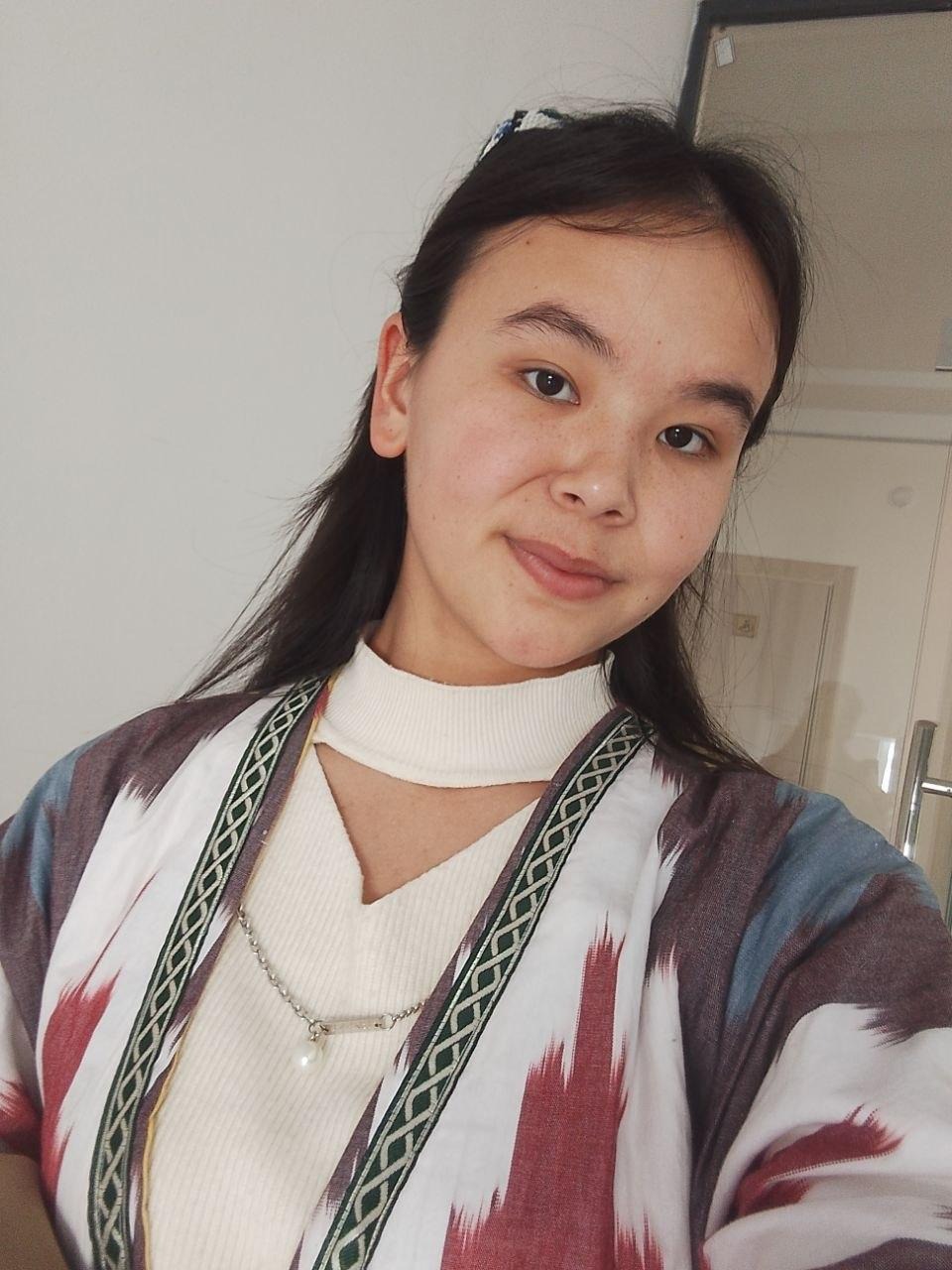
Shahnoza Amonboyeva— A student of the Faculty of Computer Engineering at Urgench State University, an explorer carving her path at the intersection of technology and creativity. She is the author of several analytical articles, with her work featured in prestigious anthologies. An active participant in international quiz competitions, she holds numerous certificates and official membership in an international association. Her current academic goals include winning the University Rector’s Scholarship and prestigious national named scholarships. Looking ahead, she aims to become a leading expert in her field by enhancing her professional qualifications in various countries worldwide.