
MY QASRIM: A WORLD WHERE HISTORY BECOMES AN EXPERIENCE
Exploring the Future of Historical Simulation Through Unreal Engine, Artificial Intelligence, Economics, and Human Creativity
By Sherzod Suvonov
What if history were not only something we read in books, but a world we could enter, explore, and learn from through our own decisions?
This question lies at the heart of My Qasrim, an early-stage 3D game project that I hope to develop into an interactive historical world. Built around an initial environment created in Unreal Engine, the project began with an interest in virtual architecture and has gradually grown into a broader vision connecting history, technology, economics, and education.
My Qasrim is not yet a completed game, and many of its most ambitious ideas remain plans for the future. However, the purpose behind it is already clear: I want to explore how an interactive world might help people understand not only what happened throughout history, but also why societies developed as they did, how people made decisions, and how those decisions shaped the world we live in today.
For me, this is more than an attempt to create a virtual environment. It is an opportunity to bring different areas of knowledge together in one creative project.
1. The Beginning: Building More Than a Virtual Castle
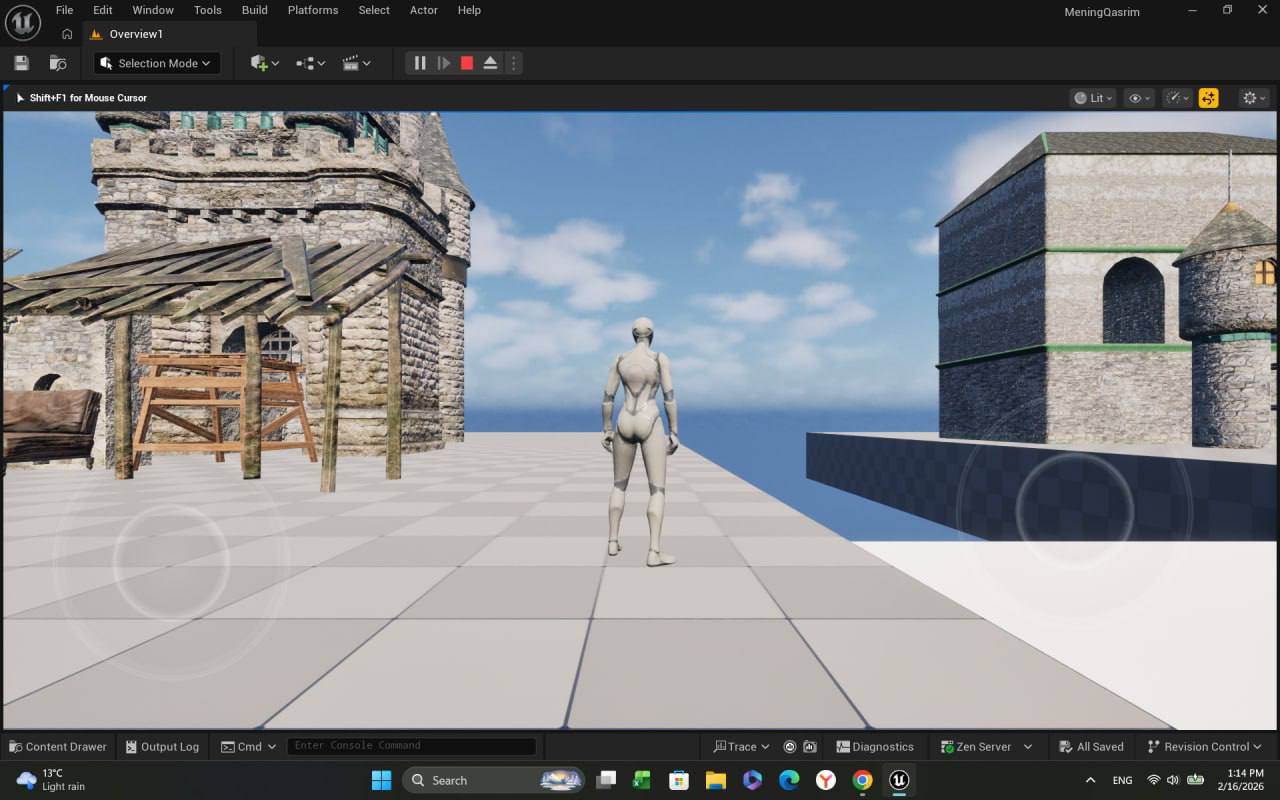
My work on My Qasrim began in Unreal Engine, where I started creating a three-dimensional environment featuring castle-inspired architecture, stone buildings, and historical-style spaces.
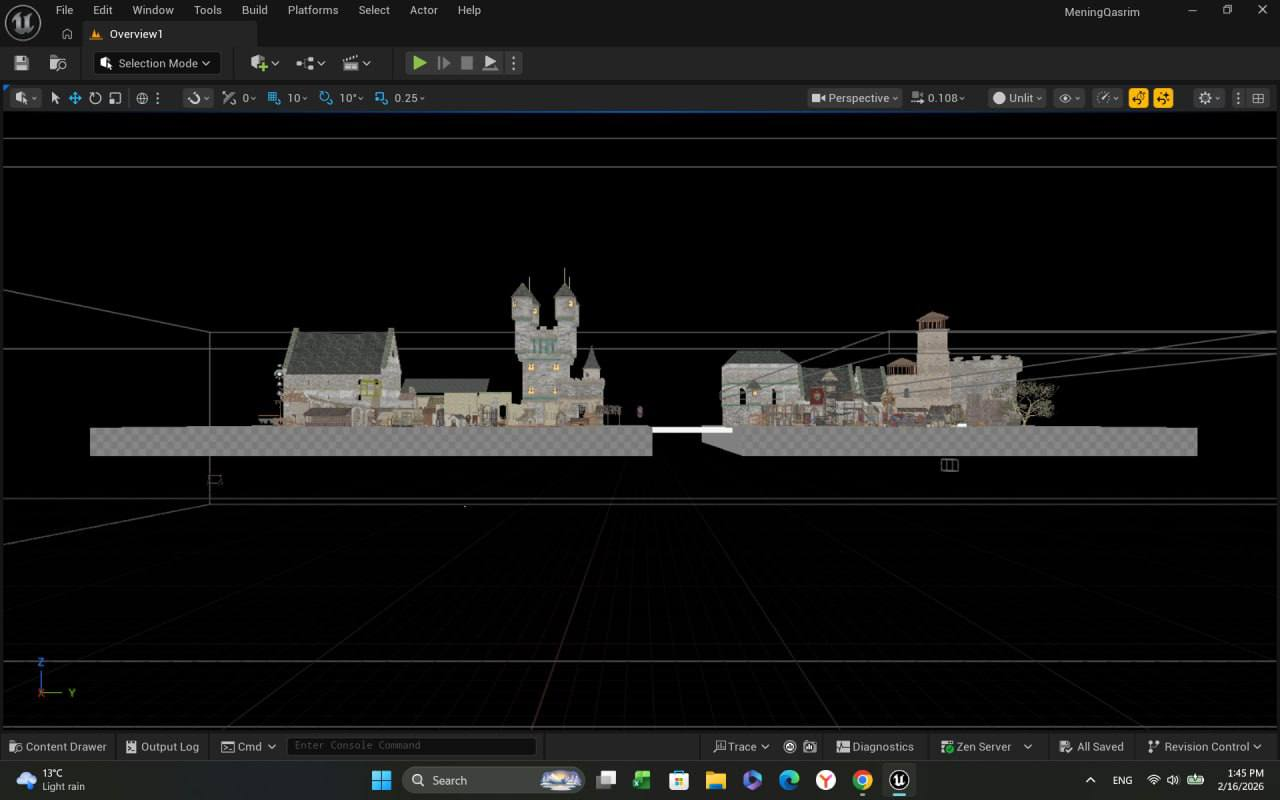
At first glance, a castle may appear to be simply an architectural structure. Yet a historical settlement can represent much more: the organization of a society, the concentration of political power, the protection of resources, the development of trade, and the everyday lives of the people who lived within and around its walls.
This is the kind of thinking I want to bring into My Qasrim. Rather than treating historical architecture as decoration, I want to use the virtual environment as the foundation for a world that has meaning, context, and opportunities for discovery.
The current environment represents an initial step, not the finished experience. The larger challenge is to develop the world around it: its historical context, activities, characters, systems, and the choices that players might eventually be able to make.
I see this early stage as valuable because every larger world must begin somewhere. Before a virtual civilization can become interactive, someone has to imagine its spaces, understand its context, and decide what kind of experience it should offer.
2. History as a World to Explore
History is often taught through books, documents, dates, maps, and classroom explanations. These methods are essential, but I believe interactive environments may offer another way to engage with the past.
Imagine entering a historical settlement, walking through its streets, examining its buildings, and learning about the people who lived there. Instead of encountering historical information only as a description, players could gradually discover how different parts of a society fit together.
This is one of the central possibilities I want to explore through My Qasrim.
The project’s long-term vision includes environments inspired by different historical periods and civilizations. These could include the Timurid era, the Ottoman Empire, and important turning points in modern history, including the First and Second World Wars. Other periods could be considered as the project develops.
Each historical setting would present its own challenges for research and design. Architecture, customs, technology, political structures, trade, and everyday life differed considerably across periods. Representing those differences responsibly would require careful study rather than simply placing historical names onto a virtual map.
My aim is to create a world that encourages curiosity. A player might enter with an interest in exploration or adventure and leave wanting to understand more about the civilization, event, or social system that inspired the experience.
The historical elements would need to be researched carefully, and the game would not replace academic study. Instead, I hope it could become a starting point for questions, further reading, and a deeper interest in history.
3. From Passive Observation to Active Participation
One possibility I find particularly interesting is allowing players to experience a historical world from different perspectives.
In many games, players follow a fixed sequence of missions. My long-term vision for My Qasrim is to investigate a more open-ended approach in which exploration and player choices could play an important role.
Depending on what can realistically be developed, players might eventually take on different roles, participate in activities, interact with communities, or contribute to the development of a settlement. Rather than experiencing every historical setting in exactly the same way, they could approach it from different perspectives.
For example, one player might be interested in architecture and settlement development, while another might prefer trade, resource management, exploration, or understanding the political and social context of a period.
These are proposed directions, not existing gameplay features. Turning them into a coherent game would require extensive design, programming, testing, and historical research.
Nevertheless, the underlying principle is important to me: people often become more interested in a subject when they have an opportunity to participate in it.
If a player must think about how a settlement obtains resources, how people exchange goods, or how a community responds to a difficult situation, the experience could encourage questions that go beyond the immediate objective of the game.
Could this kind of participation help people connect historical knowledge with practical thinking? That is one of the questions I hope to explore as My Qasrim develops.
4. The Missing Connection: History and Economics
Another major direction of My Qasrim comes from my interest in accounting, taxation, and finance.
These subjects might initially seem separate from historical game design. However, when we examine the development of civilizations, the connection becomes clear.
Societies have always needed ways to obtain resources, organize production, exchange goods, maintain infrastructure, and make decisions about shared wealth. Trade routes connected distant communities. Taxation supported states and public responsibilities. Agricultural production influenced settlement patterns. Access to resources affected political relationships and, in many cases, conflict.
Economic systems are not merely abstract numbers. They influence how people live and how societies change.
I would like to investigate how these ideas might eventually become part of My Qasrim’s gameplay.
For example, future versions of the game might include systems for managing resources, exchanging goods, developing settlements, or making decisions about the needs of a virtual community. Players might have to consider how limited resources should be used, what happens when trade is disrupted, or how different decisions affect a settlement over time.
These possibilities could create opportunities to introduce economic concepts through situations that players can understand and interact with.
A player managing a settlement might begin to recognize that resources are limited and that decisions involve trade-offs. A player participating in trade might encounter ideas related to supply, demand, risk, and exchange. A player exploring the development of a historical state might become curious about taxation, infrastructure, and the relationship between public resources and social stability.
Such experiences would need to be designed carefully. Real economies and historical societies are far more complex than simplified game systems. My intention would not be to suggest that a game can explain every economic reality, but to explore whether interactive examples can make some of these ideas easier to approach.
This is where My Qasrim could connect entertainment with financial and economic literacy.
5. Why My Own Learning Journey Is Part of the Project
My Qasrim has also changed the way I think about learning.
My educational background includes accounting, and I received a diploma from Shahriston Learning Center. I am now continuing to deepen my understanding of taxation and finance. At the same time, I have become increasingly interested in history because I realized that creating a convincing historical world requires more than technical knowledge.
A castle can be modelled in three dimensions, but understanding the society around it requires different questions. Who built it? What resources were needed? How did the surrounding community function? What role did the structure play in the political, economic, and cultural life of its time?
Questions like these encouraged me to study beyond the immediate technical requirements of the project.
I am also working on my English so that I can communicate more effectively with people internationally, access more learning resources, and eventually collaborate with others who share similar interests.
My longer-term educational goals include continuing my studies in finance and pursuing professional qualifications such as ACCA. I see this learning as part of my personal development, while My Qasrim remains a creative project that I hope to return to and expand over time.
I do not believe that one person needs to know everything before beginning a project. However, I do believe that a serious project requires the willingness to recognize what one does not yet know and to keep learning.
For me, this is one of the most valuable things about My Qasrim: the project gives me a reason to connect knowledge from different fields and understand how those fields influence one another.
6. Artificial Intelligence: A Tool for Deeper Interaction
Artificial intelligence offers another possible direction for the project.
AI is changing how people interact with information, software, and digital environments. In game development, it may provide opportunities to create characters that respond more naturally, support adaptive interactions, or help players explore questions within a virtual setting.
In a future version of My Qasrim, I would like to investigate whether AI could support historically informed conversations, help make certain interactions more responsive, or offer players different ways to learn about the world they are exploring.
For instance, a player might want to understand the role of a particular building, the importance of a trade route, or the background of an event represented in the game. An appropriately designed interactive guide could potentially help the player investigate those questions.
However, using AI in a historical environment would introduce important responsibilities. AI-generated information can be inaccurate, and historical subjects can be complex or disputed. Any educational use would need careful research, appropriate limitations, and ways to distinguish established information from uncertainty or interpretation.
AI would therefore be a tool to investigate, not a substitute for historical research or thoughtful design.
I am interested in how technology can make a world more responsive without losing sight of the human knowledge that gives it meaning. My Qasrim could eventually provide a space in which history, interactive storytelling, and emerging technologies support one another.
These possibilities remain part of the project’s long-term vision. They have not yet been implemented, but they help define the questions I want to explore.
7. A Meeting Point Between Technology and the Humanities
One reason I am excited about My Qasrim is that it does not fit neatly into a single category.
It begins with game development, but its potential reaches into history, education, economics, architecture, literature, and artificial intelligence.
A historical world needs more than buildings. It needs stories, cultural context, human motivations, and a sense of why places matter. An economic system needs more than numerical calculations. It needs people, resources, choices, and consequences. An educational experience needs more than information. It needs a reason for the learner to care.
Bringing these elements together is difficult, but it is also what makes the project interesting to me.
I see technology not only as a way to create visual experiences, but also as a medium through which ideas can be explored. A virtual environment can become a place to investigate questions about society, while interactive systems can give players opportunities to consider the consequences of their decisions.
This does not mean every player must approach the game as a lesson. Entertainment and discovery can exist together. Some players may simply enjoy exploring a detailed environment, while others may become interested in the history or economic ideas behind it.
My hope is that the project could eventually make room for both experiences.
8. Building the Project Will Require Collaboration
Although My Qasrim began with my own ideas and early work in Unreal Engine, I recognize that developing the larger vision would require many different skills.
Programmers would help implement the systems that make the world interactive. 3D artists and environment designers could contribute to its visual identity. Historians and researchers could help assess the historical context. Game designers could help turn broad ideas into engaging mechanics. People with knowledge of economics and education could contribute to the design of systems intended to communicate complex concepts clearly.
Collaboration would also be important for determining what should be built first. A project with a broad vision can become unmanageable if it attempts to develop every feature at once. The practical challenge is to identify a focused, achievable starting point and expand only when the foundations are strong enough.
I would like to continue developing my own skills while learning from people who have experience in these areas. Sharing the project at an early stage is one way to begin that process.
I understand that sharing a concept does not automatically lead to finding collaborators or building a team. However, constructive feedback can help reveal which parts of the idea are clear, which need more work, and which are realistically achievable.
That is one reason I value the opportunity to introduce My Qasrim to a wider audience.
9. What Success Would Mean for My Qasrim
For a project at this stage, success is not simply a matter of building the largest possible world or including the greatest number of features.
A more meaningful goal would be to create an experience with a clear identity: a world that rewards exploration, respects its historical inspirations, and gives players interesting reasons to think about how people and societies function.
In practical terms, that would mean developing the project step by step. The initial environment would need to grow into a coherent playable space. The historical settings would need research and a clear design purpose. Any economic systems would need to be understandable and enjoyable rather than complicated for their own sake. AI, if introduced, would need to serve the experience rather than distract from it.
It would also be important to recognize the limits of what a game can achieve. Historical simulation necessarily involves choices about what to represent and what to simplify. Economic models cannot capture every feature of real societies. Educational value depends on how content is designed and experienced, not merely on the presence of historical names or realistic buildings.
These challenges do not diminish the idea. They make careful development more important.
I want My Qasrim to grow through research, experimentation, feedback, and collaboration rather than through promises that cannot yet be supported by the work completed.
10. Looking Toward the Future
My Qasrim remains an early-stage project, but it represents a direction I want to pursue: bringing historical exploration into conversation with technology, economics, and interactive learning.
The idea began with the creation of a three-dimensional environment. It has since encouraged me to ask broader questions about the relationship between the past and the present, the role of economic systems in shaping societies, and the possibilities offered by new technologies.
I do not yet know exactly what the final project will become. Its future will depend on what can be built, what I learn along the way, and the feedback and collaboration that may emerge as the work develops.
But I believe there is value in beginning with a question and taking practical steps toward exploring it.
Can an interactive historical world help people become curious about the forces that shaped civilizations? Could it provide an engaging way to encounter ideas about resources, trade, and collective decisions? Could modern game technology help connect subjects that are often studied separately?
These are the questions behind My Qasrim.
I hope that, over time, the project can become more than a collection of virtual buildings. I hope it can develop into a world where exploration encourages questions, where historical context gives places meaning, and where interactive systems help players think about the choices that shape communities.
For now, the work continues one step at a time: learning, building, researching, and refining the vision.
My Qasrim is not a finished answer to these questions. It is my attempt to explore them.
About the Author
Sherzod Suvonov Alijonovich is an aspiring creator developing My Qasrim, an early-stage 3D historical-world project in Unreal Engine. With a background in accounting and an ongoing interest in taxation, finance, history, and artificial intelligence, he hopes to explore how interactive environments can connect technology with cultural and economic learning.
Project Status
My Qasrim is currently in an early stage of development. The project began taking shape between January and April 2026, with initial work focused on creating a 3D environment in Unreal Engine. Although active development is temporarily on hold, the project’s long-term vision remains to develop a fully realized, interactive 3D world where history, exploration, and economic systems can come together in a meaningful way.
This period is being used to strengthen the project’s foundations through further historical research and a deeper understanding of economics, accounting, and financial systems that could eventually inform its gameplay.
The existing Unreal Engine environment represents the project’s initial development work. The historical settings, open-ended gameplay, economic systems, and AI-supported interactions described in this article represent the broader vision for My Qasrim. These elements are planned future milestones rather than completed features, and their implementation will depend on further research, development, and, potentially, collaboration with others.