Over
the years, divorce rates have been on the increase and questioned the potency
of marital longevity. Unequivocally,
there has been a normalcy in noticing this uses as most homes and families have
embraced this phenomenon as a way out of apparently insurmountable marital
challenges. Hence, the reason ‘divorce is normal” is appreciated by most people
of the world.
However it is observed that some people
marry for trivial reason and as a result of divorce for trivial reasons. What they fail to realize is that it is one
thing to get married. It is a different
ball game to stay married . It is
loosely akin to when an individual purchase a car.
The paramount concern is not
necessarily the cars purchase but the maintenance to ensuring its fitness and value for –money recognition. Divorce become a way out of challenges
associated with staying married.
As stated, some people get married for
trivial reasons and as a result, divorce for trivial reasons.
Therefore,
we will consider the (likely) rampant reason people marry which subsequently
engender divorce; an approach to tackle the challenge of staying married. The following give the trivial reasons people
marry and hence divorce
Physical
appearance/looks
Sex /
Sexuality
Money/Material
needs
Sympathy/Generous
disposition
(1)
Physical appearance/looks:- Is the expression “your dressing
determines how would be addressed” true? You
would be astonished that one of the real reasons people get married is simply
because of “good looks” or an appealing physical appearance of their spouse,
under the guise of first-thing-that-attracted-me expression. On the contrary, it is factual that looks
are deceiving.
The quality of character is more
important than paying strict to physical appearance.
This
does not mean that physical appearance or look is not necessary but must not be
used as criterion or foundational recognition of marriage. If you discover that
the then good looking boyfriend of yours is really a morally or sensually dirty
type and the foundation of your marriage to your husband (your then boy friend)
was laid as physical what would do if you cannot “stomach” his really dirty or
unpreventable persona ? A divorce suit will likely be contemplated.
Sex /sexually:
Some people marry due to sexual competence of their spouses. As a matter of
fact ,people hose foundation of or reason for marrying is based on sexuality
are arguably not sexually faithful. Consequently, based on a not – concrete
marital foundation, such marring suffers set-backs. For instance, a man whose
sexual Prowess was well exerted on his wife (who married him primarily because of his sexuality: sexual power) declines will undoubtedly be
perturbed ; the suspicion that his wife long for sexual gratification from
competent individuals is crystal clear .
There is a case of divorce suit fired
by a comer on the grounds of the size of her husband’s manhood she complained
bitterly that his cannot be satisfied action.
(2) Money/material
needs: Deception 5 explains the fact that money and other material needs are
man-made invention which are subject to transient conditions. Arguably, most
ladies base their marital limelight on the recognition of money. Material needs
and money has become rampant in the notion of young men and women in their
vices on a successful marriage. In other words, people hare used the yardstick,
money to as certain the longevity and success of marriage. Unfortunately, the
is a marriage as unforeseen setbacks have unarguably eaten deep into the
tenets of many marriage ,despite immense
financial and material availability .If you lay the foundation of marriage on
money, how would you cope with your marriage if there is as alarming financial
downturn that will eventually affect your husband’s financial position ? would
you not ponder as alternative divorce ? Only time will tell!
Sympathy
-: the most concrete foundation of any successful marriage is true lover.
However, people marry on sympathetic grounds —- based on socio –cultural
conditions.
There was a particular case of a lady
raised in a family subjugated by abject poverty, who went through the thick and
thin to secure her way in the university. Luckily for her, she fell in love
with a dashing young man from a well –to- do family. They got to know each
other better and subsequently decided to be intimate a relationship was set up.
Knowing her background, he felt compassion for her and vowed to marry her after their academic years as
the university ,since they were level mates. Unknown to him, she portrayed a
camouflage behaviors to realize her long – awaited dream — parting away with
his opulence at the long run. Really, their relationship thrived from the hard
nut to the lengthy years of follow-ups; commitment and sacrifices, despite
strong opposition to the fruiting period of marital bliss. Without a doubt ,it
was a red letter day to both parties as they were in a state of euphoria.
Celebrated by every Tom, Dick and
Harry that attended the talk
–of-the-town occasion, the couple was decorated with different gifts, words of
exhortation and congratulatory remarks . For the next five years, the couple
was living a happy life of marriage as both parties gave in their “all” and
help each other in every aspect they recognized .The ugly truth which he never
anticipated was that she had been strategizing a not- easy-to –suspect strategy
to abscond with his opulence, no thanks to her “chameleonized” good behaviour.
Finally the deed was done but did not succeed absconding, though she had en massed
his wealth to her private account (an account he never knew until he was
told).To save herself from further embarrassment, she sued him for a divorce.
Though she did not get to have a share in her husband’s assets. She eventually
got what she wanted-a divorce and the transferred money
Similarly,
most people who marry in the recognition of generous disposition end up
abruptly settling for divorce, since they realize the difficulties in put up
with their excesses in the pursuit of staying married. Celebrities,
politicians, captains of industry, acclaimed religious scholars and leaders and
even the common people are seldom victims of the consequence faced generous
disposition. Because she selflessly showered her generosity towards you,
should this be reason for your
marrying her? Unfortunately, people do
marry for this reason.
Divorcees
claim the reason they divorce is because they married wrong partner. Why
the “wrong” partner? Someone with his
right senses when sieving (separating the grains from the chaffs) must be
sagacious and patient to get the anticipated. Else, the result will obviously
be unpleasant. In the same vein, this is the case of divorces who claim to have
been married to wrong partners. To such people, this is an advice: Find your
wife or husband in a number of women or men.
Consequently, divorce has crippled the
efficacy and importance of a family as the nation’s building block, truncated parent-children
relationship, encouraged juvenile delinquencies, promiscuity and other forms of
moral decadence. “Sufferers” of divorce situations especially children are said
to be on the loosing side of parental affection and grow up as adults with dysfunctional
psyche and potential threats to the society. Divorcees are generally restricted
from eminent positions of service to the society. For instance, if an
individual wants to be a governor in
the U .S .he or she must have his
or her marital status read “married “ with proven evidences of a good home and
presence of the mentioned spouse. Let us Zero in on this instance. If divorce
is normal, why won’t you be allowed to contest as a Governor in the U.S.(
Remember, the U.S. is loosely believed by people in third world countries as a
nation where there is an alarming divorce rate)?
I don’t wear my pocket watch anymore it reminds me of my age, 73, soon more, outdated gadget, time hanging where moving parts below don’t belong nor work anymore. I don’t like to think about endings. Age is a Cracker Jack box with no face, modern speed dial, no toy inside, when it stops, no salute, just pops. Lesson: “What young men want to do all night takes older men all night to do.”
South Chicago Night Night is drifters, sugar rats, street walkers, pickpockets, pimps,insects, Lake Michigan perch, neon signs blinking half the bulbs burned out.
Young Couple-@ Heart Attack Greasy Grill I was a little boy, tad hillbilly son, patterned then in present tense, hardly old enough tall enough to work nor notice if I had pubic hair -large or small endowment growing up self-conscious about short comings narrow chest. Just a teen aged nighttime boy looking 4 a part-time hook up-little girl play, with a five-card stud. Preacher daddy raised me, back-seat Christian boy low on faith high on doobie rolled cigarettes. I took my 1st job, pancake flipper@ Heart Attack–Greasy Grill, 24-7pocket coins 4 tips, a few greasy dollars, pancake short stack, secret menu was that boss’s daughter, blood on hands,my bun busted now stale, stained, & baked. Eliminate lines unessential: waitress injected me some spice old time recipe.
Unknown Poet from Rue Montpelier I warned you darts with advice strong words tripping over emotions like an imbecile- so you think you’re Leonard Cohen loving some naked Nancy in a cluttered matchbox apartment overlooking European culture simulated, above some obscure narrow Montreal street? For your information, straight poetics from insanities Almanac, Leonard Cohen died years ago in a twisted pickle poem he entitled “Narcissism.” Do you and your welfare lover desire to be the 2nd generation, deceased, unnoticed, unheard of, unwarranted for failure artists inside this thin, onion-skinned wall dingy with your dreams? I warned you darts with advice,tapering off with your impotence.
Michael Lee Johnson lived 10 years in Canada during the Vietnam era and is a dual citizen of the United States and Canada. Today he is a poet, freelance writer, amateur photographer, and small business owner in Itasca, Illinois. Mr. Johnson published in more than 1092 new publications, his poems have appeared in 39 countries, he edits, publishes 10 poetry sites. Michael Lee Johnson, has been nominated for 2 Pushcart Prize awards poetry 2015/1 Best of the Net 2016/2 Best of the Net 2017, 2 Best of the Net 2018. 194 poetry videos are now on YouTube https://www.youtube.com/user/poetrymanusa/videos. Editor-in-chief poetry anthology, Moonlight Dreamers of Yellow Haze: http://www.amazon.com/dp/1530456762; editor-in-chief poetry anthology, Dandelion in a Vase of Roses available here https://www.amazon.com/dp/1545352089. Editor-in-chief Warriors with Wings: the Best in Contemporary Poetry, http://www.amazon.com/dp/1722130717.
Over 200 years
ago, William Wordsworth thought poetry was “emotion recollected in
tranquility.” More recently in “An
Argument with Wordsworth” Wendy Cope has observed that while there is plenty of
emotion to go around, “there’s a serious shortage of tranquility in which to
recollect it.” (Cope’s poem is included in a collection of responses made by
female poets to male-dominant perspectives over time—The Muse StrikesBack: A
Poetic Response by Women to Men, eds., Katherine McAlpine and Gail White, Story
Line Press, 1997). In many volumes of fine poetry Carol Smallwood has taken up
the challenges faced by poets who wish they could eek out at least some
tranquil time, and she has found great power in her observation of everyday
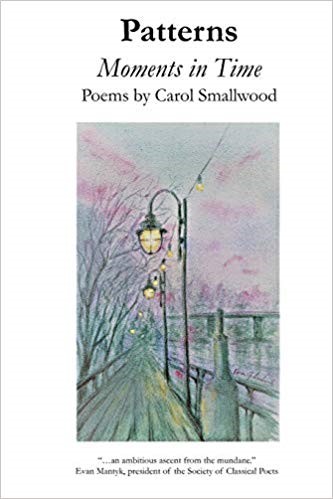
experiences. In her latest collection, Patterns:
Moments in Time, she not only stirs powerful emotions but fulfills
Wordsworth’s famous goal to present “ordinary things” to the mind “in an
unusual aspect.” Smallwood’s poems re-create ordinary events, places, and
experiences for her readers who then find or make even more new patterns
through closer observation and sharpened imagination.
The structure of
this collection bookends the variety of the many ways it is possible to see in
fresh ways what we already experience nearly every day. The Prologue sets the
stage for how even a day’s most monotonously ordinary events can be imprinted with
fresh and lasting imagery. In “Driving into Town,” pine trees that have fallen
into snow become “filled green cellophane toothpicks/ next to slim bare-limbed
trees/ as if at a cocktail party” (17).
Will that allow you to take an ordinary drive without perking up ever
again? Nothing fancy on this morning drive or in the stop at the car wash where
a routine customer becomes a “strange woman driver” and “green hula girl
plastic strips rotated/ warm water streams each side the/long empty fogged car
wash tunnel’—at last tossing the car out of the tropic back into the snow “to
make a solitary track of white” (23). Routine car washes are over. “Grandmother
Said” transforms the most routine needle-and-thread hours into creative energy
that renews the earth. The oldest doll
in the collection, Betsy is “entirely fine” as she sits resiliently for so long
“as an anchor and a lifeline” (89). The penultimate poem in the volume, “Rain
Began Hitting the Window,” begins by quoting T. S. Eliot’s “Four Quartets”: “We
shall not cease from exploration, and the end of all our exploring will be to
arrive where we started and know the place for the first time.” With memories
flooding in, the rain brings the speaker closer to the knowledge and acceptance
that we will become part of the soil we love with Aunt Hester who would “see I
wore Clorox-clean underwear” and Uncle Walt who would somewhere still be saying
“I got a wife who would bleach the hell out of the robes of God Almighty”
(99). Of course the earth spins, the
wind blows and the house wraps itself around all that is folded into the
earth—and it all comes back around again as if new: “As part of the soil—my
exploration just begun, I’d know for the very first time” (100). A prototypical pattern of whirling cumulus
clouds brings the challenge of the “Epilogue” to choose one cloud “to secure
the secret of time and space” (103).
Formally, the
villanelle is the perfect poetic pattern to circle around and back to the place
one started: renewed, surprised, refreshed. Repeating rhymes and refrains set
off on a quest that meanders through new places, yet winds its back at the
starting point with the freshness of shifting perspective and context. It’s the
persistence and musical patterns that “language” their way to penetrating
insights while always seeming to circle back and yet deeper into what is seen
and felt to be effervescently fresh. “A Villanelle for Betsy” is vintage Smallwood.
The poem revisits a very old doll with a cracked head who, we learn, has been
for some time “an anchor, an unfailing lifeline” (89). She sits patiently
through all. She sits proudly through
the patterns of repetition that reinforce resolve that is known to be “entirely
fine.” “The Wonder Spot” examines an educational tourist spot unlike any other
on earth that takes us beyond school bringing change that we become convinced
is “undeniable” (29). Another breakthrough to what is remarkable in the mundane
is “Grandmother Said” where the best uses of a needle and thread turnout to be
staving off loneliness (69).
The villanelle
follows rules exactly as does “the way to row” in a “tradition set long ago”
(21). Without any doubt “It is the
Rule,” (“A Matter of Rowing,” 21). Ambiguity receives its charge from
understanding through rules “how many ways” something can be read (“Ambiguity,”
87). “Hopscotch” where the chalk marks seem indelible, impervious, defies the
rules swishing forward “with no thought/of rain—or tomorrow” (48). “A Mainstay”
holds on to the rules of hard-cover book publishing, now challenged for so long
and ever widely by new forms. Asked
because its girth and weight almost no longer fits if the volume is her bible,
the speaker treasures her disheveled work of art, pining that “all books would
last, match the quality, continue a mainstay´(19). Some rules even bring comfort, and when
disturbed anxiety follows. “A lack of sleep encourages awareness in the safety
of predictability,” the wise speaker reflects; there is fear of the unknown and
worries about civility and predictability and a new respect for all that we
take for granted—appreciated most when threatened or disrupted (“Safety of
Predictability,” 68). In one more
example, a trip to the grocery store celebrates the defining powers of counting
and naming in adherence to or defiance of the ubiquitous rules. Not everyone pauses to observe “which aisle
had the strongest overhead fan,” how many brands of Extra Virgin Olive Oil
there are to choose from, or feel like an honored guest given precious “time to
bask among the plastic plates, marshmallows, and feel proud” (“Shopping Today,
96).
Most of
Smallwood’s collections of poems have suggested ways that we can experience
more fully what happens just about every day. More than any other, this book
looks to individual moments in time to explore the processes through which we
recognize patterns already there, create new ones through creative sensibility,
and learn how the processes of engagement make us more alive. Quilting pieces
recall earlier moments and then themselves become new moments in “a war fought
by women with a needle” emerging as a new creation “the next day fresh as a
primrose” (“Shallow Boxes,” 27). The book’s Midwestern roots win out as the
moments are meant to savor the essence of each seasonal change, building
memories that create pattern (“The Seasons,” 40). Savor also the ambiguity of
trees “reflected upside down in puddles on my way to school” or puzzling over
the syntactical puzzle of how many ways we can read “Sam blew up the door”
(“Ambiguity,” 37). Does it matter, many of the poems ask. Are the patterns
already there, wherever “there” is, or do we make the patterns “there” or later
through memory and imaginative reshaping?
It matters in “Stop Look Listen” when a “sleek red car with large
letters NASCAR” turns out to be “NURSECARE with someone flicking a cigarette
out the driver’s window” (26). Memories of the nun who uses nonsense to retool
becomes profound through proud incantation: “I recall it” (“An Unlikely
Introduction,” 41).
Moments
in Time is an unobtrusively great book that will
sneak up on you, wear well on the coffee table, stay with you, and change the
way you experience much that happens every day. Smallwood springs us from some
of the traps even good writers and readers can fall into. In Zen
and the Art of Motorcycle Maintenance, Robert M. Pirsig has suggested in a
well-known quote: “We take a handful of sand from the endless landscape of
awareness and we call that handful of sand the world.” The poems in Patterns would be happy if we were
grabbing any sand at all instead of dozing, but each poem asks us to look
closely at what the sand is, how it got in our hands, and how and why we name
it the way we do.
This large and
roomy collection never loses its focus on the many ways we make moments in time
that flourish in memory and last a lifetime. In “Select Moments,” the speaker
lies flat in the making-angels-in-the-snow position feeling for movement in the
rhythms of life itself, hoping for clues to “what it was all about” and
trusting that the moments would make sense: “Surely if I stood tall as
possible/ Long enough, tried hard enough/ there’d come hints, some pattern.”
And so this long and packed volume meanders patiently to the prologue of
cumulus clouds where a focus on one single cloud hopes to “secure the secret of
time and space (103).
Faults in the
book? Always—but maybe just flawed enough to secure the genuine aesthetic
pleasure that requires some imperfection.
The collection might be repetitious at times; some poems maybe try too
hard. Long time Smallwood fans might be
disappointed that some poems are reprised from early publication. But the
moments that wobble also become part of the haunting and satisfying patterns we
carry with us from our reading. Puzzlement, ambiguity, surprises, and the
ordinary stuff of an otherwise sleepy afternoon—everything feels just a little
less ordinary. The structure of the collection matches the unfolding of renewal
steaming out of memories. The feel of the book in one’s hands seems right, the
typeset and pristine editing, the soft beauty of the cover design—all these are
the work of a Lifetime Achievement Award winner who has much yet in the making.
Ronald Primeau
Professor of
English Emeritus, Central Michigan University
Adjunct Instructor, University of South Florida Sarasota-Manatee
The Raven’s Daughter by Peggy A. Wheeler is yet another exciting winner. This novel is suspense horror and has a bit of the supernatural. This will grab your full attention from the first page to the last and have your adrenaline going into overtime.
Tall Bear Sloan is half Native American and half Irish. She is retired from law enforcement but has worked with the Wicklow Sheriff’s Department in the past as a consultant. When twins start disappearing and turn up murdered, Jake, the Sheriff and Maggie’s very good friend, goes to Maggie and begs her to help in solving the case. At first Maggie will not do it, but eventually she relents. Maggie has dreams that become all too real, and she tries to find explanations for them. Maggie does not believe in anything supernatural or in ghosts. She believes there is always a logical explanation for events that happen.
The dreams Maggie is having now have to do with her destiny and Ravens. The dreams seem to be visions, and she finally accepts that there might be something to her dreams. This book will truly keep you on the edge of your seat and have your adrenaline pumping all the way through. When you think you have it figured out, there is a twist that will surprise you. As with all of Peggy A. Wheeler’s books, this book will captivate you and have you wanting more. This would be perfect for older teens to adults. I absolutely loved it and highly recommend it.
I am the drunk
poem without rhymes
the bartender asks how I am still surviving
I tell him that I never listen to my heart
but I hear to the voice of my loneliness
I talk less about my
miserable life
but when I am drunk, I colour the darkness
and ignore the clouds of my journey
I lie to death when I ask for another chance
The musician plays
with a passion
the singer sings with a fine pleasure
the poet writes with crying eyes, and with
a spirit dancing between the lines of the drunk poem
Love will be
always arising in my head
if a woman comes to my soundless attention
I will be happy for a temporary moment
I will fly her to my fantasies above the island of peace
I’d Rather Be Alone
I’d rather be
alone
then talking to double
-face people I meet
those people will stab-
me until I die on my tears
I’d rather be alone
take my gadgets away
give me a low-cost coffin
I am not physically tired
but mostly emotionally tired
I’d rather be
alone
I can’t fly from my sadness
my heart is broken from the
-cage of Baghdad sorrows
the door is open and I’m drunk
I’d rather be
alone
waiting to autumn to farewell
-more dreams under the dust
I cried more than a wounded
warrior who will slaughter me
Growing Up
Growing up
we learn more
about the mistakes
we had made before
the only difference
you tend to smile more
than I do, with your wounds
above my sensitive open cuts
you walk into the
sunlight
and I run by the blowing leaves
It’s crazy how much love does
I miss you even if we just kissed
Growing up in your
eyes
It’s a dream that can be found
anywhere near your breathe
let the people behind me and
-enlighten me on
my imaginations
to draw a path that will be the best
map to own you, far from everything
dark, cloudy, or that cause you to cry
My New Bio
Ahmad Al-Khatat was born in Baghdad,
Iraq. His work has appeared in print and online journals globally and has poems
translated into several languages. He has been nominated for Best of the Net
2018. He is the author of The Bleeding Heart Poet, Love On The War’s Frontline,
Gas Chamber, Wounds from Iraq, and Roofs of Dreams. He lives in Montreal,
Canada.
An
internal investigation into
the goanna’s supply chain
reveals that the widely-held
belief that its hierarchy of IT-
related capabilities functions
using three dimensions of inte-
gration is not only wrong but it is,
overall, a far less efficient reptile
than the similarly-named but un-
related inhabitants of Central &
South America plus some isolated
islands off the coast of Ecuador.
Through the eyes
The council were looking
both
to compensate & to provide
the government with evidence
that their project could be made
legitimate & would make some-
body a lot of money. None of it
was real. That seemed obvious
to me & I was only eight years
old. No-one else seemed to notice.
An existing location can no
longer be displayed
A clear understanding of
electrolyte
characteristics within the existing
student population, with the fragment
sizes generated by current DNA & capable
of producing next-generation residential
expansion, has been the focus of urban
planners seeking to identify a single
source of truth that includes check in/check
out capabilities & specialist spare parts.
Rotation
Choosing to walk this way
though other paths are easier.
In with the old, even if the
futures market seems to pre-
dict that genetically modified
crops are the way to grow.
But where will the money come
from? For the poor especially
it does not grow on trees that
do not grow. Landscapes of
drought or flood, playing fields
where insurgents surge to preach
religious intolerance. Nothing
gets through. A single variant
good – if that’s the term – for a
single season since new seeds need
to be bought to plant another crop.