Poetry from Ferris Jones

delirium

(parked in a cemetery; raining)

i understood early. life is strange for anybody. i didn’t realize my nursery school companions didn’t comprehend. i watched the coffee table walk on its four limbs. i stared at its stability. not a single dip of my father’s beer had overflowed. while it roamed, its supremacy overcame me. Intelligence to each stride. he appreciated where he was going. i craved to be that way.

it’s conscious. everything. nothing ever dies. it becomes foodstuff for the universe. dinner is prompt. we should embrace. treat well. my world, heavier than most. what did i know? i was five years old. what was real? mommy carried me, settled me. the world turned. i could perceive now. it was as absolute as that.

sweet boy

don’t weep. we won’t surrender you on this dilapidated dance floor. we will reconstruct it into a sky that will not squirm. its guardian will be of your crop. we will be the spirits that will yield blood for your tranquility. our minds will accept this pandemic and sections will disappear. nobody will realize how great they should have remained. a parachute will break your loss. go on, little one, conceive those daydreams. the earth cluttered with our remains will attend over you. no mischief will appear to you.

we will draw up arms and overthrow the pagan vampire that is autocracy. its assault will be but fables, flying before the years develop. the hijacker will expire in shackles, millions will lament, rifles will blow, capitals will ignite. airborne joy will torrent the invasion.

i will stand my history in your palms, be delicate with the mass, golden stars will be on your screens. read the message, behold the ground, envelop the tombstones. the karats are the weight, controlled by the painting of your forthcoming. i will stare on to you and your triumph, sweet boy. we will not let you, nor will we dig the tunnels.

past lives

my judgement opens from space. islands inhabit this elegant territory. true, as if planted by god’s palm. it’s rests nowhere else. lives and eye’s, roamed here for centuries. expired here. bones are in divine locations, not discovered. rafts of bamboo carried these waters. sculptures of the heroic warrior’s in the star’s highway at night. they understood time.

i’ve been there. reached from the sky and set on the water. an elegant craft. wealth. but when? i recognize i fell through the crystal water. taken part with the roads of the sand. the moon generates arrangements sustained beyond many deaths. was I one of them?

Poetry from Dan Raphael

Here we Go Again

Most years January doesn’t have to do much—its reputation’s enough, every day

in the 30s, rain with 20 mile wind from whatever direction you’re walking;

sometimes the rain polymers branches, cars and streets in cold hard transparency,

soaked soil and juggernaut wind bringing down trees and lines, increasing the darkness

that should be diminishing:  the suns been up for hours but January wont let it out,

Jan doesn’t look at us at all, knows what we’re waiting for, so becomes 2 weeks longer— February won’t mind, having been the shortest all its life knows what complaining brings,

its only reward an extra day every 4 years like a gold star that won’t stick to its forehead, February’s that long car ride, soon as it begins we’re asking is it March yet.

March marches, mars the god of war showing off its new but familiar uniforms

this month of sideways rain, month of flowers teased into blossoming then frosted brown

by northern winds tromping the calendar line claiming winter’s over

March has no idea how April got here or who let it in, April so caught

in its fashionable reflection. intoxicated by its own promise,

it seldom looks outside—why are you complaining, it’s April—

put on your shorts, dust off your bike and celebrate your way to a terrible cold.

The Universe Started in a Kitchen

Warm bread, cold coffee, basil rain

a medium rare minute

my autobiographical menu

dreams with food around but i can’t get any

Boil before you mash

wash but don’t peel

3 minutes per side

don’t measure, weigh

follow the pilot light

A kitchen off the grid

different sizes of spatulas, flippers, wood & metal spoons

3 knives

great grandma’s cast iron pan

this fork grew an extra tine

Eating steak without utensils

my molars aren’t what they used to be

Red means go, when it’s a tomato

someone tall & thin as a cornstalk

7 bees swim in an artichoke flower

some crops don’t want to be eaten

the only thing that grows in my kitchen
         is the stack of dishes and pots to wash

a stove you can take to any room, any where

Times my stomach rumbles for no reason

if i’m eating, it’s mealtime

wish the fridge and fruit bowl could refill themselves

so when I put a bed in here, i might never leave

Under Cloud Cover

a mani-permeable membrane

four way street, traffic circle sprouting sinuous

combination window mirror camera  and screen

as if I’m one

sometimes particle, sometimes wave

for the tiniest increment timeless

one blade in miles of grasses

between breaths, among heartbeats

my roots go everywhere

no reason to taste me

don’t know what I’ve been holding back til I let it go

like that sleepless, walletless hitchhike across the country

how long it took to convince myself I could sleep now

or the second trail day in Nepal, got lost,

take 20 steps, catch my breath, take 20 steps, sit or lean

resilience    recovery    resignation    reignite

in my current flame of mind

in several keys, several languages, not all of them

voiced or heard, no harmony without absence

muscle rippling bone, pushing while pulling away

how hugs become subcutaneous

each pore can breathe, each hair

can transmit and receive

sun slices through clouds

won’t let my hands touch its light

more motion than heat

places where clouds are illegal but not hard to get a little

places the sun shines through the earth ‘round midnight

Of the Land

How are my territories divided:  the physical, the emotional,

the only borders are my clothes, cat scans looking for

quick passage, hidden benefits, mazes of intestines and nerves

the river going through me can be dammed or polluted upstream

Weather grants no suffrage but always provides consequence

seasonal conundrums, the powers of habit and accumulation

but not what I was saving for which comes when

there’s no longer room or company

How to find a balance point with so many fingers on the scales

the momentum of intent, the inertia of comfort, inherent randomness

when supply demands, an idea made flesh, knowing when to shrink

or vanish, a door locked before i could learn the combination

What lets in wind but not light, a skull so tight not even

whispers can get through, an untranslatable past

becoming smithereens of the future, as it takes a thousand arms

to keep all of a life’s moments aloft, a fluid index,

when what seems chaos are the many ways to tell the same story

as plots cross-breed, as characters become their speeches,

costumes gleaned from the effluvia of closets

When we ran on all fours and kept gaining weight

so nothing could carry us away, earning the choice

to stay out of the rain, be close to a fire

what often happens around now, at this age,

what remains a mystery since no one’s seen it before

the country trying to grow inside me must be cut our or dispelled

Born Under a Vague Sign

particular matter     vague concerns     open seasoning

we need wind to mask the freeway noise

windows to keep out what the wind is carrying

how far this dust has come, a slow migration.

local rebels, taking a chance—you don’t know where that wind’s been

when the wind and rain boycott us, meteorological distancing

the masked sky diffusing the sun

adjusting the dimmer for 12-14 hours of equal gray

every time the electricity hiccups all the clocks turn to midnight or noon

shadows growing from the streets and yards

smoke trees     street trees     family trees     triage

when the windows go blank

when there’s nothing beyond my yard

since the sky’s so vacant the thunder must be manmade, ground pounding

pits and spumes of dust as if slow rain but no rain—

earth burps     soil yeast     foundations too unsettled to not squirm

can we just jump from 6 o’clock to 9, from downtown to road free

rotate this valley 90 degrees to change its relation to everything

the rain’s never lost cause it doesn’t care where it’s going

clouds throwing off water like we do cigarette butts and burger wrappers

as if we wait til sunrise to start and stop soon as dark reaches our ankles

as a compass is not a clock of space, gps is just numbers

and you know how stable they are, how easily 8 becomes three,

take the 1 from 10, when it’s easier to count the commas than the places

even temperature speaks multiple languages and never asks us

for a reference or limit, skin wants its own arithmetic

add, divide or multiply, things get so confuddled

even gravity’s misoriented, light slows to get a better look

after decades of steady friction blood escapes, nerves stop receiving

and only transmit, wirelessly, enough pain or joy at times

to reach a satellite and either bounce or tread

into the emotional vacuum, the place so many causes and effects

hide each other. as if the sun is all we got, as if the moon is content

most of the stars are not meant for us

Writing from Chimezie Ihekuna

Chimezie Ihekuna (Mr. Ben)
Chimezie Ihekuna

Title: Journey to Love
Adapted from a book by Chimezie Ihekuna (Mr. Ben)
Screenwriter: Robert Sacchi

Genre: Crime/Family Drama

For reviews, production consideration and other publicity, please contact us through the email addresses below.


mrbenisreal@gmail.com

rsacchi@rsacchi.20m.com

Synopsis/Details: 

Born and raised in Calgary, Tyler grew up with the care of his loving single mother, Grace. Having to raise the wheelchair-bound Tyler for over fourteen years was difficult for Grace, who had two jobs-teaching and factory work. Despite the challenge, she gave her son the best of love and care. Since birth, Grace made it a number one priority to be there for her son, regardless of how busy she was with her job.


Tyler always did well in school. He wasn’t the dull type. His intelligence attracted his classmates to him, even though he was fun to be with only once in a blue moon. His peers, both boys and girls in his class, liked him. But he felt incomplete since he was in a wheelchair. His unhappy mood drove people away. But this attracted the attention of his class teacher; he would do his very best to instill in him what he deserved-happiness.
However, this would be short-lived as home for Tyler meant being attended to by his mom but pushed aside by his neighbors. His mom’s efforts to make him fit in with everyone didn’t work. As Tyler grew older, his confidence and natural exuberance dwindled when he realized he wasn’t able to do what able-bodied juveniles were doing. This affected his relationship with his peers, especially the female ones. But someone, who, from childhood, had always accepted Tyler the way he had been, was…Thomas.


It was during his senior years at Calgary Secondary School Tyler saw the need to fall in love…with the opposite sex. Although Thomas would prove useful to him in a way, his predicament wouldn’t help matters! Tyler looked forward to the time in his life when the right woman would love him for who he is, accept his physical predicament, be in a serious relationship with him and possibly walk down the aisle with him. But the more Tyler searched for her, the more she kept eluding him!

Love: Long Lost But Now Found…The Background


From one girl to the other, Paul had experienced sexual pleasure for years by taking advantage of a whole host of women. Paul walked away from any consequences or relationships and ended up unharmed because of his influence! ‘Identifying’ with women at the tender age of twelve, Paul had been in fruitless relationships with twelve ladies before he met Tania at twenty one; Maureen, Cynthia, Antonia, Linda, Danielle, Katherine, Edwina, Knowles, Twain, Sharon and Faith. He had a free ride with them until he met Tania…


Tania was the only girl with whom Paul had an actual relationship. It was after three years of enduring the pains he inflicted that Tania called it quits with him. Paul looked forward to talking with Andrew, his good friend of seven years, about his fall-out Tania. But Paul was in for a big surprise…a surprise that would bring about this: “Love: Long Lost but now found!”

Prose from Santiago Burdon

Two Dollar Talisman

I have never professed to know much, although what I do know,

is there’s a distance between want and need, the road is treacherous, plagued with storms  in time cause your ambition to rust and your ego to bleed, your hunger doesn’t entitle you admission, to take part in the soul feast, believing no one’s pain is greater than your own, you’ve paid your dues now fate owes you, but you’ve defaulted on the loan.

Your want is always a desire, for  the image reflected in a selfish mirror,  you’re damned to keep counting blessings, coming up short, then feeling cheated, out of what was never yours. Still you ask why your prayers go unanswered, self indulgent wishes are ignored, worshiping the two dollar Talisman, bought at the thrift store, it has exhausted any cosmic goodwill  it never had  before, turns out  to be just another poor choice, as a last resort. if a line between  right and wrong ever existed, you snorted it long ago, and conscience you considered an encumbrance, was shed in liability’s shadow.

I’ve lived in the underbelly of a deplorable existence, the reward for addiction and a troubled mind, been to places where Jesus was afraid to visit, acting on some drug’s bad advice, I learned the less I wanted, the more I understood what it is I need, it rains diamonds on Neptune, and there’s blue sunsets on Mars, but what do I know,

I’m just an imitation of me.

Poetry from Jack Galmitz

A Vow

I wonder what you're doing
now it's 2 AM and I can't
sleep I've rumpled the sheets
with worry the shape of me
and you are you dreaming
now it's 2 AM of the day past
or days distantly hurts that stayed
with you are you sweating
or motionless are you breathing
through your nose or mouth
would you know if I were with you
would you sense me
the way a cat feels
a presence from another world
I'll put a pot of coffee on the stove
and wear my one piece pajamas
and walk on the wooden floors
maybe look out the windows
at the different views
and the lights staccato
watch the sky lightening
the appearance of the trees
and tomorrow

Poetry from Hongri Yuan, translated into English by Manu Mangattu

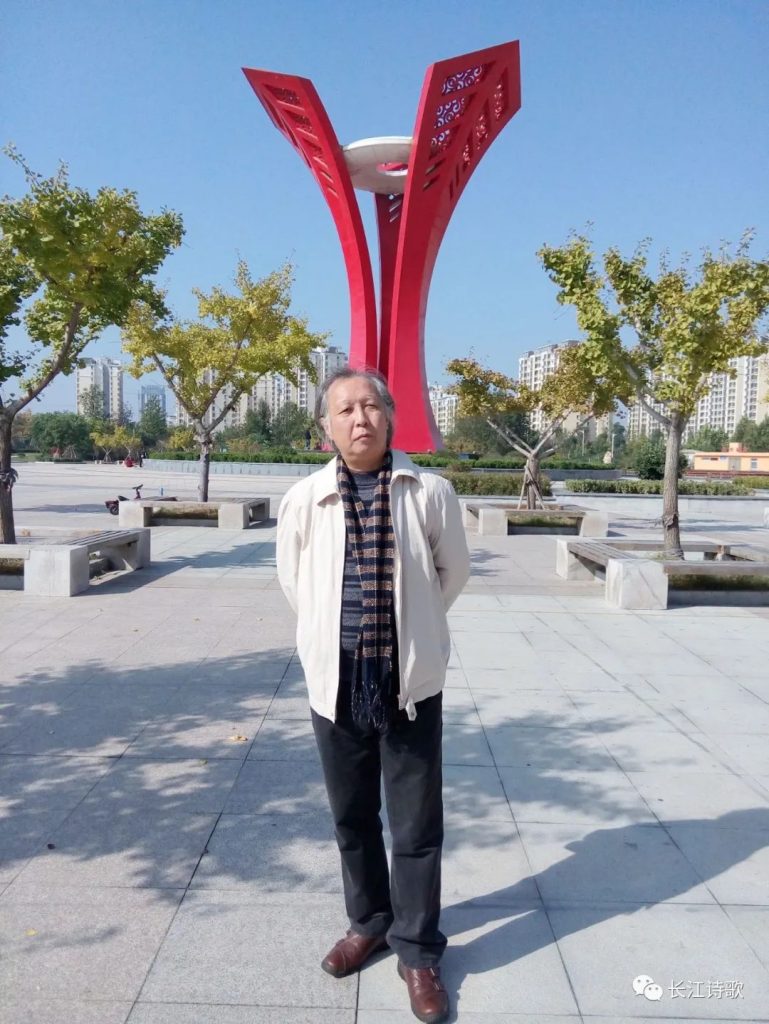
Middle aged Chinese man in a tan jacket and black pants and a scarf standing on a city sidewalk in front of some trees and a tall red sculpture
Poet Hongri Yuan

Five Poems

By Chinese Poet Yuan Hongri

Translated by Manu Mangattu

The Song of the Universe – Thy Song

Sweet soul,

Let thy breath be sweet

Let thine eyes shine as the stars

Reflect about what thou shalt see!

Thou shalt forget the words

The song of the universe is thy song

The peace of the universe is thy peace

If thou shall speak

It is almost like God

Let there be light! And there was light.

宇宙的歌声是你的歌声

甜美的灵魂

让你的呼吸甜美

让你的眼晴多如星辰

想想吧  那时你将看到什么

你将忘了词语

宇宙的歌声是你的歌声

宇宙的宁静是你的宁静

如果你说话

那就如同上帝

要有光  于是就有了光

On Angel Wings Heaven-Bound

Pluck out a star from the night sky above

And let it sing to you within your cranium

It shall bring to you the interplanetary song.

Let thine eyes reach the edge of the Milky Way

The earth is just a small stone;

Yesterday is just a butterfly.

When the angel wings conduct you to the Kingdom of Heaven

Ah! That sweet lightning will indeed make you forget the world.

当天使的翅翼驮来了天国

摘一颗星辰在夜空之上

让它在你的头颅里歌唱

它将带给你星际的乐曲

让你的目光抵达  末来的银河之城

地球只是一枚小小的石头

昨日只是一只蝴蝶

当天使的翅翼驮来了天国

哦  那甜蜜的闪电让你把世界遗忘

Home Sweet Home beyond Milky Way

Nestled in the wings of night

After the pearl gem sets in heaven

I climb to the roof of the earth

To gaze at the star.

Gazing at the star,

To witness the coming century, the city of the giant

Blossom like a silver Garden.

The Music from that mysterious Galaxy

Soothes my soul like the rain.

In the light, let my form alight

Back to my home, beyond the Milky Way.

2015.9.9

银河之外的家园

黑夜的翅翼

镶嵌了天堂的珍珠宝石

我在地球的屋顶之上

向星际凝望

仿佛看见未来世纪的巨城

绽放如白银的花园

来自神秘星系的乐曲

是一阵阵灵魂的甘雨

让我的身体乘光而行

回到了那银河之外的家园

Day and Night in Kingdom of Heaven

Last night, gazing at the stars

I saw those countless gems smile

Numberless from my past life

Limitless in the silver kingdom

Sprang from the light of thought

Forging ahead to superluminal chi

Five hundred years later, or, may I say

After a thousand five hundred years of the world

I saw a giant of a spacecraft

The eyes of those men and women

Were tranquil, serene as a diamond

Then I knew, once and forever: On the new planet,

In the Kingdom of Heaven, there is neither day nor night.

2016.2.8

没有昼夜的天国

昨夜仰望星空

我看见无数个笑容

无数个我的前世

无数个白银的王国

思想的光芒

以超光速驰来

我看见了五百年后

一千五百年后的世界

我看见乘坐飞船的巨人

男男女女的眼睛

宁静的钻石

新的星球之上

没有昼夜的天国

 2016.2.8

Distant Heaven

Often I have a foretaste of the future city of the giant.

The young giants in platinum Villas

The young giants in and out of the great mansion in platinum

And I’m one of them

In the body the sacred flame burns

On the head flickers the signs of zodiac

And the Diamond eyes glimpse the distant kingdom of heaven!

2015.12.28

遥远的天国

我常常看见那未来的巨人之城

那年轻的巨人们  进出于白金巨厦

而我是他们其中的一位

身体里燃烧神圣的火焰

头颅里闪烁巨多的星座

钻石般的目光仿佛看见遥远的天国

Bio: Yuan Hongri (born 1962) is a renowned Chinese mystic, poet, and philosopher. His work has been published in the UK, USA, India, New Zealand, Canada, and Nigeria; his poems have appeared in Poet’s Espresso Review, Orbis, Tipton Poetry Journal, Harbinger Asylum, The Stray Branch, Acumen, Pinyon Review, Taj Mahal Review, Madswirl, Shot Glass Journal, Amethyst Review, The Poetry Village, and other e-zines, anthologies, and journals. His best known works are Platinum City and Golden Giant. His works explore themes of prehistoric and future civilization.

South Asian middle aged man with brown hair and a small beard. Blue collared shirt.
Poet Hongri Yuan

About the Translator

Manu Mangattu is an English Professor, poet, editor, director and rank-holder. He has published 7 books, 73 research articles and 36 conference papers apart from 14 edited volumes with ISBN. He serves as chief editor/editor for various international journals. He has done UGC funded projects and a SWAYAM-MOOC course (Rs 15 lakhs). Besides translations from Chinese and Sanskrit, he writes poetry in English as well as in Indian languages. He was named “Comrade to Poetry China” in 2016. A visiting faculty at various universities and a quintessential bohemian-vagabond, he conducts poetry readings, workshops and lectures when inspired. After an apprenticeship in Shakespeare under Dr. Stephen Greenblatt, he currently guides 23 research scholars and mentors NET English aspirants.

Essay from Jaylan Salah

Young woman with light skin and straight brown hair, brown eyes and some lipstick

Homoeroticism in Yousry Nasrallah’s Cinema

“A recent tendency in narrative film has been to dispense with this problem altogether; hence the development of what Molly Haskell has called the “buddy movie” in which the active homosexual eroticism of the central male figures can carry the story without distraction”

– Laura Mulvey, Visual Pleasure and Narrative Cinema

The idea of comradery or buddy-relationship has been a smart ploy in cinema to get away with queer innuendos and homosexuality without facing the scissors of the censor or the disapproval of an alleged heteronormative audience. What if Sidney Poitier and Tony Curtis decided to kiss in “The Defiant Ones”? What would the reaction of the audience be back then in the late fifties? Fast-forward and buddy-movies are still a thing in the Egyptian cinema. Some of them are just there for kicks, while others hide layers of subtextual relationships.

Unless blatantly scrutinized or demonized, homosexuality in Egyptian films and TV has been only been explored through a negative lens where the queer character appears as an abnormal, raging bull-type that attacks whoever it encounters or is associated with negative villainy behavior. Gay and queer characters have been shown as thieves, sexual harassers, usually meet their doom at the end or are shown to be redeemed and cleansed as heterosexual and thus worthy of being saved.

Yousry Nasrallah’s queer characters do not define their sexuality overtly. Their ambiguity does not stem from the need to hide within the strictly defining context but owing to the sexual liberation of the late-era where gender and sexual identity as a fixated concept leave a way for a more fluid gender and sexual representation.

Mercedes – Oedipus, shrugged

Starting with “Mercedes”, the main protagonist Nobi finds himself on a quest to find his brother. His journey takes him inside a gay movie theater surrounded by gay men who freely embrace and makeout inside the dark movie theater. On the big screen is a film showing two fencers hitting at each other in a fencing competition. The choice of a film showing this particular sport would be a clever way for Nasrallah to use the multiple erotic undertones of the swordsmen in their unrevealing clothing, their masks, and their gender-neutral movements which adds to the mystery of the moment on film. After finding out his brother in the middle of the crowd, the scene cuts abruptly to a funeral in a church for the Upper-class Coptic community, in a swift move that puts queer romance as an opposite to death, as if to symbolize how the rich Copts (representing the religious bourgeois of the Egyptian society) who hide behind traditions are dead inside while the impoverished (queers) whose moments of passion are in the dark, feel more alive than them.

Nasrallah uses his background as an aristocratic Christian from a family well-endowed with art and tradition to create an Oedipal-phallic world in Mercedes. Phallocentrism is the driving theme in Mercedes, a tale of Oedipal love and loss in the capital, one of the key themes that plagued Youssef Chahine’s –Nasrallah’s mentor- mind in addition to queerness, sexuality, the relationship between the East and the West and with the Other. Nasrallah uses one of Chahine’s muses, Yousra, the Egyptian diva and highly influential female actress, as the central female protagonist of the film and one of the factors of the Oedipal dimer. Using one of Egypt’s most iconic feminine and sexual figures not only adds to the weight of the film but ensures that it carries the multilayered story which Nasrallah tries to present. Yousra as a figure of motherhood has long been toyed with, consumed, and reincarnated in films and TV because the actress in real life has publicly confessed to struggling with fertility and multiple miscarriages. This iconic woman has been vocal about her vulnerabilities as much as her impossible beauty standards, and that in a way, granted her lasting presence in the hearts of Egyptian and Arab audiences. 

In a way, “Mercedes” removes the male figure from the heterosexual relationship, so that the Oedipal dimer remains intact with only two central monomers; the mother and the son infatuated by their sole existence. The mother-son relationship kicks the male figure out of the picture and despite that not being a component of the queer film theory, Nasrallah most likely defies it by making Yousra (a woman whose lack of motherhood in real life and her public expression of that) play a mother figure within a complex Oedipal relationship. Nasrallah’s use of phallic symbols is as swift as the way he uses fans to represent a visual motif for the demise of the aristocracy, the lack of social acceptance within the elitist groups, and boredom.

One of the prominent figures in “Mercedes” are the two lesbian lovers,  Nasrallah subverted expectation by making the Muslim character the sidekick to the Christian one, contrary to the norm in Egyptian cinema where Muslim characters are upfront and Christian characters are secondary to them, serving on their stories.

In one scene, Nobi is watching “The Well of Deprivation” a movie about a multiple personality disorder patient who practices daily catharsis for the character of her repressed mother through impersonating a promiscuous alter-ego. The dual nature of the other/the twin could be seen in the film in addition to the virgin/mother/crone complex through the women whom Nobi encounters on his journey to self-discovery. Starting with the stranger with whom he has a brief encounter in the wedding reception, Afifa the virgin belly dancer who is his mother’s clone, and his mother Warda who is the source of his great Oedipal agony.

The City – Boys will be horny

In the first scene of his 2000 film “The City”, Nasrallah shows the male protagonist Ali eyeing a hypersexual, salt-of-the-earth woman with lust. It is later revealed that Nasrallah uses Ali as his muse, on the footsteps of his mentor director Youssef Chahine, Nasrallah used the actor who played his alter-ego in “Mercedes” to play a version of himself in a film that coyly uses the artist/muse complex to explore themes about art, creation, the nature of homoerotic relationships, and fluid sexuality. The same Ali who lustfully eyes the woman in the first scene is the one whose character is the center of the complex relationship verse. 

Nasrallah’s homosexual tension is at its best when male characters revert to camaraderie. He shows us a group of boys existing in a male-dominated world and enjoying male-friendly activities: in a circle sharing a joint, swimming naked, and passing around dirty jokes. His queer world is not a sci-fi verse, these boys are the byproduct of the average masculine culture, they just happen to take further interest in each other. In some instances, the characters share a rare moment of passion, such as in “The City” when the camera closes-up on Osama’s hand lingering on Ali’s shoulder after a friendly, non-sexual embrace, layering the moment with erotic undertones. In another scene, Osama cuts off his hair –which he takes pride in throughout the movie- to give as a token to Ali who plans on traveling to Paris. It symbolizes their intense relationship as buddies masquerading their homoerotic undertones. Osama and Ali’s intense friendship/love story could have been assumed as queerbaiting, had this film been somewhere outside the Arab world where homoeroticism on the big screen should only be represented menacingly. 

Nasrallah’s use of close-ups usually hints at the underlying homosexual relationship or tension between the main protagonist and another male character, especially the early ones. In more than one shot, we see the camera zooming on the faces of two men entangled in an ambiguous relationship, even a moment. In “Mercedes”, there is a close-up on ex-policeman Mohamed Taher’s lips and the face of Nobi, the main protagonist. In “The City” scenes featuring buddies Osama and Ali make use of camera angles to emphasize their complex relationship. Whereas Osama seems desperately in love with Ali, unable to eye any other character in the film with the same passion and fervor that he saves for Ali, the latter adopts a more liberated, non-restricting sexual behavior, having a girlfriend, flirting with men and women alike while keeping a soft spot for Osama. The camera uses a fetishistic approach to their deep dark eyes, their feet, and their hands, especially in the intimate scene where they share a joint and when the whole gang is swimming in the Nile, singing and drinking beer, the sideglances that they exchange tell a million stories. In one scene reminiscent of the confessional by the bonfire in Gus Van Sant’s “My Own Private Idaho”, Osama almost confesses his love for Ali; the pansexual with a strong heterosexual commitment that he seems careless to consummate.

The movie ends with Ali abandoning everybody; his girlfriend, his unrequited lover Osama, and even his dream of living abroad. He commits to his art; the only thing that gives him freedom.

Summersaults – A Summer’s Sunny Dream

In his debut “Summersaults”, Youssef Chahine’s influence is obvious on Nasrallah’s visual style and close-ups. The alternating gaze from male to female, with lingering shots on beautiful male bodies and faces, are in deep contrast with the scene of fellatio simulation when Yasser -the protagonist- licks blood off a peasant’s girl’s finger. Her face shows expressions of pleasure mimicking a woman receiving pleasure from a man. Her line “You are disgusting,” reflects how women from conservative societies usually associate sexual acts with grossness, in an attempt to make them less appealing or desired. 

Yasser’s friendship with Leil, the peasant boy who taught him how to steal casual pleasures from an extended, boring life, is only a tale of forbidden summer romance between two kids, if “My Girl” was the bittersweet coming-of-age love story of the 90s, Ali and Leil’s summer awakening has been nothing short of unrequited, and bittersweet. “Summersaults” may be a great sociopolitical critique of the Egyptian aristocracy in the 60s, but it’s a tale of love that lived longer than the houses and the lands of the rich. At its core, this movie was milder in terms of homoerotic subtext, but the ending scene when Yasser hugged Leil in the darkness of the fields, threw back a shade to what was perceived as an innocent childhood friendship, to be analyzed through a different lens.

Later projects – Less daring, more structured narrative

Even in his most commercial project to date “Brooks, Meadows and Lovely Faces” Nasrallah hints at homoeroticism through the characters of Reda International the gypsy vagabond, and Galal the cook. Reda suggests that Galal marries his sister, looking lustfully at Galal, then pecking him on the cheek. The scene carries multiple layers especially when Reda approaches another character Ashour seductively to imply that to get his stolen paperwork he has to do the gypsies a favor. Ashour is then punished by castration, mirroring his non-compliance with the gypsy’s sexual advances, which could be a bold move within the narrative to punish a heterosexual character to be for refusing to indulge in a homosexual relationship; giving the queer character, the upper, more dominant hand, if albeit queer-coded. Although the actual reason for Ashour’s castration is stated as taking the honor of a virginal girl from a rich family –through marrying her behind her family’s back- the act of castration comes as a response to his defiance in the face of the gypsy’s sexual advances.