Poetry from Michael Robinson

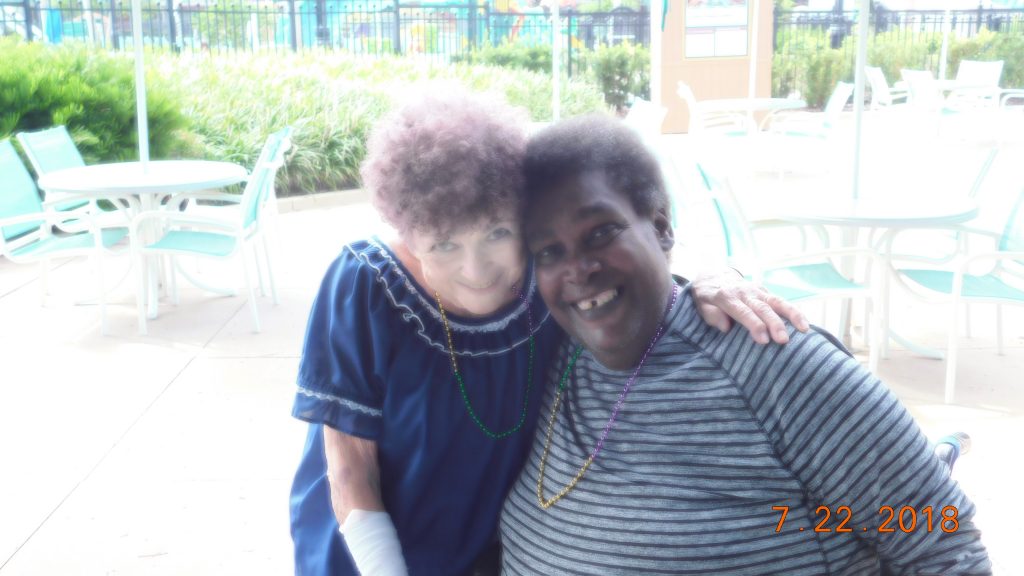
Middle aged Black man with a necklace and striped shirt, smiling, standing next to an older White woman in a blue dress in front of a pool and lounge area.
Michael Robinson (right) and fellow contributor Joan Beebe

Moments

Moments to pray in the light of night,

When the shadow of doubt no longer,

Linger in his heart in the daylight.

Daylight with all its violence and,

Destruction in the cities as fires burn,

People beaten by the police and jeeps,

Passing with their antennas blowing

It is all familiar the sounds of chaos

Without the dogs and water hoses in

1960s leading to 2020 nothing changed,

And it all is a circle of confusing.

Prayer in the midnight hour as the fan,

Continues to rotate above his head,

He sees the darkness of the daylight

In the light of the moon at midnight.

9-7-2020

Circles

It all is a circle of life and death,

Of destruction and hopeless,

Generations after generations.

It circles like the smoke during,

The riots of 68 in Chocolate City,

There was nothing sweet about the,

Violence and the beatings like in the

Killing of Emmitt Till in 1955 and

The assassination of Martin Luther King,

In 68 when the fire storms came,

And the smoke circled around and

Around going into the night skies.

9-7-2020

Emmett Till

Emmett have you found your peace?

As they murdered you in 55 for looking

At a white woman and speaking to her?

Have they planted flowers on your grave?

Or have they vandalized your memorial?

As the hate continues to flow in 2020.

Robes of discontent and hate are being,

Worn as they parade down the streets,

No longer worrying about Justice for

You and me as our dark skin is a threat,

To their way of life and they are fearful,

Of the truth that we are free to look. 

9-7-2020

Seeing the Truth

It is midnight going into the wee hours,

Of the morning as he kneels by his bed,

Praying and praying not knowing his,

Way to solace in his life after 63 years,

Of life that his brought misery and pain,

Full circle of the pain of life as his,

Brothers are being killed one by one,

In the streets by those who protect and,

Serve not us as we are being dehumanized,

Leading us not to the land of freedom,

But rather to the land of eternal sleep.

9-7-2020

Hopes that are Fading

His ancestors had hope as they prayed in the fields,

Picking cotton and being whipped and they song,

About their freedom of one day seeing God.

His generation does not see their scars on their,

Backs because they are not aware that they are.

Slaves in the 21st century as one by one they are,

Beating with the new cat’o nine tails.

No longer are they singing about seeing God,

In their life they only see that they are dying,

In the streets of cotton made of false truths,

As they stand of the corners looking into the abyss.

There are no songs inside of them looking for God.

9-7-2020

Good Night My Love

As the fan rotates and the moon disappears,

With the coming of dawn comes into view,

He thinks of you and your love for him,

Thinking of the sweetness of your soul.

As he lay in the field of cotton alone,

Seeking to find you in his dreams,

He looks at the sunrise and he says,

One last prayer to God and closes his eyes.

9-7-2020

Wind and Rain

When the wind blow and the rain fell,

His thoughts were on God in heaven,

No more did dying bring fear to him.

As the wind blow and the rain fell,

He knew that God loved him and,

He prayed his prayer that he knew,

In his heart from when he was a boy,

God would always hold him and protect,

Him when the wind blew, and the rain fell.

9-7-2020

Poetry from Emilie Mayer

Response to Catalog of Unabashed Gratitude: Synaesthesia of Poetry

My eyes turned to plums
swelled from a day of pages;
words I wrap round my thumb
and eat as raspberries.

Finger roots in the mud,
and I wonder: Standing on hands
will my legs turn to branches?
Shrubs growing from my lexicon.

The grass’ scent, interchangeable
with the bible under my pillow;
promised luck, the sand dollars
like ash filling street cracks.

And does all poetry carry memory
for the reader?
The bookshelf in that cottage home
might’ve held damp pavement,
snow brick forts, my guardian’s shampoo.

And is my work kindred to myself?
Bath soap between stanzas
and the coconut rub I’ve worn
since my knees first appeared
from under my skirt.

Now my wrinkles mirror thought
and will all poems today taste of
childhood encounters with
unearthed rollie pollies and graves dug
for stingless bees?

Should’ve been dust


I should’ve been dust by now—
my heartbeat knows
in dissonance with legacy’s agenda.

Pulse pulled from my throat,
cuts jagged cherry cheeks.
My point, somewhat lost
in searching for religion on the subway.


(I swear an angel slept against my lap;
that old man smelled of narrative.)
My point, somewhat lost
in replicating grandmother’s braids
upon my own ahistoric skin.
(I carry blood of half the continents,
but soon everything empties into nothing.)


I was made as a wall,
built of stone and sticks
of shattered hearts and mended minds—
I crumble some, more each day.


Time so wants me to shift
and follow the names carved in stone,
when all I know is how to stay.


Tracking the rhythm within my chest.
My pulse knows,
I should’ve been dust by now.

Poetry from Coco (Surakshya) Kiju

Black Sheep

In a corner of a boulevard,
Hidden in plain sight.
He’s constantly on his guard,
‘Cause everyday is a fight.

All alone in this crowded world,
No place he can call his home.
Shivering in the ruthless cold,
He just sits there like a garden gnome.

The crescent moon his only friend,
That just stares at him while he soaks in the rain.
That long winter night somehow he spends,
But so much crisis still remains.

He sees someone passing by,
And dares to call out for help.
But there’s no response to his cry,
He’s ignored just like a whelp.

He doesn’t have no aspiration,
All he can think of is survival.
But somehow he always ends up in frustration,
‘Cause he always finds himself in a trial.

Although treated like a street pup,
He wonders why they call him “black sheep”.
Hoping that he doesn’t ever wake up,
He silently cries himself to sleep.

I write a poetry blog “Poems from heart” (www.poemsfromheartcom.wordpress.com). I am an aspiring poet. I have had a few of my poems published in Cambridge Hall Poetry Journal.

Poetry from John Culp

Sometimes an inference nudges the future and this influences individuals toward that reality.

So if a skeptical glance is missed we all benefit.

Odd that the first birds did not need permission to fly.

Allow preferences a comfortable focus.

Free

More Free

I was not there to stop you

I am so glad

  Learning to experience what comes

Interesting, begins the adventure
Without swing
There is no sway

As night falls
    Dawn Brings
       the Day

Grounds pet
    My soles
to Soothe my Way

Challenged
       a front
   I kneel to pray

A faithless wind
     Horizons may

A hopeless kiss
       to plant new
                      seed

A perfect smile
Spreads grout to tile.

A solid stand
        cracks
     eternal still

A Lifted Hand
    Sends Newness

Beginning to Rise

My desires

Someone else
   Suffers alone in the
      Lifted Suns

A song that knows no 
                        Darkness
reminds me
    rewinds me
      of where I've Been

In and away
    sews threads of time

if I fell
     there were stars       
            Beneath

      & trees grow in
          This Soil of all
              things possible
          Where faith teaches
                 on the Fly

Without swing
   there is no Sway

As night falls
     Dawn Brings the Day

Grounds pet
          my Soles
                 to soothe
                       my way

 Star Dusty 
                -----------------------


I,

need to recalibrate,

that from here
forth it's always so.

there is no
water under the bridge

there only flows from my heart.

I backslide on promise
drown in the future
-less I waken yesterday

To feel toward the call

For True yesterday is the now with experience shining

You can call it a miracle,

           to forget,
Your Blessings continue.

Standings walk
the moment
to see
the future is
what you make it
because the heart knows, 

I,

may for me calibrate,

Beyond the past moment

Knowing 

the best of us all
the best of myself
together
in another
joyful reunion,

NOW.


,

Prose from Abdelsalam Ibrahim

The worms lady

Abdelsalam Ibrahim

It was the dooms day like.

Behind the big lake of Abu elgoud.

The boys who hid between the clothes of their mothers, stood shivering, and each one of them began to shake his head right and left. The shake’s degree varied from one to another. One of them shocked his head once, others shocked many times during closing eyes. Some of them affected by the shaking, so they fell down under foots and began shivering due to strong pain. Their mothers, who accompanied them, kept catching their gowns for fear of paroxysm attack which will finally oppose them to run and throw themselves in the lake to put off the flame burning in their ears. But the paroxysm overwhelming them, is unbearable, so that their mothers began to retain their fainted strength, and each one of them pulled her son off her clothes and pushes him forward. Boys began swinging, and one of them was about to fall down due to the swinging. When they heard one of them’s cry, they stuck to their mothers. Therefore mothers pushed their sons forward, but the boys who moved backwards faced a severe struggle to be constant.

Soraya entered the old house, which the sun penetrates its collapsed walls, to meet the worms’ lady. She was shivering with her son and he was almost to touch her thighs. At the meantime she managed to force him to be constant. But he fell down crying, so she pulled him again and dragged him in front of her.

When she put him in front of the old worms’ lady, he silenced, but still whooping coughs come out of his mouth repeatedly, and avoided looking at her sharp eyes.

The worms’ lady put her hand over his right ear, and began reading the mysterious rhymed exodus incantation, so the boy twisted and his mother stuck to him. He began crying. The worms’ lady raised her voice and held back his shoulders tightly.

The struggle between her and the boy came to a critical point, and resulted in the disembarking of the first worm out of his ear, so he swayed to the left, so that his cries diminished. The worm dropped in the worms’ lady’s hand, and looked at the boy, his mother, and the attendants who kept looking astonishingly. The boy looked at the worms’ lady with a revenging look which couldn’t last long against her mighty look that overcame his pains and swaying.

 The obscure reading which she recited over the ear of the boy, continued until leaks of red worms came out, so he endured the raising pain successfully. Sweat appeared over his skin, so wet his gown, dropped from his head, and mixed with his mucus, which in turn, united with the drops of saliva of his open mouth. His mother removed this mixture with her sleeve, then it began to remix again. The worms’ lady seemed exhausted, and tried to evoke the dense worms in his ears. She called the so many worms that were hidden, so that they came out with great anger.

When she finished incantation, the last worm was in her way out of his ears paths slowly, as if it was imposed to come out. It was pushed to get out from the deep alcoves. The slow exodus went up with the convulsive catching of breath of the worms’ lady. She breathed loudly. She fell down upon her back. She was about to faint.

The boy closed his eyes and slept deeply during the exodus progression of the last worm, which it eventually stopped in her way out, and did not make any progress due to the abrupt stop of exodus incantation. The worm turned round with a narrow circle. Soraya was about to catch the worm, but it was too faster to get back to the empty ear of the boy. He opened his eyes and began to swing and struggle against pain again.     

Poetry from J.J. Campbell

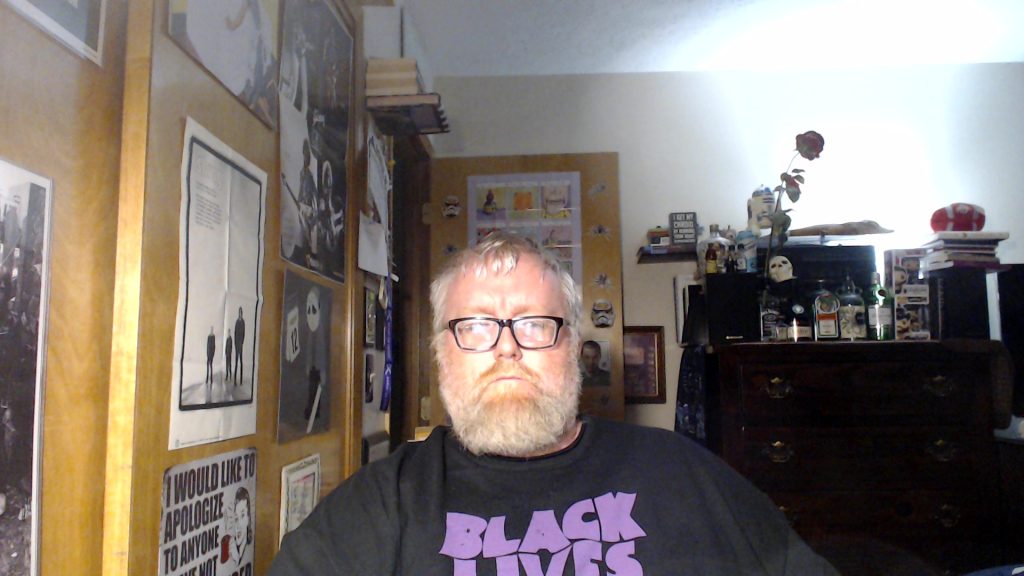
Middle aged white man with glasses, hair and a beard, sitting in a room with posters on the wall and a rose, a plastic skull and candles on a dresser. He's got a Black Lives Matter tee shirt on.
J.J. Campbell
political signs
 
i always pay
attention to
the political
signs in the
yards around
where i live
 
it gives me
a heads up
on who not
to vote for
------------------------------------------------------------
the perfect metaphor
 
the rat race ended
and nobody won
 
if that isn't the
perfect metaphor
for life in the
midwest, i don't

know what is
--------------------------------------------------------------
young angst
 
a listless
rebellion
 
young angst
with an unholy
need to release
 
it's simple to
find the evil
in the world
 
just follow

the money
---------------------------------------------------------------
never talk to strangers
 
she asked me
for a ride home
 
i was taught to
never talk to
strangers
 
that goes against
every notion a
writer should
have
 
this incident
was over a
quarter century
ago
 
what if pops up
from time to time
 
it never ends
up well
 
but the poems

keep flowing
------------------------------------------------------------------
these lonely nights
 
the only good thing
about these lonely
nights is eventually

i will run out of them

Denise David reviews Carol Smallwood’s poetry collection ‘Thread, Form and Other Enclosures’

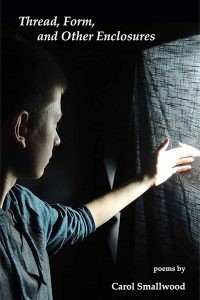
White woman with short dark hair looks out through a curtain towards light outside in a dark room.
Carol Smallwood’s Thread, Form and Other Enclosures

Accomplished poet Carol Smallwood assures us once again in her latest poetry collection, Thread, Form, and Other Enclosures that we are in the hands of an accomplished poet, who deftly uses the very form of her poems as enclosures to explore the nuances of structure within our culture, a structure, she reminds us, that may be as invisible as gravity itself, but no less powerful in its impact. This collection of over seventy poems explores the boundaries that bring us together and keep us apart: the threads, the forms, and the enclosures of our lives. Smallwood’s subjects are wide ranging, but the focus on women’s experiences interconnects throughout the collection.

              Smallwood specifically explores the relationships women traditionally have had to enclosures living as women have in a culture that has silenced women’s voices and devalued their creative work, specifically the tools of needle and thread, the weaving of women’s art. As she explores connections and disconnections, she will intertwine science and myth, the personal and the public in ways that will both surprise and satisfy us. 

              Smallwood uses the strictly defined poetic forms of the pantoum, the triolet, the villanelle, and the rondeau along with free verse to great effect following Auden’s notions of a “form looking for a subject and a subject looking for a form.” Smallwood uses these closely defined forms as poetic enclosures for ideas, using a tight structure to force us to see what we have not seen before, subtle changes in meaning coming into focus as words repeat, context shifts, and we focus again on the same words, but now read their meaning anew. In her poem “The Universe” we begin with the security of making patchwork quilts in the emptiness of a “universe with no edge or center” but move finally to a “universe with no edge or center” where the speaker recognizes death as an eventuality as everyone must, but she reminds us that women create meaning over and over as they “cut up pieces to sew with needle and thread” because as the speaker’s grandmother tells us, “You are not lonely when you sew.”

               In other poems Smallwood will lay unexpected connections before us. In her poem  “A Quartet” she will celebrate the “economy in circles,” circles present in the seemingly vast and unrestricted boundaries of the universe and within women:circles being  “the popular choice of planets/revolving moons, and womb.” Circles live in the rhythm of seasons and geology and history of life on earth.

              In another thread, Smallwood recalls Greek mythology recalling images that remind us of the importance of women deities such as the Three Fates who weave the fabric of life, determine the length of our thread, and decide when it will be cut. Mythology has granted such women enormous power over our lives. Smallwood combines this with the elevation in Greek mythology of women’s knowledge of weaving and sewing, which has been silenced or denigrated in our present day culture. Arachne’s story, well-known in mythology, speaks of a woman admired by humans and gods for her great skill as a weaver.  She will compete with the goddess Athena, displaying the dangers of human pride in breaking the boundary between mortals and gods. Arachne’s challenge to the gods, her attempts to escape her mortal enclosure, will be punished by her transformation into a spider, and yet the image of the spider, connecting to the myth will make satisfying reappearances throughout the collection, the spider as weaver forever present on earth.

              In yet another myth, we are reminded of the labyrinth created by Daedalus for King Minos. Minos’ daughter Ariadne was put in charge of the labyrinth and is thus often associated with mazes. When Theseus, the hero of ancient legend,  sought to free the boys and girls sacrificed to the Minotaur. Theseus, the famous hero, will succeed only when he receives help from Ariadne, who will offer him not only a sword, but also the large ball of thread.  The ball of thread will be invaluable in leaving a trail by which Theseus will find his way out of the labyrinth, thus, saving the children from the Minotaur. He will need both sword and thread to survive. However, when we recall Theseus, we remember him as the hero of the story, ignoring or diminishing the role of the female, the goddess Ariadne, without whose help of the sword and the thread, each the traditional tool of men and women respectively, it is unlikely he would have succeeded in finding his way out of the labyrinth.  Once again, Smallwood returns to mythology for the presence of the power of women’s knowledge and the importance of women’s art traditionally connected to thread. And later, without missing a beat, Smallwood will have us reconsider the power and importance of threading as she takes us to the intensely personal, as she speaks of threading the subclavian vein as part of her chemotherapy, part of her cancer treatment, creating interconnections, crossing boundaries and erasing enclosures between her poems.

              In addition to reminding us of the strength and importance of women in Greek myths, Smallwood will have us consider the voices of women in literature that have been silenced. She searches through literature anthologies as one might divine the earth for life-giving water, seeking the writings of women. She will leave her pursuit unsatisfied, the thirst for such writings unquenched, with the collections instead filled mostly with the words of men using “man-made” words.

Smallwood will explore the enclosures that hold knowledge in the academic world. She will return to the connection to myth reminding us of Pandora who opens the dreaded box, letting all the evils of the world escape with only hope remaining in the box. And yet, while it is Pandora who has opened the box, it will be poet Emily Dickinson, who will offer humankind a balm with her beautiful words, “Hope is a thing with feathers.”

              Smallwood will find the misogynist professor teaching history with his offer of the “blonde visualizer” for the male students in the class, but she will also find the woman trapped in the yellow wallpaper in Charlotte Perkins Gilman’s work. Smallwood moves with dexterity from the trapped woman, a character in The Yellow Wallpaper, to a swift connection with the personal, revealing her sense of entrapment in her own marriage, a husband who called her “little girl” enforcing another kind of enclosure.

              While the collection includes moments of humor, there are also the emotional poems of Smallwood’s struggle with cancer. In the ultrasound room, waiting to have blood drawn, in her poem “Matter of Rowing” Smallwood acknowledges an unexpected blessing for humans, like rowers who row backwards, in not being able to see what is ahead. We find that we, ourselves, may be blessed as well by not knowing exactly what lies ahead.

              Overall, the collection has the feel of sharing an afternoon with a friend, well-read and knowledgeable, a friend who can speak of her curiosity related to myriad aspects of life including such wide-ranging subjects as the latest theories of the universe or the history of jeans or Claire’s stiletto heels in the television series House of Cards.  Throughout her collection Smallwood offers a voice passionate about letting other women’s voices be heard.

              It is a collection to be read again and again, as each reading offers new ways of seeing and thinking, threads, forms, and other the enclosures appearing before us,  evolving, changing shape and ultimately presenting us with new insights. Her poem, “ A Brief Look” included in the Afterward, reminding us that “beauty comes at ordinary moments full grown, unexpected/and leaves us gasping.” We might say the same of Carol Smallwood’s poetry collection. 

Denise David, Ph.D. is the author of the recently published poetry collection Against Forgetting: War, Love, and After War, Shanti Arts Press, May 2020.

Carol Smallwood’s Thread, Form and Other Enclosures is available here.