Rupa Rao interviews Balachandran Nair on his youth poetry project

THE BALAKAVI VISIONARY: AN INTERVIEW WITH MR. BALACHANDRAN NAIR C.S.

BY RUPA RAO 

Young middle-aged South Asian woman with short dark curly hair, earrings, earphones, and a pink top, seated next to a plant .
Rupa Rao
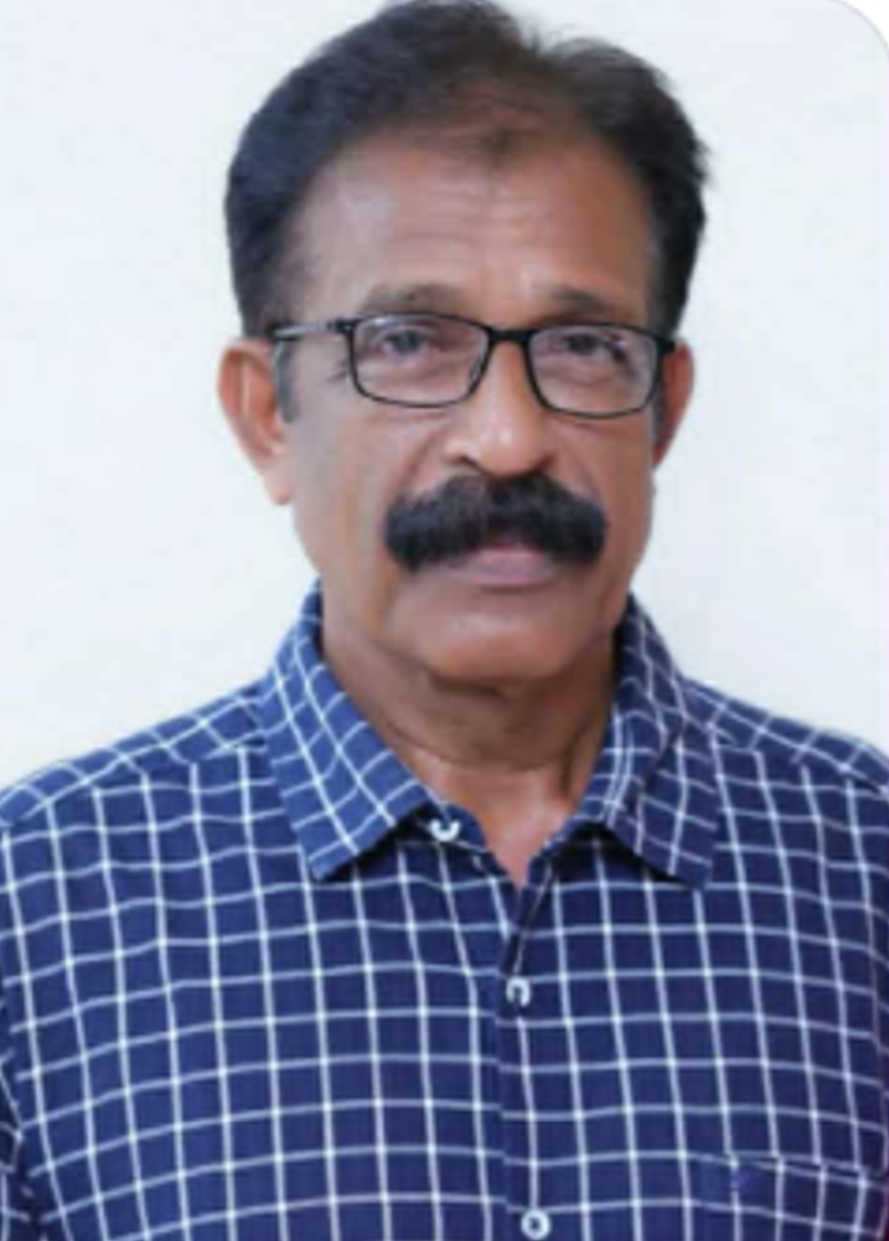
Older middle aged South Asian man, short dark hair, reading glasses, blue and white plaid collared shirt.
Balachandran Nair

Introduction

Some individuals quietly reshape the world around them, not through grand speeches or positions of power, but through persistent acts of love, conviction, and service. Mr. Balachandran Nair C.S. — poet, mentor, retired CRPF officer, and the driving force behind the BALAKAVI School Level New Poets Initiative — is one such figure.

From a childhood shaped by hardship to a life dedicated to nurturing young voices across India and beyond, his journey is a testament to resilience, creativity, and unwavering belief in the transformative power of literature. This interview captures his story, his mission, and the extraordinary movement he has built — one child, one poem, one dawn at a time.

INTERVIEW

Q1. What inspires you to focus your energies on encouraging children across states and countries to write and recite poetry?

BN: No one knows, nor has anyone recorded, who first stood facing which direction and witnessed the beautiful dawn. Yet people still gather on hilltops and seashores to watch the sunrise. I am not the sun, a hill, or the sea, but I am still able to help literary enthusiasts witness the rising of schoolchildren as new poets—reciting poems they have written for the first time in their lives. Appearing in colourful school uniforms, sounding like chirping birds. I simply capture a small bit of their talent, cupping my palms around it like a firefly, revealing it when you open your eyes in the early morning. The happiness on children’s faces when you look at them in awe keeps me going, inspiring me to collect another firefly for your next dawn.

Q2. When and how did you come up with this concept?

BN: The 14th of November, the birthday of India’s first Prime Minister, Pandit Jawaharlal Nehru, is celebrated as Children’s Day. I received an invitation to speak to the students of Government High School, Njekkad (Kerala) on that day in 2021. From childhood, I always wanted to be different. So I made a request to the school authorities: I would collect and send poems authored by a few living poets, and the students would recite them during the celebration. In return, I promised to gift each student a poetry book. They agreed, and I collected poems and books from my Facebook friends and forwarded them to the school. The programme was a grand success—many children reciting poems by living, established poets, and those poets watching online. More than a hundred books were gifted to the students and the school library. It was then that it occurred to me: if a student writes and recites their own poem, it will benefit them in many ways. That was the first seed, and I decided to move forward with the idea.

Q3. When did you step into your creative writing phase, and how did it happen?

BN: I am from Kerala, and my mother tongue is Malayalam. I learned Tamil by reading cinema posters. My last four years of schooling were in Madras. I was obsessed with cinema and watched almost every film released at that time. Cinema articles were the first things I read in newspapers. After joining the Central Reserve Police, I hardly had time to write. But the urge to write film scripts slept deeply within me. When I received promotions and had more time, I finally sat down to write scripts—mostly at night. I wrote two or three and approached several well‑known studios between 1990 and 1992. There were promises, but nothing worked out. Later, I discovered that one of my scripts had been made into a film without credit. I ran out of the theatre crying. The same thing happened again with another script in Malayalam. That film won National and State Awards. Though devastated, I gained confidence that I can write. But I didn’t write again for fifteen years.

Q4. What is your family background?

BN: My father served in the British Indian Military. During World War II, he deserted the camp with a few friends to join the Indian Independence Movement and the INA. After independence, he returned home and became a hardcore Communist. He lost everything fighting court cases but ensured we never starved. None of us could study beyond matriculation. I lost my father in 1999 and my mother in 2004. I am from Attingal, Kerala. I married in 1977 and have two daughters, aged 46 and 44. The elder is a homemaker; the younger is a Headmistress. Both have two children each. My eldest grandchild works in IT; the others are studying.

Q5. Who inspired your love for poetry?

BN: I began using Facebook in 2016. Poet Anushka Sharma, a Punjabi settled in South Africa, was my first Facebook friend. I commented humorously on her poems, and she often said my comments outshone her writing. One day she insisted I write a poem myself. I wrote my first English poem at the age of sixty‑six.

Q6. How did you juggle writing and your career?

BN: In my early days as a soldier, I had no time or space to write. But I had access to a library and read extensively. Later, after promotions, I wrote at night. Writing film scripts was my passion.

Q7. Does anyone in your family follow in your footsteps?

BN: My youngest grandchild, Ashwin B. Nair, now fourteen, writes better than me. He published his first poetry anthology Darling Doodles in 2023 and his second, Dwelling Desires, in 2025. He attended online poetry meets with me and received appreciation from veteran poets. Now in high school, he writes during vacations.

Q8. What role does your wife play in your mission?

BN: My wife, Maheswari Amma, is a devoted homemaker. She constantly worries about my health, which suffers because I skip meals, drink little water, and hold my urine during school visits. I have undergone multiple renal stone surgeries and still undergo physiotherapy for a stiff neck caused by mobile‑phone use during the 2022 drive. As a pensioner, I spend much of my pension on travel and project expenses. She endures my endless phone calls and irregular routines without complaint. Her worries are justified… but I am not obedient. I have work to do—for the children. My dream is to give her one day free from my painful aaahhhs and woooohs.

Q9. Who supported you when you began, and who supports you now?

BN: The HaVen International literary platform, founded in 1999, was my first base. I began introducing schoolchildren through it on 1 January 2022. I contacted hundreds of poets worldwide and collected their biodata and simple poems for children to recite. The idea clicked. The 2022 programme ran for 365 days and created world records for:

·        407 New Poets introduced

·        357 living poets featured

·        87 countries involved

Certificates, prizes, and an annual function followed. After a break due to health issues, I revived the project in 2025, expanding it to include differently abled children. With HaVen inactive, I partnered with the International Academy of Ethics (IAE), led by Dr. Jernail S. Anand. The 2025 programme is broadcast daily through IAE and 21 global literary platforms.

Q10. Tell me about the children involved.

BN: Every child is a gem. In BALAKAVI, most New Poets are under ten. One school in Bangalore—East West Public School—has produced 92 New Poets, thanks to teacher Grace Sitharaman. As of 24.12.2025, 287 New Poets have been introduced in 152 days. Adding the 2022 drive, the total is 694. If all schools had cooperated, the number would be in the thousands.

Q11. What do you envision next?

BN: I run BALAKAVI single‑handedly. It is a massive daily task. If a global body that values literature, education, and peace recognizes this effort, it would fulfil my mission. Such recognition would inspire literary communities worldwide to think and act differently in a rapidly changing world.

Q12. What do you enjoy reading and writing?

BN: I love detective and fiction novels—Robert Ludlum, Stephen King, Ken Follett, Frederick Forsyth, Alistair MacLean, Wilbur Smith, Irving Wallace. I write Malayalam short stories and English poems, often with unexpected twists.

Q13. Anything more you’d like to add?

BN: I want to bring differently abled children into the limelight. Many parents hide them from society. I want to change that. And I wish I could give my wife a peaceful day… but I know that may remain a dream.

Q14. How did your partnership with IAE begin?

BN: I was introduced to IAE and its Director, Dr. Jernail Singh Anand, by Dr. Molly Joseph. Dr. Anand supported BALAKAVI wholeheartedly. He visited Kerala twice—once to distribute prizes to 100 students, and again with international scholars to meet New Poets. IAE broadcasts the programme daily, followed by 21 global platforms.

Q15. Any influencers or heroes you follow?

BN: My heroes are the children. They are like honey bees—buzzing, gathering nectar, never stinging, always singing. I simply help extract honey from their writings for the world to taste.

Q16. What dreams remain?

BN: I have published seven books—five poetry anthologies, one Malayalam short‑story collection, and one translated anthology. My poems appear in 92 books. One poem was translated into 89 languages. My dream is to continue guiding children to write and publish their own books.

* Bio of Mr. Balachandran Nair C.S.**

Mr. Balachandran Nair C.S. is a retired CRPF officer, poet, mentor, and the visionary behind the BALAKAVI School Level New Poets Initiative. Born in Attingal, Kerala, he overcame early hardships to become a passionate advocate for children’s literary expression. His work has introduced hundreds of young poets to the world, bridging cultures across 87 countries. A multilingual writer and translator, he has published seven books and contributed to over ninety anthologies worldwide. His mission remains simple yet profound: to nurture young voices, especially those often overlooked, and to spread literature, peace, and hope through the innocence of children.

Closing Note

Some people plant trees whose shade they will never sit under. Mr. Balachandran Nair plants poets.

Through his unwavering dedication, he has created a movement that transcends borders, languages, and limitations. His work reminds us that the future of literature does not lie in grand institutions, but in the small hands of children holding their first poem.

May his journey continue to inspire generations — and may the dawn he brings to young minds never fade.

Rupa Rao holds an MBA and a Law degree. She serves as an administrator at the Literary Warriors Group and as Chief Coordinator for the International Academy of Ethics. Her writings appear in global poetry anthologies, magazines, and literary platforms. She balances writing with hosting poetry sessions and author chats online. A lover of nature walks and yoga, she continually seeks to nurture her soul. She has completed an eminent author’s biography and has co‑authored, curated, and edited seven poetry anthologies and one prose work. She has also edited a novella and three poetry collections for writer friends.


Essay from Ahmedova Dilorom Mahmudovna

Graphic illustrating the methods of medical science for treating various cancers caused by the human papillomavirus.

Cervical Cancer in Adolescent Girls (HPV — Human Papillomavirus)

Cervical cancer is one of the most serious and widespread oncological diseases affecting women worldwide. The primary cause of this disease is the human papillomavirus (HPV), a common virus that is mainly transmitted through sexual contact. While most HPV infections resolve spontaneously, certain high-risk types of the virus can cause abnormal changes in cervical cells, which may eventually develop into cancer if left untreated.

In adolescent girls, HPV infection is often asymptomatic, making early detection difficult. Due to the immaturity of the immune system and lack of awareness, the virus may persist in the body for a long period. Factors such as early initiation of sexual activity, multiple sexual partners, weakened immunity, and insufficient access to preventive healthcare increase the risk of cervical cancer development.

Effective prevention strategies play a crucial role in reducing the incidence of cervical cancer. Vaccination against HPV at an early age is considered the most reliable method of prevention. In addition, promoting a healthy lifestyle, providing sexual health education, and encouraging regular gynecological examinations are essential measures for early diagnosis. Timely detection of precancerous changes significantly improves treatment outcomes and reduces mortality rates.

Ahmedova Dilorom Mahmudovna is a leading lecturer in Pediatrics at the Abu Ali ibn Sina Public Health Technical School in Yangiyer.

Essay from Fayziyeva Hafiza Alisher qizi

Clip art of people of varying races, heights, and genders greeting each other in different languages.

The Human Factor in the Linguistic Picture of the World

Abstract:

This article discusses anthropocentric linguistics, its emergence, the main directions of this branch of linguistics, and the relationship between ideas expressed in language and the human factor.

Key words: anthropocentric linguistics, language, information, cultural code.

From the moment a human being is born and grows, almost all of their needs in life are expressed through language. By speaking, a person not only conveys information to others but also assimilates certain messages from them. All these processes are carried out through language, which serves as a means of communication. Thus, a human being is a user of language. However, interpreting the issue only in this way would be incorrect. Anthropocentric linguistics, which emerged in the nineteenth century, put forward exactly this principle. According to it, a human being not only uses language but also stands at its center, creates it, and expresses their emotional state and certain information through it. Anthropocentric linguistics embraces this aspect as a central concept. Indeed, a person can communicate almost every experience related to themselves and their inner world to society through language.

Before discussing the world and its linguistic picture, let us first answer the question of what language itself is. Language is understood as a set of units that are previously known to all members of a particular society, prepared for use, common and obligatory for everyone, serving to express thought and other purposes, as well as the laws governing the combination of these units. Ferdinand de Saussure defines language as “a system of linguistic signs that exists in the minds of the members of a society.” Roman Jakobson, in turn, describes language as “a code in which units are arranged in a certain system.” Indeed, as noted above, each element of the language system is prepared in advance for human speech.

Y. Stepanov expresses the following view on the concept of language: “Language is not only a system of signs but also a bearer of cultural meaning. Language is closely connected with culture; therefore, language is a cultural code.” The values formed over centuries by each nation and the elements associated with them are expressed in language. Values that reflect the identity of a nation introduce it to the entire world. For example, the image of the Uzbek people is embodied in the eyes of the world through national clothes such as adras and atlas, historical monuments, handicraft items, and national knives decorated with traditional patterns.

A code is a set of signs that is understandable to a particular group, consists of a specific system, and obeys certain rules. Therefore, since language is understandable to a nation and reflects its identity, it can also be perceived as a system of signs, that is, a code. The linguistic picture of the world refers to a set of characteristics unique to each nation that express its identity. Every people and every nation is unique and unrepeatable. Their languages are also diverse. Traditions and values naturally differ from one another as well. Undoubtedly, these elements related to a people find their expression in language.

Language is a means through which the inner world of a person is expressed in existence. Studying the language of a particular nation opens the way to studying that nation itself—its history, culture, and other elements closely connected with national identity. Even concepts related to time and temporality can be expressed in language. People’s culture of communication with one another, affectionate expressions toward children, attitudes toward animals, the plant world, and nature in general, as well as religious values and beliefs—all of these are reflected in language. Therefore, the linguistic picture of the world may differ among nations.

For example, in the Islamic world, there are halal foods permitted for consumption and haram foods that are forbidden. It is well known that a ram is considered a halal animal. At the same time, the name Qo‘chqor exists among the Uzbek people. This can be an example of an anthroponym (personal name) formed on the basis of religious concepts. This, in turn, illustrates the reflection of national mentality in language.

Let us consider another example: the bear is an animal commonly found in forests and mountainous regions. For instance, it is widespread in Russia. Due to the climate and nature familiar to them, this animal has, over the years, become one of the anthroponyms among the Russian people. This exemplifies the reflection of nature in language. Likewise, the Uzbek people have historically been a nation of craftsmen. They were mainly engaged in agriculture, horticulture, and handicrafts. As a result, this has been reflected in language, and names such as Teshavoy and Boltavoy have appeared among Uzbek anthroponyms.

Moreover, the Uzbek people have traditionally been child-loving, hospitable, and attentive to bonds of kindness and compassion. Naturally, this is also expressed in language. There are numerous proverbs, instructive stories, and fairy tales related to this in the Uzbek language. For example:

“A guest enters through the door, but their sustenance enters through the crack.”

In addition, words such as “mother,” “life,” and “homeland” in the Uzbek language do not convey the same lexical meaning in other languages. For instance, in Uzbek, ona (mother) is not merely a person who gives birth to a child, but also a symbol of affection and compassion. Since the mother is considered a sacred figure among our people, poems, epics, stories, and novellas glorifying her have been created. This concept is even mentioned in hadiths.

Let us take the concept of homeland as another example. For the Uzbek nation, homeland is the place where one is born and raised, where one’s umbilical cord blood was shed, where a mother’s lullaby was heard, where ancestors lived, where time was spent with loved ones, and where the joys of childhood were shared with friends. In the Uzbek language, there are many poems, epics, and proverbs related to the lexeme Vatan (Homeland), such as:

“If your homeland is peaceful, you are peaceful.”

“If your native land is safe, your face will not pale.”

“If you have a homeland, you have wealth.”

This word is expressed differently in different languages and conveys different meanings depending on the mentality of the people. Each language has its own subtle nuances of meaning. For example, in English it can be expressed by words such as homeland, country, or motherland. However, these words lack the emotional coloring inherent in the Uzbek concept of ona yurt (motherland). This is because customs and national feelings differ. Thus, we can understand that the human factor plays an important role in the formation, expression, and active use of every lexeme in speech.

In conclusion, language is the inner world of a human being. It expresses everything in its own way. Peoples living in hot, desert regions may love their sands and warm climate and express this in poems and epics, while those living in predominantly cold climates glorify their specific weather conditions. These elements even turn into similes and metaphors and are widely used in speech. Proverbs, folk songs, sayings, fairy tales, and other remarkable examples of oral folklore frequently contain expressions related to these elements. This is because language is always in motion. It is not merely a means of communication between people, but also a tool that expresses, interprets, and comprehends the model of the world as seen through human perception. Since peoples are different, and religions, languages, and cultures vary, the linguistic picture of the world also differs accordingly.

Fayziyeva Hafiza Alisher qizi was born on August 10, 2002, in Chust district, Namangan region. In 2024, she graduated from the Faculty of Philology of Namangan State University. Currently, she is a second-year master’s student at the Department of Philology of Namangan State Pedagogical Institute, where she is conducting scientific research on the topic “Anthropocentric Linguistics and Its Study.”

Essay from Normurodova Salima Saitkulovna

Image of a person of uncertain race or gender in a mask and lab goggles looking at chemical diagrams on a screen.

The Impact of Pandemics on Public Health

Normurodova Salima Saitkulovna

Syrdarya Region, Yangiyer City

Abu Ali Ibn Sina College of Public Health

Abstract

This article analyzes the medical, social, and psychological impacts of pandemics on public health. It examines health-related challenges caused by the widespread transmission of infectious diseases, changes in mental well-being, and the increasing burden on healthcare systems.

Keywords: pandemic, public health, infectious diseases, mental health, prevention.

Introduction

A pandemic is the widespread outbreak of an infectious disease across large regions, including multiple countries or the entire world. Throughout history, pandemics such as plague, influenza, tuberculosis, and COVID-19 have significantly affected all aspects of social life, particularly public health. In the modern era, pandemics are considered not only a medical issue but also a major social challenge.

Main Part

Pandemics primarily affect public health through physical illness. The rapid spread of infectious diseases increases morbidity and mortality rates among the population. Elderly individuals, children, and people with chronic illnesses are especially vulnerable and belong to high-risk groups.

Another important aspect is the impact of pandemics on mental health. Quarantine measures, social isolation, fear, and uncertainty contribute to increased stress, anxiety, and depression. These psychological consequences highlight the growing need for mental health support within society.

During pandemics, healthcare systems face severe challenges. Hospitals experience shortages of beds, medical staff are exposed to excessive workloads, and there may be limited access to medicines and medical equipment. As a result, the stability of healthcare systems is put at risk. Therefore, prevention and early diagnosis play a crucial role in protecting public health.

Pandemics also emphasize the importance of improving public health literacy. Adherence to hygiene rules, vaccination, and maintaining a healthy lifestyle are key factors in reducing the negative consequences of pandemics.

Conclusion

In conclusion, pandemics have a serious and multifaceted impact on public health. To minimize their negative effects, it is essential to strengthen healthcare systems, expand preventive measures, and increase attention to mental health. Only through a comprehensive approach can the consequences of pandemics be effectively managed.

References

World Health Organization (WHO) materials.

Fundamentals of Public Health. — Tashkent, 2021.

Educational materials on infectious diseases and their prevention.

Poetry from Robert Beckvall

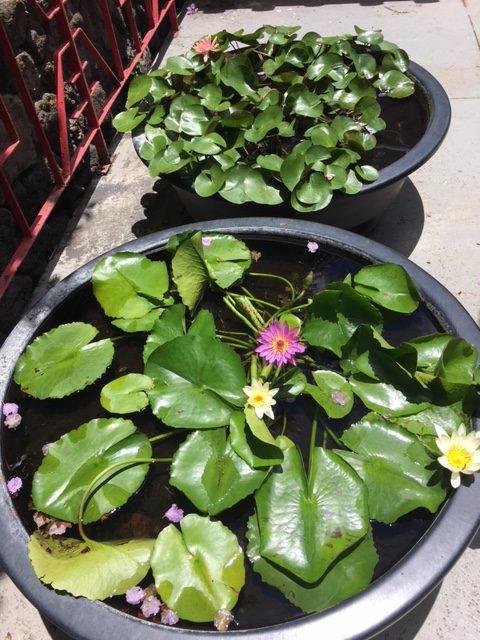
Two large plastic pots with large green leafy plants with purple and yellow flowers.

That Hawaiian Staycation

The good ‘ol U.S. Army brought me here

The Chinese girls and various aloha purveyors bade me stay

So here sits I, on a balcony green with plants, envy and Green Edition Red Bull

I can see the pink Royal Hawaiian where my sister stayed, just across from where she rocked like Gin Blossoms and counted koi

Now I am a more mundane working-class guy, portrayed as teacher and coach

My staycation has stretched out to 29 years on this island

I’ve taken trips to Arizona, China, Georgia, Seattle, and California, but always leave my heart (sacrificed?), on Oahu and sometimes hide it in our small Chinatown.

Been to Maui, Kauai, and Hawaii, but my heart and soul are on Oahu.

Robert Allen Beckvall   12-25

Chinese Youth Poetry Project

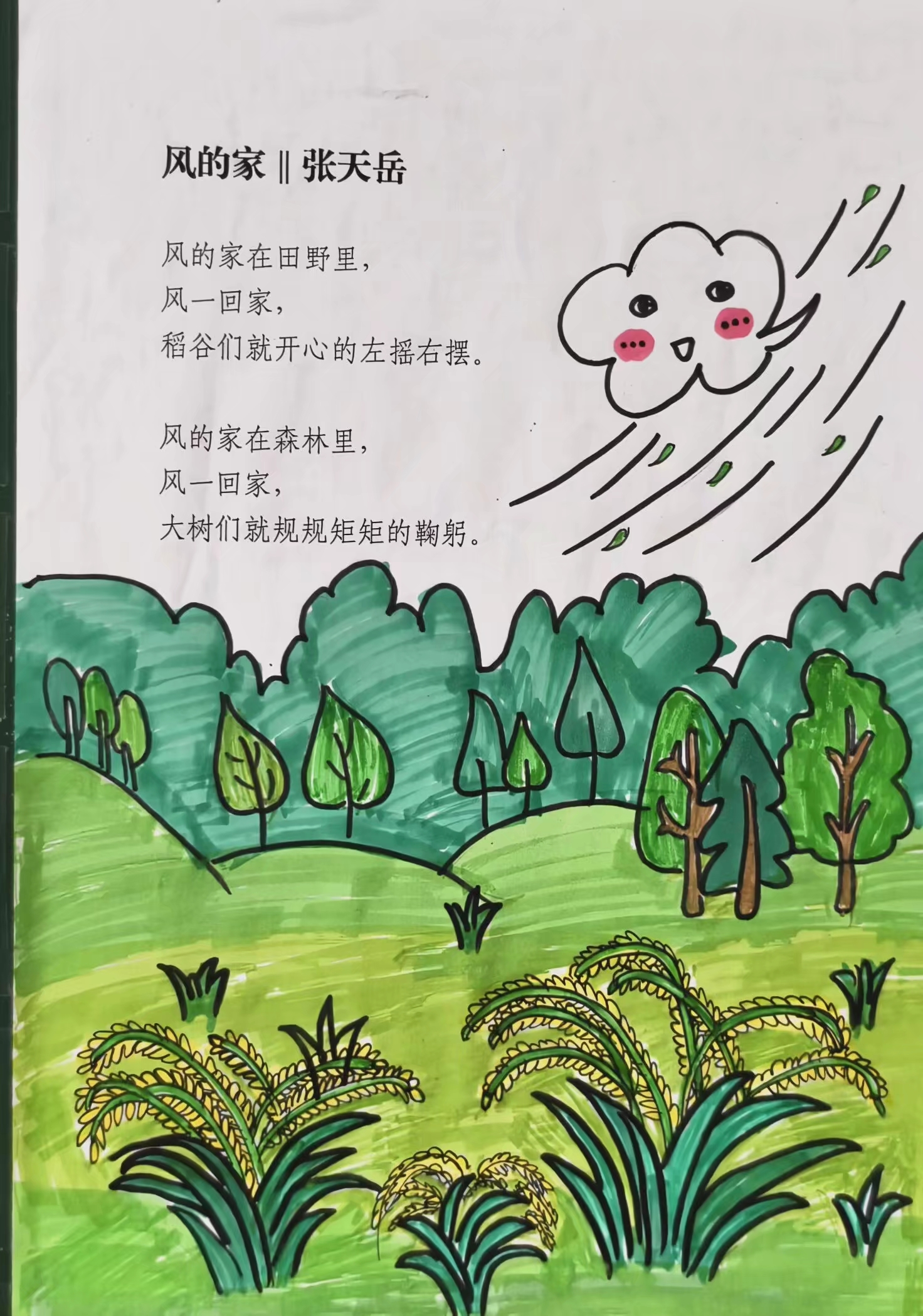
Child's drawing of a cloud with pink cheeks, rain and wind, and green and blue-green trees and grass and some fern-like plants.
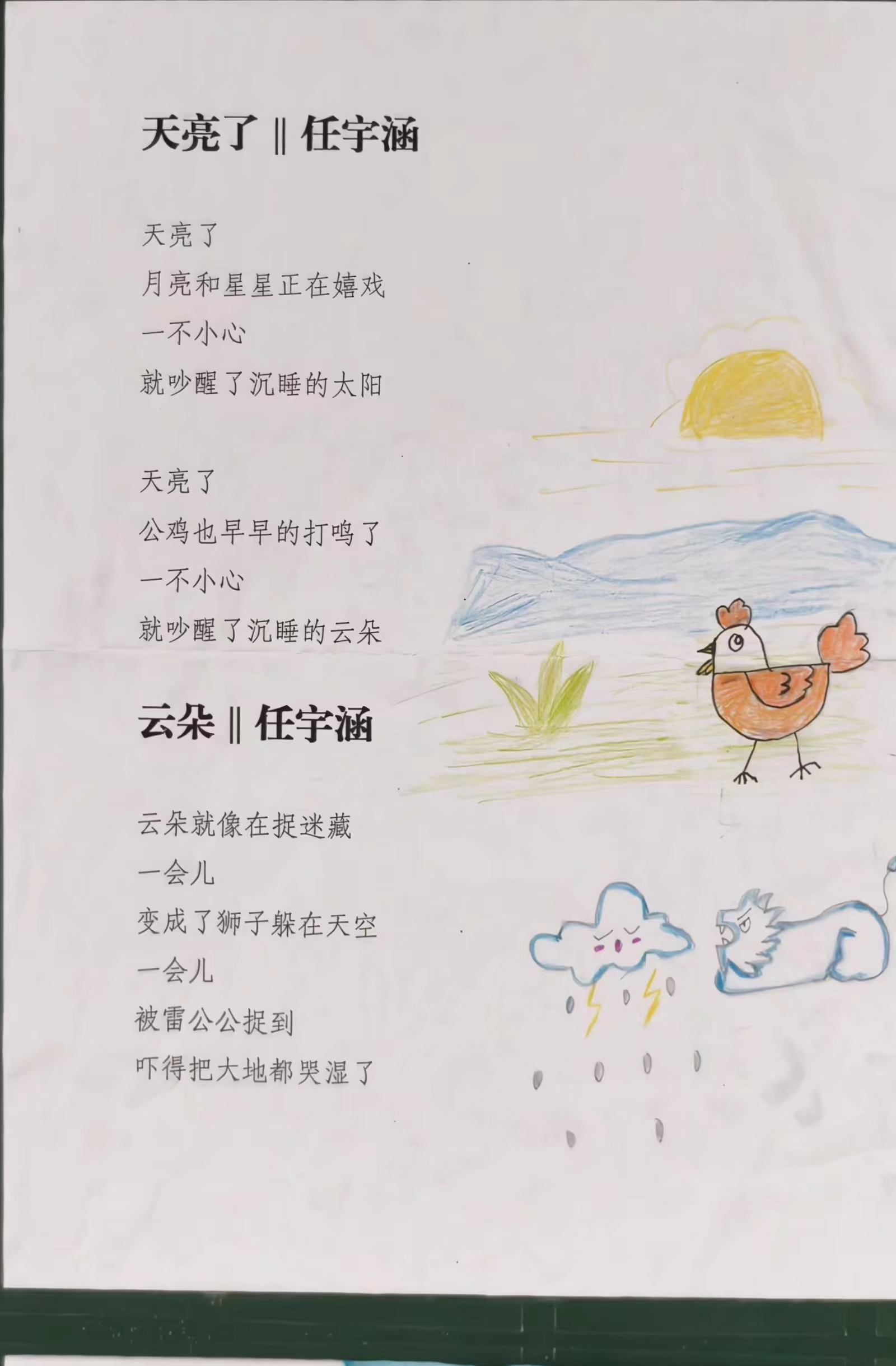
Child's drawing of a rooster with a comb, a rising sun, and distant blue hills. Also a cloud, rain, and a lion.
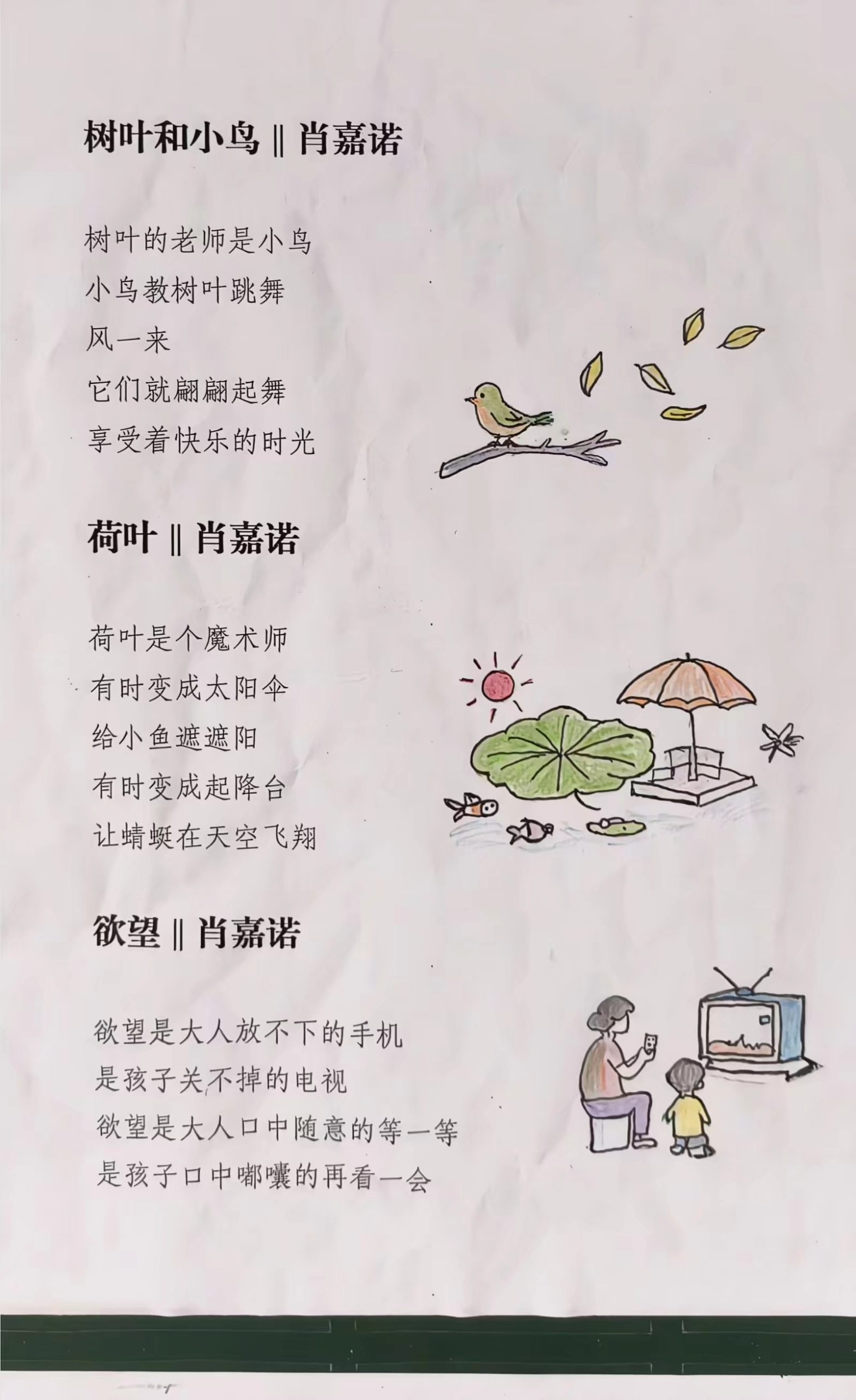
Tiny brown bird on a twig, leaves flying, and a lily pad on a pond with some fish and a beach chair on a sunny day. Dragonfly in the air.

1. 风的家‖张天岳(毓秀小学)

风的家在田野里,

风一回家,

稻谷们就开心地左摇右摆。

风的家在森林里,

风一回家,

大树们就规规矩矩地鞠躬。

 1. The Wind’s Home ‖ Zhang Tianyue (Yuxiu Primary School)

The wind’s home is in the fields;

When the wind comes home,

The rice plants sway happily left and right.

The wind’s home is in the forest;

When the wind comes home,

The big trees bow politely one by one.

2. 夜深了‖辛婉怡(毓秀小学)

夜深了

大地也安静下来了

听,虫儿在唱歌

看,星星在眨眼

闻,花儿在暗暗飘香

夜深了

小宝贝听着歌谣

沉沉地睡去了

只留下妈妈

在台灯下织毛衣的身影

 2. Night Falls ‖ Xin Wanyi (Yuxiu Primary School)

Night falls,

The earth calms down too.

Listen, the insects are singing;

Look, the stars are blinking;

Smell, the flowers are quietly fragrant.

Night falls,

The little baby listens to lullabies,

Falls into a deep sleep.

Only Mom remains,

Her figure knitting sweaters by the desk lamp.

3. 梦想‖侯峻熙(毓秀小学)

梦想在世界跑来跑去

像奔跑的运动员

一路来来回回穿梭

一直到成功的尽头

 3. Dream ‖ Hou Junxi (Yuxiu Primary School)

Dreams run around the world,

Like running athletes,

Shuttling back and forth all the way,

Until the end of success.

4. 风弟弟‖侯峻熙(毓秀小学)

顽皮的风弟弟

吹倒了妈妈的花瓶

里面满满的幸福和温暖

都洒满了整个世界

 4. Little Brother Wind ‖ Hou Junxi (Yuxiu Primary School)

Naughty Little Brother Wind

Knocked over Mom’s vase.

The full happiness and warmth inside

Spilled all over the world.

5. 时间‖裴熙月(毓秀小学)

时间

是一只可爱的小白兔

它在岁月的长河里奔跑

我一回头

它已经跑远了

时间

是一列行驶的火车

我还没来得及看风景

它已经开到下一个站台

5. Time ‖ Pei Xiyue (Yuxiu Primary School)

Time

Is a cute little white rabbit.

It runs in the long river of years;

When I turn back,

It has already run far away.

Time

Is a moving train.

Before I can enjoy the scenery,

It has arrived at the next platform.

6. 星星的学校

河北省石家庄市藁城区贾市庄镇贯庄小学 吉柯冉 9岁

星星的学校

在月亮住的地方

他们有一群一群的伙伴

月亮老师有时教写字

有时教算数

有时教唱歌

他们拍拍小手放学了

太阳公公

把他们接回家

关上门做功课

 6. The Stars’ School

Ji Keran, 9, Guanzhuang Primary School, Jiashizhuang Town, Gaocheng District, Shijiazhuang City, Hebei Province

The stars’ school

is where the moon lives.

They have groups of friends.

Teacher Moon sometimes teaches writing,

sometimes math,

sometimes singing.

They clap their little hands and finish school.

Grandpa Sun

comes to take them home,

and they close the door to do their homework.

7. 翘起的头发

河北省石家庄市藁城区贾市庄镇贯庄小学 刘怡杉 9岁

头发和发圈吵架了

发圈一扎头发

头发就生气地跑开

生气了还不好哄

小嘴巴撅得高高的

 7. The Sticking-Up Hair

Liu Yishan, 9, Guanzhuang Primary School, Jiashizhuang Town, Gaocheng District, Shijiazhuang City, Hebei Province

Hair and the hair tie had a fight.

As soon as the hair tie tries to hold the hair,

the hair runs away in anger.

Once angry, it’s hard to soothe—

it pouts its little “mouth” high up.

8. 雪的朋友

河北省石家庄市藁城区贾市庄镇贯庄小学 张家行 9岁

雪和北风

是一对好朋友

雪一下

风就吹

他们飘来飘去

闹着玩

小朋友也是

雪的好朋友

雪一下

小朋友就笑

打雪仗

堆雪人

扔雪球

 8. Snow’s Friends

Zhang Jiaxing, 9, Guanzhuang Primary School, Jiashizhuang Town, Gaocheng District, Shijiazhuang City, Hebei Province

Snow and the north wind

are good friends.

When snow falls,

the wind blows.

They drift around,

playing tricks.

Children are also

snow’s good friends.

When snow falls,

children laugh,

having snowball fights,

building snowmen,

throwing snowballs.

9. 小草的学校

河北省石家庄市藁城区贾市庄镇贯庄小学 薛若彤 9岁

春天教小草们长高

淋几滴春雨

他们长得更高了

春风走过

小草们开始跳舞、狂欢

春天老师躲在天空的云朵上

看着他们上自习

 9. The Grass’s School

Xue Ruotong, 9, Guanzhuang Primary School, Jiashizhuang Town, Gaocheng District, Shijiazhuang City, Hebei Province

Spring teaches the grass to grow tall.

A few drops of spring rain,

and they grow even taller.

When the spring wind passes by,

the grass starts dancing and celebrating wildly.

Teacher Spring hides in the clouds in the sky,

watching them study on their own.

10. 春天的闹钟

河北省石家庄市藁城区贾市庄镇贯庄小学 薛家硕 9岁

春天来了

我还在梦中

美丽的花悄悄地开了

小蜜蜂飞到花上

用它的小手拨弄着花钟

滴答滴答

我被春天的闹钟吵醒了

 10. Spring’s Alarm Clock

Xue Jiashuo, 9, Guanzhuang Primary School, Jiashizhuang Town, Gaocheng District, Shijiazhuang City, Hebei Province

Spring has come,

but I’m still in my dream.

Beautiful flowers bloom quietly.

Little bees fly to the flowers,

tinkering with the flower clocks with their little hands.

Tick-tock, tick-tock—

I’m woken up by spring’s alarm clock.

11. 棉花糖

河北省石家庄市藁城区贾市庄镇贯庄小学 裴晨宇 9岁

冬天在吆喝

棉花糖,棉花糖

我跑出去

舔了一大口

凉凉的棉花糖在胃里

甜甜地抱住我

11. Cotton Candy

Pei Chenyu, 9, Guanzhuang Primary School, Jiashizhuang Town, Gaocheng District, Shijiazhuang City, Hebei Province

Winter is shouting,

“Cotton candy! Cotton candy!”

I run outside

and take a big lick.

The cold cotton candy is in my stomach,

hugging me sweetly.

12. 云朵

河北省石家庄市藁城区贾市庄镇贯庄小学 李忆佳 9岁

云朵伤心了

哗哗哗

眼泪直掉

太阳跑出来安慰它

给它变出一个彩虹

云朵开心地笑了

12. Clouds

Li Yijia, 9, Guanzhuang Primary School, Jiashizhuang Town, Gaocheng District, Shijiazhuang City, Hebei Province

The cloud is sad—

whoosh, whoosh, whoosh,

tears keep falling.

The sun runs out to comfort it,

making a rainbow for it.

The cloud smiles happily.

Poetry from JoyAnne O’Donnell

New Year’s 

This year like a fresh white page

Still warm from the press of tomorrow.

Midnight spills sparkling light on the snow

Time exhales, fast but taming.

We step forward carrying new seeds in our pockets,

Dreams as seashells,

Morning waves of calm

Singing a vibrant new song,

Sunlight rinses the dust 

For our new plans

Like a sea of healthy rhythms

For our new days

To breathe steady as waves

Learning our shore.

Hope stands tall

with a strong tree in winter 

And now a new beginning we grow.