Poetry from David Estringel

“Smooth Whiskey” (originally published by Cephalopress)


tick…tock

tick…tock

The days are long in a life of slow motion. Waking up takes too long, despite the violent assaults of the alarm clock, unchained by a snooze button—-like me—worn down to the circuitry.

tick…tock

tick…tock

Get up late, again. Take a whore bath in the bathroom sink. Wash what needs it and get out the door. Shower’d be nice…really nice. Maybe tomorrow. Probably not, again.

tick…tock

tick…tock

Office clocks–harbingers of death to my soul–lament the dying of the fire, within. Telephone rings perforate the recirculated air of lungs and mouths like a symphony of electric crickets, tuning-up beneath the hepatic glow of fluorescent suns outside my cubicle’s walls.

tick…tock

tick…tock

Driving home in the same car, down the same roads, in the same rancid clothes that need more than just a good airing out, stuck in this bad track mix, playing on a loop, I need a drink. There’s a bottle at home. Whiskey, I think–a gift for my 50th. It goes down, rough, but smooth, after a glass or two or three.

Smooth is good in a life of no motion.

tick…tock

tick…tock

(Repeat All)


“Blue Room” (published by Former People Journal)


Nights are hardest to bear,

alone, atop these unwashed sheets

that smell of you and me, still,

crinkled and heavy with ghosts

of our sweat and loving juices.

I am tethered

to flashes of smiles and kisses

that linger beneath the sweetness of heated exhales.

To smell your breath, again,

and taste you on the back of my tongue.

To pull you into me by the small of your back

and sink into the warmth of white musk–

a tangle of tongues, fingers, and limbs.

To have you, know you, again,

Inside and out, is all I want.

Need.

Laying here, drowning in us,

my legs brush against the cold rustle of sheets you left behind,

cutting the airlessness of this room.

Rolling over, I close my eyes

and sink my face into the depths of your pillow,

escaping the void that even silence’s ring has forgotten,

and take you in, drowning in us,

this lover’s kaddish.

The scent of your hair—

blue fig and oranges—and spit,

are but pebbles on the gravestone.


 “And the Beat Goes On” (originally published by littledeathlit)


Dropping from the air

upon ears like paper blotters on willing tongues,

raging at the bloodlessness of cardboard cutouts against a shrinking sky,

through psychedelic lenses

let me seeeee, let me beeeee the pulse of silent rage

that rails against the vulgar machine

with words

that organize, legitimize, minimize, super-size, tranquilize, proselytize, tantalize, infantilize,

sexualize, stigmatize the suckled teats of long-conditioned truths.


Poking the bear, disturbing the seas of featureless beige,

stirring the comatose anima with battle-cries of sight and sound

that pierce dusty eardrums like sterling icepicks,

repressed wants teeeeem, solemn faces beeeeeam,

liberated in the warmth of a sun that breaks just beyond the horizon on coffee-house stages,

rousing thoughts

to gestate, ruminate, conjugate, propriate, sublimate, fornicate, obliterate, determinate,

propagate, exfoliate dangerous visions, birthed from the unfetteredness of a purple haze.


Fueling the scribblings of furious hands upon white sheets with whisky and cigarettes,

Making, naked, ugly underbellies of the angst-ridden and inflamed

with the glorious promises of their ecstatic treasure-trails,

let’s revel in the coolness of poetry’s heeeeeat, indulged in pollen-dusted skin so sweeeeet

within the honeyed tangles of poets’ asymmetries

to detoxify, dulcify, intensify, demystify, purify, glorify, magnify, beautify, electrify, sanctify

our bodily streams of light that sugar lips and candy the fingertips.


Tearing away at the fabric, unraveling, woven from Gloopstick youth and plasticine smiles,

repulsing at the hoards in their mindless quests for extra-flavor and double-coupon days,

looking for a steeeeeal, wanting to feeeeel,

as hollow dollars crumble to coins when plopped upon unsated palms and countertops.

Think! Think! Think! Think! Think! Think! Think! Think! Think! Think!

We are on the brink

of the Fall of the American Empire.


Dig.


“Old Filament, Broken Bulb” (originally published at Expat Press)

A white bolt from above

rips

through the clouds before our eyes—

an epiphany—

showering cuts upon the kitchen table,

releasing bad blood,

testing our guile

and gristle.
“And the Beat Goes On” was originally published at littledeathlit, “Smooth Whiskey” was originally published at Cephalophress, “Blue Room” was originally published at “Former People Journal, “Old Filament, Broken Bulb” was originally published at Expat Press.
BIO: David Estringel is an avid reader, poet, and writer of fiction, creative non-fiction, & essays. His work has been accepted and/or published by Specter Magazine, Literary Juice, Foliate Oak Magazine, Terror House Magazine, Expat Press, 50 Haikus, littledeathlit, Down in the Dirt Magazine, Route 7 Review, Setu Bilingual Journal, Paper Trains Literary Journal, The Elixir Magazine, Soft Cartel, Harbinger Asylum, Briars Lit, Open Arts Forum, Cajun Mutt Press, Former People Journal, The Ugly Writers, Writ in Dust, Cephalopress, Twist in Time, Merak Magazine, Salt Water Soul, Cherry House Press, Subterranean Blue Poetry, Printed Words, Sunflower Sutras, Tulip Tree Publishing, Salt, PPP Ezine, Digging through the Fat, Haiku Journal, Foxhole Magazine, The Basil O’Flaherty, Three Line Poetry, Agony Opera, Siren’s Call Ezine, Alien Buddha Press, Channillo, and The Good Men Project. He is currently a Contributing Editor (fiction) at Red Fez, Lead Editor/columnist at The Good Men Project, an editor/writer at The Elixir Magazine, fiction reader at riverSedge, and columnist at Channillo. David can be found on Twitter (@The_Booky_Man) and his website at http://davidaestringel.com.

Poetry from Ryan Quinn Flanagan

Snipers on the Roof like Angry Pigeons


Another terror threat

in the city


come down

from the politicos

at Queen’s Park


and it’s snipers on the roof

like angry pigeons


seizing the high ground

like Clausewitz once

demanded


catching the snazzy dinner crowd

in the scope


and when I wave to them,

no one waves back


Quite rude,

I say,

I’m not mounting the curb

and driving a car into

anyone.


Stop waving at them,

she yells.

They’ll probably shoot you

in all the panic.


And back

at the hotel

I climb out onto the

16th floor lookout

beside the exercise room

full of sweaty treadmills

and keep waving.


With a liquor store tall can

raised to mouth.


I can feel them

all ignoring me now.


The whole of the rapid

response team.


As I take off my shirt

and try to lick my own nipples.


Half expecting a bullet

above the kneecap

for all my trouble.


Continue reading

Poetry from Jeff Bagato

Grasses Revolt


Donkey belongs in the race for no reason

but to provide laughter, ass

laugh heard round the world

as America shifts sighing on dinner

table stool—meat for meals

and keep on chewing carnivore,

these our platforms, cherished

like coal oil sugarcane

and gasoline sirens, burning

once started and can’t shut ‘em off—

until the grasses revolt and run

screaming with blades akimbo

to cut money pie out from under

the bean counters and their owners,

the leash slicing tight like necktie

for the asphyxiated blind—

blades bearing castration complex

to new dominions; blades

slashing and getting the red out;

blades horny with new blood

running up roots and drunkening

the vegetable spirit to recklessness

greater than ever absolutely—

blades in and out hearts like pistons

on deep throat double feature,

matinee mimes keep the business

end tickled to a sharper edge;

blades running free, piercing

tires, cutting heads, dueling

with Steven Spielberg for the cinema

of our times; blades so dashing

they shame Barrymore & Flynn;

blades to make momma cry;

blades caught in the toilet

with their heads held high;

blades upon figurehead,

cost of business rising

till Wall Street tears flowing

ticker tape red, their eyes

filling up with a green

of a different swallow

Continue reading

Co-Editor Rui Carvalho’s New Book

The book Pieces of Hope by Rui M. is a collection of poems and short stories written in English and translated into Portuguese and Spanish, and also four poems translated into Italian and one into Danish. All work was revised by native speakers and this makes it an excellent tool to learn different languages. The book also contains inspiring artwork.

Please contact the author for preorders or queries: ruiprcar@gmail.com.

With Synchronized Chaos’ team’s best regards.

Moving owards being creaturely: Amy Sass’ play “Time Sensitive” at Oakland (CA)’s Flight Deck Theater

Ragged Wing Ensemble’s Production of Amy Sass’ play Time Sensitive at Oakland’s Flight Deck Theater.

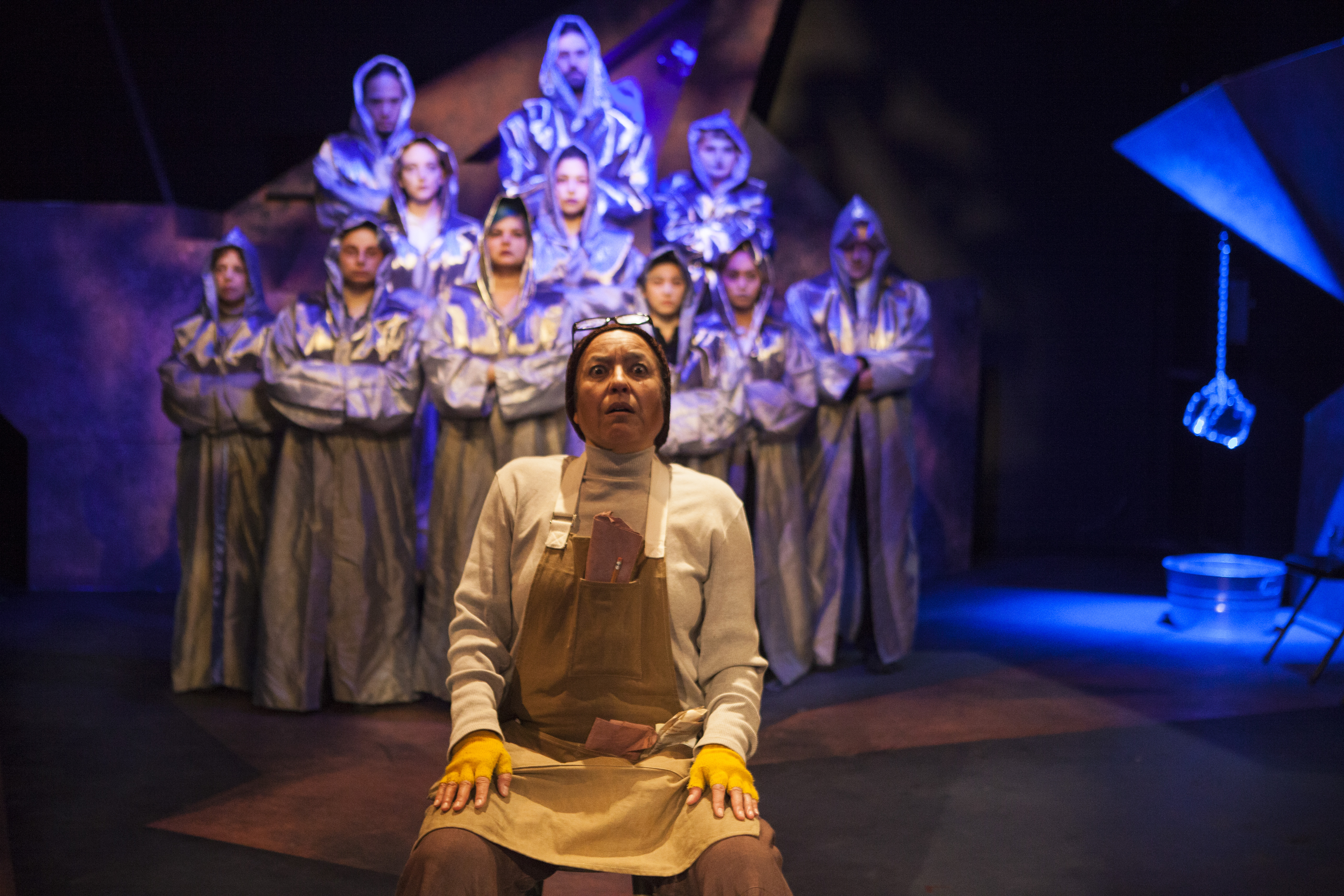
Simone Bloch, right, as the Clockmaker with the Ice Monks. Photo: Serena Morelli for Ragged Wing Ensemble.

In a recent article in Counterpunch, Wes Jackson and Robert Jensen argue for the return to a ‘creaturely’ worldview based around self-organizing renewability coming out of complex and vibrant ecosystems. They believe that it will better equip us to care for the planet and survive as a species than the industrial worldview, which is non-renewable, specialized, mechanical, and requires large amounts of concentrated energy to maintain.

Let’s Get ‘Creaturely’: a New Worldview Can Help Us Face Ecological Crises

Amy Sass’ new play Time Sensitive, now showing at Oakland’s Flight Deck Theater, echoes some similar sentiments.

‘Ordovician. Silurian. Jurassic. Cretaceous,’ chants a swaying ensemble, dressed in silver monk-like robes, during at least one interval in Time Sensitive. This and other interludes connect the characters’ individual stories with the broader narrative of humanity’s search for its place within the natural world.

Suspended blocks of melting ice provide a constantly dripping backdrop, alluding to climate change while reminding us that the rest of the world operates according to different timescales than that of our modern city life.

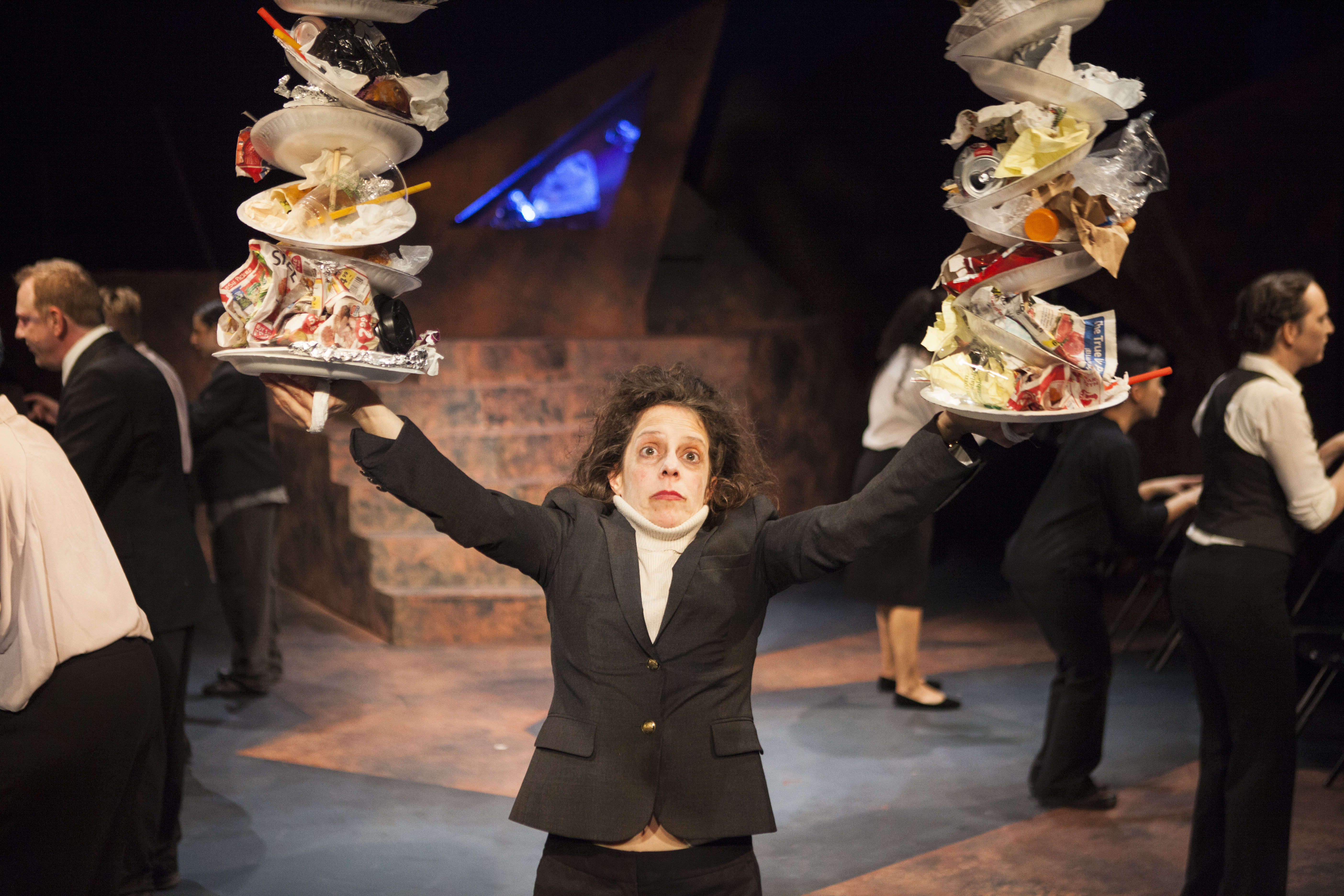
Many of the characters’ stories incorporate time as a theme, while suggesting that we can only go so far in modern society to cover up the biological and emotional realities of being human. A bank employee goes to great lengths to create perfect events for her company, even speeding up her pregnancy in hopes that it won’t interfere with work. Yet, she still ends up demoted and her subordinates replaced with robots. The fact that she and her fellow employees compete for roles where they literally carry plates filled with trash highlights both the environmental themes of the play and the disposability of workers in her office environment.

Rachel Brown as Employee One. Photo by Serena Morelli for Ragged Wing Ensemble.

A childless elderly craftsman builds a robotic device to maintain his clocks, and the device, called a KID, ‘grows’ up to realize that the energy it’s absorbing from the city isn’t as pure and clean as it needs. The bank CEO and building owner stares out at the view from the top of his building, ordering an engineer to build higher and higher – then realizes he’s terrified of heights. Even the impoverished pair who survive by any means necessary in the shadow of the skyscraper experience internal struggles: are they going to strive for the money, power and control everyone else in the city wants, or could it be possible to envision a different world?

Time Sensitive brings a great deal of physicality to the stage, as characters carry each other, leap, dance, and move in groups to convey various moods and states of being. Telling these stories through movement that’s as prominent as the dialogue further highlights the theme of how our bodies and the natural world reassert themselves despite our efforts to impose the urban life that we consider ‘civilization.’ The dialogue also reflects this physicality, as characters speak directly, even scatologically, at times.

Birth and death are two major ways that nature imposes its timescale onto our lives, as we have limited ability to reschedule either of these events. And the characters here grapple with nativity and mortality, ultimately finding, through some cleverly juxtaposed stage pairings, that both can be better faced together.

This story left me with many points to ponder. Certainly the universe is much larger and more enduring than our short-term desires for career success, and we’re not going to be able to overwrite our own, or our planet’s biological makeup in a few centuries. And we do need to think about the impact of our decisions on future generations and on the Earth.

I was left wondering, though, if scrambling for resources and being in a constant hurry is really that unnatural, given the short lifespan of many animals and their constant quests for food. If we’re going to go back to a more natural way of living, if we’re going to embrace our own natures and the ecosystems around us rather than completely replacing them, let’s think about how to do that without just replacing one ‘rat race’ with another.

And, how far can we judge the impoverished character who sought to grab some of the wealth of the city? His character devolves into greed for much more wealth than he needs to live and he rejects his friend who doesn’t share his passion. But is there a middle ground between being so sweet/flighty that you give away your last pair of shoes to a pigeon and bring yourself harm, and mimicking the values of the most powerful people in mainstream society? How do you care for yourself and meet at least your basic needs while still living in harmony with the earth and without becoming obsessed with success and power?

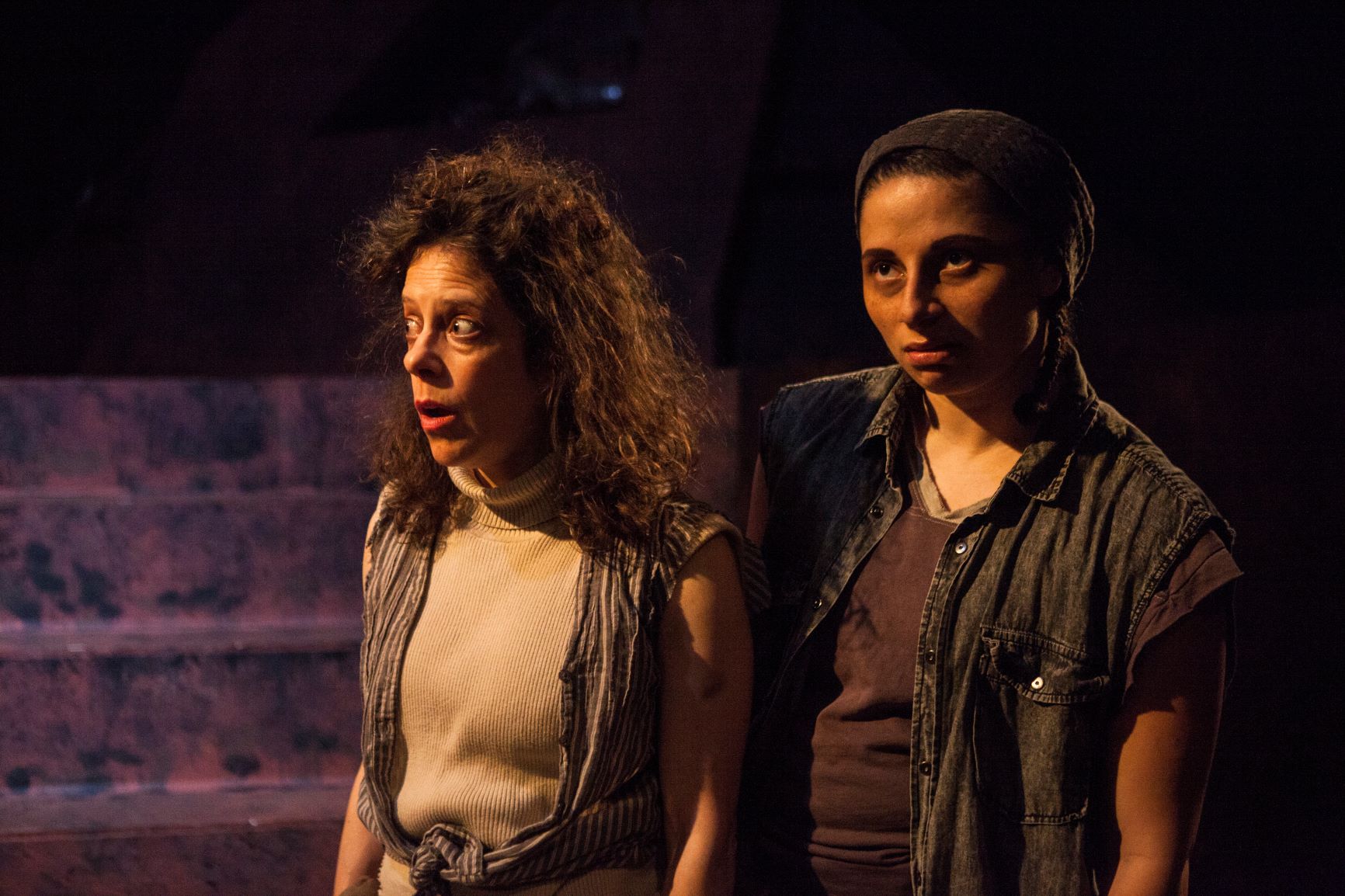
Rachel Brown left as Penny and Alicia Piemme Nelson as Roach. Photo by Serena Morelli for Ragged Wing Ensemble

Some of the play’s most poignant and thoughtful moments came from the old man and the KID, who takes a Velveteen Rabbit-like journey towards becoming real. They, more so than the people at any socio-economic level within the city, had the time and space for thought and feeling, and could envision a better and more integrated and balanced life.

Their journey together, their ‘birth’ and death, most brings to mind Jackson and Jensen’s concept of being ‘creaturely’ – and it is they who ultimately show the way out into a broader world beyond the confining city.

From Ragged Wing, note on the production: 

Originally created in workshop five years ago, Ragged Wing’s new production features an updated script as well as a deep collaboration with climate artist Carter Brooks and his ice-art, and environmental scenic design by Oakland School for the Arts Chair of Production Jean-François Revon.

Time Sensitive runs at Oakland’s Flight Deck, 1540 Broadway.

Apr 6 – May 4th, 2019

FRI & SAT 8pm,  SUN 5pm

*SAT MATINEES 2pm:  April 27, May 4

Partnered Reading, March 29th, at Portland (OR)’s OpenHaus


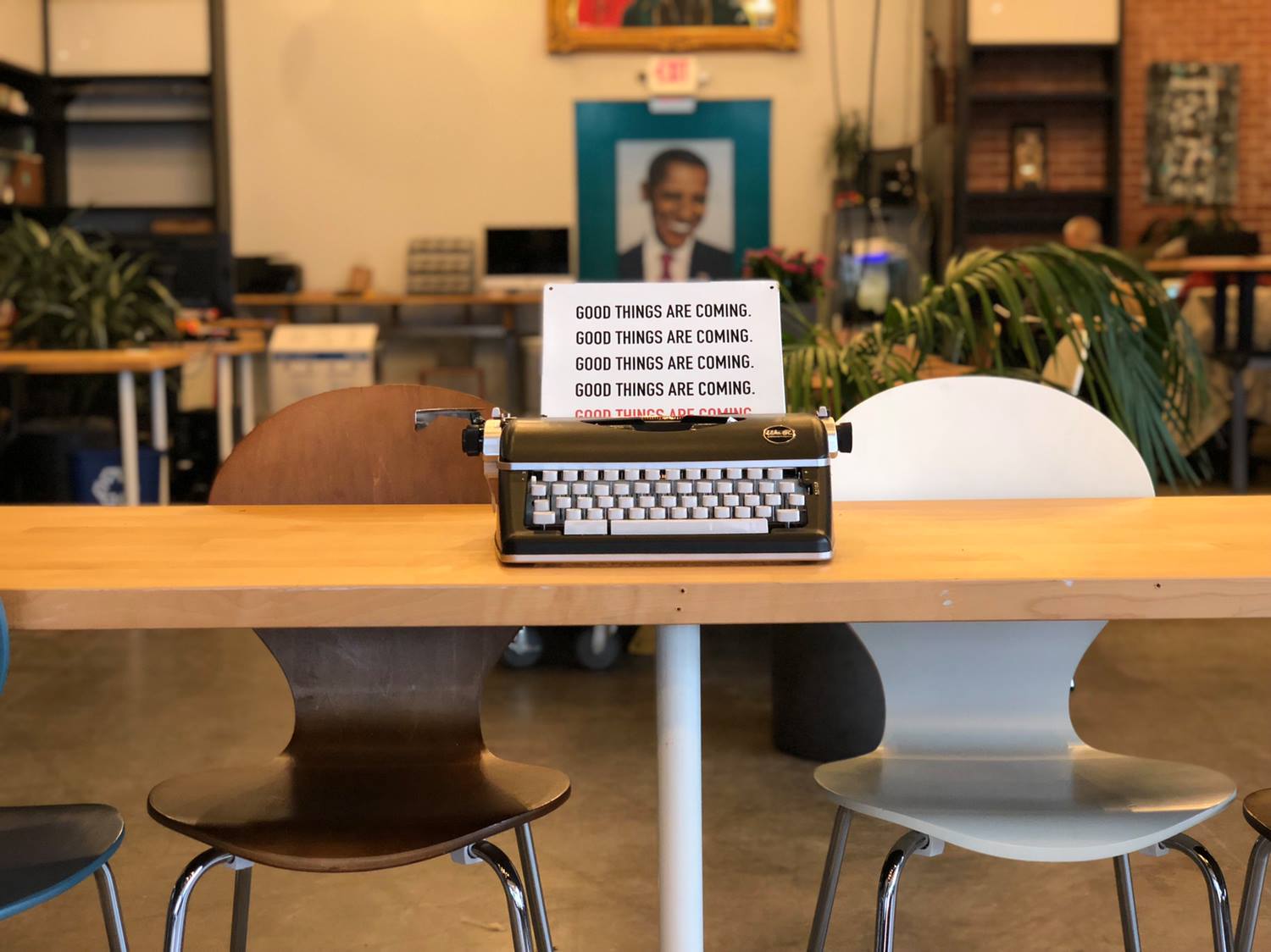
Good Things Are Coming!

This month, in lieu of a normal issue of Synchronized Chaos Magazine, we share some of the pieces that writers are presenting at the offsite event that Synchronized Chaos Magazine is co-hosting during the Association of Writing Programs’ annual conference.

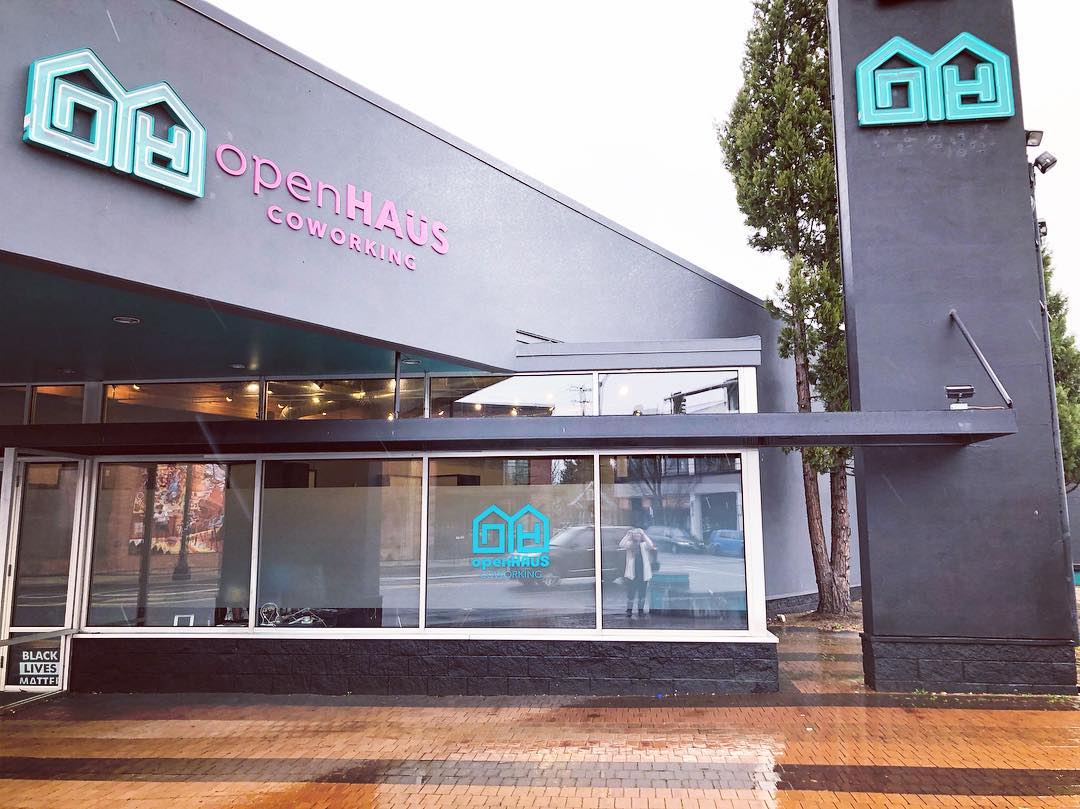
Several Synchronized Chaos contributors are reading in this event, the Partnered Reading with the Broader Community, held at 6pm at the OpenHaus coworking space (5020 Martin Luther King Blvd) on Friday March 29th. These include Scott Thomas Outlar, J. Dorroh, Leticia Garcia Bradford, and Doug Hawley.

This is a partnered reading where publishing and book marketing professionals create work in response to, and inspired by, pieces from emerging authors. The readers have paired up and created together over the past couple months and each pair will read on stage at the OpenHaus. Idea is to connect more experienced authors with up and coming writers and promote creativity and mentorship.

This is a chance for professionals to read and consider, then engage with, work from the greater writing community. We welcomed and actively recruited all sorts of guest readers, including people from the POC, neurodiverse, LGBT, disabled, homeless and low-income and other marginalized communities to participate in this event.

Also, Bonnie Greene, Melissa Moon, Lisa Loving and others will come and read some pieces by, and about, writer and artist Tony LeTigre, who regularly wrote for Synchronized Chaos and edited a few issues in 2016, and sadly passed away in a traffic accident January 19th: https://www.marinij.com/2019/01/22/greenbrae-mans-circle-stunned-by-freeway-cycling-death/

Here’s the Facebook event page for the evening of readings, RSVP is appreciated but not required: https://www.facebook.com/events/344609806131726/

We aren’t able to share all of the work because some people have elected to pursue publication in outlets that don’t accept work previously published elsewhere. If that’s you, and your work is published here, please immediately comment or email us at synchchaos@gmail.com and we’ll remove your piece.

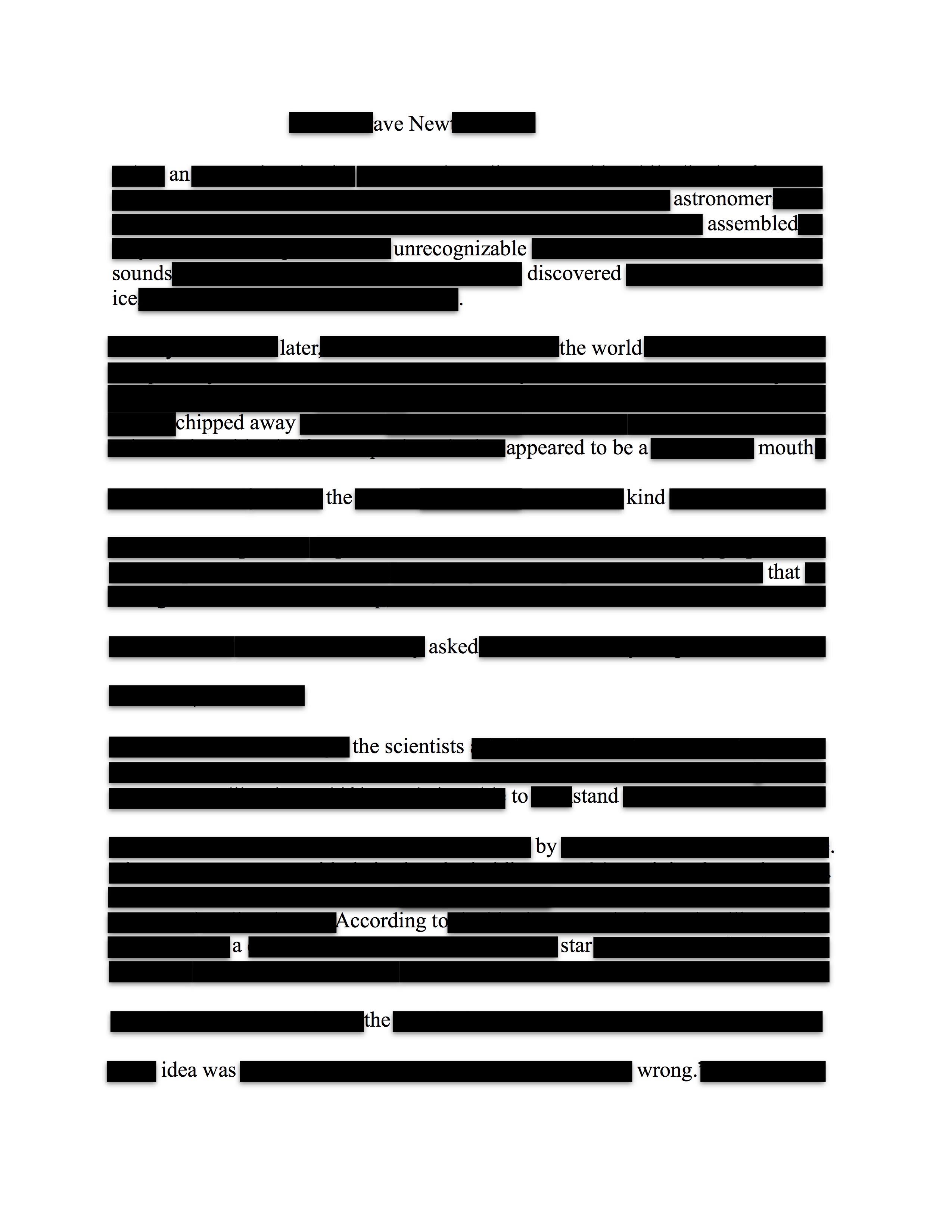
Claire Bateman and Sione Aeschliman explore spiders in various creepy crawly and elegant ways. Doug Hawley writes of an intergalactic space force and alien squids, and again of newts,to which Cati Porter responds through an erasure poem, where she takes his story and removes much of the language so that the remaining words form a new and different piece in themselves.

J. Dorroh, high school science teacher, dives into his true passion, swimming. Sybilla Nash speculates on what Tupac Shakur could have done had he not died young, while Scott Parker reflects upon the experience of reviewing his high school students’ poems inspired by Tupac after his death.

Sean Cearley contributes a concrete poem, words suggested by and superimposed onto images. Each phrase sounds as if it could be part of a larger piece. J. Dorroh writes a piece that explores the limits of human thought and endurance.

Rebecca Smolen and Leticia Garcia Bradford reflect on how the love, accomplishment, creativity and other delicious berries they seek are often just out of reach, while Robert Egan grapples with the limits of human and official capability to respond to floodwaters.

Vannessa McClelland dives into a troubled but creative mind. Gina Stella D’Assunta explores the challenge of navigating life as a vibrant bon vivant with unpredictable and painful chronic illness, and Cati Porter reinterprets Gina’s spoken word piece as a poem where punctuation and line breaks illustrate the physical limitations of a disabled body.

Edward Morris regales us with a glittering tour-de-force Old English prose piece., and Elyana Ren creates another tale inspired by Morris and Dickens. Dorothy Place lends her pen to the tale of determined, yet tragicomic, unemployed Solomon, hoping to win back his wife and his income with his modest imagination.

Scott Thomas Outlar crafts poetry and prose inspired by Heath Brougher’s unique form and style.

Huda Al-Marashi (First Comes Marriage) and Marivi Soliven (The Mango Bride) explore love, family, and the immigrant experience. Shahe Mankerian writes poetically, formally of love, echoing the sentiments of Huda’s book.

Jasmin Johnson contributes a meditative story on figuring out how to process death and grief, mourning and thus valuing the lives of loved ones marginalized by mainstream society.

In another poem she draws upon the experience of baptism, symbolically ending one’s self-directed life and being resurrected as a new person in a new life guided by God, as a kind of parallel to Mindy Ohringer’s piece about the writer’s journey. In Mindy’s short story, an aspiring writer learns to follow the leadings of their unique pieces rather than writing whatever seems literary to their audience. Mindy also contributes a thoughtful response to another of Jasmin’s poems.

We hope you enjoy the work that’s published here, and we look forward to continuing to host events in the future. Our regular editions of Synchronized Chaos Magazine return May 1st with a combined April/May issue.