Henry Bladon is based in Somerset in the UK. He is a writer of short fiction and poetry with a PhD in literature and creative writing from the University of Birmingham. He is the author of several poetry collections and his work can be seen in Poetica Review, Pure Slush, Truth Serum Press, Lunate, and O:JA&L, among other places.
Celebrity,
“cultural attention,” fame (“that last infirmity of noble mind,” as Milton said
in “Lycidas,” another elegy), is fickle, often very strange, sometimes
preposterous. Andy Warhol may have been an optimist: in the future everyone
will be famous for no more than fifteen seconds, with anyone famous for longer
than that in serious danger of being trolled by the envious until they wish
they had never been heard of.
Yet
there was, at one time, a point to fame: the holding in memory by a culture, a
nation, a people, of exemplary beings whose deeds inspired the rest of us to
strive to shape ourselves into something truer, nobler, finer—proofs of what a
person is capable of for good. We have examples enough of the contrary, their
“fame” one more proof of our eternal human folly.
The
noble spirits among us go almost unseen, unregarded; condescended to with a nod
here, an award there, but taken for granted for the sake of the mad men, the
mirrors of our weakness, who genuinely fascinate us. We are of course free
either way—but, born ignorant, needy and weak, and needing as we do to learn
everything from the darkness of our beginning, we require examples to teach us
which to choose: nobility, infamy, indifference, golden mediocrity? Or?
One
criticism of democracy has always been that it pretends the ordinary person,
the “common man,” capable of few or no superlative acts, nor claiming to be so,
is an ideal. And yet perhaps it is one, an ideal worthy of respect and value:
the basic decency of the ordinary person—once the adolescent manias have been
seared off via an acid bath in reality, leaving a rooted awareness of vulnerability,
our ultimate powerlessness—is surely closer to the reality of the human
condition than the brief exhilarations of conqueror, genius and saint.
The
exceptional person inspires us to demand more from ourselves, sometimes more
than is possible—they can be as cruel to those around them who are less able to
endure it, as toward themselves. The ordinary person reminds us that our limits
are as absolute as our promise; that the greatest of all human beings will be
never more than human: that all of us live in bodies that are born, are
vulnerable to vicissitudes we can neither prevent nor even know the existence
of till they strike us, and that perish as completely as if they had never
been.
Which
makes it all the more revelatory of our painfully contradictory position—as
vulnerable, mortal, and limited beings of flesh, blood and bone who at the same
time have the minds and spirits, the gifts of gods, demons and angels, and the
will, in our small way, to use them—when we see a direct expression of the
nobility of our spirits meeting the nothingness and cruelty of our bodies, and
the meeting does not end in stalemate, but in an eloquence that, while only a
partial victory, is nevertheless a sign of the holiness of existence, of life
and mind, of humanity and the world.
Such
a revelation I believe can be found in this book. For the poet Ivan Argüelles
has given us a book of great beauty and emotional power, heart rending and
moving, because we see enacted in it a human nobility in stark confrontation
with ultimate human weakness—in woe and wonder, bafflement, grief, and a
strange and grateful joy.
Early
in 2018, the poet and his wife lost their son Max. Max had suffered for almost
four decades from encephalitis, an inflammation of the brain contracted when he
was ten years old. He spent most of his life with his parents, moving from
crisis to crisis, in and out of hospitals, severely challenged in mind and body
if not in spirit. In recent years, the poet had also lost his brother and
identical twin, José Argüelles, about whom he has written eloquently. But this
new death, though long expected, clearly wounded at an even deeper level,
calling up an anguish not only over the loss of what was, from all accounts, a
loving and gentle soul, but over the mystery, the apparent cruelty and
senselessness of his son’s fate.
The
result has been an anguished outpouring of poetry, a despairingly eloquent
questioning of life, the universe and the emptiness suffusing it, of himself,
the world, and the void; of “the Unknown,” as he puts it—a hopeless yet
determined quest for an answer he knows, believes, suspects, and fears cannot
be found. The poems have been collected into this, his most focused and moving
book – “HOIL” was a word of unknown meaning that (according to the poet) Max
wrote on various drawings in his early childhood, and thus especially
appropriate for this book.
In
these poems Argüelles displays what anyone who knows his work would expect: a
seemingly limitless inventiveness of startling imagery, a gift for paradox
seducing assent, surrealist elisions of logic that seem as natural as
breathing, and a near perfect ear—coupled with a mastery of condensed statement
that demands, and rewards, close attention, to say nothing of a depth of personal
feeling and illumination, vulnerability, in some ways unique to his poems here.
There
are poems “spoken” by Max:
I
can’t tie my shoe strings
my
pulse is fluttering madly
black
spots devour my left eye
and
people randomly assembled
all
with someone else’s hands
what
are they doing and saying
where
is the illuminated globe
and
the scissors that cut the wind
—from SHORT CIRCUIT
And
poems spoken to him:
tell
me you’ve just gone
to
a temporary Elysium
where
flowers are made of paper
in
colors that last a day
a
place where they burn water
because
death does not exist
tell
me that on the other shore
your
hands are still making
shadows
that the blind can feel
—from MAGIC MAX
There
are poems about Max:
great
and splendid the mornings when
in
your magic chair you greeted the first light
.
. .
and
with joy bush herb grass tree leaf
beloved
of bug and bird alike you blessed
.
. .
and
when you reached your happy hand forth
to
greet and bless the homeless and hungry
who
in their morning passage came to you
a
benediction in their grateful smiles
—from SAINT MAX
And
about his child’s game of traveling through outer space, powered by a favorite
toy:
. . . I was a miconaut
in
my plastic toy sailing the galaxies
—from MAX: A SHORT AUTOBIOGRAPHY
There
are poems about the basic mystery of being:
all
the schools of thought
fit
into a blade of grass
the
heat and magma of the past
the
very turbulence of the cosmos
a
dew drop a petal in the wind
all
expressions of the seen and felt
are
nothing in the sweep of time
.
. .
. . . the rapacious gods
flash
their gaudy crowns
parading
magnificent see-through
bodies
like shadows of alabaster
they
too are nothing but absence
—from IN PERPETUITY
.
. . and the mystery of death:
where
does one go when the door shuts
are
there windows inside or a trap-hole
hidden
in the ceiling or secret words
to
transport the soul to its next destiny
.
. .
does
it feel like an ancient ruined temple
the
feel of moss the scent of damp grass
blind
statues representing the gods
of
futility and longing . . .
.
. .
is
it easier to sleep again to forget what
it
was that was being sought—a hand?
—from AVERNUS
There
are poems made up, partly or all, of questions with no answers:
how
many is number? who talks to the comb?
who
are the zero? what letter comes second?
who
counts the echoes? who sets light in the glass?
who
emerges in the cloud? who sleeps with the child?
who
wakes in the well? who pronounces the moon?
—from THE PURVEYOR OF SOUND
And
poems about the anguish of this death:
the
discarded comb
the
useless shaving brush
and
what the mirror no longer holds
distance
of immeasurable hours
nowhere
now in the spent landscape
of
discarded talismans
—from THE REMAINS
you
have become sleek a streaking flash
in
the night heavens which we scour looking
for
the brilliant dust of your swift passage
into
eternity a micronaut at last
—from MICRONAUT II
And
there are poems about the responsive questioning and questionable responses of
poetry:
when
they wrote that page
who
was at the window watching?
who
could restrain the hands of the wind?
it
came from a chasm of ink
illegible
words of a rotating night
errors
in punctuation and syntax
what
could be the one way forward
if
not opening the side door
and
going directly into the woods
—from FATE
Above
all, there is the embrace of mind, spirit and heart of a noble soul (when will
fame come?) speaking from the depths of sorrow and grace:
you
reached out for a handful of air
to
define your true being the essential inner you
great
internal blossoming of sand and rock
imprinted
with the hearsay of the archaic
enormous
unfolding waves of letters
missives
from secret gods hidden in liquid gold
what
their mouths were telling you in a language
of
fever and ancient fingerprints HOIL
which you wrote in your mysterious passage
to
the underworld riding the enigmatic thunder
—from CHILD-OF-MY-HEART
____
Christopher
Bernard is co-editor and poetry editor of the webzine Caveat Lector. His new novel Meditations
on Love and Catastrophe at The Liars’ Café will appear in 2020.
whatever broken spanish i remember she whispers to me in spanish when she’s feeling sexy i try my best to respond with whatever broken spanish i remember from school her kisses are like the sweetest candy of course, i’m a diabetic
the human condition i don’t mind the pain i have grown to accept it it’s part of the human condition it’s the price for not killing myself as a child my penalty for allowing myself to be stepped on, have my heart trampled and be constantly reminded that i was never good enough to begin with
this weird void another christmas alone stuck in this weird void all my friends live too far away there’s no woman on this earth willing to even take the chance with me too bad, i’m still a fucking dreamer skin tough enough to no longer give two shits
endless strings of lights i remember the dysfunction from my youth at christmas the eventual argument while putting up the fake tree and endless strings of lights i learned all the dirty words by the time i was five hated all the holidays before i reached ten years old not exactly good while trying to incorporate yourself into the world
the last hope i have i look in her eyes and see all the fantasies i never got to have in my youth the last hope i have at ever finding love her neon soul brings what little joy i can actually feel these days maybe one day i’ll convince her there’s actually a future we could share
J.J. Campbell (1976 – ?) is currently trapped in suburbia, wondering where the lonely housewives are hiding. He’s been widely published over the years, most recently at Red Eft Review, Under The Bleachers, Horror Sleaze Trash, Chiron Review and Yellow Mama. You can find him most days on his mildly entertaining blog, evil delights. (https://evildelights.blogspot.com)
Listen Time howling Withering Time Dreaming Time Sleeping
Where we dance Upon our Night’s desires Until the end Of days
DARKLANDS “Ashes to ashes we all fall down holy is the machine”
Into this world We come & go Descend Into history Or madness Or love A longing Hate With A vengeance
So into the Journey The voyage The abyss We go Searching For something Greater than Ourselves
Perhaps A faith A truth A religion Or heroes lost But in the dark The darklands There are no Gods No beauty No voices Muses Or inspiration There is only Fame & money Politics & wealth Control War Devastation Where your Existence Means Nothing But there Is a magick A force greater Than all this Called Truth That is More powerful Than any Darkness Any monarch Or any God Within you
FUCKING SUGAR
There are times That living downtown Walking down streets At night when you hate The noise, the traffic The world as you experience Mankind at it’s finest Going down the shitter
The fat lady Screams on her Speaker phone at Her man who I imagine In my mind To be a skinny little nervous Chain smoking weasel like creature Who flinches at the Slightest tone of her voice The loud fat lady Is asking him questions That sound more like an Interrogation like where Were you? Where did you go? Did you go grocery shopping Like I told you to? Did you Pick up my sugar? My sugar My sugar? There is an immeasurable Almost an eternity Of silence And then, a meek sound A squeak emits back as The mouse man replies “no” I.. I ….I … forgot it.
What?! The fat lady’s voice Goes up ten octaves What!? You stupid fuck Fucking idiot Fucking wasted a trip Out to the store you forgot To get my fucking sugar?! You forgot To get my fucking sugar?! You stupid you stupid Fucking asshole my Fucking Sugar Fuck FuckFuck I’ll get my fucking Sugar myself! I’ll get my fucking Sugar myself! I’ll get my fucking Sugar myself!
And as I walk By her I smile And shake my Head as she Gives my an ugly Stare from her ugly Eyes & ugly face And then It occurs to Me that no matter What I do, who I Help or save that Humanity Is doomed
POLKA WILL NEVER DIE
I was born Raised on Johnny Cash And Herb Alpert
Became a man Listening to metal Punk & goth But over the Years the darkness Came And all I have is Southern Goth Now & memories Of years, days gone by Nostalgia Oldies music Blairs from the old Radio MotownStill kicking Ass the blues still Screaming truth But Polka Will Never Die Because it is The true music Of Satan Proof There is A hell Used To violently torture The guilty souls Of men Second Only to Square dance Which The devil Created Himself
BENEATH THIS BODY
You arise awake Early in the morning The sun Its light Rises Upon the Forests The cities The beach Upon Your face
We Become Motion into Moment Distant thoughts In our minds Telling us That something Is not right But wrong This life This world This song Trapped Within a self A world of Our own Making Our voices Suppressed Our hearts Denied But we go on Ignore the Impulse to Run Escape from The cages of Reality Reckoning
But beneath This flesh this Exterior this body The spirit still Breathes the Voice still exists The soul that Merely waits For you to Find it the Poem that waits For you to Write it the Heart that Tells you to Find your true Self For Beneath this Body there Are no cages No restraints No laws Only sanctuary Only refuge Only words The light Through the Window Of the prison Wall
AUTHOR’S BIO:
R.M. Engelhardt is an American Poet and Writer who is the author of several books over the last two decades including Coffee Ass Blues & Other Poems, The Last Cigarette: The Collected Poems of R.M. Engelhardt, The Resurrection Waltz and others. His work has also been published by such journals as Retort, Red Fez, Rusty Truck, Sure! The Charles Bukowski Newsletter, Thunder Sandwich, Fashion For Collapse, 2nd Avenue, The Angry Poet, Winedrunk Sidewalk, Full of Crow, The Outlaw Poetry Network, The Rye Whiskey Review & in many others. His new book of poetry is entitled ” Dark Lands” published by Whiskey City Press, 2019.
Until the right man or woman comes, will I become sexually faithful?
By deduction, you are presently exploring your sexual prowess with different individuals. In other words, you are obviously an infidel. Sexually, are you going to be faithful to your Mr. or Mrs. Right in the making? Time will reveal the answer.
In fact, the issue of Mr. or Mrs. Right is being approached by young men and women by a vague selection of ladies and men they have slept with. In other words, people choose the ones they intend spending the rest of their lives with on the grounds of sexual interaction-probably on the best of competent individuals they have slept with. We must, in concrete terms, based on this context, define the terms “Mr. Right”. Mr. Right is that man who practically believes in chastity and self-control instead of promiscuity while Mrs. Right is the woman who demonstrates a chaste disposition and is never willing to let go of her body to gratify her admirers’ flirtatious desires in the name of a deceptive life-long union.
Given those definitions, it is anticipated that individuals portray a chaste attitude rather than sexually around while awaiting their so-called Mr. and Mrs. Rights. As an employer, the vacancies you place on bill boards, newspapers and other media outfits job offers instructing interested applicants or prospective employees to come with necessary requirements for interested applicants because you have what it takes to fully employ their services. Similarly in wanting to get a chaste woman or a man with self-control, it is expected of you to be self-controlling or chaste. Unfortunately, it is the other way round- people want chaste woman or men of great self-control without possessing these qualities.
If you influence people with promiscuity, how do you intend on getting your Mr. or Mrs. Right? You are like the employer not having what it takes to be one. In the first place, what makes you think that your right man or woman will come to you, given your not-chaste behavior?
When do you think your Mr. or Mrs. Right will come? Do you think the people you slept with are not the so called Mr. or Mrs. Rights?
To an extent, people who are sexually unfaithful have unknowingly been seen as sex objects. Hence, they become “used and dumped” by their partners. Simply, they are “replaced” by other believed-to-be-better individuals by breaking up or demise, separation and even divorce. Eventually, these imbalances become eminent.
Don’t you think it is more upright to be chaste and self-controlling, preparing you for your Mr. or Mrs. Right than depriving people their sexual worth by displaying promiscuity, vaguely pointing the possibility of meeting your Mr. or Mrs. Right, denying people the worth of chastity and respect?
Mary Jane Blalock taught me Algebra I. She had Mediterranean
skin and jet black hair that she wore shoulder length. The ends curled up
toward heaven.
One Monday she didn’t come to school. Mr. Guin, an old man
who kept bricks in his back pocket to help him from falling forward, was her
substitute. His hair was white. His skin was white. There was a lot of dandruff
on his black coat and tie.
It was a crucial time in algebra. Seems that every day in
algebra is crucial. Such a linear discipline. Don’t go to Square 2 until you
understand Square 1. Factoring
polynomials. Anyway, we were stuck with Mr. Guin for a while.
I listened to what he had to say about the topic. He seemed
to know his stuff. Even though my classmates were rude, he ignored it, as if it
hadn’t happened. Maybe he’d seen a lot of action in foreign conflict and
nothing bothered him. Maybe he just didn’t care about anything. But for some
strange reason, I picked up on factoring polynomials and aced the test. When
Janet Blalock returned, she gave me an innocent kiss of the cheek.
2.
Mrs. Schmidt, the art teacher, was having an affair with Mr.
Jennings, the assistant principal. Everyone knew it and gave them their
privacy. Their cars took bay at opposite ends of the faculty parking lot an
hour before the first bell.
I made a bet with my friends that I could manage to secure
videos or pictures of them doing whatever it was that they did two mornings a
week. My key to the school (another story) finally had a purpose. The schematics
of the buildings allowed me to guess where they might have their nest. Afraid
to breathe, I hid and waited close to their makeshift bed.
There was fondling and giggling; partial undressing and
penetration. Shelves rattled; glass jars broke on the linoleum. I forgot to
take pictures.
3.
Mr. Ruffin was in love with the student teacher. We could
tell by his latest poetry that he read aloud every Friday. We felt bad for his
wife, and for Marsha, that he was behaving so badly. But who were we to confront
an adult?
When my father died in January, Paul Ruffin and Marsha came
into my bedroom where I was lying on my bed, avoiding the crowd of people in
the house who’d dropped by to pay their respect and bring fried chicken and
casseroles.
“Here,” he said, handing me a book of poetry. “This might
not help. I wanted you to know that we are thinking about you. You should write
about your feelings when the dust settles.
You might find some inspiration in this book.” Marsha grabbed my hand
and squeezed.
“Thanks,” I said.
“Are you in it?”
“Yes, page 47.” He patted my leg and said not to worry about
my school work. “Marsha can tutor you to help you catch up. She’s really good
at that.”
“Ode to Drosophila melanogaster”
She had a difficult time finding the white-eyed
male under the microscope, and the red-eyed
female. I rearranged the scope for her and
found it every time. “Here it is,” I said.
“Damn fruitfly!” she said under her breath.
I hear the diesel burps of yellow dogs
on the other side of red bricks. “You’ll miss
your bus,” I said. “One more time,” she
begged. I checked the focus once again, and
there he was, brilliant plumage, two globe-like
compound eyes, red like the sun setting before
a hot summer storm. She placed her palms
on the black lab table, slung her pony tail
to the side of her neck. “I SEE IT!” she
shrieked. “It’s so beautiful. I gotta take a
picture, Mister, somehow, please. The bell
rang and I had to send her out into the rain.
School buses don’t wait forever.
“While
Australia Burns”
1.
Widespread
panic, hot hot planet on fire.
One
billion animals charred, burned – the silent
outrage,
people dying, homes as kindling for a do-nothing
Oz
sleeping on the job while oxygen supplies deplete themselves,
while
freakazoid doxology fills up the smoky heavens; while fat tongues
vibrate
lost hearts and souls; while the status quo is honored and worshiped
like
Baby Jesus. You tell me not to worry, that these things happen;
natural
phenomena; a catastrophe that doesn’t involve us.
It’s
on the other side of the planet, right?
2.
I
never bought the bill of sale that Gary Pounders
tried
to deliver in mechanical drawing class. He tried to steal
my
mathematical calculations, my format, and called me
Squarehead
and Tree-lover. I stepped right up to the plate
on
that one, and hit a high pop fly that flew over the river,
over
the ocean, landing on the other side of the planet.
3.
Wouldn’t
line up with the fire and brimstone spewing
from
the pastor’s mouth, the End Times are here, unfolding right before
our
bloody eyes. Waiting since childhood, when I first learned to read,
when
teachers told the truth and said that boys should never cry; waiting
on
confirmation that my foundation was sturdy and reliable.
4.
I
tell you not to worry about these things, that it’s merely a predicament
of
breathlessness, of uncharted territory, of excessive disregard of what the
trees
were
telling me long before we cut them down in order to count their rings.
“Eating Paul and Getting Yoko Ono’s Drink by Mistake”
1.
I ate Paul with meatloaf today. Yoko
Ono drove by the window in a pink-and-white
Studebaker, ran the red light on the corner
as if it wasn’t there. It wasn’t there yesterday
so maybe it wasn’t there today, just something
my mind did to me. I
told him that his beard
looked good and mentioned how neatly he’d
kept it up
2.
since the last time I ate him in the German
restaurant, the one that was closed because
the owners refused to pay their taxes. The
brats were half the size they should have been
but no one complained. It’s not natural to hear
an oompah band crank up in the middle
of the day. Large numbers of Germans
make me
3.
nervous.
The Starbucks barista mixed up my order
with something that looked like a dead wren
in the bottom of some tar. My coffee was too
simple – a grande Americain with whole milk –
so I think my drink was for Yoko. That sounds
like something she’d order.
“Cold
Storage”
While you
are shoveling snow, I am up to my ears in wishful thinking. Traded day-trip to
the
mountains
for becoming one with the refrigerator. I find my childhood on the first shelf,
the stuff that really matters. Latest left-overs, some sort of surprise that
everyone fights over: banana pudding, Hawaiian pizza, cold turkey.
Inside its
bowels, the filthy blood smudges from a leaky steak on a glass shelf, cottage
cheese containers full of the most beautiful mold – dark gray fuzz with hints
of lavender, and the oddest shade of blue. Bacon that’s in the preliminary
stages of breaking down, rotting but ever so slightly; three craft beers, and
part of a colossal green salad. There’s Kikkoman soy sauce, some left-over
Yum-yum shrimp in a small white take-out; batter from unpoured pancakes, five
brown free-range eggs, grape jelly, and all of the ingredients to make some
damn-fine Bloody Marys.
I discover
unimaginable things, unlike tuna salad and left-over vegetable casserole,
pickled beets
perhaps?
Ancient vials of pasty, caramelized substances. The vegetable bins, speckled
and hard-crusted bottoms, dried juices from any combination of green thing and
nerve. Meats, both raw and cooked, stare up at me like tumors. I want to kick
them in the shins, move them out of here, warn them of pending doom, dark and
mysterious. There’e a quart jar of mayonnaise with an expired date, two bottles
of Mike’s Hard Lemonade, a half-full package of Kraft American singles, and a
dozen hearts.
There’s no compromise for what you keep, what you discard, what you treasure and hoard; what you give away to someone in need; what ends up being your favorite thing on the list. House all of it in cold storage, use it judiciously, timely, and as wisely as you know how.
John Dorroh spends time digging in the soil. He travels as often as possible and discovers fodder for poems and short fiction. His poetry has appeared in about 75 journals, including Dime Show Review, North Dakota Quarterly, Ospressan, Selcouth Station, and Synchronized Chaos.
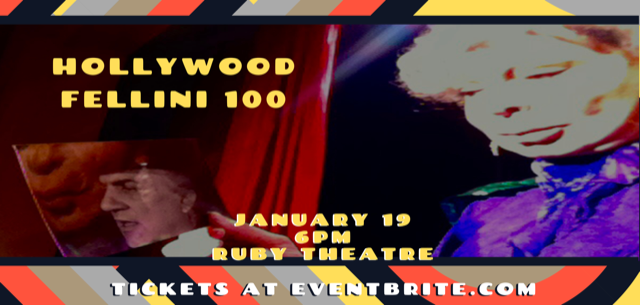
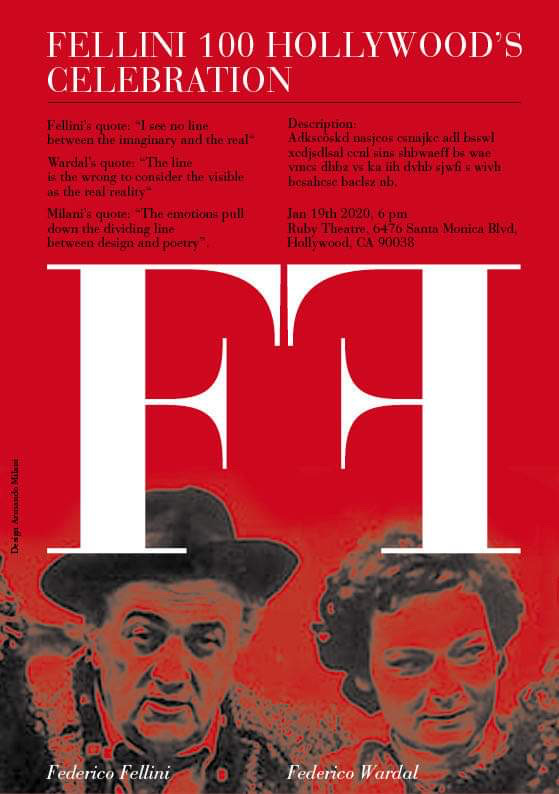
Promotional poster for the Hollywood Fellini event
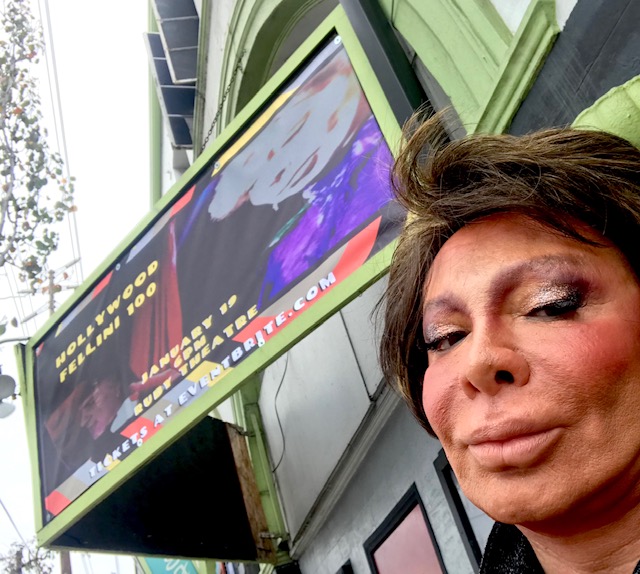
Italian Historical Film Archive/ UNESCO Italian Friends of the Bibliotheca Alexandrina presented a homage to famed director Federico Fellini on January 19th at Hollywood’s Ruby Theater on what would have been Fellini’s 100th birthday.
At this event, Fellini’s last muse, actor and director Count Federico Wardal, screened for the first time his 2020 movie “Federico and Fellini” that reveals the details of the intense and unusual friendship between Federico Fellini and Count Federico Wardal. They met for the first time in Rome at Cinecittà in April of 1975. Fellini was 55 years old and Wardal, 16 years old.
The connection between them was strong despite the significant difference in age and background. Fellini’s youth had been influenced by the devastating misery generated by the Second World War, and Wardal’s youth, on the contrary, by the economic boom and the sexual revolution of the 70s. Fellini had worked to reach economic well-being and the full freedom to express himself artistically and Wardal had taken advantage of the permissive customs prevailing in his time. He left his family at the age of 14 and performed for large audiences, first as an eccentric singer-character who broke the traditional expectations for the bourgeois middle class at the time and then as an interpreter of the theater of the absurd acting roles from leading playwrights Borchert, Becket, Pirandello, Genet, Mrozek and a great leader of the Soviet theater, Vladimir Mayakovsky. Fellini in 1975 was already a living legend and one of the most spectacular icons for Wardal’s generation.
Fellini was drawn in, not only by the spectacular and attractive appearance of Wardal, but also by his personality that knew no barriers to artistic freedom in every area of life. Fellini’s entourage was beginning to age, while Wardal was totally ahead of his time, a volcano of creativity, and this aspect interested Fellini very much. For Wardal, Fellini was the great magical father, living his dream and immersed in the art he aimed to create. These are the main elements that drove the deep partnership between Fellini and Wardal.
Fellini entrusted Wardal with the symbolic role of the adolescent Casanova in his film by that name. But a shocking event which had never happened in the history of cinema took place: a high percentage of the footage of the film Casanova was stolen, including the scenes with Wardal and a short recited monologue by him. For economic reasons, Fellini was forced to change the script of the film. Fellini invited Wardal to recite some scenes of his role again, but, in the meantime, a strong depression had grabbed the young Wardal, who gradually disappeared from his mentor Fellini who in vain called him back for his films The City of Women and Rehearsals of the Orchestra. This great broken friendship was, however, destined to resume its journey and here we stop, so as not to reveal the plot of the film Federico e Fellini presented in Hollywood.
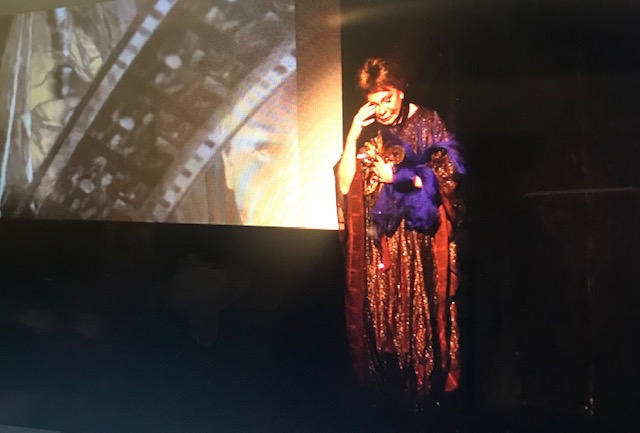
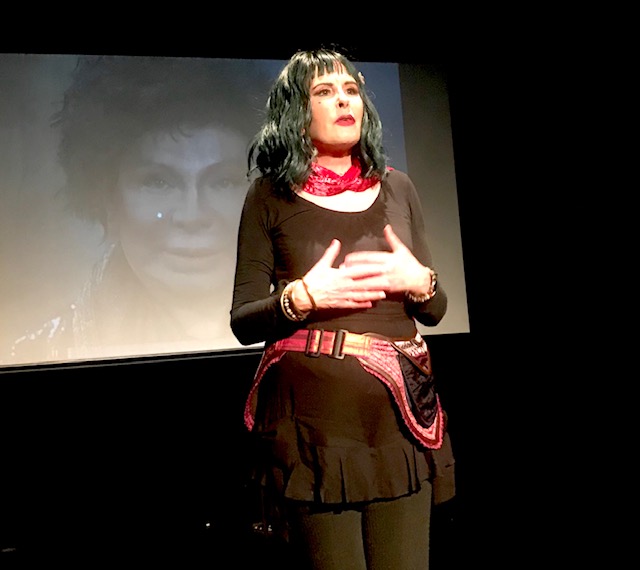
But in Hollywood, during the screening of “Federico and Fellini” there was an amazing surprise: at the 22nd minute of the screening, Wardal came out from behind the screen and performed Federico Fellini’s role live. This totally broke the ‘fourth wall’ and shattered the imaginary and dreamy dimension of the film, making it seem to the audience that the ghost of Fellini materialized on the day of his 100th birthday. Jennifer Glee, the creator of San Francisco’s local TV program Planet Glee and a multifaceted artist, intentionally kept secret the surprise of the live performance during the screening.
Hollywood’s Fellini 100 event gave in that way new life to the legend of Fellini, imprinted in the Walk of Fame and in the Wax Museum. Federico and Fellini is one of five episodes of film entitled La vita che fu Dolce ( The life that was sweet) written by Gabriele Luca Fava. The eminent Italian film critic Graziano Marraffa wrote about Wardal’s movie on December 27th, 2019: “Fellini and the alter ego, a game of mirrors …..in reality, the author Fellini has often had the need to express himself as an individual and an artist by seeking an alter ego in some of his interpreters to create new meta-narrative characters…. Now the internal and public confrontation between the last Fellini muse Federico Wardal and the director Federico Fellini, is represented in a filmic story implemented by a live performance that stratifies and diversifies the various narrative plans, analyzing the reflection on a reality that has become myth, on an unchangeable actuality: “THE SCREEN IS EMPTY”, long live Fellini!”
Marraffa continues: “The spiritual and professional alchemy between the two “Federicos” took place in 1975, during the preparation of the film IL CASANOVA DI FEDERICO FELLINI. Fellini says: “I made up my mind to tell the story of Casanova, a man who was never born, a funeral puppet without personal ideas, feelings, points of view; an unreal Italian imprisoned in the mother’s womb… The unexpected and dazzling meeting with the actor Federico Wardal in the offices of the production company P.E.A., suggested to the Maestro the idea to entrust him with the role of the adolescent Casanova, but a short distance from the filming carried out…the theft of various original negative rolls on film in the Technicolor laboratory of development and printing in Rome. The mystery was not immediately cleared up, however the author’s attempt to re-shoot the scenes starring Wardal was in vain. If it is true that nothing happens by chance, can it be considered that the non-inclusion of this part of the work should be considered consistent with Fellini’s initial sentiment?”
The circumstances around the Fellini-Wardal friendship were so intriguing that now Susanna Mitchell Egan, a well-known UK writer, is writing a book about it. A submerged Fellini emerges from all this. Wardal says: “An unfinished work of art is an eternal drama. A finished work of art only comes to life when someone remembers it … ” So both Fellini and Wardal wanted to leave their work unfinished, as an “empty screen” that desperately wants to come alive.
As Jennifer Glee remembers in her presentation about the Hollywood tribute to Fellini, Mario Fratti, the famous Italian American playwright and author of the musical Nine, about Fellini’s movie 8 1/2, decorated with five Tony awards, told Wardal to reveal his story with Fellini because it is irresistible. Finally, on January 19th, 2020, after 45 years, that story came to life again.
The Fellini tribute will tour many countries. The event’s poster of the two F’s (Federico Fellini, Federico Wardal) was created by the well-known designer Armando Milani. The movie had the cooperation of Antonello Altamura and Javan Jiles.