Poetry from Bethany Pope

Passport

Some people never leave their own backyards,

not really, not in any way that matters.

Even if they get the visa, get on the plane,

they land in Nanchang airport with a year’s worth

of purified water and dehydrated

North American-style macaroni;

fifty aluminium packets of fake cheese.

This kind of person only sees the cracks

in the cement, only notices flaws,

blind to all but the myth of their own country —

a dream of some imagined, singular greatness.

I’d offer to take them out for breakfast

porridge: ground rice, spiced beef, tender slices

of peanut and garlic, served out of

a terracotta urn the height of a child,

but they’d never agree to it and I

lack the patience. Besides, they never last,

not for long, and I’m enjoying my time.

The Undiscovered Country

There’s an unbroken blue sky underneath

the weak-plated shell of my cranium.

Lying on my stomach, beneath that sky

(those skies)

hooking my fingers into the scree

of loose, golden sandstone at the edge of a cliff,

I can peer down into the rotting green breath of the earth

which seeps up from between the fat, dry lips of the crevice.

Tree-tips, curling, fern-like and ancient,

push themselves up from their secret, fertile roots

— just within brushing-reach of my fingers.

This forest has been growing in me for a very long time.

I cannot trace the trunks to the bottom of the loam.

There are animals, possibly monsters, moving,

down there in the dark.

Millions of them, swarming.

Occasionally, I’ll glimpse a flash of bright fur, or

the spark of a scale. I can hear them,

circling the branch-strained remnants of light,

calling,

calling to me,

‘Come home! Come home! Come home!’

and I grip the parched, craving lips of the earth,

until my nails tear and bleed,

clinging to this sunlit, imaginary safety,

to keep myself from jumping.

It gets harder, every day,

to resist.

Bethany W Pope has won many literary awards and published several novels and collections of poetry. Nicholas Lezard, writing for The Guardian, described Bethany’s latest book as ‘poetry as salvation’…..’This harrowing collection drawn from a youth spent in an orphanage delights in language as a place of private escape.’ She currently lives and works in China.

Poetry from Isaac Adjei Boateng

Ike Boat - Poetrician On The Mic

Ike Boat – Poetrician On The Mic

Stars In The SkySITS <— Title Of Poem (TOP)

It’s about nature’s beauty,

To spot how its twinkle.

It brings night time identity

Even when the old grow wrinkle.

Galaxy describe its multitude

This depicts the higher altitude

Stars in the sky.


It’s among the lights of creation,

As it’s competed with the moon and the sun

But, they’re different in terms of position

No matter the shot of the gun.

Truly, the appearance is at night

Which always remain bright

Stars in the sky.


It’s small and big in sizes,

With spectacular white radiation colour above

When stared there’s no wizzes

Sometimes, it expresses and depicts love.

Thus, when drawn to show

Like how the stream flow

Stars in the sky.


No Peace Everywhere <— Title Of Poem (TOP)

It a Biblical fact, nation will rise against nation

How true this is, due to rumours of wars

The cause of it commenced with demonstration

Individuals run but not too far.

Do you remember those you were?

No peace everywhere.


How about the stubborn child at home

Who disturbs the parent almost everyday

They wish after school, he doesn’t come

So as to have no words to say.

But, how can he stay there.

No peace everywhere.


The spectators at the stadium

How the level of fun turns to hooliganism

As if they’ve taken in spoilt colodium

Fighting each other like the inner organism.

Would you accept this here?

No peace everywhere.


The Sunset Drive <— Title Of Poem (TOP)

As I stand in front of the house

I spot the radiation of the sunset.

So I sit quietly and listen without the mouse

Because, they’re safe in the net

Imagine the moving cars on the road.

When they’re tune-in without the toad.

The Sunset Drive.


Guess what, it’ll be nice to get bigger headset

So as to jump and dance to the songs on-air.

But, sometime it’s also better to be on internet

That also makes good and fair

This program is also informative.

And it’s also interactive.

The Sunset Drive.


The above poem is specially dedicated to Sunny 88.7 FM program dubbed ‘Sunset Drive’. It’s often starts at 4:30 pm broadcast from Accra, Ghana. 


The Rain TimeTRT <— Title Of Poem (TOP)

Oh, mine! Oh, mine!

When the weather suddenly change.

It doesn’t matter whether one is at home

Nor the trend of its range

The rain time.


Oh, jeez! Oh, jeez!

Sometimes, the drizzle is like playing an instrument.

When one can hear it on the roofing sheet

It becomes intense moment by moment.

The rain time.


Oh, yes! Oh, yes!

Well, I can feel it when lying on the floor.

And the desire to sleep grips me

Even when there’s no open door.

The rain time.


The Natural Habitat <— Title Of Poem (TOP)

Imagine the fishes and frogs swimming together

Even in the midst of what seems impossible.

Nevertheless, they have course to cope with each other

In order to describe them as double.

The natural habitat.


Imagine the dogs and men living together

It paves the way to become more able.

Sometimes both can go farther

Good things come when one is so sensible.

The natural habitat.


Imagine the birds and the plane flying together

Each goes it ways to ease and ensure the possible.

The intervals make sure they don’t hit one another

Yet their sounds are very loveable.

The natural habitat.


The Cold ConditionTCC <— Title Of Poem (TOP)

Nature is often unpredictable.

So, it’s better to get ready.

Because, the weather is not stable.

Too much of its freeze can bring tragedy.

Man has no means to make option.

That’s why it’s good to pay attention.

The cold condition.


Some can describe its season.

Due to the alteration of the climate.

When passing wind and air chills, it’s the reason.

Even across the ocean, its affect the shipmate.

The newly born baby feels it shivers with emotion.

I guess, different races can’t embrace it sensation.

The cold condition.


Future of it seen remain uncomfortable.

          It’s determined by the concern forecasters.

Who have studied so they’re able.

Many of them are broadcasters

The certainty of it brings protection.

No matter the region of its concentration.

The cold condition.


The Thankful HeartTTH <— Title Of Poem (TOP)

That part of human,

Which is quite symbolic.

And performs diverse functions.

Be it inward or outward.

The thankful heart.


It’s associated with man,

So it eschews what is diabolic.

Yet likes to express appreciations.

Which helps to move forward.

The thankful heart.


How awesome to know even in Oman.

Where some describe certain things a parabolic.

Often in gratitude we say congratulations.

Thus, above all others stuffs afterward.

The thankful heart.

 

Poetic essay from Kahlil Crawford

REDD ARMOIRE

home – a desolate block – died inside of me at Newport Beach where I witnessed a miniature Versailles sidewalk surfing, and learned the fitness virtues of surfboards & yellowtail.

never mind the grungy beachside citizens wading along the oil-contaminated surf- “we’ve still got the best waves” – as evidenced by the splattering of surfer bars and nascent Brazilian cafes.

bikini-clad girls in flip-flops and trucker hats parade up and down PCH and Main sans aim – purpose nor destiny – a quick pedal home toward paternal security

the surf shops hide away long forgotten legends of the tide and sand lamenting an old glory that never was – only imagined.

see, the preservation of a local culture is drowned out not by waves and songs of the seagull, but by corporate cranes migrating North.

Oceanside, California

Poetry from Loretta Siegel

EASTER SUNDAY

Church bells chiming

People climbing cobblestones

Mothers talking

Fathers calling little ones

Hush of voices

Sound of footsteps

Sunrise services begin

Mist of morning veiling treetops

Pinecone fragrance in the air

Joyous voices soaring skyward

Echo back from Mt. Tam’s edges

Weary walkers trudging downward

Children chasing butterflies

Backward glances, wistful smiles

Happy Easter, Tamalpais

Christopher Bernard reviews Songs of Lear at Zellerbach Theater

Songs About an Old Man and the Daughter He Betrayed

Scene from “Songs of Lear” (Photo by Z. Warzynski)

Scene from “Songs of Lear” (Photo by Z. Warzynski)

Songs of Lear

Song of the Goat Theater

Zellerbach Theater

May 11-12, 2019

Berkeley, California


A review by Christopher Bernard


Tragedy can be said to succeed or fail by the power of its logic. And that logic, in the theater, is linear and rigidly chronological. It is as harsh and clear as a syllogism: if the folly of x happens today, then the horrors of y will happen tomorrow.

Attempts to break with linearity are in danger of spoiling the tragic effect: the catharsis – the purging of pity and terror – that lies at the heart of the peculiar satisfaction tragedy affords. Shattering and reshaping “the linear” has its own satisfactions, as can be seen in postmodern aesthetics at their most audacious and skillful, but the tragic effect is not always one of them. This basic strength, or weakness, of tragedy is exemplified in the work under review, which attempts to pierce to the “essence” of Shakespeare’s vision; though, as sometimes happens, when you strip away supposed inessentials, sometimes the essentials volatilize almost entirely away.

Not that the effect here is not theatrical in the best sense. And, as a work of music, it is completely successful. Here is a case where creating the right expectations is essential to effecting the right satisfactions.

“Songs of Lear,” which Cal Performances brought to Berkeley this weekend, is, in fact, not a work of musical theater so much as an oratorio with movement, sometimes pantomime, sometimes fiercely chthonic dance, and a narrator, a “guide” who sets up each scene; in the case of this performance, the warm and welcoming director, Grzegorz Bral. The music consists of a song cycle for soloists and chorus in twelve numbers, expressing some of the dramatic high points of Shakespeare’s drama; in one or two cases, inventing scenes implied by the story. It was developed by the Polish theatrical company Song of the Goat Theater, headquartered in Warsaw; the company was once under the aegis of the Grotowski Institute, and the influence of Grotowski’s explorations into what he called “objective drama” and voice work seems clear.

The work premiered at Edinburgh’s Fringe Festival in 2012, where it won several important awards. The music includes Renaissance church polyphony, Corsican folk music (a style immediately recognizable to aficionados of Bulgarian and other Eastern folk music, with which it has strong similarities), and original music by Jean-Claude Acquaviva and Maciej Rychly; the music moving from the historical western forms, which dominate early on, to complete domination by the even more ancient folk forms at the performance’s stark conclusion.

(To be strictly candid, the musical tapestry moves from a simple figure, performed at the very beginning to establish tonality among the (for the most part) a cappella singers, through the evolution described, back, at the very end of the tragedy, to a reiteration, with subtle elaboration, of that first simple figure, a musical symbol of the circularity of time and the eternal recurrence of history.)

As music and a form of dance, “Songs of Lear” is absorbing, often moving, with its sharp and soaring vocal lines, its engulfing polyphony, its driving rhythms, its stabbing emotions of love and loss and betrayal. But as an attempt to encapsulate one of the most searing dramas in theatrical history, I felt it distinctly over-reaching; like sign pointing earnestly at something called “Tragedy” rather than its overwhelming embodiment in the here and now. It may perhaps be better for the spectator to know nothing of King Lear before attending; you will have no expectations and therefore no disappointments.

Too much is left out for those burdened with memories of the play: the scenes of Lear’s madness on the heath, for example, which one waits for in vain; the subplot involving the Duke of Gloucester and his sons Edmund and Edgar; and much of the story involving the betrayals by Cordelia’s sisters, the hypocritical and stony hearted Goneril and Regan; Lear’s deepening madness itself is more hinted at than portrayed. What is meant to be “essence” can easily shrink to the merely schematic (an occasional fault of the Grotowski school of theater elsewhere).

Two further criticisms: first, the use of Latin and Christian liturgical polyphony. Shakespeare’s play is based on a legend going back to pre-Christian Britain; there is the merest hint of a Christian civilization in the play itself, and no hint of an afterlife in the play’s metaphysics. The play is starkly this-worldly; the religious haze created by the music early on suggests a possibility of transcendental redemption the play itself does not pretend to; even eliminates.

My second criticism is the “guide,” part lecturer, part narrator, a role that seems an afterthought and does not feel convincingly integrated into the production. I felt that either the role should be eliminated entirely or, if not eliminated, made an integral part of the presentation; in the performance I saw, the guide’s regular intrusions, instructions and underscorings of points being made, detracted from the tension that a drama of the magnitude of King Lear has every capacity to generate, even in a reduced version as presented here.

The twelve songs are performed by a dozen singers, half male, half female, some of the singers doubling on instruments. The emphasis of the songs is on the damaged relationship between Lear and his daughter Cordelia, played by three different women (if my count is accurate; at least, it is more than one), with another of the six women playing the Fool. The last felt like a mistaken bit of casting; not that the woman wasn’t fully equal to the part—she was—but the men onstage needed more to do; this is a feminist production almost to a fault. A younger man plays the vanishingly small role of the Earl of Kent, an older man the maddened, and maddening, old king.

We are warned in the program that this is a “non-linear” presentation of the play. So it is not a surprise that the “scenes” do not always follow those in the drama; for example, Cordelia dies before Lear goes mad, though in the play this happens in reverse; it is precisely Cordelia’s death that brings the old man back to reality. Lear’s mad ramblings on the stormy heath get short shrift – an odd decision, as those scenes are certainly among the most memorable in theatrical history. Lear without the heath is a little like Hamlet without his soliloquies; he just becomes one more crazy old codger abusing his family.

If you attend this production expecting an oratorio roughly based on the story of Lear and his daughter Cordelia, and forget the rest of the play – in other words, forget “King Lear” altogether, and just see “Songs About an Old Man and the Daughter He Betrayed” – you are likely to have a very satisfactory evening. I, unhappily, was unable to clean Shakespeare’s mad, demented domestic tyrant and the overwhelming violence of his fate from my mind. The music will carry you to music’s rapture; the discreet choreography has undeniable power; and the performers are altogether winning in both movement and song.

_____

Christopher Bernard is co-editor of the webzine Caveat Lector. He writes on dance, art, theatre and literature for Synchronized Chaos. His latest novel, Meditations on Love and Catastrophe at The Liars’ Cafe will appear later this year.


Synchronized Chaos April/May 2019: Rumblings from the Subconscious

Welcome to April and May’s combined issue of Synchronized Chaos Magazine. In this issue, lots of thoughts rumble up from our subconscious minds. Silly, deep, noble, ugly, poetic, concrete, rebellious, nostalgic, wistful, altruistic, romantic – our minds contain within them rich multitudes, a plethora of thoughts.

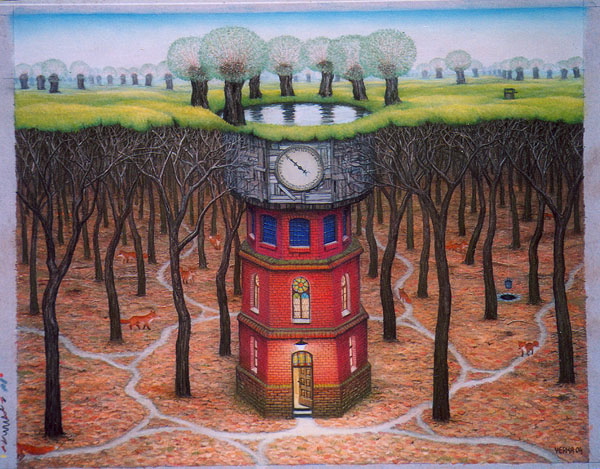
Jacek Yerka’s Subconscious Tower

A few pieces literally concern the subconscious.

Liz Hughes reviews Clem Masloff’s book Galactic Minds in her regular Book Periscope column, which is about a form of psychotherapy that involves the merging of the conscious and subconscious minds.

Cristina Deptula discusses Nisha Singh’s Bhrigu Mahesh: The Witch of Senduwar, which is a mystery novel where the hero believes that we can approach human psychology scientifically enough to say for sure that someone had it in them to do something. Detective Bhrigu Mahesh believes that we can ultimately understand the workings of both the conscious and subconscious mind.

Henry Bladon shares a piece about psychiatrist R.D. Laing, who seemed to enjoy getting people to challenge their thinking by making unconventional statements and encouraging them to embrace distress and confusion.

Other pieces can be divided into a few broad categories.

Memory and nostalgia

Joe Balaz sings a pidgin ode to the good old days and a lament on how times change, while Sandra Rogers-Hale gives a humorous take on whether she needs new technology. 

Artist Jeongeui paints a mountain mirrored in a lake. Reflections are like memories in that they resemble reality, bringing scenes to mind again. Also, as with our memories, some aspects of reflections are exactly accurate down to the last details, while others can be distorted and differ from the actual object.

Al Murdach remembers the flannel-board Christianity of his Sunday school days, while reflecting on feelings of implicit exclusion of those who are ‘imperfect.’

Michael Noel offers a tribute to musical great Dick Dale while Norman J. Olson describes visiting Elvis’ mansion, provoking thoughts on the King’s legacy, death, and how we all might be remembered.

Joan Beebe celebrates memories of happy family life, which are a comfort to her in a current time of sadness. J.J. Campbell finds that even nostalgia is a weak comfort in times of loss.

David Estringel writes of various forms of subtle grief: the loss of some poetry scenes to consumerism, a breakup that submerges him into his bed pillows, and just the slow death of not feeling his life is going anywhere.

His pieces resemble the negative side to Bob Eige’s painting Hall of Mirrors or Same Old, Same Old – the repetitive monotony.

Recollections of words and thoughts and images, sometimes loosely organized

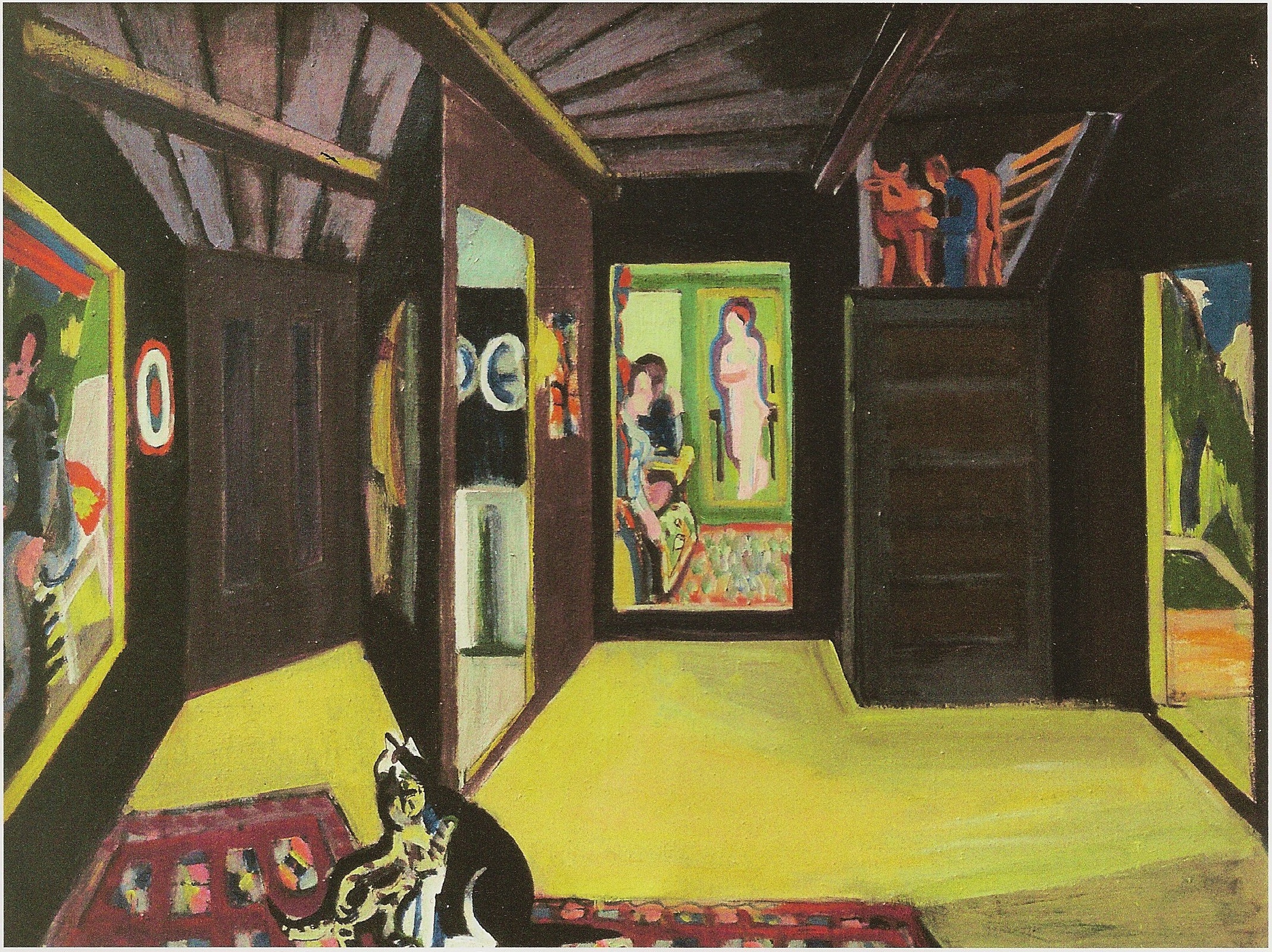
Art by German expressionist Ernst Ludwig Kirchner

Vernon Frazer’s concrete poetry adds words upon words, creating moods and images in a style organized like classical music. Ian Allaby does something similar with onomatopoetic words, lushly describing his wish to win someone’s heart.

Alan Britt reflects on the limitations of words to describe life, but acknowledges that words are often all we have.

Rodney Gardner’s poems intimate plant reproduction, meditating on awkwardness and death as we move through the life cycle.

Phillip MacDonald thinks of a tree’s changes through the seasons with a haiku, a poetic form evoking a glimpse or a brief thought. Jeff Bagato contemplates the banana in a longer but still thematically similar piece.

Christopher Bernard poses the paradox of a chilly spring: too sunny to be confined indoors, yet still cold enough for the days to feel like ice, slowing us down when we go to experience the word.

Walter Ruhlmann drags us through the miasma of where our minds can go with too much silence: ugliness in the harsh light of reality. Luke Kuzmish writes of low-budget hotels, too-early mornings, and social injustice with short lines that slow the reader down, giving a weary tone to the pieces that matches the subject matter.

Various contributors’ different takes on love

Mark Murphy shows us the paradox of middle age: we have more mature bodies and understand the world in deeper ways, but still possess the desire and hope to be loved.

Mahbub gives us poems of empathy, short little wishes and bursts of connection.

Chimezie Ihekuna asserts his sexual ethics and advocates against using others for one’s selfish ends.

In an interview with Carol Smallwood, children’s author Nancy Levinson discusses balancing writing with caring for her ill husband.

Contemplations of who we are, who we can be, where we fit into a larger world.

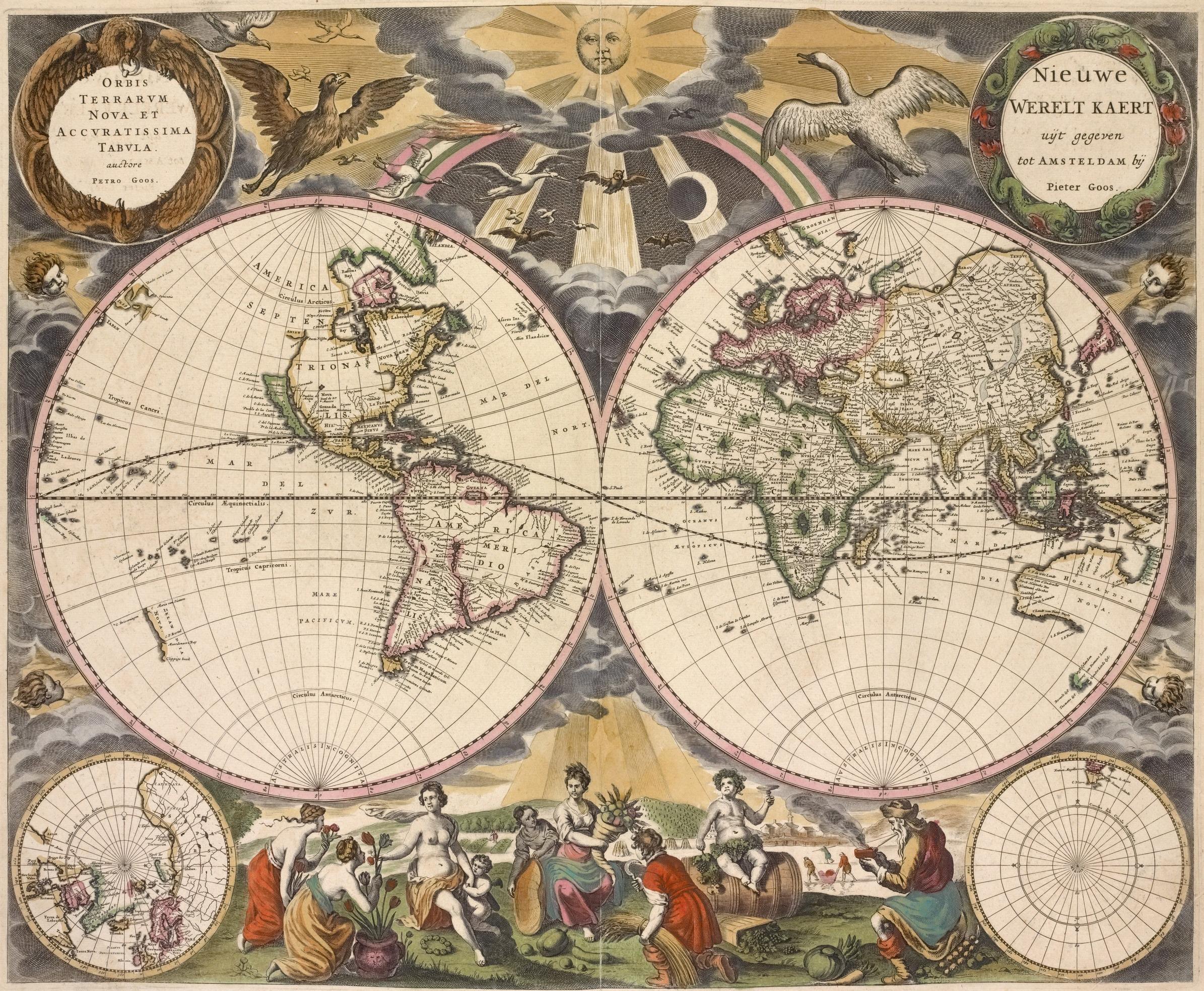
The NYPL’s digital collections include a number of maps in the public domain, like this 1672 world map by Pieter Goos.

In Ryan Flanagan’s tales of transgression, speakers engage in activities that are to some degree illegal or unsafe, and find them exciting. Christopher Bernard sneaks out to see Notre Dame during a high school trip, experiencing a moment of transcendence at age 17 that has become all the more poignant given the recent fire at the cathedral.

Adesina Ayobami Idris’ piece seems a satire of the facile get-to-know-you questions that proliferate on social media, but goes deeper, revealing her determination to find joy in the vastness of the universe, despite loss and grief.

Poet Steven surveys islands off the coast of Scotland in an elegantly restrained five-part piece, reflecting that in some ways they have not changed much over time. He also reflects on the limits of language and logic in pieces that rely heavily upon both.

Janine Canan reminds us that human civilizations come and go. We always live within nature, and She has the final word. In Jeff Bagato’s poetry, nature retakes civilization entirely.

Thank you very much for your perseverance in following your conscious and subconscious minds through the various posts of this issue!

We at Synchronized Chaos Magazine encourage people to read our regular contributor Mark Murphy’s story and consider supporting his fundraiser at the below link! 

CLICK HERE

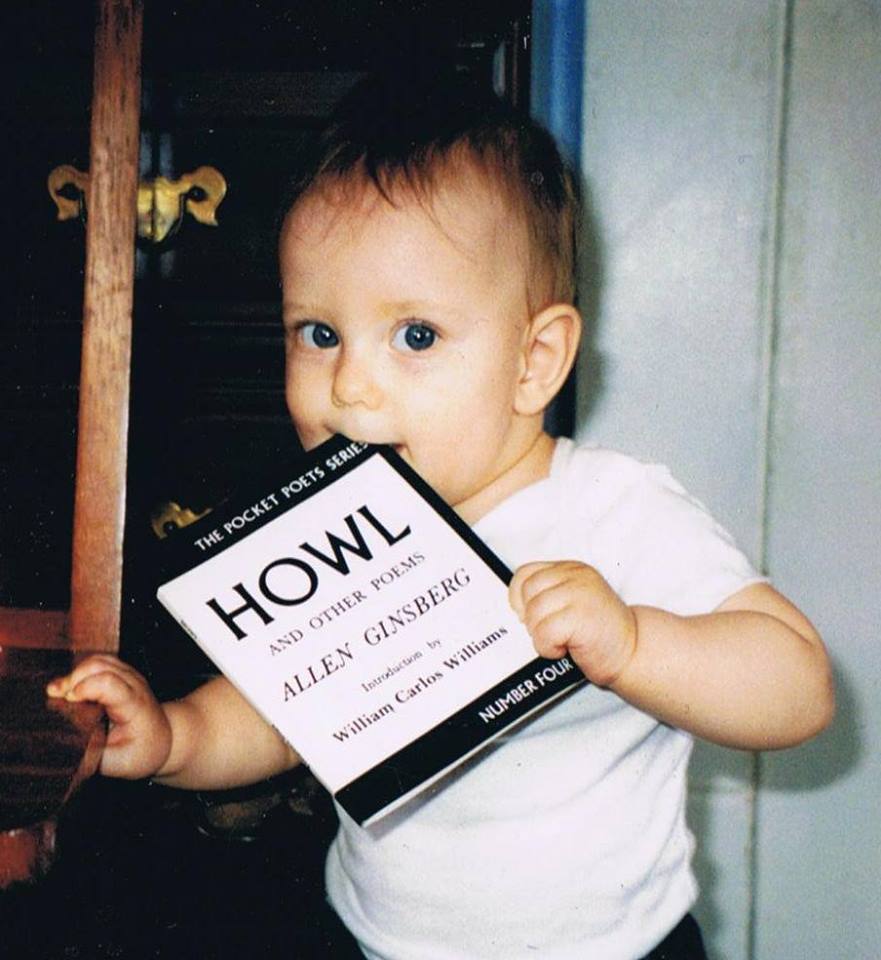
Mark enjoying poetry at a young age

10 years ago iI was living with my American wife in the UK. We were married in Dublin and then lived in the UK for two happy years, until my wife, Nora, was deported for not being a British citizen. I am a poor poet, living on benefits, due to my disability, and I haven’t been able to travel to America to see my wife because I cannot afford the air fare to get there, which has resulted in me not seeing my wife for over eight years.

In the meantime, I have written a full length collection of poems, ‘To Nora, A Singer of Sad Songs’ that is to be published this year by an American poetry press in New York. Nora is very excited and happy about this, as you can imagine. Alas, Nora desperately misses me, and needs to see me. Hopefully, this fundraiser will raise the money I need to make the trip and visit Nora and her son in upstate New York. If all goes to plan, I will visit Nora for a full month and explore the options for our future life together, including the possibility/probability of one of us re-locating to a different country. I’m also hoping to kill two birds with one stone, firstly by seeing Nora, and secondly, by promoting my new book with poetry readings. If luck is on my side, the book may well come out before I arrive in America and I may even be able to arrange some book signing sessions in local bookshops!

Here is the very first poem from ‘To Nora…’ which was written before we ever met in the flesh, and now stands as testament to our lives apart…

My Love is in America

I cannot hold you, nor yet kiss you,
yet with your song
you have rendered my heart
incapable of hiding in the loneliness of the moon.

Whatever histories pass us by
(whatever tyrants shall rise and fall)
I will bring you my poems
with bread and flowers
and we will make our bed in fields of wheat.

Whatever Graces attest their favour
(whatever divinities shimmer in the night)
you will come to me, eternally,
yielding your body, your mouth to mine,
and I will yield my seed, the fruit of all my blood.

My love, I cannot live without you,
it would be Death
and Death is over there
beyond the joy of song, beyond the sightless stars.

I hope my friends, colleagues and contacts on Facebook will understand my plight and my deep-seated need to re-unite with Nora, and donate whatever they can, small or large, to help facilitate my travel costs. My deepest thanks in advance, to anyone who responds to my call for help. May you live a blessed life.

Poetry from Joe Balaz

DA GOOD OLD DAYS

Da good old days
is kinnah like wun haze

and you gaddah go through wun maze
just to get dere.

Time’s ovahlap
is wun big lau hala mat

dat wen cover da linoleum floor.

Try open da door
and go inside

and you going find
dat da house is not da same.

You gaddah know dough
dats to be expected.

Dust off da hat
put ‘um on da head

and see how it fits today.

Restring da ukulele
so you can strum da buggah

foa see if you can still carry wun tune.

Da sparkle remains in da kupuna eye
and all da mo’opunas wonder why

mesmerized like alert zombies
on dere smart phones.

Dey stay losing touch wit demselves

cause dey kannot be alone
wit dere own minds

witout longing foa da mystique
of all dere gadgets.

If dey had to use wun quarter
to make wun call in wun phone booth

dey would tink
dat dey wuz back in da caveman days.

To dem

grandpa and tutu
look so funny

staring off into da distance
as if dey wuz remembering someting.

Well, dats how it is,

cause da vanguard
is carrying new colored kahilis

foa replace da oldah ones.

Different kine designs
on da feathered cloaks too

if you look real closely.

Da good old days
is now part of da universal fabric

dat some people wish dey could bend
through light, speed, and gravity,

so dey could jump back
into da previous frame.

kahili Feathered standards on a pole.
kupuna Elders
lau hala Dried leaves.
mo’opuna Grandchildren.
tutu Grandmother