Poetry from Mahbub

Refill

Mahbub

Mahbub

I am vacant, fully

If you are absent from me

I feel like burning my heart

Can’t sleep a moment

The whole night spent swaying

Firing inside and outside at the same scale

Feel like a complete cessation

How can I breathe?

O my love, be advance and permit to taste the apple

Move on the wheel to make a journey to the blissful world

And refill my heart

I am fully vacant

If you are not with me.

Continue reading

Poetry from Douglas Cole

Slipping Through the Zones


Douglas Cole

Douglas Cole

I make my way through security

by having nothing at all

so x-ray me to the codes

even those are forgeries


I hide behind pillars of Guanine

guards can’t see among the caravans

as young Adens trick you into chains

thinking I’ll go here and I’ll go there

leaves chattering about their lottery numbers

as wind blows them down the street


Miescher has declared this a no fly zone

and with Frank and James it doesn’t take

a Holmes to unlock that crick in the neck

as a radiant fury waiting to be born


so I cruise the ergodic outposts

where a congregation of vapors sigh

against all likelihood and odds

laying gifts at the infant feet

in story of triumph disguised as defeat


Continue reading

Poetry from Steven Storrie

ABANDONED MALLS
Weeds grow unchecked
Where young feet once played
Laces tucked in shoes
Beneath the light of summer sun
Out of date football jersey’s
Mix with gravel and smashed glass
Signalling the end of time
Cracks swallow memories whole
Burying first dates
Kisses
The timorous holding of hands
Something great once stood here
On these barren lands
Where a city buzzed with action
Saw movies
Whiled away their days
The mall
Like youth itself
Succumbs to the passing of time
Both are empty husks of themselves now
It will soon be time
For the rats
To take
Control.

Continue reading

Poetry from James Diaz

Sleep as if You are Secretly Loved
O ordinary star
how far have you dropped
toward sleeping things
and no one noticed
the rage in you
until it was burning in their back yard
are you keeping score, wooden
and woke / the upstairs
a mess
your mind won’t free you
say a thing is only a thing
and that it has not yet killed you
oh, but it will
the rooms’ softest light  —
kindling
how a hundred years
will change
only the fact
that you are no longer here
among the living
and everything
every single goddamn thing
still hurting
still peeling the meta from your ordinary glowing
that we only
had more time
to know
what the hell it is we’re doing
here
on the dark floor  —
unkind, dangerous
you say the universe 
is withheld love
I say she is a killer
and we move in her
like dust
from untouched drawers
followed / hunted
clear cut, no evidence
no kindness,
what word would even do here?

Continue reading

Essay from Francesca Butcher

A Look at Mary Shelley’s Legacy

A new film based on the life of Mary Shelley has been made that explores the creation of her famous novel Frankenstein. To celebrate the release of the film we look at the legacy of one of the world’s most imaginative writers.

Who hasn’t seen a version of Frankenstein, the scary yet sensitive monster who was shunned by society despite his best efforts to fit in?

Of course, those familiar with the hideously ugly creature know full well that it is actually nameless, and that Frankenstein is the surname of the young man—Victor—who created the monster (a very common mistake). They also know the literature behind the legend: Mary Shelley’s pioneering novel, Frankenstein or, The Modern Prometheus, the first edition of which was published anonymously on January 1, 1818. The second edition, this time bearing Shelley’s name, was published five years later in 1823.

The Novel


A depiction of Frankenstein’s monster

Spark Notes states that the novel chronicles the life of Victor Frankenstein, whose quest to discover “the secret of life” led to him to create a grotesque, eight-foot monster. The young scientist is sickened by his creation, and after a series of tragedies, he resolves to put an end to all the madness he created in the first place. Frankenstein is ultimately felled by an illness, and his passing convinces the monster to travel to the northernmost part of the world to pass away in peace.

Frankenstein is by far the most well-known work of Shelley, and is widely hailed as one of the first “true” horror and science fiction stories ever published.

The Author


Mary Shelley

Mary Wollstonecraft Shelley was an English writer who turned to writing at an early age, scribbling and writing stories to unleash her creativity. In 1814, she married the famed poet Percy Bysshe Shelley, and two years later, the then 19-year-old Mary began working on what would become Frankenstein. Shelley started writing the story due to a challenge set by the poet Lord Byron, that himself, the Shelleys, John William Polidori, and Claire Clairmont, should pen a horror story to find out who could write the best one.

Despite Shelley’s current status as a literary luminary, she nonetheless had to fight for recognition. The first two editions of Frankenstein only had a modicum of success. Complicating matters was her marriage to a literary legend, which meant Shelley had to compete with unbelievably high expectations, and even be faced with accusations that he had indeed written her novel.

It is unsurprisingly then that the aforementioned love affair, Shelley’s struggle to be considered a serious writer, and the writing of perhaps the most famous horror tale in history, provide a fitting backdrop for a film on her life.

The Legacy

Shelley was a prolific writer, but her legacy, ultimately, is the overwhelming success and influence of Frankenstein. The novel arguably gave birth to the horror genre, and the story of man creating a monster is a theme that has been explored countless times.

Shelley’s legacy lives on far beyond the page and has been adapted to every type of entertainment. Most people would have seen a version of Frankenstein, even if they had never read Shelley’s original novel. Frankenstein’s monster is commonly used by companies to market events like Halloween. Even non-traditional entertainment platforms have capitalized on the marketing of classic monsters to bring in new customers. Foxy Bingo has a slate of horror-themed games ranging from classic horror, Dr. Jekyll Goes Wild , to modern horror in the form of A Nightmare on Elm Street. It is through this constant exposure that the horror genre has become one of the most popular forms of storytelling. And the one thing all these horror games, films, and books have in common is that they all have Mary Shelley to thank. The horror genre stands on the shoulders of Mary Wollstonecraft Shelley.

Synchronized Chaos April 2018: Life Cycles

This month’s submissions relate to various parts of our life cycle, various issues and challenges that we tend to try to accomplish at different points in life.

Historical psychologist Erik Erikson identified ten different life stages and described the decisions people make and the skills they master at different times in their lives as ‘crises.’ I don’t think normal stages of life have to be considered crises, but they do come with some creative tension as we try to figure out different things at those ages.
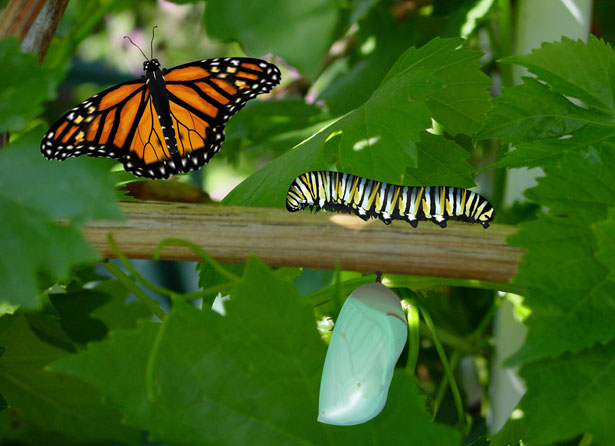
A black and orange monarch butterfly resting on leaves, a yellow and black striped caterpillar crawling on a twig, and a light green chrysalis suspended from the twig.

We’re not going to go through all ten of the stages Erikson pointed out, but this issue does explore several of them, which we’ll describe in ordinary language. Many of these stages overlap, both in real people’s lives and in these submissions.

Right away, starting as infants, we figure out whether we can trust others in this universe. Are we safe here? Will others care for us?

John Chisoba Vincent looks at the tension between communal care and responsibility and individual privacy and freedom in his poems. In different works his speakers assert that matters are ‘nobody’s business’ or ‘everybody’s business’ while illustrating the vast nature of the social problems in his home country of Nigeria.

Michael Robinson reflects on the solace and belonging he has found through romantic, spiritual and family love and how that has sustained him in an often harsh and violent world.

Next, we often work to develop a sense of identity, where we figure out who we are and how we’re going to be in this world.

Jonathan Hine’s single, short piece bursts forth in an assertion of existence, full of light and sound despite its ambiguous title.

In Elizabeth Hughes’ monthly Book Periscope column, the titles she reviews grapple with consciousness and existence. Protagonists of G.R. Jerry’s Tom and Lovey and Coulter’s A Night’s Tale exist in the space between reality and the supernatural. Greg Payan’s memoir Please Stay details his wife’s journey back from a nearly fatal brain aneurysm, and M.H. Howington’s The Redhead presents a mystery where we aren’t sure which characters are the villains or the victims or heroes until the end.

J.D. DeHart’s poems claim his own, and his various speakers’, identities in serious and extravagantly comical ways, along with reminding us of the dignity and value of women. Mahbub’s poetic speakers all belong to and participate in their world: the home country of Bangladesh, the natural world around them, the drama of a musical production. Yet we see struggle here, as his final piece presents a woman who murders in a rage after being rejected in her marriage.

Christopher Bernard reviews Chicago theater company Manual Cinema’s production of Ada/Ava at UC Berkeley’s Zellerbach Hall, which portrays a young lighthouse keeper who never quite recovers from the loss of her best friend and identical twin and thus never completely develops an identity separate from her sister’s. In the eighth installment of his novel Amor I Kaos, Christopher Bernard’s characters waver between taking care of and accepting practical realities of physical existence and drifting off into worlds and meta-worlds of thought and ponderment on being human in our universe.

Many of us later move into developing intense romantic relationships and friendships.

Sheryl Bize-Boutte’s short autobiographical essay celebrates a friendship that started in childhood and deepened in adulthood until the tragic death of her friend Cassandra at a young age from cancer. This piece explores identity as both Sheryl and Cassandra look into the implications of Cassandra’s mixed Japanese and African-American heritage, and also, sadly, serves as a reminder of our mortality.

Vijay Nair’s short story intellectualizes romance and physical love in a humorous but thoughtful argument among literary friends – and the winning position becomes apparent in a tenderly dramatic moment near the end. Chimezie Ihekuna’s essay on marriage dynamics points out the necessity of couples’ getting on the same page together and entering into a marriage with similar expectations. Vijay Nair celebrates both the sensual and intellectual aspects of love while Chimezie Ihekuna acknowledges the role of physical love, yet prioritizes the spiritual and emotional connection.

And, perhaps more so as we age, but really at any time throughout our lives, we figure out what we’re going to do, what skills we’re going to develop and what we’re going to take away from our experiences. Will we develop wisdom or give in to despair, continue to pursue creativity or fall into stagnation, work towards what we can accomplish or get stuck focusing on what makes us feel inferior?

Ryan Quinn Flanagan’s poetry confronts aging and identity in ways that are alternately humorous and poignant. We see nostalgia for drive-in movies, Beatles music and young love alongside comical pieces where the protagonists become a wild array of alternate beings juxtaposed with a piece musing about what he ‘should’ be after a certain age.

J.J. Campbell returns to our site with his familiar jocular cynicism, expressing a jaded view of aging, religion, and human nature in general. Joan Beebe’s pieces present a different perspective, as she’s a senior full of excitement about life’s possibilities. In her poems, trains take passengers to all sorts of wondrous destinations and Disney World still holds magic for adults.

Chimezie Ihekuna’s poetry deals with the quest for real, authentic truth and the meaning of life, and how easy and how frustrating it is to get sidetracked on that quest and get stuck with cheap substitutes for real meaning. J. Dorroh’s work, more visceral than Ihekuna’s, celebrates science and intellectual understanding at the same time that he illustrates a gut-level sense of wonder and curiosity that goes beyond pure rationality. Also, like John Chisoba Vincent, he critiques social problems through grotesque metaphor, with a piece on the decay of the United States.

Joe Grochalski’s work also expresses annoyance at those his speakers feel have a shallow understanding of life: inane tourists, an overly talkative neighbor, and people who try to be socially aware yet turn their outrage to issues of lesser importance. On a deeper level, Grochalski’s pieces question our identities and the impact of our family legacies and how much power we have to alter or escape them, and also suggest that his speakers may be more easily angered because they have become disillusioned with their lives with age.

Throughout our lives, many of us turn to writing and art to record, communicate and better understand what we’re experiencing psychologically. And we hope that this issue and its submissions helps you to accomplish that.

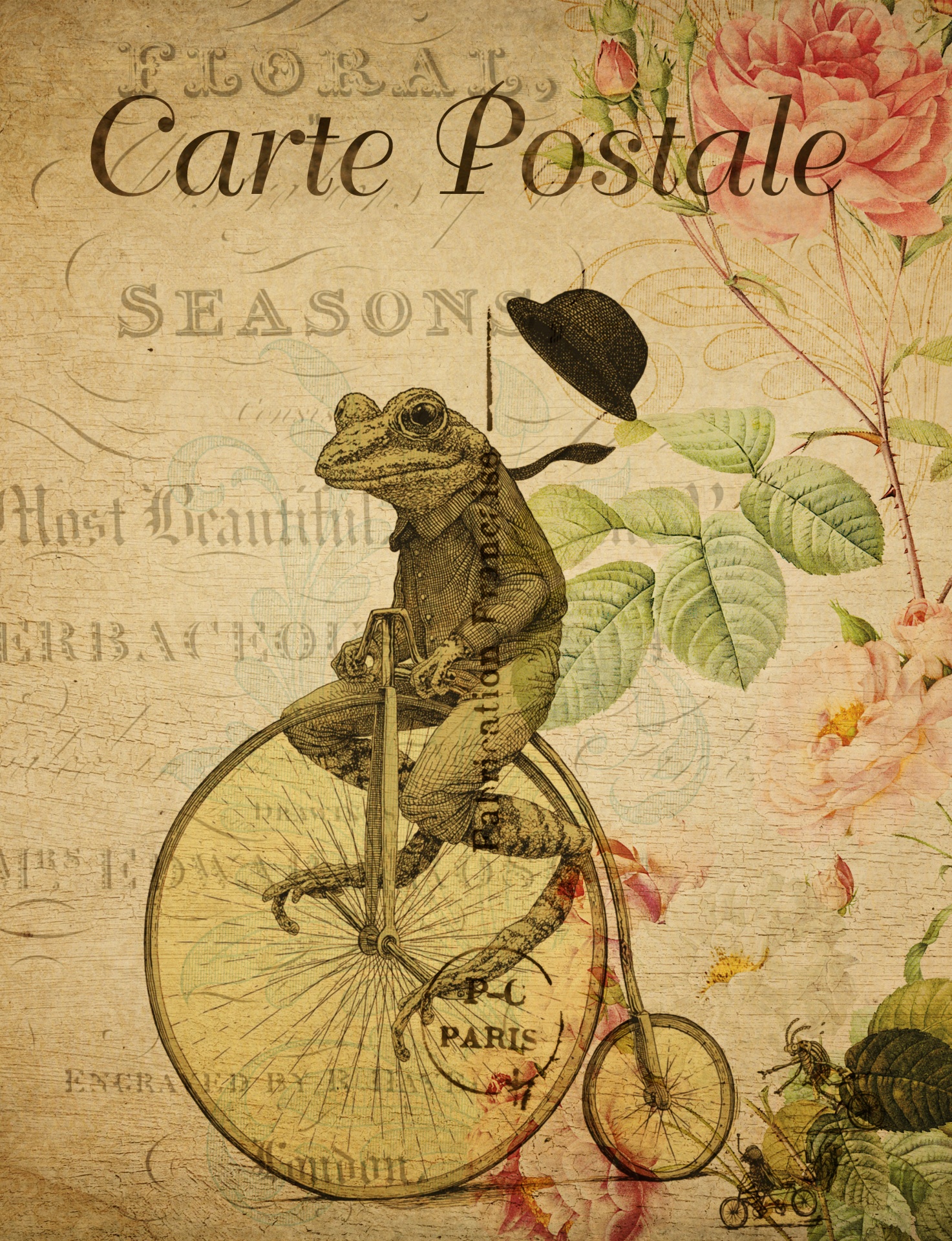
Old vingate postage stamp where a frog rides a bicycle with a larger front wheel