Poetry from Mahbub


A boy Without Name

I am a boy without name

hovering in the limitless sky

I am a storm hitting strongly on

making the door and windows

upside down uprooted the trees are

I don’t abide by the rules of any law

of the restricted country

my act is to switch

on the radio

off the television

and so do on and off

radio, television and computer

I play with mud

I build a castle

I break it, I rebuild and I rake

I am a boy without name

I don’t care for the charge

you bring for

I can go out and come back

as per my desire

I can love any whom I think to

I am a boy fully hovering from place to place

as a morning bird playing on a muse
from ears to ears.

__________________________________________________________________________

The deaths of us

Death is not any single matter to us
like the people of our country, Bangladesh
here politics is so powerful
that we, the people, are meaningless ants

a hunting ground
the lives  have no right
to continue in this world any more
the commons are the tools to their clutch
they do when and whatever they like to
our lives depend on the mercy of the lords
Its alright if one party is victorious on the other
If not, their animosity beams on the common people
throwing bombs on the running bus, truck and train
nothing can be done we are helpless to their powerful hands
pull out the fish-plate of the running train causing deaths
the lords like to satisfy their hunger day after day
we, the helpless common people nothing to do
we are the observers we are the deaths
we sleep in fear we rise in fear
life goes so suspicious
then what does it mean ‘life’?
when we recollect
the recent past dealings of our politicians
how can we think we live safe in this present world?

Top of Form

Bottom of Form

__________________________________________________________________________

My Prayer

Death is the last word to say in the present world

We come here empty

We leave the world empty

but there is something difference between

coming and leaving the world

our deeds might show whether it would be

our mental and physical peace depends on how we deal with us

if I do good for me, good for you and for everyone with whom

I spend my time

then there may have the possibility to get

peaceful blowing on the ground with colorful light

O my Creator, lead me to the right road

to go in this world

that I can get peace here at home

and there in the doomsday.

___________________________________________________________________________

To My Darling

When my eyes are burning, my body is trembling

but no response of you

then what should I do?

please darling o my darling

but no its no use of calling

I am dying,

I can’t play my ball

as its not on the side

I deserve the fair only for you

O my darling don’t break my heart

no more waiting

everything is lost before my eyes

come and get me in touch

I am lost, can’t  see anything

if  not get you without saying

find me no more

O my darling, please  —–.

__________________________________________________________________________

In The Evening

Clouds are floating, lambs are grazing

in the evening

birds are turning to their nest

I am exhausted , wants to come back home

just at that moment whistles in my ear

don’t enter

it’s  light and dark

before night

who is coming to me and say

don’t enter

I am in absent minded wanted to learn

waiting for moments

and thought of my surprise

a golden axiom is over head and I lost myself there.

Balubagan, Chapainawabganj

19/09/2015
Essay from Tony Nightwalker LeTigre

The Winter Depression
By Tony Nightwalker LeTigre

Let us call this the “winter depression,” premature as it may be on our part to count winter’s frigid malice out of the game so early. We could call it “the post-election depression,” but I don’t want to. Why give them such power? I made a comment to a friend a couple weeks back, shortly after its onset, to the effect that “if I’d known Trump was going to win, I wouldn’t have talked so much shit about Hillary.” But it was a throwaway, disingenuous, wasn’t it? Throwing to the audience (of one) what they wanted to hear. And actually, they are legion here in Pdx, which has a large & mobile mass of young radicals, Outside Inners, Rad Fae types sporting shiny new self-entitled gender pronouns that nobody else is ever going to use, Standing Rock-ers, cute young tall slim ba(b)es dressed all in black with black hats & black boots & white or red bandannas around their mouths carrying war mallets (hot!!) & weaponry & paint cans ready to fuck some shit up, & related righteous ragers ready to take to the streets & stir up a public shit storm. As well they should! And I ran with those wolves when I heard their howls & saw them coming, answering the primal call of the hunt—for am I not one of them at bottom, despite my frequent plaints; but by my own choice, & therefore free to come & go at my own wish & not at the beck & call of another?

(He does not try to dominate you, but you cannot dominate him.)

Continue reading

Poetry from Michael Marrotti

Freedom is Overrated 

Certain people

are far from

delighted

When they hear me

proudly proclaim

my allegiance

to the Light Of Life

Rescue Mission

through volunteering

Some people say

the food isn’t

all that great

Other people say

they force Jesus

on you

There’s also

people who say

it’s restrictive

no man should

have a curfew

I consider all

these potentially

pertinent points

as I enjoy

a delectable meal

courtesy of

Light Of Life

before my shift

On my way

to the cafeteria

I think of Jesus

wine and the

blood of Christ

Jesus has saved

many people

from relapsing

I think of rent

and how much

it sets me back

each month

as I serve food

to a homeless man

who once lived

better than I did

I take into consideration

after the completion

of my shift

how all that freedom

has dragged these men

down to the bottom

of society

I have a new life

experience

by thinking

for the first time

in my life

that maybe freedom

in this particular

circumstance

is a bit overrated

Essay from Joan Beebe

A Vacation in the West
 
My husband decided it was time to take a delayed retirement trip.  I picked up an AAA book and started to look at ways to have a memorable vacation.  The first thing was transportation and we decided to take the local Amtrak train to Chicago and then board the train for Denver, Colorado.   Our experience on that train to Denver was wonderful. We had a nice room with a fresh rose on the table and a shower all our own.  The food was quite good and they had coffee ready every morning at 6:00 AM. It was a very relaxing way to travel and not have to worry about traffic, road maps and detours.
 
 We stayed one night in Denver but managed to tour the Federal Mint which was very interesting. Denver was quite beautiful with the mountains in the distance
 

Continue reading

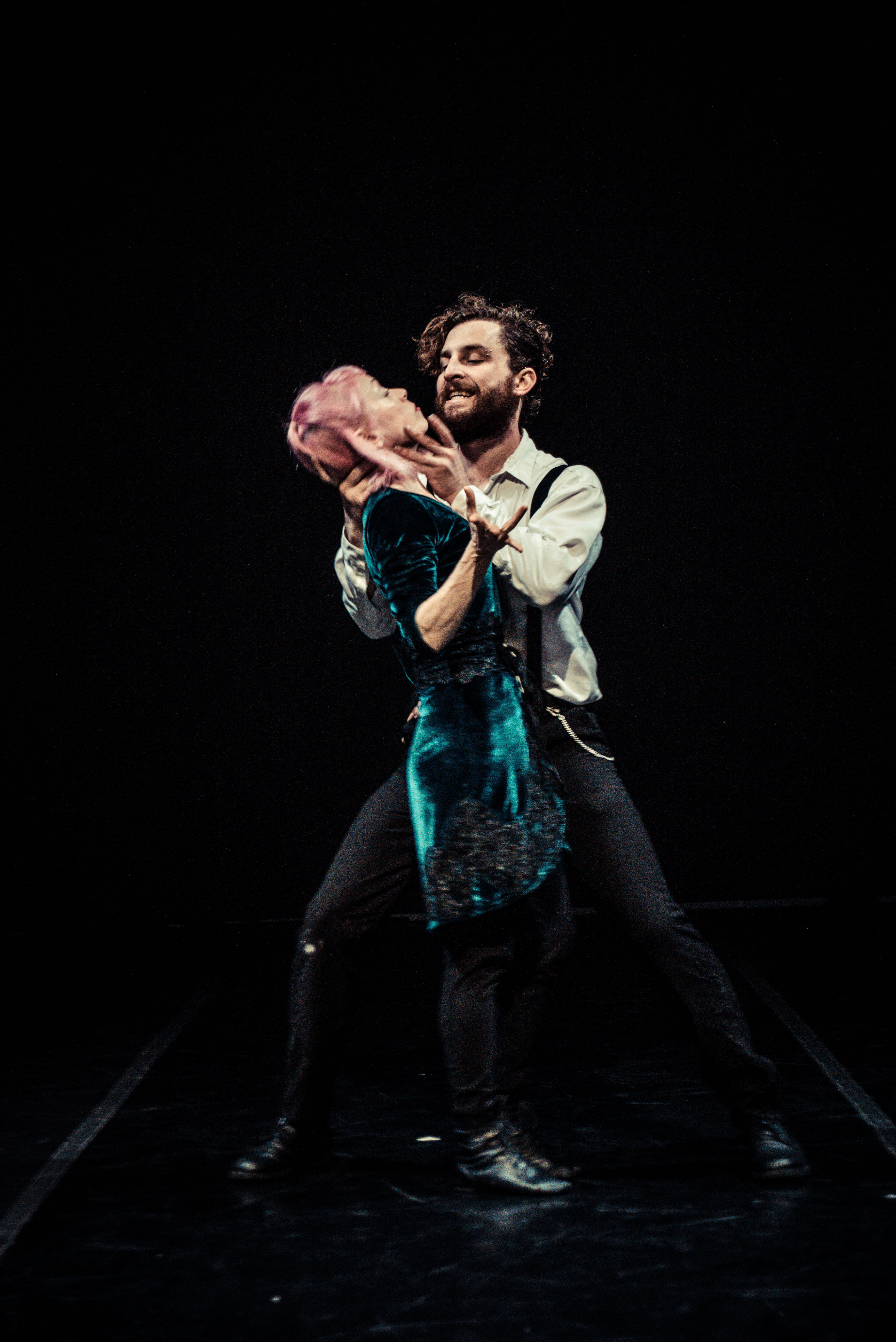
Christopher Bernard reviews 13th Floor’s play ‘Next Time I’ll Take the Stairs’ at San Francisco’s Joe Goode Annex

Zach Fischer and Jenny McAllister

Photos: Robbie Sweeny and Pak Han

ELEVATOR TO HELL AND BACK

Next Time I’ll Take the Stairs

13th Floor

Joe Goode Annex

San Francisco

A review by Christopher Bernard

I saw an earlier version of this piece – equal parts poetry, family drama, circus act and dance by 13th Floor, once a dance company, now doing theater as well – as a work in progress at the FURY Factory Festival of Ensemble and Devised Theater in June of this year, and so I’ll begin my review with what I said then:

“[‘Next Time I’ll Take the Stairs’ is] an elevator play, but with a difference, . . . depicting a ride to hell in the belly of the Otis Company’s most famous product. I say ‘to hell,’ but that may be over-simplifying just a hair; as 13th Floor tells it, it’s a ride to ‘a multi-storied world, inhabited by the shades of previous riders. Down is up, up is nowhere, and the memories of who you were can be re-formed by the stranger standing next to you.’ The show follows the adventures of brothers Arthur and Norris, their sister Rabbit, a lasciviously sadistic, compulsively inquisitive lady named Ivy and a disingenuous lug with a big wrench and the suspicious name of Otis, after all five crowd into an elevator that crashes into an alternative universe that is both unforgivingly absurd and weirdly sweet.

julie-mahony-and-david-silpa-in-next-time-photo-by-robbie-sweeny-5julie-mahony-and-david-silpa-in-next-time-photo-by-robbie-sweeny-5 Continue reading

Announcement from our creative partners – the 2016 Nature Writing Contest


Announcing the 2016 International Nature Writing Contest, sponsored by authors Rui Carvalho, Sara Rodriguez Arias, and Janine Canan and by Synchronized Chaos Magazine.  

http://talesforlove.blogs.sapo.pt/

http://talesforlove.blogs.sapo.pt/

We are searching for a new Lord Byron, who can go forth, creating poetry to praise nature and those who love her.

Beauty of nature is one of the nights imperishable, one of the endless days, with horizons made of sands on the shore.

The forest can be seen as a hospitable home, inhabited by humble virtues.

But, for those whom poetry doesn’t love, it matters not.

And this is why we seek high-quality poetry; poetry that expresses feelings with the strength of the undying masterpiece. No injury can befall that timeless poetry, made with the most pure water of the creativity’s fountain.

Please submit your original poetry or short tales here.

Please help support the nonprofit project we have chosen as a beneficiary of this contest, an organic orchard in Albanil, Portugal, in buying a rainwater capture tank to irrigate sustainably without using power.

Rainwater Capture Tank Project for a Sustainable Organic Orchard


Continue reading

Synchronized Chaos December 2016: Loss and Restoration

Welcome, readers, to December’s issue of Synchronized Chaos Magazine. This time we explore ideas related to loss and restoration.

How do we cope when something goes missing? Is it really different when we have lost a small object versus something larger, such as our personal or cultural identity, our sustenance, or the values through which we order and find meaning in life? How do we find what we seek, and what happens when we realize that what we need cannot be simply found and restored, but must be created from scratch?

Sarah Widdup gives us a tale of a mermaid who has lost her fins and ability to live under water, but returns to her ancestral ocean homeland for a time to bring a crucial personal item back to a shark.

Michael Robinson’s poem also looks into his past, describing the rough, violent, but diverse and vibrant neighborhood where he grew up. His piece compares the metaphorical prison of inner city poverty and the lack of safety and job opportunities, and his subsequent confinement in a mental hospital.

J.K. Durick’s poetry probes the lingering physical and mental after effects of war and murder and illustrates how violence can beget further destruction when it corrodes people’s psyches. He further shows how death, even natural death, is integrated inextricably with our daily lives, to where even our phone’s rings can be associated with someone’s passing.

Michael Marrotti invents a satirical tale of a poet who earns money and success through learning to craft crowd pleasing banalities. Jenny Santellano’s poems look into what it takes to be an authentic human being, with one’s thoughts and feelings superimposed on a background of everyday life and responsibilities, as well as vapid fake culture from those who have not yet probed the mysteries of life as deeply.

The tension between popular success, ordinary survival and true innovation is a common plague in the life of many artists. Although Marrotti’s speaker does not seem to suffer to the extent of Michael Robinson, even at the impoverished beginning of his career, he leaves readers wondering if there can be a middle ground where artists can feed themselves as well as our imaginations. After all, in Santellano’s piece Dante’s World, the home fires need tending, just as much as life’s meaning needs to be understood.

Donal Mahoney’s essay describes a community where people make efforts to carry each other through tough times. Even when they only have so much to eat themselves, they ‘add water to the beans’ to stretch their resources to accommodate whoever is struggling.

Christopher Bernard urges a return to community and to values such as caring and nurturance. His essay laments what he sees as a victory for aggression and toxic hypermasculinity in the United States presidential election and calls us to work to restoring social balance. In his poem Trumplandia, a takeoff on the Genesis creation story, he mocks the idea of a cultural ethic built on greed and vapid entertainment and materialism.

J.J. Campbell’s poetry illustrates how racial prejudice operates on a systemic and often subconscious level. J.D. DeHart presents images of power – law enforcement, strong people, childhood superheroes. Also, together with J.J. Campbell, he probes the boundaries between existence and nonexistence, and between having a strong sense of self or an identity crisis. 

Vijay Nair laments what he sees as Nepal’s smallness and lack of distinction on a world scale and wishes for the nation to develop a stronger sense of identity.

M. Spear describes a tangible loss in his poetry, where he misses a past acquaintance. His work also searches out our origins, which Spear suggests may be an machine rather than the creator being of many religious traditions.

Rui Carvalho reviews a graphic novel where robotic beings experience emotional pain, loss and connection. He points out how the artwork and color scheme of the graphics helps to convey the story’s theme. A machine need not be purely impersonal or soulless.

Neil Ellman contributes another set of ekphrastic poetry, where his free verse accompanies modern art pieces, transliterating its colorful images into words. The Modernist era in Western art and thought involved much exploration of loss, grief, personal and national identity, mechanization, and finding meaning in a world lost and disconnected from its traditional sources.

Richard Slota’s historical novel Stray Son, as reviewed by Cristina Deptula, points to the value of identifying and separating one’s self from the unhealthy influences of one’s past. To properly grieve the losses of his parents and the happy family and childhood that he wished for his whole life, protagonist Patrick Yaworsky feels he must start by understanding why his parents abused him. That way he can externalize what happened as a product of his parents’ own troubled upbringing and time periods, rather than internalizing it as something that he deserved or brought on himself. This represents a healthy dissociation for him, and a way to free himself from the pain of past losses and restore health and stability to at least his own nuclear family.

Cristina Deptula also reviews Phyllis Grilikes’ Autism’s Stepchild, the story of the author’s friendship with a woman whose daughter has a condition which we would today recognize as autism. The book shares their journey towards understanding Jean and accepting her the way she is while helping her learn to communicate more effectively and encouraging her to develop her interests and talents. Also, she reviews Brett Matthew Axel’s children’s fairy tale Goblinheart, which shows the beauty of being free to live an authentic life within a community who accepts you.

And, finally, Joan Beebe shows us an image of life’s restoration in the form of a new baby. 

We at Synchronized Chaos Magazine wish all of you health, nurturance, freedom, a stable sense of identity, and food for your table and your mind. And a very pleasant holiday season, as the solstice brings us from one end of the year to another, as Persephone revisits the underworld for another six months with its fabled pomegranates.

Photo by Marina Shemesh, available here: http://www.publicdomainpictures.net/view-image.php?image=55356&picture=pomegranate

Photo by Marina Shemesh, available here: http://www.publicdomainpictures.net/view-image.php?image=55356&picture=pomegranate