Fat man profile narration
“He’s been maimed-
beyond all recognition.”
said over his corpse
but not dead
may as well be
a Hitchcock sonata
of murder most foul
carnal anatomy
with a hint of vertigo deception

Fat man profile narration
“He’s been maimed-
beyond all recognition.”
said over his corpse
but not dead
may as well be
a Hitchcock sonata
of murder most foul
carnal anatomy
with a hint of vertigo deception
Kitten on the Keys
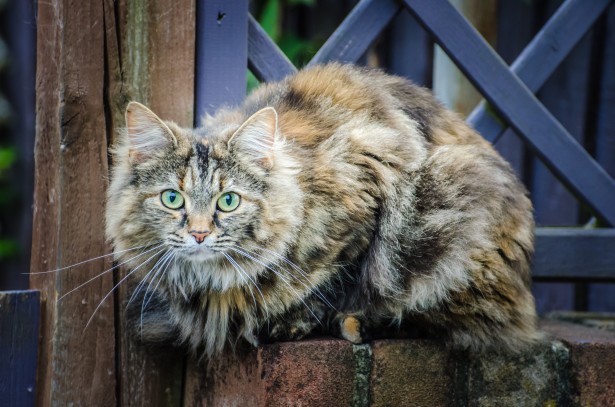
I suppose that I should introduce myself first. I’m the famous cat Jaws, the first reanimated non-human animal. The non-human distinction is important. The Hanley family, starting with patriarch Duke who reanimated a basketball player once and his wife twice, and his son David who reanimated his girlfriend Wendy twice, used the procedure with humans first, before striking gold with me.
I say striking gold, because he makes a lot of money bringing rich people’s deceased pets back to life. I don’t want to disparage my original person Wendy too much, because we always got along, but David’s munificent animal reanimation practice has brought her much closer to him.
Christopher Bernard’s Amor i Kaos (part 3)
It was almost too demeaning, she thought. To be hampered in that way despite all the options at the time. The seeming options, anyway. Because once you’ve done something, it seems as though it had always been meant to be, and so maybe the options were illusory after all. Amor fati…
—If only!
—No, really. Plus the beauty of matter, in Joubert’s lovely phrase. Because he was right, that Frenchman with the shy ambition and the small, beautiful notebook. So beautiful in its humble bravado, its bold modesty. All that clean, beautiful white space surrounding the few lovely words. No overwrought romantic windbaggery for him. But I’m drifting from the subject. Though what indeed was the subject? She looked at him with her usual skepticism. Did she love him? Maybe she did, in her peculiar way.
—My life is my hell, he told her one day. Matter-of-factly. I wish I could say I love it. I wish I could say I love you.
—Me too.
Then they parted for three days. Three weeks. Three months. Years. Decades. But not forever. They were adults. You would have thought they had learned never to be entirely sincere, that was what got young people always into so much trouble, the infatuation with “honesty,” no relationship will last five minutes of complete that.
—Apparently not.
—And so they tormented one another with their precious truth. You are my hell. A Sartrean proverb! And no one can leave hell. You see the problem.
But that meant nothing. Never even turned a hair. Minimally extant as it was. The withers unwrung, the moist appeal in the gathered vats, the wayward affront. The absolute right to one’s own life—to one’s own will. The boy who lived on the hill came to that conclusion one afternoon in the fall, as he was walking through the tall, yellowed hay at the edge of the field that bordered his family’s property. It was startlingly true. Nobody, but nobody, had a right to deprive him of his will. Nobody had a right to force him to sacrifice his will to anyone else, to a group, country, class, religion. They might have the power, the legal right, but they had no moral right. In that discovery lay his strength. His right to his will was absolute; this would become his moral compass.
—It should have turned him into a monster, acknowledged the portly man.
But no: just as no one had the right to deprive him of his will, so he had no right to deprive any other person of theirs. In his will lay his meaning, his joy. That seemed logical, right. Furthermore, the joy of other people increased his joy as long as it did not clash with it, and as long as he was happy in his will; if he wasn’t, nothing was surer to enrage him. The biggest threat to his will was, in fact, other people’s suffering, their pain, and their envy (ditto, in reversion, above). And this, which struck him like a hammer blow: the greatest source of the will’s joy, even at the core of its often deep and savage pain, was the perpetually deferred desire that is love, and not only for one but for all. The will is launched in pursuit. Life begins as desire and continues as love.
Out of Night
in a world always half in darkness
your body may long have been soaked
in a nightmare, rotting
but your heart can roam
like a synchronous satellite
in the outer space, leaving
the long night far behind
as long as your heart flies fast
and high enough, you will live
forever in light
Northern Skyline
At the same height of
Every rocky mountain
Above all seasonal change
A snowline is widely and cursively cut
As if to bite a whole patch of
Sky from heaven
With rows of rows of
Whale-like teeth
At Sea
Literally, not figuratively this time, like my always
Trying to keep my head above water, then treading it
As best I can, while I watch for sharks and shoals,
but not this time, I’m literally in it, on it, as far as I can
see is sea, ripples, waves to the horizon, a dark slate,
always coming from somewhere, always going away,
repetitious, it rocks us, hums to us, to itself always,
a chop, a roll, a swell, we stretch language to catch it,
it traps our step as we walk the deck, like drunks full
of time we search the horizon, it seems familiar and
unfamiliar, a friendly stranger, a strange friend, a place
we have never been, a place we will always be, this is
it, the loneliness we share, a precise measure of our days.
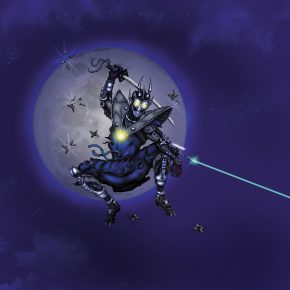
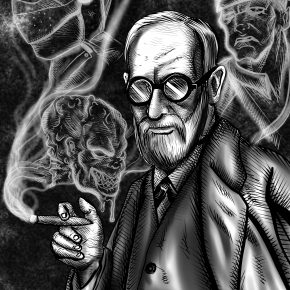
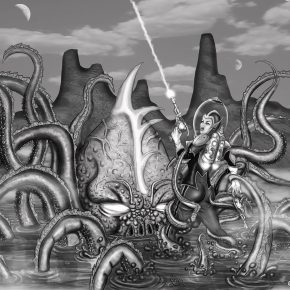
Artwork from Giorgio Borroni:
Hear an audio book from Giorgio:
https://www.audible.com/pd/Fiction/Midnight-Club-Audiobook/B00VUVJLQ2

Coastal Maine sunset