Essay by glamortramp
ADVENTURE AT THE OREGON COUNTRY FAIR 2015
by glamortramp
The Road There
Thursday 1p on July 9, one day before the event kickoff, I caught my ride to the Oregon Country Fair site with a girl who replied to my rideshare request on Craigslist. Emily, let’s call her. She had two other girls as well as myself packed into a small red 4-door, giving us full carpool cred. I wanted a pleasant interruption from city life, perhaps a sign that would point me towards the future from my present crossroads in life. “When I go into something like this for the first time, I try to have no expectations,” said Emily—one of a number of sage pieces of advice that she handed me during the ride.
I chose to leave my tent where I’ve been camping for the past two months in PDX, rather than hauling it away for three nights. The risk of anything untoward happening in my absence seemed negligible; I hadn’t encountered a single other human being since I picked that spot to camp back in early May.
Emily told us on the drive there that she was “actually working for the police force right now,” then reassured us, “I’m reasonable.” She was an OCF virgin, a first-timer, while I had vague, utopian memories of my mother bringing me to the Fair once when I was 15 or so. The other two girls were more or less veterans, in possession of significant other passes (SOPs). That meant they would be able to stay in the secret campground inside the Fair, which the general public only glimpsed from blocked trailheads & holes in the wooden walls & fence that kep them out of the VIP area. As VIPs with SOPs, they assured us, they would enjoy the upper echelons of camaraderie & group debauchery that we unprivileged plebes could only vainly imagine! We were made keenly & tantalizingly aware that the *real* fun was reserved for such insiders! But they encouraged me to believe I might have beginner’s luck or bum an SOP from someone who was leaving early & had no further use for it. It would depend largely on my social forwardness versus my tendency to withdraw into a writerly bubble of introversion.
I’d brought along a current issue of hipster alt-weekly par excellence the Portland Mercury. We flipped through it but saw no mention of the Fair; not surprisingly, given the Merc’s longstanding & weirdly intense hatred of those they deemed ‘hippies.’ Willamette Week’s coverage amounted to a single page of cartoon caricatures of various stereotypical fairgoers, including The Nice, Cool Liberal Guy, wearing a t-shirt that says THIS IS WHAT A FEMINIST LOOKS LIKE; The Naked, Pregnant Anti-Vaxxer with “her breasts painted as flowers, hula hooping with two naked & muddy children covered in some unidentifiable pox”; & The Super-High High School Student, recognizable by his “bloodshot eyes, too-new shoes, Oregon Country Fair tie-dye shirt purchased at the entry booth, iPhone constantly buzzing with ‘Mom’ on the screen.”
OK, they’re kind of funny. But I can’t help wondering, why does it seem so necessary for the Portland papers to make mean-spirited fun of everyone else all the time? Despite the apparent rivalry between the Mercury & Willamette Week, the two weeklies are often united in their snarky tone & frequent mockery of the city’s weirder elements. But are they not disparaging the very things that make, or have made, Portland unique & transgressive? Beneath their shared progressive sheen, these publications are anything but radical. They advocate voting Democrat as if the two-party system still works—or ever worked, for the people—& uphold the establishment in various ways both overt & subtle, influencing legions of readers not to rock the boat too much. “Just chill out & smoke some weed & drink some more local craft beer & ride your bike home (nude is fine) & shut up,” they exhort us. Their relentless hippie-bashing & sowing of disunity keeps us divided, fighting among ourselves rather than uniting to shake shit up for real; it discredits the 1960s-inspired counterculture, whose idea(l)s in my opinion are needed now as much, or more, than ever.
I wasn’t going to the Fair to bring back scathing reports of all the freaky people I would meet. I wanted to return to the wondrous, semi-unconscious, childlike state of grace I’d known before the fear of being judged by other people ever entered my awareness of the world.
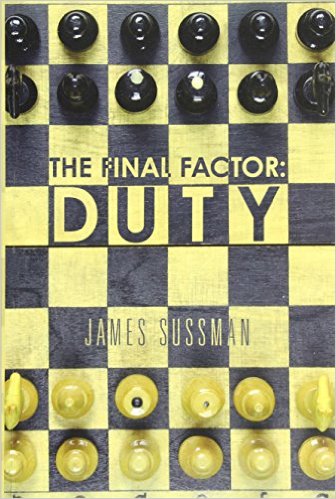
Bruce Roberts reviews James Sussman’s novel The Final Factor: Duty
Review of The Final Factor: Duty
James Sussman’s The Final Factor: Duty, is a new entrant into the popular literary genre of political thrillers. It’s not exactly a James Bond revival—there are no British secret agents involved—but the bad guys want to take over the world, the good guys possess the righteousness and the skills to fight back, and violence and sexy women pop up throughout the story.
The main culprit here is, of all people, the President of the United States, bent on causing chaos, and using that confusion to take over first the country, and then perhaps the world. He is surrounded by Yes Men who believe in his vision and are organizing to follow his plans through. Unlikely? Give him a moustache and improve his public speaking and you have Adolph Hitler.
The opposition are loyal Americans–basically a retired general and some of the FBI, plus a few hit men on the correct side. At the beginning, they seem a minority, a patriotic few who must obstruct the President’s plan secretly, for fear of reprisal. But as the evil plot tries to unfold, the good guys cause problems at every turn until at last evil is thwarted, good prevails.
Sussman’s writing is competent, and he seems to know a great deal about military and FBI procedures. He’s unlikely to win any literary awards, but the plot keeps moving at a fast pace, a requirement in such a story. There are moments when the plot seems strange, as when the sexy FBI agent seduces the old General before they get down to the business of defeating the President. That such a summer/winter couple would jump into bed anyway seems odd, but to do it when the country is on the brink of disaster seems even odder.
However, this story is a page turner! Character development is at a minimum, but the fast pace and the country-shaking conflicts hold a reader’s attention right to the end. If a reader likes this type of book, save a spot on the bookshelf for this one.
Bruce Roberts
You may order James Sussman’s novel The Final Factor: Duty here.
Essay from Joan Beebe
ON STAGE
Cristina Deptula reviews an astronomy lecture from Joel Thomas at Oakland, CA’s Chabot Space and Science Center
- Chabot Space and Science Center, Oakland, CA
- Planetarium domes at dusk
Cristina Deptula reviews a talk on the next generation of biofuels by Deepti Tanjore and Ning Sun at Oakland’s Chabot Space and Science Center
- Dr. Ning Sun
- Dr. Deepti Tanjore
Shelby Stephenson reviews the work of poet Hilda Downer
SHELBY STEPHENSON
HILDA DOWNER
(August 27, 1956 – )

-
The gravitational pull of our ancestry,
the part of us that killed the Cherokee,
the part of us that is the Cherokee,
we drag through seconds of a concentration camp,
medieval wars in single red gulp.
From “History reflects itself as an old man,”
Bandana Creek
The melting pot aglow,
coal and feldspar,
mastectomies of the mountains
Native Americans revered as gods,
what if your Mohawk nose
does not serve up the American Pie?
From “America, the Beautiful,” Sky Under The Roof
Hilda Downer’s come out with another book (Bottom Dog Press, Huron, Ohio); I look
back almost four decades to an event I loved, Hilda Downer’s Bandana Creek, a startling, tough gift from Charlene Swansea, at Red Clay Books. Swansea could not write a “Letter of Regret,” regarding Hilda’s poems; Swansea’s mind was set. Charmed by the poet’s talent, she took the book and published it.
Now I hold Downer’s Sky Under The Roof. I see Reba’s here again, Reba Vance. Hilda writes, “my best friend all of my life.” “Towheads”: “Reba and I observe the way we used to stand at eye level with daisies, stepping stones up and down for walking on air as far as we could see
across the field. Butterflies test landed tiger colors for an instant takeoff.”
In the Introduction to Bandana Creek, Charlene Swansea keeps her pitch: “Hilda spent much of her childhood in solitary exploration of the blue Appalachian Mountains. Her wonder at the
co-existence of beauty and cruelty in Nature watered her secret writings like a spring.”
Would not we readers all be Voyagers sailing with Hilda Downer’s inspiration and imaginative guidance.
Sky Under The Roof starts in mouthfuls of folly: “Picking Cherries up Howell Hollow”:
“Unlike hybrids darkly marooned in stores, / these cherries glowed a delicate red from within – /
translucent white when unripe. / Little Rudolph noses, their guidance / balanced us on that tight wire, pulling us / to higher branches to reach more light.”
Touch and taste – smell – and seeing, hearing: “My tongue felt for the seam of the pit / long
after the last rags of fruit had weathered. / Near sandy ruffles in the dirtroad, / I smelled where a spring poked its finger out the bank. / Then, I spit out all possibility / deep from the dark / deep in the mountains / deeper still in childhood / attempting to see into Who I have and have not become.”
“A woman is segmented as an ant,” Downer writes in Bandana Creek: “I wait as a woman waits. / I like my own smell. / No man has known me beautiful / when I am alone and woman, / still or stirring, / a drawing power in the shoulders, / waist hidden from vertical glance, / breast to hip.”
And from “What is Under my Dress” (Sky Under The Roof): “I might lift the hem on occasion.”
“What Is Under My Dress” seems too long to quote. I choose these words as notes from the poem: “An editor once summed up / my poetry as merely listing, / told me to put that under my belt, / and would I drive with him to Vermont. / Here’s another list: / I don’t wear a belt; / I wear a vintage prom dress; / I refuse to face life like a man.” She does not: “and I’ll make up my own mind, / if there’s any room left, /about what to put under my dress next.”
Bandana Creek’s last poem is a hymn to jars: “Looking up from inside a jar, the stars / Are holes”:
Hilda Downer: “I want to call mama / when my mother strode / down the gravel driveway / like a man.” These lines are my close companions. I want to call my mother, too, through the oaktrees on top of my Paul’s Hill; like Hilda Downer’s Bandana Creek, a stream the mountains sing, I long for breath to keep her words “wondering why I’m not satisfied, / when all I ask for is the thirst and the water.” I am drawn to my own fishing holes. Deep down in wonder, experience orders change to build a bridge to another side. Far from Bandana Creek, I feel like a terrapin coming up for air at the Rock Hole on my Middle Creek.
What else can I say to show more truly the intricacies of the cruel, sweet beauty of
Hilda Downer’s gift for lines, her ways her pages move words like “the blue fixed waves
of mountains” which turn in her eyes and on her tongue to “the only ocean we had ever seen, and even a scant shell,” she writes, “was rare”; so “we listened to the ocean from a mason jar.”
When you consider that some of us write rhymes; others long and thirst for what they do not know, you may imagine Hilda Downer, this girl who becomes a woman, and dedicates Sky Under The Roof “to my sons, Branch Richter and Meade Richter” (artist Branch did the cover-art, picturing Hilda with a child on her back; Meade’s a fiddler − his band − The Sons of Bluegrass). The mother relishes the artistry of her sons.
Poets may long for difference and sameness. Consider “Jars” – from the last quarter of Sky Under The Roof: “There are no words that work, not under this sky, but maybe – above – ”: (That’s her inscription to me on the title page of Sky Under The Roof); in “Jars” she jots − “City boy who raised his jar to Tennessee – / can anything manmade be more lovely than a singular jar, / refractions like stilts of heaven through the morning / of an invisible forest?”