Bruce Roberts reviews James Sussman’s novel The Final Factor: Duty

Review of The Final Factor: Duty

sussmancover

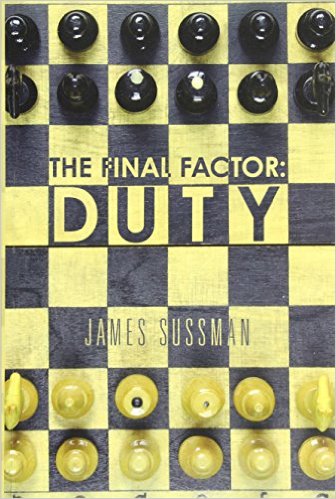
James Sussman’s The Final Factor: Duty, is a new entrant into the popular literary genre of political thrillers. It’s not exactly a James Bond revival—there are no British secret agents involved—but the bad guys want to take over the world, the good guys possess the righteousness and the skills to fight back, and violence and sexy women pop up throughout the story.

The main culprit here is, of all people, the President of the United States, bent on causing chaos, and using that confusion to take over first the country, and then perhaps the world. He is surrounded by Yes Men who believe in his vision and are organizing to follow his plans through. Unlikely? Give him a moustache and improve his public speaking and you have Adolph Hitler.

The opposition are loyal Americans–basically a retired general and some of the FBI, plus a few hit men on the correct side. At the beginning, they seem a minority, a patriotic few who must obstruct the President’s plan secretly, for fear of reprisal. But as the evil plot tries to unfold, the good guys cause problems at every turn until at last evil is thwarted, good prevails.

Sussman’s writing is competent, and he seems to know a great deal about military and FBI procedures. He’s unlikely to win any literary awards, but the plot keeps moving at a fast pace, a requirement in such a story. There are moments when the plot seems strange, as when the sexy FBI agent seduces the old General before they get down to the business of defeating the President. That such a summer/winter couple would jump into bed anyway seems odd, but to do it when the country is on the brink of disaster seems even odder.

However, this story is a page turner! Character development is at a minimum, but the fast pace and the country-shaking conflicts hold a reader’s attention right to the end. If a reader likes this type of book, save a spot on the bookshelf for this one.


Bruce Roberts

You may order James Sussman’s novel The Final Factor: Duty here. 

Essay from Joan Beebe

ON STAGE

I guess my first introduction to the stage was when I was a girl scout and my role was that of the Prince’s Herald in a play called Cinderella in Flower Land.  As a 7th grader, it was a fascinating experience.
Many years ago, after graduation from high school, I was persuaded by a friend to join an amateur acting organization.  It was known at that time and chartered by the name of the Catholic Theater of Rochester but years later merged into the Blackfriars. The aim of that group, as I remember, was not only to instill an interest in the acting field but to pursue well known plays from Broadway and produce them over the New Year’s holiday at a large theater known for bringing in popular plays and musicals  The rehearsals started months ahead and were long and intense.  However, there was always someone who found something funny in a line or two and would start laughing and soon the whole caste joined in.  It was really a good stress reliever.
We had meetings every month and, at times, the director would decide to have a few people do a short workshop play.  The rest of the members would then watch and listen and critique the actors.  Of course, the director would too and he, sometimes, would interrupt to give suggestions about body language or vocal expressions, etc.  When a play was going on at the theater, we also learned about the behind the scenes work.  There would be people for props, make up, prompter, lighting and someone who stood by in the wings to make sure the actor made his/her entrance on stage at the right time.
The musicals, produced by a different organization, basically followed the same criteria which included long rehearsals for months, teaching the actors their actions and places on the stage. There would be a lot of songs to learn and, of course, everything has to be memorized.  Both for the plays and the musicals, opening night was a night full of anticipation, nerves and excitement.  At the end of the run for these plays, there would always be a caste party which was a celebration of the well- attended and good response from the public and enjoying ones- self in the knowledge that all the hard work paid off in the enjoyment of the audiences and looking forward to the next project.

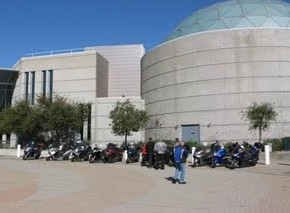
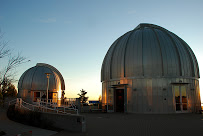
Cristina Deptula reviews an astronomy lecture from Joel Thomas at Oakland, CA’s Chabot Space and Science Center

— by Cristina Deptula
Last week, our own Joel Thomas came to talk to Chabot Space and Science Center staff and volunteers about the history of our understanding of light and time. His lecture, Galileo, George Washington and the Speed of Light, began with a discussion of Galileo’s observations and how they supported the Copernican, sun-centric model of the solar system. Through his telescope, only 30x magnification, Galileo saw the moons of Jupiter, craters on the Moon, sunspots, and the phases of Venus, which suggested that the planet was orbiting the sun.
Understanding that our planet rotated around its axis and revolved around the sun allowed for us to calculate where we were by observing the sun’s relative position in the sky. Latitude could be determined by looking at the sun’s altitude at your local noontime and comparing it to figures in declination tables, which recorded how much the sun’s position varied with distance from the equator. Figuring out longitude was possible because the earth rotated at a steady speed, 360 degrees a day, 15 degrees per hour. So if you compared your local time to Greenwich Mean time, you could see how far you had traveled in an east-west direction. This is a similar idea to knowing that you’re in an eastern state if you are three hours ahead of California time.

Continue reading

Cristina Deptula reviews a talk on the next generation of biofuels by Deepti Tanjore and Ning Sun at Oakland’s Chabot Space and Science Center

— by Cristina Deptula
Last month for our volunteer enrichment Deepti Tanjore and Ning Sun of the Lawrence Berkeley National Laboratory came to share with us about the next generation of biofuels.
According to Tanjore and Sun, last year the United States spent $274 billion on biofuels and created 14.5 billion gallons and 280,000 jobs. These substances hold promise for environmental conservation, reducing greenhouse gas emissions by more than 60 percent. Yet technical issues have slowed progress on biofuel development and made it difficult to scale biofuel production up to commercially useful levels. This talk focused on ways to improve the process to make biofuels more practical.
The first generation of biofuels were produced from cereal grains and other plants containing sugar and starch. These plants competed with food crops for land and water, so researchers looked into second generation sources of fuel, such as algae, straw, manure, nut shells, and crude glycerine. However, these had a complex chemical structure that was hard for microbes to break down into fuel. Now, as Tanjore and Sun discussed, advances in pre-treatment and the addition of enzymes to do some preliminary digestion before adding the microbes for fermentation helps break the rougher material down.

Continue reading

Shelby Stephenson reviews the work of poet Hilda Downer

SHELBY STEPHENSON

HILDA DOWNER

(August 27, 1956 – )

 

Poet Hilda Downer

Poet Hilda Downer


  • The gravitational pull of our ancestry,

the part of us that killed the Cherokee,

the part of us that is the Cherokee,

we drag through seconds of a concentration camp,

medieval wars in single red gulp.

From “History reflects itself as an old man,”

Bandana Creek

The melting pot aglow,

coal and feldspar,

mastectomies of the mountains

Native Americans revered as gods,

what if your Mohawk nose

does not serve up the American Pie?

From “America, the Beautiful,” Sky Under The Roof

Hilda Downer’s come out with another book (Bottom Dog Press, Huron, Ohio); I look

back almost four decades to an event I loved, Hilda Downer’s Bandana Creek, a startling, tough gift from Charlene Swansea, at Red Clay Books. Swansea could not write a “Letter of Regret,” regarding Hilda’s poems; Swansea’s mind was set. Charmed by the poet’s talent, she took the book and published it.

Now I hold Downer’s Sky Under The Roof. I see Reba’s here again, Reba Vance. Hilda writes, “my best friend all of my life.” “Towheads”: “Reba and I observe the way we used to stand at eye level with daisies, stepping stones up and down for walking on air as far as we could see

across the field. Butterflies test landed tiger colors for an instant takeoff.”

In the Introduction to Bandana Creek, Charlene Swansea keeps her pitch: “Hilda spent much of her childhood in solitary exploration of the blue Appalachian Mountains. Her wonder at the

co-existence of beauty and cruelty in Nature watered her secret writings like a spring.”

Would not we readers all be Voyagers sailing with Hilda Downer’s inspiration and imaginative guidance.


Sky Under The Roof starts in mouthfuls of folly: “Picking Cherries up Howell Hollow”:

“Unlike hybrids darkly marooned in stores, / these cherries glowed a delicate red from within – /

translucent white when unripe. / Little Rudolph noses, their guidance / balanced us on that tight wire, pulling us / to higher branches to reach more light.”

Touch and taste – smell – and seeing, hearing: “My tongue felt for the seam of the pit / long

after the last rags of fruit had weathered. / Near sandy ruffles in the dirtroad, / I smelled where a spring poked its finger out the bank. / Then, I spit out all possibility / deep from the dark / deep in the mountains / deeper still in childhood / attempting to see into Who I have and have not become.”

“A woman is segmented as an ant,” Downer writes in Bandana Creek: “I wait as a woman waits. / I like my own smell. / No man has known me beautiful / when I am alone and woman, / still or stirring, / a drawing power in the shoulders, / waist hidden from vertical glance, / breast to hip.”

And from “What is Under my Dress” (Sky Under The Roof): “I might lift the hem on occasion.”

“What Is Under My Dress” seems too long to quote. I choose these words as notes from the poem: “An editor once summed up / my poetry as merely listing, / told me to put that under my belt, / and would I drive with him to Vermont. / Here’s another list: / I don’t wear a belt; / I wear a vintage prom dress; / I refuse to face life like a man.” She does not: “and I’ll make up my own mind, / if there’s any room left, /about what to put under my dress next.”

Bandana Creek’s last poem is a hymn to jars: “Looking up from inside a jar, the stars / Are holes”:

Hilda Downer: “I want to call mama / when my mother strode / down the gravel driveway / like a man.” These lines are my close companions. I want to call my mother, too, through the oaktrees on top of my Paul’s Hill; like Hilda Downer’s Bandana Creek, a stream the mountains sing, I long for breath to keep her words “wondering why I’m not satisfied, / when all I ask for is the thirst and the water.” I am drawn to my own fishing holes. Deep down in wonder, experience orders change to build a bridge to another side. Far from Bandana Creek, I feel like a terrapin coming up for air at the Rock Hole on my Middle Creek.

What else can I say to show more truly the intricacies of the cruel, sweet beauty of

Hilda Downer’s gift for lines, her ways her pages move words like “the blue fixed waves

of mountains” which turn in her eyes and on her tongue to “the only ocean we had ever seen, and even a scant shell,” she writes, “was rare”; so “we listened to the ocean from a mason jar.”

When you consider that some of us write rhymes; others long and thirst for what they do not know, you may imagine Hilda Downer, this girl who becomes a woman, and dedicates Sky Under The Roof “to my sons, Branch Richter and Meade Richter” (artist Branch did the cover-art, picturing Hilda with a child on her back; Meade’s a fiddler − his band − The Sons of Bluegrass). The mother relishes the artistry of her sons.

Poets may long for difference and sameness. Consider “Jars” – from the last quarter of Sky Under The Roof: “There are no words that work, not under this sky, but maybe – above – ”: (That’s her inscription to me on the title page of Sky Under The Roof); in “Jars” she jots − “City boy who raised his jar to Tennessee – / can anything manmade be more lovely than a singular jar, / refractions like stilts of heaven through the morning / of an invisible forest?”

Bio:  Shelby Stephenson is Poet Laureate of North Carolina.  His play Maytle’s World was recently performed at the Cameron Arts Museum, Wilmington, North Carolina.

Continue reading

Poetry from Tony Longshanks LeTigre

AT LAST OUR WAYWARD SON GRASPS THE GLORY OF FIREWORKS
 
 
“Happy Fourth, baby,”
said a woman I didn’t know,
as we passed one another on the Hawthorne bridge
 
(See, being nice is cool:
you Californians should try it some time*)
 
This isn’t usually my thing, either—
this jingoistic pageant of stars & stripes
& children with cherrybombs making more noise than usual
& “God Bless the USA” blaring from the publicly funded
& ridiculously underutilized PA system
 
(Let me pick the music next time—
“Rocket,” by Goldfrapp, shimmering over the water
as the fireworks display crests to its climax!)
 
Truth be told, I prefer the geese sailing serenely
breastdown on the water to the braying obnoxiousness of human beings;
birds, like most sensible critters,
for all their euphonious prolixity at the ripe hours,
also evince a respect for silence that a writer can’t fail to admire
 
But for once, I’m going to check all the baggage of my discontent
at the star-spangled door & go with the gaudy flow,
because it’s damn near 100 degrees,
& the river feels like the ocean on Maui,
& they say it’s safe to swim in now,
since they figured out that pumping raw sewage 
& dubious chemicals into the city’s water main liquid artery
—source of all life & our most precious resource—
was probably a bad idea

Continue reading

Ryan Hodge’s Play/Write column

PW_Banner_LT

-Ryan J. Hodge

For someone who enjoys a great story, is there anything better than a narrative that engages you from the very start? Imagine a world so rich you can almost smell the scents in the air, a delivery so clever it forces you to think in a way you never thought you would. I’m Ryan J. Hodge, author, and I’d like to talk to you about…Video Games.

Yes, Video Games. Those series of ‘bloops’ and blinking lights that –at least a while ago- society had seemed to convince itself had no redeeming qualities whatsoever. In this article series, I’m going to discuss how Donkey Kong, Grand Theft Auto, Call of Duty and even Candy Crush can change the way we tell stories forever.

What Videogames Teach Us About Writing for Religion

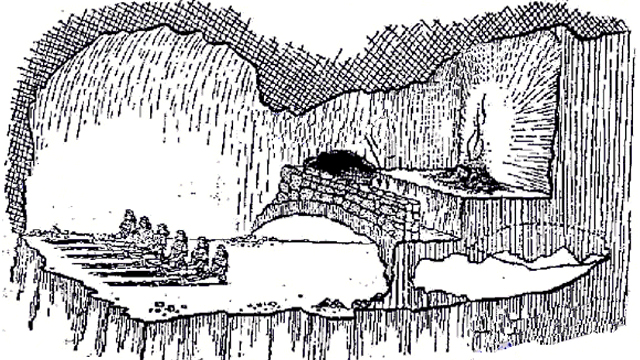
Those who have committed to even a cursory study of philosophy have probably been introduced to something known as ‘The Allegory of the Cave”. This mental exercise, proposed by the Greek Philosopher Socrates, supposes that is a group of men were restrained from birth to stare at the wall of a cave; their perception of reality would only be that of the shadows reflected on that wall. It further supposes that if one of those restrained were to be released and shown reality beyond the cave, should he ever return to his comrades, they would actively attempt to silence him –including killing him, if necessary.

The_Cave

Continue reading