Poetry from John Grey


THE GIRL AT THE BAR IN THE DREAM


Sure I wanted her.

But wanting isn’t everything.

There’s also fumbling and mumbling.

In the end, I turned away.

My wants and I moved on.


There was the dream of course.

No compromise there.

Everything desired became immediately accessible.

My words…her surrender.

But then I awoke.


There’s a world in my brain

where the most amazing things happen.

But there’s this other world,

composed of one part frozen tongue,

one part trembling knees,

and one part okay but nothing special looks.

Can’t expect much from it.

It’s a raw deal long since dealt.


And sure I wanted her.

But, most of all, I wanted an excuse.

She was waiting for someone.

She wasn’t really so hot.

It’s the lights. It’s the cleavage.

And she was probably dumb as three twigs.

Is that what I want for a lover?


But in my dream, she looked no different.

And she was sure no Einstein.

And she was waiting for someone.

She just didn’t know it.

She was waiting for me.

So my dream was a compromise after all.

Nobody’s perfect.

They just look that way.


And sure I wanted her.

Why not want what you can never have.

And even if you did have it,

it would just leave you wanting more.

And there’s always my dreams.

My wants like it there.


THE BETTER OFF


A man walks past a poor woman,

under a gray sky borne

beyond themselves

but for now each step

carrying iron down a rocky path

flanked by a flight of birds

which they cannot follow.


He’s ignores her,

his head in hands, her mind alight,

her vision immeasurably far

in a shabby sort of way,

in flame, in silence,

burdened by this path to truth.


It’s too quiet,

no alarm to raise, no message,

just a bare tree, a bare-footed woman,

and he recently returned

from every other place,

rests in front of her, on a stick.


She’s only just awakened,

Soon she must find food, shelter.

But now, she tells him,

that all straight lines sear away

the streams, winds, bear us,

the yearning’s tunneled down, turned aside.

gives gossamer to the eyes

that match day’s narrow prism,

that see only fake horizons

as up ahead we travel weathered


What could she say,

What survives the dead?

What does it mean

to ask whose heart is fire,

with a fiery knowledge,

with one absurd center,

with one unwitting voice?


RHONDA RECOUNTS


I walk down to the mailbox in the shivering cold.

I would not do this if it weren’t duty.

I slip, slide, in the snow.

Ice cracks under my slippers.

Birds, whiter-thin, nibble at the feeder.

Is that a rabbit? And is it frozen, dead?


Inside, Amelia won’t get out of her sick bed,

prefers the flakes on the window

to the letters in my shivering hands.

No two alike, she says.

But every day like the one before.


I hear mice scrambling between the walls,

Good luck to them

if they can live in such uninviting, dark places,

They hate the cold as much as I do.


More orders from Amelia’s bed.

She’d like a cup of a coffee.

Is there a magazine in the house?

Could I bring the small black and white TV

up from the kitchen and place it on the dresser.


I vacuum. I rinse dishes.

I throw clothes in the washing machine,

turn on its cycle,

listen to the burps, the grinds,

the rough and tumble, of cleansing.


Later, I sit in the chair beside her.

I still haven’t dressed, still haven’t showered.

I’m still subject to time

but the demands of a single day elude me.

Amelia is my hours, minutes, seconds now.


She recounts a dream of her husband pushing a cow up a hill.

And then one of her father sinking into a swamp.

She says, at the end, all she can see is hands reaching up.

She laughs though it hurts her insides.


A voice inside me whispers, “You have no life of your own.”

It’s simply Amelia, in her bed, somewhere behind my rib-cage,

some place so near the heart.


DEAD MEN POSING


I’m staring at a picture in a magazine,

two guys in their seventies probably,

in a Maine General Store,

circa 1976.

They’re dead now,

I keep repeating over and over and over.

They’re dead as door knobs,

as door frames, as donuts,

even the ones made on the premises.

They’re dead as the racks of Maple Syrup

on the shelves behind them

or the shovels, hardy and deep,

for that wicked Nor’easter snow.

Some cameraman figured he was snapping

a picture of life as it used to be

but it’s really death as it can’t help but being.

Those wise eyes, that skin worn down by

too many mud seasons, that leathery mouth…

all gone, now nothing but the skull

that almost penetrates where cheek meets bone.

The flannel shirts are dust.

The overalls likewise.

And those shoes, resoled more times

than they’ve had hot pancakes,

are all soul now, all spirit.

They’re captured at a moment

when one dead man is telling the other man

a long dead joke.

One’s about to grab a newspaper out of the rack.

Nothing deader than a newspaper in this day and age.

And a rack too for that matter.

The other slips his hands into his pockets.

Neither hand survived.


INTRUDER


Cougar snarls,

what am I doing in its Eden.

All of the heathen

in a lone intruder

is broached in one long

defiant coyote howl.

Junipers shake

to my trample of a twig.

Wind shifts

at the impediment of my flesh.

I sit on a rock

to clear my head.

But suddenly the rock’s head

is as cloudy as the upper sky.

A man is on its throne.

Water falls from high ledge in disbelief.

A creek cannot understand

why it trickles that first step

toward the river and the towns downstream

when civilization is already here,

a pebble toss from its novitiate current.

Send the man away, whispers the canopy.

Who needs his junk, his anxieties,

his hypocritical pieties.

Every forest creature hurtles away

from any place my foot may fall.

The trees would if they could.

Yet I am only here

to wallow in their peace, their loveliness.

How war-like, how ugly that must be.


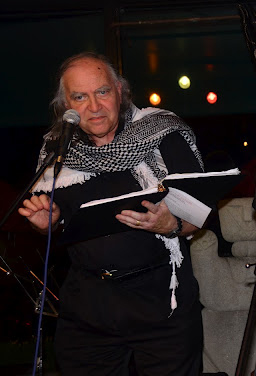
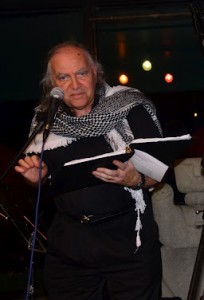
John Grey is an Australian born poet. Recently published in The Lyric, Vallum and the science fiction anthology, “The Kennedy Curse” with work upcoming in Bryant Literary Magazine, Natural Bridge, Southern California Review and the Pedestal.


Elizabeth Hughes’ Book Periscope


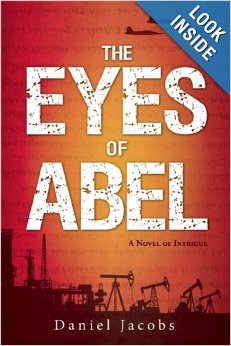
The Eyes of Abel by Daniel Jacobs

The Eyes of Abel by Daniel Jacobs

Daniel Jacobs’ The Eyes of Abel

The Eyes of Abel is a very good novel with surprising twists and turns. It is the story of Roger Charlin, a journalist, and Maya Cohen, a security agent for El Al Airlines…or is she? Charlin poses undercover, and tries to go through the security check point at El Al.

However, Maya figures out who he is quickly. She agrees to an interview with Charlin and they develop an unlikely relationship. They are both working on a fusion energy project that would lead to less reliance on oil from the Middle East. Their goal is to prevent a war in Israel, when other countries have missiles pointed at the country.

The Eyes of Abel is an extremely good novel and keeps the reader riveted to every page all the way through. It is full of nonstop suspense. Mr. Jacobs, I rate The Eyes of Abel 5 stars and very highly recommend this book. The Eyes of Abel is most definitely ‘my cup of tea’!!!

Elizabeth Hughes is a reader, dog lover and book reviewer from San Jose, California. She welcomes paying writing and review gigs and may be reached at hugheselizabeth@rocketmail.com 

Cristina Deptula on California’s Redwood Ecosystem

californiaredwoods

 Around five million years ago, the trees of the California coast redwood range would have looked quite familiar. Common plant life, now and in the past, includes sword fern, alder, madrone, dogwood, and big leaf maple, all of which budding naturalists can learn to identify on hikes by their characteristic leaves.


As Emily Burns, of the Save the Redwoods League, explained last month during a volunteer enrichment talk, California’s redwoods store a great deal of carbon, but are highly influenced by climate and moisture. They also provide a living historical record of temperature, as Burns dramatically illustrated. Specimens of redwood trunk reveal almost no growth in 1580, which proved a mystery to ecologists. Until they searched the surviving written records of explorers from that time, who mentioned weather so cold that snow lasted nearly into summer and crew members dreaded getting out of bed.

Ecologists and meteorologists say that temperatures in the North Coast have stayed roughly the same, while the Bay Area and Santa Cruz have seen warming. Also, the region has experienced fewer cold days, rather than more hot days, and the frequency of foggy days has declined. Less fog isn’t good for the swordfern, which depends on the moisture, but may actually be a positive for redwoods, who need sun. Students and teachers at Chabot are tracking changes in swordfern frond size through the Communicating Climate Change initiative, as the plant gives a fairly accurate record of the amount of moisture at any particular time. Much of the predictive modeling surrounding climate change has focused on how redwood ecosystems withstand greater heat, so adjustments to the models are likely necessary to fully understand the effects of change.

Redwood forests reached their peak millions of years ago, and before European settlement of California, they covered 2.2 million acres of land. Now, there are 1.63 million acres of redwoods, 93 percent of which have been harvested and replanted. 23 percent of these live within parks or other protected land, and some of the protected trees date as far back as 328 and 474 A.D.

Changing forests bring about varied effects on the diverse animals and plants within the habitat. Owls are returning to newly replanted areas for better foraging, but still need old growth areas to hatch their eggs. The spotted owl now faces competition from the eastern bard owl, due to cross-country migration. The Steller’s Jay, which eats the less abundant marble merlet’s eggs, has now multiplied after eating food crumbs picnickers and hikers leave behind. Also, to the consternation of ecologists, black bears are now eating the sugary redwood bark.

Forty percent of wood growth by volume occurs in a redwood tree’s branches, and an older tree continues to expand there even when its rings become smaller with age. Researchers have found that redwood growth actually accelerates as trees get older. One ancient tree known as the Big Emerald puts on 1.6 cubic meters a year, enough wood to produce 2.3 million pencils. Conservationists seek to preserve trees of all ages, as young forests let in light for new growth, while older, deeply rooted trees better protect streams from erosion.

There is some reason for optimism about the future of the redwoods, as recent centuries have seen huge annual growth in the mass of California redwood trunks. With awareness and intelligent management, we can continue to preserve and enjoy this natural area for many more generations.


Cristina Deptula is a staff writer and may be reached at cedeptula@sbcglobal.net – and she welcomes paying freelance and professional writing positions. 

Synchronized Chaos December 2013: Defining and Asserting Identity


Greetings readers, tinsel and light and sparkles and redemption and rebirth to those who welcome those sorts of things. Happy Winter Solstice, Christmas, Kwanzaa, Hanukkah, and other celebrations to all of you.

This month we bring you pieces centered on identity: fully embodying and understanding one’s self, and claiming the right to define oneself on one’s own terms.

Poet Linda Allen also draws upon the Christmas holiday as a motif in her cycle of three poems. She begins with a piece describing a winter snowfall, then another where the birds and outdoor scene echo her grief and wonder, and then a final poem which focuses on the widowed speaker’s bittersweet emotions. The natural world becomes a voice and vocabulary for her speakers, a way for them to communicate who they are and articulate their thoughts. Geese, trees, cold weather become not just a pretty landscape, but a common heritage, a way to refer to and thus talk about the same things.

Leila A. Fortier also uses natural as well as spiritual imagery in her poetic writings, rendering her speakers’ ‘ocean’ of memories through italicized fragments resembling an inner dialogue. Having the space to think, to sort through one’s own thoughts, is an important part of developing a personal identity.

In his poetry, Mitchell Grabois intersperses personal thoughts and memories with reflections on historical events, ethnic identity and American culture. His speakers use childhood innocence, rebelliousness, and wry humor as ways of coping, of existing within a changing world.

Emma Eisler’s poetic piece, like some of Fortier’s work, shows a speaker experiencing a complex and troubled interpersonal relationship. In “Flight and Fall,” her character longs to be heard, to be known for who he or she really is, rather than just seen as a symbol of the excitement and glamour of the carnival.

Arthur Gonzalez’ fantasy novel The Photo Traveler, as reviewed in Elizabeth Hughes’ monthly Book Periscope column, presents a narrator who discovers his ability to transport himself through time while escaping an abusive home situation. His moving through history to understand himself and his special role in the book’s drama resembles the internal journeys of Fortier and Allen’s poetic speakers.

Christopher Bernard reviews the current show at San Francisco’s Meridian Gallery, “By Mainly Unexpected Means -” This assortment of artwork, from 20 Silicon Valley artists (in residence at Palo Alto’s Cubberley Studios) combines the old and the new, the analog and digital, the human and the technological. Like Arthur Gonzalez’ protagonist, Gavin, the work travels through time, overlaying multiple layers of thought and history in order to better reflect and convey our world.

Amina Aineb illustrates the vulnerability of the individual in her poem “A Bizarre Way of Walking to a House.” Her writing evokes her young female speaker’s sense of being alone in an unsettling world.

Christopher Bernard’s review of poet Jack Foley’s new collection Eyes highlights the poet’s unique use of multiple voices within his text. Bernard’s piece emphasizes how Foley’s interlineated text encourages people to think rather than getting comforted or instructed, and to pay attention to language and form as well as content. By deconstructing identity in this way, Foley draws attention to the concept, and calls on us to do the hard work of creating ourselves and our world, infusing our words, lives and society with meaning.

The American Conservatory Theater (ACT)’s recent production of Beneath the Lintel, as also reviewed by Christopher Bernard, gives us protagonists with elusive personal identities. We have a murder mystery involving books, stories and libraries, where we are not sure who the perpetrator or victim really are, or even if they exist.

Martin Rushmere follows in this vein with his review of the Marin Theater Company’s production of Ibsen’s A Doll’s House, a drama which critiques the way social expectations define us and our relationships. In the drama, we see a husband forced to choose between love and honor, and a wife who chooses autonomy and self-definition over her roles as wife and mother.

Like Nora in A Doll’s House, Ayokunle Adeleye takes a risk to assert his beliefs. His strident poem in support of a Nigerian university faculty and staff strike states his position with clarity and without apology. Following in the vein of his earlier writings, he advocates for justice and government accountability and transparency within his home country.

Thank you very much for making Synchronized Chaos Magazine part of your December solstice and holiday celebrations! We wish you the light and joy of the season as you read.

http://flickr.com/photos/12836528@N00/3118302526
My heart explodes for the new Motorola+Zine+ZN5
Creative Commons photo found on flickrcc.net

Poetry from Mitchell Grabois


Dozier

The death of my grandmother

made me want to get to the heart of things

I was only nine years old

but had an advanced sense

of the Holy and Hidden

I’d already been through spiritual crises

At seven I decided I wanted to become a rabbi

At eight my parents denied me

threatened to send me to Dozier School for Boys

a harsh reform school in the Florida Panhandle

where they hate niggers and Jews

They’d set me straight there at Dozier

said my father with a maniacal grin

They’d make me one of the “White House Boys”

put me in the cinder block bunker

painted white on the outside

unpainted on the inside

where they’d beat me as if I was a runaway

slave

even if I was a Yid and and not a Nig

So get over your foolishness, boy

said my father in a thick and absurd

southern accent

something he’d learned from some TV show

You ain’t gonna be no rabbi

At age eight

already a religious martyr

I wrote a two-page treatise promoting atheism

which I ran off on the carbon copy machine

and handed out to all my classmates

By the end of the week

they were all atheists

and refused to go to church

or Sunday School

or the Wednesday night supper

with its collection of jello dishes

full of suspended horrors

The superintendent kicked me out of school

and threatened to send me to Dozier School for Boys

I said: I been there

I’m hardened

Do your worst, motherfucker

Trolls

The Icelandic poet

came to America

to do a series of readings

While he was here he abducted

three small boys

He checked in early for his fight

He conversed amusingly with the TSA agents

He’d stowed the boys

in dog cages

No one looked very closely

so they flew through the air like that

crossed the ocean

In his homeland

in his little home isolated in the dark green forest

the poet turned the boys into trolls

not the kind of trolls you think

not sex slaves either

He kept them so entranced

they didn’t even think of their parents

their brothers and sisters

let alone miss them

Bio: Mitchell Krochmalnik Grabois was born in the Bronx and now splits his time between Denver and a one-hundred-and-twenty-year-old, one room schoolhouse in Riverton Township, Michigan. His short fiction and poems have appeared in hundreds of literary magazines in the U.S. and internationally. He has been nominated for the Pushcart Prize, most recently for his story “Purple Heart” published in The Examined Life in 2012, and for his poem. “Birds,” published in The Blue Hour, 2013. Grabois’s novel, Two-Headed Dog, is available for all e-readers for 99 cents on Amazon and Barnes and Noble.com for the Kindle, the Nook and as a paperback. 

Christopher Bernard on poet Jack Foley’s new collection, ‘Eyes’


MANY-TONGUED MASTER


EYES

By Jack Foley

Poetry Hotel Press

263 pages

$24.95


A review by Christopher Bernard


[Note: In the opening paragraphs of this review, the interlineated quotations in italics are from “Villanelle” (for Ivan Argüelles), by Jack Foley, from EYES. This is an example of an interlineated text, sometimes called a “foley,” which is discussed later in this review.]


Hour: sunset; fire retreating. Hour


For many readers, EYES will be the most important introduction to the work of one of America’s most consistently interesting contemporary poets. That Jack Foley is not better known, and not yet placed where he clearly belongs, in the upper ranks of modern poets in the


Of thoughtfulness, sweet reverie.


English language, is, I believe, something of a scandal, even a disgrace to the literary establishment that historically has been so notorious for similar follies that “missing genius when it is right under their noses” has become the motto of many “publishers,” “critics,” and “academics.”


Let us talk about the stupidity of publishers. …


Given the futility of much of contemporary American culture, Foley’s work is likely to remain a minority taste until our cultural elites, craven before those great gods, popular


Let us talk of the darkening of thought’s tower


culture, the race to the bottom, and the hypercommercialization of the internet, at some point, out of sheer disgust, relearn self-respect they have forgotten and reassert the values that justify their existence, such as intellectual


Or of the endless reverence for money


courage, confrontation with shibboleths, questioning the authority of the local despot (whether an individual dictator or what has been called the “World Wide Mob”), and the slaying of sacred cattle.


At this hour: sunset; fire retreating …


When that happens, writers and thinkers like Foley may finally gain the place they deserve at the


Let us take the rotting floor!


human mind’s cold, clear heights.


Let us remember the reviews and their duplicity!


There are some benefits, of course, in the present state of things: while we’re waiting, we


Let us talk talk talk about


happy few” will have him, like a banquet of all but excessively gourmet fare,

the STUPIDITIES

all to ourselves.

of PUBLISHERS!


And as the main course in the banquet, we have this book: a brilliantly shaped selection- Foley’s work from the last several decades, printed in a large, spacious format, with a lovely design by poet, designer and musician Clara Hsu, and graced with a vigorous and munificent introduction by Ivan Argüelles, another of the Bay Area’s poetic masters (and another candidate for wider recognition when “the sleepers finally awake”).

Jack Foley’s work is that of a strenuously active intellectual, which puts him immediately at a disadvantage, of course. America must be only country where the prejudice against intellectuality is so great that even many of the writers run from the aspersion as from a rabid dog.

But Foley’s is a passionate intellectuality, and his work is the expression of a person as deeply humane as he is deeply aware. He is a poet in the ecstatic tradition of Whitman as refracted through the lenses of Pound and Olson and varieties of poststructuralism (where the open-faced smile of the American Emersonian, that happy existentialist, meets the European Nietzschean’s burned grimace), with bits of vaudeville, Cole Porter, George Gershwin, and tap dancing thrown in, all of this mixed and blended in a mind, unique but all-inviting, individual yet multitudinous, a spirit deep as day and as broad as history.

And I say this, and believe it to be no exaggeration, no decorative purple patch, because Foley’s work comes out of the generativity of language itself, a generativity that is, to all practical purposes, and conceivably also to theoretical ones, infinite. He has taken many of the crude prejudices and inane rules of “writing,” the sorts of thing that make writing classes and writers groups a curse and a torment to the spirit (“write what you know, show don’t tell, find your personal voice” and the like) that has turned too much of contemporary “writing” into a game between faux naifs and their shadows, and turned them – rules, naifs and shadows, all – on their heads. As he explains in many a lucid philosophical aside, in both prose and verse (he is not afraid of dumping into the mix of mashup rhetoric, truncated phrase and quotation unchained, a workable abstraction or an unambiguous assertion of his own when needed and helpful), Foley writes not from the center of personality in its more limited manifestations, but from the center of language, which is the archetype of the open system, a generator of meanings that, within the possible frameworks of grammatical rules and systems of phoneme and morpheme, signage, and the like, as well as the hermeneutical practices available to the human species, is essentially without limits. Infinity is thus immediately available to us (as available as it can be to an ultimately finite creature) through language, as it is through mathematics, music and the other arts, and the night sky above us.

At the center of language we also find, curiously enough and mirabile dictu, the great putative value of American culture, though it is a value paid more lip service than real service to. And that value is freedom: the absolute freedom of the mind to fashion its own meaning and meanings out of itself, to fashion its world, to crush the given into eternally fertile and life-giving fragments, annealing and reannealing them, over and over, ever and again, into the wilding and scattering shapes, frottage and fractalage, of the spirit’s – my, your, our – ever-changing fantasies and desires. Foley’s work takes place in the great theater of meaning that is language: an open-ended circus, an epic that has no conclusion, an endless conversation between an infinite number of speakers. In Foley’s work there are only pauses; there is no closure. His work contains, as it opens out to, the unexpressed and the not-yet expressed, literally, as at the “conclusion” of the poem “Fragments.”

There are few ideas headier than these – indeed, this may be why Foley makes the literary and academic establishment uneasy, strikes them dumb and off-balance; hoping that thereby he will go away, that by ignoring him he will cease to exist. They laugh at him, nervously. His few supporters in the literary establishment are sometimes ridiculed for taking him seriously: “He’s avant-garde, experimental, modernist, postmodernist – an extremist, an outlier, not mainstream, an eccentric, yikes (look at the picture, he’s wearing a keffiyeh!), a t(Errorist?)!” All that crazy modern stuff was supposed to have died with Derrida, after Bush bombed Baghdad and Americans became terrified of being kidnapped in the middle of the night, renditioned to a black site, tortured, disappeared, droned. We’ve gone back to story-telling, flattering, coddling. We want fairytales and porn, modest entertaining little poems, unpretentious, a Harry Potter, an E. L. James, a Billy Collins, a Dan Brown, to keep us bottle-fed, giggly, comfortably napping; the last thing we want is a shaman (how 60s, how quaint!). We don’t want to wake up. We might have to change something. We might have to change everything. We don’t want to hear, in English or German, du muss dein leben ändern. And we don’t want literature to have anything to do with reality.

One had thought that all such weak spirits had perished generations ago – we were beyond such schoolmasterish meatheads. But apparently not – the follies of that time are enjoying a comeback. The 20th century is going to have to be fought all over again – from socialism to modernism, from labor unions to the freedom of the heartsoulspiritmind, from revolt to rebellion, from revolution to liberation.

Foley’s work is a reminder of what is at stake.

Enough of ranting, deserved, alas, as it may be; now to a little description. But how does one describe the unique?

At the center of Foley’s literary project (to use an old, but always useful, existentialist term) are a few simple discoveries: that “literature is made up of letters” and that language “speaks us” as much as we speak it, which discoveries (along with the modern notion of the mind’s, and therefore the self’s, unconscious and multifarious drives, in which the ego is less like a crystallized monument to its own ambitions (often our preferred self-image) and more like an arena of energies in constant interaction, frozen only, achieved like a work of art, a symphony, a novel, a poem, at its conclusion) made the multi-voiced poem not only possible but, in a sense, inevitable.

This kind of poem, as practiced by Foley, often incorporates other texts (the poet sometimes rewriting them, bending then, shifting them, shaking them, making them other, making them “wrong”; chopping them up, sometimes rough, sometimes fine, like a chef cooking his dish out of meat and meanings; Foley, the echt modernist, is in this the echt postmodernist as well, just as in his casting about in analog hyperlinks he discovered the internet of culture before the clever fellows of ARPAnet ever dreamed of the internet of technology) to create not so much collages as (as he calls them) “collisions” of texts, from which meanings are presented, produced, invented, hinted at, questioned, splintered, shaved away, blown up, shattered, destroyed, renewed, and then spun through the whole process again and again, in a perpetuum mobile of created meaning, which is the heart of language in its absolute freedom, which is human freedom itself, fantasy, dream, imagination: our only way out of the inferno of reality, our Paradise rose holding universal love in its infinitely opening blossom. It is like an enactment of Maurice Blanchot’s “Infinite Conversation,” without the gray continental flavoring, its flirtation with nihilism and despair; on the contrary, it is exuberantly cheerful (“energy is eternal delight”) and alive.

The immediate engine of this process in Foley’s writing is the question, sharp, and often humorous too, in its Socratic sense of perpetual undercutting of received understanding. In Foley, this does not lead by way of reductive approximations to a unitary meaning, as so often seems to happen in Plato’s dialogues (though often less so than is commonly supposed – many of Socrates’ questions are ultimately left open and not definitively answered; even Socrates seems to be aware that he had opened a Pandora’s box indeed; that all answers are provisional and only questioning is eternal – maybe the world began with a play of questions: “Quark asked: Why?—

Why not? said Higgs” And off we were to the races) and the wretched forced march of western philosophy that followed.

Foley’s way of questioning, like Socrates’ and like the German philosopher Martin Heidegger’s, open out into a plethora of possible understandings, undermining the received “wisdom,” the prejudices, the pre-judgments, that many of us bring to common concepts, and all of us to some of them. (What is a “personal voice”? What is “personal”? Isn’t it possible that nothing is personal, nothing individual, (“I am not an ‘individual,’” as Foley says at one point. “I am as divided as can be”), that we are all just made up of the scraps of other people, and those people are made up of the scraps of other people, and so on, ad infinitum, ad nauseam, et ad absurdum, and that there is no ultimate origin? And “what do you mean by ‘voices’?” anyway)

In this sense, Foley is a philosophical poet par excellence, though he practices his philosophy outside the bankrupt discursive practices of western philosophy (philosophy is of course not “dead,” pace Heidegger, Adorno, Derrida, Badiou, Agamben e tutti quanti: philosophy will die on the day that people stop asking questions: whenever you ask a question, you are “doing philosophy”; whenever you ask it insistently, so much so that it becomes a matter of life and death – in this sense Christ, Moses and Socrates are one (the defining Judaic question is the vertiginous set of questions “What is the law that I must follow? And why?”; the defining Christian question is “Why hast thou forsaken me?” and we are still waiting for an answer) – then you are “doing western philosophy”: it is the west that made a fetish of the question; elsewhere, before and since, people who ask questions too persistently are killed) – he seems to have been impressed, and perhaps influenced, by Heidegger’s ideas about language and being, his approach to ultimate questions that are never, finally, answered, and then has taken those ideas to the logical next step. And (as he has said in other situations) he has been influenced by the ideas of Paul de Man on deconstruction, though not to undermine language; on the contrary, to liberate it in literature, and by so doing, purify it, reminding us of what we have been doing all along: that language is our responsibility, a tool, an instrument. And that its innocence is our obligation.

Foley’s multi-voiced poems led, naturally, to his “choral” poems, which are performed by two or more voices simultaneously: some of his choral poems incorporate work by other writers (Foley also practices a kind of interlinear poem, called a “foley,” in which he adds his own lines between the lines of another writer’s work, turning the usually monologic lyric into a dialogue; a poem becomes a heteroglossia; all literature becomes overtly what has always secretly been: a wealth of talmudic marginalia).

For many lovers of poetry, especially those who live in the San Francisco Bay Area, which is fortunate to enjoy the poet’s bracing, sane and warmly human presence, the choral poems are Foley’s best known work. In a way, that is something of a misfortune, because these readings can give Foley’s work a superficial resemblance to the free-associational rhodomontades of the Beats and their followers, and what one sometimes misses, in the pleasant but sometimes half-baked theatrical experience of the contemporary poetry reading (no lighting, no music, no costumes, no rehearsals), is a sense of the extraordinary care with which these texts have been constructed; this comes across on the written page far more clearly than in the comparative limitations of a staged reading. One misses the visual element too, the placing of words and phrases, “marks,” like skillfully made drawings, woodcuts, engravings, on the page. The ideal experience of these poems might well be to simultaneously follow them on the page, like a musical score, while hearing them being performed.

In EYES we can most easily enjoy the expansive exhilaration of Jack Foley’s literally inimitable work, where no two poems are alike, where in some cases they can never even end, where each work is crafted to a unique shape, where voice becomes voices (“What are ‘voices,’ anyway?”)—a gift to the culture, the country, the time, however long it takes us to catch up to it:


we are not—

those masters of language

summon wor(l)ds

which

resonate

resound

so that experience is

alive with random fragments seeking others—

fragments summoning

not unity but constant interaction

—“Fragments”


I see this review has often wandered from its subject, and for that I apologize. But it is just one example of the stimulating power of Jack Foley’s work: it does not let you settle down even on itself for very long – it opens the mind to the mind’s many worlds, and encourages you to pursue thoughts, ideas, words, universes, out of the received sanctities, the limitations and limits, the presumed security and safety, of literature – out, into the open, as far as thought dares to go. It’s not the only way to write, of course, but it is certainly a valuable and hopeful one. It is, above all, liberating.

By the way, did I mention that Jack has a sense of humor, sometimes quite wicked? You don’t believe me? Read “The Marx Brothers Run the Country” and weep with laughter, my dears. (Our masters have been reading Jack Foley even if our critics haven’t.)


____


Christopher Bernard is a poet, novelist, essayist, playwright, photographer and filmmaker living in San Francisco. He is author of the novel A Spy in the Ruins and the recent collection, The Rose Shipwreck: Poems and Photographs. He is also co-editor of the webzine Caveat Lector.



Poetry from Linda Allen

Snow

By: Linda Allen

There’s snow on the ground

It’s like God’s blanket of beauty

Nothing more comforting than snow

It’s like God’s way of telling humans to slow down and look around at the beauty in this world


Snow makes you want to cuddle up

With your honey

With your babies

Snow makes you want to cuddle up by the fire with hot chocolate and read a book


Snowball fights going on

Snowmen being built

Snow covered houses, cars, and trees

Snow brings smiles and joy to children’s faces all around the world

Snow blankets the world in beauty and love

Snow makes us forget the ugliness that happens in this world, if only for a little while


There’s snow on the ground

Blanket of beauty and love

Slow down and marvel at this world and all the beauty and possibilities

Snow

Snow, what could be more beautiful?


Christmas Day Snow

The snow covers the ground

Everything is white except the trees

The snow has to be at least 5 or 6 inches deep

She sits in the silence staring out of the sliding glass window

She sees the beautiful snow and it inspires her

Snow is like a blank canvas, it covers everything that is ugly

The wind blows softly; the birds are flying and singing do they see the beauty?

Do they see the beautiful snow?

Why are they here?

Didn’t they know to fly south for the winter?

The sun is barely over the horizon, the smell of turkey fills the house

It’s Christmas morning and she cannot seem to sleep,even though she has a head cold and two ear infections

She thinks about the people who have lost their lives this year, hoping and praying that the snow makes the tears disappear for just one moment

As they reflect on their pain for just one day for Christmas cheer

For days like this she thinks of the angels that are looking down and watching her, she thanks them for the snow

So Merry Christmas to all

Make snow angels in the snow for loved one lost and remembered

Merry Christmas


In love and memory of:

Michael Bennett (cancer)

Earl Bennett (cancer)

Roy Bennett (alcoholism-lung failure)

Three uncles that are gone, but never forgotten

Who’s That Baby in the Window? 

Who’s that baby in the window?
She looks a lot like you
Her eyes are blue just like yours
Looking at her makes me miss you so much more
I see her and want to cry
You are gonna miss so much

Who’s that baby in the window
She smiles at everyone she sees
She brightens up my day
She reminds me of you
She makes me see you every day

Who’s that baby in the window
She’s fast asleep and I could watch all night
She looks the way you did when you slept
Can you see the angel we made from heavens window?

Who’s this baby in the window?
The perfect reflection of love
Love for me
Love for our daughter
Love for our country
You paid a high price for love, but the price was worth all the pain

Who’s that baby in the window?
The daughter of a hero
Gone but never forgotten