
Christopher Bernard – review of San Francisco’s Meridian Gallery’s current show, ‘By Mainly Unexpected Means – ‘


BEAUTY BY SURPRISE


By Mainly Unexpected Means—

Work from the Cubberley Studios

Curated by Theres Rohan

Meridian Gallery

535 Powell Street, San Francisco

Through December 21


While I was passing the Meridian Gallery down Nob Hill the other lazy day, I let my eyes wander over the sign outside and was promptly stopped in my tracks by the title of the gallery’s current show. I am, I admit, a sucker for group shows: they usually include at least one artist I’ve never heard of worth the visit; so, in I went. And, after a discreet welcome by the eager-eyed staff (I didn’t have the heart to tell them I’m as penniless as most artists: the best I could give them was only words), I let myself sink into an hour of completely unexpected charm.

By Mainly Unexpected Means—,” as it happens, displays work by 20 artists who have been active at the heart of Silicon Valley, where digital is king and the virtual world is bidding to take over whatever is still left of “analog” culture. That the totalizing grasp of such revolutions always fails (history, like nature, never letting any one thing succeed for very long) is some consolation; that at the very heart of Digitaland the material world and its spiritual extensions are so subtly celebrated makes at least this art lover breathe with relief. Not that the digital world is by any means ignored or scorned here: it is, however, used to deepen our humanity, not to try to replace it.

The exhibit comprises work by artists who have been in residence at the Cubberley Community Center, in Palo Alto. In the Cubberley Visual Artists Studio Program, selected artists are provided with studio space and engage in classes, exhibitions and related activities that bring together the arts and the local community. The current exhibit provides a selection of work by these artists.

And there is some very choice work here. Julia Nelson-Gal’s “Greetings From Kalamazoo” are scrolls made up of found photos and thread, stitched together in rows of narrow bands and suggestive of collage friezes and ancient reading scrolls expressing private fantasies and half-forgotten memories. Inga Infante has a series of little, gray metal boxes, all called (with delicate irony) “Wired,” lined up with dignity on a wall, with tops ajar like doors to tiny closets and lots of white space around each; with décor on the “doors,” wires impishly turned from the boxes (making the viewer wonder what they are connected to); inside the boxes, half-hidden, are curious objects and pictures.

Lois Anderson has a single, small but memorable piece, called “The Knowledge Factory”: a diminutive book made up of a couple dozen paper quires, bound with string so it can’t be opened, with “Withdrawn” ominously stamped, in institutional lettering, on wraparound paste-ons and a title “The Knowledge Factory student power and academic politics in America” making a statement that is clear, provocative and profoundly witty.

Sharon Chinen has perhaps the most sheerly beautiful analog work in the exhibit, with a series of exquisitely delicate pieces in the exhibit’s first gallery: wall hangings made of the thinnest wire and worked into, in some cases, spiderweb-like, in other cases nest-like, in still others crown-like, forms; expressing a combination of hardness and gentleness, strength and fragility, the kind of power that is only revealed through this kind of tenderness and control.

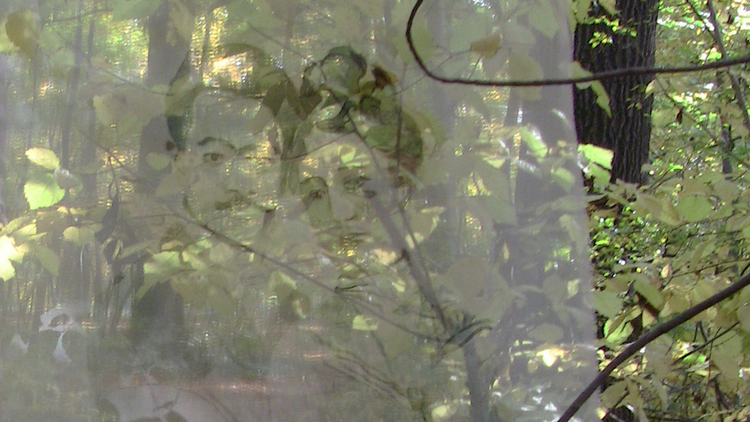
There are two video installations, either of which alone would make a visit to the exhibit worthwhile. Michal Gavish’s “Untitled Frame” is a brief film in which a transparent cloth seems to be hanging in a woodland, swinging in a gentle breeze; printed on the cloth, or appearing and vanishing in multiple-exposure, in long-bygone styles of painting, drawing, and photography, are the faces of an apparently Latin American couple, an older balding man wearing glasses, a woman with sad eyes and unregarded hair, people perhaps from the artist’s past, or from an imaginary past; the only sounds (projected from small speakers above and behind the viewer, who sits in one of two old-fashioned dark wooden chairs that themselves call up memories from early in the last century) of bird calls and distant traffic and the conversations of passersby on an unseen street.

Nora Raggio’s “Geo Wideo” is easy to miss, as it’s placed, alone, in a small room off the gallery’s main lobby, horizontally on the top of a small table. But it would be a shame to pass it over: it’s an example of digital tablet art; the viewer looks down at it from above and watches the piece slowly unfold in silence, screen passing across screen in random sequence and various divisions, revealing forms from nature: dense gray clouds, puddles spotted with tiny bits of natural detritus like floating splinters of stars, indecipherable blurs and flowing streams, and moving lattices of shapes: flowers, leaves, water.

Other standouts in the show include two large-scale archival pigment prints by Peter Foley, densely saturated photographs of interior architectural spaces: “Untitled Red” a pink-tinted empty space almost perfectly symmetrical, with a wrinkled, wall-to-wall carpet in shock red; and “Untitled Blue” a corner of an industrial room in the midst of demolition, viewed from a low angle, with a majestic rip across a panel of sheetrock revealing what looks like an old unused elevator shaft and a car with a door of cobalt blue.

Other work of interest includes photographs of a land installation by Linda Gass, curious “tools” by Ken Edwards, oil paintings by Ann McMillan and watercolors by Marguerite Fletcher, and metal serving platters wittily engraved with common, humiliating commands from childhood (“stand up straight,” “look at me when I’m talking to you”) by Marianne Lettieri.

A performance piece by Lessa Bouchard that is part of the exhibit will be performed on Saturday, December 7, at 4 pm. The exhibition also includes a small catalogue that includes an index of the artists’ websites for the curious.


_____

Christopher Bernard is a poet, novelist, essayist, playwright, photographer and filmmaker living in San Francisco. He is author of the novel A Spy in the Ruins and the recent collection, The Rose Shipwreck: Poems and Photographs. He is also co-editor of the webzine Caveat Lector.


 

Christopher Bernard reviews ACT’s performance of Beneath the Lintel


David Strathairn in Underneath the Lintel

UNDER THE SUBLIME


Underneath the Lintel

A play by Glen Berger

Starring David Strathairn

Directed by Carey Perloff

American Conservatory Theater

A review by Christopher Bernard

Underneath the Lintel, the one-man play by Glen Berger that is receiving its first ACT production in San Francisco this fall, is a detective story of sorts, though the victim of the crime is not exactly dead – indeed, he is, or at least seems to be, anything but, and the crime is not murder, at least not of the usual sort, though what the victim is a victim of, is certainly most foul. There is even some question whether the crime’s perpetrator even exists.

Nevertheless, the play’s sole performer is most insistent that, if this particular victim exists, the criminal must exist also, and one finds oneself in the end agreeing with him, even excitedly so- if there is this victim, then there must be this criminal. And for reasons that will become clear, many of us will in fact want, even hope for, this very criminal’s existence. So in order to find the criminal, we must first find the victim. And that is where the story begins. Does the victim exist? And if not, where do all those drops of blood lead? To underneath a certain lintel?

(A lintel is a piece of wood (usually) that forms the top of a doorway or window, so “underneath a lintel” is the equivalent of standing in a doorway or leaning out a window. More about this later.)

But, before I continue, let me get some necessary housekeeping out of the way. First, this is one of the most completely successful productions at ACT that I have seen in years. There is an unusually strong balance of acting, producing, directing and scriptwriting that I don’t often find in local theater. The direction is discreet and focused; the acting is skillful, honest and selfless; the set is ingenious but not self-conscious, a back wall cluttered with paraphernalia from productions past, the sort of stuff you would expect to find in a small-town lecture hall, complete with carousel projector and little pull down screen, and the kind of bulky stairs-on-wheels you’d stumble over in a large, public library. And the play offers that blend of entertainment and enigma, puzzlement and illumination, strong feeling, deep thoughtfulness and humane comedy – philosophical in the original sense of the all-involving, all-tormenting, all-hopeful, and sometimes entirely ridiculous, search for truth that is the soul of all great love affairs – that theater, in the wealth of its humanity, can provide more effectively than any other medium.

A graying, slightly befuddled, one-time librarian from Poland (played with the deftest of touches by David Strathairn) walks onstage to give, “for one afternoon only,” a talk – or rather, as the play is subtitled, “An Impressive Presentation of Lovely Evidences,” as he says in his slightly tarnished English. He opens a battered suitcase, in which he says he has collected “scraps” of a life, “evidences” that he hopes will “prove a life, and justify another,” namely, his own.

One day, in 1986, as the librarian was cataloguing books returned through the overnight book-return slot at the library of the small city in Poland where he has lived and worked all his life, one of the books – a much thumbed and annotated Baedeker – had been checked out, according to the last stamp on the inside book slip, 113 years before. The librarian is, naturally, dumbfounded, though also, like the small town functionary he is, indignant and his bureaucratic prowess being put to the test, decides to track down the offender and extract the fine the library, in all its dignity, is due. This, unwittingly for him, leads eventually to a worldwide search – from London to Bonn to Beijing, from New York to Sydney – in a tantalizing quest for the elusive borrower of the spectacularly belated volume; a quest that will cost him his job, his friends, his country, perhaps even his sanity, and may prove to be never-ending, even futile.

At each station of his progress, if that is what one can call it, he picks up a piece of the puzzle, a rag-end of “evidence” of the existence of the borrower, a person he grows to believe is none other than the mythical . . .

One cannot really discuss this play in any detail without being in danger of revealing too much – and yet, if one reveals nothing, one is left without the pleasure of demonstrating to the reader just how deep this artful, profoundly thoughtful and deeply felt play eventually goes, far more than one could possibly have guessed from the frayed bits of evidence and hardly sublimely promising opening – and yet sublime it becomes. So, if the presentation here stutters now and again, withdraws, shies coyly and bids fair to be just a bit too oblique, the writer can only plead extenuating circumstances and, if anything, a great, even perhaps too great, respect for author and players and public. But here we go anyway.

We’ll let it sit at “mythical,” shall we, and let the implications unfold in all their many, searching, reaching, even over-reaching and, yes, tantalizing directions. But I can’t drop it entirely without mentioning that it has something to do with an incident, perhaps apocryphal, during the passion of Jesus of Nazareth, as he dragged his cross among the Roman soldiers through the alleys of Jerusalem on the way to Golgotha, past the homes and shops of the locals, few of whom had any idea who this person might be – just one more troublemaker on his way to what was probably a well-deserved end – when the poor fellow dropped his cross, to rest briefly before the door of a cobbler, where the cobbler was taking a brief break from his labors under his lintel, and, frightened by the looks of the soldiers, the crowd, the other criminals on their way to execution, and the bloody face staring up at him under a nasty looking crown of thorns, the cobbler told the fellow to shove off, get off his stoop, and keep going, and Jesus said he would do so, but the man would have to tarry here until he came again. And, according to the story, the man did tarry, and is still tarrying, until the second coming, or forever: the Wandering Jew, the victim of the one certain “criminal,” God.

____


Christopher Bernard is a poet, novelist, essayist, photographer and filmmaker living in San Francisco. He is author of the novel A Spy in the Ruins and the recent collection, The Rose Shipwreck: Poems and Photographs. He is also co-editor of the webzine Caveat Lector.
 

Poetry from Leila A. Fortier


~Abrasions of Artifice~

and she broke me…

Pried from the refrain of words…the posture of a white page and crystal silence~ Snapped back like a wet towel of reality~ I know not all the reasons for my crying~ Something in the welling of moments left unsung~ Testimonies of the broken, falling silent as stars—settling into dust beneath floorboards~ Our moments are squandered by intrusions of light~ Where the moon hangs paled and reticent against midday sky~ Let someone else swallow eternity, we say…before stepping back blindly into abrasions of artifice~

~Alone with the Formula~

*

It

Is low tide:

Native fishermen

Scatter—seemingly walking

On water~ Simplicity of nature~

Skimming only the surface of that

Meridian between sea and sky~

I am drowning in the high

Tide of a numerical equation; less than zero; a negative

Sum~ There is no breath~ No light within

These depths where nature has

Left me alone with

The form-

ula

*

/ Divide /

*Inspired by Kirk Morgan’s “In Prayer to His Goddess”

I

Have not

Cherished him enough

For that which he understands

Above all others~ This preservation of

Mystery~ Covenant of the sacred~ Guardian

Of the ineffable~ This absolute of necessity~ For

That which hands were never meant to touch and

Those words never meant to be spoken~ Tainted

By breath and defiled by the kiss of mortality

Destined for devastation by crafters

Who would exploit the dream~ Only waking dormant

Nightmares~ Adding insult to injury~ The clutched

Words we drive into the earth…soiling the

Sacred~ Damn these roots that

Have forged this

/ Divide /

Between him and I…interrupting

Ephemera~ Where all things

Transitory have no

Beginning

And no

End

~

~Infinitely Smaller~

Ripples break

The silence somewhere

Between rush and fatigue~

All is swallowed and spewed

By the sea~ Whitewashing the

Arrogance of material being

Stone, glass, porcelain~

Hollowed shells

And bullet

Casings

The

Lone

Rubber

Boot has a

Story~ Polished

In decomposition~ Even

The cigarette butt has meaning

I remember when I used to smoke~

Or when I used to eat meat~ I wonder

How many more things I will release

Kiss goodbye without blinking

In becoming infinitely

Smaller

~No Prison in the Poem~

~

You

Plead for more

Of this beautiful nonsense~

Wrapping yourself in my abstractions~

Like cocoon and chrysalis~ You take it all to

Heart~ Take it personally~ But I cannot be

Imprisoned…even within my own poem~

My silence eludes you~ You

For understanding~ You see…I have tucked

The answers outside my own reach~

Thrown away the invisible

Key~ A mystery

Even unto

Myself

~

Leila A. Fortier

Leila A. Fortier is a poet, artist, and photographer currently residing in Okinawa, Japan while pursuing her BFA in creative writing through Southern New Hampshire University. Her sculpted poetry is often accompanied by her own multi-medium forms of art, photography, and spoken performance. The use of italics in her text forms a symbolic representation of inner dialog while the tilde lends to the fluidity and continuum of her thought processes. Selections of her work have been translated into French, Italian, Spanish, Arabic, and German in a growing effort to foster cultural diversity and understanding through poetry. With over one hundred publishing credits, her work in all its mediums has been featured in a vast array of publications both in print and online. A complete listing of her published works can be found at: www.leilafortier.com

Elizabeth Hughes’ Book Periscope

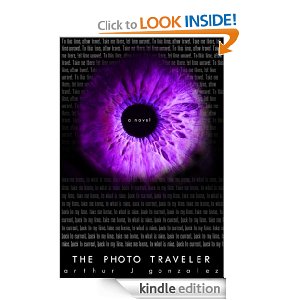
The Photo Traveler is a really good book. I highly recommend it. If you like sci-fi thrillers, then this is a book for you. Even if you don’t, I am sure you will enjoy this book tremendously.
The Photo Traveler starts out with Gavin, who has been adopted by an abusive family. He believes his parents have been killed in a fire. The adoptive father had not always been abusive until his wife was murdered at a store, while she and Gavin were out shopping with their daughter, Mel. After that day, Jet, his adoptive father, blamed Gavin and made him pay by beating him.
Gavin finds out he actually has biological grandparents that are still alive, and sets off to Washington DC to find them. Once there, they tell him that he is a Photo Traveler, and his parents may not indeed be dead. He also finds out that there are people after them for vials that contain a liquid that will allow travel at any time, not just through photos taken in the past. With those vials they could change the world. Gavin goes through many surprising journeys trying to find the truth of his life, and the lives of his grandparents, and to find out how the vials are used to change history and possibly the future.
I very highly recommend The Photo Traveler and cannot wait for the second book to come out. Thanks for the great book, Mr. Gonzalez. The Photo Traveler is definitely my cup of tea!!
The Photo Traveler may be ordered here: http://www.amazon.com/Photo-Traveler-ebook/dp/B00BI4KEQC/
Elizabeth Hughes is a reviewer from San Jose, CA who loves suspense, mystery, action and books of all sorts. She may be reached at hugheselizabeth@rocketmail.com and seeks paid freelance writing opportunities. 

Essay from Ayokunle Adeleye

In Defense of the ASUU STRIKE.

Resolved: ASUU strikes are utterly ineffective, totally uncalled for,
profoundly senseless, and the students are always the only victims.

Defense: It is no news that the Academic Staff Union of Universities
(ASUU) had, for the past three years, embarked on shorter warning
strikes over the non-implementation of its Agreement with the Federal
Goverment (FG) with the general public- and market women- haplessly
looking on and seemingly enjoying the show; after all, silence means
consent. Finally, the perpetual stimulus has reached threshold
potential and the whole nation runs amok over a long-foreseen and
imminent tetanic contraction. Abaa!

Where was the Senate during those calmer, but innoculating, times when
ASUU yelled and none responded. Wasn’t this the same Senate that would
rather cut off our petroleum product subsidy than starve their obese
allowances? Now that ASUU has thrown away its hearing aid we blame her
for a deafness we all share(d), a deafness we stubbornly refused to
acknowledge before now. Did we not know that following prior
innoculation, the (immune) response tended to be faster, stronger and
of longer duration? Did we think all was well with our ailing
varsities and the half-baked, hardly employable, products they churned
out- overcrowded and antiquated ovens that they have become?

Alas! It is now that we realise that the guillotine is not the cure
for the hailing head. The FG can spend N350m to renovate a residence
(of the permanent representative to the UN, we are told) but our
universities can rot for all they care! And ASUU must not go on
industrial action? Then who will?- and what will?

If U don’t want strike then what do U want? Silence? Mona Lisa
attitude: sad and smiling; suffering and smiling? That we Nigerians
have been known for the world over- and for a long time now? Dialogue?
Who, in their right minds, would dialogue with a blind government-
blinded to and by corruption in unthinkable quarters and to
unspeakable depths? Or why would an elected official hide behind
bullet-proof doors if not to hide his/her stench from the malnourished
polity s/he has lived off, an undying parasite that s/he is? And why
would a governor deny his own country, his own people, legal import
duty on the wealth he extracted from us anyway? And now that he
perceives we’re wasteland we must not benefit from his huge purchase-
nor must our professionals be employed on it. Greed. Greed. Greed. And
greed! But the river that forgets its source shall soon dry.

Alas, in Nigeria, your rights are not pre-ordained; you fight till you
are reckoned with. That’s the Nigeria we’ve come to see. (A Nigeria
where 16 trumps 19 in a majority vote. Where Governors enjoying
constitutional immunity cannot meet peacefully without invasive Police
interruption in their lodges. Where ordinary Nigerians cannot assemble
to protest unfavourable FG policies- and inactions on corrupt
purchases- without pervasive military occupation in our streets.)

So, if ASUU hadn’t gone on this strike would the Almighty Bros J- the
other, human, J- meet with them for 13 hours? If U think that’s a Yes,
why then did it take him 4 whole months? Not to be missed is the
fire-brigade approach- typical of Nigeria, alas not only in Sports-: a
lingering, festering, 4-month-old strike was to be called off in the
twinkling of an eye when the Paramount Ruler would not bat his eyelid
for 123 days- just because he has finally said so!

Nigeria we hail thee…

Oh, and to say that all students are the victim(s) of this strike will
be to commit the famous Fallacy of Composition: Alas, not all students
are jobless- and joblessly roaming about the streets- some of us have
actually taken this time-out to try our hands in some business or the
other, learn a trade, or practise our calling and sharpen our skills.
Life is tough, life is a competition; and strikes are just one of
those volcanic eruptions by which the strong and sturdy are separated
from the weak and feeble!

Perhaps another are those election violence we have to be part of
because our (literal) grandfathers still wallow in politics and will
not just dive in and be meals for the fish. They’d rather we wear life
vests- riddled with the holes of their mischief- and dive in to save
their sinking, stinking, political careers. So they can be President
or Governors, and Senators, and Honourables at all cost- human lives
not exempted!

Everything aforesaid is in my opinion, as is this: Anyone older than
the country Nigeria has no business whatsoever ruling in whatever
capacity. We’ve had enough of you; you’ve overstayed your (stolen)
welcome. An actor leaves the stage when the ovation is loudest, to
stay a second longer is for, in the words of the immortal Tai Solarin
which I will undoubtedly jumble up, the housefly to meet the toileting
bushman yet toileting. Ẹ lọ sẹ́mpẹ́. Una don try. Au revoir!

Ayokunle Adeleye. Undergraduate. Ogun State.
adelayok@gmail.com

Poetry from Emma Eisler


Flight and Fall


Give me a ticket to your carnival show

I want to watch you whirl through the big-tent

I’ll sneak in; ride on the wave of ten-dollar perfume and fallen dreams

Perpetual chatter, ersatz happiness

Performers whose illusions lure only the lonely

I’ll wait with you backstage

You’ll whisper in my ear,

That’s the boy who flies the highest, but he’ll fall the fastest

That’s the girl who started out selling pocket candy and possibility”

And which are you?” I’ll ask

You’ll look away and answer, “The girl who loves to dance”

But I already knew that

I’ll look at your arsenic eyes and licorice hair

At your tapping foot that’s itching to be free

Just like the rest of you

You’re the girl who loves to dance

So much she’ll die dancing, frail legs spinning

Hummingbird heart whirring in her final thrill

The lights and colors pull you away, on stage

And you never bothered to ask, “Which are you?”

Too entranced by the circus of your desire

Tunnel vision of all you wish to do

But if you’d asked, I’d answer,

I’m the boy who loves to watch, so much he’d die watching,

Drown in the scent of cotton candy,

Spiraling flight of trapeze artists wishing for wings”

But even if you asked, you wouldn’t hear me anyway

Because for you, love has always been a softer shade

Than longing 

Poetry from Amina Aineb


A Bizarre Way of Walking to a House

How bizarre it was to walk from the Bazaar,

the gypsy night parade to my abode

and the tiptoe of trepidation.

No longer do I know

daisy dew in darling day

so I’ll scream it all in some bizarre way:

A girl, walking, folded into a defensive pounce.

What lurks in these

forests of houses?

She paces herself and tries not to look vulnerable.

Step beat pause sweat. Soon,

her march slain by the meander—

the sharp sidewalk, the dying spotlight glow of streetlights,

the animal in that house’s alley, the tall swinging beings

that carry no torches, rubber meshing with asphalt in tires, on her feet,

spacious air and night humidity licking her shoulders and she

runs

how could she not know

runs

of this spirit world

runs

I’ll die with no requests from my abode.

In the day, I’ll sleep eagerly

And in the day, perhaps you might see me,

the stranger smiling on the street.