Christopher Bernard on the Aurora Theater Company’s production of Amy Herzog’s After the Revolution


“Après moi, la revolution . . .”


After the Revolution

A play by Amy Herzog

Aurora Theatre Company

Berkeley, California

Extended through October 6


A review by Christopher Bernard


One of the lessons of the 20th century was the delusory successes, and persistent failures, of our major political systems, including liberalism and capitalism, and the absolute horrors wrought by what seemed to be the only alternatives, the class collectivism of the left and the racial collectivism of the right.

Now we stand in the early 21st century, the best of us confused, others stymied, the worst fanatical. We all seem to have been wrong, though some have the learned the “collectivist” lesson too well – “overlearned” it such that we have driven ourselves to a bloody-minded individualism with most of the blood on foreign shores, and, at home, ignorant brains and addicted bodies, bloated self-images, a raging sense of entitlement, a culture of self-deception, and spirits cynical and half-criminal; a spirit of “sinister giddiness” dancing drunkenly across the land.

We have forgotten the moral idealism, some of it deeply inspiring, even when based on shaky premises, of some of those movements we have turned against, in particular, the socialists and communists. It is still difficult for us Americans to speak sanely and rationally – well, about anything, really, but especially about communism, equating it, as we now usually do, with the worst depredations of Lenin, Stalin, Mao Zedong, Pol Pot, and their ilk. And we are not entirely wrong to do so – except that we forget that the communists in this country, were among those who fought most strongly for the rights of the working man, and, ultimately, the middle class, during the Great Depression, and saw most clearly the dangers of fascism in Europe and at home.

Without the communists, the socialists, the trade unionists, and other members of the radical left of the ’30s and ’40s, we almost certainly would not have the New Deal safety net that the middle class takes for granted today – nor in all likelihood would we have a middle class, despite the neoconservatives’ attempt to destroy it over the last thirty years.

But now we have an opportunity to revisit those issues, and remind ourselves of what we have almost lost, thanks to this enlightening, honest, morally engaging, politically dynamic, intelligent and humane, and very satisfying, play by Amy Herzog, a playwright who is in serious danger of giving the battered and often disdained values of intelligence, good sense, humanism, and moral probity back their good names.

“After the Revolution” – a revolution that, pointedly, never happened – examines three generations of the sort of American family that is rarely shown in popular culture, vociferously political, outraged at the world’s evils and refusing the temptations of moral disengagement, steeped in Marxism and the traditions of the radical left. Emma (played admirably, and endearingly, by Jessica Bates), of the youngest generation, has created a fund, named after her admired dead grandfather, for left-wing causes. The grandfather, who has given his family a memory and legacy of moral integrity and political heroism, was an active communist in the ’30s and ’40s, and a martyr to the McCarthy hearings in the decade following. A series of revelations then ensue, that force the smart, idealistic, forthright and thoroughly likeable Emma to explore, excruciatingly, her family’s past, and the complex of truths, half-truths, and lies, on which she has based, not only her understanding of herself and her world, but of her past and her future.

This play does what the modern play, at its best, can do so well: confront the audience immediately, under a probing, sometimes stark, but never gratuitously harsh, lamp, with the moral, social, and political dilemmas of being a human being at our time, and in our place. The problem play invented by Ibsen lives on and shines.

The relationships in the play are developed with a fine acuity – in particular, between the grandmother (superbly performed by Ellen Ratner), who, like many of the Old Left, remains, at heart, something of a Stalinist, in denial of the revelations of what “Uncle Joe” did throughout his time in power. And the relationship between Emma and her sister, Jess, a drug addict constantly in and out of rehab, provides the play’s most endearingly bizarre laughs. (The druggy, uncensored sister is caught very well, with only a few over-the-top moments, by Sarah Mitchell.)

But the central relationship is between Emma and her father (performed by Rolf Saxon with just the right amount of flaming indignation and helpless bafflement at the moral bind he is caught in), and on this the drama mainly turns, like a door on a hinge. And this relationship – and it is refreshing to see a modern relationship between father and daughter depicted as based on genuine respect and love – shows how even the deepest love between people can trick us into the kindest, and yet most dangerous, temptation of all. Nothing threatens honesty, integrity, truth, so much as love – because love can seem at times, not only to condone, but to require, lying. And this is not only true in family politics, of course, but in politics at large. Because the lies of love of the left have remained with us so foul that, for some, they have fouled that love – a genuine love of humanity and pity for its sufferings – itself.

Someone else who must be mentioned is Peter Kybart, who plays one of the donors to Emma’s fund, a fellow-traveler from decades back, who does not quite understand the depth of Emma’s dilemma, and brushes it off with a breeziness that displays not so much cynicism, as a lack of understanding of the real issues involved (this is one of the play’s weaker moments, as Emma seems too easily persuaded). A further weakness is Emma’s romantic relationship, which unravels with implausible speed as Emma sinks deeper into despair, because of the moral dilemma she finds herself in. The somewhat thankless role of Emma’s lover is ably done by Adrian Anchondo. Emma’s apolitical uncle, a necessary counterweight to the sometimes hopelessly unrealistic political flights of the rest of the family, is played with staunch (but, unfortunately, unexplored in the play) good sense by Victor Talmadge. The fine direction is by Joy Carlin, and the clever, imaginative set by J. B. Wilson.

This play really should be seen by anyone involved in left-wing politics now, or in the last century. And indeed, by anyone who cares about the political prospects of compassion in the cold, bloody early decades of this one.


Christopher Bernard is a poet and novelist living in San Francisco. He is author of the novel A Spy in the Ruins and a book of poems and photographs, The Rose Shipwreck. He is also co-editor of the webzine Caveat Lector.
 

Short story from George Sparling

The Nearness of You

    Sue should have been surprised, when she saw the top story on Google News about Len

slashing the throats of a black man and white woman on the busy square. She wept

reading about Alice’s death. The black man also died. Alice, her bisexual, longtime

partner, had done what came naturally and Sue hoped she had not pushed Len’s hate

button.

    Sue waited for a table at a vegetarian restaurant, and seated next to her was a man who

beat his feet on the floor and rubbed the stub of his ring finger which had two digits

missing.

    “Rousseau took walks to think. I tap and think,” he said. A table freed, he asked

whether she wanted to sample what he ordered and he would share some of her meal. “A

few bites, I don’t have HIV.” His energetic speech appealed to her, whose stamina

needed a recharge, so she and he sat across from one another.

    “My name’s Sue. I drive a bus, 200 miles a day,” she said. “I do what I want on

weekends.”

    “Call me Len. This is my first day in town. You know, I never had a job.” “How in the hell

had he supported himself”, she thought, sipping the smoothie as he said, “Prosit,” and

clicked her glass with his smoothie. He mimicked her frown, two pairs of eyes staring

over their glasses. The waiter brought them smoothies while they waited. “I dreamed

about blueberry smoothies in the slammer.” She heard his feet bop the table’s metal

stand.


    “Prosit,” she echoed. Soft, electronic harp music and ocean waves played on the sound

system and swept away Sue’s qualms. The bright, colored framed images on the walls,

diners’ comfortable conversations, the hum attuned to the shared experience, appeased her

doubts about him.   


    They ordered soup, salad, and entrees. Len said, “Good German word, ‘prosit’, they

really made Europe tick, cleansing filth. Where would we be without Germans?”

    Alice, her Jewish partner, would have thrown a barrage of punches at this asshole with

that. Alice at the beach with some guy, Sue had slipped out of her familiar orbit and

bumped into this, but why walk away from fine food?

    She turned in the chair, stretched out her hairy leg, and said:

    “I can bench press one hundred pounds ten reps. That makes my fear threshold pretty

high.” He stared at her exposed leg. She wanted to make it plain that he would not hit on her.

    “It must put hair off your chest and lead in your pencil.”

    “That’s a guy thing. What about you?”

    “About what?” The waiter placed the orders on the table and when he left ,Sue

asked with a smirk, “How much lead’s in your pencil?”

    “Before my trial, I wrote a blog. I don’t ejaculate anymore. Are you sorry?” He had no

sorry bone in his body. Was he intentionally ambiguous? Either the blog or trial was

responsible for his sexual retreat. “Why had paranoia begun to encroach?” Sue thought,

uncomfortable with its alien presence. Interjecting sex bluntly did not gel with organic

food.

    “Why the trial?”

    “See this? A groid cut most of it off. I survived but he caught a cold.”


    “Caught a cold”? You meant ‘black man’, don’t you?” Her voice rose and

diners turned their heads. Her aspirations proved too high for this lowlife. “Alice and I

usually eat at that table by the windows,” she added, pointing at the teenage trio at the

table.      

    “Got killed, but not by me. I didn’t want to do a backdoor parole and die a natural

death inside.” He looked smug, boasting his prison slang.

    She would stick it out with Len. His disclosures both disarmed her and threatened her.

When she told Alice about Len, she would undoubtedly tell Sue that she should have told him

he was a thug, and ‘accidentally” kick him in the shin beneath the table, and leave with

two checks to pay. 

    “I marched for gay rights and got arrested but they released me after three hours.”

She wanted to demonstrate their differences – she, a genuine progressive, he, an inveterate

criminal. There was no hope of converting Len. She had marched for an end to those

Christian conversion groups, thinking gays could become respectable heterosexuals.

But it took mass movements to get rid of racists like him. Or, Sue might arrange for her

black weight trainer to put the terror of God into Len, get him the hell out of this laid-back, cool town.

    “Protesting is a dead end.”

     “Who’d have you in their demonstration anyway?”

     Sometimes police infiltrators joined them during protests against the treatment of

Bradley Manning, world-famous whistleblower that leaked damning documents about

this government’s illegal and genocidal atrocities in Iraq. But, the march continued with

the undercover uglies anyway. It was difficult to avoid enemies.

    There was an empty table to their right where she might break bread alone, yet she

remained seated. What held her there? She hoped never to run into Len again, but if he

stayed in town, that would be impossible.

    Sue ate her meal slowly. Len slurped his soup and chewed maple glazed

walnuts, goat cheese and roasted beets, then plowed into the Shepard’s pie, chomping

down the mashed Yukon potatoes and sweet potatoes, soy sausages, steamed veggies and

cashew gravy. He then reached over and snagged half her spinach salad, stabbing with

his fork the grilled bosc pear slices, dried cranberries and toasted hazelnuts, and

Ethiopian tempeh, then spooned lots of her millet loaf.

    A little too loudly, Sue said, ‘Save some for me, dammit.” Diners fell silent a few

beats, then resumed conversations.

    “Lebensraum, my dear, I needed more food and the Germans in the thirties needed

more land.” After Len’s pillage, Sue’s remaining food had the taste of paranoia.

    Sometimes, late at night, Alice and Sue would cuddle, listening to nostalgic, romantic

songs. Among their favorites was “The Nearness of You,” sung by Sarah Vaughn. It was

written in 1938. That same year, Nazi Germany announced its “lebensraum” policy. It

wanted more land, especially to invade Poland. Poland, on Germany’s eastern border, its

proximity marking it for invasion and enabling the Nazis to sweep into Russia, crushed

communism before it matured. Those nights, the lyrics brought Sue and Alice closer and

forged a union unbroken by boundaries. Len erected barriers, just as nations at war do.

    “Ever listen to music, Len?” Sue said.

    He blushed, then recovered. Everybody listened to music- it was inescapable, but her

question caught him off-guard, as if he were not part of humanity. He squinted his eyes,

brought both fists on the table, flicking the severed finger at her. It was like brandishing

the raised middle finger, but more menacing, more threatening. It was as if he had given

her a cliterectomy. He regained calm as it moved across his face, he unclenched his

fists and moved his face and body away from her. He had leaned across the table to

achieve maximum intimidation, and now relaxed, except for his restless legs.

    “I listen to Sabaton, a metal band singing about Germany’s wars and millions of dead

heroes. Their lyrics are taken from history and almost makes me shoot my load,” he said.

     Why his candid disclosures – had he nothing to lose? Most persons would have left by

now, but Sue would not leave the untainted food. After all, she and Alice dined here

frequently and it was as much as their territory as Len’s. She conceded space to him,

allowing all persons admission under the Big Tent. An exponent of multiculturalism,

even released criminals and their underworld culture had the right to co-mingle with folks

such as Alice and Sue. His extreme terrorizing and Sue’s maximal tolerance: inclusion

must be the price of human differences.


    “Peace is better that rehashing old history.” She pretended not to hear the “load”

business. “Metal bands thrive on fear.” 

     “Fear motivates me. In Florida, I was so scared of getting attacked by a groid that I

shot the sucker. I didn’t kill him, though.” His body vibrated as he spoke, and he bounced

in his chair. The diners had thinned out but the remaining ones looked alarmed.

    Finished, Len said he would pay for them. Sue consented as she had already done

by sitting three feet from him.

    They walked a few blocks to the square. His arms brushed hers as they walked. They

sat on a bench. “Damn, why does his thigh have to touch me?”

    “I’m broke,” he said laughing under his breath.


    “Why pay our bill then?”


    “Something will come up,” he said. “I can beg or mug somebody. The square looks

touristy. That’s where the money is, in their fat wallets.”

    He pulled out a nasty looking knife from a sheath, concealed at his hip, that was inside his pants.

    “Careful, don’t cut me.”

    “I couldn’t stop yapping to you. Prison does weird things. This finger’s missing

when I tried to mug an old gal in Florida.” His voice steadier than at the table, he stared

into her eyes.

     Sue stood up, said goodbye and walked home.

     Alice was not there. “I could’ve killed Sue, but instead knifed these two, she a n*****

lover and the groid too,” the article read. That puzzled the reporter. There was no mention

of who Sue was- Sue had not yet been notified by local authorities.

    Sue played “The Nearness of You” alone in the living room and asked herself whether

she, Sue, was responsible for their deaths on the day-lit public square.

    People are just too damn close these days, she thought.

Short story from Lance Manion

risking the scraped knee

from Maniacworld.com

I must have looked like a crazy person.

The way our eyes met, and then, instead of quickly finding something- anything- to look at to ease the discomfort of unexpected human interaction, my eyes froze. They darted down a bit to the nose and then a quick swing around the eyebrows but they never left her face.

They dipped down to the lips.

And what lips.

A sudden rush of memories that had nothing to do with these particular lips came nevertheless. I wonder how much of those memories played across my crazy-person face as I fought to look away.

She looked like someone I once knew but there was no way to explain that to her without risking a good macing. I was already firmly in weirdo territory, no reason to push my luck.

I walked to a nearby bench and plopped down to collect myself. I could feel her eyes on me.

She was there with a child that I could only assume was hers based on her body language.

She was younger than the person she would look to be like today. She looked like she did when she was the person I was remembering. She she she. Obviously this wasn’t just any she.

You always think about riding past the old house to see how things look all these years later but the truth is that the little tree out front is now a big tree, and its roots have grown up under the sidewalk and pushed it all out of shape and made it uneven. And even a simple ride past now is treacherous.

You understand?

So when I sat on the bench I tried not to look at her but, as treacherous as it might have been, I wanted a quick look.

It might have been her, if time had frozen. It was uncanny. I didn’t think people could look so much alike. How she did her hair. How she moved. The jeans she wore. The shoes.

She even doted on her son like I’d always imagined she would have.

Some quick look, right?

Ok, it was a long look and for some reason I got the impression that while she was aware that I was watching her while trying not to look like I was watching her, she was alright with it. I would have looked just the same but it was nice of her not to run screaming.

Eventually you loaded up her son into the minivan and left and that was the same minivan I saw pull up the next day at the same time.

I was now circling the house on my metaphorical bike complete with the nostalgic baseball cards in the tires and the emoting banana seat.

It wasn’t until the third day that I walked up to explain myself … as best I could. While I worried I might come off a bit creepy, she said it explained a lot.

She said she liked it. She liked finding out what little stories are going on in other people’s heads.

We met every day after that for a week.

Her husband traveled internationally and was gone much more than he was at home. Even when he was home. The tree out front was growing but he wasn’t paying much attention to the sidewalk.

She had started her own business and it seemed to be flourishing. It took me three days to find out exactly what it was. She didn’t want to tell me because she was afraid I would laugh. I told her I wouldn’t.

She explained that after that video of a squirrel waterskiing went viral, everyone who owned a squirrel wanted to have it learn to water ski. She had a big pool out back anyway so … she was a water skiing instructor for squirrels and other small mammals.

I laughed.

I laughed because that was something that could have helped me to picture the girl she originally reminded me of. The last I heard, she was a fencing instructor for disabled and mentally handicapped children. That was a long time ago.

The tree out front had no doubt grown plenty since then.

So now I knew one more little story in one more pretty head, but even as I talked to my new acquaintance, I knew I was only there because of who she looked like.

I could have her become her. Or vice versa.

Or I could continue down the street and leave the house behind once and for all.

Sinking back into the banana seat and feeling the wind in my hair, I peddled as fast as I could and never looked back.

Looking back on it now, she probably thought it was because she was a water skiing instructor for squirrels.


Lance Manion is the author of four humorous short story collections; Merciful Flush, Results May Vary, The Ball Washer and his latest, Homo sayswhaticus. He blogs daily on his website www.lancemanion.com and frequently contributes to many online fiction sites.

Bruce Roberts on Opera San Jose’s production of Verdi’s opera Falstaff

Falstaff Fantastic

I’ve always been ambivalent towards opera. On one hand, I love the voices-those powerful theater-filling instruments that make one ashamed to even try singing in the shower. Their power and majesty are thrilling, inspiring, and humbling—all at the same time.

On the other hand, they tell stories-with characters, and with dialogue. That dialogue–and the accompanying events–often do not achieve the same level of awe-inspiring performance as the singing. A singer might swell his voice to reach the stars–while asking for a sandwich.

I thought of this recently as I sat in San Jose’s beautiful California Theater and watched the opening night performance of Verdi’s last opera, Falstaff. Readers who know Shakespeare at all, know Falstaff as an overweight, loud-mouthed drunkard in Henry IV, a would-be seducer of women, and a bad influence on young Prince Hal, trying to keep him drinking and partying until Hal rises above, rejecting Falstaff to become the heroic Henry V.

The prince does not appear in Verdi’s version—which is based more on Shakespeare’s Merry Wives of Windsor— but Falstaff is there, with all of his bad habits intact—as befitting a comedy. He drinks, he brags, he welshes on his bar tab, he plots to seduce women, he berates his workers, but most of all—as played by Scott Bearden—he sings, with a thundering, powerful voice, the equal of anyone else on stage. Would that his comedic acting equaled his voice.

The true comediennes in this performance were the ladies. More capable of injecting feeling into their wonderful voices, and supporting it with animated faces, Jennifer Forni as Alice Ford, Lisa Chavez as Meg Page, and Nicole Birkland as Dame Quickly establish immediately that Falstaff is no match for them. Their indignation at Falstaff’s plan to seduce them, their glee as they plot their revenge, and their total joy as the revenge comes to pass, are all portrayed with liveliness of voice and face and gesture that keeps the audience in rapt attention. Of course their words and actions do not measure up to their awe-inspiring voices—but that’s opera.

The symbiotic relationship between voice and action and meaning, however, does shine through with the young lovers in the play. Nannetta Ford, played by Cecilia Violetta Lopez, and Fenton, played by James Callon, have the passionate language of romance to match their euphoric, elegant voices, and the results are amazing. Love sizzles in the beauty of their singing, the animation of their faces. And in Ms. Lopez’s larger role, as the Fairy Witch who dominates the final torture of Falstaff, she is the epitome of lively charm.

All in all, attending opening night of Falstaff at the San Jose Opera was a wonderful experience. Tuxedos and elegant gowns everywhere, a glamorous 1927 old-style theater—glittering from a recent 80 million dollar restoration, and a cast with voices magnificent made for an unforgettable evening.

Bruce Roberts is a writer and retired junior high teacher from Hayward, California. He may be reached at brobe60491@sbcglobal.net

Poetry from eLPy

Every Forest 
By eLPy

Public-Domain-Images.com, please support the site!

I have learned something
Inside myself
About the world around me.
Everything IS special
And has its time and place.
Every forest is alive
And full of unimaginable things.
Every forest is exotic
To the next travelling stranger.
Every forest is the best example
Of a community working together
Efficiently and carefully
Using its resources.
No one forest is better than the next.
It’s all in our perspectives.
Yes, the Amazon is a jungle
Filled with more wondrous things than most
More exotic than most
More extravagant and mind-numbing
But it is still
Only one of many along a spectrum
To really love the Amazon
You must know how to appreciate them all
Otherwise,
Its fascination too will die out
Amongst repetitive stimulations
By visitations
The key to conservation is integration
Bringing it all together
We don’t conserve things
Because we don’t value them
For what they are
We preserve them
Because we value what they are
To us
We don’t save the rainforests
Because we don’t appreciate
Our own.
We’re always searching
Searching for something better
Than what’s in front of us
But,
What if we integrated
mass amalgamated
All those strangely appealing,
exotic because unknown to us
Thoughts, images, dreams, and ideals
Into what already exists?
What if we conserved things
Because
We loved them
Not just because they’re disappearing?
Like Winter Strong
By eLPy
Sharp like spices,
Ice slices
through
down and under
into you
Winter weather cold,
and brutal too,
Feel it, brave it, true, bold
the landscape revealing
only raw materials, and then concealing
Your fears and weaknesses, perhaps
your happiness inside warm hats
contained in flake-shaped crystals
falling to mesmerize
against the hustle
Against white, color is strong
existence in the Evergreen
all year long
appearance not apparent
until you see it last the current
Respect
Nature need not expect
forced upon suspecting
all who live a life
whether accepting or requesting
Soon, it will pass
fade into life
until there is the last
heart frozen under despair
the weather clears to be fair
And what was raw
seemingly barren
summons like the crow’s caw
what’s been there all along
No less than Winter Strong
LIFE.
Pushed
By eLPy
I was pushed to the edge by my friend
The banality incessant
Finally, the scales tipped and I fell off
The noisy backdrop always so comforting
Like being alone in a crowded room
You don’t want to be a part of the crowd
but you need the crowd to be a part of you
This was at my fingertips
With a mere and simple push
This button, that button, on and off
Then it pushed me back
There was nothing there this night
Relief was evanescent
Exhibiting my choleric attitude
As I couldn’t find what I searched for
The clutter and the chatter
Became a discursive banter
That I could no longer handle
If just for the noise I would keep my friend
All night
But this time the noise reached my threshold
I could not hold on
And off
Goes my friend
Now the screen is dark
And the room is quiet
Lacking in certitude about how now
The night will play out
It’s all up to me, what’s inside
The noise is harnessed in that rectangle
No longer free to bombard me
I’m left with the responsibility
Just me and my creativity
To make the room come back to life
All alone, I have to make it okay to be
All Alone.
Hypocrisy
By eLPy
We push death
To benefit some agendas
We cry culture
To right atrocities
We preach wrongs
To right our egos.
Who are we?
We are everywhere.
Let me take life
So that I may live mine
As I please.
I will do
What I punish you for
Because it benefits me.
I will punish you
For trying to live
As you see fit
For then,
There will be room for me
To live as I see fit!
Who is this “I”?
This “I” is everywhere,
In almost everyone.
Mass animal slaughter
Today, it’s dolphins in Japan.
Justice followed Genocide
When we deemed it worthy
Iraq
But let go as long as possible
When we didn’t
Darfur
Celebrated celebrities
Praised as false idol Gods
Paris Hilton, Britney Spears, Kim Kardashian
God
Diminished & demoted
Saints
Kept distant & reflected on remotely
MLK, Ghandi, Jesus
Haughty criminals disguised as leaders
Kept close, they remain in power
George W. Bush, countless corporate & political figures
Millions spent on marketing
Minorities spent on pain
All in the name of “our” gain
People defending their worth
As people
The “Jena 6”
Against people lying to
Remain high & mighty
White people, especially the wealthy
Or any one people/culture
Forcing themselves
Above another
We’ll hold the bait
For anyone/anything to race
Then ride their coattails
And in the end
Take their place
We kill our earth
And all her creatures
Just so we can exploit
Her features
The oceans, rainforests, all ecosystems
We take lives
From their homes
Exotic pet trade
Just to flaunt them
In our own & then neglect them
When we’re done
The pet trade
We tell others how to live
But that chance
We do not give
Developing nations, well really
Everyone different from ourselves
Billions spent on entertainment
Reality shows, award shows, political shows
Of deception, monetary affection and the infection
Of the need for power & control
While cents are spent on common sense
Global malaria prevention
Necessary, life-saving childhood vaccinations
Improved & proper sanitation
A consideration of the book of revelations
These are just a few of the things
We could do on our vacations
So imagine
All the progress we should make
Within our occupations
We don’t have to look far
Or even try hard
To find solutions
Cause they’re not in some
Upper/middle class
Economical revolution
Perhaps,
They are found,
Global salvation is found
In the abolishment
Of mankind’s
Soul’s
Pollution…
Thunderous Nights Within
By eLPy
The room spins
And the thunderous fear
Crashes in to you.
Oh shit,
This is real.
You can feel it all around
Until you’re claustrophobic.
Just when you thought
You could breathe
And the sun will come again
Your darkness nailed all
Your doors
Shut.
You could feel each nail
As it crucified your existence
Screaming out the windows
But no one near
Can hear your frequency.
Your decibels are off this scale
And on to the next.
Where they can hear you
It is the rest that forget you
Because you exist
In these moments
Beyond comprehension,
Like northern lights
And natural phenomena
There are few who even want
To know
What to do.
Let alone take on this
Trial of error
That is sometimes
And so much
You.
The thunder follows lightning
Because it is only in seconds
You can see anything right now.
But oh how you wish lightning followed thunder first
Like fearless follows fear,
You need the sun
To follow nightmares
Right as you wake
To remember them
As it is then
You doubt you’ll escape.
It’s a natural disaster
Inside of you,
The winds won’t die
The rains won’t stop
And the thunder only gets louder.
The floods rise
The winds spin
And the sky darkens
Taking with it your hope
Of a rainbow
And its pot of gold.
To ask for help
Becomes a danger
To the others,
But you fear
You will not brave
You cannot swim
And the light is too far
Like driving to catch morning
Before you even see it
On the horizon.
Here,
You are not safe
Where you live,
As it is in this place
That you are conspiring
Against yourself.
But it is not you
And you can’t explain who
Until all the doors
And windows
All the safe exits
On the first floor
Are blocked with barricades
Of thoughts
That spiral in and down.
Run to the second
And then
Only can you jump,
No parachute
No glider
Not even an umbrella.
Then there is
Faith
And your second story
Becomes a second chance…
Yet…you still have to wonder
Is there
ANYONE
Still out there
Who can, will
Or even wants
To embrace this catastrophic place?
Or have all
The residents
Moved on, moved out
And forgotten?
With all this rubble
This work to be done
Comes fear like disease.
Panic rivals health
Peace of mind
Becomes so scarce
It’s wealth
And you are
But a poor gravesite
Where you are found
To be lost
As you see
That they’re blind.
There’s no one here
With directions
To the mountain near the sun
And its safety,
The rainbow and its pot of gold.
No, I don’t believe
The leprechaun exists!
But I can show you
Where there is paralyzing fear
That is real
And magic places made up
To pose enough
Like happy meals.
Where there is enough sadness
To make the sky blue
Leaving you
Up there
Lost in space
Where time is spent
And reality is wasted
Until it is forgotten
And something else
Replaces it.
Stuck in a house
With no roof
And no basement,
The thunder always
Rocks you,
The lightning always
Shocks you,
And tornados always
Catch you
With no safe place
To take cover.
So you sit
In this darkness
And maybe you wait till dawn,
Or maybe you dive into the shadows,
But you’re always wondering,
Until you can’t,
Where are the survivors?
Did they make it through?
Can they reach back with key in hand
To locked doors and unceasing storms?
Where are the saviors
To rescue us
From these behaviors?
    God,
          Grant us the heart
          And the eyes of an owl
          So we may see still                                   Through the dark
          And capture the light
          When it is scarce
          to guide us
                      through these pitch black, thunderous nights
                                         that live within us.

Poetry from Irving Greenfield

ON HEARING A MAURICE RAVEL QUARTET

by Irving A Greenfield

From Stresatravel.blogspot.com

The music touched me,

and I touched the music.

A theme, played by the violist,

dug out of the notes with strings and a bow,

thrown to the moment and caught something

something I did not want to remember.

The cantorial chant of the High Holy Days,

now a memory realized;

A plea for mercy, even to me, an unbeliever.

LIBERSTOAD

The mood hurls him into the past;

he’s a small boy curled up on thread-bare couch,

maybe it was green?

Half awake, half asleep,

Listening to the Saturday afternoon performance of Tristan and Isolde.

As he listens now,

seated on high-back chair next to the window with a harbor view.

He listens and reaches back into the past; the music his arms and hands.

Something magical, beyond his ability to understand how that memory,

that image so long gone came back to occupy a place in his brain,

A place he never knew he had,

especially for that insignificant moment when he was a boy

listening as he listens now to Tristan and Isolde

as eternal sleep claims him.

THE MEMORY AND THE MUSIC

The reality and the memory

bridged by the music

an outdoor concert on a sweltering summer’s night

with the salt scent of the ocean heavy in the air

a burst of music

The William Tell Overture”

the pounding hoof beats and a ‘high-oh Silver!’”

And a small boy is sprawled out on the floor

in front of the Majestic Radio

his gray-haired father sits close by

pretending not to listen to the daring-do

of the Masked-man and his Indian friend, Tonto

but listening all the same

The memory of it made sweeter by the music,

by the gallop of so many years

Kim Brown on Katherine Scott Nelson’s novella Have You Seen Me

In the worlds of some teenagers, life can be hard.
The challenges that some teenagers have to endure may make it seem impossible to live.
The violence, drug use, and bad behavior tend to be the escape from the harshness of their realities.
The ridicule, constant fighting and disagreements with parents, school mates and other family members who have no clue about the pain that a teenager is going through do not help. Teenage life can be extreme, even for the calmest teenager. Being accepted for who one really is the hope of many teenagers, but is rarely realized.
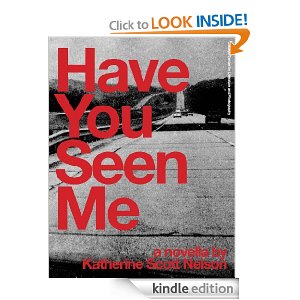
There will always be the stigmas, the misconceptions, and the expectations of the world and the family for a teenager to try to live up to. But you will find in this book, Have You Seen Me, a novella by Katherine Scott Nelson, two teenagers, both struggling with their own way of life and trying to make life work right for themselves.
This book is a great read for mothers and fathers, and teenagers who are great at just being who they are. As parents we often get so caught up in trying to structure our children’s experiences that we forget that we live in a great huge world that has more of an influence on our children that we do. The longing to belong as a teenager is important, and this is a difficult season of life. Although we want to create a perfect teenager who always stays on the right path, we should just be thankful for our son and daughter’s soul and life.
In this book you will see how teenagers at young ages are exposed to the most detrimental experiences inside and outside of the home. One chooses to escape momentarily, while the other tries, unsuccessfully at first, to disappear forever.
No matter the problems that a teenager is facing, they should know that there will always be resources that will be able to help them. Running away from the challenges of family and home, unless to escape physical or sexual abuse, can end in tragedy.
Thank God for friends. In this book, we see these two friends who face similar challenges in life, one who runs away to New York City, and another who is cautious enough to endure the test of time. He is confused, yet unable to take such drastic steps to relieve his frustration, and anger. He holds on and is able to still grow as a teenager, and also lend a helping hand to his friend in trouble.
Through hardships, adversities, anger, family disagreements, distressing and difficult circumstances, conditions of pain, sickness, or dysfunction, we need our teenagers to hold on and be strong. We need our teenagers, despite all the right or wrong choices they may have made, to seek refuge in a family member or friend. As we see in this book, the teenager who goes astray not only takes their family and friends through pain, but they also ultimately hurt themselves in the short and long term.
Now, some advice to teenagers:
As teenagers we have to understand that we can be empowered by many people. The main thing is to learn to love discipline, and to learn to love the ones who may have a different view than ours. We as teenagers have to learn to love ourselves and take time to learn about the world, people and places that surround us.
Kim Brown welcomes thoughts and feedback, and may be reached at kimbrown_kimronice@yahoo.com