Tapati McDaniels on W. Kamau Bell’s Totally Biased comedy tour
Totally Biased Stand Up Tour at The Chapel
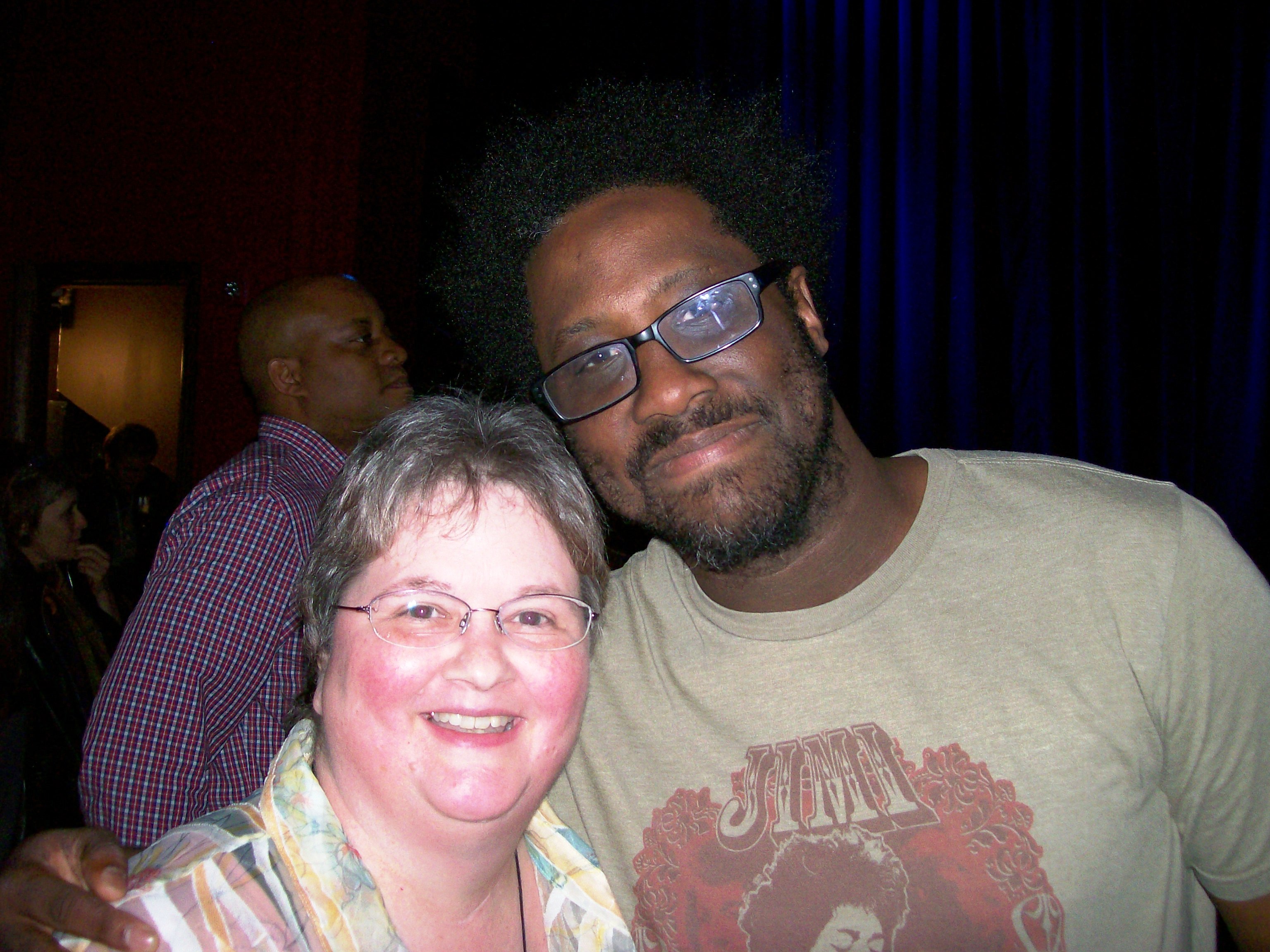
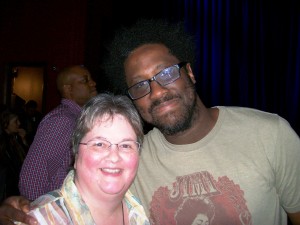
W. Kamau Bell brought his “Totally Biased Stand Up Tour” to San Francisco at The Chapel on Valencia Street Sunday, July 21 and 22. My husband David and I were there for Sunday’s performance. We’ve watched every episode of the FX show Totally Biased, wondering why it was just a half hour long. So we were, excuse the borrowed phrase, totally biased in favor of the show when we arrived. Fans will be happy to hear that the show will be an hour long on the new FXX channel which W. Kamau Bell assured me will be available on basic cable beginning September 4.
Appearing with Bell are writers and performers from the show, Kevin Avery, Dwayne Kennedy and Hari Kondabolu, along with Karinda Dobbins, a Bay Area comedian. The tour is showcasing talented local comedians in each city. Karinda Dobbins started the show, introduced by Bell’s disembodied voice via loudspeaker.
Dobbins soon had us cracking up, making the first Zimmerman trial joke of the night. One might imagine the show would be laden with them so soon after the verdict but it was nicely balanced, a leavening of reactions to the verdict without overtaking the other material. Dobbins told a story about a work review from her white boss which came the Monday following the verdict. “I got the best review ever. Thanks, George Zimmerman!” The audience went wild. She followed up with stories about her daughter ‘s music and some misleading Nicki Minaj lyrics involving oral sex and the flavor mango. I don’t want to spoil it but readers might want to review the lyrics to Minaj’s “Can’t Stop, Won’t Stop.” David and I resolved to catch more of her shows in the future.
Kevin Avery followed Dobbins. He’s the head writer for Totally Biased and grew up in the Bay Area. He is a very physical comedian, throwing his entire body into his performance as he described how he didn’t realize a college friend, also black, was gay before he came out because it was the ’90s, era of Hammer pants, wild hair, sequins and glitter. Emulating a back up dancer for MC Hammer had us clutching our sides as we laughed so hard it hurt. According to Avery, if you were black and gay in the ’90s you had to burst out of the closet with attitude before anyone would notice you were gay. Much of Avery’s set was self-deprecating, making fun of himself for being out of step with black culture, to the detriment of his dating relationships. He made fun of his speech and how close it is to “white guy speech” as performed by black comedians, explaining that his parents enrolled him and his brother in a Catholic school, all white except for them. After having spent his childhood in the Bay Area, he then went to college in Alabama where he was awaited by culture shock.
Next up was Dwayne Kennedy. He addressed Trayvon’s shooting directly, saying, “If you were a black man, you can’t walk on the sidewalk, run, even go to the store. You got to levitate. I’m just going to levitate to the store.” Why was Dwayne arrested? “He broke the law of gravity.”
Kennedy talked about why there aren’t more black serial killers. “There would be”, he explains, “if black people had higher incomes. At the very least you need a car. Dude, my bus pass ran out, can you come pick me up? I got this body…”
Kennedy says he’s praying for the hole in the ozone to open up more(mimics spraying aerosol can) and notices that more white guys are marrying black women. “They want a UV umbrella; take shelter of that increased melanin, African number 10.” But he saw an interracial couple one day and mimics the sister telling her husband off and Kennedy says “You didn’t think that was free?”
Hari Kondabolu was last up before W. Kamau Bell and made it clear that colonialism would be a theme. The comic, born and raised in Queens, had visited Australia, which has rules about not bringing harmful life-forms into the country which could destroy the ecosphere. “The indigenous people of Australia would agree.” Kondabolu makes fun of whiny liberals who say they’re moving to Canada and points out that Canada also has a history of colonialism, killed natives, and their prime minister is trying to gut the social welfare programs.
His best story of the night involved his dad picking him up from the airport. A white lady jumped into his dad’s back seat, mistaking his dad’s car for a taxi. Kondabolu tried to tell her that it’s not a cab, to which she said “Too bad, guess you should have run faster.” He could only assume that she didn’t really look at the car, just the color of his dad’s skin. “Oh, he’s in the servant class.” I won’t spoil the story’s ending, in case you get a chance to hear him tell it.
W. Kamau Bell was last to perform, followed by a Q and A session with the Totally Biased comedians. Continuing his comedic education on the subject of racism, he tells a story about a Facebook interaction with an ex-friend (emphasis on the word “ex”) who is a white atheist. This ex-friend posted a story concerning racism and tagged Bell so that he was getting alerts on his phone for each comment. The guy declared that whatever the story was about, that it wasn’t racist and Bell disagreed. At some point the ex-friend then said, “As an atheist, I am a member of an oppressed group too.” Bell says maybe atheists rank somewhere near the bottom of a long and ever-changing list of oppressed people, next to people who are allergic to nuts. Bell explains that white people don’t get to decide what’s racist or not. It’s not our area of expertise. People of color are taking the graduate course in racism, writing 500-page papers, attending class every day. White people audit the class, attend when they feel like it and then breeze in like they can break it all down. He said, “Just like I can’t offer an opinion on what’s sexist because I don’t know, I just audit the class.” With regard to his friend, he adds, “I’d rather you just burned a cross on my lawn, it’s cleaner. The cross will stop burning but you won’t shut the f— up.”
Bell states that his daughter is the reason he incorporates identity or sociopolitical politics into his comedy, to make the world a better place for her generation. So it’s no surprise that his daughter is prominently mentioned during his act. Beaming with pride, Bell talks about being a parent on the playground with a mixed race kid among other mixed race kids—who look like each other more than their own parents. Once they’re all together, things get confusing—he mimes losing her amid the many lookalike children and pulling out the wrong one—for instance, discovering it’s a boy, when he goes to change the diaper. Oops! Gotta go back and exchange the boy for a girl until he gets his daughter back. Bell muses that she looks white when he holds her and black when his mom holds her, “like a broken chameleon.”
The Q and A with the Totally Biased cast came next and as they set out chairs for the guys we all wondered where Karinda Dobbins was. The first question regarded the worst place they’ve ever performed and they had some hilarious stories that brought home the courage it takes to get up and try to make people laugh night after night in all kinds of venues across the country. Then, someone asked what we all wondered, “Why isn’t Karinda up there with you?” I think it was intended in every venue to be a Q and A with just the cast, but as we all wanted to see her, they brought Karinda Dobbins out. I wish she’d been there for the worst gig question because I can imagine she’d have a good story to tell. We all really enjoyed her performance and I hope appearing with the cast of Totally Biased results in more bookings. All in all it was a night of witty comedy at a lovely venue.
You can follow the performers on Twitter, in order of appearance: @KarindaDobbins, @KevinAvery, @DwayneTKennedy, @harikondabolu and @wkamaubell. Sample tweet from W. Kamau Bell: “Thank you to the people of Florida who came out to the @Totallybiased tour. & special thanks to George Zimmerman for not killing me.”
Tapati McDaniels is a writer from Sunnyvale, California, who is working on a memoir. She may be reached by leaving comments here, or at @tapati on Twitter.

Wendy Saddler reviews Dean Hartwell’s St. Peter’s Choice
BOOK REVIEW: ST. PETER’S CHOICE
I was recently given an online copy of a rather interesting book called “St. Peter’s Choice” by Dean Hartwell, from a friend, which I proceeded to read. I was curious about this book, especially about the overall theme, about the existence of God, Heaven, and Hell. In short, it questions everything about the Christian faith, in an attempt to cast it as just another falsehood. The story centers on the following characters:
Peter: a man who God used, despite his shortcomings to be a mighty minister of the gospel, who is now at the pearly gates admitting believers.
X, Y, and Z: Three non-believers with whom Peter has an in-depth conversation with, concerning God and the afterlife.
This conversation delves into the very foundation of Christianity, with X, Y, and Z openly challenging everything God says and does throughout history, thus proving that IF God exists, He is mean, capricious, and heartless. They also poke holes in theological facts, such as the existence of Hell. When they’re banned from Heaven, they are in a place of darkness, and can’t feel anything negative, such as the fire, heat or pain they expected. From this, they decide that God must be some type of liar. Therefore, everything else He has said in His word is useless fiction. In the end of the book, Peter refuses to enter Heaven out of protest with the other three, and stays with them, wherever they are.
The problem with this is that the writer cherry-picks Scripture, and takes it out of context, to support his views. He uses old, tired and superficial arguments against God and His Word, such as claiming that the Old and New Testaments contradict each other, when in reality they can be shown to support each other. The writer also fails to see that Hell is also described in the Bible as “the lake of fire burning with brimstone”, a place of “weeping and gnashing of teeth”, of “outer darkness” and torment (Matthew 8:12, 22:13, Luke 16:32, and Revelation 19:20, 20:10, 14-15) which will last for eternity. Not the mere emptiness Hartwell describes.
The writer apparently has issues with the truth of God’s word, as well as with God, so he spouts what can only be the tenets of atheism, in ways that are not internally consistent. As I also looked into the other works of this author, it was very clear that this person is deeply into conspiracy theories, (9/11 hoax, etc) that have been easily debunked.
While very thought-provoking and entertaining, this book is a work of pure fiction. It’s based on the atheistic influences of philosophical and scientific author Richard Dawkins, whose ideas are contradictory and confused at times, and the works of Dan Brown, whose assertions have been proven to be false. If one is unsure of their faith, needs affirmation of it, and wants to see “both sides,” I would recommend this. However, I would strongly caution that they carefully read God’s Word, examine history in every aspect, and seek out godly counsel. If one wants to read this to get an idea of what an atheist thinks, then go for it, but this in no way is something for a Christian to read as a devotional book.
Wendy Saddler is from Bensalem, Pennsylvania and may be reached at blondetrekkie@comcast.net
‘Human Spirit,’ a poem by Lorene Miller
HUMAN SPIRIT
Her stride whispers her story.
Her voice is lost in the breeze.
She owns a face colored by the sun, with deep wrinkles defining dark thoughts.
Walrus like whiskers sprout from her chin and crusted saliva settles in the corners of her mouth.
Front teeth are missing and grey hair grows around a rubber band once bundling off a small ponytail.
Her clothing hangs on her body like a clothesline.
Her quiet existence floats around town tightly clutching in her arms, escaping newspapers, loose leaflets and plastic bags.
She is seen
diligently watering trees using a small paper cup.
She is seen
volunteering her services to nervous shoppers at the local thrift store.
She is seen
standing among young children reading free give away picture books.
She is seen
having quiet conversations to no one other than to herself.
She is known
to turn down monetary offerings.
She is known
to help a stranger look for a fallen wallet in a parking lot of a convenience store.
She is known
to show genuine concern for kept doves in a large aviary in the center of a city park.
She is known
to refuse a hamburger because she is a vegetarian
She appears to exist without definition, But yet when looked upon she defines a thought,
“When we see past society’s disguises is when the human spirit will walk on an equal plane.”
Lorene Miller is an active part of the writing group at her local library, in Hayward, California. She may be reached at lorenemiller2222@comcast.net
Image from George Hodan, who appreciates donations for cups of coffee for the use of his photos!
Synchronized Chaos August 2013 – Artistic Renderings
This month, August 2013, brings us to the fifth anniversary of Synchronized Chaos International Magazine. We celebrate with all of you, and thank those who have worked hard to keep this publication alive.
This month, the works submitted suggest a collection of artistic renderings, either literally or by applying the concept to other areas of experience. An artistic rendering involves reproducing something very accurately, paying attention to light, shadow, shape and proportion. This might seem more technical than artistic, but sometimes we need to understand what’s going on before we can start to interpret and react to it.
UC Berkeley astronomer Dr. Mate Adamkovics presents a complex picture of weather and climate on Saturn’s moon Titan, extrapolated from data from the Cassini mission and other recent observations. Using mathematical models, we can determine quite a lot of information from just a few empirical details.
Neuroscience columnist Leena Prasad does something similar, turning brain anatomy comparisons into a narrative about creativity, as expressed by a painter and his wife. And Evelyn Posamienter renders X-ray images of human brains into a series of formal poems, her Brainiography, suggesting the scientific precision of the medical examinations, but also the humanity of her protagonist, who reflects upon naivete, curiosity, and a changed life due to disability.
Painter Courtney Thiesen describes much the same thing as she outlines her mental process in generating work. She notices interesting objects around her and feelings she has, and lets them percolate in her mind and ultimately take shape as a completed portrait or scene. Poet and novelist Christopher Bernard looks at a finished painting, Haymaking by Jules Bastien-Lepage, and probes how much we can know about the character and the scene just by viewing the work, and how much is left a mystery.
Elizabeth Hughes examines a whole series of titles in her Book Periscope column (Sondra Sneed’s What to Do When You’re Dead, Gary Huerta’s Divorce: A Survival Guide for Men, Evelyn Posamienter’s Poland at the Door, Ekaterina Gaidouk’s The Adventures of Chi-Chi the Chinchilla, Mindy Mitchell and Edward Land’s Lube of Life, Taquila Thompson’s Hood Wolves, and Dean Hartwell’s St. Peter’s Choice). This month’s authors don’t shy away from the ‘big questions,’ tackling religious faith and doubt, gender relations and marriage, and urban crime and poverty. They also point to new and expanded life possibilities for seniors as we live longer, and illustrate life lessons for children in complex and unique ways. These books show how we can rise to deal with our challenges by re-thinking matters. Whether by discovering healing through faith, rejecting limiting dogmas or expectations for your age or cultural groups, rendering history and tragedy into art, or choosing to respond to difficult circumstances with compassion and patience.
Travel writing represents another way to capture and synthesize experience. Rui Carvalho’s Text from Portugal shows us Lisbon in a way that lets us actually see the destination, rather than focusing on the author’s internal psychology. We are thus able to learn about these places and visualize them through photos. While reading some popular memoirs, people can be tempted to cry out, ‘Author! Periscope Up, Mirror Down!’ in order to refocus the travel narrative onto the outside world. While some travel writers can effectively balance internal and external journeys, it can be good to have the chance to see a different place for what it is before bringing interpretations to the scene, and Carvalho allows viewers to do this.
Evelyn Posamienter travels metaphorically through European history and her speaker’s personal past in her poetry, with scenes of old age, lonely childhood and insecurity alongside creeping continents and crumbling cities.
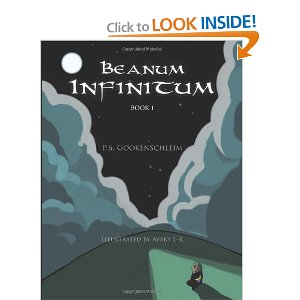
Finally, debut author P.B. Gookenschleim, the ‘Lunch Lady’ returns to the grand scheme of things in her work, Beanum Infinitum. Reviewed here by staff writer Sarah Melton, the book poses existential questions about our place in the universe through the short illustrated tale of Beanitrio, one talking bean alone in the cosmos.
Reading this month’s issue can remind us that we are not alone in the universe. Others, from different times and places, have raised similar questions about our purpose and destiny, and have expressed themselves and sought to understand the world through science, art and writing.
Please enjoy this issue, and join us in celebrating five years!
Whose Brain Is It?
Presented within the flow of the lives of real people and fictional characters, this is a monthly exploration of how parts of the brain work.
Unpredictable
by Leena Prasad
Clyde is sitting in front of a large white canvas. He starts to throw random colors onto the canvas and within a few minutes, an image starts to emerge. Several hours later, a rough draft of a painting is taking shape.
“Clyde, honey, you have a doctor’s appointment in forty-five minutes.” His wife, Irene, stands at the door watching him for few minutes before she finally interrupts.
As he heads out the door, she wonders once again how her husband’s mind works. As a research scientist, her work is so different than his that she is often in awe of her husband’s casual creative leaps of mind.
Irene has read a little bit about how the brain works. She knows that axons are the transport lines between brain neurons and they are protected by a material called the myelin sheath. White matter is the collection of axons and the thickness of the myelin sheaths determine the density of the white matter. White matter carries messages across the brain.
Irene reads about research done by Dr. Rex Jung, a neuroscientist who studies creativity. According to his findings, the white matter in the creativity circuits of the mind is denser in highly creative people, a similarity shared by people with bipolar disorder and schizophrenia. This is not to say that creative people suffer from psychopathology, rather that there are some similarities in the structure of the brain. Thicker white matter in some parts of the brain correlates to higher IQ whereas thinner white matter in other parts of the brain correlates to higher creativity (as defined by the researchers). Dense white matter carries information faster whereas thinner white matter slows down the transmission. This resonates with Irene because it seems to her that her thoughts travel in straight lines whereas Clyde’s mind sometimes takes loops and turns to go from one place to another.

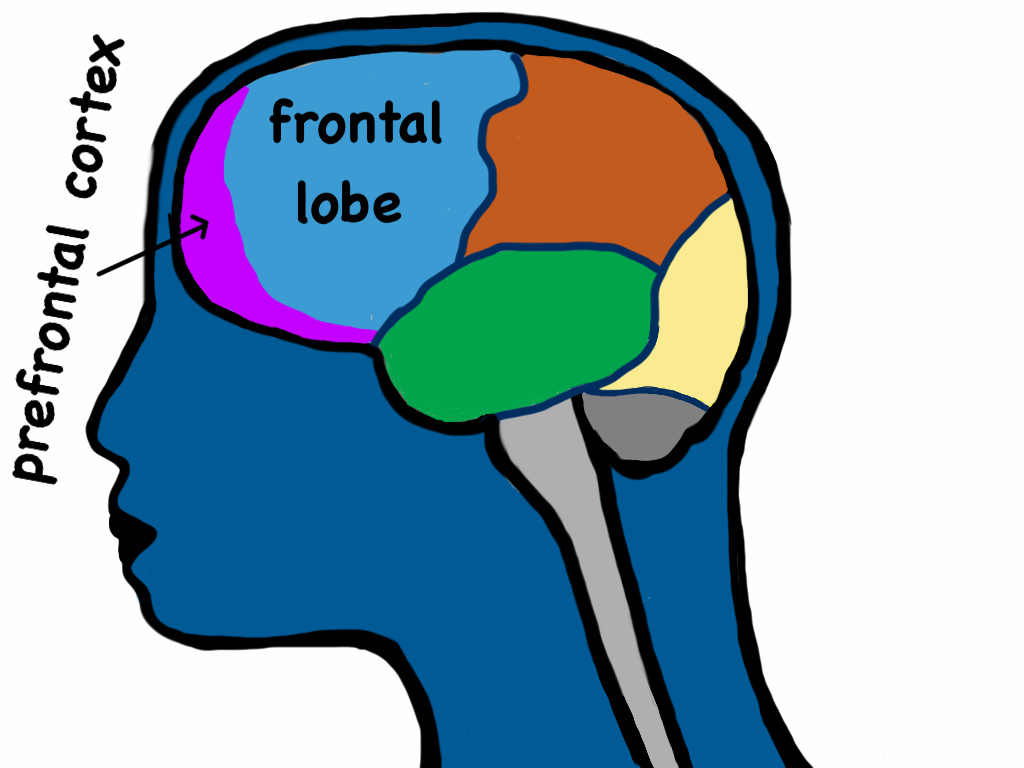
Clyde is highly intelligent in addition to being very creative. So, this means that he has thick white matter in the IQ areas and thinner white matter in the creativity processing neurons. But there’s more to creativity than just the white matter. According to Jung, the prefrontal cortex, the brain’s planning and control center, takes a break when the mind is experiencing a creative moment. This clarifies how Clyde often forgets about practical matters when his mind switches to a creative mode. It also explains his ability to be playful without the pre-frontal cortex putting brakes on his uninhibited ability to have fun.
When Clyde walks through the door several hours later, he has a bagful of groceries in his hand and has remembered to bring everything on her list. Later, he pulls out a painting of a dozen yellow roses from his studio to surprise her. His wife is happy that his thick white matter, thin white matter, and pre-frontal cortex are working as a team to create a pleasant day for both of them.
Leena Prasad has a writing portfolio at FishRidingABike.com. Links to earlier stories in her monthly column can be found at WhoseBrainIsIt.com.
Josh Buchanan, a UC Berkeley graduate, edits this column with an eye on grammar and scientific approach.
References:
- Jung, Rex., White Matter Integrity, Creativity, and Psychopathology:Disentangling Constructs with Diffusion Tensor Imaging, PLoS ONE | www.plosone.org, March 22, 2010
- Tippett, Krista, host of Creativity and the Everyday Brain with Rex Young, On Being, May 2, 2013, http://www.onbeing.org/program/creativity-and-everyday-brain/1879
Sarah Melton on PB Gookenschleim’s Beanum Infinitum
BOOK REVIEW: “Beanum Infinitum – Book 1” by PB Gookenschleim
– Reviewed by S. Melton
The premise of “Beanum Infinitum” is a unique and fascinating idea – to explain the basic concepts of existentialism, with references to advanced physics and astronomy and a sprinkling of absurdist humor throughout – and all in the format of a whimsical childrens book. While some aspects of the total creation are flawed, those who take the time to read this unique piece of literature may find it to be “A Legume in the Rough”.
A couple of things the reader will want to know before purchasing and/or reading this book on Amazon. First, while this story is in a 44-page childrens book format, it is not a book for young children. Or at least, not for children whose parents would mind reading the f-word occasionally interjected at somewhat random moments. Also, while the book is available as a self-published finished work via AuthorHouse, the author describes it as “more of a promotional issue”, which explains the intermixed pencil drawings and hand-written side notes alongside the cleaner-formatted text and color illustrations. I would love to see this book re-imagined with a professional illustrator, for while the penciled-in doodles seemed to serve as more of a distraction than a descriptor of the story, you could also easily see what the author was portraying.
That being said, the premise itself was unique and engaging. A story within a story, an ancient storyteller spins the tale of Beanitrio, a tiny sentient pinto bean living on the planet Refry (in the Charro Way Galaxy – sensing a theme yet?), who is coming to terms with his own self-awareness and the world around him. His journey of discovery grew, as he discovered more each day about the world, the galaxy, the universe around him. His emotions ran wild with each new revelation, from joy and excitement to loneliness and desperation. Then, as the mysteries of “How” unfolded, the ever-looming question of “Why?” was revisited time and time again as he struggled to find his purpose and place in his strange and wondrous surroundings.
On a personal level, it almost felt as if there were two people writing the book – like the majority was painstakingly penned by a learned, highly intelligent and introspective philosopher, but with a nine year old child with a head full of poo and fart jokes (the kind that said child is convinced will NEVER get old) looking over their shoulder and interjecting his/her two cents every so often. Sometimes this combination serves to add a little levity to an otherwise deep and intense existential dilemma – but more often it’s an unwanted (by this reader, at least) detraction from the flow of the prose and substance that kept it truly interesting.
All in all, “Beanum Infinitum: Book 1” is definitely worth a look for those wanting to dip their toes into the realm of existential philosophy without any of the stuffiness or forced intellectualism that sometimes runs hand in hand with it. It’s definitely among the more ‘especial’ tales out there, and leaves the reader wondering what situations could possibly be in store next when Book 2 hits the shelves.
Beanum Infinitum may be purchased here: http://www.amazon.com/Beanum-Infinitum-P-B-Gookenschleim/dp/1477261095