-

-
-
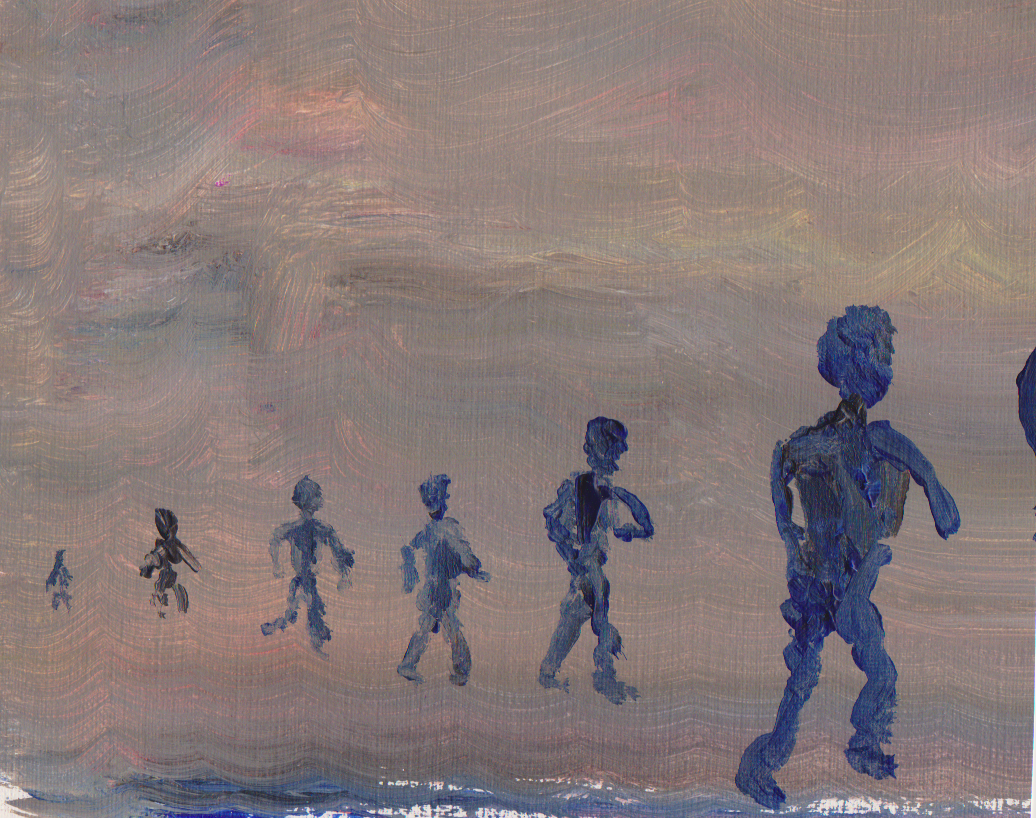
The Children Shall Be Blameless
-

-
Victrola
It was as if there’d been a mix up at the hospital when she was born. April was the second child born to Agnes and Herb Redding. Her older sister Ruth, along with the three younger girls, Helen, Elizabeth, or Betty and Barbie didn’t do well in school. April was at the top of her class from the word go and when they threatened to hold Ruth back a year, putting her in April’s class, April learned the new math she had never been taught in one week, tutored her older sister every night in addition to doing her own homework and quizzed Ruth every morning at the breakfast table. With April’s help Ruth managed to get caught up. The younger girls struggled as well and April helped them. All the girls had jobs along the way but April was the only one to keep hers. She worked at St. Patrick’s Guild as a clerk two nights a week after school and all day Saturday. In addition to high end chalices and gold-plated adornments for churches, the Guild also sold Catholic Missals, Bibles- of course, and all manner of scapulars and spiritual medals and chains. By the time she graduated from high school, April had also acted as the Guild’s chief buyer and was sorely missed when she graduated. They were good Catholic girls and went to church every Sunday. Herb stayed home but mother Agnes went while the girls were in grade school but only on holidays after that.
Anyone who valued effort and intellect admired April. She was a born leader in school projects and frankly, anything that needed to be done. She was not as pretty as Ruth but she would, it was felt, grow into a handsome woman and whose work ethic, intellect and optimism would make her the prize catch of the Redding girls. Ruth graduated from high school and got a job. A year later, April graduated with honors and was awarded a four-year scholarship to a prestigious private college two states away. She hadn’t been gone four months when the family seemed to fall apart. During that brief time, Ruth had married and divorced, Helen had gotten pregnant, Betty, it was learned, had been molested by the father of the family she had babysat for, and Barbie, then a freshman, had simply stopped going to school altogether without telling anyone. And it was clear who was at fault: April.
A variety of solutions were suggested, but none of them involved April continuing in college. She simply had to put that business on the back burner and come home because the family was falling apart without her. April did come home long enough to inform her parents and her sisters that “life without April,” would continue unabated and that everyone needed to grow up and get on with their lives without her. She went back to school that night.
When Christmas came and went without so much as a Christmas card from anyone in her family, a lesser woman may well have reacted impulsively. But April took it in another direction. She got together with teachers and administrators and proposed a shortened time frame to achieve her Bachelor’s Degree. With four months behind her, she told them she could do it in two years from that moment if they would cooperate. She outlined the plan in detail and included all of the electives she would need to fill up by independent study. This allowed for classroom instruction in all of her mandatory classes and amounted to an average of seventy hours a week including study time. When some of them reacted with shock, she told them that while this schedule was concentrated, it indeed represented twenty percent less than the time she had put in the previous four years going to school, tutoring her sisters and working part time. And finally, she told them that family considerations would simply not allow her to continue at a four-year pace. The faculty had a meeting that included interviews with her current professors and a long distance conference call with her high school guidance counselor. Finally, there was a call to her parents.
April was informed that a decision had been made, and that her proposal with certain adjustments amounting to an extra half-semester, had been recommended for approval by the committee, and all that remained was the approval of Dean Andrew Winslow and that involved her going to see him.
April Redding was not only intelligent, she was also smart. She knew how to get her way while navigating through the obstacles that were in her way and that included men. She was just attractive enough, she knew how to win men over long enough to convince them that her way, was the best way for everyone concerned.
“Your family seems to be crumbling without your influence to guide them,” he said. “It seems to me that if you were really as smart as you think you are, you might have prepared them better for life without you.”
“I agree,” she said. “But I have considered how I might have done that better and the fact is, they’d have never gotten as far as they have without me. The whole thing would have collapsed and I’d have been left among the ruins, trying to get my own life in order. It was easier to prop them all up along the way: for them and for me.”
He took off his glasses and considered her for a moment. When he did, April could see that he was not as old as she was expecting: mid to late thirties or so she guessed.
“I can imagine,” he said dryly. “I was guessing something along those very lines. Do you think they’ll survive it?”
“Well,” she began, “I do love them. But if “each according to their gifts” is any barometer, then I don’t hold out much hope. That’s why I made the proposal. I’m hoping the attrition won’t be too bad in just over two years than it would be in four.”
“You don’t think that’s shortsighted?” he said. “What are you going to do, prop them up forever? They have to grow up sometime.”
“What would you suggest?” she asked.
“That I reject these damn theatrics,” he said, “and that you concentrate on the four-year program we offered you. If it were as bad as you claim, and I have no reason to doubt it, four years would allow them to find their own way better than two. Besides, how do you think you’re going to do in business after this is over? I’ve seen families reach up and pull good people back down and keep them down in perpetuity. Frankly I have serious misgivings about academically preparing students for the real world only to see them fail over issues such as these.”
3
“Are you saying I should grow up, Dean Winslow?” she asked. “Because if you are, then I suggest it is you, it is you who is naïve and I would be frankly shocked to learn that one of the finest private Liberal Arts colleges in the country would take such a parochial view when it comes to considerations of the family.”
“That’s good”, he said. “I’m glad to know we’re still entitling the brightest and the best. And the implied threat of legal action was just the right tone, also.”
With that, he sat up and took out a fountain pen, unscrewed it, and signed his consent for the arrangement and signed a copy for April and handed it to her.
“If you come in here,” he began, “and say you no longer need this kind of a schedule, that will be fine. However, there is one issue I’m not sure you’re aware of yet, that may present a problem. As you know, the Bertrand Library is only three stories high, but with four levels underground and the connecting tunnels I’m afraid there are security issues that I’m just not comfortable with. May I call you April?”
“Yes,” she said.
“Are you what you’d call a feminist, April?” he asked.
“Depends on the issue,” she said, “Dean Winslow.”
“In the simplest of terms,” he said, “we do have what some might call a sexist regulation here that I’m afraid there’ll be no getting around in your case. We had a rape here a couple of years ago. It took place on the third level of the library and the men- there were several, made their “escape” if you will, in a variety of directions, and while we had our suspicions of at least two of the alleged rapists, there was not enough evidence for a prosecution. The ensuing lawsuit was settled out of court and the consultant we hired to see such a thing never happened again, recommended we counter-sue the architect who was long dead, of course, and restrict access to the lower levels to female students after hours. That seemed unfair on the surface of it until I listened to the security tape of the rape of that student. The camera lens had been covered in some foam, but the audio was somewhat haunting. That will never occur on my watch again- ever. Therefore, you may find your demanding schedule to be hindered, for lack of a better word by this “sex-specific” regulation. So I’ll make this as clear as I possibly can. I will not retreat from this position for any reason. And April, if you get pissy with me over it, I assure you that your endeavor, and your scholarship to this institution will suffer. Have I made myself clear?”
“Very clear, yes,” she said. “May I ask what happened to the girl?”
“You may indeed,” he said. “The two-point-one million dollars we paid out had a wonderful effect on her psycho-therapy. It stopped almost at once. She went into real estate speculation.”
He paused and it seemed to April, specifically for effect.
“She and I had a conversation once,” he said. “I made her think I was gay because I could sense she had an agenda. It turns out I was right, but it was not enough to insulate this college or myself from responsibility or liability.”
“I’m sorry,” said April, “Right about being gay, or right about her agenda?”
“It was not that poorly worded,” he said. “I think you know what I meant.”
“Perhaps it wasn’t,” she said. “But I’m not sure I understand. She had an agenda regarding you?”
4
“I believe so, yes,” he said. “And at least one of her other professors as well. She sort of made it known she was available, to the two of us at least. It’s not uncommon but she didn’t deserve what happened to her.”
“May I ask,” she began, “do you harbor some sort of guilt about this matter, over and above your responsibility to protect the students? That is, some personal responsibility?”
“I believe we’re done here, Miss Redding,” he said. “Good luck with your ambitious schedule.”
April left the Dean’s office, still keyed in on one line of Dean Winslow’s strange confession.
‘It’s not uncommon, but she didn’t deserve what happened to her.’
It was the “but” that seemed wrong. She played with it for a while.
“It was not uncommon for the victim to make herself available to one of her instructors or even the Dean.” That meant, of course, not uncommon for students in general to say, develop a crush on a professor. That seemed understandable. It was as if the “but” would indicate that some form of “dealing with it” should be invoked, “but” nothing as severe as a gang rape. This would also seem to indicate at least the possibility of a prior knowledge of the events before they had taken place. And he had been guilty on a personal level, he as much as said so. There was something else. Why would the police play the security tape audio for the Dean? Had he been a suspect in some way? What could hearing a woman being ravaged by several students reveal to the police? A recognizable voice perhaps? But then, surely one or more of her instructors would more likely be able to pick out the voice of a student. That is, unless he was being asked to try and pick out the voice of an instructor.
Several days later, April was told that the Dean was too busy to see her when she stopped by in the morning. That afternoon she was told he was still in meetings.
“Good,” she told his receptionist. “That means he hasn’t left for the day. I’ll just wait.”
“Sometimes he doesn’t come back to the office,” she offered.
“Will this be one of those times?” April asked.
“I don’t know,” she said.
“Then your uncertainty gives me at least a chance of seeing the Dean,” she said. “I’ll be taking that chance, thank you.”
Twenty minutes later, April heard a door close in the dean’s office.
“I guess I’m lucky then,” she announced.
“I’m sorry?” she said.
“Tell Dean Winslow that April Redding would like to see him, please,” she said.
At that moment, a light on the phone blinked, and after picking it up, she put it down again without speaking and said, “The Dean will see you now.”
“How do you know all this?” he asked.
“Research,” she said. “Nearly everything is on microfilm down at the public library: newspaper accounts mostly. The rest I was able to dig up here and there. I’m only trying to protect myself. If you believe it’s possible that one or more of the instructors of
5
this institution is, or could be involved with what happened to Janine Rademacher, I would like to know.”
“I don’t know,” he said.
“What do you think?” she asked.
“I don’t think I can comment further,” he said standing up.
“Do you have personal knowledge,” she began, “of anyone who may have played a part in the gang rape of this girl?”
He remained standing but said nothing.
“I can see that you do,” she said getting up. “I’m not sure where that leaves us with Dean Winslow but I’m sure this has been eating at you pretty badly or you wouldn’t have inadvertently blurted out your complicity. For my part though, I can deal with students and I can protect myself, as far as it goes. But I’m afraid any institution…”
“Sit Down, April,” he said.
She sat down.
“I had a sense,” he said, “that one of our professors may have had a hand in it, yes. There was evidence that pointed to several students who were…shall we say, friends of this instructor.”
“And this professor was Doctor Johnson, I believe?” she said.
The Dean looked at her with amazement.
“Yes,” he said. “He had been the professor I spoke of, who Janine expressed an interest in, as well.”
“And it was he, who was gay?” she asked.
He nodded and said, “It’s not as if he’d given into it, actually. He had a family and took a great interest in some of our student athletes. I had suspected for some time that something was wrong. In the past, some of our student athletes had problems meeting our academic standards. We could expect some attrition because of this, in the range of ten to twelve percent a year. That number started going down; let’s say, enough for us to look into it. Anyway, Paul Johnson had been helping several of them in exchange, we believed for sex. But as I say, Paul had not actually given in to his urges and nothing untoward had taken place. However, he had been passing marginal student athletes and they became very loyal to him. In fact, he expressed concern to one or two of them that Janine had “come onto him” as a matter of bragging about it, I suppose; you know, building himself up for their benefit.”
He walked around and back to his chair.
After sitting back down he said, “That was the genesis of it. Paul had confided in me about Janine; it’s somewhat policy here to do so. And at that meeting, I told him that he had to stop this business with these young guys and that we’re an institution of learning, and maybe, I didn’t handle it as well as I could have. He became very upset. The next thing I knew, Janine had been raped. We used those suspicions of mine to clean up the athletic program and dismissed a number of students over the matter. Naturally, the police questioned a few of them as well. On the tape, one of her attackers inadvertently referenced a saying Paul used in some of his lectures. He’d present an argument, and without affirming it one way or the other, he’d say “possible.” When I heard it, I felt sure it was some of Paul’s athletes. As I’m sure you know, Paul took his life
6
last year. He was much older than me and had been one of my instructors in graduate school. He had been a mentor to me at one time, but if he held any resentment over my success, he never showed it. I’ve thought a lot about it. I might have been more help to the police. I might have but I wasn’t, and you’re right, it has bothered me for some time. And you’re the only one who knows.”
“On the contrary,” she said. “The men who raped her know. At least one of them went on to do it again. He’s in prison for it now. Do you remember Eric Stampier?”
“Yes, I do,” he said. “He was one of them?”
“Yes,” she said. “The three likely others were: the Blake twins, Ken and Kelly, and David Christensen.”
“How did you find all this out?” he asked.
“ I play to win, Dean Winslow,” she said. “If something is going to threaten me, I find out who or what it might be and how they might come at me. As I said, I can handle students. If I had to worry about the instructors too, that was another matter.”
She got up. Dean Winslow got up with her.
“Thank you for seeing me,” she said.
“Would you be interested in a job?” he said.
April smiled and said, “You needn’t worry about me, Dean Winslow. This matter is between us, and frankly, I think you acted about the way anyone else would have acted under the circumstances. By the way, I thought you might be interested to know that Janine Rademacher is back in school: Wisconsin: River Falls.”
“Really?” he said. “Good for her. But my offer is a legitimate one, and may be the kind of thing you can handle, as well as keep your ambitious schedule.”
Back at the dorm, April laid out some chapter notes, and thought about the Dean’s offer. In the end, she thought, it didn’t matter if it was in the nature of a payoff. The truth is, she was the person for the job; she was perfectly suited for it, and if the flexibility he promised was true, she could easily handle it. The problem was the pay, and the beginnings of an idea began to form in her mind.
“As a matter of fact we do: Blair House and Baggs House,” he said. “Why do you ask?”
“Have you ever used both homes at the same time?” she asked.
“I think so,” he said “But that was before my time. It was at the centennial, I believe. Again, why do you ask?”
“I’m considering taking the job as your assistant,” she said. “But I had some ideas and I thought we might talk about it.”
“Fine,” he said and beckoned her to sit.
“No, not here,” she said. “I’ve been here too much as it is, and for me to be effective, I have to be seen as more of a student than the “The Dean’s Girl”. Let’s have dinner together, and I’ll outline what I’ve been thinking. I will tell you, however, that if you agree, I’d be switching back to the four-year program. That’s the only way I could be of any real use to you anyway. Do you think that might interest you?”
“Yes, it would,” he said. “Where would you like to go for dinner?”
“Someplace nice,” she said. “Someplace the average student couldn’t afford.”
7
“I know just the place,” he said smiling back. “Shall I pick you up?”
“No, I’ll meet you there,” she said.
It was too far out of town for that, and so April met Dean Andrew Winslow at a theater downtown and after she got in his car, she noticed that he was not wearing his glasses.
It had the effect of making him look younger.
“Yes, I know,” he said. “The truth is, I’m one of the younger deans in the country. The glasses help, and I do need them for reading, but they age me a bit, and that’s not a bad thing, in my business. I like your dress. It’s lovely.”
“Thank you,” she said. “It’s not a bad thing in my business either.”
“What business is that?” he asked.
“The ‘getting people to come around to my way of thinking’ business, of course.”
“How’s business?” he asked.
“Pretty good, actually,” she said.
The Chelsea was one of the oldest and finest restaurants in the state. But with the sudden death of the original owners’s only son, a company that would buy up high-end restaurants and maintain them under their original name had taken over. To many in the area, it would never be the same, and business had fallen off just enough to guarantee a reservation during the week.
During dinner, Andrew almost forgot it was not a date, as April was as charming as any woman he had ever known. That concerned him only inasmuch as what he felt April could do for him as the chief administrator of the college. He had been married, and found it less than rewarding and basically didn’t trust the women he had been attracted too. He was attracted to April, but regarded her somewhat differently. For one thing, she was still very young, and seemed to have her share of baggage, with this dysfunctional family and all.
“The lease on the Baggs House is almost up,” she began. “I checked the charter and it’s no longer automatically renewable. What’s more, it’s not on school property. The truth is, if the lease lapses the school will have no claim to it at all.”
“I suppose that’s right,” he said. “I believe it’s on the agenda for the next board meeting.”
“Yes,” she said, “but the board meets on the eighteenth. The lease is up on the twelfth of next month. If you don’t commit to renew before the final thirty days, a bidding situation could develop. And according to what I’ve heard, that’s just what will happen. Are you willing to give up a home that’s been a part of this college for seventy years?”
“How do you know this?” he gasped. “How the hell do you find these things out?”
“That’s what I do,” she said. “I find things out, and try to use them to my advantage. Here is what I propose. I’ve discovered a loophole in the lease that stipulates a usage clause. If the prospective leaser wants to get “pissy” as you call it, he could prove that you’re not meeting that need and since the land is off school property, a judge would be likely to rule in his favor. Then, it’s back to square one and your bidding situation. The
8
truth is, you’re not using the house and it’s doubtful that your board will want to pay a lot for a building not in use. But when the smoke clears, you’ll be “the Dean who lost the Baggs
House”. That’s where I come in. You will make me caretaker of the Bagg’s House and pay me a modest sum to maintain it. This serves two purposes. First of all, you save the house and secondly, you get me as an assistant, without having to budget for one. That way, I get the house and you get an assistant without anyone knowing you have one.”
He just sat there.
“What do you say?” she asked.
“I’m waiting for the other shoe to drop,” he said. “You see I have a PhD. I’m quite certain that this has something to do with your family, but I’ve only formed the outline of an idea.”
“No,” she said. “On that you’re wrong. It has nothing to do with them at all. But there’s more. In order to be effective, I need to get to know your faculty, without them knowing I’m working for you. That’s why I think we should schedule regular events at the house. It’s just off-campus, rich with tradition, and a more congenial place for the faculty to gather. You will host these events: tea and scones, the occasional cocktail party, and I will see to everything else. I’ll maintain a room at the dorm, but to begin with at least, I’ll stay at the Baggs House. If you agree, you will move the board meeting up to this Thursday, and explain to them the situation with the lease. You will tell them that for the time being, you are bringing in a caretaker to address the usage issue and that next month’s regular board meeting will take place at the Baggs house to be followed by cocktails and a buffet dinner. State in no uncertain terms, that the days when this college could afford to ignore assets like the Baggs House is now over.”
“Will you be there?” he asked.
“No,” she said. “You need to be seen as having taken charge of this situation in the nick of time, so to speak, and will further reinforce their choosing a more youthful presence to be Dean. But I am thinking of a faculty get-together some time later, at which you will introduce me as the caretaker and official hostess of the Baggs House. You will say that you are instituting a tradition where the Baggs House is concerned, whereby scholarship students with exemplary grades after one full semester shall be chosen to act as Caretaker/Host or Hostess for a term of one year and that only incoming freshman shall qualify. Because no one can dispute my qualifications to be the first student chosen, this makes the most sense. After a year, I’ll know all the faculty well enough to be all the use to you that you will need.”
“How much will I pay you?” he asked.
“That remains to be seen,” she said. “We’ll have to see what the house needs. That’s why you’ll need to budget more for the first year in any case. After that though, considering the student chosen gets to live in a beautiful house, I wouldn’t think it would amount to much. The honor of being caretaker should precede everything else.”
He looked at her.
“Do we have a deal?” she asked.
“Of course we have a deal,” he said with a laugh. “It’s brilliant. You’ve thought of everything. But I’m going to feel a little awkward taking all the credit.”
9
“You’ll get over it,” she said. “Anyway, that’s why you’re hiring me, and this is only the beginning. Now, let’s have a liqueur and our coffee.”
The board stole looks at each other more then usual, and frankly, reacted with a certain amazement, as Andrew Winslow laid out his plans for the Baggs House. He had been an adequate Dean, certainly, but this smacked of an assertiveness none of them had ever seen before. Moreover, he had answers for every question, and without hesitation. By the time he announced that the next board meeting should be held at the Baggs House, followed by drinks and dinner, several were actually shaking their heads.
Then it happened.
“That will be a perfect opportunity,” Haley Madison said, “To meet our first Caretaker/Host.”
“Hostess, actually,” was all he could come up with, and he new he’d made a mistake. In his enthusiasm, he had perhaps prepared too well and they were suspicious.
“Wonderful,” said Florence Greeley. “And I feel confident that I can speak for all here when I say this is a fabulous idea. So often our deserving scholarship students, coming from diverse backgrounds, as they do, never get the social opportunity you’re providing. And to lose the Baggs House, Dean Winslow, you have our undying thanks.”
After adjourning, Andrew faced another problem as all wanted to know where this was coming from.
“A student came to see me on another matter,” he began, “In passing, I mentioned our two properties and that tripped something off in my mind. I remembered there was to be, I don’t know, something new about the lease arrangement, and I’m sure glad I did. I wouldn’t want to be remembered as the Dean who lost Baggs House.”
“As indeed you would have,” said Anthony Beckwith. “Good work, Winslow.”
After listening on the phone to Dean Winslow’s account of the board meeting, April had been so quiet that Andrew actually said “Are you still there?” several times before getting to the part where the board wanting to meet her.
“Well,” she said quietly, “it sounds to me as though you didn’t handle this very well at all. In fact, it sounds very much that you invited this kind of scrutiny by acting so out of character. Would you agree?”
“May I remind you that I am the Dean?” he said. “Yes, I do agree, but you’re at least partially responsible. I’ve never been that prepared in my life, and I got a little carried away, I suppose. In any case, it will be fine. They just want to meet you as the inaugural student caretaker.”
“They’ll want a profile,” she said. “Would you mind if I wrote it and submitted it for your approval? It has to be travelogue: bland as can be. Too much interest, and they’ll have reporters coming around. That wouldn’t be good, you know.”
“Yes,” he said. “They asked for one. Go ahead and write it.”
In the weeks that followed, April determined what was needed at the Baggs House, and set about stocking the bar with liquor, cleaning and polishing the coffee maker and cookie plates and saw to the things she couldn’t do herself, such as the carpet and drapery cleaners and window washers, and had the furnace serviced and the like. The initial
10
outlay of money would be less then she originally thought, but told Andrew it would be best if she had her own school charge account to deal with these things as they came up. He agreed and why not? April was always right, it seemed. She had wanted to wait before the announcementthat she was the inaugural Caretaker/Hostess of the historic Baggs House, but under pressure from the board, she relented and composed that as well.
April charmed the board just enough to get through the evening, displaying a demure shyness that Andrew had never seen and indeed, knew was an act. With the board gone, and the last of the brandy put away, Dean Andrew Winslow made a confession.
“I miss you,” he said. “When I asked you to be my assistant, I thought we might actually see more of each other, not less.”
“I’m flattered,” she said with a smile, “But I believe this will be best in the short term. Once I’m acquainted with the faculty, seeing more of you wouldn’t seem unusual. But we would want to avoid the impression that anything else was going on between us. Would you agree?”
“Well, yes,” he said. “All I meant was that I just missed seeing you, that’s all.”
“I could tell,” she said. “The board could tell also. Do you think that’s a good thing?”
“What do you mean?” he said.
“May I call you Andrew?” she said.
“Please,” he answered.
“You couldn’t take your eyes off of me tonight, Andrew,” she said with a smile. “I feel it was rather clear to many of them that you have a crush on me. Again, I’m flattered. But in the future and for the future of this program, I think you should try a little harder not to show it. From the way Mrs. Greeley talked tonight, I could envision a scenario where every Caretaker/Host that follows me would be a minority who couldn’t tell a knife from a fork. You instituted this program, and now you’re going to have to fight to keep it from turning into something else.”
“No,” he said. “I didn’t institute this program: you did. This is your vision, not mine. If we had more contact, I think I could better understand what you have in mind and use that understanding to fight for it. And I wasn’t the only one who couldn’t take their eyes off you tonight: all the men could not either, certainly. You’re quite attractive, you know. I don’t see why we couldn’t meet every week, at least. If you’re going to have this kind of influence on me, I need more exposure to you: and for the college too.”
“All right,” she said. “We can make it part of the Caretaker’s duties, if you like. I enjoy your company as well.”
The faculty functions at the Baggs House were not well attended at first, but began to pick up in the spring. By then, April knew all the department heads and several of the key players under them. Several of her instructors began to stop by as well and before long, it was becoming clear that it was more than the Baggs House. It was April Redding, and as her year as the inaugural caretaker/host was nearing the end, she suggested that of the promising scholarship freshman to succeed her, Andrew make a list of five candidates and that she would indoctrinate all of them in their duties and attend several of the
11
functions leading up to the selection of the winner. But April had set the bar too high for one student and after talking it over with the candidates, she suggested Andrew amend the program to include one male and one female: a sort of “host/hostess” format. He agreed, and as the holidays approached, April had seemed rather distant during one of their weekly sessions.
“Is something wrong?” he asked.
“Just this time of year, I guess,” she said. “Which reminds me, I think we should host Christmas dinner for members of the faculty without families. I’m thinking if only half of them showed up, we’d have at least eight.”
“Aren’t you going home for Christmas?” he asked.
“No,” she said. “What do you think?”
Dean Winslow took a deep breath.
“I think it’s a good idea,” he said. “But I think the candidates should host. It will be their first hosting function and provided that we have a commitment from enough of the faculty, that would be best.”
“I’m not sure how many will stay here for the holidays,” she said.
“ Well,” he said, “however many there are, then they can do it. I’d like to ask you a question. I’d like you to spend Christmas with me- at my parent’s home upstate.”
“Do you think that’s a good idea,” she asked.
“Yes, I do,” he said. “I’m not particularly caring about appearances anymore. I’m very fond of you, and I want you to meet what’s left of my family, and spend Christmas with all of them and me.”
April smiled and nodded her head.
“Is that a yes?” he asked.
“No,” she said. “I was just nodding an affirmation. I’m fond of you too.”
“Then will you come?” he asked.
“Yes,” she said. “Thank you. I’d love to.”
At the final board meeting of the year, a motion was made to renew and rework Dean Andrew Winslow’s contract even though he had a year to serve under the present one. The contract proposed was for five years, instead of the present three at a ten-percent increase. Andrew thanked the board for their vote of confidence, and said he would give it every consideration over the holidays, and give them his decision after the New Year.
Three of the five candidates would be staying on campus for Christmas, and agreed to host a Christmas dinner at Baggs House. April suggested an eggnog social for Christmas Eve as well, and all were amenable to that. The arrangements all made, April packed her suitcase and had just come out to catch her cab downtown,when she saw someone hand the driver some money and the cab drove off. It was Andrew.
As his car turned onto the interstate, April’s eyes still registered disapproval. But she wore a slight smile.
“You’re getting pretty bold,” she said. “Am I going to have to lock my door tonight at your parent’s house?”
“No need for that,” he said. “Didn’t I tell you we’re sharing?”
“Very funny, too,” she said. “You weren’t this funny when we first met.”
12
“I wasn’t a lot of things when we first met,” he said. “That seems long ago now. The board offered me a new contract last night.”
“I know,” she said. “Florence Greeley told me last week they were going to.”
“My God,” he said shaking his head. “My own board is consulting you now. Any other matters I should know about?”
“There is one,” she said with a smile. “But let’s not talk shop anymore. You invited me to spend Christmas with you and your family. You even picked me up for the whole world to see. Someone might think you’re sweet on me.”
“I should wonder at their impertinence,” he said. “The respected Dean of a prestigious private college, sweet on a co-ed? An undergraduate co-ed at that! I’ve never heard of such a thing.”
They smiled at each other.
“I was wondering,” he asked, “If you’ve heard from your family?”
“I received a letter from one of my sisters last August,” she said. “Why do you ask?”
“I was pleasantly surprised to learn you weren’t going home for the holidays,” he said. “I just wondered why?”
“Last year I never got a Christmas card from my family,” she said. “At first I was hurt. I knew they were mad at me for staying in school. But then I realized it had nothing to do with that. I always took care of those things at home: Christmas cards, birthdays and “get well” cards. With me gone, there was no one to do it. I’m fairly sure it never occurred to them. When I was a little girl, I remember reading a story about a woman who described the filthy conditions she had to live in when she was growing up. One night while she was sleeping, she was bitten by a rat. She said she began wishing she could live in a cage where the rats couldn’t get at her. It was as though it never occurred to her to simply clean the house. It would be easier to live in a cage. I love my family. But looking back, so much of my day seemed to be taken up with plugging holes in the dyke. It wasn’t all bad. In some ways that sort of preparation helped me develop some very useful habits. With me gone, you’d think one of them would step up and do what was necessary. But that hasn’t happened.”
“So, the family considerations were not the reason you requested a two year program?” he asked.
“No,” she said. “I just wanted to accelerate the rest of my life. When you offered me a job as your assistant, I realized there was no hurry. When the Baggs House jumped out at me when I did my research, I realized I could contribute to the college as well. School has never been much of a challenge for me. I do better in a multi-task mode.”
“I’ve noticed that,” he said with a smile.
With still a hundred miles to drive, Dean Andrew Winslow made a decision.
“You know,” he began, “we’ll be getting in kind of late as it is: probably just time enough to meet my parents and go to bed. There’s a wonderful restaurant I know of. I thought we’d stop for an early dinner there.”
“That sounds nice,” she said. “Can I ask you a question?”
13
He nodded.
“You seem a little nervous today,” she said. “Is something wrong?”
“No,” he said, and he said it too fast, he knew. “I mean no. I’m just kind of excited and anxious for you to meet my family, that’s all.”
After a pause, he said, “No, that’s not it. That’s not it at all. I’m just very much in love with you and I’m hoping that, in time maybe, you could love me too. I know I’m older and well, I’ve been married before. I never thought I would feel this way again. I mean, you don’t have to make up your mind right away, but I’d like to know if you will marry me?”
“Take this exit, Andrew,” she said.
At the top of the ramp, and with no one behind them, she said, “Put the car in park.”
He did.
“I’m going to finish my education and will most likely win every argument we will ever have,” she began. “If you think you can deal with that, I’d love to marry you.”
Andrew was ecstatic, but not exactly clear on her acceptance. After kissing and kissing some more, they got back on the highway.
“I was going to wait for the restaurant,” he said, “but I was getting too nervous. Can I give you the ring when we get there? And, I mean, you’re going to marry me now, or soon, aren’t you? Not after you graduate? That’s not what you meant, is it?”
“You are so adorable,” she said. “I fell in love with you the night we went to dinner at the Chelsea. I was hoping I wasn’t too intimidating. And yes, I’ll marry you anytime you like. But I think, well frankly, Florence saw this coming. I’ll confess I was hoping she was right. In any case, it’s Blair House. With the use and success of Baggs House, some of the board members felt that, should you balk at a contract extension, they’d vote to refurbish Blair House and make it the Dean’s residence. I’m sure they’re thinking the newly married Dean and his wife will entertain with some regularity, and well, they’re talking about Blair House.”
“It’s a beautiful home,” he said. “But I don’t know. I don’t want anything intruding on our life away from school. How do you feel about it? I mean I’m only the Dean. As Caretaker/Hostess of Baggs House, you’ve had more time to mull it over.”
“I’m not sure,” she said. “It is a lovely gesture, though. But I’ve never been married. I really don’t know. I do think it would be unwise to refuse if it comes to that, and so in my estimation, the best course is to simply accept the contract, and if Blair House is offered, we’ll deal with that when it comes up.”
“Yes I think you’re right,” he said. “I just want you to be happy. I want us to be happy.”
“I am happy, Andrew,” she said. “I’m very happy.”
It was a joyous Holiday as Andrew had told his parents he was going to propose. When April walked in wearing the diamond, his mother screamed with delight. Her soon-to-be in-laws were cerebral and somewhat quiet ordinarily, but this would be a Christmas to remember.
14
They were married in a relatively small ceremony that spring, in the college chapel with the reception at Baggs House. They decided to honeymoon in Cancun at the end of the semester. Their return would coincide with the conclusion of the Blair House remodeling project, and the Dean and his wife would take up residence then. As they did, questions as to why they married three months earlier, were answered with the announcement that Mrs. Winslow was with child. The following January, April gave birth to Melissa Ann Winslow, who would be the apple of her father’s eye for all of her days. April stopped taking classes for Melissa’s first year. After that, a nanny was employed, and April returned to school, graduating with honors, three years later. She would spread her graduate studies over three years to accommodate the arrival of Andrew John Winslow III. Dean Winslow decided not to accept an offer from another, larger private institution, and was rewarded with a new eight-year contract by the board.
April had always remained active in the affairs of Baggs House, acting as unofficial mentor for those yearly candidates, and of course, Caretaker/Host couples. After staying home with young Andrew for the first year, April retuned to her graduate studies and having lost two years along the way, one of the early Caretaker/Hosts that followed her had caught up and was now her classmate. His name was Milt Peterson; a very bright, good-looking young man two years younger than April. She had always been fond of Milt as far as it goes, but as her final year of graduate studies began, there were whispers that Andrew had been seeing a lot of a young history professor named Emily Levitow. This was new territory for April, and she confronted her husband directly. He denied it, but during a faculty reception at their home, April felt certain they had shared more then “looks across a crowded room.” So that when Milt, sensing an opening, facetiously suggested they go away for a weekend, April surprised both of them by saying yes.
“Really?” he said.
“I said yes once, Milt,” she said. “Don’t make me say it again.”
“Of course,” he said. “But your situation poses the complications. Tell me what works for you? Shall I meet you? Can you get away for the whole weekend?”
April nodded and then paused.
“You know, Milt,” she said, “I’m not sure I can, and if I wait for the weekend, I’ll probably change my mind. But I’m ready to be your lover right now. Do you know of someplace we could go?”
It was a portion of Lyon’s Hall, where temporary office cubicles had been set up during remodeling, early that year. That portion of the building was vacant, but being the basement, sound carried, and Milt lowered his voice to a whisper, when they entered the far cubicle. When he did, April kissed him, and as they fumbled to take off each other’s clothes, she realized she had never known passion like this. She had never known some of the things Milt was doing either, and she struggled to keep from moaning out loud.
Afterwards, they kissed and cooed, and got started again, and when it was over, Milt seemed suddenly filled with the sense that they were pushing their luck.
“I think we should leave separately,” he said zipping up his pants.
April was a little behind and said in a whisper, “You go on.”
15
They kissed passionately once more, and Milt left. There in the dark of the cubicle, April seemed in no hurry. It had been deliciously naughty and wildly passionate – two things she had never known as a twenty-five year old mother, who came to her husband as a virgin. Her slacks back on, she hummed a little tune to herself as she picked up her bra. She had never heard a thing and as the hat came down over her head, and the hand covered her mouth, she knew she was going to be raped.
There were two. It happened very fast and it was possible there were more, but she felt sure there were two.
“If you make a sound, we’ll hurt you,” one said, and took his hand away from her mouth. Then he tied a scarf around her eyes, and pulled up the hat to her nose, while the other one pulled down her pants.
It lasted nearly a half an hour. As she lay there sobbing softly afterwards, she thought that was strange. They were in no hurry, as if not worried at all that someone might come along. They didn’t seem to mind her making noise either. The only other thing was the metal. When they were done, they took off the hat, and scarf from behind. As he did he leaned in toward her ear and whispered, “Don’t turn around,” and she felt the cold of some metal on her shoulder. Then, they began walking quickly and finally one broke into a run. She got up and dressed as fast as she could and left.
“What were you doing down there?” Andrew asked.
“I shouldn’t be surprised,” she began, “that that question should be the first one out of your mouth. I was down there with a fellow student, giving him and getting for myself a little payback for you and Ms. Levitow.”
“I told you that never happened!” he barked.
“Oh, for Christ’s sake, Andrew,” she said. “Have you forgotten who I am? You owed me a denial! But do you think I’d ever bring it up without knowing the facts? My God, you two were as discreet as school children: the Chelsea, the Best Western, that goddamn bed and breakfast off the highway! So let’s stop playing games, shall we. Two men in the basement of Lyon’s Hall raped me. And if I were you, I’d be very careful how you word your solution to this matter.”
“No, you’re right,” he said. “I’m very sorry. I’ll call security. I’m terribly sorry.”
“I don’t think you should do that,” she said.
April told Andrew about the metal and that the possibility existed that they might be security guards. She was examined at the emergency room and then questioned by police. In spite of the embarrassing details, Andrew insisted on being at his wife’s side through the entire process. That afternoon Milt Peterson sat with the police detective downtown.
“Mr. Peterson,” he began, “After you left April Winslow this morning she was raped by two men.”
“What?” he said.
“Yes,” he continued. “We’d like to ask you a few questions about your activity this morning.”
Milt looked away and shook his head and then sat up straighter and leaned forward.
16
“Yes,” he said. “Of course.”
“Why did you decide to leave early this morning?” he asked.
“April,” he began, “Mrs. Winslow is the Dean’s wife. I was nervous we’d get caught. We were there for a while, and I was just getting nervous.”
“Have you been in that area of Lion’s Hall before?” he asked.
Milt shook his head and said, “No.”
“If we interview some of your classmates,” he said, “Are we gonna find out that was not your first time down there?”
“Yes,” he said. “I mean, not for sex. They, me and this guy went down there, and smoked a joint once. It seemed pretty abandoned, and there was just this caution tape.”
“Then why didn’t you just say that?” he said. “Did you ever see any other students, or anyone else down there?”
“No,” he said.
The Lyon’s Hall construction area was sealed off, and guarded night and day. An announcement that another rape had occurred on campus was made immediately, and students were being encouraged to look out for one another, and report any suspicious behavior. The next day, a female student came forward, saying that she had been raped the year before, and only hoped that her silence in the matter had not further empowered her attackers. There were similarities in the two attacks, but after two weeks police were willing to concede the rape of April Winslow may have been a crime of opportunity by two students who happened to have heard April and Milt. When Peterson left, they simply took advantage of the situation. The security personnel were interviewed and released, and as a police matter, it may have ended there.
For his part, Dean Andrew Winslow stood by April and had begun to beat himself up pretty good over his affair with Emily Levitow. He’d been sleeping in the study only two days, when April got up to check on the children, and Melissa was not in her bed. She found her curled up in her father’s arms, sound asleep. That ended the separate sleeping arrangements, and after a couple of weeks, April had started to put things behind her, as best she could. Andrew could not. Naturally, it caused him to reflect on the rape of Janine Rademacher and April’s impressive research on the subject. That kicked off something in his mind, and he decided to do some research of his own.
It amounted to cross-checking the names of the student athletes dismissed in the Paul Johnson affair, with the current security personnel employment list. The names of the twin brothers, Ken and Kelly Blake came up. He picked up the phone and called the police.
After being dismissed as student athletes, the brothers had gone into private security, and stayed in the business of attacking young women from time to time. Their big mistake, it turns out, was working together at several colleges over the years, where rapes had occurred, and finally, returning to the scene of the original crime, to do it again, twice. But with only circumstantial evidence, and little else to go on, prosecution seemed doubtful. Then one morning, Kelly Blake waked in, and confessed to sixteen rapes over a ten-year period, and implicated brother Ken in every one. He said he had found God but
17
brother Ken had not, and left town, and would remain at large for nearly a year before being picked up down south.
April had gone to see the police detectives to thank them personally for the job they did.
“Your husband did all the work, Mrs. Winslow,” he said. “Without his establishing a connection to the college with those ex-jocks, I doubt we’d have caught them.”
And so April and Andrew Winslow sat down one evening to talk about the rest of their lives.
“You know,” he began, “The irony of it is, I’d have never cheated on my first wife. I didn’t have the confidence. You gave me that and built me up in ways I’d never imagined. And I betrayed you with it. I accept responsibility for everything that’s happened. I don’t know if I can ever make it up to you. But I do love you April, and I always have. There was never a question of that. I just got too full of myself, and I’ll be sorry about it for the rest of my life.”
“There’s blame to go around, Andrew,” she said. “My family turned their back on me, and I let them do it, even though I knew they didn’t know any better. And I didn’t build you up, Andrew. I just helped you to be the man you always were. I loved you then, and I love you now. But I went in the basement with a student and tried to be the woman I never was and well, look what happened. But now we have another problem, Andrew, and I’m not sure we can weather this one.”
“Whatever it is,” he said taking her hands in his, “Ill be here for you.”
Little William looked like a baby. He was quick to smile and looked like an angel asleep. Andrew had gone out of his way to be first, the doting husband to his pregnant wife, and second, a loving father to his third child. That it probably was not ‘his’ third child was an option he simply would not allow to take hold. He would be the only father ‘young Bill’ as he would call him, would ever know.
While April kept trying to see Milt Peterson in her new baby, she never did, really. But he was a bright, lovely child and was loved by his brother and his sister, his mom and his dad. The good Catholic girl that April was raised to be, would have never considered another alternative. As was the custom in the Winslow family, April spent the first year with her new baby, and finished her Master’s Thesis along the way. Though she toyed with the idea of pursuing a doctorate, by the time young Andrew entered grade school, she had become comfortable as an Associate Professor. She reluctantly conceded that she would not have had time to teach more than two classes a semester, and still keep up her duties as the Dean’s wife, and the mother of his children.
April answered the occasional correspondence from her sisters and her mother, and wrote them long letters every Christmas along with the latest pictures of her growing family. Dad was never one for writing, but she called once a month and eleven years after her ‘life without April’ speech, the Winslow family made a visit to Mommy’s home, two states away.
If April had any misgivings about going home, they were all realized within minutes. Her parent’s house was as she remembered it: the newspaper strewn about,
18
overflowing ashtrays, dirty dishes and a bathroom she’d have not ordinarily allowed her children to use. Andrew had been warned ahead of time, and may well have been shocked, but he hid it well. The children however, were fascinated. They had never seen creatures like their grandparents, never been allowed to wander from room to room, eating cookies, never heard a smoker’s cough, looked for change down in the couch, drank whole milk or knew a man who could fart when you pulled his finger. Grandma poured the milk, and passed out Hershey Bars, and showed Melissa her ancient jewelry box, with lots of cool stuff, while Grandpa pulled out his medals and memorabilia from the Korean War.
April did what she always did. She began filling the sink with water, to do the dishes. Grandpa gave Andrew a beer and though he nursed it as best he could, had downed three by the time his sister-in-laws and their children arrived, with the buckets of Kentucky Fried Chicken. He concluded these were good people: very loud good people, even if they had certainly taken home the wrong baby when they picked up April. Her older sister Ruth, was a vamp, and never missed one chance to rub her breasts against him in any door jam she just happened to be going through, every time he was. The rest of the sisters were non-descript, but their children were not, and with a few tattoos and worse teeth, could have passed for Hell’s Angels. Two of the husbands showed up and one was a very personable fellow. Andrew thought that had he not run afoul of the law in his early twenties, he might have had a chance to be the sportscaster he had always dreamed of being. The other fellow hardly spoke, but that was okay. In fact, everything was just fine, because Grandpa had kept Andrew’s hand filled with a cold one all day, and he was blasted. He dare not pass out though: not with Ruth around.
Sometime around ten-thirty, April kissed all her sisters and mom and dad, saying she’d see them all at the restaurant the following afternoon, and drove her family back to the motel. Her husband was basically drunk, and her children’s experience with their nephews could be summed up when young Andrew asked his mother what a ‘cocksucker’ was.
By the time dinner at the Golden Dragon Buffet was over, and the Winslow family was on their way to the airport, April told her family to take ‘a good look around’ because they probably wouldn’t be coming back. But her family had a different experience and they reacted with disappointment. Even Andrew launched into a diatribe on ‘the strength of diversity in families.’ April began to look at her family differently. Her children and her husband had been more than ‘good sports.’ They were family. They were accepting, and accepted, and by the end of the day, on a first-name basis with cousins, and aunts, and grandparents they had never known. She suddenly felt sad that the reconciliation hadn’t come sooner. But the doors had been opened, and her family now had another family to be a part of.
In the years that followed, the Winslows watched their children grow, and Andrew and April rediscovered each other. There had been intrigues, and mistakes on both sides, that had been enough to destroy other couples. They knew they were lucky.
Their children grew into fine young people, and before they knew it, Melissa was graduating from high school, and young Bill was just starting. Andrew had been Bill’s protector in grade school. But in his junior year in high school, Andrew bit off a bit more
19
than he could chew with one student, and had taken a beating. Freshman Bill called the junior out the next week and kicked his ass, earning him a suspension. But when he returned, there was no more trouble for the Winslow boys in schools, and the brothers would remain close all of their lives.
‘The man Andrew was’ would stray twice more, before turning sixty. It would happen far from home, and years would pass in between, and if April ever knew, she never said a word. While she was a handsome woman in her twenties and thirties, she had grown stunning in middle-age and ever optimistic when a small lump was detected in her breast. Her doctors agreed, and for that reason, she didn’t tell Andrew. While she waited for the test results, a letter came. The return address was a hospice in San Francisco, and inside the envelope, another one, with the word, ‘April’ written on it.
Dearest April,
I can only hope this letter find you and your family well. I am writing this from a care center, where I am in the final stages of AIDS, and will not live much longer. But I feel I cannot face whatever may be next, without confessing to you the greatest failure of my life and to ask for your forgiveness.
I waited for you to come out, after I left the basement area, where we met that day. I waited and waited, and when you didn’t come out, I went back. I heard what they were doing to you, but I was too frightened to act. I left to find a phone or a security guard, but I have always known that I ran away because I was too scared. I have never told anyone, and for twenty-three years since, failing you that way, has haunted me. I would give anything, if I could just get that moment back, and help you. But I cannot, and if you’re reading this, I have passed this life. I only hope you can find it in your heart to forgive me.
I was always an insatiable flirt, but knew I was gay from an early age. Those women who called my bluff never knew, as I assume you never did, and I am a coward in this as well. I never made love to a woman again, and I am so deeply saddened that I let you down as a lover, and a fellow human being. I know you are a Catholic, as I am. If you can find it in your heart to forgive me, perhaps you could light a candle for me sometime.
Love
Milt
As Andrew arrived home that afternoon, he found April sobbing uncontrollably, and couldn’t speak. She pointed to the letter on the dining room table, and after reading it, Andrew cried as well. That night, they drove to St. Benedict’s Catholic Church, where April lit a candle for Milt Peterson.
Two days later, came the news that the biopsy was positive, and the lump in her breast was malignant. Milt Peterson’s final letter had seemed an ill wind, and while she had been hopeful, she wasn’t surprised. There was the lumpectomy, and the radiation, and the chemotherapy, as well, and she went into remission for a while. But when the cancer came back, she put on a bright face, but started preparing her new family for ‘life without
20
April.’ The cancer had spread enough, that the doctors felt that with a radical mastectomy, and a full course of treatment, they could extend her life two years. April said no, and in the months she had left, planned and hosted several family ‘get togethers’ and made specific plans for her departure. After telling Andrew, when he’d stop crying long enough to have a conversation, she insisted that he remarry, within two years. To that end, she wished to be buried back home, so there’d be no danger of his haunting a cemetery. The children would be allowed one visit to the hospice, nearing the end, but not their two grandchildren, who she said were too young to see grandma in such a state. She told Andrew that if he liked, he could light a candle for her at St. Benedict’s on her birthday each year. She asked that if he did, he was too light one for “poor Milt Peterson,” who had suffered all those years over her indiscretion.
In her final week, April made a confession to Andrew, and the couple shared a final laugh.
“There never was a prospective buyer for Baggs House,” she said. “I made that up.”
April Redding Winslow was laid to rest in her hometown, two weeks later. She was only 49. Andrew Winslow would remarry six weeks shy of two years later, and he would retire with honors as the longest running Dean in the prestigious school’s history. His final act as Dean, would be to preside over the official renaming of Baggs House, to be henceforth known as ‘April Baggs House.’ Yearly reunions of former Caretaker/Hosts and Hostesses would see bright young men and women raise their glasses to April Redding Winslow, who continued to leave her mark from two states away.
W. Jack Savage is a retired broadcaster and artist. He is the author of six books (wjacksavage.com) To date, thirty-two of Jack’s stories have been published by various online and print magazines, and eighteen of his pictures have been published as well. Jack and his wife Kathy live in Monrovia, California.