
Performance Review: Mariano Pensotti’s “El pasado es un animal grotesco” (“The Past Is a Grotesque Animal”)

HOW COMPLETELY WRONG YOU CAN BE

El pasado es un animal grotesco (The Past Is a Grotesque Animal)

Text and direction: Mariano Pensotti

Performed at YBCA Forum

Reviewed by Christopher Bernard


Argentine theatrical director and writer Mariano Pensotti’s ambitious performance piece evanesced in three performances in the middle of February in San Francisco, in the middle of a lengthy international tour his company is doing, and leaving behind it a long trail of disintegrating engrams like cold, vanishing sparks: the sense of a futile but unavoidable search into the meaning of the past for the present, and of the present for the future, even if all we can ever hope to keep of our present moments is a deck of damaged photographs called memories from which we devise an elaborate fiction we call our life.

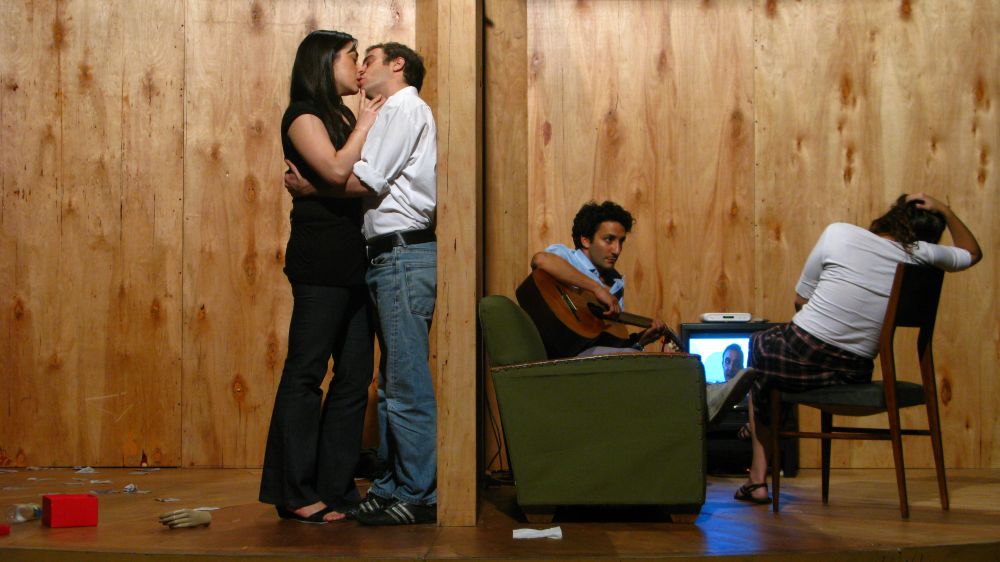
The piece (it doesn’t feel quite right to call it a play) is performed on a revolving stage, made of undressed pine and divided into four pie-shaped sets; partly via dialog, partly by way of an endless, recitative-like voice-over, in Spanish, with English supertitles, by four actors playing young Argentines living out the dilemmas of growing up between the years 1999 and 2009; that is, between Argentine’s economic collapse and an uncannily similar one that hit the West at large ten years later.

As Pensotti recounts in the program notes, he got the idea for the piece from a collision of events and questions: a series of damaged photos, many of nameless Argentines, that he started collecting from a photo lab that used to stand near his home (and has since closed due to the digitalization of photography) and a series of questions about the growth of hopeful, dream-filled youth as it moves into its first years of disillusioning maturity, and another series of questions about how we build our identities on a complicated foundation made up of the illusions of aspiration, the fragments of failed dreams, and the compromises we make with an often recalcitrant and incomprehensible reality.

If this makes the play seem to court the problems of excessive ambition, it should. The play itself – performed by an extraordinarily able and energetic quartet of actors (Pilar Gamboa, Javier Lorenzo, Santiago Gobernori and Maria Ines Sancerni) who, in the two-hour performance, create dozens of characters spawning subplots and counterplots in more than 80 scenes – just manages to maintain enough coherence to keep me, as a spectator, committed, at the occasional price of psychological plausibility, and thus momentary losses of sympathy with the characters’ dilemmas. Which is a small shame, as those dilemmas are often ludicrous and tragic and all-too real: a young filmmaker and his girlfriend, love-drunk on each other, entangle and disentangle their romance between painful sorties into the disappointments of the harsher reality outside their impassioned dyad; a young woman discovers that her father has a second family, and sets out to spy on him and pull him back into her own emotional orbit by means as devious as his own have been toward her; an aspiring young business man receives a box containing a severed hand that turns his next ten years into a recurring nightmare of almost farcical paranoia that he is never able to resolve, explain or become resigned to: a MacGuffin representing the ultimately grotesque enigma of human life.

At the end of the play, as the stories of the four Argentines are left in an uneasy state of irresolution, the last, or perhaps the first, element that fed Pensotti’s restive imagination peals out, as the empty stage revolves beneath the fading light, through the sound system that throughout has been regaling us with a mixture of pop tunes, “house” and what one of the characters himself complains is too much folk music: the alt-band “of Montreal,” with the dark, knowing, disillusioned voice of Kevin Barnes singing,

“The past is a grotesque animal, and in its eyes you see …”

http://www.amazon.com/Past-Grotesque-Animal/dp/B003SA81TQ/ref=sr_1_2?s=music&ie=UTF8&qid=1329589414&sr=1-2

————————————————————————————————————

Christopher Bernard is the co-editor of Caveat Lector magazine and author of A Spy in the Ruins.
Performance Review: “A Case of Libel”, presented by Novato Theatre Company

[Reviewed by Martin Rushmere]

The themes are even more relevant today than they were 60 years ago. Patriotism, Communism, the First Amendment and the ghost of McCarthy are all re-awakened in this robust production of the 1963 courtroom-plus-politics drama, based on a real case in 1954.   Courageous Second World War correspondent Denis Corcoran is outraged when a nationally syndicated columnist repeatedly accuses him of debauchery, cowardice and communist sympathies.

Instead of pistols at dawn, the two clash in court. (Corcoran got in the first barbs with a blistering attack on his journalist rival).

Director Ron Nash and producer Brenda Weidner coax a sterling effort from everyone, with the most consistent performance from Kris Neely as the opposing lawyer. Shrewd casting makes the imposing bulk of Paul Abbot as Corcoran’s lawyer dominate the scenes even when he is not speaking. And Ron Dailey as three characters (thank heavens no Equity actors are involved) comes off very well – although the Scottish burr does falter a touch.

A clever piece of stagecraft, to relate the events to the context of the times they were in, is getting the actors to read news headlines from the period (color television, jet travel, Elvis). Stirring speeches and unexpected twists in the storyline keep the attention focused.

However, the play is overlong (three Acts) and could do with judicious cutting of some of the speeches. The problem lies with politics in the last 50 years, because politicians and presidential candidates have trotted out the lines and sentiments so often that they have become hackneyed, ringing with insincerity. Especially in the closing speeches (stirringly delivered by both lead actors) one could predict, if not the actual words, the themes about to be uttered.

The courts, costs of litigation and legal processes have changed so much that in today’s climate the sequence of events seems almost quaint. But the pressing moral, social and political issues still burn as bright and productions such as this deserve their days on the stage.

————————————————————————————————————————————————————–

Click here for more information about A Case of Libel.

You can contact the reviewer, Martin Rushmere, at martinzim@earthlink.net.


Whose Brain Is It? [March 2012 – Leena Prasad]

Whose Brain Is It?

Presented within the flow of the lives of fictional characters, this is a monthly column with a journalist’s perspective on brain research.


“Are you nervous at all?” Sanjay says.

“Excited,” Dana responds to her husband. “Yes, nervous, but with excitement.”

She is having her brain examined today. Well, not exactly examined, but observed by a method called Positron-Emission Tomography (PET scan) which is used to measure changes in cerebral blood flow as a result of brain activity.

“It’s not too late for you to take part in this also, you know.”

“No, no, I’d rather watch.”

Since her decision to participate in the study, they have been reading up on how the brain controls muscular movements.  There is a region towards the back of the brain, appropriately called the posterior parietal cortex, which takes visual information as input and translates it into motor commands. These commands travel through a pipeline of several brain regions to the primary motor cortex, a region that sends neural impulses to the spinal cord resulting in muscle contractions.

Later that afternoon, Dana dresses as if she’s going out dancing.

“Does my primary motor cortex look ready for action?”

“I don’t know but I think my posterior parietal cortex is getting activated.” Her husband winks at her.

She is wearing a flowing jade silk skirt that comes up just above her knee, a silk shirt with just the amount of cleavage that her husband likes, and pencil heels. She has been told that she should prepare for tango dancing as if she was going out to a nightclub and not to a science lab.

Dana and Sanjay have been dancing for many years now. They won an amateur tango contest last year which is what brought them the attention that had led to her participation in this experiment.

When they arrive at the place where the study is to be conducted, she looks around for a dance floor, perhaps a live band. The place looks like an office with a few desks and computers. Through an open door, she sees some large machines. The professor, Dr. D, arrives soon and explains the procedure to her.

“So, I, uh, I’ll be lying down the whole time,” she says. How can they study tango dancing if she will be lying down the entire time? She looks over at Sanjay and he looks as skeptical as she feels.

Dr. D laughs. “I know it sounds very strange.”

“I thought someone said that I will be moving my legs, I mean, I was told to dress for dancing.”

“Yes, yes, the machine is designed so that there is a surface area for moving your legs as if you are dancing. That’s the idea, to watch what’s happening in your brain as your legs move to the music.”

Dana does not look convinced. But she has committed to this, trusts the scientist, and is curious about the outcome. She follows the professor to a room with a large intimidating machine. She has seen these machines on television. People usually lie down in them with their head placed inside the machine. The only difference is that this particular machine actually has an inclined bottom surface where here legs would rest.

“That surface is for you to move your legs,” Dr. D says. “You’ll be listening to tango music through headsets.”

As Dana moves her legs in rhythm to the tango music, sensory organs in her leg muscles will pass on data to the brain’ in terms of the location and orientation of her muscles. The brain will use this information to update the motor commands that it sends back to the muscles. Scientists understand the neural mechanisms of basic motor functions. They are curious, however, to observe how these same mechanisms scale up to handle the complexity of the motions of dance.

In a study at the University of Texas Health Science Center at San Antonio, scientists used PET scans to observe the brains of five male and five female tango dancers in an experiment that occurred as described for the fictional character Dana.

Once Dana is lying inside the scanner with her head immobilized, she is asked to execute the basic salida step of the Argentine tango as she hears the music through her headset. By restricting the legs to motions where the body could not actually move in space, the scientist were able to limit the study to the exact movement of the leg muscles without having to worry about the extra movements of the entire body moving from one location to another.

Sanjay is not allowed to be in the lab so he is unable to watch the results but the professor explains what he and his colleagues saw in the brains of Dana and the other participants.

“We were able to confirm a hypothesis about the parietal lobe,” he said. “That’s the area in the back part of your head.”

“That’s such a large area,” Dana says. “Was there a specific region that you were observing?”

“Yes, yes, the hypothesis is that the brain contains a representative image of the body in a specific area called the precuneus. This representation helps the precuneus to choreograph the movements of the muscles, with the help of other parts of the brain. Of course, we can’t exactly see the representation in the precuneus but we can see blood flow activity in the area with a PET scan.”

“So more blood flow means more activity?” Sanjay says.

“Yes. And the tango dancing created a high level of activity in this region.”

“What’s name of the region, again?” Dana asks.

“Precuneus. You can google it to see the location and the size.”

“But what’s the point of this study,” Sanjay says. “It’s just curiosity or does it provide some answers?’

“Well, possibly. This area is one of the least studied areas of the brain so the more we know about it, the better we can use the knowledge.”

“We were asked to do the steps with and without music. What was the reason for that?”

“Very good question. That was to subtract the affect of music on the brain and to confirm that the precuneus is still activated.”

As they are driving  home, Dana searches for precuneus on her iPhone and reads out parts of the Wikipedia definition to her husband:

The precuneus is…involved with episodic memory, visuospatial processing, reflections upon self, and aspects of consciousness.

“Precuneus,” Sanjay says. “Sounds like it’s a busy part of the brain.”

“Tango dancing will never be the same for me again.”

“Well, it will be, except now the precuneus will be helping to choreograph the dancing and also be aware of itself while you are dancing.”

—————————————————————————————————————————————————–

Please send feedback and suggestions for future columns to leena@fishridingabike.com. Go to WhoseBrainIsIt.com for links to past columns and to FishRidingABike.com for Leena’s writing portfolio. Leena has a journalism degree from Stanford University.

References:

Brown, Steven & Parsons, Lawrence M. “The Neuroscience of Dance.” Scientific American July 2008:78-83. Print.

Excerpt from “Steph’s Gold Medal” – John Clay

Look at that 20-mins-due flash, the bad news all lit up there in little red L.C.D. blocks. See it?

I know. Shame. I’m disappointed for you miss. Really, I’m incensed. And I can’t be easy company, can I? I smell, I know. But forget what pop culture tells ya. I don’t have to be touting the Big Issue to have a friendly chat with my fellow citizen, do I?

Thanks, and yeah, exactly, I AM NOT my lack of accommodation. Thank you. I’m a street orator, actually, and it looks like you’re stuck here…

Sod’s law, Missus. Bloody busses. Bloody English weather. Believe me, there is no way you’d catch me wandering London through this spill. It’s like God himself has only just realised he’d got his Creation business perfect but then screwed it all up with Adam. And now he’s switched on his hundred and forty-four thousand mile plasma, watched five minutes of the Iraqi death toll on CNN and has lost almost complete faith in judgement. He’s weeping rivers. ‘Not had a crisis like this since the flood’, sing the angels, who’ll mop it all up. Just like last time. Look at the hail-stones pelting down so hard. I swear they’ll split pavement.

Heh, sorry. Saw the Burqa and thought I’d let rip at the enemy. Take it you’re a convert right, you being white and christened Susan or something? You kneel five times a day and all that? See, that’s where I’d fail Allah. And don’t ask me what I believe. I write fantasy fiction, I’d only make something up. A cantankerous-narcissist-god with fire for hair. Or something. So, Susan or something. I’m me and you are?

Steph. Of course you are. Lovely name, nice to meet ya… I’m… Well let’s see: I’ve answered to arsehole, Oi you, tramp, loser, Boleraam, John Clay…

I’ve got quite a few. Call me Spiderfingers.

What?

Yeah, loads. Did a lot of Babushka Doll stuff actually. Nothing publishable though. Oh well eh Steph?

You’ve NEVER heard of Babushka Doll Lit?

Wow. Really? That’s like saying you’ve never heard of Nirvana. We’d better do something about that then. Babushka Doll Literature: more of a game than a series of stories. Hope you’ve a good memory.

O.K, whilst we still agree I’m not the type of tramp that believes in monsters and chats to daffodils, I’ll tell you about an adventurous boy and his rather unenviable position. Maybe if you like it, you could tell someone else? It’s not too hard to remember. If you enjoy a story enough, all the details should be like the clothes on your body. With your eyes shut you can recall every last item clinging and hanging off of you. Hey, I know you see this crusty-bearded ball of faded Technicolor that’s trying to befriend you, and under there, you’re preparing to politely grin away through some navel-gazing ordeal. But life dealing this tramp shit for cards? Not the subject for an opening story of mine.

I call it Bradley the Boy Wonder. But that could change. He Normally Spits is a close second choice. And hey, you may’ve heard this yarn before but don’t you dare stop me if you have, ‘cos no one, I mean not even Atlas tells it the way I could.


Bradley, the Boy Wonder

There was this kid who had two ‘gifts’. The first was a rather unique offering, a rather unusual gesture by the deities of biology. Kid could fold himself in half. Now, in lesser versions of this urban myth, where filthier imaginations have filled in plot holes and whatnot, you’ve probably heard that four of his ribs hadn’t developed properly, and that his lower spine was missing two vertebrae. But that’s all complete bull-crap. Wank Boy, as some mediocre orators call him, Wank Boy was all about the yoga. Really, this high school kid, we’ll call him Bradley – American – this kid Bradley was raised by his single mum who, apart from being a filthy rich Californian, had a penchant for extreme Venksai-Yoga. She’d been teaching Bradley Lotus spreads and Frog stretches ever since age three. And yes, I spoke of two gifts and yes, you got it Steph; this lil’ urban myth (every word as close to the truth as I could possibly take you), relies on Bradley boy’s second gift. Y’see, Bradley was big. Enormous. Would have been called Vlad the Impaler had he made it to college. But Bradley dies at the end of this.

He’s 13, alone in the house one hot Californian Sunday morning. Its summer holidays again and so, my god, how Bradley let those crazy hormones run him wild. See, Bradley’s mother skips outta their tidy piece of beachfront, hops gaily into the SUV and just sits for a moment, smiling about her impending book signing. This latest highpoint of subsequent media intrusion and path of re-invention has left her giddy. And if you were Bradley’s mother, ready to pull out of the driveway, if you’d chosen to crane your neck up at the kitchen window, well. You’d see Bradley watching you. Spying the cloud of fluffy happiness, the one you woke up inside this morning. That white candy floss nesting your hippy brain as you finally pull out the drive on a full tank of unleaded. You’re blissfully unaware of your little wonder running upstairs to his room. You have no idea that he’s using his ‘gift from Venksai’ in an erotic fashion, bent double and over on the bed, jacking his head up and down. Like some kind of human oil pump. What d’ya call em? Geysers? Or is that the hot pool things in Iceland? Doesn’t matter. You get the picture.

Bradley’s found a seriously fucked up way of combining the two gifts Mother Nature’s dropped in his gene pool.

But Bradley’s shit scared of the noise, the hormonal moaning gushing from inside his throat, so full of himself. He doesn’t wanna alarm old lady Docherty next door, even though next door is a whole house away. So the kid’s playing a Best of The Doors album. He’s lighting his own fire so to speak. He’s sucking away to 60’s pop… And then… He becomes inflamed with a wild idea: he could get (as Jim’s just crooned) much higher. And when he manages to slide himself in-between the gap of old oak wardrobe and the far wall of his room, when he gets to thinking of Jim Morrison taking it from behind, getting concrete hard so that he HAS to breathe through his nose, 13 year old Bradley is in his own very private heaven.

Till he gets stuck.

———————————————————————————————————

John Clay, he’s a London based author who routinely submits fiction to his online writers circle. He vents his thoughts on the mythology of rock and roll monthly in ‘Spiderfingers’. 

With obscene regularity, his characters negotiate the fields of sex, violence and faithlessness in a world where god exists but has deep seated emotional issues.John however and by his own admission is a well-adjusted and fully functioning member of society. He also believes the royal family are cold blooded lizards from a dead planet called Tu-Tu.’


Opera San Jose Delivers a Charming Rendition of Verdi’s “La Traviata”

Reviewed by Kandake E. Brockington (Author of Journey through Darkness: Book I of the Journey Saga)

Opera San Jose delivered an emotionally gripping performance for the Sunday February 12th matinee presentation of Giuseppe Verdi’s La Traviata. I won’t spend this review discussing roulades, librettos, and other terms I honestly know very little about. I am an author of fantasy fiction, a mother, and a long-time resident of San Jose. Until last week I had never been to the California Theatre, but I was in for a delightful surprise.

Located in downtown San Jose, the heart of Silicon Valley, the California Theatre on Almaden Blvd is a small, elegant theater within walking distance of the light rail station and San Jose State University. Upon entering the grand lobby the theatre is dimly lit and romantic, an appropriate setting for an opera. The California Theatre website gives a description of an intimate setting and that is pretty accurate. The seats and rows are very close together with little room for stretching. It was also very warm inside as the auditorium appeared packed to capacity.

Once the performance began, a hush fell over the theatre as everyone anticipated the arrival of our heroine of La Traviata, Violetta Valery, played wonderfully by guest

artist Rebecca Davis. La Traviata, loosely translated as “the fallen woman,” is the tragic story of Violetta, a courtesan who changes her life around after falling in love with one of her adoring suitors, Alfredo Germont. After finding true love for the first time, Violetta is forced to leave behind the only happiness she’s ever known when Alfredo’s father Giorgio Germont makes her feel guilty for living scandalously with his son.

The lighting of the stage revealed a set of tables and chairs, and a beautiful larger than life-size painting of the courtesan on the back wall. The opening act was full of lighthearted music and Violetta appeared in a billowing yellow gown surrounded by her friends dressed in purple and black. I found the wardrobe colors of the opening act a little odd, as did my neighbor, a fellow reporter of another Silicon Valley publication. We agreed that Violetta did not stand out very well in the dress and we would have preferred to see her in something bolder to flaunt her wealth and courtesan status, but overall that was quickly overlooked once the spotlight was on Davis. Her soprano voice commanded the emotional themes of love, sacrifice, and remorse throughout the performance.

One of the most standout scenes for Davis was in Act II when Violetta interacts with Giorgio Germont, Alfredo’s father, played by baritone Evan Brummel. Violetta passionately tells Giorgio that she will die if he forces her to leave Alfredo. This is where the translation, provided in English supertitles above stage, added depth to the performance. My neighboring reviewer actually debated with my friend, a Pistoia native—and Italian speaker— over the literal meaning of Italian words. But the translation, along with Davis’ performance, worked well at displaying Violetta’s fear of isolation. The translation captured her despair and complete loss of hope.

Tenor Michael Dailey was handsome and charismatic in the role of Alfredo and his standout performance came from Act III when Alfredo disrespects Violetta by throwing money at her feet. But Dailey really shines in the final act when the lovers are reunited after a huge misunderstanding. In Act IV, Dailey conveys a wide range of emotions. Upon their reunion Alfredo is remorseful and joyful, but after realizing the extent of Violetta’s illness he becomes fearful and then devastated in her death scene.

Some other details worth mentioning were the acoustics of the theater which were excellent. The orchestra pit was nearly invisible from the orchestra section; however the director, San Jose State University professor of music, David Rohrbaugh was lively and riveting.

I was moved by La Traviata and mesmerized by the spirit of Violetta Valery. This production is highly recommended for its breathtaking music, memorable performances, and poetic translations of the libretto. For first-timers, the free 45-minute lecture given before each performance provides an in-depth introduction to opera. For opening performances, matinee attendees have the option to meet members of the cast, the stage director, and conductor immediately following the performance.

——————————————————————————————————————————————-

Contact Kandake E. Brockington at kandake@live.com


Opera San Jose Presents “La Traviata”

California Theatre

345 South First Street

in downtown San Jose

www.operasj.org


Through: Feb 26

Tickets: $51-$101

408-437-4455

Synchronized Chaos Magazine – Feb 2012: Footsteps


“You never really understand a person until you consider things from his point of view – until you climb into his skin and walk around in it.”  (Atticus Finch, To Kill a Mockingbird, by Harper Lee)

Read and step into the heart and soul of those near and far away.

Author Ayokunle Adeleye (Ayk) offers several poetic and timely articles on the current economic and political state of Nigeria. As a resident of Nigeria, he offers a unique look into issues regarding power struggle, twisted politics, and the President’s lack of compassion for the country’s struggling people.

Nicole Arocho’s piece, Te Pori, is an essay about her experiences studying abroad in Auckland, New Zealand. She particularly focuses on the hospitality of the locals and peacefulness of the land.

We are pleased to include the culturally rich and soulful artwork from Valerie Brown-Troutt.

Click here for Leena Prasad’s monthly column: Whose Brain Is It? Presented within the flow of the lives of fictional characters, this is a monthly column with a journalist’s perspective on brain research.

Be sure to check out the next installment of J’Rie Elliot’s Lost Souls. The first part of the story was included in last month’s issue.

Here are our featured book reviews this month:

Christopher Bernard also reviewed In the Land of Blood and Honey, a film from first-time director Angelina Jolie, and he was even luckier to catch an early performance (before the entire show sold out) of Mugwumpin’s Future Motive Power at the Old Mint in San Francisco.

As always, thanks for reading!

Nigeria: Where ‘Leaders’ Are Rulers

[Article by Ayokunle Adeleye]

I woke up this morning to the harmattan occupation of my room. Little
did I know that in nearby Lagos, my fellow Nigerians woke up more to
the army occupation of their neighbourhood than to the harmattan
occupation of the same! My fellow Nigerians are under siege, not by
the neighbouring Beninois army, not in a House of Assembly-sanctioned
State of Emergency, but at the whim of a capricious and rather
effeminate President caving in to hideous pressure. I can hardly
believe that my beloved President and Commander-in-Chief of my
fatherland’s armed forces will deploy the latter on us—my fellow
Nigerians and me! Yet, this was the same man who would not deploy the
army on the Boko Haram, but now so readily—it seems—deploys it on
law-abiding citizens merely utilising their constitution-guaranteed
right to peaceful protests and lawful assemblies! Something is
definitely wrong with someone in some (asshole) Rock somewhere. (DO
pardon me. I have lost my civility to my indignation at my injured
civic pride for there is nothing civil about deploying soldiers on my
people.)

Had I woken up earlier, I am told, I would have listened to my
President speak to us like my principal spoke to us students on the
assembly ground back in secondary school years ago. Confused in my
confined rage, and confounded by the blatant rape of our once stellar
democracy, I ponder, Why will a non-military President deploy troops
on us when even past ex-military Presidents did not? Could it be that
he is ignorant to the weight of his actions having never been in
uniform? Alas, he does not feel our pains who is not in our shoes.
Alas, our case is as the British historian, Lord Acton deplored in his
Letter to Bishop Mandell Creighton in 1887, “Power tends to corrupt,
and absolute power corrupts absolutely. Great men are almost always
bad men… There is no worse heresy than that the office sanctifies
the holder of it.”

A long time ago, another wise man observed, “Power corrupts and
absolute power corrupts absolutely.” Has our President been so carried
away in political inebriation to deploy his troops on his people? But
why won’t he? He never had to contest. He had opportunities handed to
him on platters of silver, if not gold. Was he not handed the
Presidency without sweat? And afterwards, did he not have the
incumbent’s advantage in the last general elections? Whatever felicity
he feels, he feels in error, for his recently acquired felinity makes
him the Nebuchadnezzar he purportedly detests being. His lion’s face
is scowled, rather unfortunately, at the wrong people; we are after
all not Boko Haram. And as it did not end well for Nebuchadnezzar, as
he was humiliated before his people, so shall it be with our President
if he does not reconsider, for democracy is a government of the
people, by the people and for the people. He obviously needs to be
schooled in history, for my earlier-quoted wise-man George Bernard
Shaw concluded, “Except for those who learn from lessons of history.”

And here is the history:
Long ago before records were kept, long ago when history was still
written in the minds of the aged and recited in the ears of toddlers,
long ago when men had little available history to learn from, Ilorin,
the capital city of Kwara State, Nigeria, was under Yoruba kingship.
Long ago, before, as we are told, Afonja, Yoruba king of Ilorin
solicited the assistance of the Fulani MILITARY against his own
people. The rest, as they say, is history, but Afonja lost his throne
to the Fulanis he invited, so that rather than have an Oba of Ilorin,
what is is an Emir of Ilorin.

The Bible itself is replete with accounts of kings who enlisted the
help of other, supposedly more powerful, kings only to be dethroned by
the latter or rendered vassal kings. If you wonder if the same is
possible in contemporary times, or in modern-day Nigeria, consider
this: As recently as two scores and six years ago, our then young
(six-year-old) democracy was overthrown by the military in an event
that was commemorated yesterday, January 15th, the same yesterday when
our President intimidated our Labour leaders. Yet it is the same
military that our President turns to for help.  What remains to see is
if the same can happen in modern-day Nigeria as our incumbent
President gives our military the veritably desirable taste of power.
Perhaps our President needs to be re-schooled in our National Anthem,
“The labour of our heroes PAST,
Shall never be in vain.”
May God help us all.

It is rather distasteful that Nigerians in diaspora can protest in
another man’s land but our own President shuts us up in our own land!
Yet he shuts us up, not by soliciting for empathy, nay, that is rather
un-Nigerian. He shuts us up by letting soldiers out of their barracks
and into our streets while he stays un-terrorised in Aso Rock. Our
President bullies us into submission on the pretext that we are
hoodlums in need, and dire need indeed, of military subjugation.
Whatever the case, he should not have deployed the Nigerian Army on
Lagos State. If anything, he should have charged the Mobile Police
instead. As reference, the US will never deploy their military on
their soil; they will rather employ the National Guard. Our President
therefore leaves us to wonder about what he really wants, another
coup? or another civil war?

And what is worse? He called our Labour leaders together and BRIEFed
them! When did a dialogue become a BRIEFing? With all the respect
befitting a Grand Commander of my Federal Republic, and in full
utilisation of my rights to freedom of speech and expression, and my
entitlement to my opinion, it is suggested that the President’s latest
acts of instigation be evaluated for no DEMOCRATIC President deploys
troops without cause on the electorate—especially not an electorate
that endured sorrows, tears and bloodshed in the fight for democracy;
especially not an electorate that braved horse whips, tear gas and
bullets, to enforce him as Acting President, and defied the heat of
the tropical sun just to ink the ballot papers in his favour despite
salty brows and sweaty palms that refused opposition bribes. We wiped
sweat off our brows for him, he cannot browbeat us, however ungrateful
an ingrate that he is.

With the suspended Labour strike, Nigerians have seemingly been
silenced in their fatherland, intimidated by their own military forces
and once again denied their voice, their right. But the struggle is
far from over, for when a government refuses the voice of his people,
it welcomes the herald of his demise. In his Declaration of the Rights
of Man, Maximilien Robespierre wrote, “Any law which violates the
indefeasible rights of man is essentially unjust and tyrannical; it is
not a law at all.” In shutting down our peaceful protests, our right,
our government has become an unjust law to us. In the Summa
Theologica, Italian theologian and philosopher, Thomas Aquinas, wrote,
“Human law is law only by virtue of its accordance with right reason,
and by this means it is clear that it flows from Eternal law. In so
far as it deviates from right reason it is called an unjust law; and
in such a case, it is no law at all, but rather an assertion of
violence.” Our government has become an unjust law to us, yet an
unjust law is no law at all.

Our President has brought the fight to us, and those of us who
hitherto were on the fence must now leave the borders, the fence, that
we are and move in to OCCUPY NIGERIA that we may force out liars who
claim to reduce fuel price from ₦141 to ₦97 when in fact they have
increased it from ₦65 to ₦97. The fuel-price bottle is not half-empty,
it is half-full, and may it not fill up with the wrath and indignation
of the Nigerian populace incited by a dictatorial, un-uniformed RULING
Head of State parading as a democratic, LEADING President in civvies.
Should the fuel-price bottle become full, it would not be the end of
our beginning; it would indeed be the beginning of our end. May that
never happen. Amen.

A student of The FOUR Generations: Why You Do the Things YOU Do!
published by AuthorHouse UK Publishers and University Press Plc.,
Ibadan, I remain yours, a fellow-Nigerian Nigeria occupant, Ayk Midas
Afowoolukoyasire, urging, they can’t kill us all for they won’t dare
govern themselves (they are not just civilised enough, you know).

———————————————————————————————————–

Ayokunle Adeleye currently lives in Sagamu, Nigeria. His recent book, The Four Generations, is currently available for purchase on Amazon.com: http://www.amazon.com/Four-Generations-Why-you-things/dp/1456779133.