Organs are not dead – reviving the classic instrument at Berkeley’s Community Theater


“It’s really just a big box of whistles.”

A fellow organist and audience member gestured towards the giant Wurlitzer regularly showcased in concert at the Berkeley Community Theater.

Once providing grandiose piped sound for churches and movie theaters across the United States, organs are now relegated to special events and formal weddings and funerals.

Yet, enthusiasts still play and perform classic organ pieces, and several shared insights into the instrument’s workings and history during Berkeley’s early November concert.

“Making music with air and pipes goes way back in history, at least to the ancient Greeks,” said Gordon Pratt, organ player of many years.

Over time, technology advanced so that organs became more elaborate, with larger instruments containing five levels of keys, and entire arrays of tabs and pedals for further sound variety. One may select the exact type of sound one needs by setting tabs for each pipe in particular ways before one begins playing, and sustain a note by pressing foot pedals.

Asked how an organ player could move his or hands up and down quickly enough to keep up with a musical piece, Pratt and others explained that one became better with practice.

“A piano has a long horizontal set of keys, and classical pianists learn to move their fingers where they need to go, so organists can do the same.”

Church organs are physically different from many instruments intended for old-time movie theaters. A theater organ can produce more vibrato for horror-style sound effects, while a church organ typically plays more melodious hymns. The Berkeley Theater’s Wurlitzer is capable of playing both styles of music, pulling off Mendelssohn’s Wedding March and music from the Phantom of the Opera with ease.

An older crowd attended the organ performance, many of whom remembered playing the instrument themselves at church or in high school. Volunteers sold organ music on vinyl records or cassette tapes. Yet not all the music played, either on the Wurlitzer or the accompanying piano, was nostalgic. We were also treated to the theme from Jurassic Park and a dramatic, complex rendering of the theme from the Man from Snowy River in addition to the classical pieces and old Broadway showtunes.

Many types of modern and traditional music can be performed on an organ – and the Berkeley Community Theater’s regular, monthly first-Sunday concerts invite the public to enjoy the art form.

More information on the Berkeley Community Theater and the organ’s workings and constructions here: http://www.atos.org/Pages/Journal/Berkeley/berkeley.html

First-timers are free for the relatively inexpensive concerts!

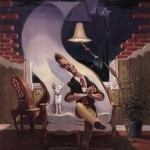
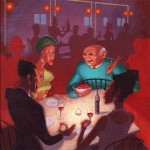
Stephen Williams – acrylic work ‘where dreams and memory collide’

Stephen Williams grew up in Oregon where he studied photography and watercolor. After moving to San Francisco in the late 80s, he has found himself obsessed with making art, acrylic paintings especially, out of his apartment. For over ten years he’s watched his inventory grow as he participated in the occasional private sale and fundraising benefit at galleries such as the Lab. Now he is ready to bring his art to the public.

          Inspired by illustrations in comic books, photography and dioramas, his use of saturated color and crisp detail matched with intense atmospheric light create moody, nostalgic images. Aiming for ‘naturalistic artifice,’ he uses his figures, costumes, props and settings to explore effects of form and space, identity and performance. The world he creates is a gauzy realm where dreams and memory collide.


He may be reached at stefanowilliams@sbcglobal.net


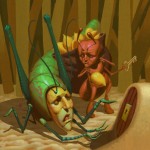
Spencer Hallam: Varied Illustrations


Illustration is the task to create visual content in close association with another publication or product in order to provide greater identification with the intended audience. This is possible since bonded with the painted layers of any good illustration can exist compelling insight into truth.  As an illustrator I find this to be one satisfying way to pass on a meaningful narrative and bring significance to living. Though my works are fantastical, futuristic, abstract, or absurdist parody, they all represent attempts to allegorize some truth underlying their nature, or they would blow away, having no foundation.


-Spencer Hallam

Spencer may be reached at spencerhallam@gmail.com

End of the world, teens to the rescue: review of Ashley Boettcher’s Threshold


Ashley Boettcher’s Threshold represents an ambitious undertaking for a first time novelist. The book weaves together an alternate American military and political history with a secret-agent mystery tale involving a threatened presidential assassination. Also, she provides a gently humorous slice of teen and family social life, interspersed with a mystical element complete with real-life Sirens and ancient evils gowned witches hide away from otherworldly flames.

Even with the fate of the civilized world at stake, Boettcher’s characters fight to avoid detentions, develop crushes on each other, and resent that their little kid brothers get assigned the most exciting parts of the investigation. Boettcher’s observant eye for the idealism and insecurity of the teenage psyche allows her to create coherent main characters and scenes which drive the story forward. Meanwhile, the beauty of the otherworldly, magical scenes take the narrative outside of its high-school confines, connecting the tale to larger spiritual and moral dramas.  

The best mystery novels allow readers to piece together clues along with fictional investigators, solving the puzzle right before the character makes his or her final ‘Aha!’ pronouncement. Threshold considers itself a mystery, as the novel jumps among plot threads and freezes its characters at precise moments of suspense. Especially in the first half, however, readers are still working out the alternate history and likely will not catch the significance of certain clues. The effective pacing and authentic rhythm and dialogue of the piece works well for a suspense thriller. And the entire piece could be strengthened by ‘setting the stage’ beforehand through a prologue or some telling details, so readers may focus on the unfolding drama of the killer’s stalking the President and the detectives without attempting to grasp two mysteries at once.

Also, some of the novel’s plot points, while imaginative, seem fantastical. And not the ones involving Sirens, exorcism, prophecies and science-fiction cloning/eugenics from the secretive Society. Those actually create a supernatural mood of mystical horror where arguing over the feasibility of details becomes less necessary. And the notes from the assassin, slightly tedious at the beginning while completely inexplicable, foreshadow a chilling, Hamlet-like exploration of obsession and post-traumatic stress syndrome and the healing role of faith.

Some of the real-life, modern-day scenes feel not quite real: two teens unearthing the President’s family secrets ‘on the Internet,’ the young detectives’ hiding in a trunk and surviving a car bomb, the eventual escape of the ‘copycat’ killer with a pen. Threshold could be strengthened by ensuring the technical feasibility of the ‘real-life’ scenes through researching and then subtly weaving details into the narrative to convey that knowledge.

Threshold presents a stark contrast between good and evil, life and death, love and terror. Perhaps this is the novel’s greatest strength – we see life in all its confusing glory, humanity in all its manifestations, posited as the antithesis to a one-dimensional secret society obsessed with power and death.

Hopefully Boettcher will continue writing, playing to her strengths with the help of qualified editors.

n  Ashley Boettcher’s Threshold is an upcoming novel, available in present form directly from the author – who may be reached at Ashley.boettcher@gmail.com.


Lisa Demb: More of Happy Armageddon and Margaritaville


San Francisco artist Lisa Demb continues her “Happy Armageddon” and “Margaritaville” series with further work, again experimenting with gentle transitional shading and different color schemes.

Each set of color evokes slightly different feelings in many viewers, and Demb has created a personal gallery where the multiple renderings of the similar images hang next to and flow into one another. No one knows exactly how the ‘end of the world’ or the future will look, and the variety calls attention to the idealized, conceptual images which appear for every color scheme while drawing viewers in through the visual brilliance.

Recently I had the privilege of visiting her home artist studio, and we discussed her creative process over Beethoven sonatas and warm tea. For Demb, pencil drawing is one current manifestation of a lifelong creative journey and a means to explore personal questions of faith and destiny.

Lisa Demb welcomes comments, questions, requests, and any feedback regarding her artwork. She also produces custom-designed stationery, which you may order directly from her. You may write to Ms. Demb at 140 Jones Street, San Francisco, CA 94102 or call 415-776-2115 and ask for her by name.

Laura Callin Bennett – Love Frog Three


Love Frog Three
Medium: India ink and acrylic on paper
Size
: 4″ x 6″
Date: 2009

I am an artist who is interested in evolution, natural selection, artificial
breeding, and genetic engineering.

I think evolution is beautiful. It gives elegant explanations for why animals
look and act the way they do. I am working on a series of one hundred small
paintings that explore the idea of evolution in a playful way. They are all
the same size, four inches by six inches.

I think of the paintings as little organisms that are all related to one
another. Because they are related they have certain things in common,
including India ink outlines and acrylic paint in a particular range of
colors. If you look at a bird-watching field guide, you can see that related
birds often have the same colors, just rearranged into different patterns.
That is because they all inherited their colors from a common ancestor. A
systematic, limited palette of colors gives the same kind of unity to my
population of paintings.

Whenever I want to create a new painting, I start by looking at two of my
earlier paintings side by side. I imaginatively combine their ideas, designs,
and colors as I make a new “hybrid” offspring painting. Some of the
designs that recur throughout my work are images of rabbits, birds, and women.
Rabbits represent domesticity, comfort, and a certain childlike innocence. The
women are self-portraits or alter egos; I draw them when I am in an
introspective mood. Birds appear because they are the most visible creatures
in my environment. Most mammals stay hidden, but it only takes a short walk
around my apartment complex to see white-crowned sparrows, mourning doves,
scrub jays, and more. In my painting series I am taking in all of these ideas,
processing and reworking them, and watching as new and interesting forms
evolve.

Laura Callin Bennett

www.LauraCallinBennett.com

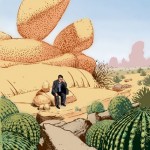
Andrew Ek’s Illustrations: Movie Stills on Canvas


I am a self-taught painter. I attended the Art Institute of Pittsburgh briefly for Industrial Design Technology. My paintings are crystallized visions that have surfaced or have been captured, usually at random, from a thought or emotion. The creative process begins upon viewing an image or visiting a place and I feel compelled to develop that idea into a painting. I am interested in the flesh and draw inspiration from the figure. My aim is to envelop the viewer into an unfolding narrative in a vivid cinematic context, similar to a movie still. I live with my wife and two cats in the Bay Area.

Andrew’s advice to other aspiring painters, and his inspirations:

I guess my advice would be to completely immerse oneself in painting and read every book about it. Study the masters. Practice & develop your style through trial & error and never give up.

The painters who have influenced me over the years are many.But here are a few who inspired me to learn how to paint: Edward Hopper, Paul Delvaux, Philip Pearlstein, the Pre-Raphaelites, George Tooker, Eric Fischl. 


Andrew Ek may be reached at ek_images@yahoo.com or through his website www.andrewek.com and his work is on exhibit at San Francisco’s Artist X-Change gallery, in the Mission District.