I Fear You Not – Affirmation Poem from Blanca Jones


I Fear You Not


Babylon – Daniel 1-6:16

LITTLE HORN – Daniel 7:8

MAN OF LAWLESSNESS – 2 Thessalonians 2:1-12

ANTICHRIST – 1 John 2:18

DRAGON – Revelations 12:9


You have no effect on me!

You cannot touch me!

Your efforts serve only to strengthen me.

I fear you not

For I rejoice in my

Relationship with my sweet Lord!


The disguised temptations you present me

Are inevitably revealed and disrobed

By the grace of my loving God.

Although I am weak – I am strong!

Although I stumble – I right myself.

Although I fall – I rise above you!

Although you bring me darkness,

I see light!

And I fear you not

For I rejoice in my

Relationship with my sweet Lord!


Although you entice me with luxuries

I pray for forgiveness and wisdom.

Although I am woman (man)

Christ lives in me!

I belong to my Lord!

Upon your destruction

I will reside

In the house of my Lord

For all eternity

And I will enfold

As many as I can under my wings!


For I fear you not

As I rejoice in my

Relationship with my sweet Lord!


Bless us all my Lord who rejoice in your love

Bless us all my Lord who seek your truth

Bless us all my Lord who seek your strength

Bless us all my Lord who fall at your feet

Bless us all my Lord who walk the path leading us home

In your name we pray

Our Lord Christ Jesus

Amen

Blanca Jones lives in the San Francisco Bay Area, welcomes feedback on her writing, and may be reached at blancajones@att.net

A review of San Francisco Opera’s Il Trittico: Details Make the Show


San Francisco Opera’s Il Trittico showcases several world-class vocal talents, who in the one-act format transition seamlessly among completely different roles. Paolo Gavanelli becomes Il Tabarro’s distraught, betrayed husband and then Gianni Schicchi’s hilarious, shrewd title-character lawyer. Patricia Racette transforms herself into Il Tabarro’s restless wife, Suora Angelica’s grieving nun, and Schicchi’s innocently romantic daughter. However, the minor characters and subtle staging innovations bring this triptych up from a decent show to a spectacular performance.

Each of Puccini’s one-acts follows a basic, coherent plotline, but with enough background action and distinctive supporting characters to add color to the pieces and remain engaging after audiences guess the ending. Il Tabarro’s Frugola, another discontented boatman’s wife who avoids adultery, deposits her frustrations and other odds and ends into a memorable purseful of junk. The food scraps she saves for her beloved cat, the stories behind each object she collects, and her dream of a country cottage remained with me longer than Giorgetta’s forbidden affair. And the working stevedores’ rough clothing and the half-lighting and simple sets befitting a wooden barge highlights the contrast between both wives’ dreams and the reality of their lives.

Suora Angelica’s convent, updated into a children’s hospital, sings with joyful Ave Marias and the chatter of cheerful sisters. We see the ladies playing with wheelchair-bound children, breaking small regulations, sharing innocent desires, and remarking upon water from a fountain turned golden with afternoon sunlight. They make the best of a clinical environment, perfectly staged with glaring indoor lighting, cold straight-backed chairs, and medicines in full view of patients and caregivers.

 Such a life-affirming sensibility further adds to the tragedy of Angelica’s suicide and the emotional impact of her miracle vision. The vision, a child waiting to welcome her to heaven, might have seemed contrived in the hands of a less competent opera company. Yet the hospital, with its old-style frosted-glass door, provides the perfect way for the boy to appear ethereal yet believable.

Gianni Schicchi’s supporting characters include a corpse hidden in plain sight, a host of feuding, greedy relatives, notaries, doctors, and two guileless young lovers. Revered soprano Racette herself plays Schicchi’s daughter, one of the pair of lovers – demonstrating San Francisco Opera’s awareness of the importance of quality vocals for the entire cast and not merely relying on the strength of a scene’s main characters. Audience members chuckle at her famous “O mio babbino caro” – as Racette comes across as having a youthful crush on Rinuccio, which fits in with the piece’s charm. Schicchi and the various relatives’ over-the-top facial expressions and lyrical shows of emotion remind us this is a comedy, and the final pillow-fight in the black and white art-deco stage bedroom conveys a refined-sitcom sensibility.

For all three pieces, the orchestral music complements the action without overpowering the vocals or plot. Dramatic at tense moments and atmospheric when needed to set the pace and mood for action between arias, it provides the continuity Puccini intended when he designed these three acts to be presented together. Although the plots bear no relation to one another, a background motif of celebrating common, quirky, crazy humanity and life’s daily moments runs through the entire performance – helped along by the entire cast, crew, and orchestra of San Francisco’s Il Trittico.

Il Trittico currently shows at San Francisco’s War Memorial Opera House. One production remains, a Saturday evening performance this October 3rd. You may visit the SF Opera website at www.sfopera.org for more information.

Patsy Ledbetter: “For Brian”


For Brian…
 
His seat in the orchestra was empty that day…
I remember my friend and how he loved to play.
His passion for music knew no bounds.
His french horn made amazing sounds.
I grieve for my friend for I know so clear..
To give up one’s music can bring tears…
The agony of knowing he can no longer play,
Encourages my playing as I think of the day
When sorrows of life will give way to joy,
And sadness will no longer reign in that boy.
Lord give us a vision and music in our souls…
May we play and sing with You as our goal.
Your passion for music remains the same…
We sing to you with no thought of fame. 
Keep us useful with each passing day…
Humble in Your sight as we sing and play.
Patsy Ledbetter plays classical music in a large California orchestra, along with writing poetry and raising a family. She welcomes comments on her work and may be reached at patsyled@sbcglobal.net

Wayne Jiang’s Still Life Series


Wayne Jiang

Artist Statement


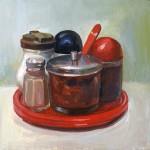
The fundamental nature of my aesthetic rests in the use of simple, quiet compositions that visually communicate emotion within the precepts of narrative realism: renderings of ordinary objects, subtle glimpses of everyday life. These images are collectively reflected on stillness, solitude, and mystery- yet with an element of comfort and familiarity.


My creative approach is driven by the desire to balance traditional principles of painting, contemporary design, and personal identity. This series of restaurant paintings draw inspiration from two artistic genres: 17th Century Dutch Still Life paintings and 20th century American Realism, as exemplified in the works of Willem Kalf, John Register, and Ralph Goings.


In my effort to combine traditional and contemporary design practices, I strive to create works of art that retain a timeless quality while incorporating contemporary subject matter. In doing so, it is my resolve to provide viewers with visual explanations of emotion that will hopefully make for a lasting impression.


Wayne Jiang may be reached at riverwave@sbcglobal.net and welcomes comments on his work and inquiries from interested buyers and galleries.


Daniel Rekshan – investigating the world and reporting back by painting


From Daniel Rekshan:

Basically, I agree with Kandinsky and the Theosophical movement in general that the role of the artist is to investigate the spiritual world and share the findings with those individuals surrounding the artist. 

 I study, meditate, and do dream-work in order to explore the spiritual world.  My findings are most clearly stated in my art and when I express them in words, they get a little bizarre.   Here are some I’ve listed in a statement I’m writing now:

  • Divinity is an action of the individual
  • Likewise, evil is an action of the individual
  • The individual must take responsibility for the cultural mythos, ie, must enact the divine acts in each moment and sublimate the base acts.
  • There are many worlds. This physical/cultural/mythological/spiritual complex is one of many worlds. Our world blends with the other on the border of the physical. Just as there is an indefinite complexity of organisms on this plane, so too is there on the others.
  • The physical is a paper-thin illusion
  • Individual motivation, thus action, determines the inhabited world.

These notions are clearly expressed in my dreamscapes.  The representational aspect of my landscapes obscures my motivation and their message; that’s why I have such long titles.

My physical creative process involves expression of either an external or internal vision, ie, landscape versus dreamscape.  I simply create a composition in perspective, build up tonal planes, add hues and highlights, and iterate the process if needed.  My landscapes are done location.  Interestingly, I’ve been “growing out” of an easel.  I find it is better to sit cross-legged on the ground, as in meditation or in art-making as a child.

Find Daniel’s work online at http://www.danielsimagination.com and you may also contact him through the website.

Sun Lo and the Sewer – short fiction by Patsy Ledbetter


Sun Lo and the Sewer by Patsy Ledbetter


     She eyed them suspiciously.  Her heart beat faster as they approached.  The tall strangers seemed anxious to speak to her.  Why had they requested her presence?  What had she done wrong?  She was not used to being observed.  What did they want?  Why were they here?

      Many questions surrounded Sun Lo as she made her way down the corridor to her small room.  She was a small, middle-aged woman with short, graying hair.  She was slightly bent over with a limp and a missing tooth.  She had lived a simple, solitary life…work, eat and sleep.  Yet there was something angelic about her….She carried a secret.  Her strength came from a higher power….love she felt from her Heavenly Father.

     “Hello Sun Lo.  My name is John and this is my wife Sara.”  We have heard of your unbelievable sacrifice and we are here to pray with you and bring you some gifts,” said the kind man.  His wife had an encouraging and sympathetic smile.

     Sun Lo told the story of how she had been questioned about her faith when she was a young girl and because she was open and honest about her faith in Jesus Christ, she was sentenced by the authorities to rake the sewer for forty years.  She was provided with a place to live and enough to eat and drink. A very dull and discouraging job she was entrusted with and because she loved her Lord, she took up her cross daily and followed her orders.  It was lonely and frightening at times, but Jesus was with her.

     “I would be honored to hear you pray, Mr. John.  I have not heard the prayer of another in forty years.  John spoke softly and sincerely.  He asked for the Lord’s blessing on Sun Lo and all of the Christians in China. 

     “I am so excited to tell you that we have collected money and we have brought you two year’s worth of wages!” John spoke quickly.

     He handed her the wad of money and she pushed it aside.

     “I am not interested in money,” she spoke quietly.

Editor’s Note: This story deals with an important, current issue of our time – persecution and discrimination against people of conscience due to religious, political, or other nonviolently held beliefs. We at Synchronized Chaos seek to educate readers that millions of people around the world still live without freedom of conscience, and we stand with those working for basic human liberties. Nonpartisan, nonsectarian organizations such as Amnesty International and Human Rights Watch have campaigns where artists and writers can write letters to world governments on behalf of prisoners of conscience and stand alongside those wrongly persecuted.

Patsy Ledbetter may be reached at patsyled@sbcglobal.net and welcomes feedback on her writing and conversations with other writers.

Continue reading

Jeremy Warach’s Vignettes – fragments of stories which never were


Vignette #9: Super Glue on a Ball Bearing

The space station had the shape of a vast ring, or perhaps a doughnut, or better yet the wheel of a bicycle.  It was a narrow torus, connected by four spokes to a central hub.  The station rotated slowly about the hub, like a bicycle wheel being pedaled by an unearthly titan, and the centrifugal force created by this rotation provided simulated gravity to those who dwelt inside the ring.
 

The security guard was off duty and sat in one of the station’s lounges with his friend, also a security guard.  The panoramic windows in the floor showed space spinning by under their feet.  At various times in the station’s orbit, they would see the great face of Earth zoom past dizzyingly, completely filling the field of view.  Newcomers to the station could be disoriented by how quickly the starscape spun past, but the security guard and his friend were far too used to the sight to even give it a second thought.
 

The guard was discussing the workshift earlier in the day with his friend.  They had processed a shipload of arriving passengers:  miners on a layover from the ground, heading out on a month-long asteroid mining mission, and wealthy sightseers, spending a week or more on the station before taking a shuttle back down to the surface.  Miners and tourists made up the bulk of the transient population.  Scientists, engineers, and various administrative personnel composed the more permanent staff.
 

The guard was was pouring beer from a pitcher into his and his friend’s glasses, when they felt a deep thud pass through the station.  The guard looked at the clock on the wall and scowled, then turned to his friend and asked, “There wasn’t any shuttle arrival scheduled for now, was there?” 
 

His friend finished taking a gulp from his glass and wiped off his mouth with the back of his sleeve.  “Not that I knew of,” he responded.
 

The guard knew about all the arrivals.  Or at least, he had known about all of them until now.  He wondered if he should ask someone about this.  Then he shrugged his shoulders and lifted his glass to his lips.

Read other vignettes and leave comments for Jeremy Warach here: http://warach.com/wordpress/category/vignettes/

Warach welcomes writers’ groups and other artists to finish the stories, or link them together into one piece, if that’s possible.